I.S.F.D LENGUAS VIVAS BARILOCHE –
PRÁCTICA DOCENTE III
ENTREGA DE PLANIFICACIÓN
ALUMNO PRACTICANTE: Keila Belén Medina
Año y sección: 7mo B secundario
Nivel lingüístico del curso: B1-B2 CEFR based
Cantidad de alumnos: 26
Tipo de Planificación: Clase
Unidad Temática: Short Stories
Clase Nº: 2
Duración de la clase: 1 hora 20 minutos
Fecha de la clase: 29 de Mayo del 2019
Fecha de entrega de la planificación: 24 de Mayo del 2019
Learning Aims
During this lesson, learners will be able to…finish their work around the one-
pages, discuss about the main figures of speech and general questions around
the story, and to sum up everything they have read so far.
Language Focus
LEXIS FUNCTIONS STRUCTURE
R
E
V
-Tenses: present simple, past
simple, past continuous.
-Figures of speech:
alliteration, similes, hyperbole,
metaphors, idioms.
-Unknown vocabulary.
-To describe facts, what
happened or what was
happening.
-To add more information
about something.
-To incorporate new words
into students’ glossary.
-“The troddler is small”, “The
troddler was crying”
-“It was as ugly as can be”
N
E
W
-Unknown vocabulary.
-Summarizing: connectors
(First, then, also, what is more,
moreover, for that reason, etc)
-To continue adding new
words into students’
glossary.
-To develop clearer ideas
while writing and speaking.
-“First, we learnt that the
troddler is a toddler troll. For
that reason, we believe that
the word now makes more
sense than before”
Materials
-Sheets for each group (6 groups of 4 students, and two big sheets for each group)
-Markers
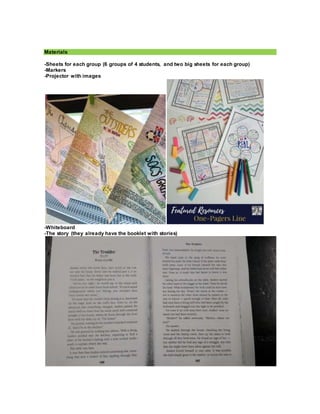
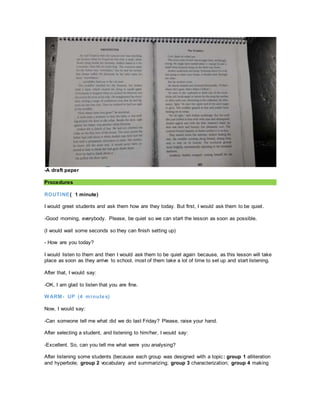
-Projector with images
-Whiteboard
-The story (they already have the booklet with stories)
-A draft paper
Procedures
ROUTINE( 1 minute)
I would greet students and ask them how are they today. But first, I would ask them to be quiet.
-Good morning, everybody. Please, be quiet so we can start the lesson as soon as possible.
(I would wait some seconds so they can finish setting up)
- How are you today?
I would listen to them and then I would ask them to be quiet again because, as this lesson will take
place as soon as they arrive to school, most of them take a lot of time to set up and start listening.
After that, I would say:
-OK, I am glad to listen that you are fine.
WARM- UP (4 minutes)
Now, I would say:
-Can someone tell me what did we do last Friday? Please, raise your hand.
After selecting a student, and listening to him/her, I would say:
-Excellent. So, can you tell me what were you analysing?
After listening some students (because each group was designed with a topic: group 1 alliteration
and hyperbole; group 2 vocabulary and summarizing; group 3 characterization; group 4 making
questions and identifying tenses; group 5 hypothesizing; and group 6 metaphors, similes and
idioms.) I would ask them:
-I know that you need some more minutes to write down more ideas. But, as you know, this is
meant to be a guide for you to develop a one-pager.
TRANSITION
-That is why I want you to listen to me carefully right now.
PRESENT ATI ON (5 minutes)
I would have at hand the projector ready to show the examples of one -pagers.
Students already know how to create a one-pager, this is not new for them but
the reason behind the visual support is for them to get more ideas on how to
experiment with art while focusing on the language. For that reason, I would clarify:
-I know that you have worked with one-pagers before and that you know how to make it. But,
please, remember that a one-pager is not only about writing. It is also about art. For instance, you
can draw, you can use different colours. Please, feel free to be creative.
Then, after clarifying that, I would say:
-As regards the team work, you can choose now between working in pairs of two or to keep working
in groups of four. In any case, you must include the topics you analyzed and the main plot of the
story. I will give you 2 big sheets per group. If you work in pairs, you will work with one sheet. And, if
you work in groups of four, you can paste the two sheets to make a big one-pager (I would show
them how).
Now, before writing on the whiteboard the groups’ topics (alliteration, hyperbole: group 1, etc) and
next to them “+ plot”, I would ask:
-Do you have any doubt? (I would wait to check if someone raises his/her hand)
I nobody raises the hand, I would say:
-Anyway, I will go group by group to get to know how you decided to work. Then, you can ask me
anything. Also, you can always raise you hands and I will go to you. Remember you can use the
dictionaries if necessary.
TRANSITION
-So, now, you can arrange your seats to get in groups.
DEVELOP M ENT (PRACTI CE and PRODUCTI ON)
Activity 1: Finishing the Analysis Stage
Timing: 10 minutes
Scaffolding strategie s instances marked with highlighter
Students will now have time to complete the ideas they started to develop last
lesson.
-Now that you are ready, you may start working on what you need to complete.
Those who already finished this stage will be asked to revise everythi ng and
check spelling.
-When you finish, you raise your hands so I can help you to check spelling and
word order. This way, you will be sure to continue to the next stage. OK?
I would go group by group, checking what they need and how I can help them.
After that, I would hand in the sheets to each group and tell them that they may
start discussing how they want to organize the one-pager.
TRANSITION:
-Once you received your sheets, listen to me for a minute.
Activity 2: Designing the One -Pagers
Timing: 30 minutes
Scaffolding strategie s instances marked with highlighter
-All right, now you all have your sheets. Great. (I would write “PLAN- DRAFT-
DEVELOP)
I would say:
-Plan, draft, and develop. What do you think this means?
After listening students’ ideas, I would say:
-Right. First you have to discuss what you have in mind for the one -pager. Then
you draft it, you change or add what you think is best and finally you develop the
one-page you want to show. Do you get the idea?
After listening to the answers, I would say:
-Good, then please start working. I will be with you as soon as you raise your
hand. Also, I will go group by group to check your advanc es.
I would do so, and when they are about to finish, I would say:
TRANSITION
-Silence please! Now, as you are finishing the one-pagers, I will tell you what
comes next.
Activity 3: Exposing the results and question s
Timing: 30 minutes
-Now, as you know, you will be asked to show you one-page to the rest of your classmates. But,
what you didn’t know is that I will ask each group a question related to what you analyzed. Don’t
worry, I won’t ask anything else but what you have studied up to now. OK?
As I wait for them to ask a question (if any), I would call the first group.
This is the list of questions I designed for each group:
Group 1: Can you define what a hyperbole is? Please, use you own words.
Group 2: If you didn’t know the meaning of the unknown words, do you think you would have been
able to understand what was going on? Why?
Group 3: What is your favourite character? Why? / Which character you liked the least? Why?
Group 4: How do you think that tenses can help you to understand the plot line?
Group 5: If you had to choose only one hypothesis you made, which one is your favourite? Why?
Group 6: Do you think that metaphors, similes and idioms change the story in any way? What
would happen if they were not included?
The questions would be asked after each group finished exposing the one-pager. It intends to be a
spontaneous activity, to check students’ comprehension and as a speaking task too. When
necessary, students will be helped to express the things they want to say in English (sometimes
they don’t know what is the specific word for what they intend to say).
TRANSITION
-You did amazing. I liked this activity. Now, as it is almost time for the break, please go back to your
regular places and listen to me for a minute.
CLOSURE (5 minutes)
-What did you like the most about this lesson?
After they answer (some volunteers), I would say:
-Were the questions too difficult for you? Or not?
When I finished listening to some volunteers, I would say:
-All right. Thank you for sharing your thoughts. Now, please, stay on you places and wait for Naty to
tell you to go to the break. See you on Friday!
Each activity must be described in terms of the following components:
 Timing
 Activitydescription and instructions as they will be said to students
(include direct speech)
 Scaffolding strategies
 Transition comment to link each stage of the lesson with the next one
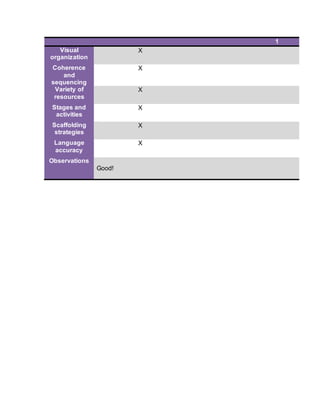
To be completed by your tutor:
Lesson plan
component
Excellent
5
Very Good
4
Good
3
Acceptable
2
Needs
improvement
1
Visual
organization
X
Coherence
and
sequencing
X
Variety of
resources
X
Stages and
activities
X
Scaffolding
strategies
X
Language
accuracy
X
Observations
Good!

Medina pd iii - lesson plan- lesson 2- passed

  • 1.
    I.S.F.D LENGUAS VIVASBARILOCHE – PRÁCTICA DOCENTE III ENTREGA DE PLANIFICACIÓN ALUMNO PRACTICANTE: Keila Belén Medina Año y sección: 7mo B secundario Nivel lingüístico del curso: B1-B2 CEFR based Cantidad de alumnos: 26 Tipo de Planificación: Clase Unidad Temática: Short Stories Clase Nº: 2 Duración de la clase: 1 hora 20 minutos Fecha de la clase: 29 de Mayo del 2019 Fecha de entrega de la planificación: 24 de Mayo del 2019 Learning Aims During this lesson, learners will be able to…finish their work around the one- pages, discuss about the main figures of speech and general questions around the story, and to sum up everything they have read so far. Language Focus LEXIS FUNCTIONS STRUCTURE R E V -Tenses: present simple, past simple, past continuous. -Figures of speech: alliteration, similes, hyperbole, metaphors, idioms. -Unknown vocabulary. -To describe facts, what happened or what was happening. -To add more information about something. -To incorporate new words into students’ glossary. -“The troddler is small”, “The troddler was crying” -“It was as ugly as can be” N E W -Unknown vocabulary. -Summarizing: connectors (First, then, also, what is more, moreover, for that reason, etc) -To continue adding new words into students’ glossary. -To develop clearer ideas while writing and speaking. -“First, we learnt that the troddler is a toddler troll. For that reason, we believe that the word now makes more sense than before”
  • 2.
    Materials -Sheets for eachgroup (6 groups of 4 students, and two big sheets for each group) -Markers -Projector with images -Whiteboard -The story (they already have the booklet with stories)
  • 5.
    -A draft paper Procedures ROUTINE(1 minute) I would greet students and ask them how are they today. But first, I would ask them to be quiet. -Good morning, everybody. Please, be quiet so we can start the lesson as soon as possible. (I would wait some seconds so they can finish setting up) - How are you today? I would listen to them and then I would ask them to be quiet again because, as this lesson will take place as soon as they arrive to school, most of them take a lot of time to set up and start listening. After that, I would say: -OK, I am glad to listen that you are fine. WARM- UP (4 minutes) Now, I would say: -Can someone tell me what did we do last Friday? Please, raise your hand. After selecting a student, and listening to him/her, I would say: -Excellent. So, can you tell me what were you analysing? After listening some students (because each group was designed with a topic: group 1 alliteration and hyperbole; group 2 vocabulary and summarizing; group 3 characterization; group 4 making
  • 6.
    questions and identifyingtenses; group 5 hypothesizing; and group 6 metaphors, similes and idioms.) I would ask them: -I know that you need some more minutes to write down more ideas. But, as you know, this is meant to be a guide for you to develop a one-pager. TRANSITION -That is why I want you to listen to me carefully right now. PRESENT ATI ON (5 minutes) I would have at hand the projector ready to show the examples of one -pagers. Students already know how to create a one-pager, this is not new for them but the reason behind the visual support is for them to get more ideas on how to experiment with art while focusing on the language. For that reason, I would clarify: -I know that you have worked with one-pagers before and that you know how to make it. But, please, remember that a one-pager is not only about writing. It is also about art. For instance, you can draw, you can use different colours. Please, feel free to be creative. Then, after clarifying that, I would say: -As regards the team work, you can choose now between working in pairs of two or to keep working in groups of four. In any case, you must include the topics you analyzed and the main plot of the story. I will give you 2 big sheets per group. If you work in pairs, you will work with one sheet. And, if you work in groups of four, you can paste the two sheets to make a big one-pager (I would show them how). Now, before writing on the whiteboard the groups’ topics (alliteration, hyperbole: group 1, etc) and next to them “+ plot”, I would ask: -Do you have any doubt? (I would wait to check if someone raises his/her hand) I nobody raises the hand, I would say: -Anyway, I will go group by group to get to know how you decided to work. Then, you can ask me anything. Also, you can always raise you hands and I will go to you. Remember you can use the dictionaries if necessary. TRANSITION -So, now, you can arrange your seats to get in groups. DEVELOP M ENT (PRACTI CE and PRODUCTI ON) Activity 1: Finishing the Analysis Stage Timing: 10 minutes Scaffolding strategie s instances marked with highlighter Students will now have time to complete the ideas they started to develop last lesson. -Now that you are ready, you may start working on what you need to complete.
  • 7.
    Those who alreadyfinished this stage will be asked to revise everythi ng and check spelling. -When you finish, you raise your hands so I can help you to check spelling and word order. This way, you will be sure to continue to the next stage. OK? I would go group by group, checking what they need and how I can help them. After that, I would hand in the sheets to each group and tell them that they may start discussing how they want to organize the one-pager. TRANSITION: -Once you received your sheets, listen to me for a minute. Activity 2: Designing the One -Pagers Timing: 30 minutes Scaffolding strategie s instances marked with highlighter -All right, now you all have your sheets. Great. (I would write “PLAN- DRAFT- DEVELOP) I would say: -Plan, draft, and develop. What do you think this means? After listening students’ ideas, I would say: -Right. First you have to discuss what you have in mind for the one -pager. Then you draft it, you change or add what you think is best and finally you develop the one-page you want to show. Do you get the idea? After listening to the answers, I would say: -Good, then please start working. I will be with you as soon as you raise your hand. Also, I will go group by group to check your advanc es. I would do so, and when they are about to finish, I would say: TRANSITION -Silence please! Now, as you are finishing the one-pagers, I will tell you what comes next. Activity 3: Exposing the results and question s Timing: 30 minutes -Now, as you know, you will be asked to show you one-page to the rest of your classmates. But, what you didn’t know is that I will ask each group a question related to what you analyzed. Don’t worry, I won’t ask anything else but what you have studied up to now. OK? As I wait for them to ask a question (if any), I would call the first group. This is the list of questions I designed for each group: Group 1: Can you define what a hyperbole is? Please, use you own words.
  • 8.
    Group 2: Ifyou didn’t know the meaning of the unknown words, do you think you would have been able to understand what was going on? Why? Group 3: What is your favourite character? Why? / Which character you liked the least? Why? Group 4: How do you think that tenses can help you to understand the plot line? Group 5: If you had to choose only one hypothesis you made, which one is your favourite? Why? Group 6: Do you think that metaphors, similes and idioms change the story in any way? What would happen if they were not included? The questions would be asked after each group finished exposing the one-pager. It intends to be a spontaneous activity, to check students’ comprehension and as a speaking task too. When necessary, students will be helped to express the things they want to say in English (sometimes they don’t know what is the specific word for what they intend to say). TRANSITION -You did amazing. I liked this activity. Now, as it is almost time for the break, please go back to your regular places and listen to me for a minute. CLOSURE (5 minutes) -What did you like the most about this lesson? After they answer (some volunteers), I would say: -Were the questions too difficult for you? Or not? When I finished listening to some volunteers, I would say: -All right. Thank you for sharing your thoughts. Now, please, stay on you places and wait for Naty to tell you to go to the break. See you on Friday! Each activity must be described in terms of the following components:  Timing  Activitydescription and instructions as they will be said to students (include direct speech)  Scaffolding strategies  Transition comment to link each stage of the lesson with the next one To be completed by your tutor: Lesson plan component Excellent 5 Very Good 4 Good 3 Acceptable 2 Needs improvement
  • 9.