I.S.F.D LENGUAS VIVAS BARILOCHE –
PRÁCTICA DOCENTE III
ENTREGA DE PLANIFICACIÓN
ALUMNO PRACTICANTE: Keila Belén Medina
Año y sección: 7mo B secundario
Nivel lingüístico del curso: B1-B2 CEFR based
Cantidad de alumnos: 26
Tipo de Planificación: Clase
Unidad Temática: Short stories
Clase Nº: 4
Duración de la clase: 1 hora 20 minutos
Fecha de la clase: 5/ 6/ 2019
Fecha de entrega de la planificación: 31/ 5/ 2019
Learning Aims
During this lesson, learners will be able to complete the last tasks related to this
short story, to finish reading the short story and to start planning a short role-
play as a closure for the work they have done.
Language Focus
LEXIS FUNCTIONS STRUCTURE
R
E
V
-Connectors.
-Spelling.
-To promote coherence and
cohesiveness.
-To write accurately.
-First, he found the note.
Then he decided to start
looking for his mom.
N
E
W
-Work on punctuation about
writing.
-To develop clearer ideas.
-To go from this:
He found a note and it had
some clues on it and for that
reason he decided to search
for his mom.
To this:
Anders found a note from his
mom. The note had some
clues on it. For that reason,
he decided to search for his
mom.
Materials
-Story (last pages)
-Folders.
-Whiteboard, markers.
-Photocopies.
Procedures
ROUTINE (3 minutes)
I would greet students and ask them to have their books at hand.
-Good morning, everybody. How are you doing today?
-I am glad to know that. Please, get your books at hand because today we are going to finish
working with the story.
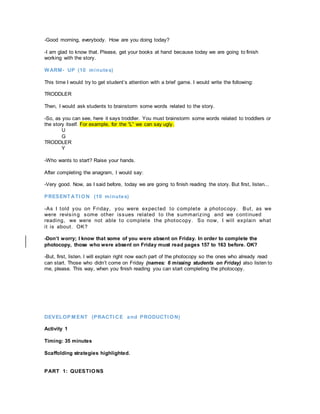
WARM- UP (10 minutes)
This time I would try to get student’s attention with a brief game. I would write the following:
TRODDLER
Then, I would ask students to brainstorm some words related to the story.
-So, as you can see, here it says troddler. You must brainstorm some words related to troddlers or
the story itself. For example, for the “L” we can say ugly.
U
G
TRODDLER
Y
-Who wants to start? Raise your hands.
After completing the anagram, I would say:
-Very good. Now, as I said before, today we are going to finish reading the story. But first, listen...
PRESENT ATI ON (10 minutes)
-As I told you on Friday, you were expected to complete a photocopy. But, as we
were revising some other issues related to the summarizing and we continued
reading, we were not able to complete the photocopy. So now, I will explain what
it is about. OK?
-Don’t worry; I know that some of you were absent on Friday. In order to complete the
photocopy, those who were absent on Friday must read pages 157 to 163 before. OK?
-But, first, listen. I will explain right now each part of the photocopy so the ones who already read
can start. Those who didn’t come on Friday (names: 6 missing students on Friday) also listen to
me, please. This way, when you finish reading you can start completing the photocopy.
DEVELOP M ENT (PRACTI CE and PRODUCTI ON)
Activity 1
Timing: 35 minutes
Scaffolding strategies highlighted.
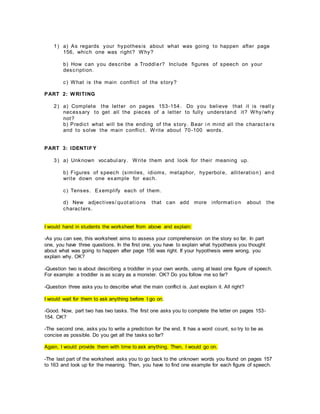
PART 1: QUESTIONS
1) a) As regards your hypothesis about what was going to happen after page
156, which one was right? Why?
b) How can you describe a Troddl er? Include figures of speech on your
description.
c) What is the main conflict of the story?
PART 2: WRITING
2) a) Complete the letter on pages 153-154. Do you believe that it is reall y
necessary to get all the pieces of a letter to fully understand it? Why/why
not?
b) Predict what will be the ending of the story. Bear i n mind all the charact ers
and to solve the main conflict. Write about 70-100 words.
PART 3: IDENTIF Y
3) a) Unknown vocabul ary. Write them and look for their meaning up.
b) Figures of speech (similes, idioms, metaphor, hyperbol e, alliteration) and
write down one example for each.
c) Tenses. Exemplify each of them.
d) New adjectives/ quot ati ons that can add more informati on about the
characters.
I would hand in students the worksheet from above and explain:
-As you can see, this worksheet aims to assess your comprehension on the story so far. In part
one, you have three questions. In the first one, you have to explain what hypothesis you thought
about what was going to happen after page 156 was right. If your hypothesis were wrong, you
explain why. OK?
-Question two is about describing a troddler in your own words, using at least one figure of speech.
For example: a troddler is as scary as a monster. OK? Do you follow me so far?
-Question three asks you to describe what the main conflict is. Just explain it. All right?
I would wait for them to ask anything before I go on.
-Good. Now, part two has two tasks. The first one asks you to complete the letter on pages 153-
154. OK?
-The second one, asks you to write a prediction for the end. It has a word count, so try to be as
concise as possible. Do you get all the tasks so far?
Again, I would provide them with time to ask anything. Then, I would go on.
-The last part of the worksheet asks you to go back to the unknown words you found on pages 157
to 163 and look up for the meaning. Then, you have to find one example for each figure of speech.
In the case of that you are not able to find an example for one figure of speech; you can invent one
based on the pages you read today. OK?
I would provide time for them to ask anything, again. Then I would finish:
-The last one asks you to identify tenses and exemplify them. Do you have any doubt?
I would wait for students to ask any doubt they may have. And then, I would say:
-Ok, so far so good. But now, I want to focus on some general mistakes I noticed while I was
correcting your summarizing sheets from the previous lesson.
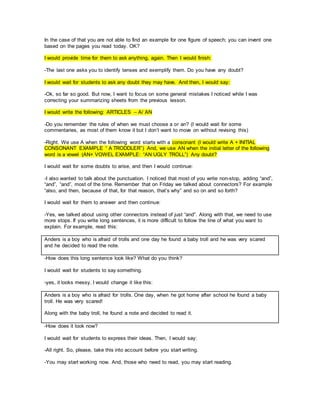
I would write the following: ARTICLES – A/ AN
-Do you remember the rules of when we must choose a or an? (I would wait for some
commentaries, as most of them know it but I don’t want to move on without revising this)
-Right. We use A when the following word starts with a consonant (I would write A + INITIAL
CONSONANT EXAMPLE “ A TRODDLER”) And, we use AN when the initial letter of the following
word is a vowel (AN+ VOWEL EXAMPLE: “AN UGLY TROLL”) Any doubt?
I would wait for some doubts to arise, and then I would continue:
-I also wanted to talk about the punctuation. I noticed that most of you write non-stop, adding “and”,
“and”, “and”, most of the time. Remember that on Friday we talked about connectors? For example
“also, and then, because of that, for that reason, that’s why” and so on and so forth?
I would wait for them to answer and then continue:
-Yes, we talked about using other connectors instead of just “and”. Along with that, we need to use
more stops. If you write long sentences, it is more difficult to follow the line of what you want to
explain. For example, read this:
Anders is a boy who is afraid of trolls and one day he found a baby troll and he was very scared
and he decided to read the note.
-How does this long sentence look like? What do you think?
I would wait for students to say something.
-yes, it looks messy. I would change it like this:
Anders is a boy who is afraid for trolls. One day, when he got home after school he found a baby
troll. He was very scared!
Along with the baby troll, he found a note and decided to read it.
-How does it look now?
I would wait for students to express their ideas. Then, I would say:
-All right. So, please, take this into account before you start writing.
-You may start working now. And, those who need to read, you may start reading.
When necessary, I would go and help students if any doubt arises during the time they are working
on the photocopy. Also, I would be very alert to anything that the SEN student may need.
TRANSITION:
-As almost all of you finished the photocopy, I will explain what you need to do now. Remember,
you all must listen.
Activity 2
Timing: 19 minutes
Scaffolding strategies highlighted
-First of all, please, before you decide to hand in the photocopy, revise the verbs, spelling, articles
and punctuation.
When all students finished the revision, and started to hand in the photocopies, I would say:
-I will ask you now to read the last pages of the story. OK? As you do so, highlight unknown words
so then you can look their meaning up. Also, choose your favorite part of the story when you finish
reading. I will explain later why I am asking you this. Come on, please start reading.
After students finished reading, I would say:
-So, how was the ending? Was that what you expected?
I would wait for some answers.
-Were you able to choose your favorite part?
I would wait for their answers. Then, I would say:
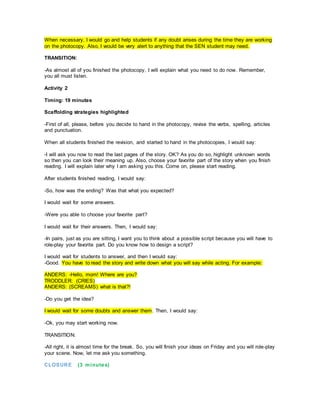
-In pairs, just as you are sitting, I want you to think about a possible script because you will have to
role-play your favorite part. Do you know how to design a script?
I would wait for students to answer, and then I would say:
-Good. You have to read the story and write down what you will say while acting. For example:
ANDERS: -Hello, mom! Where are you?
TRODDLER: (CRIES)
ANDERS: (SCREAMS) what is that?!
-Do you get the idea?
I would wait for some doubts and answer them. Then, I would say:
-Ok, you may start working now.
TRANSITION:
-All right, it is almost time for the break. So, you will finish your ideas on Friday and you will role-play
your scene. Now, let me ask you something.
CLOSURE (3 minutes)
-Did you enjoy the story?
I would hear their answers and then say:
-Was the story too predictabl e for you? Would you change anything?
Again, I would wait for answers.
-Ok, keep that in mind. On Friday, we will focus on it. Now, pl ease wait until Naty
lets you go out. See you!
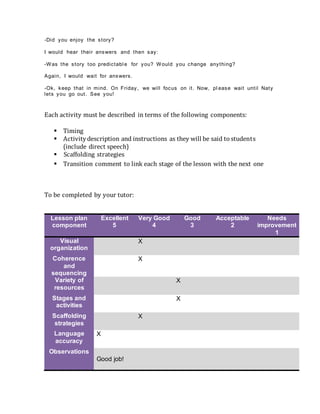
Each activity must be described in terms of the following components:
 Timing
 Activitydescription and instructions as they will be said to students
(include direct speech)
 Scaffolding strategies
 Transition comment to link each stage of the lesson with the next one
To be completed by your tutor:
Lesson plan
component
Excellent
5
Very Good
4
Good
3
Acceptable
2
Needs
improvement
1
Visual
organization
X
Coherence
and
sequencing
X
Variety of
resources
X
Stages and
activities
X
Scaffolding
strategies
X
Language
accuracy
X
Observations
Good job!
Keep an eye on timing!

Medina pd iii - lesson plan- lesson 4 - passed

  • 1.
    I.S.F.D LENGUAS VIVASBARILOCHE – PRÁCTICA DOCENTE III ENTREGA DE PLANIFICACIÓN ALUMNO PRACTICANTE: Keila Belén Medina Año y sección: 7mo B secundario Nivel lingüístico del curso: B1-B2 CEFR based Cantidad de alumnos: 26 Tipo de Planificación: Clase Unidad Temática: Short stories Clase Nº: 4 Duración de la clase: 1 hora 20 minutos Fecha de la clase: 5/ 6/ 2019 Fecha de entrega de la planificación: 31/ 5/ 2019 Learning Aims During this lesson, learners will be able to complete the last tasks related to this short story, to finish reading the short story and to start planning a short role- play as a closure for the work they have done. Language Focus LEXIS FUNCTIONS STRUCTURE R E V -Connectors. -Spelling. -To promote coherence and cohesiveness. -To write accurately. -First, he found the note. Then he decided to start looking for his mom. N E W -Work on punctuation about writing. -To develop clearer ideas. -To go from this: He found a note and it had some clues on it and for that reason he decided to search for his mom. To this:
  • 2.
    Anders found anote from his mom. The note had some clues on it. For that reason, he decided to search for his mom. Materials -Story (last pages)
  • 4.
    -Folders. -Whiteboard, markers. -Photocopies. Procedures ROUTINE (3minutes) I would greet students and ask them to have their books at hand.
  • 5.
    -Good morning, everybody.How are you doing today? -I am glad to know that. Please, get your books at hand because today we are going to finish working with the story. WARM- UP (10 minutes) This time I would try to get student’s attention with a brief game. I would write the following: TRODDLER Then, I would ask students to brainstorm some words related to the story. -So, as you can see, here it says troddler. You must brainstorm some words related to troddlers or the story itself. For example, for the “L” we can say ugly. U G TRODDLER Y -Who wants to start? Raise your hands. After completing the anagram, I would say: -Very good. Now, as I said before, today we are going to finish reading the story. But first, listen... PRESENT ATI ON (10 minutes) -As I told you on Friday, you were expected to complete a photocopy. But, as we were revising some other issues related to the summarizing and we continued reading, we were not able to complete the photocopy. So now, I will explain what it is about. OK? -Don’t worry; I know that some of you were absent on Friday. In order to complete the photocopy, those who were absent on Friday must read pages 157 to 163 before. OK? -But, first, listen. I will explain right now each part of the photocopy so the ones who already read can start. Those who didn’t come on Friday (names: 6 missing students on Friday) also listen to me, please. This way, when you finish reading you can start completing the photocopy. DEVELOP M ENT (PRACTI CE and PRODUCTI ON) Activity 1 Timing: 35 minutes Scaffolding strategies highlighted. PART 1: QUESTIONS
  • 6.
    1) a) Asregards your hypothesis about what was going to happen after page 156, which one was right? Why? b) How can you describe a Troddl er? Include figures of speech on your description. c) What is the main conflict of the story? PART 2: WRITING 2) a) Complete the letter on pages 153-154. Do you believe that it is reall y necessary to get all the pieces of a letter to fully understand it? Why/why not? b) Predict what will be the ending of the story. Bear i n mind all the charact ers and to solve the main conflict. Write about 70-100 words. PART 3: IDENTIF Y 3) a) Unknown vocabul ary. Write them and look for their meaning up. b) Figures of speech (similes, idioms, metaphor, hyperbol e, alliteration) and write down one example for each. c) Tenses. Exemplify each of them. d) New adjectives/ quot ati ons that can add more informati on about the characters. I would hand in students the worksheet from above and explain: -As you can see, this worksheet aims to assess your comprehension on the story so far. In part one, you have three questions. In the first one, you have to explain what hypothesis you thought about what was going to happen after page 156 was right. If your hypothesis were wrong, you explain why. OK? -Question two is about describing a troddler in your own words, using at least one figure of speech. For example: a troddler is as scary as a monster. OK? Do you follow me so far? -Question three asks you to describe what the main conflict is. Just explain it. All right? I would wait for them to ask anything before I go on. -Good. Now, part two has two tasks. The first one asks you to complete the letter on pages 153- 154. OK? -The second one, asks you to write a prediction for the end. It has a word count, so try to be as concise as possible. Do you get all the tasks so far? Again, I would provide them with time to ask anything. Then, I would go on. -The last part of the worksheet asks you to go back to the unknown words you found on pages 157 to 163 and look up for the meaning. Then, you have to find one example for each figure of speech.
  • 7.
    In the caseof that you are not able to find an example for one figure of speech; you can invent one based on the pages you read today. OK? I would provide time for them to ask anything, again. Then I would finish: -The last one asks you to identify tenses and exemplify them. Do you have any doubt? I would wait for students to ask any doubt they may have. And then, I would say: -Ok, so far so good. But now, I want to focus on some general mistakes I noticed while I was correcting your summarizing sheets from the previous lesson. I would write the following: ARTICLES – A/ AN -Do you remember the rules of when we must choose a or an? (I would wait for some commentaries, as most of them know it but I don’t want to move on without revising this) -Right. We use A when the following word starts with a consonant (I would write A + INITIAL CONSONANT EXAMPLE “ A TRODDLER”) And, we use AN when the initial letter of the following word is a vowel (AN+ VOWEL EXAMPLE: “AN UGLY TROLL”) Any doubt? I would wait for some doubts to arise, and then I would continue: -I also wanted to talk about the punctuation. I noticed that most of you write non-stop, adding “and”, “and”, “and”, most of the time. Remember that on Friday we talked about connectors? For example “also, and then, because of that, for that reason, that’s why” and so on and so forth? I would wait for them to answer and then continue: -Yes, we talked about using other connectors instead of just “and”. Along with that, we need to use more stops. If you write long sentences, it is more difficult to follow the line of what you want to explain. For example, read this: Anders is a boy who is afraid of trolls and one day he found a baby troll and he was very scared and he decided to read the note. -How does this long sentence look like? What do you think? I would wait for students to say something. -yes, it looks messy. I would change it like this: Anders is a boy who is afraid for trolls. One day, when he got home after school he found a baby troll. He was very scared! Along with the baby troll, he found a note and decided to read it. -How does it look now? I would wait for students to express their ideas. Then, I would say: -All right. So, please, take this into account before you start writing. -You may start working now. And, those who need to read, you may start reading.
  • 8.
    When necessary, Iwould go and help students if any doubt arises during the time they are working on the photocopy. Also, I would be very alert to anything that the SEN student may need. TRANSITION: -As almost all of you finished the photocopy, I will explain what you need to do now. Remember, you all must listen. Activity 2 Timing: 19 minutes Scaffolding strategies highlighted -First of all, please, before you decide to hand in the photocopy, revise the verbs, spelling, articles and punctuation. When all students finished the revision, and started to hand in the photocopies, I would say: -I will ask you now to read the last pages of the story. OK? As you do so, highlight unknown words so then you can look their meaning up. Also, choose your favorite part of the story when you finish reading. I will explain later why I am asking you this. Come on, please start reading. After students finished reading, I would say: -So, how was the ending? Was that what you expected? I would wait for some answers. -Were you able to choose your favorite part? I would wait for their answers. Then, I would say: -In pairs, just as you are sitting, I want you to think about a possible script because you will have to role-play your favorite part. Do you know how to design a script? I would wait for students to answer, and then I would say: -Good. You have to read the story and write down what you will say while acting. For example: ANDERS: -Hello, mom! Where are you? TRODDLER: (CRIES) ANDERS: (SCREAMS) what is that?! -Do you get the idea? I would wait for some doubts and answer them. Then, I would say: -Ok, you may start working now. TRANSITION: -All right, it is almost time for the break. So, you will finish your ideas on Friday and you will role-play your scene. Now, let me ask you something. CLOSURE (3 minutes)
  • 9.
    -Did you enjoythe story? I would hear their answers and then say: -Was the story too predictabl e for you? Would you change anything? Again, I would wait for answers. -Ok, keep that in mind. On Friday, we will focus on it. Now, pl ease wait until Naty lets you go out. See you! Each activity must be described in terms of the following components:  Timing  Activitydescription and instructions as they will be said to students (include direct speech)  Scaffolding strategies  Transition comment to link each stage of the lesson with the next one To be completed by your tutor: Lesson plan component Excellent 5 Very Good 4 Good 3 Acceptable 2 Needs improvement 1 Visual organization X Coherence and sequencing X Variety of resources X Stages and activities X Scaffolding strategies X Language accuracy X Observations Good job!
  • 10.
    Keep an eyeon timing!