I.F.D.C. LENGUAS VIVAS
TALLER DE PRÁCTICA DOCENTE
Tutora: Aurelia Velázquez
ALUMNO RESIDENTE: Carolina Anticev
Período de Práctica: High School
Institución Educativa: Primo Capraro
Dirección: Gallardo 40
Sala / Grado / Año - sección: 3er año
Cantidad de alumnos: 13
Nivel lingüístico del curso: B1+
Tipo de Planificación: Clase
Unidad Temática: 7 “Crime”
Clase Nº: 6
Fecha: 30/10/2018
Hora: 8:00 – 9:20 hs
Duración de la clase: 80 minutos
Fecha de primera entrega: 28/10/2018
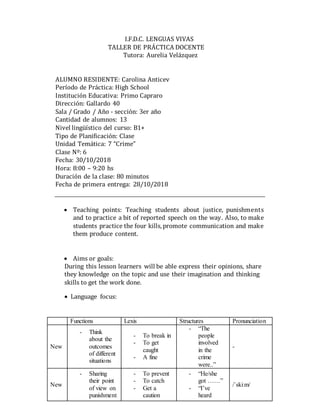
 Teaching points: Teaching students about justice, punishments
and to practice a bit of reported speech on the way. Also, to make
students practice the four kills,promote communication and make
them produce content.



 Aims or goals: 
During this lesson learners will be able express their opinions, share
they knowledge on the topic and use their imagination and thinking
skills to get the work done.
 Language focus:
Functions Lexis Structures Pronunciation
New
- Think
about the
outcomes
of different
situations
- To break in
- To get
caught
- A fine
- “The
people
involved
in the
crime
were..”
-
New
- Sharing
their point
of view on
punishment
- To prevent
- To catch
- Get a
caution
- “He/she
got ……”
- “I’ve
heard
/ˈskiːm/
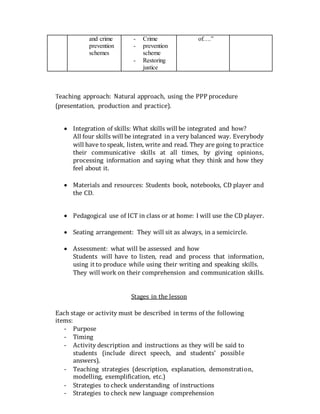
and crime
prevention
schemes
- Crime
- prevention
scheme
- Restoring
justice
of….”
Teaching approach: Natural approach, using the PPP procedure
(presentation, production and practice).

 Integration of skills: What skills will be integrated and how?
All four skills will be integrated in a very balanced way. Everybody
will have to speak, listen, write and read. They are going to practice
their communicative skills at all times, by giving opinions,
processing information and saying what they think and how they
feel about it.

 Materials and resources: Students book, notebooks, CD player and
the CD.
 Pedagogical use of ICT in class or at home: I will use the CD player.

 Seating arrangement: They will sit as always, in a semicircle.

 Assessment: what will be assessed and how 
Students will have to listen, read and process that information,
using it to produce while using their writing and speaking skills.
They will work on their comprehension and communication skills.
Stages in the lesson
Each stage or activity must be described in terms of the following
items:
- Purpose
- Timing
- Activity description and instructions as they will be said to
students (include direct speech, and students’ possible
answers).
- Teaching strategies (description, explanation, demonstration,
modelling, exemplification, etc.)
- Strategies to check understanding of instructions
- Strategies to check new language comprehension
- Interaction patterns
- Skills
- Resources
- Transition comment to link each stage of the lesson with the next
one
Mandatory lessonstages:
- Lead-in or Warm-up
- Presentation
- Development
- Closure
- Homework
The format in which the stages are presented will vary according to the
teaching approach or combination of approaches you decide to base your
lesson plan upon.
You must always include this chart, which will be completed by your
tutor:
CLASS N°6
Routine & Warm-up (15 minutes)
Purpose: To start the class, get the students working and continue with
last class’ activity.
“Hello everybody! How are you today? I want you to get in yesterday’s
groups and finish the work you were doing. Remember that you have to
hand it over when you’re finished, you have 15 minutes okay”
Transition: “Great, now, please write the name of all the group
members and give me the sheets”.
Activity N°1 (20 minutes)
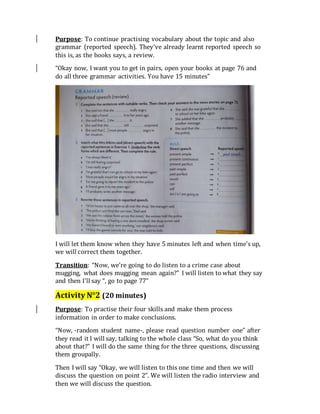
Purpose: To continue practising vocabulary about the topic and also
grammar (reported speech). They’ve already learnt reported speech so
this is, as the books says, a review.
“Okay now, I want you to get in pairs, open your books at page 76 and
do all three grammar activities. You have 15 minutes”
I will let them know when they have 5 minutes left and when time’s up,
we will correct them together.
Transition: “Now, we’re going to do listen to a crime case about
mugging, what does mugging mean again?” I will listen to what they say
and then I’ll say “, go to page 77”
Activity N°2 (20 minutes)
Purpose: To practise their four skills and make them process
information in order to make conclusions.
“Now, -random student name-, please read question number one” after
they read it I will say, talking to the whole class “So, what do you think
about that?” I will do the same thing for the three questions, discussing
them groupally.
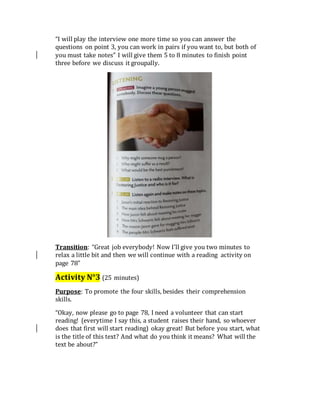
Then I will say “Okay, we will listen to this one time and then we will
discuss the question on point 2”. We will listen the radio interview and
then we will discuss the question.
“I will play the interview one more time so you can answer the
questions on point 3, you can work in pairs if you want to, but both of
you must take notes” I will give them 5 to 8 minutes to finish point
three before we discuss it groupally.
Transition: “Great job everybody! Now I’ll give you two minutes to
relax a little bit and then we will continue with a reading activity on
page 78”
Activity N°3 (25 minutes)
Purpose: To promote the four skills, besides their comprehension
skills.
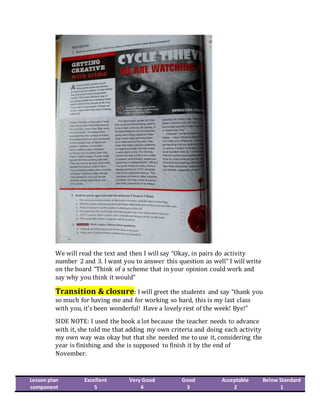
“Okay, now please go to page 78, I need a volunteer that can start
reading! (everytime I say this, a student raises their hand, so whoever
does that first will start reading) okay great! But before you start, what
is the title of this text? And what do you think it means? What will the
text be about?”
We will read the text and then I will say “Okay, in pairs do activity
number 2 and 3. I want you to answer this question as well” I will write
on the board “Think of a scheme that in your opinion could work and
say why you think it would”
Transition & closure: I will greet the students and say “thank you
so much for having me and for working so hard, this is my last class
with you, it’s been wonderful! Have a lovely rest of the week! Bye!”
SIDE NOTE: I used the book a lot because the teacher needs to advance
with it, she told me that adding my own criteria and doing each activity
my own way was okay but that she needed me to use it, considering the
year is finishing and she is supposed to finish it by the end of
November.
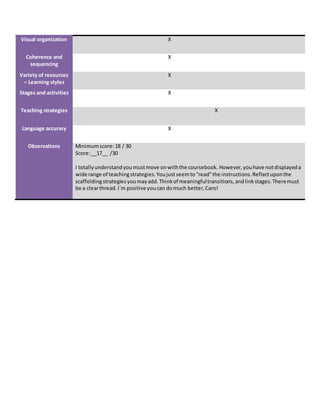
Lesson plan
component
Excellent
5
Very Good
4
Good
3
Acceptable
2
Below Standard
1
Visual organization X
Coherence and
sequencing
X
Variety of resources
– Learning styles
X
Stages and activities X
Teaching strategies X
Language accuracy X
Observations Minimumscore:18 / 30
Score:__17__ /30
I totallyunderstandyoumustmove onwiththe coursebook. However, youhave notdisplayeda
wide range of teachingstrategies.Youjustseemto“read”the instructions.Reflectuponthe
scaffoldingstrategiesyoumayadd.Thinkof meaningfultransitions,andlinkstages.Theremust
be a clearthread.I´m positive youcan domuch better,Caro!

TPD - HIGH SCHOOL - CLASS N°6

  • 1.
    I.F.D.C. LENGUAS VIVAS TALLERDE PRÁCTICA DOCENTE Tutora: Aurelia Velázquez ALUMNO RESIDENTE: Carolina Anticev Período de Práctica: High School Institución Educativa: Primo Capraro Dirección: Gallardo 40 Sala / Grado / Año - sección: 3er año Cantidad de alumnos: 13 Nivel lingüístico del curso: B1+ Tipo de Planificación: Clase Unidad Temática: 7 “Crime” Clase Nº: 6 Fecha: 30/10/2018 Hora: 8:00 – 9:20 hs Duración de la clase: 80 minutos Fecha de primera entrega: 28/10/2018  Teaching points: Teaching students about justice, punishments and to practice a bit of reported speech on the way. Also, to make students practice the four kills,promote communication and make them produce content.     Aims or goals:  During this lesson learners will be able express their opinions, share they knowledge on the topic and use their imagination and thinking skills to get the work done.  Language focus: Functions Lexis Structures Pronunciation New - Think about the outcomes of different situations - To break in - To get caught - A fine - “The people involved in the crime were..” - New - Sharing their point of view on punishment - To prevent - To catch - Get a caution - “He/she got ……” - “I’ve heard /ˈskiːm/
  • 2.
    and crime prevention schemes - Crime -prevention scheme - Restoring justice of….” Teaching approach: Natural approach, using the PPP procedure (presentation, production and practice).   Integration of skills: What skills will be integrated and how? All four skills will be integrated in a very balanced way. Everybody will have to speak, listen, write and read. They are going to practice their communicative skills at all times, by giving opinions, processing information and saying what they think and how they feel about it.   Materials and resources: Students book, notebooks, CD player and the CD.  Pedagogical use of ICT in class or at home: I will use the CD player.   Seating arrangement: They will sit as always, in a semicircle.   Assessment: what will be assessed and how  Students will have to listen, read and process that information, using it to produce while using their writing and speaking skills. They will work on their comprehension and communication skills. Stages in the lesson Each stage or activity must be described in terms of the following items: - Purpose - Timing - Activity description and instructions as they will be said to students (include direct speech, and students’ possible answers). - Teaching strategies (description, explanation, demonstration, modelling, exemplification, etc.) - Strategies to check understanding of instructions - Strategies to check new language comprehension
  • 3.
    - Interaction patterns -Skills - Resources - Transition comment to link each stage of the lesson with the next one Mandatory lessonstages: - Lead-in or Warm-up - Presentation - Development - Closure - Homework The format in which the stages are presented will vary according to the teaching approach or combination of approaches you decide to base your lesson plan upon. You must always include this chart, which will be completed by your tutor: CLASS N°6 Routine & Warm-up (15 minutes) Purpose: To start the class, get the students working and continue with last class’ activity. “Hello everybody! How are you today? I want you to get in yesterday’s groups and finish the work you were doing. Remember that you have to hand it over when you’re finished, you have 15 minutes okay” Transition: “Great, now, please write the name of all the group members and give me the sheets”. Activity N°1 (20 minutes)
  • 4.
    Purpose: To continuepractising vocabulary about the topic and also grammar (reported speech). They’ve already learnt reported speech so this is, as the books says, a review. “Okay now, I want you to get in pairs, open your books at page 76 and do all three grammar activities. You have 15 minutes” I will let them know when they have 5 minutes left and when time’s up, we will correct them together. Transition: “Now, we’re going to do listen to a crime case about mugging, what does mugging mean again?” I will listen to what they say and then I’ll say “, go to page 77” Activity N°2 (20 minutes) Purpose: To practise their four skills and make them process information in order to make conclusions. “Now, -random student name-, please read question number one” after they read it I will say, talking to the whole class “So, what do you think about that?” I will do the same thing for the three questions, discussing them groupally. Then I will say “Okay, we will listen to this one time and then we will discuss the question on point 2”. We will listen the radio interview and then we will discuss the question.
  • 5.
    “I will playthe interview one more time so you can answer the questions on point 3, you can work in pairs if you want to, but both of you must take notes” I will give them 5 to 8 minutes to finish point three before we discuss it groupally. Transition: “Great job everybody! Now I’ll give you two minutes to relax a little bit and then we will continue with a reading activity on page 78” Activity N°3 (25 minutes) Purpose: To promote the four skills, besides their comprehension skills. “Okay, now please go to page 78, I need a volunteer that can start reading! (everytime I say this, a student raises their hand, so whoever does that first will start reading) okay great! But before you start, what is the title of this text? And what do you think it means? What will the text be about?”
  • 6.
    We will readthe text and then I will say “Okay, in pairs do activity number 2 and 3. I want you to answer this question as well” I will write on the board “Think of a scheme that in your opinion could work and say why you think it would” Transition & closure: I will greet the students and say “thank you so much for having me and for working so hard, this is my last class with you, it’s been wonderful! Have a lovely rest of the week! Bye!” SIDE NOTE: I used the book a lot because the teacher needs to advance with it, she told me that adding my own criteria and doing each activity my own way was okay but that she needed me to use it, considering the year is finishing and she is supposed to finish it by the end of November. Lesson plan component Excellent 5 Very Good 4 Good 3 Acceptable 2 Below Standard 1
  • 7.
    Visual organization X Coherenceand sequencing X Variety of resources – Learning styles X Stages and activities X Teaching strategies X Language accuracy X Observations Minimumscore:18 / 30 Score:__17__ /30 I totallyunderstandyoumustmove onwiththe coursebook. However, youhave notdisplayeda wide range of teachingstrategies.Youjustseemto“read”the instructions.Reflectuponthe scaffoldingstrategiesyoumayadd.Thinkof meaningfultransitions,andlinkstages.Theremust be a clearthread.I´m positive youcan domuch better,Caro!