Medical Parasitology
    Lab8, part 2
     :Prepared by
   NASR A. Sinjilawi
Nematodes

 Ascaris lumbricoides.
 Hookworms:

   A- Ancylostoma duodenale.
   B- Necator americanus.
 Strongyloides stercoralis
Ascaris lumbricoides
 Common name: Roundworm.
 Habitat: Small intestine.
 Definitive host: Human.
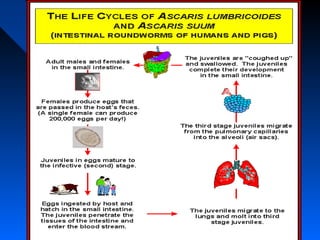
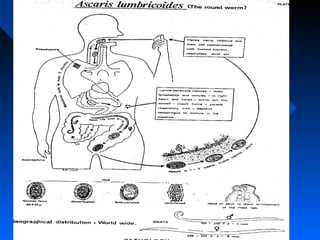
 Route of infection:Hands carry infective ova
  from soil contaminated with human excreta,
  vegetables, dust, …etc.
 No Intermediate host.
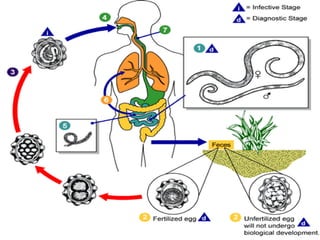
 Infective stage: Eggs.
 Diagnostic stage: Eggs in Stool.
 Disease: Ascariasis.
Ascaris lumbricoides life cycle1
Ascaris lumbricoides life cycle2
Ascaris lumbricoides life cycle3
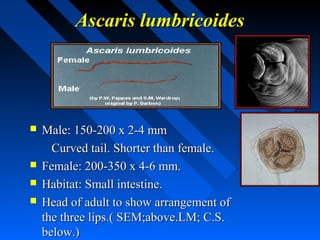
Ascaris lumbricoides


   Male: 150-200 x 2-4 mm
      Curved tail. Shorter than female.
   Female: 200-350 x 4-6 mm.
   Habitat: Small intestine.
   Head of adult to show arrangement of
    the three lips.( SEM;above.LM; C.S.
    below.)
Ascaris lumbricoides Eggs


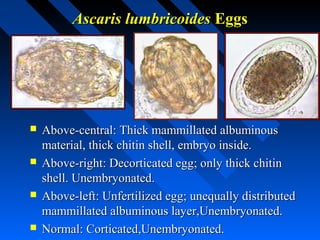
   Above-central: Thick mammillated albuminous
    material, thick chitin shell, embryo inside.
   Above-right: Decorticated egg; only thick chitin
    shell. Unembryonated.
   Above-left: Unfertilized egg; unequally distributed
    mammillated albuminous layer,Unembryonated.
   Normal: Corticated,Unembryonated.
C.S. in Female of A. Lumbricoides

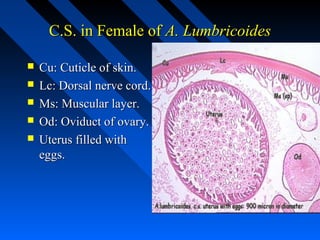
   Cu: Cuticle of skin.
   Lc: Dorsal nerve cord.
   Ms: Muscular layer.
   Od: Oviduct of ovary.
   Uterus filled with
    eggs.
Ancylostoma duodenale
   Common name: Old world hookworm.
   Habitat: Small intestine.
   Definitive host: Human.
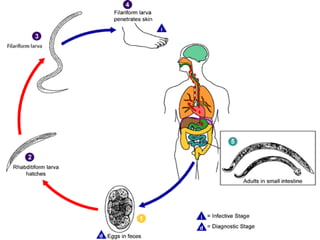
   Route of infection: Filariform larvae penetrate the skin
    of human.
   No Intermediate host.
   Infective stage: Third stage larvae ( filariform).
   Diagnostic stage: Eggs in Stool.
   Disease: Hookworm infection, Ancylostomiasis.
   Geographic Distribution: Southern Europe, North parts
    of Africa, China, India, and Japan.
Ancylostoma duodenale
       life cycle
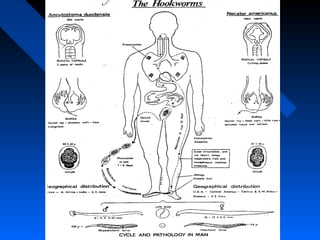
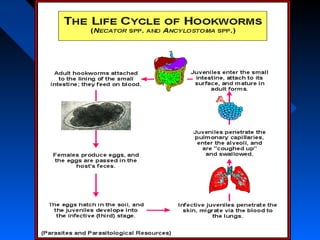
Hookworm life cycle
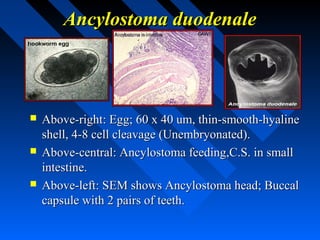
Ancylostoma duodenale


   Above-right: Egg; 60 x 40 um, thin-smooth-hyaline
    shell, 4-8 cell cleavage (Unembryonated).
   Above-central: Ancylostoma feeding,C.S. in small
    intestine.
   Above-left: SEM shows Ancylostoma head; Buccal
    capsule with 2 pairs of teeth.
Necator americanus
   Common name: New world hookworm.
   Habitat: Small intestine.
   Definitive host: Human.
   Route of infection: Filariform larvae penetrate the
    skin of human.
   No Intermediate host.
   Infective stage: Third stage larvae ( filariform).
   Diagnostic stage: Eggs in Stool.
   Disease: Hookworm infection, Ancylostomiasis.
   Geographic Distribution: Western hemisphere,
    central and south Africa, south Asia, south pacific,
    and India.
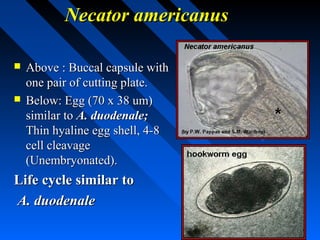
Necator americanus

   Above : Buccal capsule with
    one pair of cutting plate.
   Below: Egg (70 x 38 um)
    similar to A. duodenale;
    Thin hyaline egg shell, 4-8
    cell cleavage
    (Unembryonated).
Life cycle similar to
A. duodenale
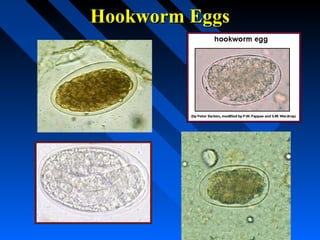
Hookworm Eggs
Necator americanus life cycle
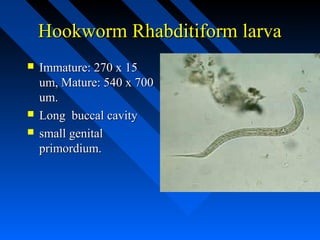
Hookworm Rhabditiform larva
   Immature: 270 x 15
    um, Mature: 540 x 700
    um.
   Long buccal cavity
   small genital
    primordium.
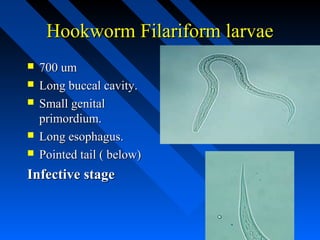
Hookworm Filariform larvae
   700 um
   Long buccal cavity.
   Small genital
    primordium.
   Long esophagus.
   Pointed tail ( below)
Infective stage
Strongyloides stercoralis
   Common name: Thread worm
   Habitat: Small intestine.
   Definitive host: Human.
   Route of infection: Filariform larvae penetrate the
    skin of human.
   No Intermediate host.
   Infective stage: Third stage larvae ( filariform).
   Diagnostic stage: First stage larvae(Rhabditiform)
    in feces.
   Disease: Strongyloidiasis.
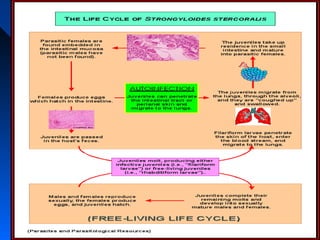
Strongyloides stercoralis life
           cycle1
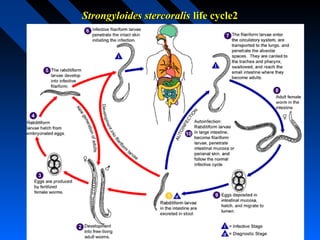
Strongyloides stercoralis life cycle2
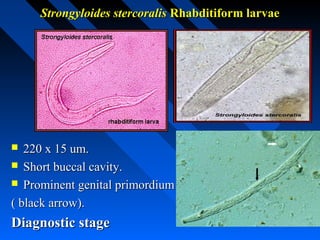
Strongyloides stercoralis Rhabditiform larvae


  220 x 15 um.
 Short buccal cavity.
 Prominent genital primordium

( black arrow).
Diagnostic stage
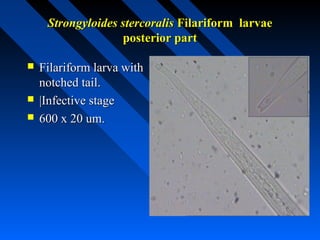
Strongyloides stercoralis Filariform larvae
                   posterior part

   Filariform larva with
    notched tail.
   |Infective stage
   600 x 20 um.
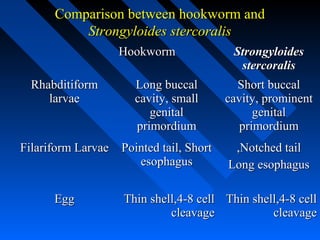
Comparison between hookworm and
          Strongyloides stercoralis
                  Hookworm               Strongyloides
                                          stercoralis
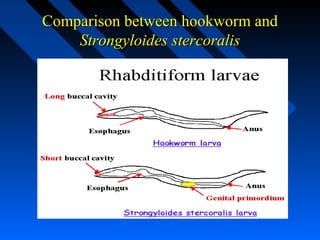
  Rhabditiform        Long buccal         Short buccal
     larvae           cavity, small     cavity, prominent
                         genital              genital
                      primordium           primordium
Filariform Larvae Pointed tail, Short    ,Notched tail
                     esophagus          Long esophagus

      Egg          Thin shell,4-8 cell Thin shell,4-8 cell
                            cleavage            cleavage
Comparison between hookworm and
    Strongyloides stercoralis

medical-parasitology-power-point-lab8 part2

  • 1.
    Medical Parasitology Lab8, part 2 :Prepared by NASR A. Sinjilawi
  • 2.
    Nematodes  Ascaris lumbricoides. Hookworms: A- Ancylostoma duodenale. B- Necator americanus.  Strongyloides stercoralis
  • 3.
    Ascaris lumbricoides  Commonname: Roundworm.  Habitat: Small intestine.  Definitive host: Human.  Route of infection:Hands carry infective ova from soil contaminated with human excreta, vegetables, dust, …etc.  No Intermediate host.  Infective stage: Eggs.  Diagnostic stage: Eggs in Stool.  Disease: Ascariasis.
  • 4.
  • 5.
  • 6.
  • 7.
    Ascaris lumbricoides  Male: 150-200 x 2-4 mm Curved tail. Shorter than female.  Female: 200-350 x 4-6 mm.  Habitat: Small intestine.  Head of adult to show arrangement of the three lips.( SEM;above.LM; C.S. below.)
  • 8.
    Ascaris lumbricoides Eggs  Above-central: Thick mammillated albuminous material, thick chitin shell, embryo inside.  Above-right: Decorticated egg; only thick chitin shell. Unembryonated.  Above-left: Unfertilized egg; unequally distributed mammillated albuminous layer,Unembryonated.  Normal: Corticated,Unembryonated.
  • 9.
    C.S. in Femaleof A. Lumbricoides  Cu: Cuticle of skin.  Lc: Dorsal nerve cord.  Ms: Muscular layer.  Od: Oviduct of ovary.  Uterus filled with eggs.
  • 10.
    Ancylostoma duodenale  Common name: Old world hookworm.  Habitat: Small intestine.  Definitive host: Human.  Route of infection: Filariform larvae penetrate the skin of human.  No Intermediate host.  Infective stage: Third stage larvae ( filariform).  Diagnostic stage: Eggs in Stool.  Disease: Hookworm infection, Ancylostomiasis.  Geographic Distribution: Southern Europe, North parts of Africa, China, India, and Japan.
  • 11.
  • 12.
  • 13.
    Ancylostoma duodenale  Above-right: Egg; 60 x 40 um, thin-smooth-hyaline shell, 4-8 cell cleavage (Unembryonated).  Above-central: Ancylostoma feeding,C.S. in small intestine.  Above-left: SEM shows Ancylostoma head; Buccal capsule with 2 pairs of teeth.
  • 14.
    Necator americanus  Common name: New world hookworm.  Habitat: Small intestine.  Definitive host: Human.  Route of infection: Filariform larvae penetrate the skin of human.  No Intermediate host.  Infective stage: Third stage larvae ( filariform).  Diagnostic stage: Eggs in Stool.  Disease: Hookworm infection, Ancylostomiasis.  Geographic Distribution: Western hemisphere, central and south Africa, south Asia, south pacific, and India.
  • 15.
    Necator americanus  Above : Buccal capsule with one pair of cutting plate.  Below: Egg (70 x 38 um) similar to A. duodenale; Thin hyaline egg shell, 4-8 cell cleavage (Unembryonated). Life cycle similar to A. duodenale
  • 16.
  • 17.
  • 18.
    Hookworm Rhabditiform larva  Immature: 270 x 15 um, Mature: 540 x 700 um.  Long buccal cavity  small genital primordium.
  • 19.
    Hookworm Filariform larvae  700 um  Long buccal cavity.  Small genital primordium.  Long esophagus.  Pointed tail ( below) Infective stage
  • 20.
    Strongyloides stercoralis  Common name: Thread worm  Habitat: Small intestine.  Definitive host: Human.  Route of infection: Filariform larvae penetrate the skin of human.  No Intermediate host.  Infective stage: Third stage larvae ( filariform).  Diagnostic stage: First stage larvae(Rhabditiform) in feces.  Disease: Strongyloidiasis.
  • 21.
  • 22.
  • 23.
    Strongyloides stercoralis Rhabditiformlarvae  220 x 15 um.  Short buccal cavity.  Prominent genital primordium ( black arrow). Diagnostic stage
  • 24.
    Strongyloides stercoralis Filariformlarvae posterior part  Filariform larva with notched tail.  |Infective stage  600 x 20 um.
  • 25.
    Comparison between hookwormand Strongyloides stercoralis Hookworm Strongyloides stercoralis Rhabditiform Long buccal Short buccal larvae cavity, small cavity, prominent genital genital primordium primordium Filariform Larvae Pointed tail, Short ,Notched tail esophagus Long esophagus Egg Thin shell,4-8 cell Thin shell,4-8 cell cleavage cleavage
  • 26.
    Comparison between hookwormand Strongyloides stercoralis