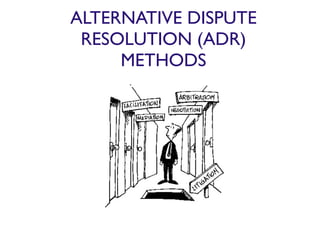
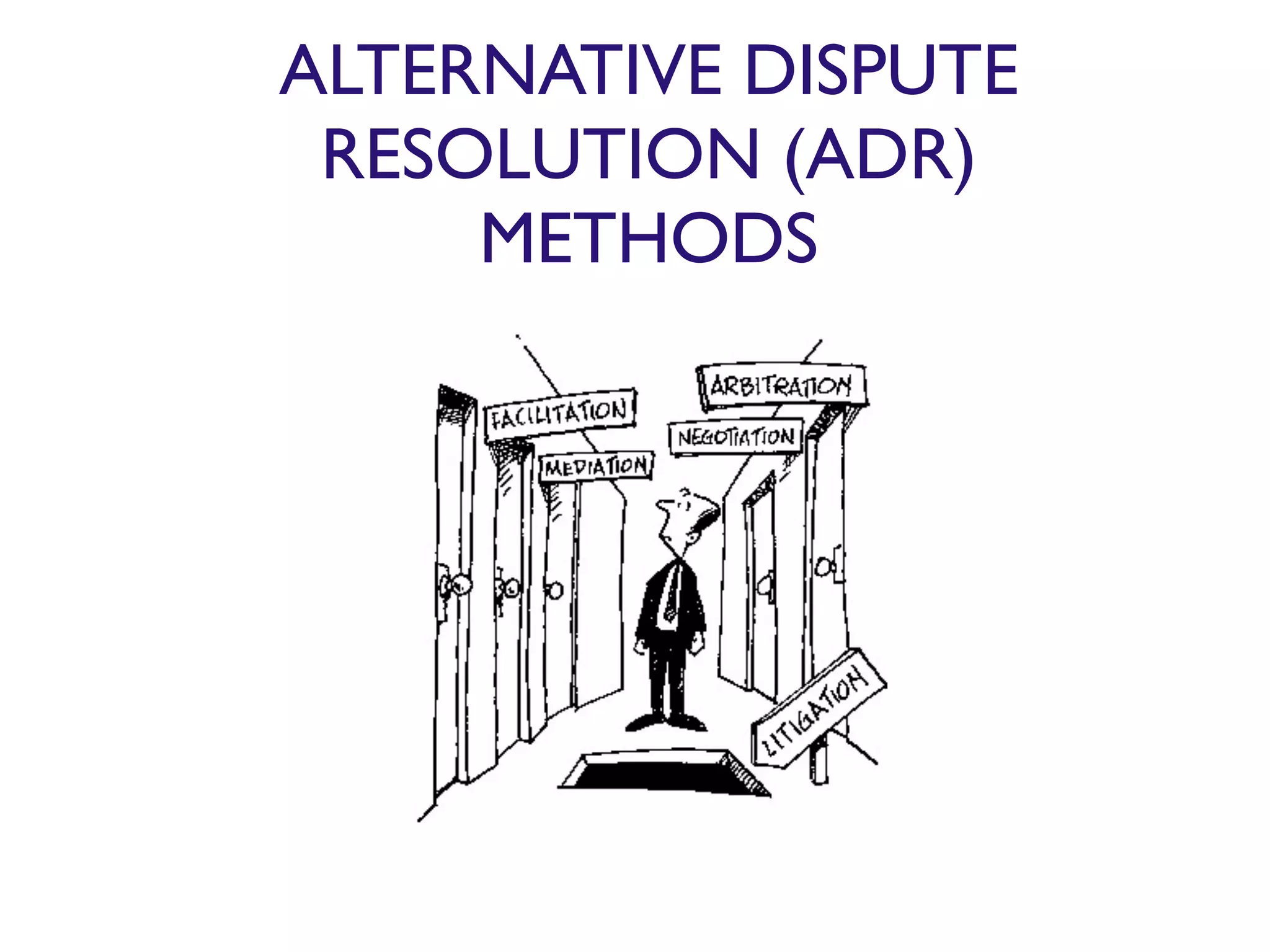
ALTERNATIVE DISPUTE
 RESOLUTION (ADR)
     METHODS
Think of a dispute that you have been involved in...............


      How was that dispute solved.............................
ALTERNATIVE DISPUTE
 RESOLUTION (ADR)
     METHODS
ALTERNATIVE DISPUTE
             RESOLUTION (ADR)
                 METHODS
Civil disputes occur when a person’s rights have been infringed
or an individual has been injured as a result of another person’s
                       action or inaction
ALTERNATIVE DISPUTE
               RESOLUTION (ADR)
                   METHODS
 Civil disputes occur when a person’s rights have been infringed
 or an individual has been injured as a result of another person’s
                        action or inaction

ADR involves settling a civil legal dispute by
a method other than a al decision before a
                  court.
ALTERNATIVE DISPUTE
               RESOLUTION (ADR)
                   METHODS
 Civil disputes occur when a person’s rights have been infringed
 or an individual has been injured as a result of another person’s
                        action or inaction

ADR involves settling a civil legal dispute by
a method other than a al decision before a
                  court.


                   Is ADR appropriate for Criminal Disputes?
Negotiation
Negotiation

Negotiation involves two parties discussing and
 compromising to obtain an agreed solution
Negotiation

       Negotiation involves two parties discussing and
        compromising to obtain an agreed solution

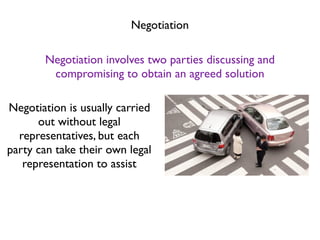
Negotiation is usually carried
      out without legal
  representatives, but each
party can take their own legal
   representation to assist
Negotiation

       Negotiation involves two parties discussing and
        compromising to obtain an agreed solution

Negotiation is usually carried
      out without legal
  representatives, but each
party can take their own legal
   representation to assist
Negotiation

       Negotiation involves two parties discussing and
        compromising to obtain an agreed solution

Negotiation is usually carried
      out without legal
  representatives, but each
party can take their own legal
   representation to assist


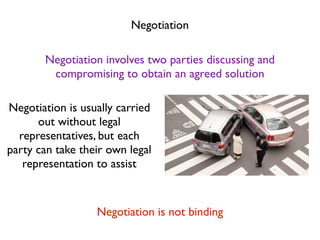
                  Negotiation is not binding
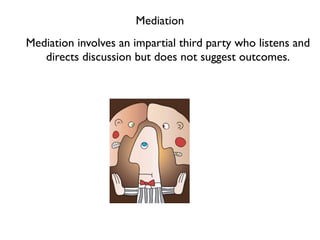
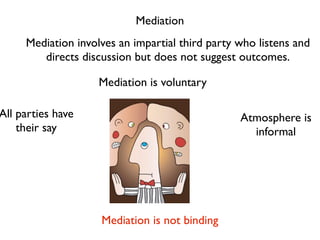
Mediation
Mediation involves an impartial third party who listens and
   directs discussion but does not suggest outcomes.
Mediation
Mediation involves an impartial third party who listens and
   directs discussion but does not suggest outcomes.

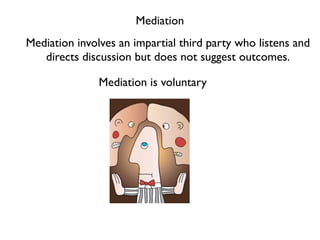
               Mediation is voluntary
Mediation
     Mediation involves an impartial third party who listens and
        directs discussion but does not suggest outcomes.

                    Mediation is voluntary

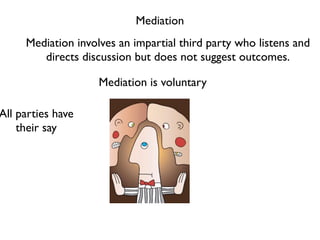
All parties have
    their say
Mediation
     Mediation involves an impartial third party who listens and
        directs discussion but does not suggest outcomes.

                    Mediation is voluntary

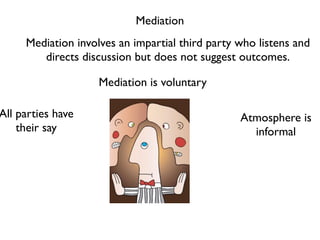
All parties have                                 Atmosphere is
    their say                                      informal
Mediation
     Mediation involves an impartial third party who listens and
        directs discussion but does not suggest outcomes.

                    Mediation is voluntary

All parties have                                 Atmosphere is
    their say                                      informal


                    Mediation is not binding
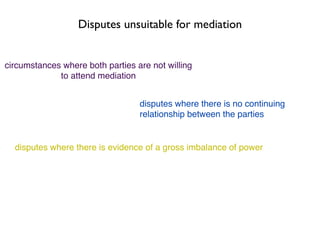
Disputes unsuitable for mediation


circumstances where both parties are not willing
             to attend mediation
Disputes unsuitable for mediation


circumstances where both parties are not willing
             to attend mediation


                                  disputes where there is no continuing
                                  relationship between the parties
Disputes unsuitable for mediation


circumstances where both parties are not willing
             to attend mediation


                                  disputes where there is no continuing
                                  relationship between the parties


  disputes where there is evidence of a gross imbalance of power
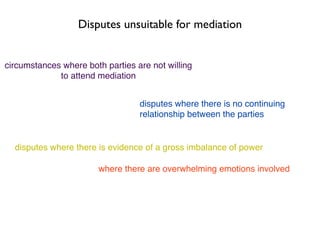
Disputes unsuitable for mediation


circumstances where both parties are not willing
             to attend mediation


                                  disputes where there is no continuing
                                  relationship between the parties


  disputes where there is evidence of a gross imbalance of power

                        where there are overwhelming emotions involved
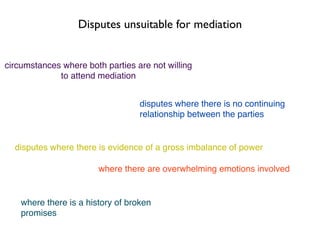
Disputes unsuitable for mediation


circumstances where both parties are not willing
             to attend mediation


                                   disputes where there is no continuing
                                   relationship between the parties


  disputes where there is evidence of a gross imbalance of power

                        where there are overwhelming emotions involved


    where there is a history of broken
    promises
Conciliation
Conciliation

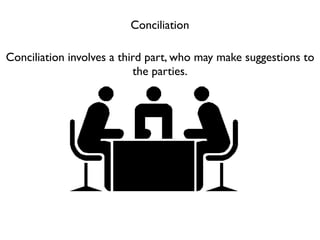
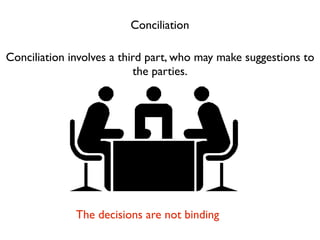
Conciliation involves a third part, who may make suggestions to
                           the parties.
Conciliation

Conciliation involves a third part, who may make suggestions to
                           the parties.


              The decisions are not binding
Arbitration
Arbitration


 Arbitration involves an independent third party who actually
makes suggestions and actually imposes a decision on the parties.
Arbitration


 Arbitration involves an independent third party who actually
makes suggestions and actually imposes a decision on the parties.

  The magistrates’
 court refers all civil
  disputes involving
   claims less than
10,000 to arbitration
Arbitration


 Arbitration involves an independent third party who actually
makes suggestions and actually imposes a decision on the parties.

  The magistrates’
 court refers all civil
  disputes involving
   claims less than
10,000 to arbitration


                      Arbitration is binding
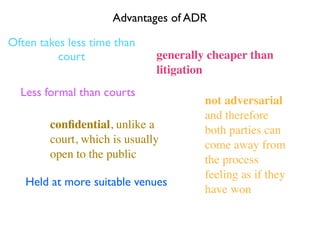
Advantages of ADR
Advantages of ADR

Often takes less time than
          court
Advantages of ADR

Often takes less time than
          court

  Less formal than courts
Advantages of ADR

Often takes less time than
          court

  Less formal than courts

        confidential, unlike a
        court, which is usually
        open to the public
Advantages of ADR

Often takes less time than
          court

  Less formal than courts

        confidential, unlike a
        court, which is usually
        open to the public

   Held at more suitable venues
Advantages of ADR

Often takes less time than
          court               generally cheaper than
                              litigation
  Less formal than courts

        confidential, unlike a
        court, which is usually
        open to the public

   Held at more suitable venues
Advantages of ADR

Often takes less time than
          court               generally cheaper than
                              litigation
  Less formal than courts
                                       not adversarial
                                       and therefore
        confidential, unlike a          both parties can
        court, which is usually        come away from
        open to the public             the process
                                       feeling as if they
   Held at more suitable venues
                                       have won
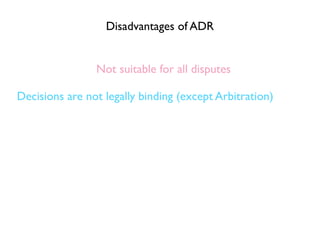
Disadvantages of ADR


Not suitable for all disputes
Disadvantages of ADR


                Not suitable for all disputes

Decisions are not legally binding (except Arbitration)
Disadvantages of ADR


                Not suitable for all disputes

Decisions are not legally binding (except Arbitration)


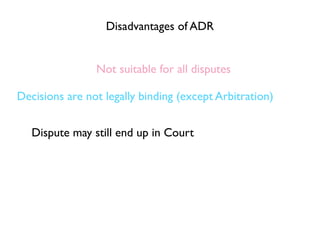
   Dispute may still end up in Court
Disadvantages of ADR


                Not suitable for all disputes

Decisions are not legally binding (except Arbitration)


   Dispute may still end up in Court


    Need both parties to voluntarily participate

Alternative Dispute Resolution Methods

  • 1.
  • 2.
    Think of adispute that you have been involved in............... How was that dispute solved.............................
  • 3.
  • 4.
    ALTERNATIVE DISPUTE RESOLUTION (ADR) METHODS Civil disputes occur when a person’s rights have been infringed or an individual has been injured as a result of another person’s action or inaction
  • 5.
    ALTERNATIVE DISPUTE RESOLUTION (ADR) METHODS Civil disputes occur when a person’s rights have been infringed or an individual has been injured as a result of another person’s action or inaction ADR involves settling a civil legal dispute by a method other than a al decision before a court.
  • 6.
    ALTERNATIVE DISPUTE RESOLUTION (ADR) METHODS Civil disputes occur when a person’s rights have been infringed or an individual has been injured as a result of another person’s action or inaction ADR involves settling a civil legal dispute by a method other than a al decision before a court. Is ADR appropriate for Criminal Disputes?
  • 7.
  • 8.
    Negotiation Negotiation involves twoparties discussing and compromising to obtain an agreed solution
  • 9.
    Negotiation Negotiation involves two parties discussing and compromising to obtain an agreed solution Negotiation is usually carried out without legal representatives, but each party can take their own legal representation to assist
  • 10.
    Negotiation Negotiation involves two parties discussing and compromising to obtain an agreed solution Negotiation is usually carried out without legal representatives, but each party can take their own legal representation to assist
  • 11.
    Negotiation Negotiation involves two parties discussing and compromising to obtain an agreed solution Negotiation is usually carried out without legal representatives, but each party can take their own legal representation to assist Negotiation is not binding
  • 12.
    Mediation Mediation involves animpartial third party who listens and directs discussion but does not suggest outcomes.
  • 13.
    Mediation Mediation involves animpartial third party who listens and directs discussion but does not suggest outcomes. Mediation is voluntary
  • 14.
    Mediation Mediation involves an impartial third party who listens and directs discussion but does not suggest outcomes. Mediation is voluntary All parties have their say
  • 15.
    Mediation Mediation involves an impartial third party who listens and directs discussion but does not suggest outcomes. Mediation is voluntary All parties have Atmosphere is their say informal
  • 16.
    Mediation Mediation involves an impartial third party who listens and directs discussion but does not suggest outcomes. Mediation is voluntary All parties have Atmosphere is their say informal Mediation is not binding
  • 17.
  • 18.
    Disputes unsuitable formediation circumstances where both parties are not willing to attend mediation
  • 19.
    Disputes unsuitable formediation circumstances where both parties are not willing to attend mediation disputes where there is no continuing relationship between the parties
  • 20.
    Disputes unsuitable formediation circumstances where both parties are not willing to attend mediation disputes where there is no continuing relationship between the parties disputes where there is evidence of a gross imbalance of power
  • 21.
    Disputes unsuitable formediation circumstances where both parties are not willing to attend mediation disputes where there is no continuing relationship between the parties disputes where there is evidence of a gross imbalance of power where there are overwhelming emotions involved
  • 22.
    Disputes unsuitable formediation circumstances where both parties are not willing to attend mediation disputes where there is no continuing relationship between the parties disputes where there is evidence of a gross imbalance of power where there are overwhelming emotions involved where there is a history of broken promises
  • 23.
  • 24.
    Conciliation Conciliation involves athird part, who may make suggestions to the parties.
  • 25.
    Conciliation Conciliation involves athird part, who may make suggestions to the parties. The decisions are not binding
  • 26.
  • 27.
    Arbitration Arbitration involvesan independent third party who actually makes suggestions and actually imposes a decision on the parties.
  • 28.
    Arbitration Arbitration involvesan independent third party who actually makes suggestions and actually imposes a decision on the parties. The magistrates’ court refers all civil disputes involving claims less than 10,000 to arbitration
  • 29.
    Arbitration Arbitration involvesan independent third party who actually makes suggestions and actually imposes a decision on the parties. The magistrates’ court refers all civil disputes involving claims less than 10,000 to arbitration Arbitration is binding
  • 30.
  • 31.
    Advantages of ADR Oftentakes less time than court
  • 32.
    Advantages of ADR Oftentakes less time than court Less formal than courts
  • 33.
    Advantages of ADR Oftentakes less time than court Less formal than courts confidential, unlike a court, which is usually open to the public
  • 34.
    Advantages of ADR Oftentakes less time than court Less formal than courts confidential, unlike a court, which is usually open to the public Held at more suitable venues
  • 35.
    Advantages of ADR Oftentakes less time than court generally cheaper than litigation Less formal than courts confidential, unlike a court, which is usually open to the public Held at more suitable venues
  • 36.
    Advantages of ADR Oftentakes less time than court generally cheaper than litigation Less formal than courts not adversarial and therefore confidential, unlike a both parties can court, which is usually come away from open to the public the process feeling as if they Held at more suitable venues have won
  • 37.
  • 38.
    Disadvantages of ADR Notsuitable for all disputes
  • 39.
    Disadvantages of ADR Not suitable for all disputes Decisions are not legally binding (except Arbitration)
  • 40.
    Disadvantages of ADR Not suitable for all disputes Decisions are not legally binding (except Arbitration) Dispute may still end up in Court
  • 41.
    Disadvantages of ADR Not suitable for all disputes Decisions are not legally binding (except Arbitration) Dispute may still end up in Court Need both parties to voluntarily participate