Photographic Terminology
Lydia Cooke
Unit 57: Photography and Photographic Practice Terminology
P1, P2, M1, M2
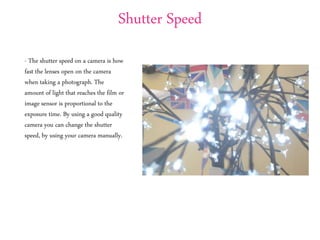
Shutter Speed
- The shutter speed on a camera is how
fast the lenses open on the camera
when taking a photograph. The
amount of light that reaches the film or
image sensor is proportional to the
exposure time. By using a good quality
camera you can change the shutter
speed, by using your camera manually.
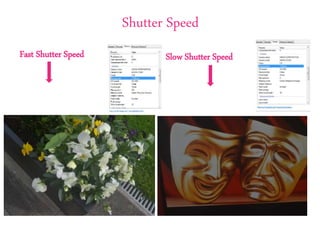
Shutter Speed
Fast Shutter Speed Slow Shutter Speed
ISO
• ISO (I.S.O.) is the abbreviation for
the International Organization of
Standardization, a governing body based in
Europe that provides the standards for a wide
variety of subjects. Most decent cameras now
have interchangeable ISO settings which is
especially useful for digital photography because
you can change the ISO setting for every shot
you take without the need to change film.
ISO
Low ISOHigh ISO
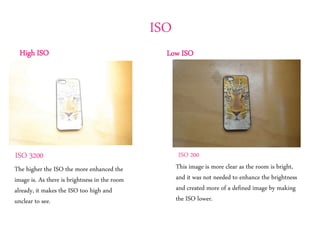
The higher the ISO the more enhanced the
image is. As there is brightness in the room
already, it makes the ISO too high and
unclear to see.
ISO 3200
This image is more clear as the room is bright,
and it was not needed to enhance the brightness
and created more of a defined image by making
the ISO lower.
ISO 200
Aperture & Depth of Field
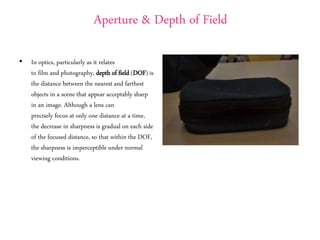
• In optics, particularly as it relates
to film and photography, depth of field (DOF) is
the distance between the nearest and farthest
objects in a scene that appear acceptably sharp
in an image. Although a lens can
precisely focus at only one distance at a time,
the decrease in sharpness is gradual on each side
of the focused distance, so that within the DOF,
the sharpness is imperceptible under normal
viewing conditions.
Aperture & Depth of Field
Narrow Depth of Field Wide Depth of Field
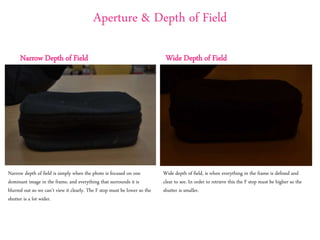
Wide depth of field, is when everything in the frame is defined and
clear to see. In order to retrieve this the F stop must be higher so the
shutter is smaller.
Narrow depth of field is simply when the photo is focused on one
dominant image in the frame, and everything that surrounds it is
blurred out so we can’t view it clearly. The F stop must be lower so the
shutter is a lot wider.
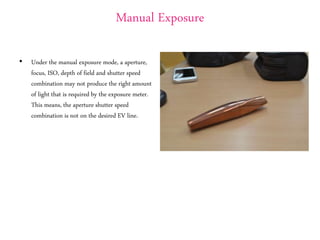
Manual Exposure
• Under the manual exposure mode, a aperture,
focus, ISO, depth of field and shutter speed
combination may not produce the right amount
of light that is required by the exposure meter.
This means, the aperture shutter speed
combination is not on the desired EV line.
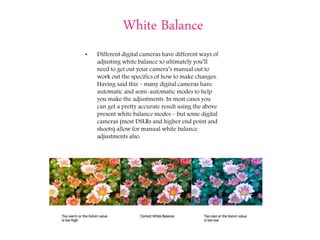
White Balance
• Different digital cameras have different ways of
adjusting white balance so ultimately you’ll
need to get out your camera’s manual out to
work out the specifics of how to make changes.
Having said this – many digital cameras have
automatic and semi-automatic modes to help
you make the adjustments. In most cases you
can get a pretty accurate result using the above
present white balance modes – but some digital
cameras (most DSLRs and higher end point and
shoots) allow for manual white balance
adjustments also.
Rule of thirds
The rule of thirds is applied by aligning a subject
with the guide lines and their intersection
points, placing the horizon on the top or bottom line, or
allowing linear features in the image to flow
from section to section.
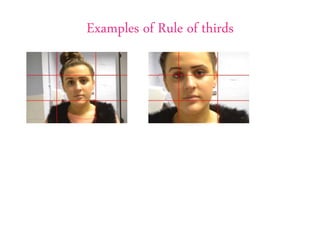
Examples of Rule of thirds

mediaTask 2 photography terminology work sheet

  • 1.
    Photographic Terminology Lydia Cooke Unit57: Photography and Photographic Practice Terminology P1, P2, M1, M2
  • 2.
    Shutter Speed - Theshutter speed on a camera is how fast the lenses open on the camera when taking a photograph. The amount of light that reaches the film or image sensor is proportional to the exposure time. By using a good quality camera you can change the shutter speed, by using your camera manually.
  • 3.
    Shutter Speed Fast ShutterSpeed Slow Shutter Speed
  • 4.
    ISO • ISO (I.S.O.)is the abbreviation for the International Organization of Standardization, a governing body based in Europe that provides the standards for a wide variety of subjects. Most decent cameras now have interchangeable ISO settings which is especially useful for digital photography because you can change the ISO setting for every shot you take without the need to change film.
  • 5.
    ISO Low ISOHigh ISO Thehigher the ISO the more enhanced the image is. As there is brightness in the room already, it makes the ISO too high and unclear to see. ISO 3200 This image is more clear as the room is bright, and it was not needed to enhance the brightness and created more of a defined image by making the ISO lower. ISO 200
  • 6.
    Aperture & Depthof Field • In optics, particularly as it relates to film and photography, depth of field (DOF) is the distance between the nearest and farthest objects in a scene that appear acceptably sharp in an image. Although a lens can precisely focus at only one distance at a time, the decrease in sharpness is gradual on each side of the focused distance, so that within the DOF, the sharpness is imperceptible under normal viewing conditions.
  • 7.
    Aperture & Depthof Field Narrow Depth of Field Wide Depth of Field Wide depth of field, is when everything in the frame is defined and clear to see. In order to retrieve this the F stop must be higher so the shutter is smaller. Narrow depth of field is simply when the photo is focused on one dominant image in the frame, and everything that surrounds it is blurred out so we can’t view it clearly. The F stop must be lower so the shutter is a lot wider.
  • 8.
    Manual Exposure • Underthe manual exposure mode, a aperture, focus, ISO, depth of field and shutter speed combination may not produce the right amount of light that is required by the exposure meter. This means, the aperture shutter speed combination is not on the desired EV line.
  • 9.
    White Balance • Differentdigital cameras have different ways of adjusting white balance so ultimately you’ll need to get out your camera’s manual out to work out the specifics of how to make changes. Having said this – many digital cameras have automatic and semi-automatic modes to help you make the adjustments. In most cases you can get a pretty accurate result using the above present white balance modes – but some digital cameras (most DSLRs and higher end point and shoots) allow for manual white balance adjustments also.
  • 10.
    Rule of thirds Therule of thirds is applied by aligning a subject with the guide lines and their intersection points, placing the horizon on the top or bottom line, or allowing linear features in the image to flow from section to section.
  • 11.