UNIT 18
CINEMATOGRAPHY
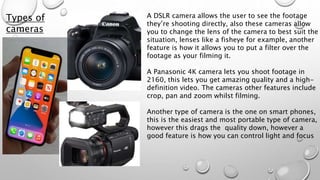
A DSLR camera allows the user to see the footage
they’re shooting directly, also these cameras allow
you to change the lens of the camera to best suit the
situation, lenses like a fisheye for example, another
feature is how it allows you to put a filter over the
footage as your filming it.
A Panasonic 4K camera lets you shoot footage in
2160, this lets you get amazing quality and a high-
definition video. The cameras other features include
crop, pan and zoom whilst filming.
Another type of camera is the one on smart phones,
this is the easiest and most portable type of camera,
however this drags the quality down, however a
good feature is how you can control light and focus
Types of
cameras
FRAME
RATES
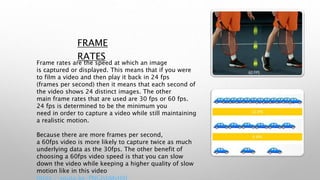
Frame rates are the speed at which an image
is captured or displayed. This means that if you were
to film a video and then play it back in 24 fps
(frames per second) then it means that each second of
the video shows 24 distinct images. The other
main frame rates that are used are 30 fps or 60 fps.
24 fps is determined to be the minimum you
need in order to capture a video while still maintaining
a realistic motion.
Because there are more frames per second,
a 60fps video is more likely to capture twice as much
underlying data as the 30fps. The other benefit of
choosing a 60fps video speed is that you can slow
down the video while keeping a higher quality of slow
motion like in this video
APERTURE
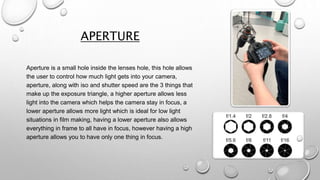
Aperture is a small hole inside the lenses hole, this hole allows
the user to control how much light gets into your camera,
aperture, along with iso and shutter speed are the 3 things that
make up the exposure triangle, a higher aperture allows less
light into the camera which helps the camera stay in focus, a
lower aperture allows more light which is ideal for low light
situations in film making, having a lower aperture also allows
everything in frame to all have in focus, however having a high
aperture allows you to have only one thing in focus.
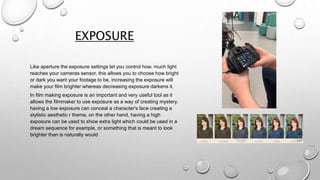
Like aperture the exposure settings let you control how. much light
reaches your cameras sensor, this allows you to choose how bright
or dark you want your footage to be, increasing the exposure will
make your film brighter whereas decreasing exposure darkens it.
In film making exposure is an important and very useful tool as it
allows the filmmaker to use exposure as a way of creating mystery.
having a low exposure can conceal a character's face creating a
stylistic aesthetic r theme, on the other hand, having a high
exposure can be used to show extra light which could be used in a
dream sequence for example, or something that is meant to look
brighter than is naturally would
EXPOSURE
ISO
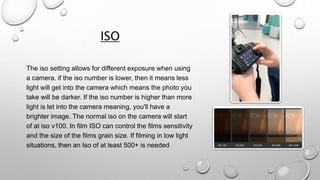
The iso setting allows for different exposure when using
a camera. if the iso number is lower, then it means less
light will get into the camera which means the photo you
take will be darker. If the iso number is higher than more
light is let into the camera meaning, you'll have a
brighter image. The normal iso on the camera will start
of at iso v100. In film ISO can control the films sensitivity
and the size of the films grain size. If filming in low light
situations, then an Iso of at least 500+ is needed
SOUND ATTACHMENTS
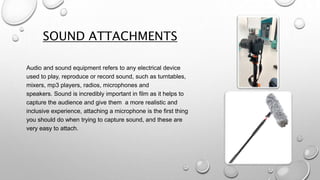
Audio and sound equipment refers to any electrical device
used to play, reproduce or record sound, such as turntables,
mixers, mp3 players, radios, microphones and
speakers. Sound is incredibly important in film as it helps to
capture the audience and give them a more realistic and
inclusive experience, attaching a microphone is the first thing
you should do when trying to capture sound, and these are
very easy to attach.
CAMERA MOUNTS
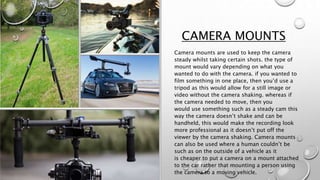
Camera mounts are used to keep the camera
steady whilst taking certain shots. the type of
mount would vary depending on what you
wanted to do with the camera. if you wanted to
film something in one place, then you’d use a
tripod as this would allow for a still image or
video without the camera shaking. whereas if
the camera needed to move, then you
would use something such as a steady cam this
way the camera doesn’t shake and can be
handheld, this would make the recording look
more professional as it doesn’t put off the
viewer by the camera shaking. Camera mounts
can also be used where a human couldn’t be
such as on the outside of a vehicle as it
is cheaper to put a camera on a mount attached
to the car rather that mounting a person using
the camera to a moving vehicle.

Unit 18 l01

  • 1.
  • 2.
    A DSLR cameraallows the user to see the footage they’re shooting directly, also these cameras allow you to change the lens of the camera to best suit the situation, lenses like a fisheye for example, another feature is how it allows you to put a filter over the footage as your filming it. A Panasonic 4K camera lets you shoot footage in 2160, this lets you get amazing quality and a high- definition video. The cameras other features include crop, pan and zoom whilst filming. Another type of camera is the one on smart phones, this is the easiest and most portable type of camera, however this drags the quality down, however a good feature is how you can control light and focus Types of cameras
  • 3.
    FRAME RATES Frame rates arethe speed at which an image is captured or displayed. This means that if you were to film a video and then play it back in 24 fps (frames per second) then it means that each second of the video shows 24 distinct images. The other main frame rates that are used are 30 fps or 60 fps. 24 fps is determined to be the minimum you need in order to capture a video while still maintaining a realistic motion. Because there are more frames per second, a 60fps video is more likely to capture twice as much underlying data as the 30fps. The other benefit of choosing a 60fps video speed is that you can slow down the video while keeping a higher quality of slow motion like in this video
  • 4.
    APERTURE Aperture is asmall hole inside the lenses hole, this hole allows the user to control how much light gets into your camera, aperture, along with iso and shutter speed are the 3 things that make up the exposure triangle, a higher aperture allows less light into the camera which helps the camera stay in focus, a lower aperture allows more light which is ideal for low light situations in film making, having a lower aperture also allows everything in frame to all have in focus, however having a high aperture allows you to have only one thing in focus.
  • 5.
    Like aperture theexposure settings let you control how. much light reaches your cameras sensor, this allows you to choose how bright or dark you want your footage to be, increasing the exposure will make your film brighter whereas decreasing exposure darkens it. In film making exposure is an important and very useful tool as it allows the filmmaker to use exposure as a way of creating mystery. having a low exposure can conceal a character's face creating a stylistic aesthetic r theme, on the other hand, having a high exposure can be used to show extra light which could be used in a dream sequence for example, or something that is meant to look brighter than is naturally would EXPOSURE
  • 6.
    ISO The iso settingallows for different exposure when using a camera. if the iso number is lower, then it means less light will get into the camera which means the photo you take will be darker. If the iso number is higher than more light is let into the camera meaning, you'll have a brighter image. The normal iso on the camera will start of at iso v100. In film ISO can control the films sensitivity and the size of the films grain size. If filming in low light situations, then an Iso of at least 500+ is needed
  • 7.
    SOUND ATTACHMENTS Audio andsound equipment refers to any electrical device used to play, reproduce or record sound, such as turntables, mixers, mp3 players, radios, microphones and speakers. Sound is incredibly important in film as it helps to capture the audience and give them a more realistic and inclusive experience, attaching a microphone is the first thing you should do when trying to capture sound, and these are very easy to attach.
  • 8.
    CAMERA MOUNTS Camera mountsare used to keep the camera steady whilst taking certain shots. the type of mount would vary depending on what you wanted to do with the camera. if you wanted to film something in one place, then you’d use a tripod as this would allow for a still image or video without the camera shaking. whereas if the camera needed to move, then you would use something such as a steady cam this way the camera doesn’t shake and can be handheld, this would make the recording look more professional as it doesn’t put off the viewer by the camera shaking. Camera mounts can also be used where a human couldn’t be such as on the outside of a vehicle as it is cheaper to put a camera on a mount attached to the car rather that mounting a person using the camera to a moving vehicle.