
EDITORIAL
(leading article) an article in a newspaper or
magazine that expresses the opinion of the editor,
editorial board, or publisher.
The editorial board is a group of editors, usually at
a print publication, who dictate the tone and
direction that the publication's editorials will take.
In much of the English-speaking world, editorials
are typically not written by the regular reporters of
the news organization, but are instead collectively
authored by a group of individuals
INVESTIGATIVE
JOURNALISM The use of detective-like reporting methods to unearth
scandals.
 1972: Woodward and Bernstein expose the Watergate break
in
 In June 1972, five men were arrested for breaking into the
Democratic National Committee offices at the Watergate
Complex in Washington, DC. Two young reporters at The
Washington Post, Bob Woodward and Carl Bernstein, were
intrigued that one of the burglars was on the payroll of
President Richard Nixon’s reelection committee and began
digging further. Woodward and Bernstein uncovered a series
of political crimes and “dirty tricks” that connected the
burglary back to the White House. Their reporting led to
indictments of 40 administration officials and the eventual
resignation of President Nixon. The paper won the 1973
Pulitzer Prize for the investigative reporting.
MEDIA BIAS
Media bias is a term used to describe a real or
perceived bias of journalists and news producers
within the mass media, in the selection of which
events will be reported and how they are covered.
The term "media bias" usually refers to a pervasive
or widespread bias contravening the standards of
journalism, rather than the perspective of an
individual journalist or article.The direction and
degree of media bias in various countries is widely
disputed, although its causes are both practical
and theoretical.
TRIAL BALLOONS
Information leaked for the purpose of
determining what the political reaction will
be.
a company might announce they are going to
release a new computer program in a year,
and then read the press coverage for hints on
whether or not the product will have appeal
in the marketplace. If the coverage is
favourable the money will be spent on
development, but if not the project can be
cancelled before using up resources.
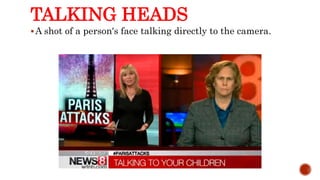
TALKING HEADS
A shot of a person's face talking directly to the camera.
LINKAGE INSTITUTIONS
The channels or access points through which issues
and people's policy preferences get on the policy
agenda – connecting citizens to the government
4 main groups:
Media – where we find out
Political parties – ideologies how the government
should be run
Campaigns and elections – reminding citizens of
their ultimate power: vote
Interest groups – organize people with common
interests and attitudes
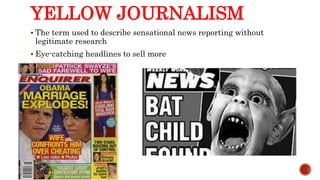
YELLOW JOURNALISM
 The term used to describe sensational news reporting without
legitimate research
 Eye-catching headlines to sell more
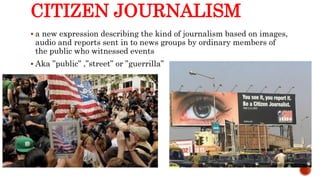
CITIZEN JOURNALISM
 a new expression describing the kind of journalism based on images,
audio and reports sent in to news groups by ordinary members of
the public who witnessed events
 Aka ”public” ,”street” or ”guerrilla”
BROADSHEETS
 newspapers (traditionally larger in size, long vertical pages) which
generally contain serious reports and analyses of news
 The Times, The Daily Telegraph, The Financial Times
JOURNALISM LANGUAGE
 to cover a story
 to report on an event or development

 in-depth coverage of
 a thorough analysis of

 to verify
 to check that something is correct

 eyewitness reports
 descriptions of what happened by people who actually saw an event take place

 breaking news
 news which is just coming in
SYNONYMS
journalism
profession
statement
correspondents
grave
deaths
wars
spotlight
proved
fatal
announcement
fatalities
focus
turned out
reporters
news reporting
deadly
serious
career
conficts

Media vocabulary

  • 2.
    EDITORIAL (leading article) anarticle in a newspaper or magazine that expresses the opinion of the editor, editorial board, or publisher. The editorial board is a group of editors, usually at a print publication, who dictate the tone and direction that the publication's editorials will take. In much of the English-speaking world, editorials are typically not written by the regular reporters of the news organization, but are instead collectively authored by a group of individuals
  • 3.
    INVESTIGATIVE JOURNALISM The useof detective-like reporting methods to unearth scandals.  1972: Woodward and Bernstein expose the Watergate break in  In June 1972, five men were arrested for breaking into the Democratic National Committee offices at the Watergate Complex in Washington, DC. Two young reporters at The Washington Post, Bob Woodward and Carl Bernstein, were intrigued that one of the burglars was on the payroll of President Richard Nixon’s reelection committee and began digging further. Woodward and Bernstein uncovered a series of political crimes and “dirty tricks” that connected the burglary back to the White House. Their reporting led to indictments of 40 administration officials and the eventual resignation of President Nixon. The paper won the 1973 Pulitzer Prize for the investigative reporting.
  • 4.
    MEDIA BIAS Media biasis a term used to describe a real or perceived bias of journalists and news producers within the mass media, in the selection of which events will be reported and how they are covered. The term "media bias" usually refers to a pervasive or widespread bias contravening the standards of journalism, rather than the perspective of an individual journalist or article.The direction and degree of media bias in various countries is widely disputed, although its causes are both practical and theoretical.
  • 5.
    TRIAL BALLOONS Information leakedfor the purpose of determining what the political reaction will be. a company might announce they are going to release a new computer program in a year, and then read the press coverage for hints on whether or not the product will have appeal in the marketplace. If the coverage is favourable the money will be spent on development, but if not the project can be cancelled before using up resources.
  • 6.
    TALKING HEADS A shotof a person's face talking directly to the camera.
  • 7.
    LINKAGE INSTITUTIONS The channelsor access points through which issues and people's policy preferences get on the policy agenda – connecting citizens to the government 4 main groups: Media – where we find out Political parties – ideologies how the government should be run Campaigns and elections – reminding citizens of their ultimate power: vote Interest groups – organize people with common interests and attitudes
  • 8.
    YELLOW JOURNALISM  Theterm used to describe sensational news reporting without legitimate research  Eye-catching headlines to sell more
  • 9.
    CITIZEN JOURNALISM  anew expression describing the kind of journalism based on images, audio and reports sent in to news groups by ordinary members of the public who witnessed events  Aka ”public” ,”street” or ”guerrilla”
  • 10.
    BROADSHEETS  newspapers (traditionallylarger in size, long vertical pages) which generally contain serious reports and analyses of news  The Times, The Daily Telegraph, The Financial Times
  • 11.
    JOURNALISM LANGUAGE  tocover a story  to report on an event or development   in-depth coverage of  a thorough analysis of   to verify  to check that something is correct   eyewitness reports  descriptions of what happened by people who actually saw an event take place   breaking news  news which is just coming in
  • 12.