Introduction to
Journalism and
Journalistic Writing
Objectives
To acquaint the
students with the
world of journalism
Learning Outcomes
 To understand area of
journalism in general
and political journalism
in particular
 To articulate political
news and views
 To compare and create
differentiated content
for print and electronic
media
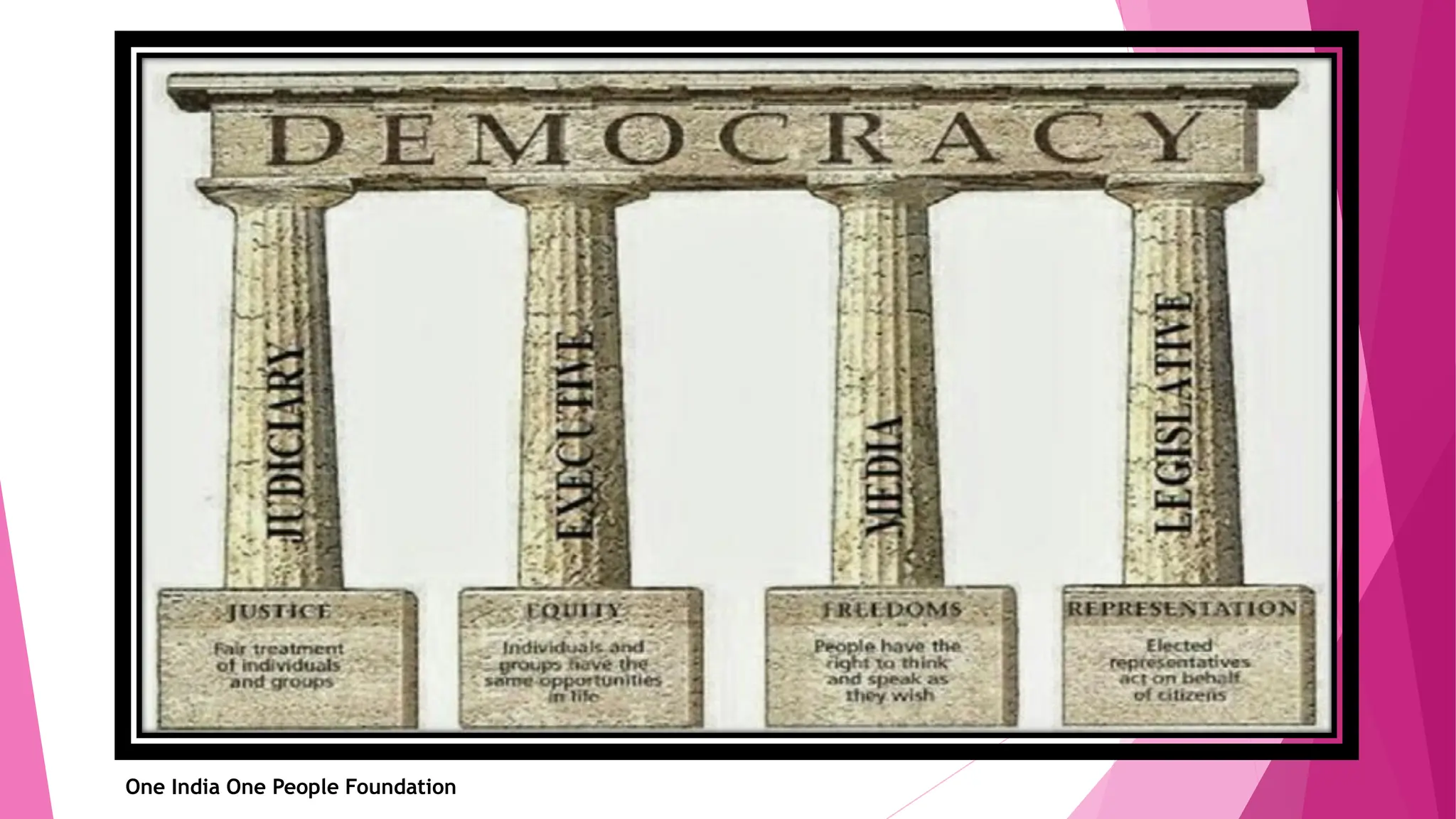
One India One People Foundation
Knowledge gained : Journalism
 What is Journalism ?
 Journalism is a process of collection, preparation and distribution of news
and related commentary and feature materials through print and electronic
media
 NEWS : North + East + West + South
 Journalism is about news and views
 Satisfying human curiosity
 Creation and dissemination of reports about current affairs, human iterests
 Print and electronic media : Newspapers, magazines, books, blogs,
webcasts, podcasts, social networking and social media sites, and e-mail as
well as through radio, motion pictures, and television
 Periodicity of a journal : daily, weekly, fortnightly, monthly, bimonthly,
quarterly, half yearly, annual
Introduction
 The word journalism was originally applied to the reportage of current events in printed
form, specifically newspapers
 With the advent of radio, television, and the Internet in the 20th century the use of the
term broadened to include all printed and electronic communication dealing with
current affairs
 Purpose of journalism : to research and report events that impact people’s lives and
society at a large in different ways
 Occupation for those
 having inquisitive mind
 like to converse, communicate and interview influential personalities and leaders
 Attend and cover events
 Are fond of writing, editing, reporting
 Doing photography
 And like to broadcast, disseminate, make it public, communicate
Role of Journalism
 The role of journalism is to provide people with up-to-date information on politics
 Journalism is a powerful tool for informing the public about politicians’ actions
 Political journalism constitutes one of the most prominent domains of journalism
 Generates awareness and formulate public opinion
 It can help make politicians accountable and show voters who they should vote for in
elections
 As an instrument of the state, journalism must be impartial and objective
 Essential for the functioning of democracy
 Political journalism should function as an information provider, watchdog, and forum
for political discussions, thereby helping citizens understand political matters and
help prevent abuse of power
Nature of Journalism
 Journalism as a profession and as a mission
 Shares a close, interdependent, contentious relationship with political actors, shaping both the
processes and the content of political journalism
 Journalism has as its main activity the reporting of events stating who, what, where, why and how
 Journalism is the timely reporting of events at the local, provincial, national and international
levels.
 Reporting involves the gathering of information and publishing/broadcasting a fair and balanced story
 Journalism is not just fact-finding media analysis opinion writing or commentary although all of those
aspects can play a part at times but is concerned with the dissemination of news and views about
the society
 Journalism has become the media of mass education by educating general masses
 Journalism has widened and it has transcended the limits of mere reporting
 Journalism is broadly categorized into media based and content based journalism
Media-based journalism
 Print journalism : includes writing and publishing for newspapers, magazines,
newsletters, private publications, online news pages and others
 Electronic / Broadcast journalism : includes broadcasting for both radio and
television. Television journalists rely on visual information to illustrate and
characterize their reporting, including on-camera interviews with people
involved in the story
 On-line journalism : Fast and vast growth of internet and World Wide Web has
spawned the newest medium for journalism, on-line journalism
 Blogs
 Podcast
 Live and real time
Content based
 Feature journalism: Newspapers and periodicals often contain features written by journalists, Deep
journalism
 Area-specific : Political, Social, Economic, Cultural
 Sports journalism: covers many aspects of human athletic competition, and is an integral part of most
journalism products, including newspapers, magazines, and radio and television news broadcasts.
 Science journalism: Science journalism is a relatively new branch of journalism, in which journalists
reporting conveys information on science topics to the public.
 Investigative journalism: Investigative journalism, in which journalists investigative and expose unethical,
immoral and illegal behavior by individual, business and government agencies, can be complicated, time-
consuming and expensive-requiring teams of journalists, months of research, interviews (sometimes
repeated interviews) with numerous people, long-distance travel, computers to analyze public-record
databases, or use of the company’s legal staff to secure documents under freedom of information laws.
 People journalism or celebrity: Celebrity journalism differs from feature writing in that it focuses on
people who are either already famous or are especially attractive. Journalists who follow celebrities
constantly to obtain potentially embarrassing photographs, have come to characterize celebrity journalism
 Paparazzi : often covers celebrities obsessively unethically in order to provide coverage
Scope of journalism
 Vertical : News from International, National, State level and local level
 Horizontal :
 Press Conferences of Governments, Opposition Parties, Leaders, Whistle blowers
 Policy decisions
 Movements and agitations
 Interests of common man, disadvantageous and underprivileged groups
 Collective /Public goods : Health, Education
 Law-making, reporting from Parliament, State legislatures
 Electoral Politics, Elections, Rallies, Exit Polls
 International Relations
 Judicial verdicts, court hearings
Types of Journalism
 Political Journalism
 Opinion Journalism
 Investigative Journalism
 Watchdog Journalism
 Business and Trade Journalism (Pink Papers : Economic Times/
Financial Express)
 Entertainment / Infotainment Journalism
 Online Journalism / Web Journalism
 Broadcast Journalism
What is Political Journalism ? Meaning
 Political journalism is the branch of professional journalism that deals with
coverage and analysis of political events, issues, campaigns, etc.
 Political journalism is a media occupation that gathers, reports and analyzes
information about government and politics
 Political journalism is the practice of gathering, assessing, and disseminating
information
 about current events in politics
 news about government and politics
 covers political decisions, campaigns, and news
 often focuses on political figures, parties, candidates, elections, and policies.
 The term also refers to an editorial or opinion column that expresses a political
view
 It is also called as ‘political reporting’ and is a part of ‘political communication’
Political Journalism : Definition
 Britannica : Journalism, the collection, preparation, and distribution of
news and related commentary and feature materials through such print and
electronic media as newspapers, magazines, books, blogs, webcasts,
podcasts, social networking and social media sites, and e-mail as well as
through radio, motion pictures, and television.
 Political journalism is the systematic collection, evaluation, and
presentation of news about government and politics
 Political journalism is a type of journalism that includes covering of
different elements of politics, political practices, political processes and
political values
 Political journalism offers the citizenry opportunities to be informed of
current political issues, provides a link between the rulers and the ruled,
government and the electorate
Principles for Journalism writing : Knowledge
 Journalism's first obligation is to the truth
 Its first loyalty is to citizens
 Its essence is a discipline of verification
 Its practitioners must maintain an independence from those they cover
 It must serve as an independent monitor of power
 It must provide a forum for public criticism and compromise
 It must strive to make the significant interesting and relevant
 It must keep the news comprehensive and proportional
 Its practitioners must be allowed to exercise their personal conscience
 Protecting confidentiality of the source is important
 Practicing ethics and following a code of conduct
 Beware of fake news, don’t indulge into paid news
History of Political Journalism (Self Study)
 Role of mass media especially news papers in
pre-independence era
 National Media
 Regional / Vernacular Media
 Mass awareness and awakening through news papers
 Self Study
 Case of Study of Bal Shastri Jambhekar, Jotirao Phule,
Lokmanya Tilak and Agarkar, Mahatma Gandhi, Dr.
Ambedkar and their efforts
Title Lorem Ipsum Dolor
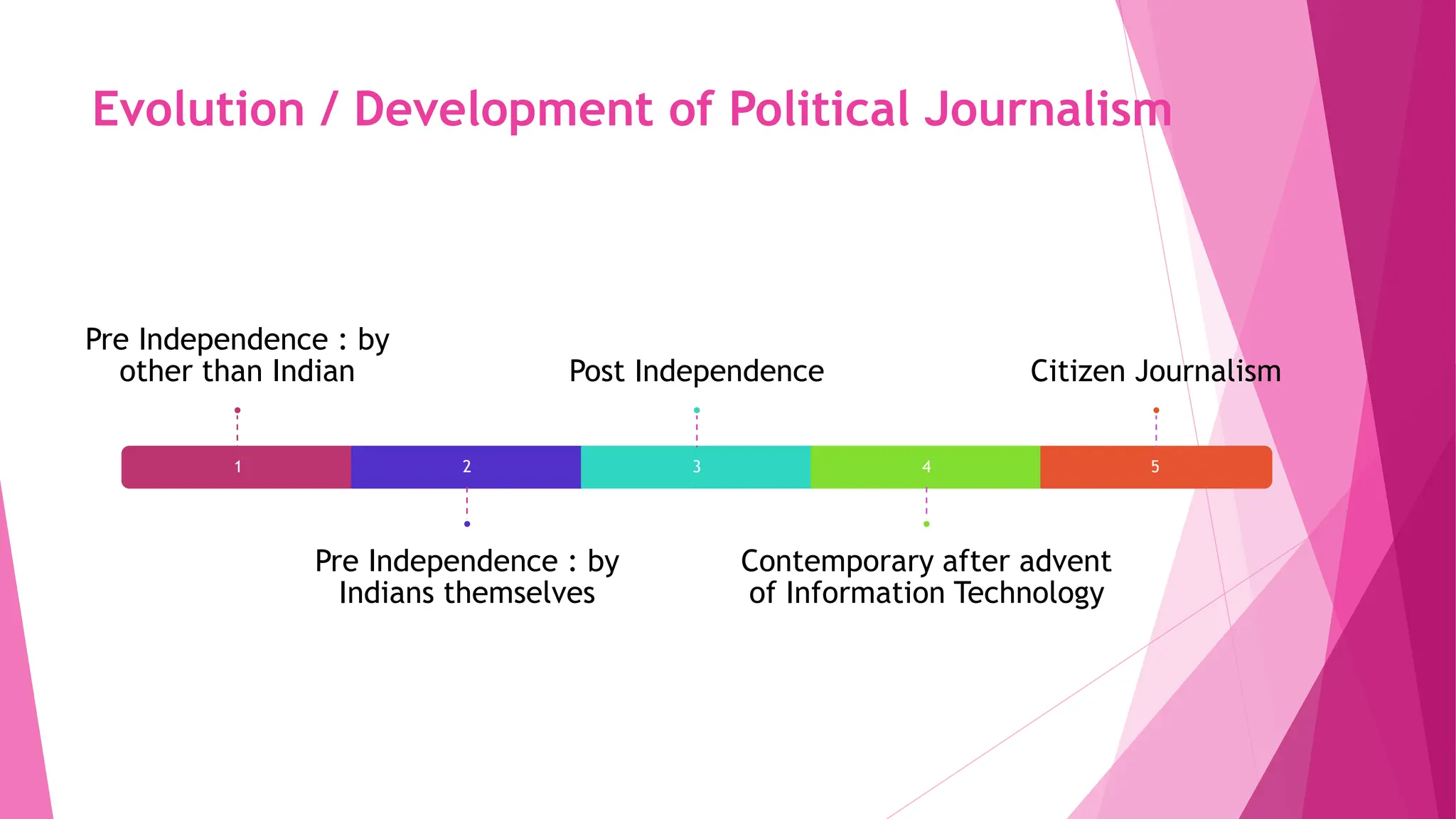
1
Pre Independence : by
other than Indian
2
Pre Independence : by
Indians themselves
3
Post Independence
4
Contemporary after advent
of Information Technology
5
Citizen Journalism
Evolution / Development of Political Journalism
Agencies : Print Media
 It is a form of mass media in which it shares the news or concerning
pieces of information via the printed form of publications
 Print media is the oldest means by which people still share
information across an entire group of audiences
 It only publishes info in a printed form (hard copy) and then releases
it to its users to make it more reader-friendly than the electronic
media.
 Some very popular types of print media include books, magazines,
newspapers, etc.
 No live reporting, live discussion, or live show is possible with the print
media. It follows the methodology of an interval update.
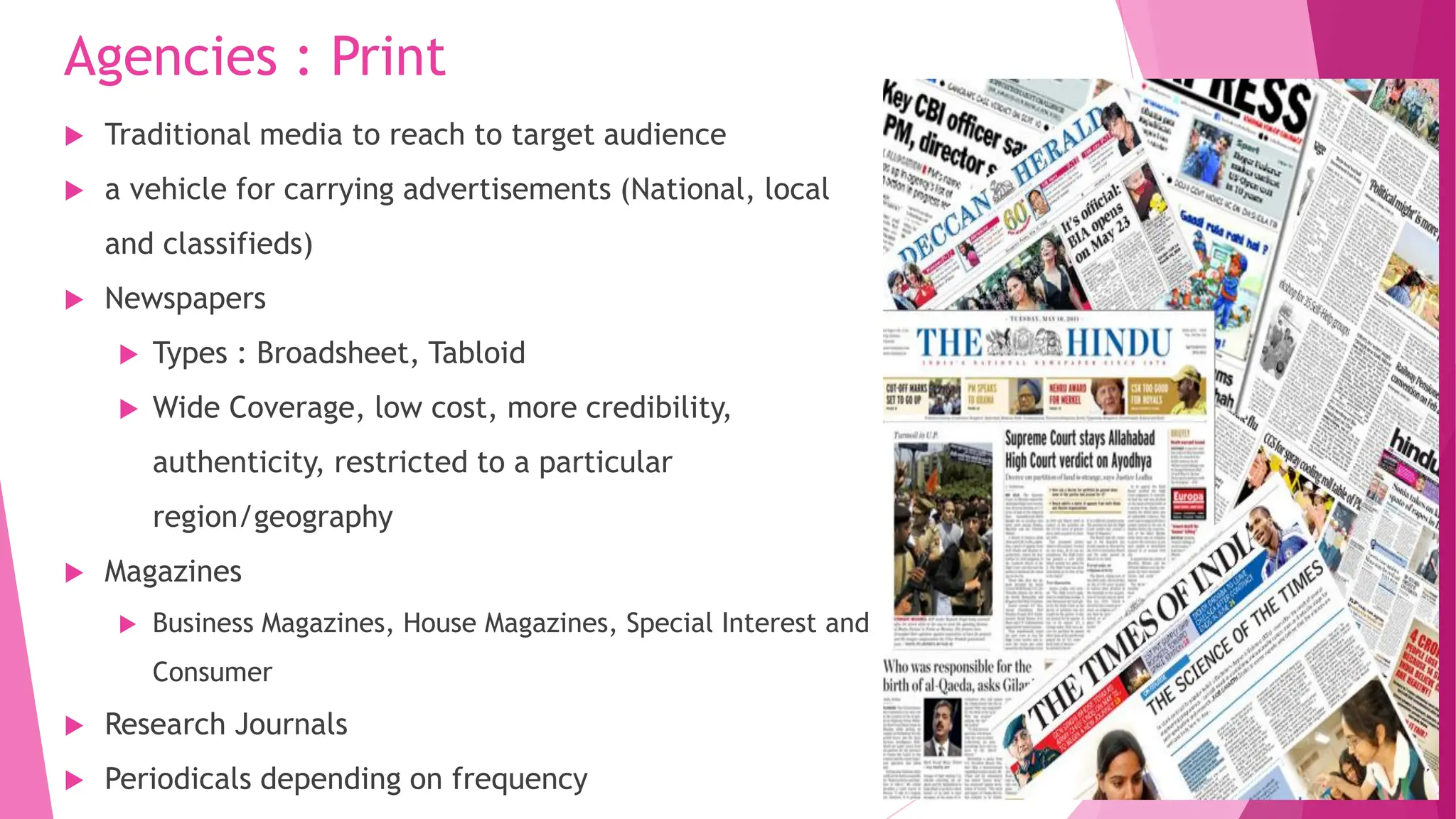
Agencies : Print
 Traditional media to reach to target audience
 a vehicle for carrying advertisements (National, local
and classifieds)
 Newspapers
 Types : Broadsheet, Tabloid
 Wide Coverage, low cost, more credibility,
authenticity, restricted to a particular
region/geography
 Magazines
 Business Magazines, House Magazines, Special Interest and
Consumer
 Research Journals
 Periodicals depending on frequency
Electronic Media
 It is a form of mass media that shares news or any other pieces of information
via an electronic medium to all of the viewers and audiences.
 Electronic media serves as a very advanced means of sharing data and info/
news.
 In this type of media, the publisher needs to upload the information (or
broadcast it)- after which any user can easily view it through their electronic
mediums (devices).
 It acts more user-friendly than print media.
 Some of the most popular types of electronic media include mobile app news,
television news, desktop streams, and many more.
 Electronic media makes it possible for its users to hold live discussions, live
updates, live reporting, etc.
 It is because this media makes use of a method of an immediate update.
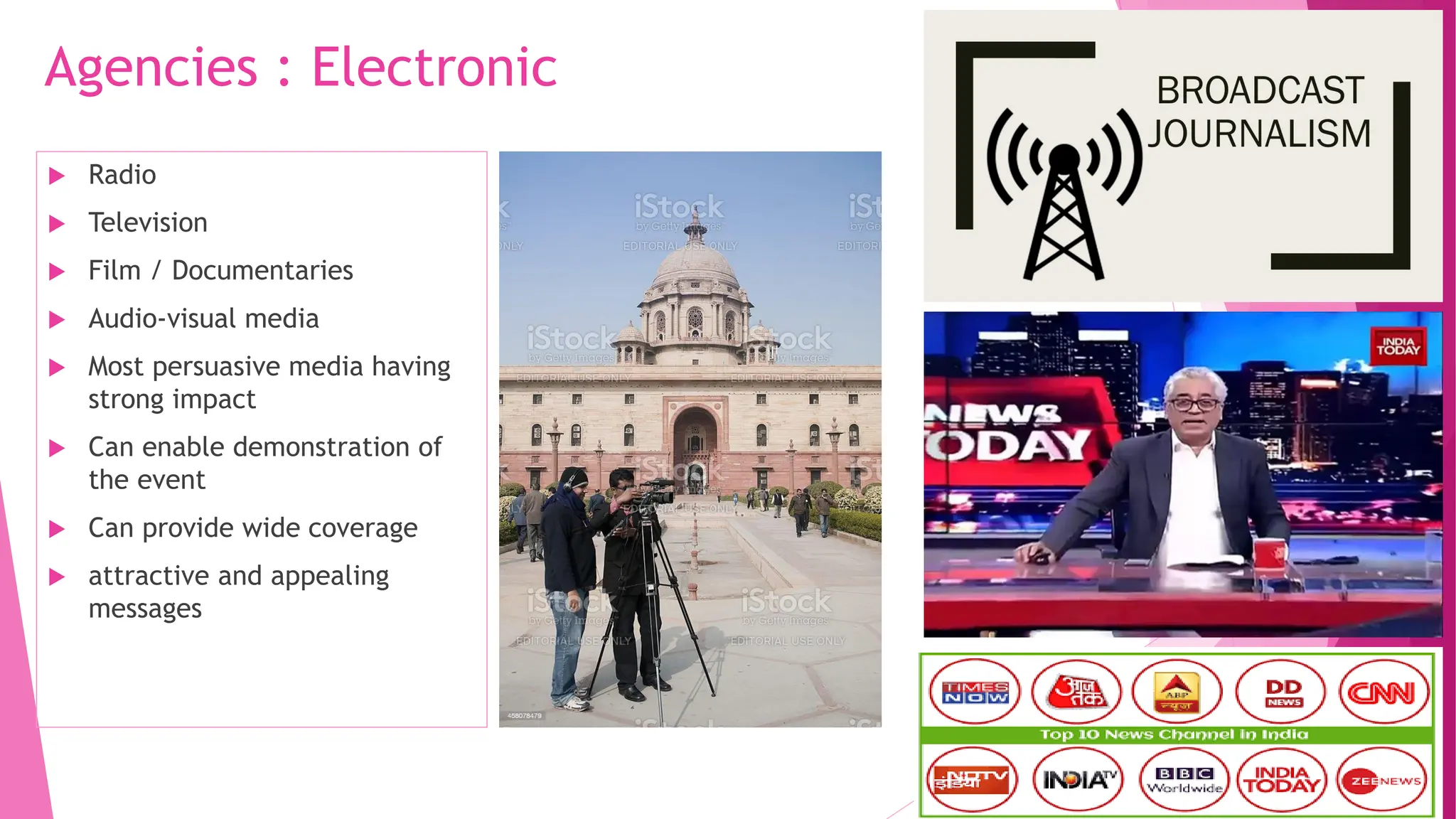
Agencies : Electronic
 Radio
 Television
 Film / Documentaries
 Audio-visual media
 Most persuasive media having
strong impact
 Can enable demonstration of
the event
 Can provide wide coverage
 attractive and appealing
messages
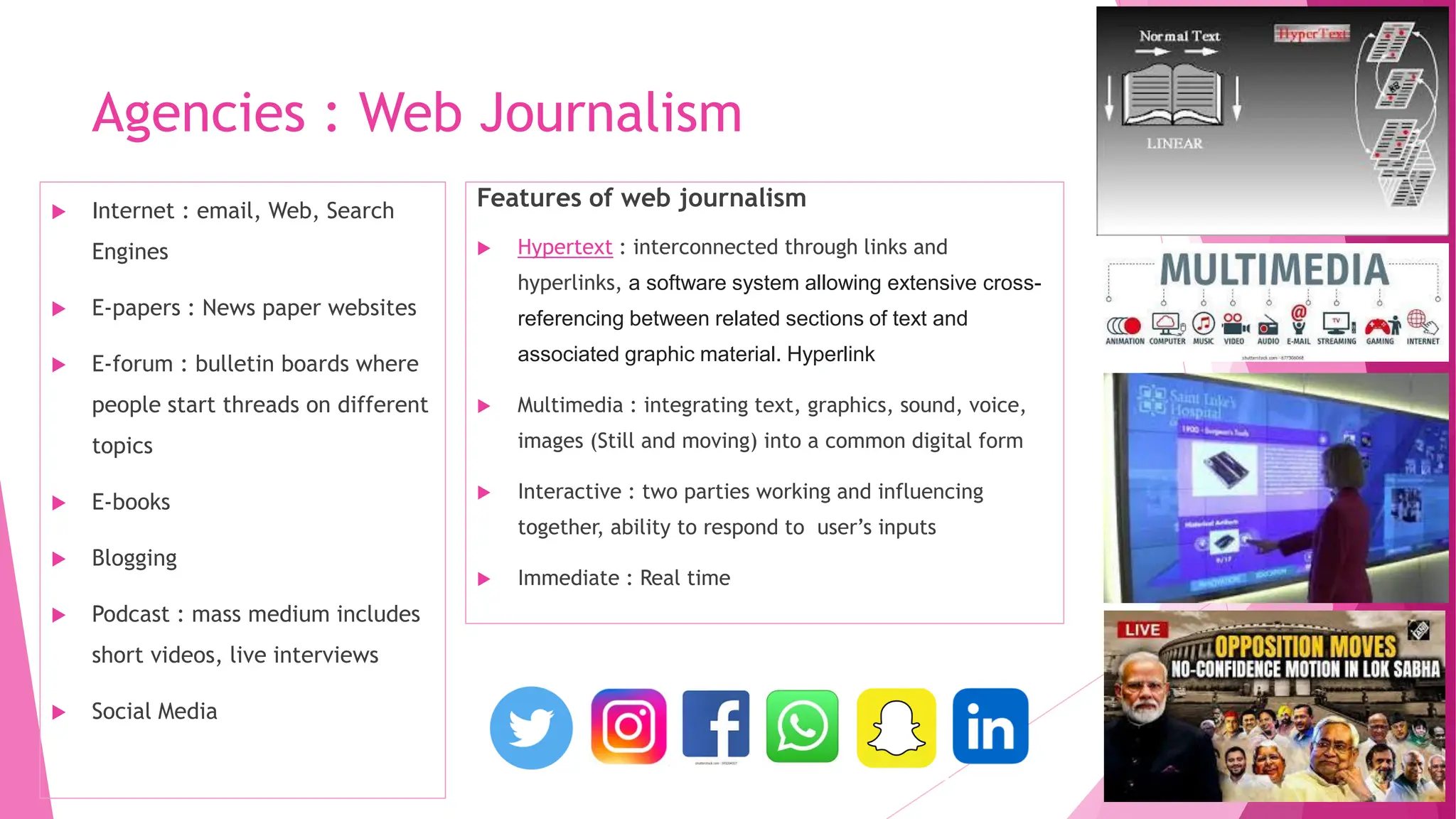
Agencies : Web Journalism
Features of web journalism
 Hypertext : interconnected through links and
hyperlinks, a software system allowing extensive cross-
referencing between related sections of text and
associated graphic material. Hyperlink
 Multimedia : integrating text, graphics, sound, voice,
images (Still and moving) into a common digital form
 Interactive : two parties working and influencing
together, ability to respond to user’s inputs
 Immediate : Real time
 Internet : email, Web, Search
Engines
 E-papers : News paper websites
 E-forum : bulletin boards where
people start threads on different
topics
 E-books
 Blogging
 Podcast : mass medium includes
short videos, live interviews
 Social Media
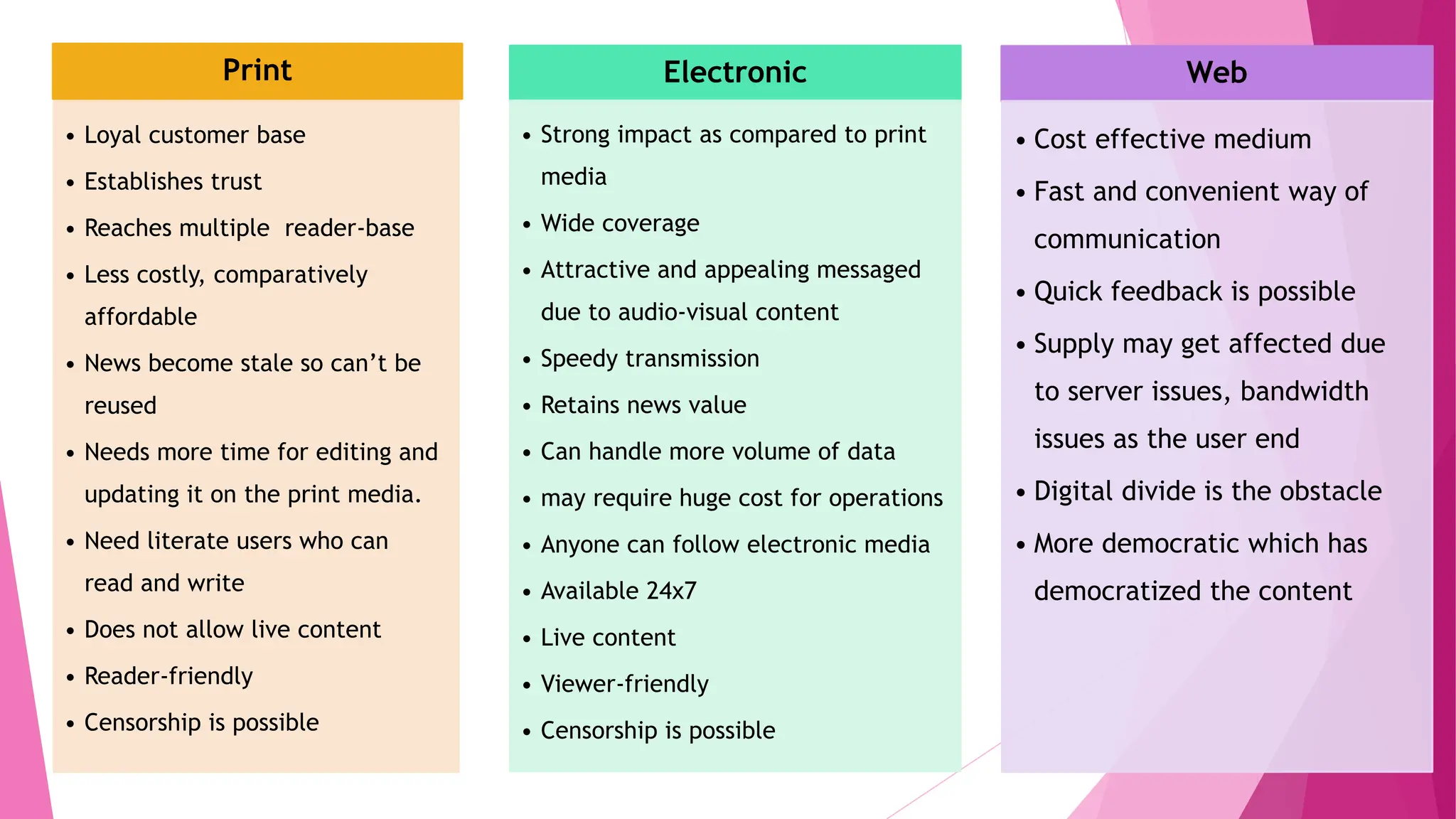
Print
• Loyal customer base
• Establishes trust
• Reaches multiple reader-base
• Less costly, comparatively
affordable
• News become stale so can’t be
reused
• Needs more time for editing and
updating it on the print media.
• Need literate users who can
read and write
• Does not allow live content
• Reader-friendly
• Censorship is possible
Electronic
• Strong impact as compared to print
media
• Wide coverage
• Attractive and appealing messaged
due to audio-visual content
• Speedy transmission
• Retains news value
• Can handle more volume of data
• may require huge cost for operations
• Anyone can follow electronic media
• Available 24x7
• Live content
• Viewer-friendly
• Censorship is possible
Web
• Cost effective medium
• Fast and convenient way of
communication
• Quick feedback is possible
• Supply may get affected due
to server issues, bandwidth
issues as the user end
• Digital divide is the obstacle
• More democratic which has
democratized the content
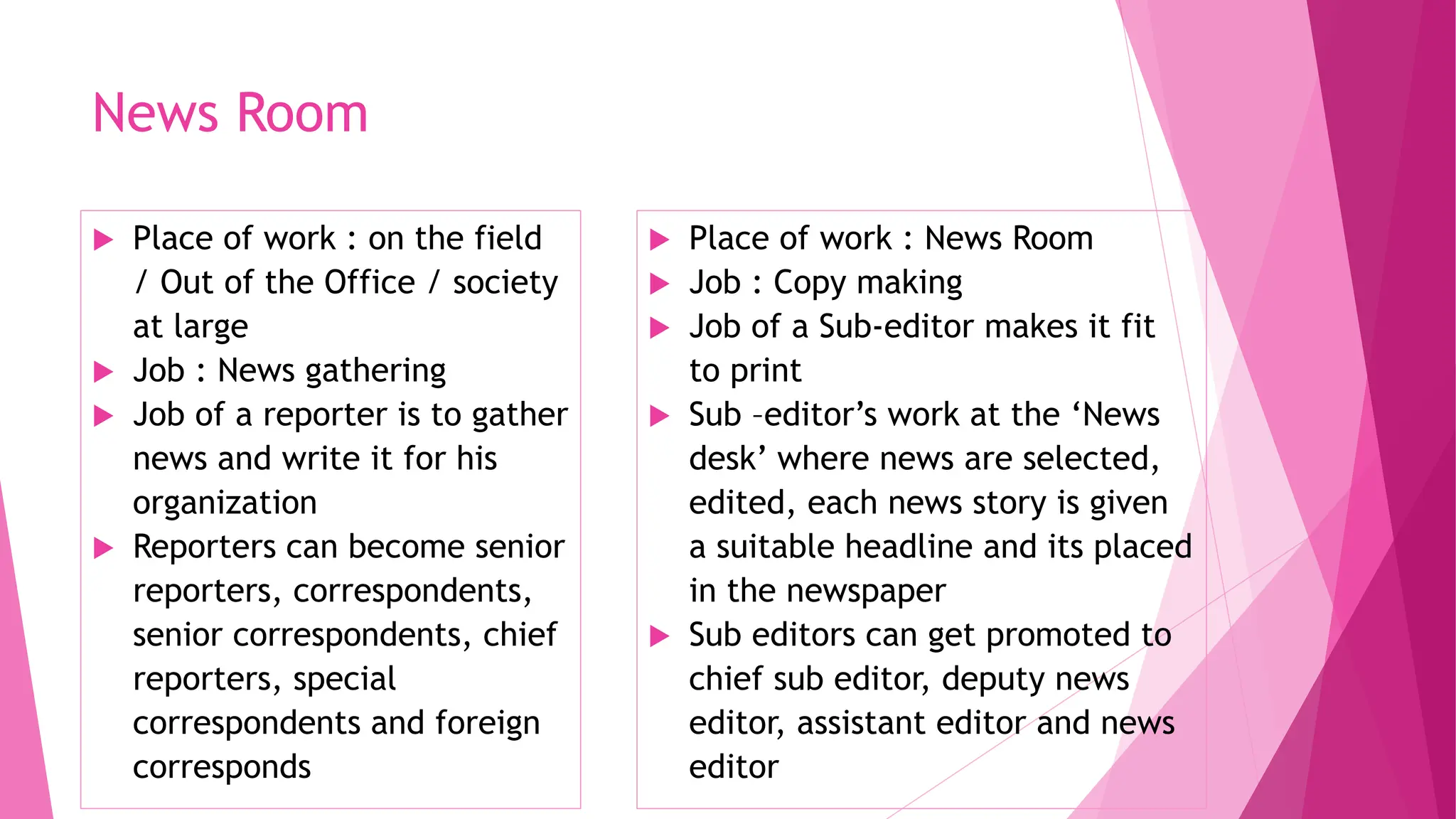
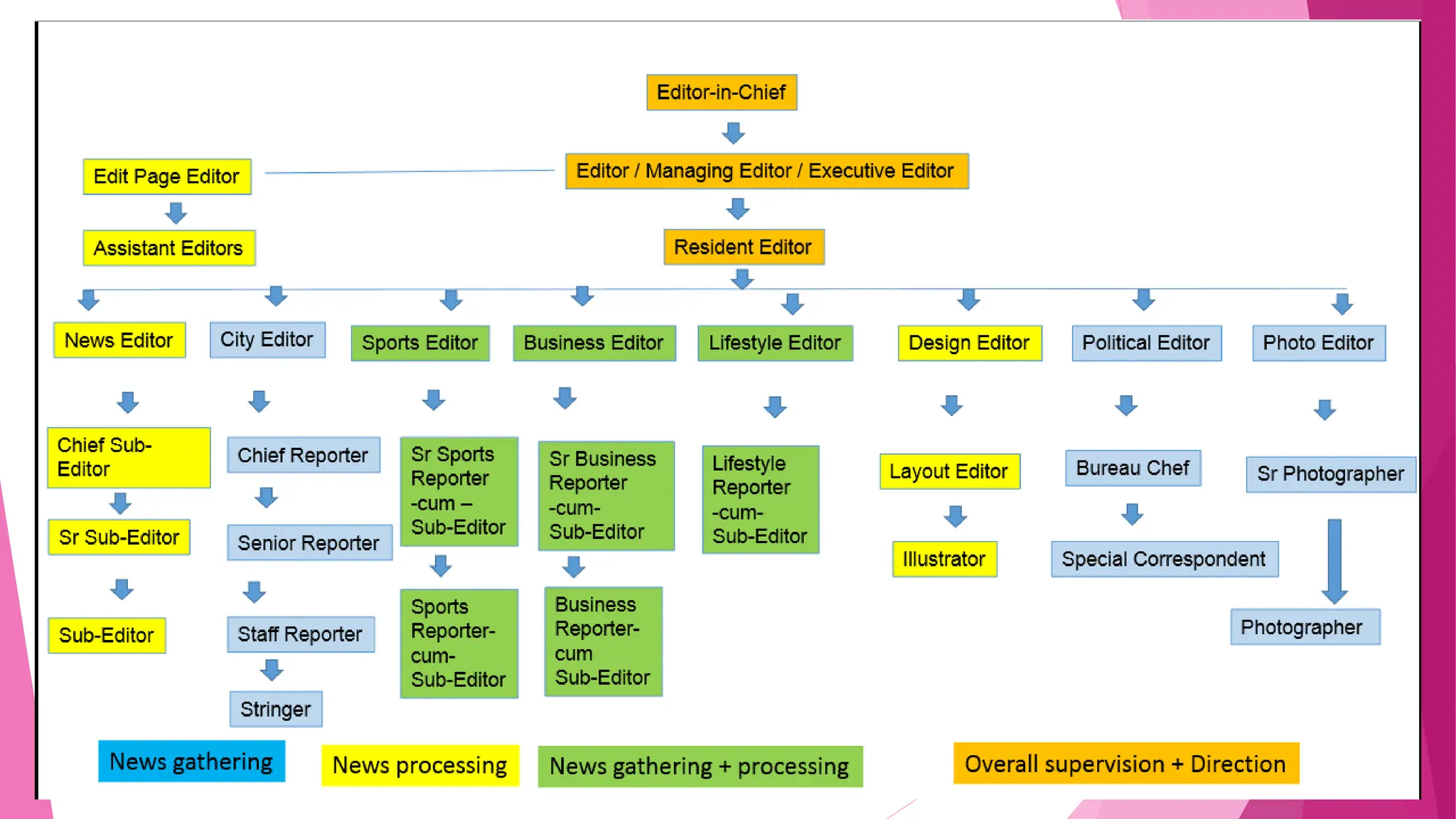
News Room
 Place of work : on the field
/ Out of the Office / society
at large
 Job : News gathering
 Job of a reporter is to gather
news and write it for his
organization
 Reporters can become senior
reporters, correspondents,
senior correspondents, chief
reporters, special
correspondents and foreign
corresponds
 Place of work : News Room
 Job : Copy making
 Job of a Sub-editor makes it fit
to print
 Sub –editor’s work at the ‘News
desk’ where news are selected,
edited, each news story is given
a suitable headline and its placed
in the newspaper
 Sub editors can get promoted to
chief sub editor, deputy news
editor, assistant editor and news
editor
Qualities required to be a journalist
 Curiosity
 Common sense
 News sense: to have news sense or nose for news to distinguish news from non-news. One should be able to
compare various news values and decide where to being his story and should not miss important details
 Imagination: helps to retain readers interest, headlines attract the reader and improve readership (Breaking
News-TRP)
 Alertness: Many major news breaks in the past were possible because of alertness of reporter. Scoops don’t
walk in to newspaper offices- alert reporters catch them in air and pursue
 Patience: voluntary self control or patience helps one to endure waiting, provocation, injustice, suffering or
any of the unpleasant incidence
 Farsightedness: An intelligent envisioning of the future helps news men in general. The quality helps them
identify processes and people who will be important in future. Reporters can watch such processes and
cultivate people who may become important news sources in the future
 Skepticism: necessary quality to cultivate. Not to accept anything at its face value
Behavioural
 Self Discipline: Self discipline suggests dedication and firm commitment
 Punctuality: It is a good habit so that the journalist does not miss something. Reaching late
makes you depend on secondary sources and ask others, competitor may hide some
important information
 Integrity: It is a virtue in itself and implies undeviating honesty and strict adherence to a
strong code of ethics. It is more important for a reporter for they are more exposed to
temptations
 Fearlessness and Frankness: Helps in taking risks to find out truths. Nobody gives a story on
a platter. To probe, question and exercise power of dedication to get a good story is essential
 Tactfulness: A reporter should be tactful, should have the ability to handle sensitive people
without creating unpleasant situations. One should be careful, not to upset or offend anyone
 Calmness: Reporter and sub editors often work in trying circumstances. They have to remain
calm and composed in most exciting and tragic circumstances. Should pply appropriate
mental and physical effort to write or edit a story
 Diligence: Reporter and sub-editors should be diligent. Their jobs require painstaking
exertion of intense care and effort, alertness and dedication to the task and very
watchfulness
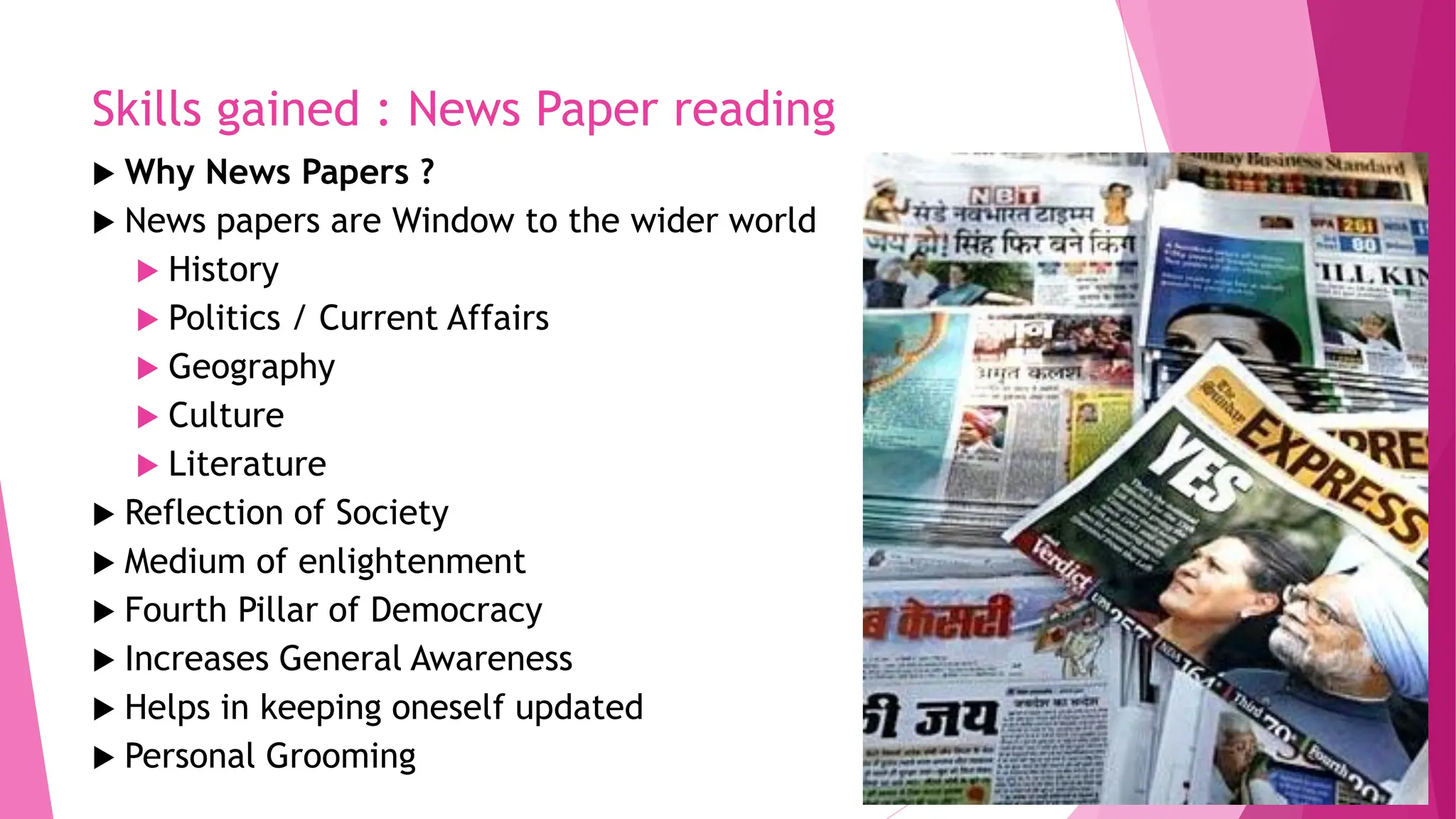
Skills gained : News Paper reading
 Why News Papers ?
 News papers are Window to the wider world
 History
 Politics / Current Affairs
 Geography
 Culture
 Literature
 Reflection of Society
 Medium of enlightenment
 Fourth Pillar of Democracy
 Increases General Awareness
 Helps in keeping oneself updated
 Personal Grooming
News Paper Reading
 News
First Page Headlines
National Politics
 International News
 National News
 State
 City
 Business & Economy
 Sports
 Supplements
 Cartoons
 Views
 Editorials
 Middles
 Opposite Edits
 Articles / Features
 Columns
 Advertisements
 Lifestyle
 Entertainment
News Paper Reading : a Habit
Cultivate the habit of reading one news
paper a day
Be bilingual : English and Marathi
Special Supplements
Scrap Book/ Diary / Clipping Book
Journalistic Writing
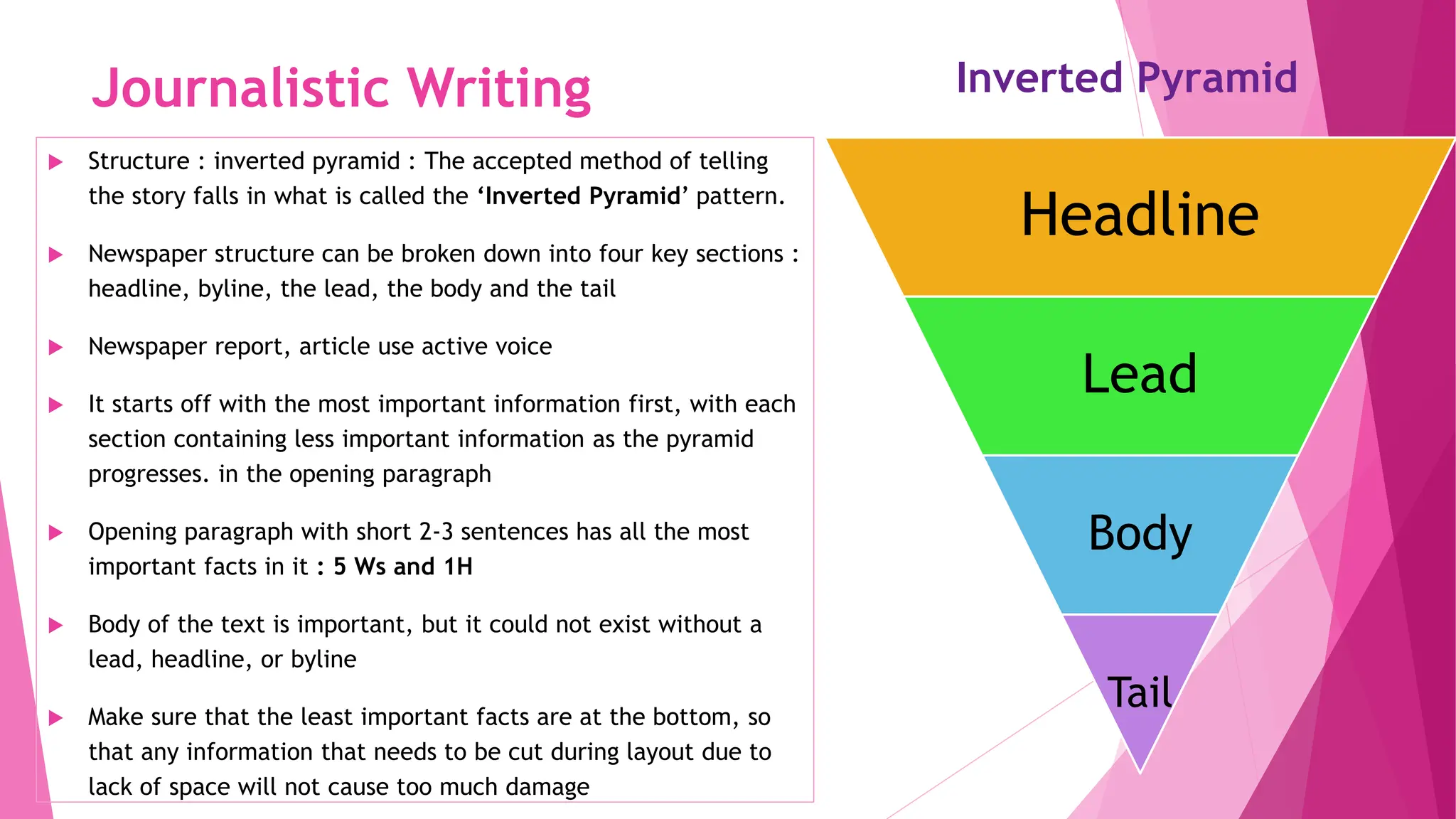
 Structure : inverted pyramid : The accepted method of telling
the story falls in what is called the ‘Inverted Pyramid’ pattern.
 Newspaper structure can be broken down into four key sections :
headline, byline, the lead, the body and the tail
 Newspaper report, article use active voice
 It starts off with the most important information first, with each
section containing less important information as the pyramid
progresses. in the opening paragraph
 Opening paragraph with short 2-3 sentences has all the most
important facts in it : 5 Ws and 1H
 Body of the text is important, but it could not exist without a
lead, headline, or byline
 Make sure that the least important facts are at the bottom, so
that any information that needs to be cut during layout due to
lack of space will not cause too much damage
Headline
Lead
Body
Tail
Inverted Pyramid
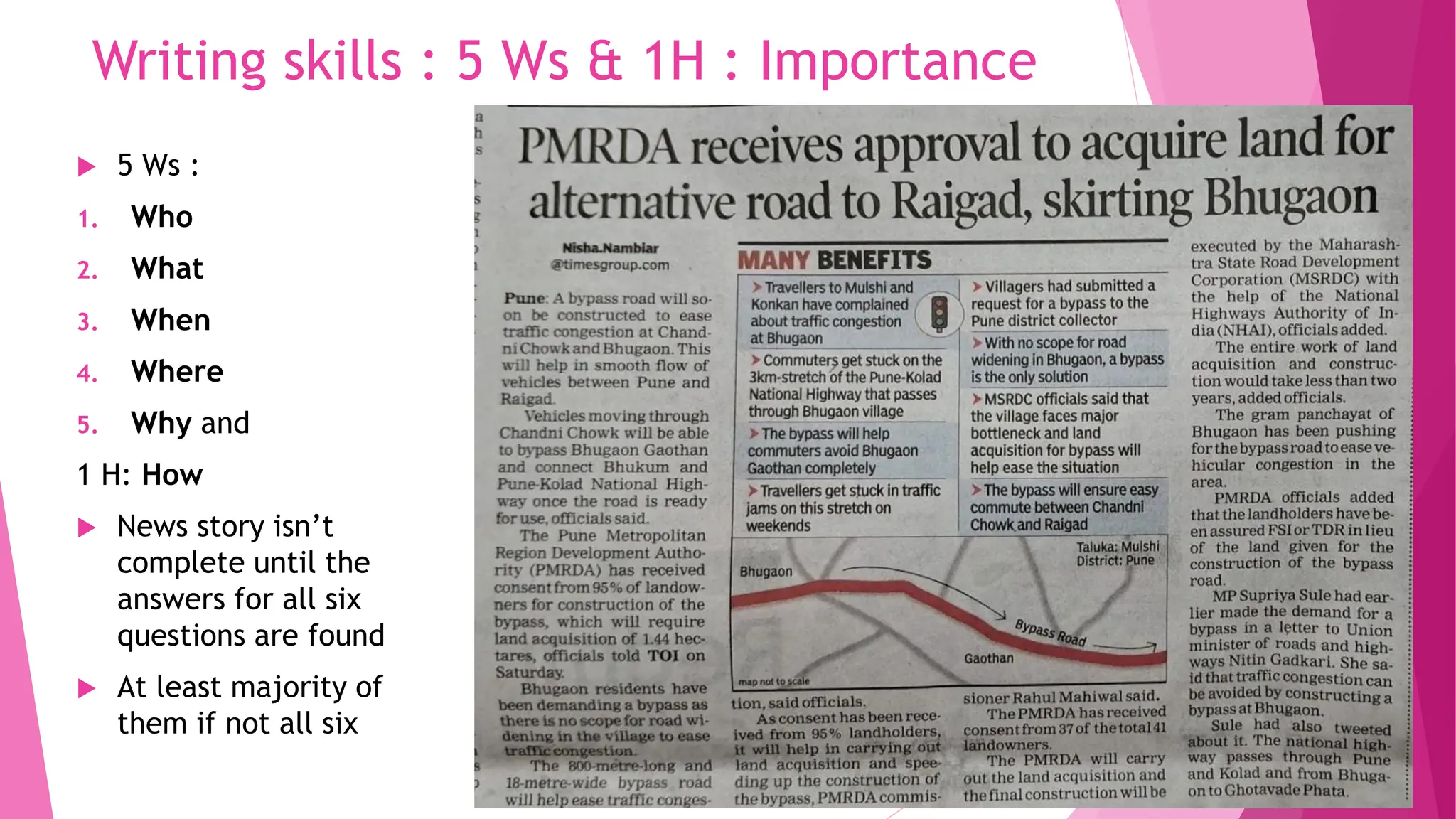
Writing skills : 5 Ws & 1H : Importance
 5 Ws :
1. Who
2. What
3. When
4. Where
5. Why and
1 H: How
 News story isn’t
complete until the
answers for all six
questions are found
 At least majority of
them if not all six
Headline
 Any news story that appears in a news paper consists on a superficial look of
three parts: the headline, the first paragraph usually set in bold and the
remainder of the story
 The headline is the first to attract the reader
 Giving an appropriate headline is an art itself
 Choosing the length and size of the headline is to make the first choice as to its
importance and relevance
 The headline’s message is terse, abrupt and often startling
 The whole idea is to make the reader stop and look. Headline seeks to hold
attention and compel the reader to read the story.
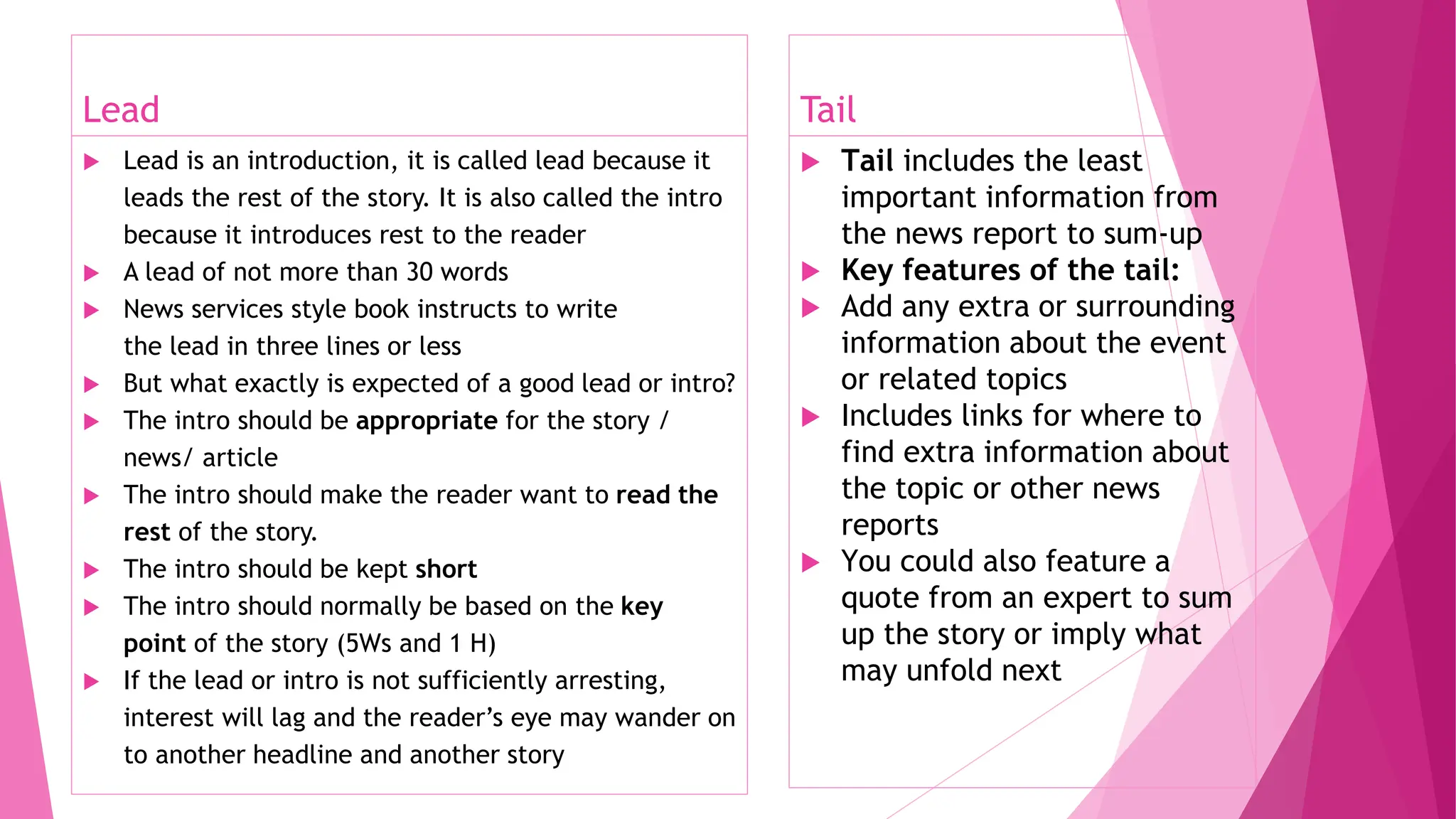
Lead
 Lead is an introduction, it is called lead because it
leads the rest of the story. It is also called the intro
because it introduces rest to the reader
 A lead of not more than 30 words
 News services style book instructs to write
the lead in three lines or less
 But what exactly is expected of a good lead or intro?
 The intro should be appropriate for the story /
news/ article
 The intro should make the reader want to read the
rest of the story.
 The intro should be kept short
 The intro should normally be based on the key
point of the story (5Ws and 1 H)
 If the lead or intro is not sufficiently arresting,
interest will lag and the reader’s eye may wander on
to another headline and another story
Tail
 Tail includes the least
important information from
the news report to sum-up
 Key features of the tail:
 Add any extra or surrounding
information about the event
or related topics
 Includes links for where to
find extra information about
the topic or other news
reports
 You could also feature a
quote from an expert to sum
up the story or imply what
may unfold next
Journalistic Writing Skills
 Command over language
 Clarity : clarity of mind and expression. A person who is confused cannot tell
a story to others
 Objectivity : Reporter and sub- editor should aim at objectivity while dealing
with a story. They should not allow their personal bias or ideas to creep in to
a story. They should not take side but try covering all the different viewpoints
to achieve balance in the story.
 Accuracy: check and recheck the facts, should not take any chance as
accuracy is directly proportional to the credibility of a reporter and the
newspaper / channel
 Speed: In today’s world speed matters everywhere. A person who cannot work
fast cannot be a good reporter. While maintaining all other desirable qualities
a reporter should strive to work faster. She/He should think fast, write fast
and write or type fast for he has to meet deadlines or may have to go to
another assignment.
Political Reporting
Elections : Festival of Democracy (Print) BBC coverage of Indian Elections (Electronic)
 Pre poll coverage, during the Campaign coverage : voter registration, duplication of voters,
malpractices, appeal by government, voter awareness, candidate nomination, show of
strength rallies, explaining manifesto of political parties, media briefs, press conferences,
interviews of candidates, party leaders
 Election days : photo opportunity, coverage of voting, new voters, malpractices if any,
 Post poll coverage, exit poll debates and discussions, opinion polls, counting and result
 Blogs on elections, political analysis by expert analysts
▪ Explaining events, issues, concerns, developments, debates, policy decisions
▪ Explanation is more important, showing cause and effect relations, impact of decisions
Need to know the Laws : Indian
Press Laws
 Press Council Act 1978
 Official Secret Act
 Defamation/ Libel/Slander
 Contempt of Court
 Censorship
 Infringement of IPR
 Copyright
 Creative Commons and Open Data
 Data Protection
 Hate speech/ Harassment /
Stalking
Freedom of Speech/ Expression
Criticism of the government
Good guide to news reporting
 Use short simple words
 Use more one-syllable words
 Use familiar words
 Use personal words
 Use concrete words
 Make every word work
 Avoid technical words
 Use full forms, don’t use acronyms
 Get rid of cliched phrases
 Use active voice
 Put sparkle and freshness into simple phrases
 Use short sentences as an aid to clear
thinking
 Makes sentences active
 Use short, simple paragraphs
 Use one idea paragraphs
 Write for a specific purpose
 Work with one basic idea
 The stress as will be quickly noted is
on simplicity, the short word, the
short sentence and the short
paragraph.
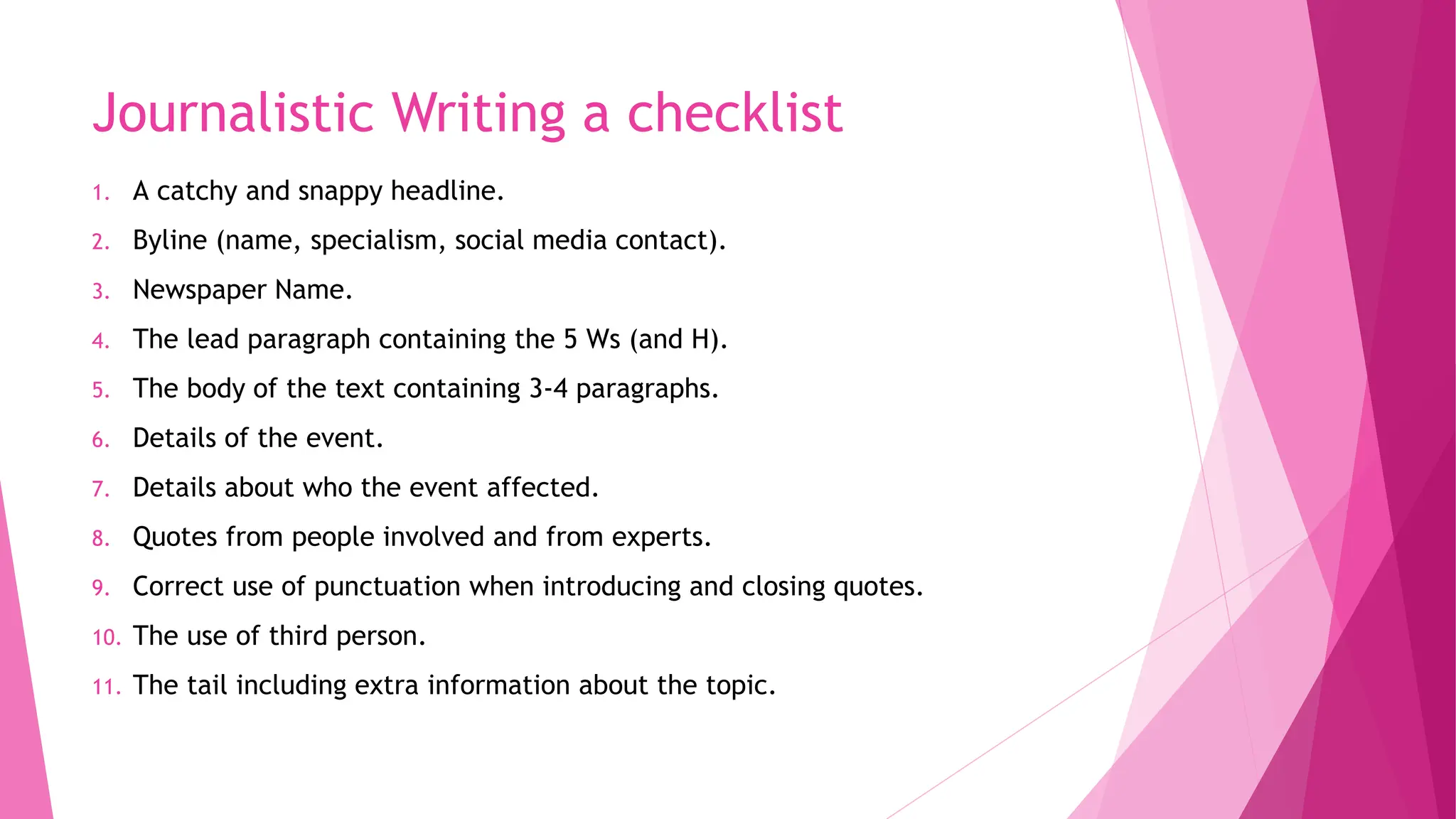
Journalistic Writing a checklist
1. A catchy and snappy headline.
2. Byline (name, specialism, social media contact).
3. Newspaper Name.
4. The lead paragraph containing the 5 Ws (and H).
5. The body of the text containing 3-4 paragraphs.
6. Details of the event.
7. Details about who the event affected.
8. Quotes from people involved and from experts.
9. Correct use of punctuation when introducing and closing quotes.
10. The use of third person.
11. The tail including extra information about the topic.
Readings
 1. Borhade Shekhar,2019, India & USA’s Strategic Dilemma in a Fractured World Order,
Ahmednagar, Suvarnshilp Publications
 2. Carey Jams W & Cates A., 2004, Journalism, West Port, London, Laibraries Unlimited
 3. Hacker, K and Van Djik J, 2000, Digital Democracy: Issues of Theory and Practice,
Thousand Oaks, Sage
 4. Sardesai Rajdeep, 2020,How Modi Won India, Noida, Harper Collins India
 5. R. Ramkrishnan, 1994, Press & Politics in an Indian State, Hyderabad, Delta Publishing
House
 6. Reese, S.D., Gandy, O.H. Grant, A.E., 2001, Framing Public Life – Perspectives on
Media and Our Understanding of the Social World, LEA, Mahwah.
 7. Roy Barun, 2001, Beginners Guide to Journalism, Mumbai, PustakMahal
 8. Trent, J.S. &Friedenburg R. V., 1995, Political Campaign Communication, Westport,
Praeger
References
 https://www.britannica.com/topic/journalism
 http://ecoursesonline.iasri.res.in/mod/page/view.php?id=32969

Introduction to Journalism and Journalistic Writing.pdf

  • 1.
  • 2.
    Objectives To acquaint the studentswith the world of journalism Learning Outcomes  To understand area of journalism in general and political journalism in particular  To articulate political news and views  To compare and create differentiated content for print and electronic media
  • 3.
    One India OnePeople Foundation
  • 4.
    Knowledge gained :Journalism  What is Journalism ?  Journalism is a process of collection, preparation and distribution of news and related commentary and feature materials through print and electronic media  NEWS : North + East + West + South  Journalism is about news and views  Satisfying human curiosity  Creation and dissemination of reports about current affairs, human iterests  Print and electronic media : Newspapers, magazines, books, blogs, webcasts, podcasts, social networking and social media sites, and e-mail as well as through radio, motion pictures, and television  Periodicity of a journal : daily, weekly, fortnightly, monthly, bimonthly, quarterly, half yearly, annual
  • 5.
    Introduction  The wordjournalism was originally applied to the reportage of current events in printed form, specifically newspapers  With the advent of radio, television, and the Internet in the 20th century the use of the term broadened to include all printed and electronic communication dealing with current affairs  Purpose of journalism : to research and report events that impact people’s lives and society at a large in different ways  Occupation for those  having inquisitive mind  like to converse, communicate and interview influential personalities and leaders  Attend and cover events  Are fond of writing, editing, reporting  Doing photography  And like to broadcast, disseminate, make it public, communicate
  • 6.
    Role of Journalism The role of journalism is to provide people with up-to-date information on politics  Journalism is a powerful tool for informing the public about politicians’ actions  Political journalism constitutes one of the most prominent domains of journalism  Generates awareness and formulate public opinion  It can help make politicians accountable and show voters who they should vote for in elections  As an instrument of the state, journalism must be impartial and objective  Essential for the functioning of democracy  Political journalism should function as an information provider, watchdog, and forum for political discussions, thereby helping citizens understand political matters and help prevent abuse of power
  • 7.
    Nature of Journalism Journalism as a profession and as a mission  Shares a close, interdependent, contentious relationship with political actors, shaping both the processes and the content of political journalism  Journalism has as its main activity the reporting of events stating who, what, where, why and how  Journalism is the timely reporting of events at the local, provincial, national and international levels.  Reporting involves the gathering of information and publishing/broadcasting a fair and balanced story  Journalism is not just fact-finding media analysis opinion writing or commentary although all of those aspects can play a part at times but is concerned with the dissemination of news and views about the society  Journalism has become the media of mass education by educating general masses  Journalism has widened and it has transcended the limits of mere reporting  Journalism is broadly categorized into media based and content based journalism
  • 8.
    Media-based journalism  Printjournalism : includes writing and publishing for newspapers, magazines, newsletters, private publications, online news pages and others  Electronic / Broadcast journalism : includes broadcasting for both radio and television. Television journalists rely on visual information to illustrate and characterize their reporting, including on-camera interviews with people involved in the story  On-line journalism : Fast and vast growth of internet and World Wide Web has spawned the newest medium for journalism, on-line journalism  Blogs  Podcast  Live and real time
  • 9.
    Content based  Featurejournalism: Newspapers and periodicals often contain features written by journalists, Deep journalism  Area-specific : Political, Social, Economic, Cultural  Sports journalism: covers many aspects of human athletic competition, and is an integral part of most journalism products, including newspapers, magazines, and radio and television news broadcasts.  Science journalism: Science journalism is a relatively new branch of journalism, in which journalists reporting conveys information on science topics to the public.  Investigative journalism: Investigative journalism, in which journalists investigative and expose unethical, immoral and illegal behavior by individual, business and government agencies, can be complicated, time- consuming and expensive-requiring teams of journalists, months of research, interviews (sometimes repeated interviews) with numerous people, long-distance travel, computers to analyze public-record databases, or use of the company’s legal staff to secure documents under freedom of information laws.  People journalism or celebrity: Celebrity journalism differs from feature writing in that it focuses on people who are either already famous or are especially attractive. Journalists who follow celebrities constantly to obtain potentially embarrassing photographs, have come to characterize celebrity journalism  Paparazzi : often covers celebrities obsessively unethically in order to provide coverage
  • 10.
    Scope of journalism Vertical : News from International, National, State level and local level  Horizontal :  Press Conferences of Governments, Opposition Parties, Leaders, Whistle blowers  Policy decisions  Movements and agitations  Interests of common man, disadvantageous and underprivileged groups  Collective /Public goods : Health, Education  Law-making, reporting from Parliament, State legislatures  Electoral Politics, Elections, Rallies, Exit Polls  International Relations  Judicial verdicts, court hearings
  • 11.
    Types of Journalism Political Journalism  Opinion Journalism  Investigative Journalism  Watchdog Journalism  Business and Trade Journalism (Pink Papers : Economic Times/ Financial Express)  Entertainment / Infotainment Journalism  Online Journalism / Web Journalism  Broadcast Journalism
  • 12.
    What is PoliticalJournalism ? Meaning  Political journalism is the branch of professional journalism that deals with coverage and analysis of political events, issues, campaigns, etc.  Political journalism is a media occupation that gathers, reports and analyzes information about government and politics  Political journalism is the practice of gathering, assessing, and disseminating information  about current events in politics  news about government and politics  covers political decisions, campaigns, and news  often focuses on political figures, parties, candidates, elections, and policies.  The term also refers to an editorial or opinion column that expresses a political view  It is also called as ‘political reporting’ and is a part of ‘political communication’
  • 13.
    Political Journalism :Definition  Britannica : Journalism, the collection, preparation, and distribution of news and related commentary and feature materials through such print and electronic media as newspapers, magazines, books, blogs, webcasts, podcasts, social networking and social media sites, and e-mail as well as through radio, motion pictures, and television.  Political journalism is the systematic collection, evaluation, and presentation of news about government and politics  Political journalism is a type of journalism that includes covering of different elements of politics, political practices, political processes and political values  Political journalism offers the citizenry opportunities to be informed of current political issues, provides a link between the rulers and the ruled, government and the electorate
  • 14.
    Principles for Journalismwriting : Knowledge  Journalism's first obligation is to the truth  Its first loyalty is to citizens  Its essence is a discipline of verification  Its practitioners must maintain an independence from those they cover  It must serve as an independent monitor of power  It must provide a forum for public criticism and compromise  It must strive to make the significant interesting and relevant  It must keep the news comprehensive and proportional  Its practitioners must be allowed to exercise their personal conscience  Protecting confidentiality of the source is important  Practicing ethics and following a code of conduct  Beware of fake news, don’t indulge into paid news
  • 15.
    History of PoliticalJournalism (Self Study)  Role of mass media especially news papers in pre-independence era  National Media  Regional / Vernacular Media  Mass awareness and awakening through news papers  Self Study  Case of Study of Bal Shastri Jambhekar, Jotirao Phule, Lokmanya Tilak and Agarkar, Mahatma Gandhi, Dr. Ambedkar and their efforts
  • 16.
    Title Lorem IpsumDolor 1 Pre Independence : by other than Indian 2 Pre Independence : by Indians themselves 3 Post Independence 4 Contemporary after advent of Information Technology 5 Citizen Journalism Evolution / Development of Political Journalism
  • 17.
    Agencies : PrintMedia  It is a form of mass media in which it shares the news or concerning pieces of information via the printed form of publications  Print media is the oldest means by which people still share information across an entire group of audiences  It only publishes info in a printed form (hard copy) and then releases it to its users to make it more reader-friendly than the electronic media.  Some very popular types of print media include books, magazines, newspapers, etc.  No live reporting, live discussion, or live show is possible with the print media. It follows the methodology of an interval update.
  • 18.
    Agencies : Print Traditional media to reach to target audience  a vehicle for carrying advertisements (National, local and classifieds)  Newspapers  Types : Broadsheet, Tabloid  Wide Coverage, low cost, more credibility, authenticity, restricted to a particular region/geography  Magazines  Business Magazines, House Magazines, Special Interest and Consumer  Research Journals  Periodicals depending on frequency
  • 19.
    Electronic Media  Itis a form of mass media that shares news or any other pieces of information via an electronic medium to all of the viewers and audiences.  Electronic media serves as a very advanced means of sharing data and info/ news.  In this type of media, the publisher needs to upload the information (or broadcast it)- after which any user can easily view it through their electronic mediums (devices).  It acts more user-friendly than print media.  Some of the most popular types of electronic media include mobile app news, television news, desktop streams, and many more.  Electronic media makes it possible for its users to hold live discussions, live updates, live reporting, etc.  It is because this media makes use of a method of an immediate update.
  • 20.
    Agencies : Electronic Radio  Television  Film / Documentaries  Audio-visual media  Most persuasive media having strong impact  Can enable demonstration of the event  Can provide wide coverage  attractive and appealing messages
  • 21.
    Agencies : WebJournalism Features of web journalism  Hypertext : interconnected through links and hyperlinks, a software system allowing extensive cross- referencing between related sections of text and associated graphic material. Hyperlink  Multimedia : integrating text, graphics, sound, voice, images (Still and moving) into a common digital form  Interactive : two parties working and influencing together, ability to respond to user’s inputs  Immediate : Real time  Internet : email, Web, Search Engines  E-papers : News paper websites  E-forum : bulletin boards where people start threads on different topics  E-books  Blogging  Podcast : mass medium includes short videos, live interviews  Social Media
  • 22.
    Print • Loyal customerbase • Establishes trust • Reaches multiple reader-base • Less costly, comparatively affordable • News become stale so can’t be reused • Needs more time for editing and updating it on the print media. • Need literate users who can read and write • Does not allow live content • Reader-friendly • Censorship is possible Electronic • Strong impact as compared to print media • Wide coverage • Attractive and appealing messaged due to audio-visual content • Speedy transmission • Retains news value • Can handle more volume of data • may require huge cost for operations • Anyone can follow electronic media • Available 24x7 • Live content • Viewer-friendly • Censorship is possible Web • Cost effective medium • Fast and convenient way of communication • Quick feedback is possible • Supply may get affected due to server issues, bandwidth issues as the user end • Digital divide is the obstacle • More democratic which has democratized the content
  • 23.
    News Room  Placeof work : on the field / Out of the Office / society at large  Job : News gathering  Job of a reporter is to gather news and write it for his organization  Reporters can become senior reporters, correspondents, senior correspondents, chief reporters, special correspondents and foreign corresponds  Place of work : News Room  Job : Copy making  Job of a Sub-editor makes it fit to print  Sub –editor’s work at the ‘News desk’ where news are selected, edited, each news story is given a suitable headline and its placed in the newspaper  Sub editors can get promoted to chief sub editor, deputy news editor, assistant editor and news editor
  • 25.
    Qualities required tobe a journalist  Curiosity  Common sense  News sense: to have news sense or nose for news to distinguish news from non-news. One should be able to compare various news values and decide where to being his story and should not miss important details  Imagination: helps to retain readers interest, headlines attract the reader and improve readership (Breaking News-TRP)  Alertness: Many major news breaks in the past were possible because of alertness of reporter. Scoops don’t walk in to newspaper offices- alert reporters catch them in air and pursue  Patience: voluntary self control or patience helps one to endure waiting, provocation, injustice, suffering or any of the unpleasant incidence  Farsightedness: An intelligent envisioning of the future helps news men in general. The quality helps them identify processes and people who will be important in future. Reporters can watch such processes and cultivate people who may become important news sources in the future  Skepticism: necessary quality to cultivate. Not to accept anything at its face value
  • 26.
    Behavioural  Self Discipline:Self discipline suggests dedication and firm commitment  Punctuality: It is a good habit so that the journalist does not miss something. Reaching late makes you depend on secondary sources and ask others, competitor may hide some important information  Integrity: It is a virtue in itself and implies undeviating honesty and strict adherence to a strong code of ethics. It is more important for a reporter for they are more exposed to temptations  Fearlessness and Frankness: Helps in taking risks to find out truths. Nobody gives a story on a platter. To probe, question and exercise power of dedication to get a good story is essential  Tactfulness: A reporter should be tactful, should have the ability to handle sensitive people without creating unpleasant situations. One should be careful, not to upset or offend anyone  Calmness: Reporter and sub editors often work in trying circumstances. They have to remain calm and composed in most exciting and tragic circumstances. Should pply appropriate mental and physical effort to write or edit a story  Diligence: Reporter and sub-editors should be diligent. Their jobs require painstaking exertion of intense care and effort, alertness and dedication to the task and very watchfulness
  • 27.
    Skills gained :News Paper reading  Why News Papers ?  News papers are Window to the wider world  History  Politics / Current Affairs  Geography  Culture  Literature  Reflection of Society  Medium of enlightenment  Fourth Pillar of Democracy  Increases General Awareness  Helps in keeping oneself updated  Personal Grooming
  • 28.
    News Paper Reading News First Page Headlines National Politics  International News  National News  State  City  Business & Economy  Sports  Supplements  Cartoons  Views  Editorials  Middles  Opposite Edits  Articles / Features  Columns  Advertisements  Lifestyle  Entertainment
  • 29.
    News Paper Reading: a Habit Cultivate the habit of reading one news paper a day Be bilingual : English and Marathi Special Supplements Scrap Book/ Diary / Clipping Book
  • 30.
    Journalistic Writing  Structure: inverted pyramid : The accepted method of telling the story falls in what is called the ‘Inverted Pyramid’ pattern.  Newspaper structure can be broken down into four key sections : headline, byline, the lead, the body and the tail  Newspaper report, article use active voice  It starts off with the most important information first, with each section containing less important information as the pyramid progresses. in the opening paragraph  Opening paragraph with short 2-3 sentences has all the most important facts in it : 5 Ws and 1H  Body of the text is important, but it could not exist without a lead, headline, or byline  Make sure that the least important facts are at the bottom, so that any information that needs to be cut during layout due to lack of space will not cause too much damage Headline Lead Body Tail Inverted Pyramid
  • 31.
    Writing skills :5 Ws & 1H : Importance  5 Ws : 1. Who 2. What 3. When 4. Where 5. Why and 1 H: How  News story isn’t complete until the answers for all six questions are found  At least majority of them if not all six
  • 32.
    Headline  Any newsstory that appears in a news paper consists on a superficial look of three parts: the headline, the first paragraph usually set in bold and the remainder of the story  The headline is the first to attract the reader  Giving an appropriate headline is an art itself  Choosing the length and size of the headline is to make the first choice as to its importance and relevance  The headline’s message is terse, abrupt and often startling  The whole idea is to make the reader stop and look. Headline seeks to hold attention and compel the reader to read the story.
  • 33.
    Lead  Lead isan introduction, it is called lead because it leads the rest of the story. It is also called the intro because it introduces rest to the reader  A lead of not more than 30 words  News services style book instructs to write the lead in three lines or less  But what exactly is expected of a good lead or intro?  The intro should be appropriate for the story / news/ article  The intro should make the reader want to read the rest of the story.  The intro should be kept short  The intro should normally be based on the key point of the story (5Ws and 1 H)  If the lead or intro is not sufficiently arresting, interest will lag and the reader’s eye may wander on to another headline and another story Tail  Tail includes the least important information from the news report to sum-up  Key features of the tail:  Add any extra or surrounding information about the event or related topics  Includes links for where to find extra information about the topic or other news reports  You could also feature a quote from an expert to sum up the story or imply what may unfold next
  • 34.
    Journalistic Writing Skills Command over language  Clarity : clarity of mind and expression. A person who is confused cannot tell a story to others  Objectivity : Reporter and sub- editor should aim at objectivity while dealing with a story. They should not allow their personal bias or ideas to creep in to a story. They should not take side but try covering all the different viewpoints to achieve balance in the story.  Accuracy: check and recheck the facts, should not take any chance as accuracy is directly proportional to the credibility of a reporter and the newspaper / channel  Speed: In today’s world speed matters everywhere. A person who cannot work fast cannot be a good reporter. While maintaining all other desirable qualities a reporter should strive to work faster. She/He should think fast, write fast and write or type fast for he has to meet deadlines or may have to go to another assignment.
  • 35.
    Political Reporting Elections :Festival of Democracy (Print) BBC coverage of Indian Elections (Electronic)  Pre poll coverage, during the Campaign coverage : voter registration, duplication of voters, malpractices, appeal by government, voter awareness, candidate nomination, show of strength rallies, explaining manifesto of political parties, media briefs, press conferences, interviews of candidates, party leaders  Election days : photo opportunity, coverage of voting, new voters, malpractices if any,  Post poll coverage, exit poll debates and discussions, opinion polls, counting and result  Blogs on elections, political analysis by expert analysts ▪ Explaining events, issues, concerns, developments, debates, policy decisions ▪ Explanation is more important, showing cause and effect relations, impact of decisions
  • 36.
    Need to knowthe Laws : Indian Press Laws  Press Council Act 1978  Official Secret Act  Defamation/ Libel/Slander  Contempt of Court  Censorship  Infringement of IPR  Copyright  Creative Commons and Open Data  Data Protection  Hate speech/ Harassment / Stalking Freedom of Speech/ Expression Criticism of the government
  • 37.
    Good guide tonews reporting  Use short simple words  Use more one-syllable words  Use familiar words  Use personal words  Use concrete words  Make every word work  Avoid technical words  Use full forms, don’t use acronyms  Get rid of cliched phrases  Use active voice  Put sparkle and freshness into simple phrases  Use short sentences as an aid to clear thinking  Makes sentences active  Use short, simple paragraphs  Use one idea paragraphs  Write for a specific purpose  Work with one basic idea  The stress as will be quickly noted is on simplicity, the short word, the short sentence and the short paragraph.
  • 38.
    Journalistic Writing achecklist 1. A catchy and snappy headline. 2. Byline (name, specialism, social media contact). 3. Newspaper Name. 4. The lead paragraph containing the 5 Ws (and H). 5. The body of the text containing 3-4 paragraphs. 6. Details of the event. 7. Details about who the event affected. 8. Quotes from people involved and from experts. 9. Correct use of punctuation when introducing and closing quotes. 10. The use of third person. 11. The tail including extra information about the topic.
  • 39.
    Readings  1. BorhadeShekhar,2019, India & USA’s Strategic Dilemma in a Fractured World Order, Ahmednagar, Suvarnshilp Publications  2. Carey Jams W & Cates A., 2004, Journalism, West Port, London, Laibraries Unlimited  3. Hacker, K and Van Djik J, 2000, Digital Democracy: Issues of Theory and Practice, Thousand Oaks, Sage  4. Sardesai Rajdeep, 2020,How Modi Won India, Noida, Harper Collins India  5. R. Ramkrishnan, 1994, Press & Politics in an Indian State, Hyderabad, Delta Publishing House  6. Reese, S.D., Gandy, O.H. Grant, A.E., 2001, Framing Public Life – Perspectives on Media and Our Understanding of the Social World, LEA, Mahwah.  7. Roy Barun, 2001, Beginners Guide to Journalism, Mumbai, PustakMahal  8. Trent, J.S. &Friedenburg R. V., 1995, Political Campaign Communication, Westport, Praeger
  • 40.