BY ANTONIO DANIEL NII MARTEY
Foxiest45.da@gmail.com
WHAT IS CULTURE MEDIA?
The food material or substances required for growing microorganisms in vitro (outside the
body) is called culture medium.
USES OF CULTURE MEDIUM
It is important to grow microorganisms outside the body for the following purposes:
 To identify the cause of infection from the clinical sample, so that proper treatment can be
given.
 To study the characteristics or properties of microorganisms.
To prepare biological products like vaccines, toxoids, antigens
Composition of culture media
• water
• energy source
• carbon source
• nitrogen source
• mineral salts
• special growth factors
TYPES OF CULTURE MEDIA
I. Classification based on physical state
a) solid medium
b) semi solid medium
c) liquid medium
II. Classification based on the ingredients
a) simple medium
b) complex medium
c) synthetic or defined medium
d) special media
MICROBIOLOGY MEDIA PREPARATION
Materials and equipment required for media preparation
Media agar powder
Measuring cylinder
Beaker
500ml Duran Bottle/ Conical flask
Distilled or deionized water
Masking tape
Autoclave
Weighing balance
Petri dish
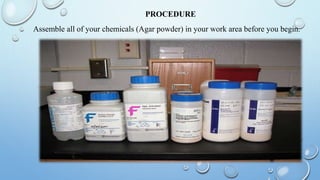
PROCEDURE
Assemble all of your chemicals (Agar powder) in your work area before you begin.
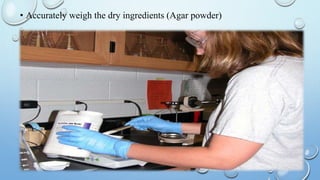
• Accurately weigh the dry ingredients (Agar powder)
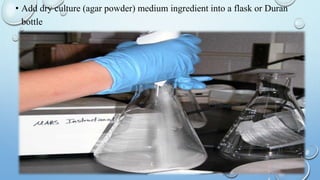
• Add dry culture (agar powder) medium ingredient into a flask or Duran
bottle
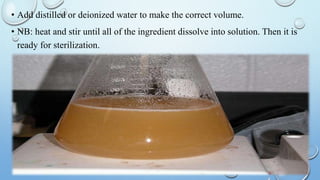
• Add distilled or deionized water to make the correct volume.
• NB: heat and stir until all of the ingredient dissolve into solution. Then it is
ready for sterilization.
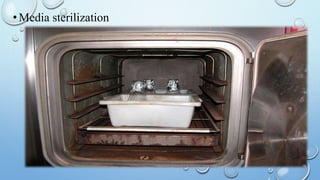
•Media sterilization
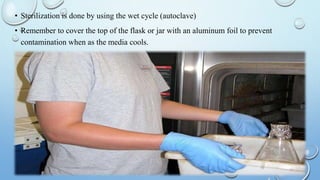
• Sterilization is done by using the wet cycle (autoclave)
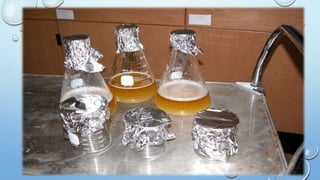
• Remember to cover the top of the flask or jar with an aluminum foil to prevent
contamination when as the media cools.
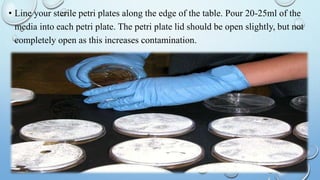
• Line your sterile petri plates along the edge of the table. Pour 20-25ml of the
media into each petri plate. The petri plate lid should be open slightly, but not
completely open as this increases contamination.
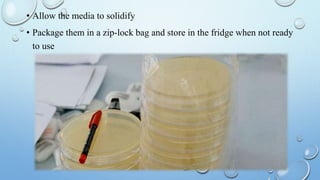
• Allow the media to solidify
• Package them in a zip-lock bag and store in the fridge when not ready
to use
Nutrient agar media is a general purpose nutritional media, which is used for
cultivation of microorganisms by supporting the growth of a broad range of non-
fastidious organisms
Composition
 0.5% peptone
 0.3% beef extract/yeast extract
 1.5% agar
 0.5% NaCl
 Distilled water
 pH neutral (7.4) at 25 °C.
USES OF NUTRIENT AGAR
1. It is commonly used for isolation and purification of microbial
culture colonies.
2. It is also used for producing the bacterial lawns/ carpets for
antibiotic susceptibility tests.
3. Also used for purity checking before susceptibility testing and
biochemical reactions testing.
4. Used to solve teaching or demonstrative purposes, where
prolonged growth and ambient temperature with nutrients is
required.
Mueller Hinton Agar: Disc diffusion sensitivity tests for antimicrobial drugs should be
carried out on this media as per WHO recommendation to promote reproducibility and
comparability of results.
COMPOSITION
 Casein peptone H 17.5 gms
Starch 1.5 gms
pH 7.4 + 0.2
Agar 17.0 gms
Beef infusion 3.0 gms
Distilled water 1000 ml
USES OF MULLER HINTON AGAR
For cultivation of Neisseria and Moraxella spp.
For antimicrobial susceptibility testing of bacteria and
yeast.

Media preparation

  • 1.
    BY ANTONIO DANIELNII MARTEY Foxiest45.da@gmail.com
  • 2.
    WHAT IS CULTUREMEDIA? The food material or substances required for growing microorganisms in vitro (outside the body) is called culture medium. USES OF CULTURE MEDIUM It is important to grow microorganisms outside the body for the following purposes:  To identify the cause of infection from the clinical sample, so that proper treatment can be given.  To study the characteristics or properties of microorganisms. To prepare biological products like vaccines, toxoids, antigens
  • 3.
    Composition of culturemedia • water • energy source • carbon source • nitrogen source • mineral salts • special growth factors
  • 4.
    TYPES OF CULTUREMEDIA I. Classification based on physical state a) solid medium b) semi solid medium c) liquid medium II. Classification based on the ingredients a) simple medium b) complex medium c) synthetic or defined medium d) special media
  • 5.
    MICROBIOLOGY MEDIA PREPARATION Materialsand equipment required for media preparation Media agar powder Measuring cylinder Beaker 500ml Duran Bottle/ Conical flask Distilled or deionized water Masking tape Autoclave Weighing balance Petri dish
  • 6.
    PROCEDURE Assemble all ofyour chemicals (Agar powder) in your work area before you begin.
  • 7.
    • Accurately weighthe dry ingredients (Agar powder)
  • 8.
    • Add dryculture (agar powder) medium ingredient into a flask or Duran bottle
  • 9.
    • Add distilledor deionized water to make the correct volume. • NB: heat and stir until all of the ingredient dissolve into solution. Then it is ready for sterilization.
  • 11.
  • 12.
    • Sterilization isdone by using the wet cycle (autoclave) • Remember to cover the top of the flask or jar with an aluminum foil to prevent contamination when as the media cools.
  • 13.
    • Line yoursterile petri plates along the edge of the table. Pour 20-25ml of the media into each petri plate. The petri plate lid should be open slightly, but not completely open as this increases contamination.
  • 14.
    • Allow themedia to solidify • Package them in a zip-lock bag and store in the fridge when not ready to use
  • 15.
    Nutrient agar mediais a general purpose nutritional media, which is used for cultivation of microorganisms by supporting the growth of a broad range of non- fastidious organisms Composition  0.5% peptone  0.3% beef extract/yeast extract  1.5% agar  0.5% NaCl  Distilled water  pH neutral (7.4) at 25 °C.
  • 16.
    USES OF NUTRIENTAGAR 1. It is commonly used for isolation and purification of microbial culture colonies. 2. It is also used for producing the bacterial lawns/ carpets for antibiotic susceptibility tests. 3. Also used for purity checking before susceptibility testing and biochemical reactions testing. 4. Used to solve teaching or demonstrative purposes, where prolonged growth and ambient temperature with nutrients is required.
  • 17.
    Mueller Hinton Agar:Disc diffusion sensitivity tests for antimicrobial drugs should be carried out on this media as per WHO recommendation to promote reproducibility and comparability of results. COMPOSITION  Casein peptone H 17.5 gms Starch 1.5 gms pH 7.4 + 0.2 Agar 17.0 gms Beef infusion 3.0 gms Distilled water 1000 ml
  • 18.
    USES OF MULLERHINTON AGAR For cultivation of Neisseria and Moraxella spp. For antimicrobial susceptibility testing of bacteria and yeast.