MEDIA USED IN MICROBIOLOGY
Madhusmita Roy
2nd Semester M.Sc.MLST
RKMVERI
Moderator
Dr. Subhrangshu Mondal
MD Microbiology
Chittaranjan National Institute , Kolkata
INTRODUCTION
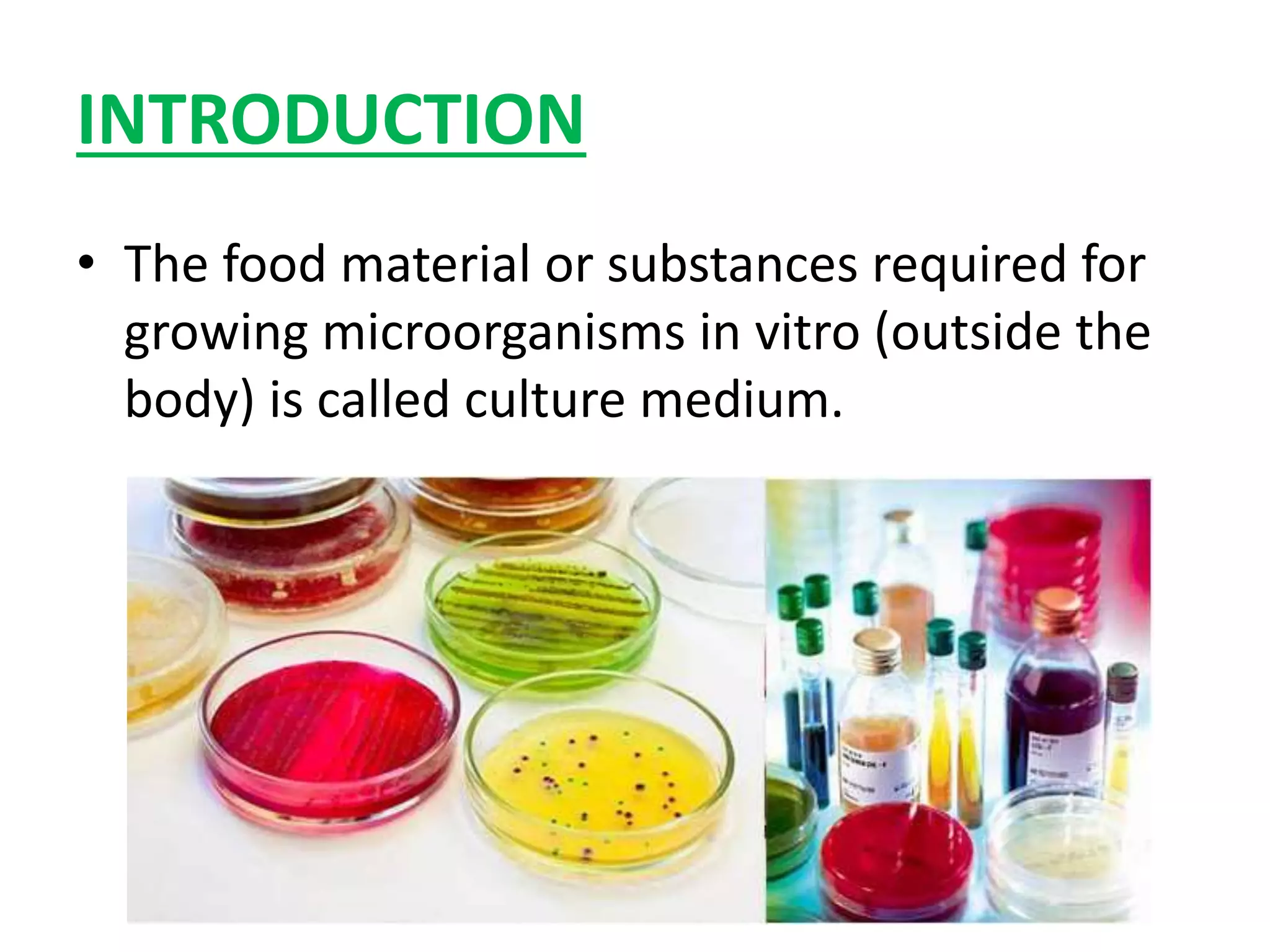
• The food material or substances required for
growing microorganisms in vitro (outside the
body) is called culture medium.
HISTORY
• History of culture media dates back to the 19th
century.
• Louis Pasteur used simple broth made up of
urine or meat.
• Robert Koch realized the importance of solid
media and used potato pieces to grow
bacteria.
• It was on the suggestions of Fannie Elishemius
, wife of Walther Hesse that Agar was used to
solidify culture media.
CULTURE AND THE MEDIUM
• CULTURE: Is the term given to microorganisms
that are cultivated in the lab for the purpose
of identifying and studying them.
• MEDIUM: Is the term given to the
combination of ingredients that will support
the growth and cultivation of microorganisms
by providing all the essential nutrients
required for the growth.
COMMON INGREDIENTS OF BACTERIAL
CULTURE MEDIA
• Water : It is essential for bacterial growth. Distilled water is used in
culture media.
• Peptone: It is obtained from hydrolyzed animal or plant protein and
provides Nitrogen and Amino Acids.
• Meat Extract: It provides Amino Acids, vitamins , mineral salts for
bacterial growth.
• Carbohydrate: It provides a source of energy and Carbon to the
bacteria.
• Yeast Extract: It is used to stimulate the growth of bacteria.
• Mineral Salts : Traces of Magnesium , Potassium , iron , and
calcium are essential for bacteria.
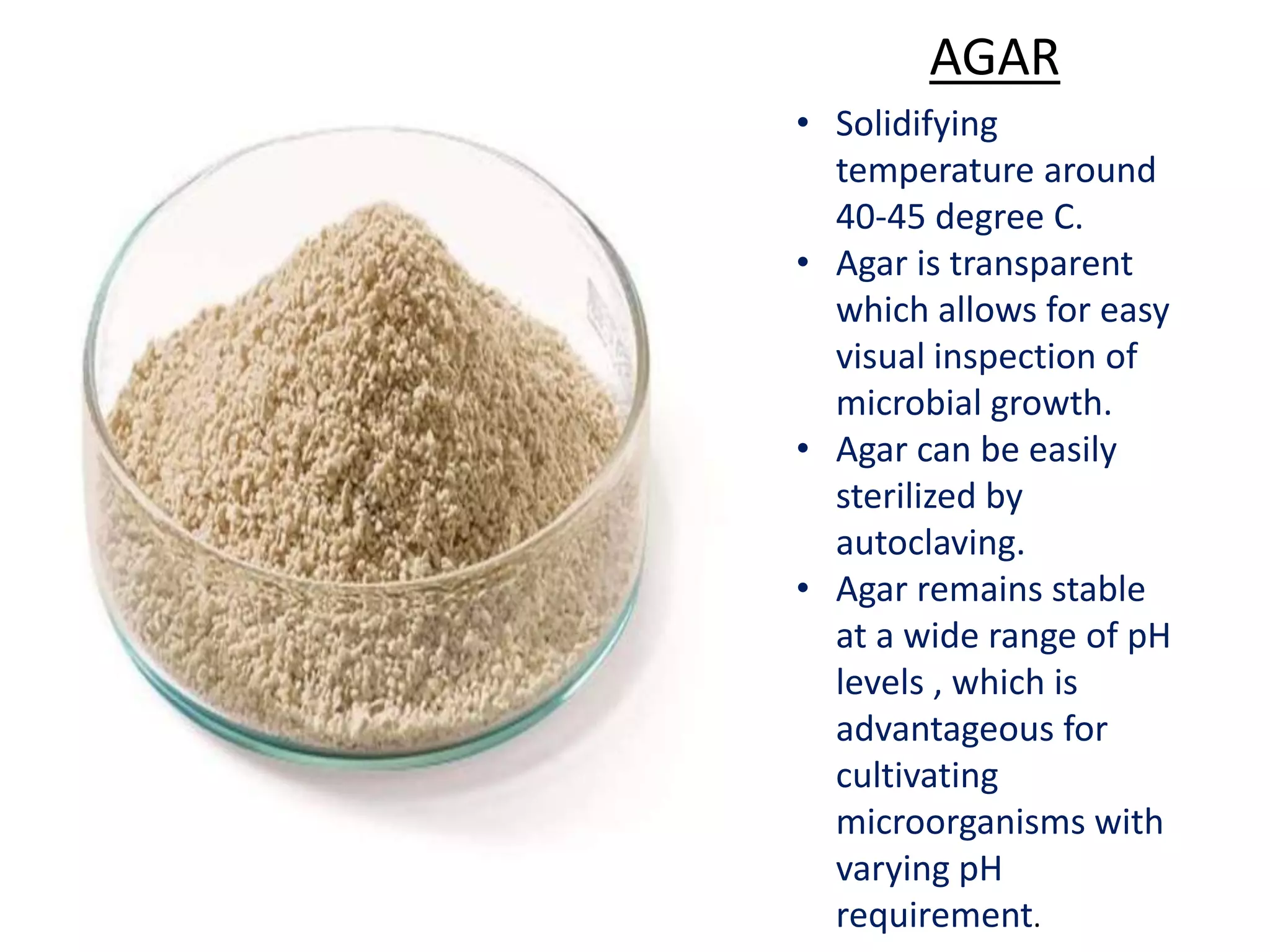
• Agar: It is an inert polysaccharide obtained from sea-weed or marine
algae. It is an solidifying agent used in media preparation. It dissolves
at 90-100 degree C and solidifies at 45 degree C.
AGAR
• Solidifying
temperature around
40-45 degree C.
• Agar is transparent
which allows for easy
visual inspection of
microbial growth.
• Agar can be easily
sterilized by
autoclaving.
• Agar remains stable
at a wide range of pH
levels , which is
advantageous for
cultivating
microorganisms with
varying pH
requirement.
• On the basis of consistency:
a) Liquid Media: Peptone Water , Nutrient Broth ,
Brain Heart Infusion Broth.
b) Solid Media : Nutrient Agar , Blood Agar ,
MacConkey’s Agar , Chocolate Agar.
CLASSIFICATION OF CULTURE MEDIA
• On the basis of Composition:
a) Simple Media-Simple Media are culture media which
contain the minimum adequate nutrition for non
fastidious organisms. E.g.- Nutrient Agar(Beef extract ,
peptone , agar , NaCl , Distilled water),Nutrient
Broth(Peptone , Beef Extract , NaCl , Distilled water)
b) Complex Media- Complex media have added
ingredients for bringing out certain properties or
providing special nutrient required for the growth
of the bacteria. E.g.- Tryptic soy agar( Tryptone ,
Peptone , Glucose , NaCl ,Dipotassium Phosphate),
MacConkey’s Media(Peptone , Lactose , Sodium
taurocholate , Agar , Neutral Red)
• On the basis of application:
a. Basal Media: It is a simple media which allow
growth of most of the non fastidious bacteria. E.g.-
Nutrient Broth , Nutrient Agar.
b. Enriched Media: These media are prepared by
enriching the basal agar by adding blood or serum
so that growth of many fastidious bacteria is
supported. E.g. Blood agar , chocolate agar etc.
• Enrichment Media: Liquid medium which allows
only certain bacteria to grow and inhibits other
bacteria . E.g. Tetrathionate broth , Selenite – F broth ,
and Alkaline peptone water.
• Selective Media: Solid media which are made
selective by adding substances that inhibit the growth
of some bacteria allowing growth of other bacteria .
e.g. deoxycholate citrate agar(DCA) addition of
deoxycholate inhibits the growth of Gram – positive
bacteria and E.coli, while allowing growth of
Salmonella sp. and Shigella sp. Lowenstein – Jensen
media for cultivation of Mycobacterium tuberculosis.
Composition of Lowenstein – Jensen Media
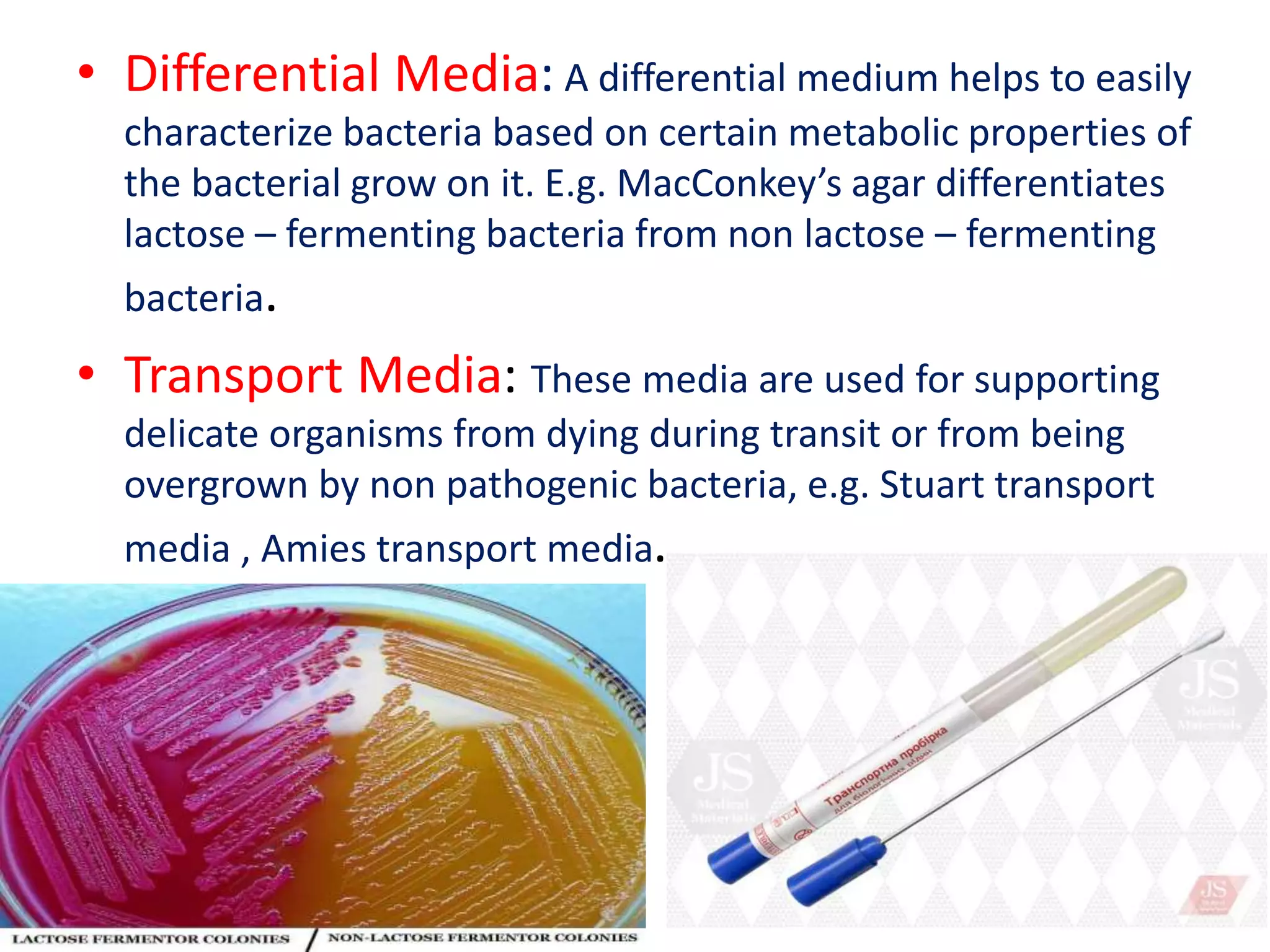
• Differential Media: A differential medium helps to easily
characterize bacteria based on certain metabolic properties of
the bacterial grow on it. E.g. MacConkey’s agar differentiates
lactose – fermenting bacteria from non lactose – fermenting
bacteria.
• Transport Media: These media are used for supporting
delicate organisms from dying during transit or from being
overgrown by non pathogenic bacteria, e.g. Stuart transport
media , Amies transport media.
MEDIA USED IN MICROBIOLOGY.pptx

MEDIA USED IN MICROBIOLOGY.pptx

  • 1.
    MEDIA USED INMICROBIOLOGY Madhusmita Roy 2nd Semester M.Sc.MLST RKMVERI Moderator Dr. Subhrangshu Mondal MD Microbiology Chittaranjan National Institute , Kolkata
  • 2.
    INTRODUCTION • The foodmaterial or substances required for growing microorganisms in vitro (outside the body) is called culture medium.
  • 3.
    HISTORY • History ofculture media dates back to the 19th century. • Louis Pasteur used simple broth made up of urine or meat. • Robert Koch realized the importance of solid media and used potato pieces to grow bacteria. • It was on the suggestions of Fannie Elishemius , wife of Walther Hesse that Agar was used to solidify culture media.
  • 4.
    CULTURE AND THEMEDIUM • CULTURE: Is the term given to microorganisms that are cultivated in the lab for the purpose of identifying and studying them. • MEDIUM: Is the term given to the combination of ingredients that will support the growth and cultivation of microorganisms by providing all the essential nutrients required for the growth.
  • 5.
    COMMON INGREDIENTS OFBACTERIAL CULTURE MEDIA • Water : It is essential for bacterial growth. Distilled water is used in culture media. • Peptone: It is obtained from hydrolyzed animal or plant protein and provides Nitrogen and Amino Acids. • Meat Extract: It provides Amino Acids, vitamins , mineral salts for bacterial growth. • Carbohydrate: It provides a source of energy and Carbon to the bacteria. • Yeast Extract: It is used to stimulate the growth of bacteria. • Mineral Salts : Traces of Magnesium , Potassium , iron , and calcium are essential for bacteria. • Agar: It is an inert polysaccharide obtained from sea-weed or marine algae. It is an solidifying agent used in media preparation. It dissolves at 90-100 degree C and solidifies at 45 degree C.
  • 6.
    AGAR • Solidifying temperature around 40-45degree C. • Agar is transparent which allows for easy visual inspection of microbial growth. • Agar can be easily sterilized by autoclaving. • Agar remains stable at a wide range of pH levels , which is advantageous for cultivating microorganisms with varying pH requirement.
  • 7.
    • On thebasis of consistency: a) Liquid Media: Peptone Water , Nutrient Broth , Brain Heart Infusion Broth. b) Solid Media : Nutrient Agar , Blood Agar , MacConkey’s Agar , Chocolate Agar. CLASSIFICATION OF CULTURE MEDIA
  • 8.
    • On thebasis of Composition: a) Simple Media-Simple Media are culture media which contain the minimum adequate nutrition for non fastidious organisms. E.g.- Nutrient Agar(Beef extract , peptone , agar , NaCl , Distilled water),Nutrient Broth(Peptone , Beef Extract , NaCl , Distilled water) b) Complex Media- Complex media have added ingredients for bringing out certain properties or providing special nutrient required for the growth of the bacteria. E.g.- Tryptic soy agar( Tryptone , Peptone , Glucose , NaCl ,Dipotassium Phosphate), MacConkey’s Media(Peptone , Lactose , Sodium taurocholate , Agar , Neutral Red)
  • 9.
    • On thebasis of application: a. Basal Media: It is a simple media which allow growth of most of the non fastidious bacteria. E.g.- Nutrient Broth , Nutrient Agar. b. Enriched Media: These media are prepared by enriching the basal agar by adding blood or serum so that growth of many fastidious bacteria is supported. E.g. Blood agar , chocolate agar etc.
  • 10.
    • Enrichment Media:Liquid medium which allows only certain bacteria to grow and inhibits other bacteria . E.g. Tetrathionate broth , Selenite – F broth , and Alkaline peptone water. • Selective Media: Solid media which are made selective by adding substances that inhibit the growth of some bacteria allowing growth of other bacteria . e.g. deoxycholate citrate agar(DCA) addition of deoxycholate inhibits the growth of Gram – positive bacteria and E.coli, while allowing growth of Salmonella sp. and Shigella sp. Lowenstein – Jensen media for cultivation of Mycobacterium tuberculosis.
  • 11.
    Composition of Lowenstein– Jensen Media
  • 12.
    • Differential Media:A differential medium helps to easily characterize bacteria based on certain metabolic properties of the bacterial grow on it. E.g. MacConkey’s agar differentiates lactose – fermenting bacteria from non lactose – fermenting bacteria. • Transport Media: These media are used for supporting delicate organisms from dying during transit or from being overgrown by non pathogenic bacteria, e.g. Stuart transport media , Amies transport media.