How does your media product
represent particular social
groups?
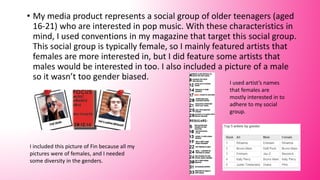
• My media product represents a social group of older teenagers (aged
16-21) who are interested in pop music. With these characteristics in
mind, I used conventions in my magazine that target this social group.
This social group is typically female, so I mainly featured artists that
females are more interested in, but I did feature some artists that
males would be interested in too. I also included a picture of a male
so it wasn’t too gender biased.
I included this picture of Fin because all my
pictures were of females, and I needed
some diversity in the genders.
I used artist’s names
that females are
mostly interested in to
adhere to my social
group.
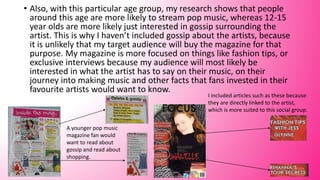
• Also, with this particular age group, my research shows that people
around this age are more likely to stream pop music, whereas 12-15
year olds are more likely just interested in gossip surrounding the
artist. This is why I haven’t included gossip about the artists, because
it is unlikely that my target audience will buy the magazine for that
purpose. My magazine is more focused on things like fashion tips, or
exclusive interviews because my audience will most likely be
interested in what the artist has to say on their music, on their
journey into making music and other facts that fans invested in their
favourite artists would want to know.
I included articles such as these because
they are directly linked to the artist,
which is more suited to this social group.
A younger pop music
magazine fan would
want to read about
gossip and read about
shopping.
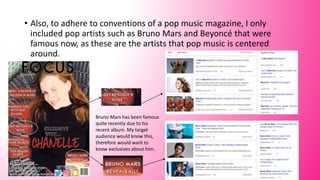
• Also, to adhere to conventions of a pop music magazine, I only
included pop artists such as Bruno Mars and Beyoncé that were
famous now, as these are the artists that pop music is centered
around.
Bruno Mars has been famous
quite recently due to his
recent album. My target
audience would know this,
therefore would want to
know exclusives about him.

Media evaluation question 2

  • 1.
    How does yourmedia product represent particular social groups?
  • 2.
    • My mediaproduct represents a social group of older teenagers (aged 16-21) who are interested in pop music. With these characteristics in mind, I used conventions in my magazine that target this social group. This social group is typically female, so I mainly featured artists that females are more interested in, but I did feature some artists that males would be interested in too. I also included a picture of a male so it wasn’t too gender biased. I included this picture of Fin because all my pictures were of females, and I needed some diversity in the genders. I used artist’s names that females are mostly interested in to adhere to my social group.
  • 3.
    • Also, withthis particular age group, my research shows that people around this age are more likely to stream pop music, whereas 12-15 year olds are more likely just interested in gossip surrounding the artist. This is why I haven’t included gossip about the artists, because it is unlikely that my target audience will buy the magazine for that purpose. My magazine is more focused on things like fashion tips, or exclusive interviews because my audience will most likely be interested in what the artist has to say on their music, on their journey into making music and other facts that fans invested in their favourite artists would want to know. I included articles such as these because they are directly linked to the artist, which is more suited to this social group. A younger pop music magazine fan would want to read about gossip and read about shopping.
  • 4.
    • Also, toadhere to conventions of a pop music magazine, I only included pop artists such as Bruno Mars and Beyoncé that were famous now, as these are the artists that pop music is centered around. Bruno Mars has been famous quite recently due to his recent album. My target audience would know this, therefore would want to know exclusives about him.