HOW DOESYOUR MEDIA PRODUCT
REPRESENT PARTICULAR SOCIAL
GROUPS?
Jone Aboitiz
CRAGS
C.R.A.G.S
■ For our production we wanted to include and challenge different stereotypes and
ideologies that our audience can get when watching our production.We needed our
film to include a range of different stereotype specifically mainstream ones due to the
fact that it is more conventional to our institution producing studio films which our
film is. In order to do this, we used C.R.A.G.S which is the creation of stereotypes
based on class, race, age, gender and sexuality.The characters in our production are
stereotypical representations of the people in the world we live in and it is up to our
audience to decide whether our representations are correct or not and it is up to them
to find out the different stereotypical representations in our production.
Class
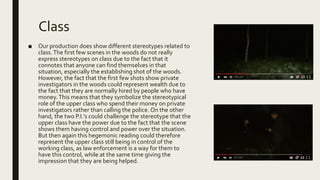
■ Our production does show different stereotypes related to
class.The first few scenes in the woods do not really
express stereotypes on class due to the fact that it
connotes that anyone can find themselves in that
situation, especially the establishing shot of the woods.
However, the fact that the first few shots show private
investigators in the woods could represent wealth due to
the fact that they are normally hired by people who have
money.This means that they symbolize the stereotypical
role of the upper class who spend their money on private
investigators rather than calling the police. On the other
hand, the two P.I.’s could challenge the stereotype that the
upper class have the power due to the fact that the scene
shows them having control and power over the situation.
But then again this hegemonic reading could therefore
represent the upper class still being in control of the
working class, as law enforcement is a way for them to
have this control, while at the same time giving the
impression that they are being helped.
Class cont.
■ In the room scene, different shots of the room suggests
that the two teenagers are in a boarding school room
which represents the people of the upper class.This is
because boarding school is expensive where in most cases
is only affordable by parents who have a high income.
Based on this,Ali and Lexie are stereotypical
representations of teenagers who grew up with a wealthy
family and can have anything they want.The shot of the
iphone also connotes that they are part of the upper class
due to the fact that it shows that they have the latest
technology.Also the medium long shots showing what
the room has also connotes wealth and represents the
stereotype that people of the upper class have fancy
things. However, the fact that that our protagonist,Ali, is
later seen being in a troublesome situation challenges the
stereotype of the upper class as it shows that money wont
always keep you safe.
Race
■ When it comes to race, our production focused on the western culture.This is because all
our characters are white and are all of the same race. Our antagonist and protagonist
being white represent different aspects of the western culture and play stereotypical
western teenagers making them more mainstream and relatable. It fact we changed the
voice of the main character to make her more mainstream and relatable to our audience.
The reason why our production focused on the western culture is because our product
would be a mass market film that would need to attract a mainstream audience who are
predominately white which is what westerners are.
Age
■ In the first woods scene where the two P.I’s are seen,
the male is clearly older while the woman is clearly
younger, therefore representing the binary
opposition of old vs young. However, this challenges
this binary opposition due to the fact that it shows
that young people are capable of doing the same
jobs as older people who have had more experience
in that job. Not only this but the fact that it is the
young PI who is more active, seen getting her hands
dirty and making the discovery further shows that
we are challenging this binary opposition. This also
subverts the stereotype that older people know
more than younger people and have better jobs than
younger people due to the fact that the younger
woman seems to have more control over the
situation than the older male.The clothing of these
two being in suits while the teens in the next scene
wearing casual clothes represents how older people
tend to drees better and more formal than younger
people.
Age cont.
■ Ali and Lexie are representations of teenage girls in our
society. The actions of Ali connotes her self-centered
personality due to the fact that she spends most of the
scene looking in the mirror. Based on this,Ali represents
the stereotypical role of teenage girls who care a lot
about their image and who always have to look good.
Lexie on the other hand subverts this stereotype due to
the fact that she does not really seem to care about how
she looks and her outfit is simple and not as girly as Ali’s.
However, Lexie represents the teenage girls in today’s
society who are constantly using their phones and have
a hard time putting it down.This is due to the fact that
through out the whole scene she is seen using her phone
and even has a hard time listening to Ali because of it.
They both represent the teenagers nowadays who
prefer to hang out in their bedrooms rather than going
out to a restaurant or a café.
Gender
■ Our production has more females than males in it which
means that more female stereotypes are either
expressed or subverted in our production. First of all the
fact that we have a woman as a P.I and that she is seen
doing more and constantly ahead of the male PI
subverts the stereotype that men are more powerful
than women due to the fact that this shows thatTiff is
dominating Phill and is in more control over the
situation than he is.The fact thatTiff is seen doing all
the dirty work meaning kneeling down and getting her
hands dirty subverts the stereotype that men work
harder than women due to the fact that is shows that
Tiff is working harder than Phil. However, the fact that
Phil is seen standing overTiff while she is kneeling down
could also represent the stereotype that men are more
powerful than women due to the fact that he is looking
down on her.
Gender cont.
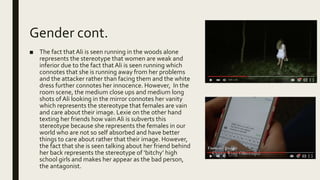
■ The fact thatAli is seen running in the woods alone
represents the stereotype that women are weak and
inferior due to the fact that Ali is seen running which
connotes that she is running away from her problems
and the attacker rather than facing them and the white
dress further connotes her innocence. However, In the
room scene, the medium close ups and medium long
shots of Ali looking in the mirror connotes her vanity
which represents the stereotype that females are vain
and care about their image. Lexie on the other hand
texting her friends how vainAli is subverts this
stereotype because she represents the females in our
world who are not so self absorbed and have better
things to care about rather that their image. However,
the fact that she is seen talking about her friend behind
her back represents the stereotype of ‘bitchy’ high
school girls and makes her appear as the bad person,
the antagonist.
Sexuality
■ In our production, sexuality is mainly represented
through our female characters due to the fact that they
make up most of our cast. Throughout the opening
sequence, Ali is seen wearing revealing and tight clothing
such as skinny jeans, a crop top and an open back dress
representing the stereotypical role of a very feminine
character due to the fact that her clothing is more
feminine than masculine which also represents Barth’s
striptease theory.The fact that majority of the females in
our film are wearing dark color clothing connotes their
power and subverts their femininity due to the fact that
dark blue and black tend to be more masculine than
feminine.
CONSTRUCTIONIST
THEORY
REPRESENTATIONS
Seen in our production
Teenage girls are vain
■ Reality-Teenage girls are at a stage in their life where they are going through puberty
and their body and attitudes are changing
■ Opinion of the producer-Teenage girls tends to care about how they look because
they want to look good for men,Teenage girls want to look good because it makes
them feel better about themselves and stand out in society or fit into society
■ Context- Nowadays, teenage girls all over the world feel pressured to look good to fit
into society and because the media is convincing them that the only way to make it in
this life is if you are thin, pretty and look good due to the fact that there is a lot of
criticism towards celebrities and normal people as well.
Women are empowered
■ Reality-There are more opportunities for women to prove that they are just as
powerful as men in todays world,Women now have good education opportunities and
there are more women working
■ Opinion of the producer-Women can be just as strong as men and just as powerful as
them,Women choose how they want to be seen as and live to take care of themselves
and do what is right for them, Men and women are equal and neither gender is better
than the other
■ Context- In todays world, there are more opportunities for women to grow and be
independent and there are more women working as compared to the past. Feminism
has grown and women are starting to be seen as being equal to men and not inferior.
The Upper class have it all
■ Reality- People in the upper class have jobs that pay well which can do more than just
supporting their families
■ Opinion of the producer-The people of the upper class work hard to get the money that
they have and want the best for their children which is why they may put their children in
boarding school. However, they tend to spend a lot of money on new technologies and
having a lot of splendid and fancy things which at times may not always be the right thing
to do for their children.
■ Context- Nowadays, consumerism is very important in our society as people associate
owning more items to being at the top of society meaning the owning of items is used to
show their social status.
CANYOUR PRODUCTION BE
READ AS HEGEMONIC? DOES IT
PROMOTE ANY IDEOLOGIES
THAT KEEP GROUPS IN
SOCIETY OPPRESSED?
■ Our production can be read as hegemonic when it comes to women.
This is becauseTiff being seen in the woods as the P.I who is taking
control and in charge may make women feel empowered and feel that
they are just as capable to work as hard as men do. However, the fact
that we see in the end that Phill is standing overTiff while she is doing
all the work promotes the ideology that men still dominate the society
due to the fact that he is looking down on her connoting that he is the
powerful and more dominant one.This therefore, promotes
hegemonic masculinity due to the fact that it keeps men in power
without making the women feel inferior.
■ Ali running in the woods with her back to the camera will make the
women in society feel strong, brave and feel in control due to the fact
that hiding her face, being emphasized by the flash cut, connotes that
she is not conforming to the males gaze. Not only this but the
opposition of her white dress and muddy appearance subverts the
connotation of her innocence. However, the fact that she is seen
running away from something or someone connotes that she is the
prey being attacked and chased by a predator promoting the ideology
that women are inferior.This is because the predator will still be seen
as the powerful one making Ali appear as the weak one that is being
chased, like a prey.This can be seen a hegemonic because women are
being tricked into thinking that they are empowered when really they
are being seen as the prey, making women still inferior when it comes
to their place in society.
FEMALE
REPRESENTATION
THEORIES
Evident in our production
■ Majority of the characters in our production are females which
means that all 5 theories are evident in our production when it
comes to the representation of the female characters in our film.
First, the medium shot ofTiff calling Phil and the long shots and
medium long shots where she is seen as always being a head of Phil
connotes that she is the one that is in control and is working hard
which represents David Gauntlet’s theory of an empowered female
because she is being seen as the powerful one, in controll and
rejecting being a passive object. However, the fact that when she is
calling Phil the camera is be hind him and looking at her from a far
could represent Laura Mulvey’s male gaze theory due to the fact
that it shows her being viewed trough the eyes of a male. At the
same time it could also represent JaniceWinships’ theory of notion
of complicity becauseTiff is choosing to put herself in the males
gaze by looking back to call him.
■ The medium long shot ofTiff kneeling down connotes that she is
the one who is doing all the dirty work and getting her hands dirty
could represent Judith Butler’s gender performance theory due to
the fact that she is doing a mans job and is appearing to be more
masculine than feminine based on her actions and even her job.
However, when she is kneeling down the camera eventually tilts
down which puts her in the males gaze again since it connotes that
someone is looking down on her and that she is inferior and being
judged, which represents Laura Mulveys male gaze theory.
■ The long shots and medium shots ofTiff and Lexie showing their
outfits that are of a dark color makes them appear to be wearing
clothing that is more masculine than feminine due to the fact that
dark colors are normally associated with men.This is a representation
of Roland Barthes striptease theory due to the fact that their clothing
is what sexualizes them.This can also represent Judith Butlers gender
performance because they are appearing to be more masculine than
feminine. Not only this but their dark clothing also makes them come
across as being empowered because it connotes power and strength
which represents David Gauntletts theory of an empowered female. It
also represents this because they are choosing to put themselves
away from the males gaze by dressing similar to them. On the other
hand, the clothes Ali is wearing connoted her femininity due to the
fact that crop tops and skinny jeans are normally things that females
would wear which also represents Roland Barthe’s striptease theory
because her outfit sexualizes her by showing her femininity.
■ Throughout the whole room scene, the medium close ups and the
long shots of Ali showing her constantly looking at the mirror and
putting on make up connotes her femininity.This represents Judith
Butlers Gender Performance Theory due to the fact that applying
make up is normally something that females do therefore making Ali
appear to be more feminine than masculine. Not only this but the
medium close ups of her face could represent Laura Mulveys theory
of a males gaze due to the fact that Ali’s face is being objectified.
However, this could also represent Janice Winship’s theory because by
putting lipstick and always looking in the mirror Ali is choosing to put
herself in the males gaze and choosing to objectify her lips.
DOYOUR
REPRESENTATIONS SUIT
YOUR INSTITUTION?
Representations to Institution
■ I believe that the different representations in our film does suit our institution due to the fact
that studio films tend to have more main stream ideologies which our production does have.
Not only this but even some of different representations of women where in they come
across as being empowered do challenge the representations of studio films but the fact that
we still do put the women in the males gaze suits our institution.This is because majority of
the studio films tend to stick to the fact that men are still dominating the society.We also
challenge mainstream ideologies on the importance of wealth due to the fact that it is a
critique of the boarding school culture as the girls are seen as self-centered, bitchy and seen
getting into trouble or in a situation where they are seen as not being safe by their wealth.
However, it does suit our institution as the school setting is conventional in Hollywood
products. Even if our production does challenge some representations, it can still be
considered as a studio film due to the fact that the mass market audience are also
postmodern who don’t mind representations being played with and challenged occasionally.

Media evaluation question 2

  • 1.
    HOW DOESYOUR MEDIAPRODUCT REPRESENT PARTICULAR SOCIAL GROUPS? Jone Aboitiz
  • 2.
  • 3.
    C.R.A.G.S ■ For ourproduction we wanted to include and challenge different stereotypes and ideologies that our audience can get when watching our production.We needed our film to include a range of different stereotype specifically mainstream ones due to the fact that it is more conventional to our institution producing studio films which our film is. In order to do this, we used C.R.A.G.S which is the creation of stereotypes based on class, race, age, gender and sexuality.The characters in our production are stereotypical representations of the people in the world we live in and it is up to our audience to decide whether our representations are correct or not and it is up to them to find out the different stereotypical representations in our production.
  • 4.
    Class ■ Our productiondoes show different stereotypes related to class.The first few scenes in the woods do not really express stereotypes on class due to the fact that it connotes that anyone can find themselves in that situation, especially the establishing shot of the woods. However, the fact that the first few shots show private investigators in the woods could represent wealth due to the fact that they are normally hired by people who have money.This means that they symbolize the stereotypical role of the upper class who spend their money on private investigators rather than calling the police. On the other hand, the two P.I.’s could challenge the stereotype that the upper class have the power due to the fact that the scene shows them having control and power over the situation. But then again this hegemonic reading could therefore represent the upper class still being in control of the working class, as law enforcement is a way for them to have this control, while at the same time giving the impression that they are being helped.
  • 5.
    Class cont. ■ Inthe room scene, different shots of the room suggests that the two teenagers are in a boarding school room which represents the people of the upper class.This is because boarding school is expensive where in most cases is only affordable by parents who have a high income. Based on this,Ali and Lexie are stereotypical representations of teenagers who grew up with a wealthy family and can have anything they want.The shot of the iphone also connotes that they are part of the upper class due to the fact that it shows that they have the latest technology.Also the medium long shots showing what the room has also connotes wealth and represents the stereotype that people of the upper class have fancy things. However, the fact that that our protagonist,Ali, is later seen being in a troublesome situation challenges the stereotype of the upper class as it shows that money wont always keep you safe.
  • 6.
    Race ■ When itcomes to race, our production focused on the western culture.This is because all our characters are white and are all of the same race. Our antagonist and protagonist being white represent different aspects of the western culture and play stereotypical western teenagers making them more mainstream and relatable. It fact we changed the voice of the main character to make her more mainstream and relatable to our audience. The reason why our production focused on the western culture is because our product would be a mass market film that would need to attract a mainstream audience who are predominately white which is what westerners are.
  • 7.
    Age ■ In thefirst woods scene where the two P.I’s are seen, the male is clearly older while the woman is clearly younger, therefore representing the binary opposition of old vs young. However, this challenges this binary opposition due to the fact that it shows that young people are capable of doing the same jobs as older people who have had more experience in that job. Not only this but the fact that it is the young PI who is more active, seen getting her hands dirty and making the discovery further shows that we are challenging this binary opposition. This also subverts the stereotype that older people know more than younger people and have better jobs than younger people due to the fact that the younger woman seems to have more control over the situation than the older male.The clothing of these two being in suits while the teens in the next scene wearing casual clothes represents how older people tend to drees better and more formal than younger people.
  • 8.
    Age cont. ■ Aliand Lexie are representations of teenage girls in our society. The actions of Ali connotes her self-centered personality due to the fact that she spends most of the scene looking in the mirror. Based on this,Ali represents the stereotypical role of teenage girls who care a lot about their image and who always have to look good. Lexie on the other hand subverts this stereotype due to the fact that she does not really seem to care about how she looks and her outfit is simple and not as girly as Ali’s. However, Lexie represents the teenage girls in today’s society who are constantly using their phones and have a hard time putting it down.This is due to the fact that through out the whole scene she is seen using her phone and even has a hard time listening to Ali because of it. They both represent the teenagers nowadays who prefer to hang out in their bedrooms rather than going out to a restaurant or a café.
  • 9.
    Gender ■ Our productionhas more females than males in it which means that more female stereotypes are either expressed or subverted in our production. First of all the fact that we have a woman as a P.I and that she is seen doing more and constantly ahead of the male PI subverts the stereotype that men are more powerful than women due to the fact that this shows thatTiff is dominating Phill and is in more control over the situation than he is.The fact thatTiff is seen doing all the dirty work meaning kneeling down and getting her hands dirty subverts the stereotype that men work harder than women due to the fact that is shows that Tiff is working harder than Phil. However, the fact that Phil is seen standing overTiff while she is kneeling down could also represent the stereotype that men are more powerful than women due to the fact that he is looking down on her.
  • 10.
    Gender cont. ■ Thefact thatAli is seen running in the woods alone represents the stereotype that women are weak and inferior due to the fact that Ali is seen running which connotes that she is running away from her problems and the attacker rather than facing them and the white dress further connotes her innocence. However, In the room scene, the medium close ups and medium long shots of Ali looking in the mirror connotes her vanity which represents the stereotype that females are vain and care about their image. Lexie on the other hand texting her friends how vainAli is subverts this stereotype because she represents the females in our world who are not so self absorbed and have better things to care about rather that their image. However, the fact that she is seen talking about her friend behind her back represents the stereotype of ‘bitchy’ high school girls and makes her appear as the bad person, the antagonist.
  • 11.
    Sexuality ■ In ourproduction, sexuality is mainly represented through our female characters due to the fact that they make up most of our cast. Throughout the opening sequence, Ali is seen wearing revealing and tight clothing such as skinny jeans, a crop top and an open back dress representing the stereotypical role of a very feminine character due to the fact that her clothing is more feminine than masculine which also represents Barth’s striptease theory.The fact that majority of the females in our film are wearing dark color clothing connotes their power and subverts their femininity due to the fact that dark blue and black tend to be more masculine than feminine.
  • 12.
  • 13.
    Teenage girls arevain ■ Reality-Teenage girls are at a stage in their life where they are going through puberty and their body and attitudes are changing ■ Opinion of the producer-Teenage girls tends to care about how they look because they want to look good for men,Teenage girls want to look good because it makes them feel better about themselves and stand out in society or fit into society ■ Context- Nowadays, teenage girls all over the world feel pressured to look good to fit into society and because the media is convincing them that the only way to make it in this life is if you are thin, pretty and look good due to the fact that there is a lot of criticism towards celebrities and normal people as well.
  • 14.
    Women are empowered ■Reality-There are more opportunities for women to prove that they are just as powerful as men in todays world,Women now have good education opportunities and there are more women working ■ Opinion of the producer-Women can be just as strong as men and just as powerful as them,Women choose how they want to be seen as and live to take care of themselves and do what is right for them, Men and women are equal and neither gender is better than the other ■ Context- In todays world, there are more opportunities for women to grow and be independent and there are more women working as compared to the past. Feminism has grown and women are starting to be seen as being equal to men and not inferior.
  • 15.
    The Upper classhave it all ■ Reality- People in the upper class have jobs that pay well which can do more than just supporting their families ■ Opinion of the producer-The people of the upper class work hard to get the money that they have and want the best for their children which is why they may put their children in boarding school. However, they tend to spend a lot of money on new technologies and having a lot of splendid and fancy things which at times may not always be the right thing to do for their children. ■ Context- Nowadays, consumerism is very important in our society as people associate owning more items to being at the top of society meaning the owning of items is used to show their social status.
  • 16.
    CANYOUR PRODUCTION BE READAS HEGEMONIC? DOES IT PROMOTE ANY IDEOLOGIES THAT KEEP GROUPS IN SOCIETY OPPRESSED?
  • 17.
    ■ Our productioncan be read as hegemonic when it comes to women. This is becauseTiff being seen in the woods as the P.I who is taking control and in charge may make women feel empowered and feel that they are just as capable to work as hard as men do. However, the fact that we see in the end that Phill is standing overTiff while she is doing all the work promotes the ideology that men still dominate the society due to the fact that he is looking down on her connoting that he is the powerful and more dominant one.This therefore, promotes hegemonic masculinity due to the fact that it keeps men in power without making the women feel inferior. ■ Ali running in the woods with her back to the camera will make the women in society feel strong, brave and feel in control due to the fact that hiding her face, being emphasized by the flash cut, connotes that she is not conforming to the males gaze. Not only this but the opposition of her white dress and muddy appearance subverts the connotation of her innocence. However, the fact that she is seen running away from something or someone connotes that she is the prey being attacked and chased by a predator promoting the ideology that women are inferior.This is because the predator will still be seen as the powerful one making Ali appear as the weak one that is being chased, like a prey.This can be seen a hegemonic because women are being tricked into thinking that they are empowered when really they are being seen as the prey, making women still inferior when it comes to their place in society.
  • 18.
  • 19.
    ■ Majority ofthe characters in our production are females which means that all 5 theories are evident in our production when it comes to the representation of the female characters in our film. First, the medium shot ofTiff calling Phil and the long shots and medium long shots where she is seen as always being a head of Phil connotes that she is the one that is in control and is working hard which represents David Gauntlet’s theory of an empowered female because she is being seen as the powerful one, in controll and rejecting being a passive object. However, the fact that when she is calling Phil the camera is be hind him and looking at her from a far could represent Laura Mulvey’s male gaze theory due to the fact that it shows her being viewed trough the eyes of a male. At the same time it could also represent JaniceWinships’ theory of notion of complicity becauseTiff is choosing to put herself in the males gaze by looking back to call him. ■ The medium long shot ofTiff kneeling down connotes that she is the one who is doing all the dirty work and getting her hands dirty could represent Judith Butler’s gender performance theory due to the fact that she is doing a mans job and is appearing to be more masculine than feminine based on her actions and even her job. However, when she is kneeling down the camera eventually tilts down which puts her in the males gaze again since it connotes that someone is looking down on her and that she is inferior and being judged, which represents Laura Mulveys male gaze theory.
  • 20.
    ■ The longshots and medium shots ofTiff and Lexie showing their outfits that are of a dark color makes them appear to be wearing clothing that is more masculine than feminine due to the fact that dark colors are normally associated with men.This is a representation of Roland Barthes striptease theory due to the fact that their clothing is what sexualizes them.This can also represent Judith Butlers gender performance because they are appearing to be more masculine than feminine. Not only this but their dark clothing also makes them come across as being empowered because it connotes power and strength which represents David Gauntletts theory of an empowered female. It also represents this because they are choosing to put themselves away from the males gaze by dressing similar to them. On the other hand, the clothes Ali is wearing connoted her femininity due to the fact that crop tops and skinny jeans are normally things that females would wear which also represents Roland Barthe’s striptease theory because her outfit sexualizes her by showing her femininity. ■ Throughout the whole room scene, the medium close ups and the long shots of Ali showing her constantly looking at the mirror and putting on make up connotes her femininity.This represents Judith Butlers Gender Performance Theory due to the fact that applying make up is normally something that females do therefore making Ali appear to be more feminine than masculine. Not only this but the medium close ups of her face could represent Laura Mulveys theory of a males gaze due to the fact that Ali’s face is being objectified. However, this could also represent Janice Winship’s theory because by putting lipstick and always looking in the mirror Ali is choosing to put herself in the males gaze and choosing to objectify her lips.
  • 21.
  • 22.
    Representations to Institution ■I believe that the different representations in our film does suit our institution due to the fact that studio films tend to have more main stream ideologies which our production does have. Not only this but even some of different representations of women where in they come across as being empowered do challenge the representations of studio films but the fact that we still do put the women in the males gaze suits our institution.This is because majority of the studio films tend to stick to the fact that men are still dominating the society.We also challenge mainstream ideologies on the importance of wealth due to the fact that it is a critique of the boarding school culture as the girls are seen as self-centered, bitchy and seen getting into trouble or in a situation where they are seen as not being safe by their wealth. However, it does suit our institution as the school setting is conventional in Hollywood products. Even if our production does challenge some representations, it can still be considered as a studio film due to the fact that the mass market audience are also postmodern who don’t mind representations being played with and challenged occasionally.