Yelim Chung
USE OF GENERIC CONVENTIONS
 At the beginning of the course we were introduced to the generic codes and conventions used
in music magazines. On our blogs, we analysed many different examples that allowed us to
understand how they were really used, for example, the main image will commonly use direct
mode of address on the front page as it engages the target audience immediately.
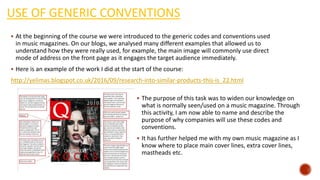
 Here is an example of the work I did at the start of the course:
http://yelimas.blogspot.co.uk/2016/09/research-into-similar-products-this-is_22.html
 The purpose of this task was to widen our knowledge on
what is normally seen/used on a music magazine. Through
this activity, I am now able to name and describe the
purpose of why companies will use these codes and
conventions.
 It has further helped me with my own music magazine as I
know where to place main cover lines, extra cover lines,
mastheads etc.
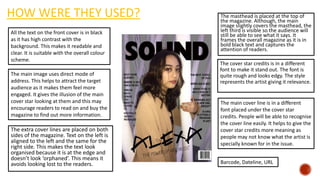
HOW WERE THEY USED? The masthead is placed at the top of
the magazine. Although, the main
image slightly covers the masthead, the
left third is visible so the audience will
still be able to see what it says. It
frames the overall magazine as it is in
bold black text and captures the
attention of readers.
The extra cover lines are placed on both
sides of the magazine. Text on the left is
aligned to the left and the same for the
right side. This makes the text look
organised because it is at the edge and
doesn’t look ‘orphaned’. This means it
avoids looking lost to the readers.
The cover star credits is in a different
font to make it stand out. The font is
quite rough and looks edgy. The style
represents the artist giving it relevance.
All the text on the front cover is in black
as it has high contrast with the
background. This makes it readable and
clear. It is suitable with the overall colour
scheme.
Barcode, Dateline, URL
The main image uses direct mode of
address. This helps to attract the target
audience as it makes them feel more
engaged. It gives the illusion of the main
cover star looking at them and this may
encourage readers to read on and buy the
magazine to find out more information.
The main cover line is in a different
font placed under the cover star
credits. People will be able to recognise
the cover line easily. It helps to give the
cover star credits more meaning as
people may not know what the artist is
specially known for in the issue.
CHALLENGES AND DEVELOPMENTS
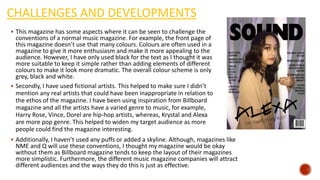
 This magazine has some aspects where it can be seen to challenge the
conventions of a normal music magazine. For example, the front page of
this magazine doesn’t use that many colours. Colours are often used in a
magazine to give it more enthusiasm and make it more appealing to the
audience. However, I have only used black for the text as I thought it was
more suitable to keep it simple rather than adding elements of different
colours to make it look more dramatic. The overall colour scheme is only
grey, black and white.
 Secondly, I have used fictional artists. This helped to make sure I didn’t
mention any real artists that could have been inappropriate in relation to
the ethos of the magazine. I have been using inspiration from Billboard
magazine and all the artists have a varied genre to music, for example,
Harry Rose, Vince, Dorel are hip-hop artists, whereas, Krystal and Alexa
are more pop genre. This helped to widen my target audience as more
people could find the magazine interesting.
 Additionally, I haven’t used any puffs or added a skyline. Although, magazines like
NME and Q will use these conventions, I thought my magazine would be okay
without them as Billboard magazine tends to keep the layout of their magazines
more simplistic. Furthermore, the different music magazine companies will attract
different audiences and the ways they do this is just as effective.
CHALLENGES AND DEVELOPMENTS
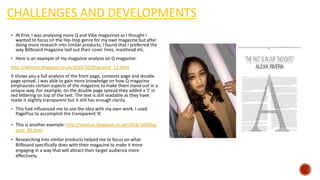
 At first, I was analysing more Q and Vibe magazines as I thought I
wanted to focus on the Hip-Hop genre for my own magazine but after
doing more research into similar products, I found that I preferred the
way Billboard magazine laid out their cover lines, masthead etc.
 Here is an example of my magazine analysis on Q magazine:
http://yelimas.blogspot.co.uk/2016/10/blog-post_12.html
It shows you a full analysis of the front page, contents page and double
page spread. I was able to gain more knowledge on how Q magazine
emphasises certain aspects of the magazine to make them stand out in a
unique way. For example, on the double page spread they added a ‘J’ in
red lettering on top of the text. The text is still readable as they have
made it slightly transparent but it still has enough clarity.
 This had influenced me to use the idea with my own work. I used
PagePlus to accomplish the transparent ‘A’.
 This is another example: http://yelimas.blogspot.co.uk/2016/10/blog-
post_90.html
 Researching into similar products helped me to focus on what
Billboard specifically does with their magazine to make it more
engaging in a way that will attract their target audience more
effectively.
CONTENTS PAGE
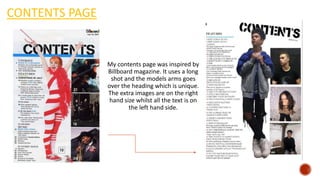
My contents page was inspired by
Billboard magazine. It uses a long
shot and the models arms goes
over the heading which is unique.
The extra images are on the right
hand size whilst all the text is on
the left hand side.
DOUBLE PAGE SPREAD
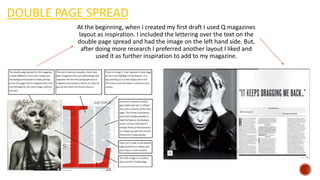
At the beginning, when I created my first draft I used Q magazines
layout as inspiration. I included the lettering over the text on the
double page spread and had the image on the left hand side. But,
after doing more research I preferred another layout I liked and
used it as further inspiration to add to my magazine.
REPRESENTATION OF SOCIAL GROUPS
 The target audience of my magazine are young adults, aged between 16-30 years old. The
magazine will appeal mostly to people who have an interest in the music genres shown on my
magazine. For example, Hip-Hop, pop, R&B. It isn’t aimed at people who have musical interest
in rock or heavy metal as it doesn’t mention anything about the genre. Billboard magazine
helped to make my magazine appeal to my target audience as it sometime has a simplistic but
effective theme but also can achieve the edgy and cool theme. From the way the artist at the
front page had to be dressed (mise-en-scene) to the type of camera shot used to achieve a
certain perspective was influenced from the research I carried out Billboard magazine.
 The magazine can be read by both male and female as the variety of artists mentioned in the
magazine help to widen the audience. The use of many fictional artists help to make sure that
the audience finds an individual that can attract their interest.
 The female artist at the front page has a casual but chic style. She isn’t dressed up but isn’t
wearing ordinary clothes at the same time. She is wearing small black dress and a long brown
coat. Fashion helps to express her individuality. Stereotypically, the audience may assume her
music is pop genre so will attract people that like her music or pop music in general.
 The magazine is targeted at a Western audience but it has no limitations on which race can read
the magazine as anyone who has an interest in the magazine can read it.
REPRESENTATION OF SOCIAL GROUPS
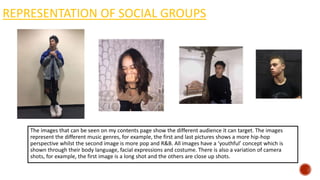
The images that can be seen on my contents page show the different audience it can target. The images
represent the different music genres, for example, the first and last pictures shows a more hip-hop
perspective whilst the second image is more pop and R&B. All images have a ‘youthful’ concept which is
shown through their body language, facial expressions and costume. There is also a variation of camera
shots, for example, the first image is a long shot and the others are close up shots.
DISTRIBUTION
 Prometheus Global Media would be the distributer of my magazine. It is a
American entertainment publishing company based in New York City. It is the
distribution company of Billboard magazine so it is fitting for my magazine.
http://www.prometheusgm.com/billboard
 PGM focuses on publishing magazines on entertainment so my magazine
would be suitable as it would be under the same genre.
 Additionally, PGM has the same target audience as my magazine, they focus
on people ages around 16-30 years old. Having the same target audience
would be most appropriate.
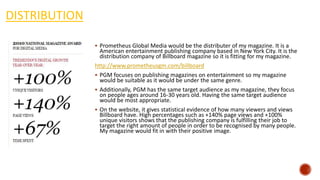
 On the website, it gives statistical evidence of how many viewers and views
Billboard have. High percentages such as +140% page views and +100%
unique visitors shows that the publishing company is fulfilling their job to
target the right amount of people in order to be recognised by many people.
My magazine would fit in with their positive image.
TARGET AUDIENCE
 My target audience are both male and females aged between 16-30 years old.
Targeting young adults was most appropriate as the artists I made create songs for the
same age group. It would be unrealistic if my artists target young adults but the target
audience for my magazine were older adults. The themes/concept of my magazine
reflected the target audience of my artists.
 When creating my magazine, I created a questionnaire to gather data on how my target
audience wanted to be seen on my magazine,
Here is the link to the results: http://yelimas.blogspot.co.uk/2016/12/research-into-
potential-target-audience.html
 I used these results to improve my work and make sure I used their suggestions to
create a product that satisfied consumer needs.
ATTRACTING THE AUDIENCE
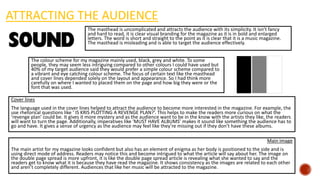
The masthead is uncomplicated and attracts the audience with its simplicity. It isn’t fancy
and hard to read, it is clear visual branding for the magazine as it is in bold and enlarged
letters. The word is short and straight to the point as it is clear that it is a music magazine.
The masthead is misleading and is able to target the audience effectively.
The colour scheme for my magazine mainly used, black, grey and white. To some
people, they may seem less intriguing compared to other colours I could have used but
40% of my target audience said they would prefer a simple colour scheme compared to
a vibrant and eye catching colour scheme. The focus of certain text like the masthead
and cover lines depended solely on the layout and appearance. So I had think more
carefully on where I wanted to placed them on the page and how big they were or the
font that was used.
Cover lines
The language used in the cover lines helped to attract the audience to become more interested in the magazine. For example, the
use rhetorical questions like ‘ IS KRIS PLOTTING A REVENGE PLAN?’. This helps to make the readers more curious on what the
‘revenge plan’ could be. It gives it more mystery and as the audience want to be in the know with the artists they like, the readers
will want to turn the page. Additionally, imperatives like ‘MUST HAVE ALBUMS’ makes it sound like something the audience has to
go and have. It gives a sense of urgency as the audience may feel like they’re missing out if they don’t have these albums.
Main image
The main artist for my magazine looks confident but also has an element of enigma as her body is positioned to the side and is
using direct mode of address. Readers may notice this and become intrigued to what the article will say about her. The image on
the double page spread is more upfront, it is like the double page spread article is revealing what she wanted to say and the
readers get to know what it is because they have read the magazine. It shows consistency as the images are related to each other
and aren’t completely different. Audiences that like her music will be attracted to the magazine.
TECHNOLOGIES
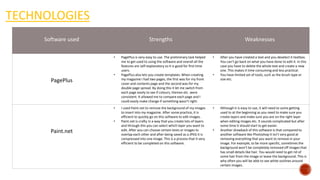
Software used Strengths Weaknesses
PagePlus
• PagePlus is very easy to use. The preliminary task helped
me to get used to using the software and overall all the
features are self-explanatory so it is good for first time
users.
• PagePlus also lets you create templates. When creating
my magazine I had two pages, the first was for my front
cover and contents page and the second was for my
double page spread. By doing this it let me switch from
each page easily to see if colours, themes etc. were
consistent. It allowed me to compare each page and I
could easily make change if something wasn’t right.
• After you have created a text and you deselect it textbox.
You can’t go back on what you have done to edit it. In this
case you have to delete the whole text and create a new
one. This makes it time consuming and less practical.
• You have limited set of tools, such as the brush type or
size etc.
Paint.net
• I used Paint.net to remove the background of my images
to insert into my magazine. After some practice, it is
efficient to quickly go on this software to edit images.
• Paint.net is crafty in a way that you create lots of layers
and through this you can select which layer you want to
edit. After you can choose certain texts or images to
overlap each other and after being saved as a JPEG it is
compressed into one image. This is a process that it very
efficient to be completed on this software.
• Although it is easy to use, it will need to some getting
used to at the beginning as you need to make sure you
create layers and make sure you are on the right layer
when editing images etc. It sounds complicated but after
some time it should start to get easier.
• Another drawback of this software is that compared to
another software like Photoshop it isn’t very good at
removing everything that you want to remove in your
image. For example, to be more specific, sometimes the
background won’t be completely removed off images that
has small details like hair. You would need to get rid of
some hair from the image or leave the background. This is
why often you will be able to see white outlines around
certain images.
TECHNOLOGIES – DRAFTING AND PLANNING
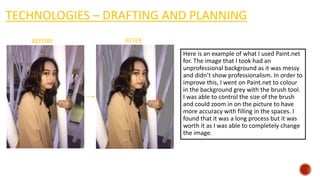
Here is an example of what I used Paint.net
for. The image that I took had an
unprofessional background as it was messy
and didn’t show professionalism. In order to
improve this, I went on Paint.net to colour
in the background grey with the brush tool.
I was able to control the size of the brush
and could zoom in on the picture to have
more accuracy with filling in the spaces. I
found that it was a long process but it was
worth it as I was able to completely change
the image.
BEFORE AFTER
PHOTOGRAPHIC CHOICES
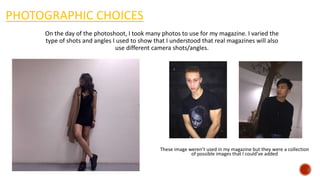
On the day of the photoshoot, I took many photos to use for my magazine. I varied the
type of shots and angles I used to show that I understood that real magazines will also
use different camera shots/angles.
These image weren’t used in my magazine but they were a collection
of possible images that I could’ve added
BLOGGER
 Blogger was a suitable way to make log of all the work I have done since the beginning of
the course until now. It allows me to easily share so it is viewable by others.
 When creating a blog post it was easy as I just had to add a title and write about what I
wanted. Also, adding JPEGs are simple so if you want to add an image it can be done very
quickly. Personally, the best way when analysing music magazines were to write in textboxes
on Publisher and just upload what I did as a picture. However, a drawback is that if you want
to write after uploading a picture it can be hard to place the text where you want it to be
because it isn’t easily moveable.
 Blogger can be accessed anywhere as long you have a compatible device and connection,
this makes working from home or school efficient.
 Overall, it is a very organised and professional way to present my work.
This is my blog: http://yelimas.blogspot.co.uk/
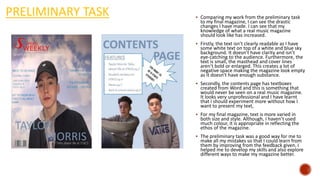
PRELIMINARY TASK  Comparing my work from the preliminary task
to my final magazine, I can see the drastic
changes I have made. I can see that my
knowledge of what a real music magazine
should look like has increased.
 Firstly, the text isn’t clearly readable as I have
some white text on top of a white and blue sky
background. It doesn’t have clarity and isn’t
eye-catching to the audience. Furthermore, the
text is small, the masthead and cover lines
aren’t bold or enlarged. This creates a lot of
negative space making the magazine look empty
as it doesn’t have enough substance.
 Secondly, the contents page has textboxes
created from Word and this is something that
would never be seen on a real music magazine.
It looks very unprofessional and I have learnt
that I should experiment more without how I
want to present my text,
 For my final magazine, text is more varied in
both size and style. Although, I haven’t used
much colour, it is appropriate in reflecting the
ethos of the magazine.
 The preliminary task was a good way for me to
make all my mistakes so that I could learn from
them by improving from the feedback given. I
helped me to develop my skills and also explore
different ways to make my magazine better.
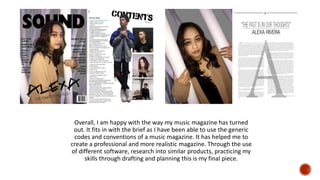
Overall, I am happy with the way my music magazine has turned
out. It fits in with the brief as I have been able to use the generic
codes and conventions of a music magazine. It has helped me to
create a professional and more realistic magazine. Through the use
of different software, research into similar products, practicing my
skills through drafting and planning this is my final piece.

Media evaluation

  • 1.
  • 4.
    USE OF GENERICCONVENTIONS  At the beginning of the course we were introduced to the generic codes and conventions used in music magazines. On our blogs, we analysed many different examples that allowed us to understand how they were really used, for example, the main image will commonly use direct mode of address on the front page as it engages the target audience immediately.  Here is an example of the work I did at the start of the course: http://yelimas.blogspot.co.uk/2016/09/research-into-similar-products-this-is_22.html  The purpose of this task was to widen our knowledge on what is normally seen/used on a music magazine. Through this activity, I am now able to name and describe the purpose of why companies will use these codes and conventions.  It has further helped me with my own music magazine as I know where to place main cover lines, extra cover lines, mastheads etc.
  • 5.
    HOW WERE THEYUSED? The masthead is placed at the top of the magazine. Although, the main image slightly covers the masthead, the left third is visible so the audience will still be able to see what it says. It frames the overall magazine as it is in bold black text and captures the attention of readers. The extra cover lines are placed on both sides of the magazine. Text on the left is aligned to the left and the same for the right side. This makes the text look organised because it is at the edge and doesn’t look ‘orphaned’. This means it avoids looking lost to the readers. The cover star credits is in a different font to make it stand out. The font is quite rough and looks edgy. The style represents the artist giving it relevance. All the text on the front cover is in black as it has high contrast with the background. This makes it readable and clear. It is suitable with the overall colour scheme. Barcode, Dateline, URL The main image uses direct mode of address. This helps to attract the target audience as it makes them feel more engaged. It gives the illusion of the main cover star looking at them and this may encourage readers to read on and buy the magazine to find out more information. The main cover line is in a different font placed under the cover star credits. People will be able to recognise the cover line easily. It helps to give the cover star credits more meaning as people may not know what the artist is specially known for in the issue.
  • 6.
    CHALLENGES AND DEVELOPMENTS This magazine has some aspects where it can be seen to challenge the conventions of a normal music magazine. For example, the front page of this magazine doesn’t use that many colours. Colours are often used in a magazine to give it more enthusiasm and make it more appealing to the audience. However, I have only used black for the text as I thought it was more suitable to keep it simple rather than adding elements of different colours to make it look more dramatic. The overall colour scheme is only grey, black and white.  Secondly, I have used fictional artists. This helped to make sure I didn’t mention any real artists that could have been inappropriate in relation to the ethos of the magazine. I have been using inspiration from Billboard magazine and all the artists have a varied genre to music, for example, Harry Rose, Vince, Dorel are hip-hop artists, whereas, Krystal and Alexa are more pop genre. This helped to widen my target audience as more people could find the magazine interesting.  Additionally, I haven’t used any puffs or added a skyline. Although, magazines like NME and Q will use these conventions, I thought my magazine would be okay without them as Billboard magazine tends to keep the layout of their magazines more simplistic. Furthermore, the different music magazine companies will attract different audiences and the ways they do this is just as effective.
  • 7.
    CHALLENGES AND DEVELOPMENTS At first, I was analysing more Q and Vibe magazines as I thought I wanted to focus on the Hip-Hop genre for my own magazine but after doing more research into similar products, I found that I preferred the way Billboard magazine laid out their cover lines, masthead etc.  Here is an example of my magazine analysis on Q magazine: http://yelimas.blogspot.co.uk/2016/10/blog-post_12.html It shows you a full analysis of the front page, contents page and double page spread. I was able to gain more knowledge on how Q magazine emphasises certain aspects of the magazine to make them stand out in a unique way. For example, on the double page spread they added a ‘J’ in red lettering on top of the text. The text is still readable as they have made it slightly transparent but it still has enough clarity.  This had influenced me to use the idea with my own work. I used PagePlus to accomplish the transparent ‘A’.  This is another example: http://yelimas.blogspot.co.uk/2016/10/blog- post_90.html  Researching into similar products helped me to focus on what Billboard specifically does with their magazine to make it more engaging in a way that will attract their target audience more effectively.
  • 8.
    CONTENTS PAGE My contentspage was inspired by Billboard magazine. It uses a long shot and the models arms goes over the heading which is unique. The extra images are on the right hand size whilst all the text is on the left hand side.
  • 9.
    DOUBLE PAGE SPREAD Atthe beginning, when I created my first draft I used Q magazines layout as inspiration. I included the lettering over the text on the double page spread and had the image on the left hand side. But, after doing more research I preferred another layout I liked and used it as further inspiration to add to my magazine.
  • 11.
    REPRESENTATION OF SOCIALGROUPS  The target audience of my magazine are young adults, aged between 16-30 years old. The magazine will appeal mostly to people who have an interest in the music genres shown on my magazine. For example, Hip-Hop, pop, R&B. It isn’t aimed at people who have musical interest in rock or heavy metal as it doesn’t mention anything about the genre. Billboard magazine helped to make my magazine appeal to my target audience as it sometime has a simplistic but effective theme but also can achieve the edgy and cool theme. From the way the artist at the front page had to be dressed (mise-en-scene) to the type of camera shot used to achieve a certain perspective was influenced from the research I carried out Billboard magazine.  The magazine can be read by both male and female as the variety of artists mentioned in the magazine help to widen the audience. The use of many fictional artists help to make sure that the audience finds an individual that can attract their interest.  The female artist at the front page has a casual but chic style. She isn’t dressed up but isn’t wearing ordinary clothes at the same time. She is wearing small black dress and a long brown coat. Fashion helps to express her individuality. Stereotypically, the audience may assume her music is pop genre so will attract people that like her music or pop music in general.  The magazine is targeted at a Western audience but it has no limitations on which race can read the magazine as anyone who has an interest in the magazine can read it.
  • 12.
    REPRESENTATION OF SOCIALGROUPS The images that can be seen on my contents page show the different audience it can target. The images represent the different music genres, for example, the first and last pictures shows a more hip-hop perspective whilst the second image is more pop and R&B. All images have a ‘youthful’ concept which is shown through their body language, facial expressions and costume. There is also a variation of camera shots, for example, the first image is a long shot and the others are close up shots.
  • 14.
    DISTRIBUTION  Prometheus GlobalMedia would be the distributer of my magazine. It is a American entertainment publishing company based in New York City. It is the distribution company of Billboard magazine so it is fitting for my magazine. http://www.prometheusgm.com/billboard  PGM focuses on publishing magazines on entertainment so my magazine would be suitable as it would be under the same genre.  Additionally, PGM has the same target audience as my magazine, they focus on people ages around 16-30 years old. Having the same target audience would be most appropriate.  On the website, it gives statistical evidence of how many viewers and views Billboard have. High percentages such as +140% page views and +100% unique visitors shows that the publishing company is fulfilling their job to target the right amount of people in order to be recognised by many people. My magazine would fit in with their positive image.
  • 16.
    TARGET AUDIENCE  Mytarget audience are both male and females aged between 16-30 years old. Targeting young adults was most appropriate as the artists I made create songs for the same age group. It would be unrealistic if my artists target young adults but the target audience for my magazine were older adults. The themes/concept of my magazine reflected the target audience of my artists.  When creating my magazine, I created a questionnaire to gather data on how my target audience wanted to be seen on my magazine, Here is the link to the results: http://yelimas.blogspot.co.uk/2016/12/research-into- potential-target-audience.html  I used these results to improve my work and make sure I used their suggestions to create a product that satisfied consumer needs.
  • 18.
    ATTRACTING THE AUDIENCE Themasthead is uncomplicated and attracts the audience with its simplicity. It isn’t fancy and hard to read, it is clear visual branding for the magazine as it is in bold and enlarged letters. The word is short and straight to the point as it is clear that it is a music magazine. The masthead is misleading and is able to target the audience effectively. The colour scheme for my magazine mainly used, black, grey and white. To some people, they may seem less intriguing compared to other colours I could have used but 40% of my target audience said they would prefer a simple colour scheme compared to a vibrant and eye catching colour scheme. The focus of certain text like the masthead and cover lines depended solely on the layout and appearance. So I had think more carefully on where I wanted to placed them on the page and how big they were or the font that was used. Cover lines The language used in the cover lines helped to attract the audience to become more interested in the magazine. For example, the use rhetorical questions like ‘ IS KRIS PLOTTING A REVENGE PLAN?’. This helps to make the readers more curious on what the ‘revenge plan’ could be. It gives it more mystery and as the audience want to be in the know with the artists they like, the readers will want to turn the page. Additionally, imperatives like ‘MUST HAVE ALBUMS’ makes it sound like something the audience has to go and have. It gives a sense of urgency as the audience may feel like they’re missing out if they don’t have these albums. Main image The main artist for my magazine looks confident but also has an element of enigma as her body is positioned to the side and is using direct mode of address. Readers may notice this and become intrigued to what the article will say about her. The image on the double page spread is more upfront, it is like the double page spread article is revealing what she wanted to say and the readers get to know what it is because they have read the magazine. It shows consistency as the images are related to each other and aren’t completely different. Audiences that like her music will be attracted to the magazine.
  • 20.
    TECHNOLOGIES Software used StrengthsWeaknesses PagePlus • PagePlus is very easy to use. The preliminary task helped me to get used to using the software and overall all the features are self-explanatory so it is good for first time users. • PagePlus also lets you create templates. When creating my magazine I had two pages, the first was for my front cover and contents page and the second was for my double page spread. By doing this it let me switch from each page easily to see if colours, themes etc. were consistent. It allowed me to compare each page and I could easily make change if something wasn’t right. • After you have created a text and you deselect it textbox. You can’t go back on what you have done to edit it. In this case you have to delete the whole text and create a new one. This makes it time consuming and less practical. • You have limited set of tools, such as the brush type or size etc. Paint.net • I used Paint.net to remove the background of my images to insert into my magazine. After some practice, it is efficient to quickly go on this software to edit images. • Paint.net is crafty in a way that you create lots of layers and through this you can select which layer you want to edit. After you can choose certain texts or images to overlap each other and after being saved as a JPEG it is compressed into one image. This is a process that it very efficient to be completed on this software. • Although it is easy to use, it will need to some getting used to at the beginning as you need to make sure you create layers and make sure you are on the right layer when editing images etc. It sounds complicated but after some time it should start to get easier. • Another drawback of this software is that compared to another software like Photoshop it isn’t very good at removing everything that you want to remove in your image. For example, to be more specific, sometimes the background won’t be completely removed off images that has small details like hair. You would need to get rid of some hair from the image or leave the background. This is why often you will be able to see white outlines around certain images.
  • 21.
    TECHNOLOGIES – DRAFTINGAND PLANNING Here is an example of what I used Paint.net for. The image that I took had an unprofessional background as it was messy and didn’t show professionalism. In order to improve this, I went on Paint.net to colour in the background grey with the brush tool. I was able to control the size of the brush and could zoom in on the picture to have more accuracy with filling in the spaces. I found that it was a long process but it was worth it as I was able to completely change the image. BEFORE AFTER
  • 22.
    PHOTOGRAPHIC CHOICES On theday of the photoshoot, I took many photos to use for my magazine. I varied the type of shots and angles I used to show that I understood that real magazines will also use different camera shots/angles. These image weren’t used in my magazine but they were a collection of possible images that I could’ve added
  • 23.
    BLOGGER  Blogger wasa suitable way to make log of all the work I have done since the beginning of the course until now. It allows me to easily share so it is viewable by others.  When creating a blog post it was easy as I just had to add a title and write about what I wanted. Also, adding JPEGs are simple so if you want to add an image it can be done very quickly. Personally, the best way when analysing music magazines were to write in textboxes on Publisher and just upload what I did as a picture. However, a drawback is that if you want to write after uploading a picture it can be hard to place the text where you want it to be because it isn’t easily moveable.  Blogger can be accessed anywhere as long you have a compatible device and connection, this makes working from home or school efficient.  Overall, it is a very organised and professional way to present my work. This is my blog: http://yelimas.blogspot.co.uk/
  • 25.
    PRELIMINARY TASK Comparing my work from the preliminary task to my final magazine, I can see the drastic changes I have made. I can see that my knowledge of what a real music magazine should look like has increased.  Firstly, the text isn’t clearly readable as I have some white text on top of a white and blue sky background. It doesn’t have clarity and isn’t eye-catching to the audience. Furthermore, the text is small, the masthead and cover lines aren’t bold or enlarged. This creates a lot of negative space making the magazine look empty as it doesn’t have enough substance.  Secondly, the contents page has textboxes created from Word and this is something that would never be seen on a real music magazine. It looks very unprofessional and I have learnt that I should experiment more without how I want to present my text,  For my final magazine, text is more varied in both size and style. Although, I haven’t used much colour, it is appropriate in reflecting the ethos of the magazine.  The preliminary task was a good way for me to make all my mistakes so that I could learn from them by improving from the feedback given. I helped me to develop my skills and also explore different ways to make my magazine better.
  • 27.
    Overall, I amhappy with the way my music magazine has turned out. It fits in with the brief as I have been able to use the generic codes and conventions of a music magazine. It has helped me to create a professional and more realistic magazine. Through the use of different software, research into similar products, practicing my skills through drafting and planning this is my final piece.