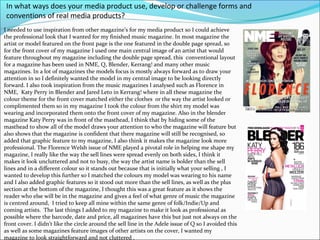
I needed to use inspiration from other magazine’s for my media product so I could achieve
the professional look that I wanted for my finished music magazine. In most magazine the
artist or model featured on the front page is the one featured in the double page spread, so
for the front cover of my magazine I used one main central image of an artist that would
feature throughout my magazine including the double page spread, this conventional layout
for a magazine has been used in NME, Q, Blender, Kerrang! and many other music
magazines. In a lot of magazines the models focus is mostly always forward as to draw your
attention in so I definitely wanted the model in my central image to be looking directly
forward. I also took inspiration from the music magazines I analysed such as Florence in
NME, Katy Perry in Blender and Jared Leto in Kerrang! where in all these magazine the
colour theme for the front cover matched either the clothes or the way the artist looked or
complimented them so in my magazine I took the colour from the shirt my model was
wearing and incorporated them onto the front cover of my magazine. Also in the blender
magazine Katy Perry was in front of the masthead, I think that by hiding some of the
masthead to show all of the model draws your attention to who the magazine will feature but
also shows that the magazine is confident that there magazine will still be recognised, so
added that graphic feature to my magazine, I also think it makes the magazine look more
professional. The Florence Welsh issue of NME played a pivotal role in helping me shape my
magazine, I really like the way the sell lines were spread evenly on both sides, I think it
makes it look uncluttered and not to busy, the way the artist name is bolder than the sell
lines and in a different colour so it stands out because that is initially what your selling , I
wanted to develop this further so I matched the colours my model was wearing to his name
and I also added graphic features so it stood out more than the sell lines, as well as the plus
section at the bottom of the magazine, I thought this was a great feature as it shows the
reader who else will be in the magazine and gives a feel of what genre of music the magazine
is centred around, I tried to keep all mine within the same genre of folk/Indie/Up and
coming artists. The last things I added to my magazine to make it look as professional as
possible where the barcode, date and price, all magazines have this but just not always on the
front cover. I didn’t like the circle around the sell line in the Adele issue of Q so I avoided this
as well as some magazines feature images of other artists on the cover, I wanted my
magazine to look straightforward and not cluttered .
In what ways does your media product use, develop or challenge forms and
conventions of real media products?
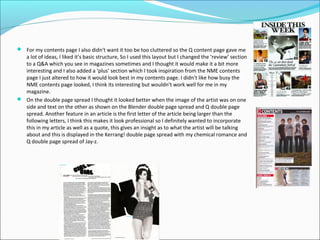
 For my contents page I also didn't want it too be too cluttered so the Q content page gave me
a lot of ideas, I liked it’s basic structure, So I used this layout but I changed the ‘review’ section
to a Q&A which you see in magazines sometimes and I thought it would make it a bit more
interesting and I also added a ‘plus’ section which I took inspiration from the NME contents
page I just altered to how it would look best in my contents page. I didn’t like how busy the
NME contents page looked, I think its interesting but wouldn’t work well for me in my
magazine.
 On the double page spread I thought it looked better when the image of the artist was on one
side and text on the other as shown on the Blender double page spread and Q double page
spread. Another feature in an article is the first letter of the article being larger than the
following letters, I think this makes it look professional so I definitely wanted to incorporate
this in my article as well as a quote, this gives an insight as to what the artist will be talking
about and this is displayed in the Kerrang! double page spread with my chemical romance and
Q double page spread of Jay-z.
How does your media product represent
particular social groups?
 For my college magazine I did survey and I analysed the results to see who to aim my magazine at
and what they would like, the age range was 10-16 but I mostly aimed it a college students and the
largest percentage said the other types of magazine they buy Is fashion, they said they most
enjoying looking at images, the majority of them said they was also interested in music and they
would like to see the magazine bold, colourful and informative, the people who answered this
survey were all students, so the survey gave me a good idea of what social group to aim at; student,
teenagers and young adults and what they would like to see in a college magazine, So I put a
student as the central image who was dressed smart but still fashionable so all students can relate
and I added a quote ‘I never thought I could get here’ so it would reach out to struggling students
and inspire them to keep working hard and that they will succeed, I also added another picture of
another two students and there achievements in outer curriculum activities. I named it ‘The
College’ but showed that is was a CWA (College of West Anglia) magazine, to show students that it
will have information and advice applicable to there college. I also wanted to target smaller social
groups by mentioning fashion, an agony column, scholarships, study tips and music charts.
 For my music magazine I took a different approach, I decided to portray the model on the front
cover as a folk/indie artist and then I shaped the rest the bands around this. The social group this
aims at are a wide variety, I’ve mentioned bands on the front cover so If spotted by someone who
were interested in that particular band they would automatically be interested and most likely
people of there social group would be too. The social groups my music magazine appeals to is Indie,
Indie Rock, Classic Rock, Dance and folk which covers people of many ages, plus the articles I
included about Glastonbury and V festival will appeal to social groups of people who go to festivals,
a gig guide for people who are interested in going to gigs, ‘Twitter Loves’ which in modern day will
appeal to a large variety of people because of how common social networks are in today's society
What kind of media institution might distribute
your media product and why?
Because of the wide variety of social groups my
magazine appeals to it could be distributed in
supermarkets because of its diversity of the music
presented in the magazine and WHSmith, HMV
and many other high street retailers. WHSmith
would be an ideal high-street store to distribute
my magazine as it has many more magazines than
you would find in supermarkets, it appeals to a
wider demographic. A media institution that
would be good to distribute my magazines is
Bauer Media distributors this is because the wide
variety of magazines that they sell, such as
Kerrang!, kiss, mojo and then a many others such
as bird watching and angling times, from this you
can see that they distribute a diverse mix of
magazines.
Who would be the audience for your
media product?
For my college magazine the target audience is aimed at 15-20
year olds, preferably students, teenagers and young adults.
Throughout I've tried to apply the colour scheme, images
used, terminology and articles to this criteria.
For my music magazine the target audience is probably from
the ages of sixteen to middle age, not that it wouldn’t
particularly appeal to elderly people but a few of the bands
mentioned are from a new era of dance/rock music which is
not to everyone's taste. I think posters would appeal to
students (college and university) and the artist who is featured
on the cover is going to mentioning his love life in the double
page spread so that would be driven towards more of a
mature audience. Also in the contents ‘Gig guides’, ‘Festival
Must-Haves’ and articles about Glastonbury, T in the park and
V festival are mentioned, so it would appeal to 16-17 year olds
onwards.
How did you attract/address your audience?
 On the front cover of my college magazine I tried to attract and address my audience by presenting
things that I think they will be interested in, I put a headline above the masthead stating that it was
‘The college of west Anglia magazine’ this is to attract students and show that in the magazine there
will be things that they can relate to and are effecting them directly at there college, that they will
be tackling issues that effect them. I also tried to attract them with the sell lines, in one of the sell
lines I mention two local boys who have created there own fashion line and that it is doing well, this
appeals to people interested in fashion, starting there own fashion lines and Shows people that
people from their area have achieved something significant. There is also ‘what's on at college’ this is
to show students that maybe there is more going on at college then they realise and the ‘agony
aunt’ section is to appeal to students who have no one to confine in or relate too, being a student
can be a turbulent time in your life so this section is there to attract students and make them feel
they have someone to talk to. The central image of the student and the caption ‘I never thought I
could get here’ is to promote hard work at college and to show students that if they put the effort in
it’ll be worth it in the long run. On the contents page I have a features that relate to education
(scholarships, study tips, ‘where are you going from here’) this is to attract students and give them
advice.
What have you learnt about technologies from
the process of constructing this product?
At the beginning of this course I had no knowledge
of how to use Photoshop so this was a opportunity
to learn. There are many tools and features in
Photoshop that made my magazine look more
professional as opposed to using Microsoft
(publisher, word ect.) for example on my music
magazine front cover, I used the eraser tool on
Photoshop to give the illusion of the masthead being
behind the models head. I also needed to use Mac’s
to download fonts and use Photoshop to edit my
photos. I used an online blog to show the process
and progress of my work because it was easier to
access and edit.
Looking back at your preliminary task, what do you feel you have
learnt in the progression from it to the full product?
In my college magazine I started of with very limited
knowledge of how to use Photoshop and work on
Mac’s so my college magazine was produced entirely
on Microsoft using Word, the end result was as good as
it could have been but using Photoshop for my College
magazine would have made it look more professional.
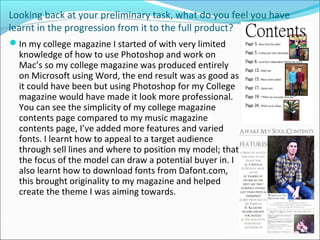
You can see the simplicity of my college magazine
contents page compared to my music magazine
contents page, I’ve added more features and varied
fonts. I learnt how to appeal to a target audience
through sell lines and where to position my model; that
the focus of the model can draw a potential buyer in. I
also learnt how to download fonts from Dafont.com,
this brought originality to my magazine and helped
create the theme I was aiming towards.
Audience Feedback
 Having audience feedback definitely played a pivotal role in
constructing my magazines for my media project, it helped
me decide on important features of my magazine e.g what
artists to use, colours, font size ect. and it also helped me
with smaller graphic features.
 In my college magazine I used survey monkey to make a
survey and find out who to target my magazine at, what
would be best featured in it and why. This helped my gain a
wide range of views and collective ideas.
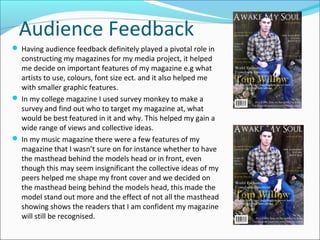
 In my music magazine there were a few features of my
magazine that I wasn’t sure on for instance whether to have
the masthead behind the models head or in front, even
though this may seem insignificant the collective ideas of my
peers helped me shape my front cover and we decided on
the masthead being behind the models head, this made the
model stand out more and the effect of not all the masthead
showing shows the readers that I am confident my magazine
will still be recognised.

Evaluation

  • 2.
    I needed touse inspiration from other magazine’s for my media product so I could achieve the professional look that I wanted for my finished music magazine. In most magazine the artist or model featured on the front page is the one featured in the double page spread, so for the front cover of my magazine I used one main central image of an artist that would feature throughout my magazine including the double page spread, this conventional layout for a magazine has been used in NME, Q, Blender, Kerrang! and many other music magazines. In a lot of magazines the models focus is mostly always forward as to draw your attention in so I definitely wanted the model in my central image to be looking directly forward. I also took inspiration from the music magazines I analysed such as Florence in NME, Katy Perry in Blender and Jared Leto in Kerrang! where in all these magazine the colour theme for the front cover matched either the clothes or the way the artist looked or complimented them so in my magazine I took the colour from the shirt my model was wearing and incorporated them onto the front cover of my magazine. Also in the blender magazine Katy Perry was in front of the masthead, I think that by hiding some of the masthead to show all of the model draws your attention to who the magazine will feature but also shows that the magazine is confident that there magazine will still be recognised, so added that graphic feature to my magazine, I also think it makes the magazine look more professional. The Florence Welsh issue of NME played a pivotal role in helping me shape my magazine, I really like the way the sell lines were spread evenly on both sides, I think it makes it look uncluttered and not to busy, the way the artist name is bolder than the sell lines and in a different colour so it stands out because that is initially what your selling , I wanted to develop this further so I matched the colours my model was wearing to his name and I also added graphic features so it stood out more than the sell lines, as well as the plus section at the bottom of the magazine, I thought this was a great feature as it shows the reader who else will be in the magazine and gives a feel of what genre of music the magazine is centred around, I tried to keep all mine within the same genre of folk/Indie/Up and coming artists. The last things I added to my magazine to make it look as professional as possible where the barcode, date and price, all magazines have this but just not always on the front cover. I didn’t like the circle around the sell line in the Adele issue of Q so I avoided this as well as some magazines feature images of other artists on the cover, I wanted my magazine to look straightforward and not cluttered . In what ways does your media product use, develop or challenge forms and conventions of real media products?
  • 3.
     For mycontents page I also didn't want it too be too cluttered so the Q content page gave me a lot of ideas, I liked it’s basic structure, So I used this layout but I changed the ‘review’ section to a Q&A which you see in magazines sometimes and I thought it would make it a bit more interesting and I also added a ‘plus’ section which I took inspiration from the NME contents page I just altered to how it would look best in my contents page. I didn’t like how busy the NME contents page looked, I think its interesting but wouldn’t work well for me in my magazine.  On the double page spread I thought it looked better when the image of the artist was on one side and text on the other as shown on the Blender double page spread and Q double page spread. Another feature in an article is the first letter of the article being larger than the following letters, I think this makes it look professional so I definitely wanted to incorporate this in my article as well as a quote, this gives an insight as to what the artist will be talking about and this is displayed in the Kerrang! double page spread with my chemical romance and Q double page spread of Jay-z.
  • 4.
    How does yourmedia product represent particular social groups?  For my college magazine I did survey and I analysed the results to see who to aim my magazine at and what they would like, the age range was 10-16 but I mostly aimed it a college students and the largest percentage said the other types of magazine they buy Is fashion, they said they most enjoying looking at images, the majority of them said they was also interested in music and they would like to see the magazine bold, colourful and informative, the people who answered this survey were all students, so the survey gave me a good idea of what social group to aim at; student, teenagers and young adults and what they would like to see in a college magazine, So I put a student as the central image who was dressed smart but still fashionable so all students can relate and I added a quote ‘I never thought I could get here’ so it would reach out to struggling students and inspire them to keep working hard and that they will succeed, I also added another picture of another two students and there achievements in outer curriculum activities. I named it ‘The College’ but showed that is was a CWA (College of West Anglia) magazine, to show students that it will have information and advice applicable to there college. I also wanted to target smaller social groups by mentioning fashion, an agony column, scholarships, study tips and music charts.  For my music magazine I took a different approach, I decided to portray the model on the front cover as a folk/indie artist and then I shaped the rest the bands around this. The social group this aims at are a wide variety, I’ve mentioned bands on the front cover so If spotted by someone who were interested in that particular band they would automatically be interested and most likely people of there social group would be too. The social groups my music magazine appeals to is Indie, Indie Rock, Classic Rock, Dance and folk which covers people of many ages, plus the articles I included about Glastonbury and V festival will appeal to social groups of people who go to festivals, a gig guide for people who are interested in going to gigs, ‘Twitter Loves’ which in modern day will appeal to a large variety of people because of how common social networks are in today's society
  • 5.
    What kind ofmedia institution might distribute your media product and why? Because of the wide variety of social groups my magazine appeals to it could be distributed in supermarkets because of its diversity of the music presented in the magazine and WHSmith, HMV and many other high street retailers. WHSmith would be an ideal high-street store to distribute my magazine as it has many more magazines than you would find in supermarkets, it appeals to a wider demographic. A media institution that would be good to distribute my magazines is Bauer Media distributors this is because the wide variety of magazines that they sell, such as Kerrang!, kiss, mojo and then a many others such as bird watching and angling times, from this you can see that they distribute a diverse mix of magazines.
  • 6.
    Who would bethe audience for your media product? For my college magazine the target audience is aimed at 15-20 year olds, preferably students, teenagers and young adults. Throughout I've tried to apply the colour scheme, images used, terminology and articles to this criteria. For my music magazine the target audience is probably from the ages of sixteen to middle age, not that it wouldn’t particularly appeal to elderly people but a few of the bands mentioned are from a new era of dance/rock music which is not to everyone's taste. I think posters would appeal to students (college and university) and the artist who is featured on the cover is going to mentioning his love life in the double page spread so that would be driven towards more of a mature audience. Also in the contents ‘Gig guides’, ‘Festival Must-Haves’ and articles about Glastonbury, T in the park and V festival are mentioned, so it would appeal to 16-17 year olds onwards.
  • 7.
    How did youattract/address your audience?  On the front cover of my college magazine I tried to attract and address my audience by presenting things that I think they will be interested in, I put a headline above the masthead stating that it was ‘The college of west Anglia magazine’ this is to attract students and show that in the magazine there will be things that they can relate to and are effecting them directly at there college, that they will be tackling issues that effect them. I also tried to attract them with the sell lines, in one of the sell lines I mention two local boys who have created there own fashion line and that it is doing well, this appeals to people interested in fashion, starting there own fashion lines and Shows people that people from their area have achieved something significant. There is also ‘what's on at college’ this is to show students that maybe there is more going on at college then they realise and the ‘agony aunt’ section is to appeal to students who have no one to confine in or relate too, being a student can be a turbulent time in your life so this section is there to attract students and make them feel they have someone to talk to. The central image of the student and the caption ‘I never thought I could get here’ is to promote hard work at college and to show students that if they put the effort in it’ll be worth it in the long run. On the contents page I have a features that relate to education (scholarships, study tips, ‘where are you going from here’) this is to attract students and give them advice.
  • 8.
    What have youlearnt about technologies from the process of constructing this product? At the beginning of this course I had no knowledge of how to use Photoshop so this was a opportunity to learn. There are many tools and features in Photoshop that made my magazine look more professional as opposed to using Microsoft (publisher, word ect.) for example on my music magazine front cover, I used the eraser tool on Photoshop to give the illusion of the masthead being behind the models head. I also needed to use Mac’s to download fonts and use Photoshop to edit my photos. I used an online blog to show the process and progress of my work because it was easier to access and edit.
  • 9.
    Looking back atyour preliminary task, what do you feel you have learnt in the progression from it to the full product? In my college magazine I started of with very limited knowledge of how to use Photoshop and work on Mac’s so my college magazine was produced entirely on Microsoft using Word, the end result was as good as it could have been but using Photoshop for my College magazine would have made it look more professional. You can see the simplicity of my college magazine contents page compared to my music magazine contents page, I’ve added more features and varied fonts. I learnt how to appeal to a target audience through sell lines and where to position my model; that the focus of the model can draw a potential buyer in. I also learnt how to download fonts from Dafont.com, this brought originality to my magazine and helped create the theme I was aiming towards.
  • 10.
    Audience Feedback  Havingaudience feedback definitely played a pivotal role in constructing my magazines for my media project, it helped me decide on important features of my magazine e.g what artists to use, colours, font size ect. and it also helped me with smaller graphic features.  In my college magazine I used survey monkey to make a survey and find out who to target my magazine at, what would be best featured in it and why. This helped my gain a wide range of views and collective ideas.  In my music magazine there were a few features of my magazine that I wasn’t sure on for instance whether to have the masthead behind the models head or in front, even though this may seem insignificant the collective ideas of my peers helped me shape my front cover and we decided on the masthead being behind the models head, this made the model stand out more and the effect of not all the masthead showing shows the readers that I am confident my magazine will still be recognised.