MED-341:
Acute Leukaemia
Professor Abdulkareem Almomen, MD, FRCPC
(March 2011)
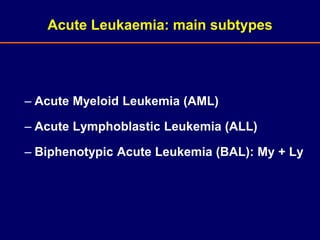
– Acute Myeloid Leukemia (AML)
– Acute Lymphoblastic Leukemia (ALL)
– Biphenotypic Acute Leukemia (BAL): My + Ly
Acute Leukaemia: main subtypes
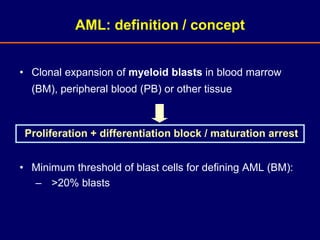
• Clonal expansion of myeloid blasts in blood marrow
(BM), peripheral blood (PB) or other tissue
• Minimum threshold of blast cells for defining AML (BM):
– >20% blasts
AML: definition / concept
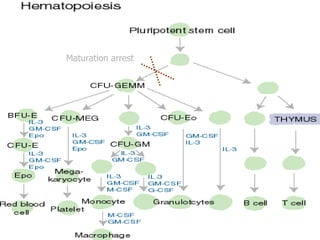
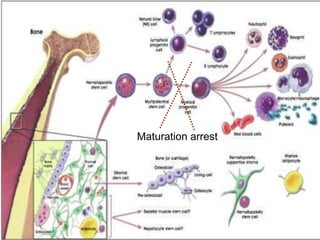
Proliferation + differentiation block / maturation arrest
Maturation arrest
Maturation arrest
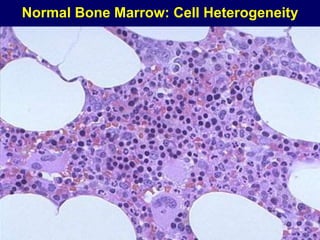
Normal Bone Marrow: Cell Heterogeneity
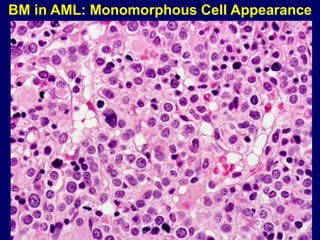
BM in AML: Monomorphous Cell Appearance
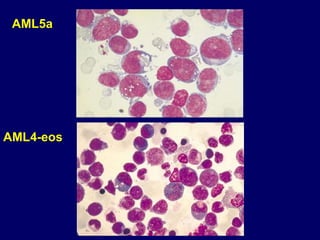
AML5a
AML4-eos
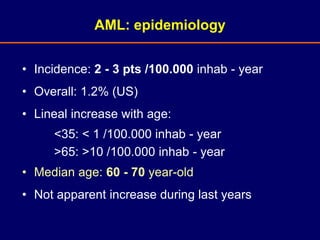
• Incidence: 2 - 3 pts /100.000 inhab - year
• Overall: 1.2% (US)
• Lineal increase with age:
<35: < 1 /100.000 inhab - year
>65: >10 /100.000 inhab - year
• Median age: 60 - 70 year-old
• Not apparent increase during last years
AML: epidemiology
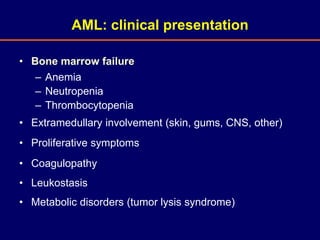
• Bone marrow failure
– Anemia
– Neutropenia
– Thrombocytopenia
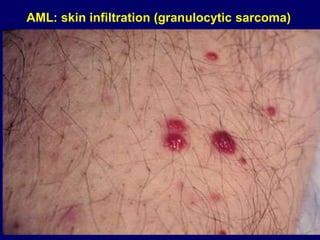
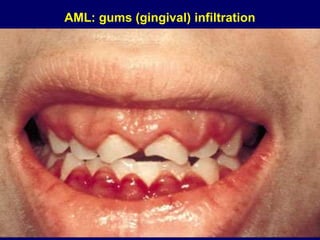
• Extramedullary involvement (skin, gums, CNS, other)
• Proliferative symptoms
• Coagulopathy
• Leukostasis
• Metabolic disorders (tumor lysis syndrome)
AML: clinical presentation
AML: skin infiltration (granulocytic sarcoma)
AML: gums (gingival) infiltration
Acute Myeloid Leukemia (AML)
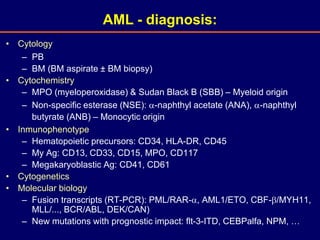
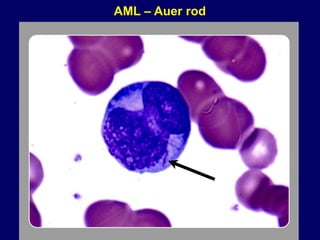
• Cytology
– PB
– BM (BM aspirate ± BM biopsy)
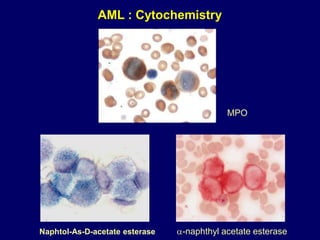
• Cytochemistry
– MPO (myeloperoxidase) & Sudan Black B (SBB) – Myeloid origin
– Non-specific esterase (NSE): -naphthyl acetate (ANA), -naphthyl
butyrate (ANB) – Monocytic origin
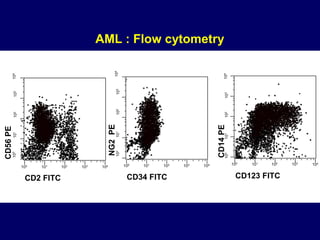
• Inmunophenotype
– Hematopoietic precursors: CD34, HLA-DR, CD45
– My Ag: CD13, CD33, CD15, MPO, CD117
– Megakaryoblastic Ag: CD41, CD61
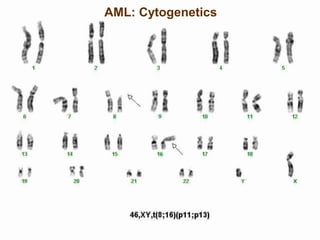
• Cytogenetics
• Molecular biology
– Fusion transcripts (RT-PCR): PML/RAR-, AML1/ETO, CBF-/MYH11,
MLL/..., BCR/ABL, DEK/CAN)
– New mutations with prognostic impact: flt-3-ITD, CEBPalfa, NPM, …
AML - diagnosis:
AML – Auer rod
MPO
Naphtol-As-D-acetate esterase -naphthyl acetate esterase
AML : Cytochemistry
CD56
PE
100 101 102 103 104
CD2 FITC
10
0
10
1
10
2
10
3
10
4
NG2
PE
100 101 102 103 104
CD34 FITC
10
0
10
1
10
2
10
3
10
4
CD14
PE
100 101 102 103
104
CD123 FITC
10
0
10
1
10
2
10
3
10
4
AML : Flow cytometry
AML: Cytogenetics
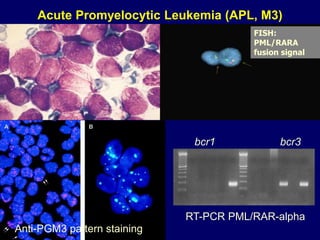
Acute Promyelocytic Leukemia (APL, M3)
bcr1 bcr3
RT-PCR PML/RAR-alpha
FISH:
PML/RARA
fusion signal
Anti-PGM3 pattern staining
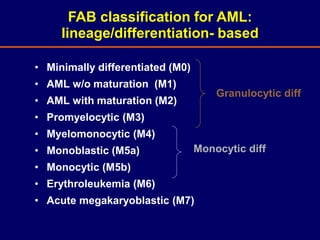
• Minimally differentiated (M0)
• AML w/o maturation (M1)
• AML with maturation (M2)
• Promyelocytic (M3)
• Myelomonocytic (M4)
• Monoblastic (M5a)
• Monocytic (M5b)
• Erythroleukemia (M6)
• Acute megakaryoblastic (M7)
FAB classification for AML:
lineage/differentiation- based
Granulocytic diff
Monocytic diff
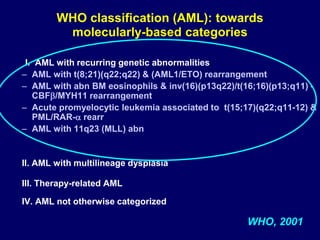
I. AML with recurring genetic abnormalities
– AML with t(8;21)(q22;q22) & (AML1/ETO) rearrangement
– AML with abn BM eosinophils & inv(16)(p13q22)/t(16;16)(p13;q11) -
CBF/MYH11 rearrangement
– Acute promyelocytic leukemia associated to t(15;17)(q22;q11-12) &
PML/RAR- rearr
– AML with 11q23 (MLL) abn
II. AML with multilineage dysplasia
III. Therapy-related AML
IV. AML not otherwise categorized
WHO, 2001
WHO classification (AML): towards
molecularly-based categories
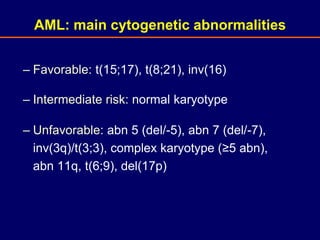
– Favorable: t(15;17), t(8;21), inv(16)
– Intermediate risk: normal karyotype
– Unfavorable: abn 5 (del/-5), abn 7 (del/-7),
inv(3q)/t(3;3), complex karyotype (≥5 abn),
abn 11q, t(6;9), del(17p)
AML: main cytogenetic abnormalities
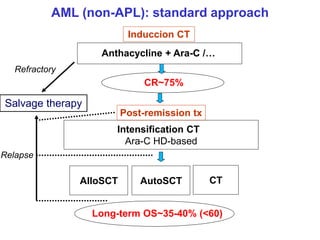
AML (non-APL): standard approach
Intensification CT
Ara-C HD-based
Post-remission tx
AlloSCT AutoSCT CT
Induccion CT
Anthacycline + Ara-C /…
CR~75%
Long-term OS~35-40% (<60)
Salvage therapy
Refractory
Relapse
Acute Lymphoblastic Leukemia (ALL)
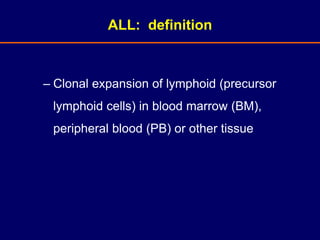
ALL: definition
– Clonal expansion of lymphoid (precursor
lymphoid cells) in blood marrow (BM),
peripheral blood (PB) or other tissue
ALL: main subtypes
– B-cell ALL / precursor B lymphoblastic leukemia
– T-cell ALL / precursor T lymphoblastic leukemia
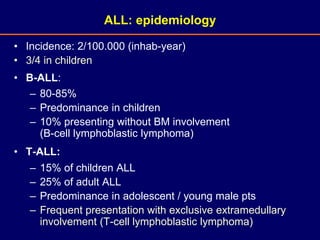
• Incidence: 2/100.000 (inhab-year)
• 3/4 in children
• B-ALL:
– 80-85%
– Predominance in children
– 10% presenting without BM involvement
(B-cell lymphoblastic lymphoma)
• T-ALL:
– 15% of children ALL
– 25% of adult ALL
– Predominance in adolescent / young male pts
– Frequent presentation with exclusive extramedullary
involvement (T-cell lymphoblastic lymphoma)
ALL: epidemiology
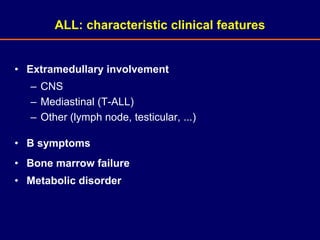
• Extramedullary involvement
– CNS
– Mediastinal (T-ALL)
– Other (lymph node, testicular, ...)
• B symptoms
• Bone marrow failure
• Metabolic disorder
ALL: characteristic clinical features
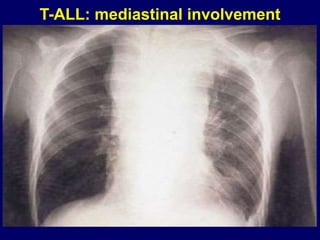
T-ALL: mediastinal involvement
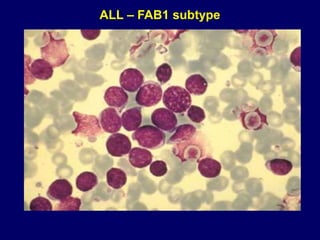
ALL – FAB1 subtype
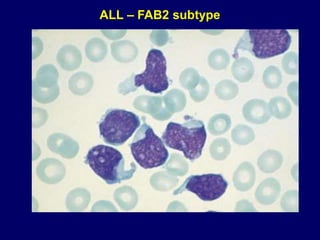
ALL – FAB2 subtype
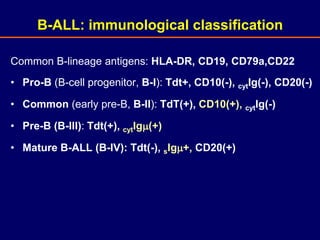
Common B-lineage antigens: HLA-DR, CD19, CD79a,CD22
• Pro-B (B-cell progenitor, B-I): Tdt+, CD10(-), cytIg(-), CD20(-)
• Common (early pre-B, B-II): TdT(+), CD10(+), cytIg(-)
• Pre-B (B-III): Tdt(+), cytIg(+)
• Mature B-ALL (B-IV): Tdt(-), sIg+, CD20(+)
B-ALL: immunological classification
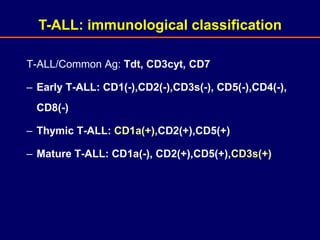
T-ALL/Common Ag: Tdt, CD3cyt, CD7
– Early T-ALL: CD1(-),CD2(-),CD3s(-), CD5(-),CD4(-),
CD8(-)
– Thymic T-ALL: CD1a(+),CD2(+),CD5(+)
– Mature T-ALL: CD1a(-), CD2(+),CD5(+),CD3s(+)
T-ALL: immunological classification
– Favorable: t(12;21),
– Intermediate risk: normal karyotype, t(1;19)
– Unfavorable: t(9;22), 11q23 abn [t(4;11) & other],
hypoploid
ALL: main cytogenetic abnormalities
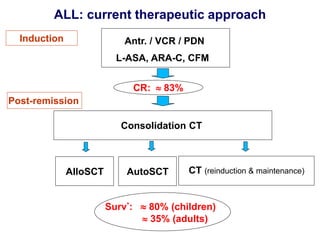
ALL: current therapeutic approach
Consolidation CT
Post-remission
AlloSCT AutoSCT CT (reinduction & maintenance)
CR:  83%
Induction Antr. / VCR / PDN
L-ASA, ARA-C, CFM
Surv*:  80% (children)
 35% (adults)
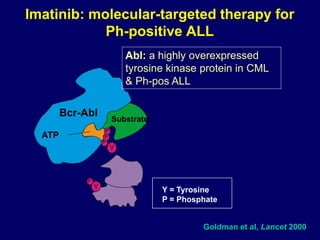
Imatinib: molecular-targeted therapy for
Ph-positive ALL
Goldman et al, Lancet 2000
Y = Tyrosine
P = Phosphate
Bcr-Abl
ATP
Substrate
P
P
P
P
Abl: a highly overexpressed
tyrosine kinase protein in CML
& Ph-pos ALL
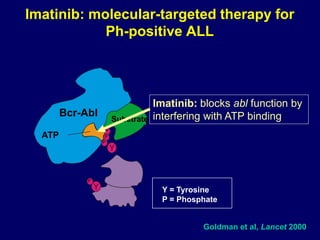
Imatinib: molecular-targeted therapy for
Ph-positive ALL
Goldman et al, Lancet 2000
Bcr-Abl
Bcr-Abl
ATP
Substrate
P
P
P
P
Imatinib: blocks abl function by
interfering with ATP binding
Y = Tyrosine
P = Phosphate
Outcome
– Response criteria
• Complete response
• Cytogenetics response
• Molecular response
– Failure: primary refractory, relapse
– …
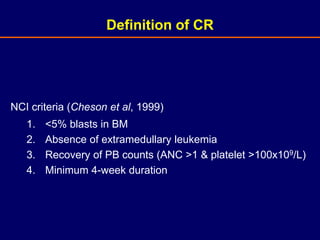
NCI criteria (Cheson et al, 1999)
1. <5% blasts in BM
2. Absence of extramedullary leukemia
3. Recovery of PB counts (ANC >1 & platelet >100x109/L)
4. Minimum 4-week duration
Definition of CR
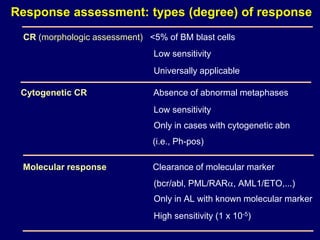
CR (morphologic assessment) <5% of BM blast cells
Low sensitivity
Universally applicable
Cytogenetic CR Absence of abnormal metaphases
Low sensitivity
Only in cases with cytogenetic abn
(i.e., Ph-pos)
Molecular response Clearance of molecular marker
(bcr/abl, PML/RAR, AML1/ETO,...)
Only in AL with known molecular marker
High sensitivity (1 x 10⁻⁵)
Response assessment: types (degree) of response
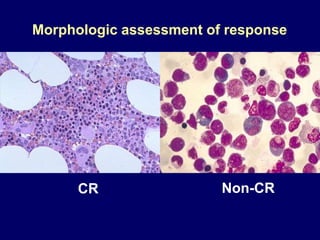
Morphologic assessment of response
CR Non-CR

MED 341. Acute Leukemia. March 2011.ppt

  • 1.
    MED-341: Acute Leukaemia Professor AbdulkareemAlmomen, MD, FRCPC (March 2011)
  • 2.
    – Acute MyeloidLeukemia (AML) – Acute Lymphoblastic Leukemia (ALL) – Biphenotypic Acute Leukemia (BAL): My + Ly Acute Leukaemia: main subtypes
  • 3.
    • Clonal expansionof myeloid blasts in blood marrow (BM), peripheral blood (PB) or other tissue • Minimum threshold of blast cells for defining AML (BM): – >20% blasts AML: definition / concept Proliferation + differentiation block / maturation arrest
  • 4.
  • 5.
  • 6.
    Normal Bone Marrow:Cell Heterogeneity
  • 7.
    BM in AML:Monomorphous Cell Appearance
  • 8.
  • 9.
    • Incidence: 2- 3 pts /100.000 inhab - year • Overall: 1.2% (US) • Lineal increase with age: <35: < 1 /100.000 inhab - year >65: >10 /100.000 inhab - year • Median age: 60 - 70 year-old • Not apparent increase during last years AML: epidemiology
  • 10.
    • Bone marrowfailure – Anemia – Neutropenia – Thrombocytopenia • Extramedullary involvement (skin, gums, CNS, other) • Proliferative symptoms • Coagulopathy • Leukostasis • Metabolic disorders (tumor lysis syndrome) AML: clinical presentation
  • 11.
    AML: skin infiltration(granulocytic sarcoma)
  • 12.
  • 13.
  • 14.
    • Cytology – PB –BM (BM aspirate ± BM biopsy) • Cytochemistry – MPO (myeloperoxidase) & Sudan Black B (SBB) – Myeloid origin – Non-specific esterase (NSE): -naphthyl acetate (ANA), -naphthyl butyrate (ANB) – Monocytic origin • Inmunophenotype – Hematopoietic precursors: CD34, HLA-DR, CD45 – My Ag: CD13, CD33, CD15, MPO, CD117 – Megakaryoblastic Ag: CD41, CD61 • Cytogenetics • Molecular biology – Fusion transcripts (RT-PCR): PML/RAR-, AML1/ETO, CBF-/MYH11, MLL/..., BCR/ABL, DEK/CAN) – New mutations with prognostic impact: flt-3-ITD, CEBPalfa, NPM, … AML - diagnosis:
  • 16.
  • 17.
    MPO Naphtol-As-D-acetate esterase -naphthylacetate esterase AML : Cytochemistry
  • 18.
    CD56 PE 100 101 102103 104 CD2 FITC 10 0 10 1 10 2 10 3 10 4 NG2 PE 100 101 102 103 104 CD34 FITC 10 0 10 1 10 2 10 3 10 4 CD14 PE 100 101 102 103 104 CD123 FITC 10 0 10 1 10 2 10 3 10 4 AML : Flow cytometry
  • 19.
  • 20.
    Acute Promyelocytic Leukemia(APL, M3) bcr1 bcr3 RT-PCR PML/RAR-alpha FISH: PML/RARA fusion signal Anti-PGM3 pattern staining
  • 21.
    • Minimally differentiated(M0) • AML w/o maturation (M1) • AML with maturation (M2) • Promyelocytic (M3) • Myelomonocytic (M4) • Monoblastic (M5a) • Monocytic (M5b) • Erythroleukemia (M6) • Acute megakaryoblastic (M7) FAB classification for AML: lineage/differentiation- based Granulocytic diff Monocytic diff
  • 23.
    I. AML withrecurring genetic abnormalities – AML with t(8;21)(q22;q22) & (AML1/ETO) rearrangement – AML with abn BM eosinophils & inv(16)(p13q22)/t(16;16)(p13;q11) - CBF/MYH11 rearrangement – Acute promyelocytic leukemia associated to t(15;17)(q22;q11-12) & PML/RAR- rearr – AML with 11q23 (MLL) abn II. AML with multilineage dysplasia III. Therapy-related AML IV. AML not otherwise categorized WHO, 2001 WHO classification (AML): towards molecularly-based categories
  • 24.
    – Favorable: t(15;17),t(8;21), inv(16) – Intermediate risk: normal karyotype – Unfavorable: abn 5 (del/-5), abn 7 (del/-7), inv(3q)/t(3;3), complex karyotype (≥5 abn), abn 11q, t(6;9), del(17p) AML: main cytogenetic abnormalities
  • 25.
    AML (non-APL): standardapproach Intensification CT Ara-C HD-based Post-remission tx AlloSCT AutoSCT CT Induccion CT Anthacycline + Ara-C /… CR~75% Long-term OS~35-40% (<60) Salvage therapy Refractory Relapse
  • 26.
  • 27.
    ALL: definition – Clonalexpansion of lymphoid (precursor lymphoid cells) in blood marrow (BM), peripheral blood (PB) or other tissue
  • 28.
    ALL: main subtypes –B-cell ALL / precursor B lymphoblastic leukemia – T-cell ALL / precursor T lymphoblastic leukemia
  • 29.
    • Incidence: 2/100.000(inhab-year) • 3/4 in children • B-ALL: – 80-85% – Predominance in children – 10% presenting without BM involvement (B-cell lymphoblastic lymphoma) • T-ALL: – 15% of children ALL – 25% of adult ALL – Predominance in adolescent / young male pts – Frequent presentation with exclusive extramedullary involvement (T-cell lymphoblastic lymphoma) ALL: epidemiology
  • 30.
    • Extramedullary involvement –CNS – Mediastinal (T-ALL) – Other (lymph node, testicular, ...) • B symptoms • Bone marrow failure • Metabolic disorder ALL: characteristic clinical features
  • 31.
  • 32.
    ALL – FAB1subtype
  • 33.
    ALL – FAB2subtype
  • 34.
    Common B-lineage antigens:HLA-DR, CD19, CD79a,CD22 • Pro-B (B-cell progenitor, B-I): Tdt+, CD10(-), cytIg(-), CD20(-) • Common (early pre-B, B-II): TdT(+), CD10(+), cytIg(-) • Pre-B (B-III): Tdt(+), cytIg(+) • Mature B-ALL (B-IV): Tdt(-), sIg+, CD20(+) B-ALL: immunological classification
  • 35.
    T-ALL/Common Ag: Tdt,CD3cyt, CD7 – Early T-ALL: CD1(-),CD2(-),CD3s(-), CD5(-),CD4(-), CD8(-) – Thymic T-ALL: CD1a(+),CD2(+),CD5(+) – Mature T-ALL: CD1a(-), CD2(+),CD5(+),CD3s(+) T-ALL: immunological classification
  • 36.
    – Favorable: t(12;21), –Intermediate risk: normal karyotype, t(1;19) – Unfavorable: t(9;22), 11q23 abn [t(4;11) & other], hypoploid ALL: main cytogenetic abnormalities
  • 37.
    ALL: current therapeuticapproach Consolidation CT Post-remission AlloSCT AutoSCT CT (reinduction & maintenance) CR:  83% Induction Antr. / VCR / PDN L-ASA, ARA-C, CFM Surv*:  80% (children)  35% (adults)
  • 38.
    Imatinib: molecular-targeted therapyfor Ph-positive ALL Goldman et al, Lancet 2000 Y = Tyrosine P = Phosphate Bcr-Abl ATP Substrate P P P P Abl: a highly overexpressed tyrosine kinase protein in CML & Ph-pos ALL
  • 39.
    Imatinib: molecular-targeted therapyfor Ph-positive ALL Goldman et al, Lancet 2000 Bcr-Abl Bcr-Abl ATP Substrate P P P P Imatinib: blocks abl function by interfering with ATP binding Y = Tyrosine P = Phosphate
  • 40.
    Outcome – Response criteria •Complete response • Cytogenetics response • Molecular response – Failure: primary refractory, relapse – …
  • 41.
    NCI criteria (Chesonet al, 1999) 1. <5% blasts in BM 2. Absence of extramedullary leukemia 3. Recovery of PB counts (ANC >1 & platelet >100x109/L) 4. Minimum 4-week duration Definition of CR
  • 42.
    CR (morphologic assessment)<5% of BM blast cells Low sensitivity Universally applicable Cytogenetic CR Absence of abnormal metaphases Low sensitivity Only in cases with cytogenetic abn (i.e., Ph-pos) Molecular response Clearance of molecular marker (bcr/abl, PML/RAR, AML1/ETO,...) Only in AL with known molecular marker High sensitivity (1 x 10⁻⁵) Response assessment: types (degree) of response
  • 43.
    Morphologic assessment ofresponse CR Non-CR