OBJECTIVES
• Origin and Evaluation
• Definitions
• Various approaches in mechatronics
• Interdisciplinary scenario of mechatronics
• Need of mechatronics
• Advantages
• Disadvantages
• Applications
ORIGIN AND EVOLUTION
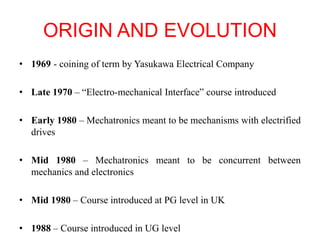
• 1969 - coining of term by Yasukawa Electrical Company
• Late 1970 – “Electro-mechanical Interface” course introduced
• Early 1980 – Mechatronics meant to be mechanisms with electrified
drives
• Mid 1980 – Mechatronics meant to be concurrent between
mechanics and electronics
• Mid 1980 – Course introduced at PG level in UK
• 1988 – Course introduced in UG level
DEFINITION
• The word mechatronics is composed of “Mecha” from mechanics and the
“Tronics” from electronics - YASUKAWA ELECTRIC COMPANY
• The synergistic integration of mechanical engineering, with electronics and
intelligent computer control in the design and manufacturing of industrial
products and processes.
-HARASHIMA, TOMIZUKA, FUKADA
[1996]
• Mechatronics is the application of complex decision making to the
operation of physical systems
-AUSLANDER & KEMPF [1996]
• Mechatronics is a methodology used for the optimal design of electro
mechanical products.
- SHETTY & KOLK [1997]
• A mechatronic system is not just a marriage of electrical and mechanical
systems and is more than just a control system; it is a complete integration
DEFINITION
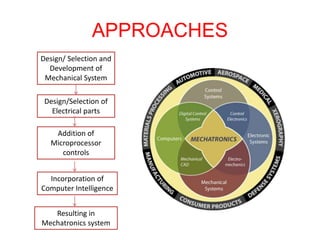
APPROACHES
Design/ Selection and
Development of
Mechanical System
Design/Selection of
Electrical parts
Addition of
Microprocessor
controls
Incorporation of
Computer Intelligence
Resulting in
Mechatronics system
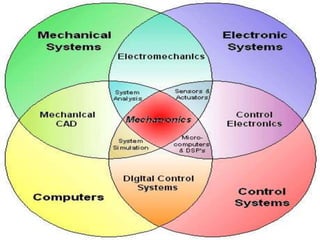
INTERDISCIPLINARY
SCENARIOS
NEED OF MECHATRONICS
ADVANTAGES
• Cost effective and of very good quality
• The performance characteristics of mechatronics products are
such which are otherwise very difficult to achieve without
synergistic combination.
• High degree of flexibility
• A mechatronic product can be better than just sum of its parts.
• Greater extent of machine utilization
• Capital expenses are reduced due to integration of sensors and
control systems in a complex system.
• Greater productivity
• High quality and producing reliability
DISADVANTAGES
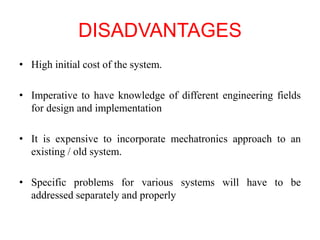
• High initial cost of the system.
• Imperative to have knowledge of different engineering fields
for design and implementation
• It is expensive to incorporate mechatronics approach to an
existing / old system.
• Specific problems for various systems will have to be
addressed separately and properly
APPLICATIONS
APPLICATIONS
Smoke Detector System
APPLICATIONS
APPLICATIONS
SYSTEM
A system can be thought of as a box which has input and
out and where we are not concerned with what goes on inside the
box but only the relation between the output and the input
Electric power will be input to motor and rotation is output.
Systems are of two types
1. Measurement system
2. Control system
SYSTEM
INPUT OUTPUT
MEASUREMENT SYSTEMS
A measurement system can be thought of as a box which
is used for making measurements.
THERMOMETE
R
INPUT OUTPUT
SENSOR
SIGNAL
CONDITIONER DISPLAY
Quantity
being
measured
Value of the
Quantity
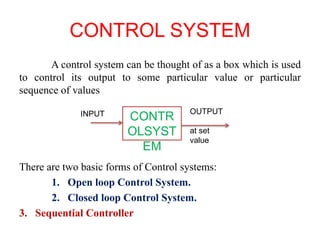
CONTROL SYSTEM
A control system can be thought of as a box which is used
to control its output to some particular value or particular
sequence of values
There are two basic forms of Control systems:
1. Open loop Control System.
2. Closed loop Control System.
3. Sequential Controller
CONTR
OLSYST
EM
INPUT OUTPUT
at set
value
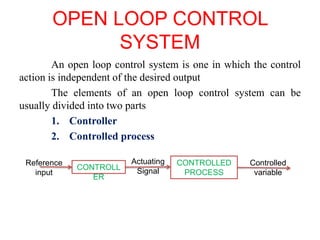
OPEN LOOP CONTROL
SYSTEM
An open loop control system is one in which the control
action is independent of the desired output
The elements of an open loop control system can be
usually divided into two parts
1. Controller
2. Controlled process
CONTROLL
ER
CONTROLLED
PROCESS
Reference
input
Actuating
Signal
Controlled
variable
OPEN LOOP CONTROL
SYSTEM
ADVANTAGES
• Simple Construction
• Easy maintenance.
• Less costly than a closed
loop system.
• No stability problem.
• Convinient when output is
difficult to measure
DISADVANTAGES
• The output may differ from
the desired value due
internal and external
disturbances.
• This system needs frequent
and careful calibrations.
• Any change in system
cannot be taken care
automatically
• Presence of non-linearities
causes malfunctioning
CLOSED LOOP CONTROL
SYSTEM
A closed loop system is one which control action in
somehow dependent on the output.
The controlled output is fed back through a feedback
element and compared with the reference input.
Control
Unit
Correction
Unit
Process
Measuring
device
Reference
Value
Comparison
element
Error
signal
Controlled
variable
Measured value
CLOSED LOOP CONTROL
SYSTEM
ADVANTAGES
• More accurate comparatively
• Perform accurately even in the
presence of non-linearities.
• Change in the system
component is automatically
taken care of.
DISADVANTAGES
• Complicated in construction
• Higher in cost and power.
• May become unstabe at times.
E
N
G
I
N
E
M
A
N
A
G
E
M
E
N
T
S
Y
S
T
E
M
ENGINE MANAGEMENT
SYSTEM
ENGINE MANAGEMENT
SYSTEM
WASHING MACHINE
WEIGHING SCALE
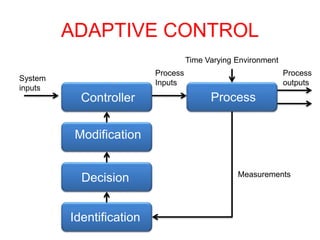
ADAPTIVE CONTROL
Controller
Modification
Decision
Identification
Process
Time Varying Environment
Process
outputs
Measurements
System
inputs
Process
Inputs
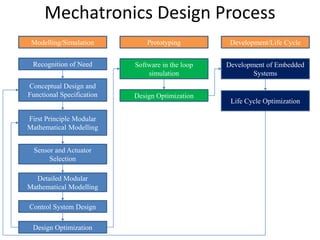
Mechatronics Design Process
Modelling/Simulation Prototyping Development/Life Cycle
Recognition of Need
Conceptual Design and
Functional Specification
First Principle Modular
Mathematical Modelling
Sensor and Actuator
Selection
Detailed Modular
Mathematical Modelling
Control System Design
Design Optimization
Software in the loop
simulation
Design Optimization
Development of Embedded
Systems
Life Cycle Optimization
Mechatronics.pptx
Mechatronics.pptx
Mechatronics.pptx
Mechatronics.pptx
Mechatronics.pptx
Mechatronics.pptx

Mechatronics.pptx

  • 1.
    OBJECTIVES • Origin andEvaluation • Definitions • Various approaches in mechatronics • Interdisciplinary scenario of mechatronics • Need of mechatronics • Advantages • Disadvantages • Applications
  • 2.
    ORIGIN AND EVOLUTION •1969 - coining of term by Yasukawa Electrical Company • Late 1970 – “Electro-mechanical Interface” course introduced • Early 1980 – Mechatronics meant to be mechanisms with electrified drives • Mid 1980 – Mechatronics meant to be concurrent between mechanics and electronics • Mid 1980 – Course introduced at PG level in UK • 1988 – Course introduced in UG level
  • 3.
    DEFINITION • The wordmechatronics is composed of “Mecha” from mechanics and the “Tronics” from electronics - YASUKAWA ELECTRIC COMPANY • The synergistic integration of mechanical engineering, with electronics and intelligent computer control in the design and manufacturing of industrial products and processes. -HARASHIMA, TOMIZUKA, FUKADA [1996] • Mechatronics is the application of complex decision making to the operation of physical systems -AUSLANDER & KEMPF [1996] • Mechatronics is a methodology used for the optimal design of electro mechanical products. - SHETTY & KOLK [1997] • A mechatronic system is not just a marriage of electrical and mechanical systems and is more than just a control system; it is a complete integration
  • 4.
  • 6.
    APPROACHES Design/ Selection and Developmentof Mechanical System Design/Selection of Electrical parts Addition of Microprocessor controls Incorporation of Computer Intelligence Resulting in Mechatronics system
  • 7.
  • 8.
  • 9.
    ADVANTAGES • Cost effectiveand of very good quality • The performance characteristics of mechatronics products are such which are otherwise very difficult to achieve without synergistic combination. • High degree of flexibility • A mechatronic product can be better than just sum of its parts. • Greater extent of machine utilization • Capital expenses are reduced due to integration of sensors and control systems in a complex system. • Greater productivity • High quality and producing reliability
  • 10.
    DISADVANTAGES • High initialcost of the system. • Imperative to have knowledge of different engineering fields for design and implementation • It is expensive to incorporate mechatronics approach to an existing / old system. • Specific problems for various systems will have to be addressed separately and properly
  • 11.
  • 12.
  • 13.
  • 14.
  • 15.
    SYSTEM A system canbe thought of as a box which has input and out and where we are not concerned with what goes on inside the box but only the relation between the output and the input Electric power will be input to motor and rotation is output. Systems are of two types 1. Measurement system 2. Control system SYSTEM INPUT OUTPUT
  • 16.
    MEASUREMENT SYSTEMS A measurementsystem can be thought of as a box which is used for making measurements. THERMOMETE R INPUT OUTPUT SENSOR SIGNAL CONDITIONER DISPLAY Quantity being measured Value of the Quantity
  • 17.
    CONTROL SYSTEM A controlsystem can be thought of as a box which is used to control its output to some particular value or particular sequence of values There are two basic forms of Control systems: 1. Open loop Control System. 2. Closed loop Control System. 3. Sequential Controller CONTR OLSYST EM INPUT OUTPUT at set value
  • 18.
    OPEN LOOP CONTROL SYSTEM Anopen loop control system is one in which the control action is independent of the desired output The elements of an open loop control system can be usually divided into two parts 1. Controller 2. Controlled process CONTROLL ER CONTROLLED PROCESS Reference input Actuating Signal Controlled variable
  • 19.
    OPEN LOOP CONTROL SYSTEM ADVANTAGES •Simple Construction • Easy maintenance. • Less costly than a closed loop system. • No stability problem. • Convinient when output is difficult to measure DISADVANTAGES • The output may differ from the desired value due internal and external disturbances. • This system needs frequent and careful calibrations. • Any change in system cannot be taken care automatically • Presence of non-linearities causes malfunctioning
  • 20.
    CLOSED LOOP CONTROL SYSTEM Aclosed loop system is one which control action in somehow dependent on the output. The controlled output is fed back through a feedback element and compared with the reference input. Control Unit Correction Unit Process Measuring device Reference Value Comparison element Error signal Controlled variable Measured value
  • 21.
    CLOSED LOOP CONTROL SYSTEM ADVANTAGES •More accurate comparatively • Perform accurately even in the presence of non-linearities. • Change in the system component is automatically taken care of. DISADVANTAGES • Complicated in construction • Higher in cost and power. • May become unstabe at times.
  • 22.
  • 23.
  • 24.
  • 25.
  • 26.
  • 27.
    ADAPTIVE CONTROL Controller Modification Decision Identification Process Time VaryingEnvironment Process outputs Measurements System inputs Process Inputs
  • 29.
    Mechatronics Design Process Modelling/SimulationPrototyping Development/Life Cycle Recognition of Need Conceptual Design and Functional Specification First Principle Modular Mathematical Modelling Sensor and Actuator Selection Detailed Modular Mathematical Modelling Control System Design Design Optimization Software in the loop simulation Design Optimization Development of Embedded Systems Life Cycle Optimization