Background of study
 Water is the source of life ( Al-Quran)
 Water is the important factor for the growth,
germination and productivity of the plant (Went,
1949).
 Sustainable in agriculture playing a main role in
the agricultural industry in term of produce high
quality of product without pollutes the
environment.
 The use of rainwater as a source of water for
irrigates the crop is one of the sustainable
agriculture.
Problem statement
 Turbidity increases during rainfall or due to flow
changes or disturbances leading to high variations in
turbidity levels (Mylvahanen et al., 1998)
 Irrigating with dirty or turbid water is the potential
heavy metal accumulation in soil and foodstuff
(Battilani et al., 2009).
 Unneeded particular substances on the rooftop and
gutter such as moss, dry leaves and rust that
attached at the rooftop and gutter also will be flow
together to the rainwater harvesting storage tank
during rainfall
Objective of study
 To develop a turbidity sensor that has a
connection with solenoid valve in order to
control the quality of water in rainwater
harvesting tank
 To test the functionally for each system
requirement for ensuring the system benefit for
controlling and monitoring the quality of water.
Scope
 To assist in monitoring the quality of water in the
rainwater harvesting tank
 To assist in maintenance of rainwater harvesting
tank
Methodology
1. Planning
4. Implementation
2. Information
gathering and
requirement
3. Analysis and
design
5. Performance
evaluation
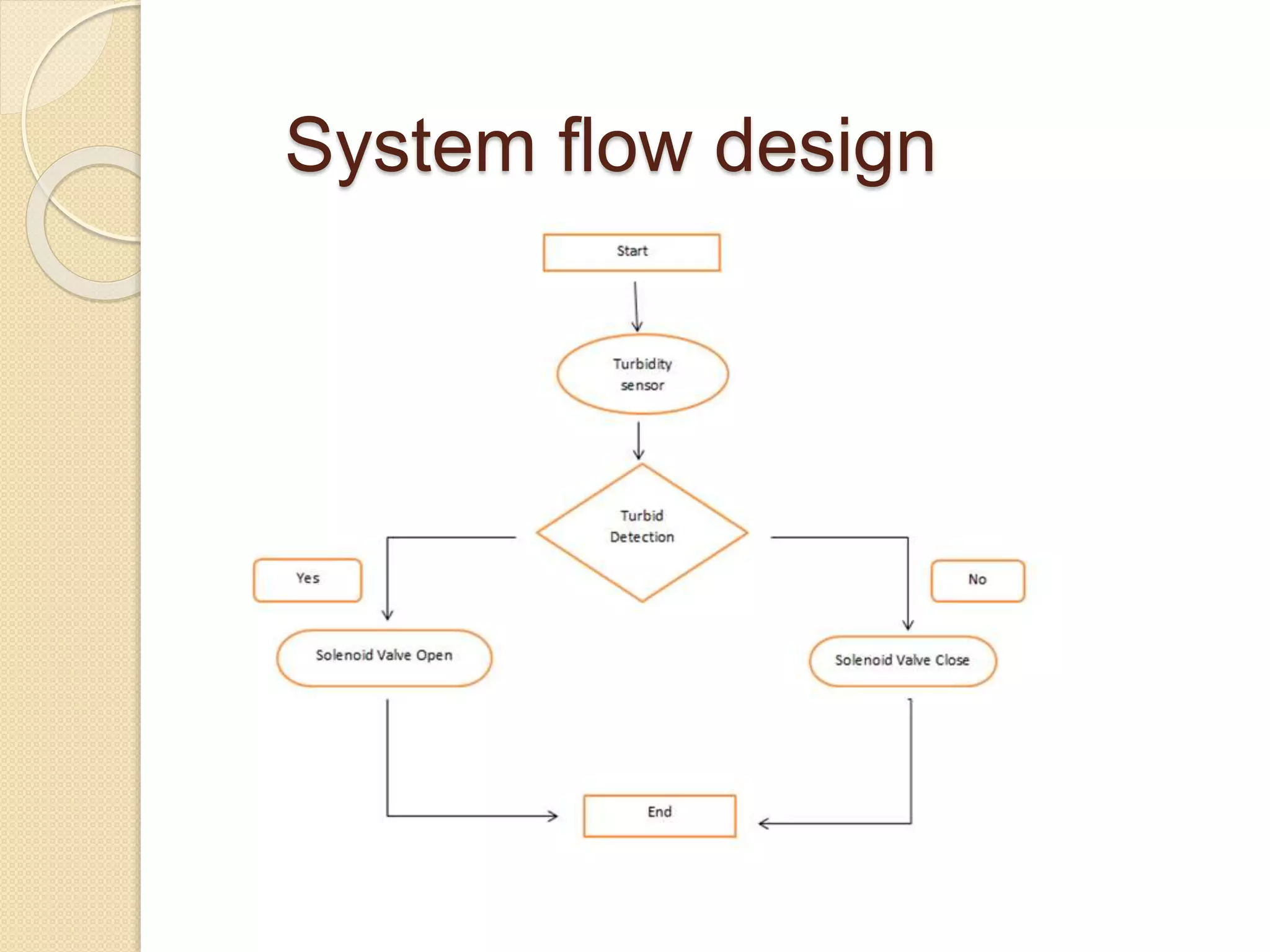
System flow design
Result
Objective 1 : To develop a turbidity sensor
that has a connection with solenoid valve
in order to control the quality of water in
rainwater harvesting tank
Complete circuit of project
Prototype of project
Result
Objective 2 : To test the functionally for each
system requirement for ensuring the system
benefit for controlling and monitoring the
quality of water.
Result of functional testing
Hardware User Percent
Free from Error Error success fails
Turbidity sensor
1. Able to detect turbidity 19 1 95% 5%
Solenoid Valve
1. Able to open and close 19 1 95% 5%
Reading of reading of voltage
and nephelometric turbidity unit
Reading before detect
turbid
Reading after detect turbid
Conclusion
 The main goal of this system is to control
the quality of water in the rainwater
harvesting tank is suitable for supply to the
crop.
 The objectives of this system is open the
valve of solenoid valve automatically when
turbid level is high and to reduce the burden
of farmer to monitor the quality of water in
rainwater harvesting tank.
Recommendation
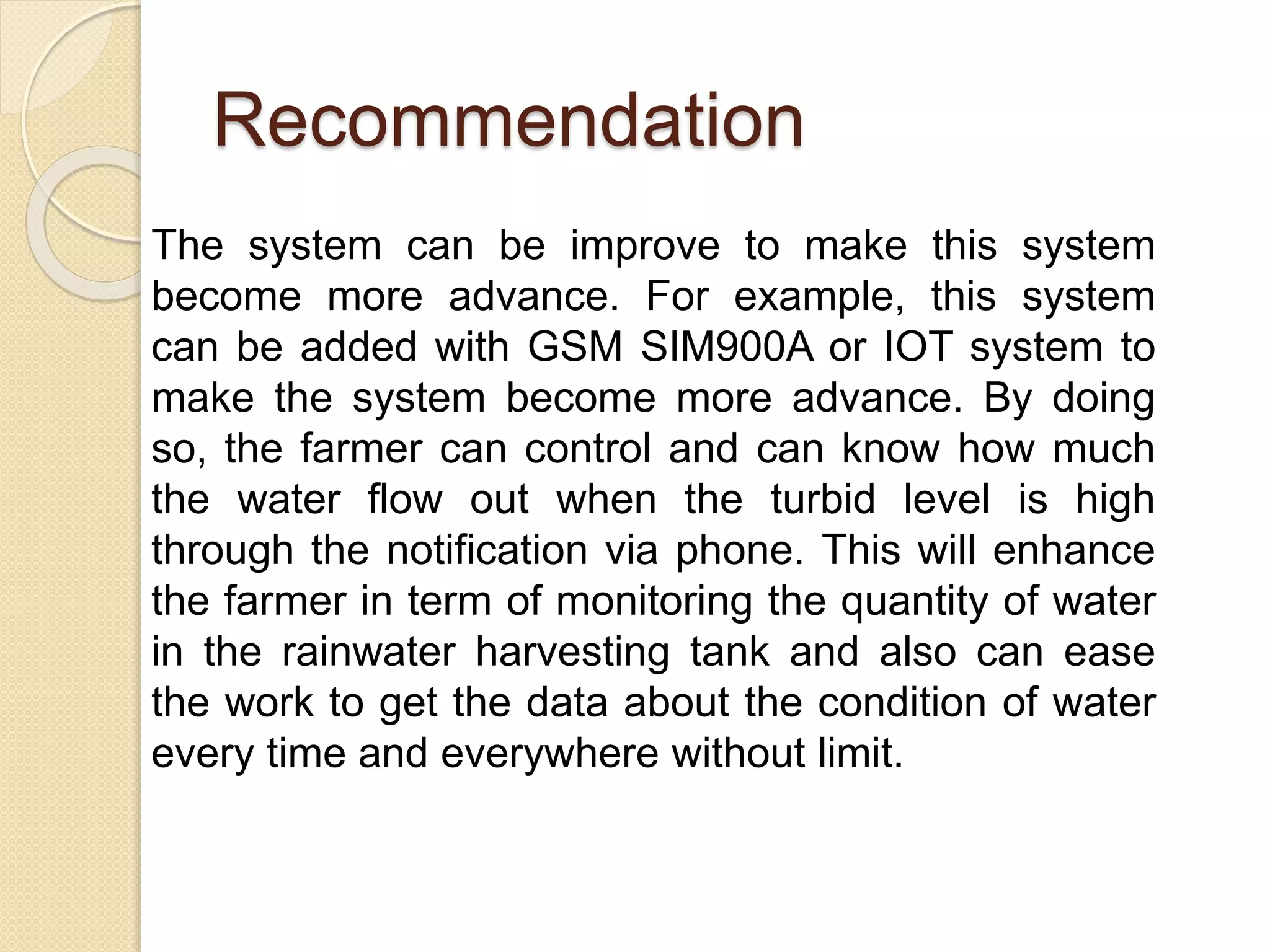
The system can be improve to make this system
become more advance. For example, this system
can be added with GSM SIM900A or IOT system to
make the system become more advance. By doing
so, the farmer can control and can know how much
the water flow out when the turbid level is high
through the notification via phone. This will enhance
the farmer in term of monitoring the quantity of water
in the rainwater harvesting tank and also can ease
the work to get the data about the condition of water
every time and everywhere without limit.
References
 Amruta, M. K., & Satish, M. T. (2013). Solar powered water quality
monitoring system using wireless sensor network. In 2013 International
Mutli-Conference on Automation, Computing, Communication, Control
and Compressed Sensing (iMac4s), 281-285.
 Gaiani, C., Banon, S., Scher, J., Schuck, P., & Hardy, J. (2005). Use of a
turbidity sensor to characterize micellar casein powder rehydration:
Influence of some technological effects. Journal of Dairy Science, 88(8),
2700-2706.
 Horsburgh, J. S., Jones, A. S., Stevens, D. K., Tarboton, D. G., &
Mesner, N. O. (2010). A sensor network for high frequency estimation of
water quality constituent fluxes using surrogates. Environmental
Modelling & Software, 25(9), 1031-1044.
 Thompson, T. L., Pang, H. C., & Li, Y. Y. (2009). The potential
contribution of subsurface drip irrigation to water-saving agriculture in the
western USA. Agricultural Sciences in China, 8(7), 850-854.
 Ward, F. A., & Michelsen, A. (2002). The economic value of water in
agriculture: concepts and policy applications. Water Policy, 4(5), 423-446

mechatronic in sustainable agriculture irrigation

  • 2.
    Background of study Water is the source of life ( Al-Quran)  Water is the important factor for the growth, germination and productivity of the plant (Went, 1949).  Sustainable in agriculture playing a main role in the agricultural industry in term of produce high quality of product without pollutes the environment.  The use of rainwater as a source of water for irrigates the crop is one of the sustainable agriculture.
  • 3.
    Problem statement  Turbidityincreases during rainfall or due to flow changes or disturbances leading to high variations in turbidity levels (Mylvahanen et al., 1998)  Irrigating with dirty or turbid water is the potential heavy metal accumulation in soil and foodstuff (Battilani et al., 2009).  Unneeded particular substances on the rooftop and gutter such as moss, dry leaves and rust that attached at the rooftop and gutter also will be flow together to the rainwater harvesting storage tank during rainfall
  • 4.
    Objective of study To develop a turbidity sensor that has a connection with solenoid valve in order to control the quality of water in rainwater harvesting tank  To test the functionally for each system requirement for ensuring the system benefit for controlling and monitoring the quality of water.
  • 5.
    Scope  To assistin monitoring the quality of water in the rainwater harvesting tank  To assist in maintenance of rainwater harvesting tank
  • 6.
    Methodology 1. Planning 4. Implementation 2.Information gathering and requirement 3. Analysis and design 5. Performance evaluation
  • 7.
  • 8.
    Result Objective 1 :To develop a turbidity sensor that has a connection with solenoid valve in order to control the quality of water in rainwater harvesting tank
  • 9.
  • 10.
  • 11.
    Result Objective 2 :To test the functionally for each system requirement for ensuring the system benefit for controlling and monitoring the quality of water.
  • 12.
    Result of functionaltesting Hardware User Percent Free from Error Error success fails Turbidity sensor 1. Able to detect turbidity 19 1 95% 5% Solenoid Valve 1. Able to open and close 19 1 95% 5%
  • 13.
    Reading of readingof voltage and nephelometric turbidity unit Reading before detect turbid Reading after detect turbid
  • 14.
    Conclusion  The maingoal of this system is to control the quality of water in the rainwater harvesting tank is suitable for supply to the crop.  The objectives of this system is open the valve of solenoid valve automatically when turbid level is high and to reduce the burden of farmer to monitor the quality of water in rainwater harvesting tank.
  • 15.
    Recommendation The system canbe improve to make this system become more advance. For example, this system can be added with GSM SIM900A or IOT system to make the system become more advance. By doing so, the farmer can control and can know how much the water flow out when the turbid level is high through the notification via phone. This will enhance the farmer in term of monitoring the quantity of water in the rainwater harvesting tank and also can ease the work to get the data about the condition of water every time and everywhere without limit.
  • 16.
    References  Amruta, M.K., & Satish, M. T. (2013). Solar powered water quality monitoring system using wireless sensor network. In 2013 International Mutli-Conference on Automation, Computing, Communication, Control and Compressed Sensing (iMac4s), 281-285.  Gaiani, C., Banon, S., Scher, J., Schuck, P., & Hardy, J. (2005). Use of a turbidity sensor to characterize micellar casein powder rehydration: Influence of some technological effects. Journal of Dairy Science, 88(8), 2700-2706.  Horsburgh, J. S., Jones, A. S., Stevens, D. K., Tarboton, D. G., & Mesner, N. O. (2010). A sensor network for high frequency estimation of water quality constituent fluxes using surrogates. Environmental Modelling & Software, 25(9), 1031-1044.  Thompson, T. L., Pang, H. C., & Li, Y. Y. (2009). The potential contribution of subsurface drip irrigation to water-saving agriculture in the western USA. Agricultural Sciences in China, 8(7), 850-854.  Ward, F. A., & Michelsen, A. (2002). The economic value of water in agriculture: concepts and policy applications. Water Policy, 4(5), 423-446