@ IJTSRD | Available Online @ www.ijtsrd.com
ISSN No: 2456
International
Research
Smart Drip Irrigation System
PG Scholar, Dep
Sri Krishna College of Engineering and Technology
Kuniamuthur, Coimbatore
ABSTRACT
Water is an essential thing for crops and plants in
agriculture. In traditional agriculture systems are take
large amount of time to watering the crops lands and
also have a lots of water wastes. Avoiding these
problems drip irrigation systems are introduced. Drip
irrigation technique is the best and efficient technique
to supply the water to plants/crops in effective
manner. In our IoT based smart and automatic drip
irrigation system is solve the problems in existing
systems and also provide the many features to
farmers. This system is using Wemos D1 ESP 8266
which controls all sensors and send and receive the
sensing values through the internet. In this paper
explains the over view installation, system design and
working of system.
Keywords: Wemos D1 ESP 8266, IoT, OTA
I. INTRODUCTION
Agriculture is backbone of India. India
largest fruits and vegetables producer of the world.
traditional Indian agriculture techniques are not
supported for today’s world. Because
irrigations system facing large water wastage, workers
salary, and etc. In a modern world we try to introduc
and use the new water management techniques to
manage and save the water effectively.
one of the country to teach the water management and
water usage in around the world. Drip irrigation
system is a replacement of traditional irrigation
systems. Drip irrigation is mainly used irrigation
techniques. It will supports small plants, trees, poly
houses, showcase agriculture, green house farming
and etc. In drip irrigation the water is sending into
each plant/ crop equally and parallel. And also
@ IJTSRD | Available Online @ www.ijtsrd.com | Volume – 2 | Issue – 4 | May-Jun 2018
ISSN No: 2456 - 6470 | www.ijtsrd.com | Volume
International Journal of Trend in Scientific
Research and Development (IJTSRD)
International Open Access Journal
Smart Drip Irrigation System
Shilpa. A
Department of Computer Science and Engineering
Sri Krishna College of Engineering and Technology
Kuniamuthur, Coimbatore, India
Water is an essential thing for crops and plants in
agriculture. In traditional agriculture systems are take
large amount of time to watering the crops lands and
also have a lots of water wastes. Avoiding these
rip irrigation systems are introduced. Drip
irrigation technique is the best and efficient technique
to supply the water to plants/crops in effective
manner. In our IoT based smart and automatic drip
irrigation system is solve the problems in existing
ems and also provide the many features to
farmers. This system is using Wemos D1 ESP 8266
which controls all sensors and send and receive the
sensing values through the internet. In this paper
explains the over view installation, system design and
Wemos D1 ESP 8266, IoT, OTA
India is one of the
fruits and vegetables producer of the world. In
agriculture techniques are not
supported for today’s world. Because the manual
large water wastage, workers
modern world we try to introduce
and use the new water management techniques to
manage and save the water effectively. Israel is the
one of the country to teach the water management and
Drip irrigation
system is a replacement of traditional irrigation
Drip irrigation is mainly used irrigation
techniques. It will supports small plants, trees, poly
houses, showcase agriculture, green house farming
In drip irrigation the water is sending into
each plant/ crop equally and parallel. And also it will
reduces the watering time and water usage. In this
type of irrigation is suitable for large and small land
farmers, desert agriculture farmers,
based agricultural lands and etc.
In drip irrigation the water is sending with a pressure
to pumping the water into all drips. In
technologies fertilizers mixed with water and send
into plants. It will reduces the time and
access parallel. In this method water is drop
send into directly root structure. Mulching sheets
technology reduces the water wastage via water
evaporation. It Drip irrigations installation cost high
but it will be used again and again for our land.
balancing the food crops for a growth of
drip irrigation suitable and profitable way for farming.
In a computer era robots and heavy machines can
replaces the humans. In this scenario we
our irrigation technologies to manage and maintain
the system using IOT/ WOT and any other
technologies. In many systems are developed already
in irrigation in our system adding new features to
easily use and maintain end users.
irrigation system model. Fig.
automated drip irrigation system controlled via the
end user devices.
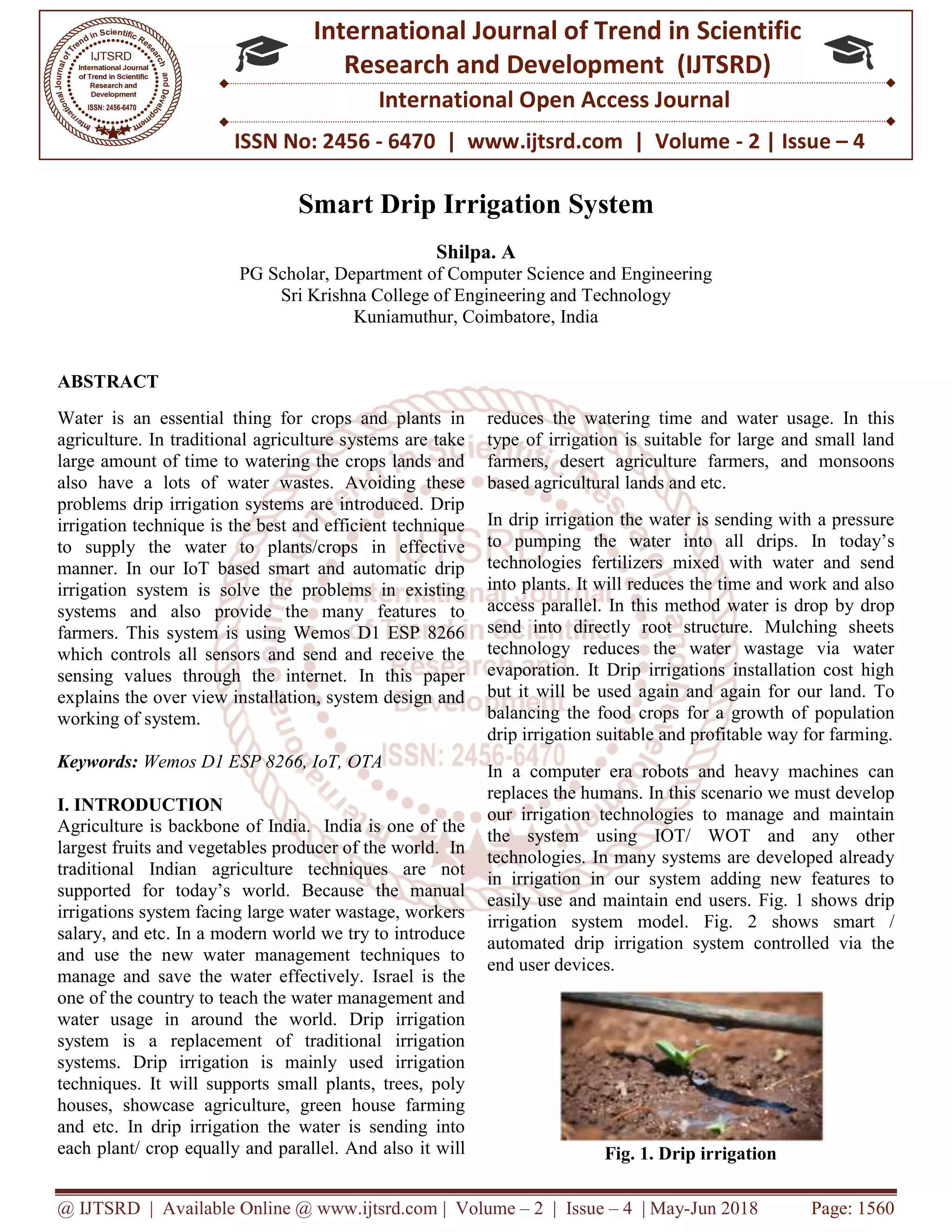
Fig. 1. Drip irrigation
Jun 2018 Page: 1560
www.ijtsrd.com | Volume - 2 | Issue – 4
Scientific
(IJTSRD)
International Open Access Journal
of Computer Science and Engineering
reduces the watering time and water usage. In this
type of irrigation is suitable for large and small land
farmers, desert agriculture farmers, and monsoons
based agricultural lands and etc.
In drip irrigation the water is sending with a pressure
to pumping the water into all drips. In today’s
technologies fertilizers mixed with water and send
into plants. It will reduces the time and work and also
this method water is drop by drop
send into directly root structure. Mulching sheets
technology reduces the water wastage via water
It Drip irrigations installation cost high
but it will be used again and again for our land. To
balancing the food crops for a growth of population
drip irrigation suitable and profitable way for farming.
In a computer era robots and heavy machines can
scenario we must develop
technologies to manage and maintain
sing IOT/ WOT and any other
technologies. In many systems are developed already
in irrigation in our system adding new features to
and maintain end users. Fig. 1 shows drip
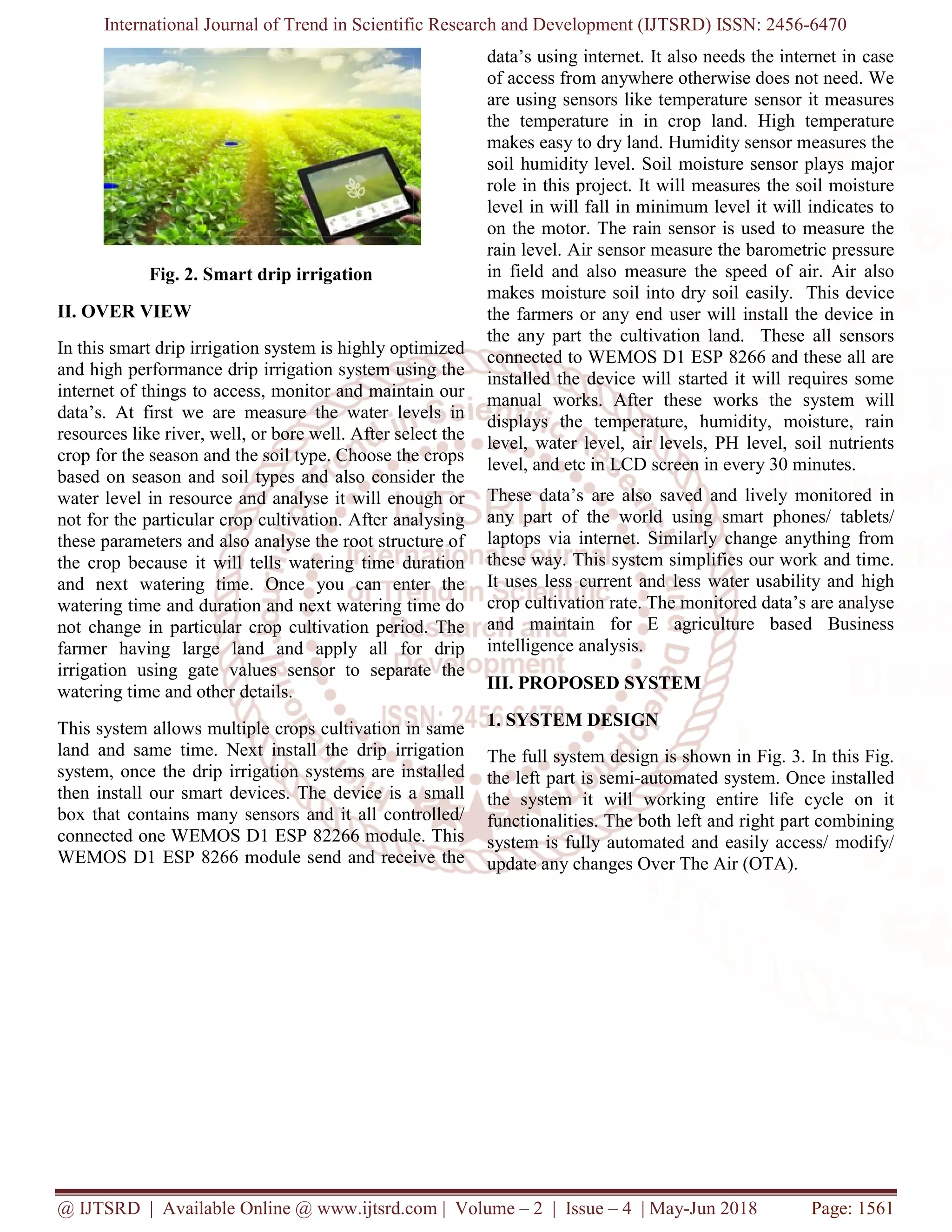
Fig. 2 shows smart /
automated drip irrigation system controlled via the
1. Drip irrigation
International Journal of Trend in Scientific Research and Development (IJTSRD) ISSN: 2456-6470
@ IJTSRD | Available Online @ www.ijtsrd.com | Volume – 2 | Issue – 4 | May-Jun 2018 Page: 1561
Fig. 2. Smart drip irrigation
II. OVER VIEW
In this smart drip irrigation system is highly optimized
and high performance drip irrigation system using the
internet of things to access, monitor and maintain our
data’s. At first we are measure the water levels in
resources like river, well, or bore well. After select the
crop for the season and the soil type. Choose the crops
based on season and soil types and also consider the
water level in resource and analyse it will enough or
not for the particular crop cultivation. After analysing
these parameters and also analyse the root structure of
the crop because it will tells watering time duration
and next watering time. Once you can enter the
watering time and duration and next watering time do
not change in particular crop cultivation period. The
farmer having large land and apply all for drip
irrigation using gate values sensor to separate the
watering time and other details.
This system allows multiple crops cultivation in same
land and same time. Next install the drip irrigation
system, once the drip irrigation systems are installed
then install our smart devices. The device is a small
box that contains many sensors and it all controlled/
connected one WEMOS D1 ESP 82266 module. This
WEMOS D1 ESP 8266 module send and receive the
data’s using internet. It also needs the internet in case
of access from anywhere otherwise does not need. We
are using sensors like temperature sensor it measures
the temperature in in crop land. High temperature
makes easy to dry land. Humidity sensor measures the
soil humidity level. Soil moisture sensor plays major
role in this project. It will measures the soil moisture
level in will fall in minimum level it will indicates to
on the motor. The rain sensor is used to measure the
rain level. Air sensor measure the barometric pressure
in field and also measure the speed of air. Air also
makes moisture soil into dry soil easily. This device
the farmers or any end user will install the device in
the any part the cultivation land. These all sensors
connected to WEMOS D1 ESP 8266 and these all are
installed the device will started it will requires some
manual works. After these works the system will
displays the temperature, humidity, moisture, rain
level, water level, air levels, PH level, soil nutrients
level, and etc in LCD screen in every 30 minutes.
These data’s are also saved and lively monitored in
any part of the world using smart phones/ tablets/
laptops via internet. Similarly change anything from
these way. This system simplifies our work and time.
It uses less current and less water usability and high
crop cultivation rate. The monitored data’s are analyse
and maintain for E agriculture based Business
intelligence analysis.
III. PROPOSED SYSTEM
1. SYSTEM DESIGN
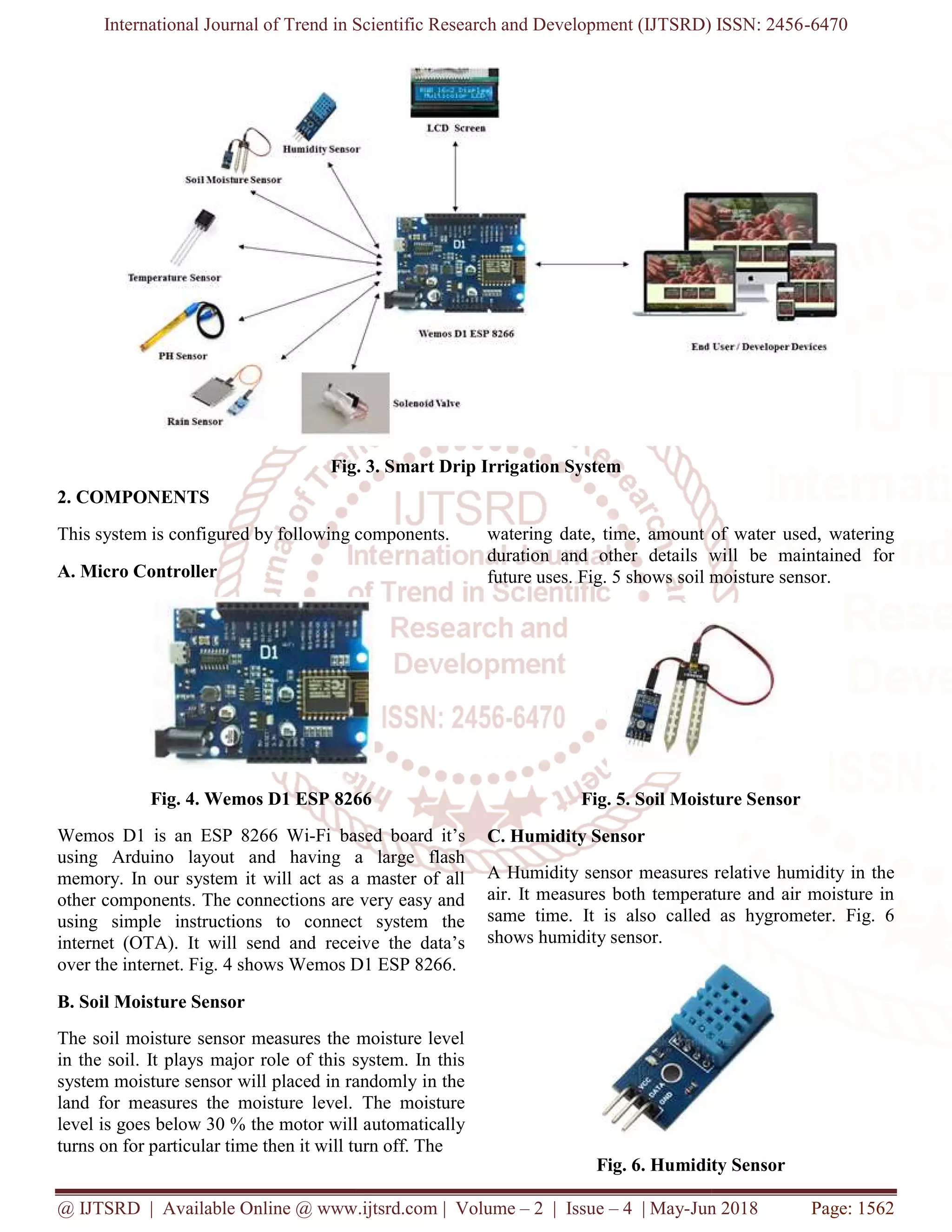
The full system design is shown in Fig. 3. In this Fig.
the left part is semi-automated system. Once installed
the system it will working entire life cycle on it
functionalities. The both left and right part combining
system is fully automated and easily access/ modify/
update any changes Over The Air (OTA).
International Journal of Trend in Scientific Research and Development (IJTSRD) ISSN: 2456
@ IJTSRD | Available Online @ www.ijtsrd.com
Fig.
2. COMPONENTS
This system is configured by following components.
A. Micro Controller
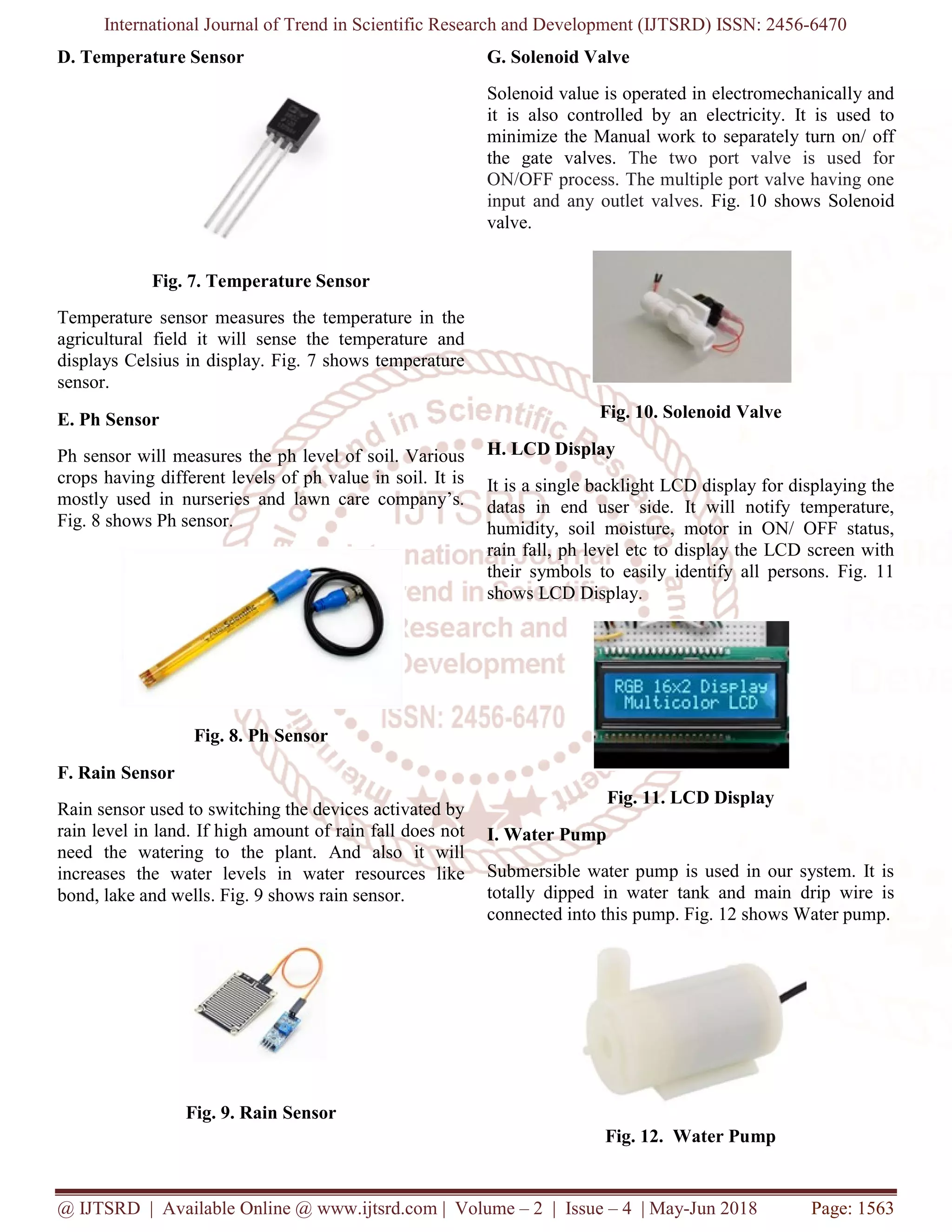
Fig. 4. Wemos D1 ESP 8266
Wemos D1 is an ESP 8266 Wi-Fi based board it’s
using Arduino layout and having a large flash
memory. In our system it will act as a master of all
other components. The connections are very easy and
using simple instructions to connect system the
internet (OTA). It will send and receiv
over the internet. Fig. 4 shows Wemos D1 ESP 8266.
B. Soil Moisture Sensor
The soil moisture sensor measures the moisture level
in the soil. It plays major role of this system. In this
system moisture sensor will placed in randomly in the
land for measures the moisture level.
level is goes below 30 % the motor will a
turns on for particular time then it will turn off. The
International Journal of Trend in Scientific Research and Development (IJTSRD) ISSN: 2456
Available Online @ www.ijtsrd.com | Volume – 2 | Issue – 4 | May-Jun 2018
Fig. 3. Smart Drip Irrigation System
d by following components.
4. Wemos D1 ESP 8266
based board it’s
using Arduino layout and having a large flash
memory. In our system it will act as a master of all
other components. The connections are very easy and
using simple instructions to connect system the
internet (OTA). It will send and receive the data’s
4 shows Wemos D1 ESP 8266.
The soil moisture sensor measures the moisture level
in the soil. It plays major role of this system. In this
system moisture sensor will placed in randomly in the
land for measures the moisture level. The moisture
level is goes below 30 % the motor will automatically
turns on for particular time then it will turn off. The
watering date, time, amount of water used, watering
duration and other details wi
future uses. Fig. 5 shows soil moisture sensor.
Fig. 5. Soil Moisture Sensor
C. Humidity Sensor
A Humidity sensor measures relative
air. It measures both temperature and air moisture in
same time. It is also called as hygrometer.
shows humidity sensor.
Fig. 6. Humidity Sensor
International Journal of Trend in Scientific Research and Development (IJTSRD) ISSN: 2456-6470
Jun 2018 Page: 1562
date, time, amount of water used, watering
duration and other details will be maintained for
shows soil moisture sensor.
. Soil Moisture Sensor
measures relative humidity in the
It measures both temperature and air moisture in
It is also called as hygrometer. Fig. 6
. Humidity Sensor
International Journal of Trend in Scientific Research and Development (IJTSRD) ISSN: 2456-6470
@ IJTSRD | Available Online @ www.ijtsrd.com | Volume – 2 | Issue – 4 | May-Jun 2018 Page: 1563
D. Temperature Sensor
Fig. 7. Temperature Sensor
Temperature sensor measures the temperature in the
agricultural field it will sense the temperature and
displays Celsius in display. Fig. 7 shows temperature
sensor.
E. Ph Sensor
Ph sensor will measures the ph level of soil. Various
crops having different levels of ph value in soil. It is
mostly used in nurseries and lawn care company’s.
Fig. 8 shows Ph sensor.
Fig. 8. Ph Sensor
F. Rain Sensor
Rain sensor used to switching the devices activated by
rain level in land. If high amount of rain fall does not
need the watering to the plant. And also it will
increases the water levels in water resources like
bond, lake and wells. Fig. 9 shows rain sensor.
Fig. 9. Rain Sensor
G. Solenoid Valve
Solenoid value is operated in electromechanically and
it is also controlled by an electricity. It is used to
minimize the Manual work to separately turn on/ off
the gate valves. The two port valve is used for
ON/OFF process. The multiple port valve having one
input and any outlet valves. Fig. 10 shows Solenoid
valve.
Fig. 10. Solenoid Valve
H. LCD Display
It is a single backlight LCD display for displaying the
datas in end user side. It will notify temperature,
humidity, soil moisture, motor in ON/ OFF status,
rain fall, ph level etc to display the LCD screen with
their symbols to easily identify all persons. Fig. 11
shows LCD Display.
Fig. 11. LCD Display
I. Water Pump
Submersible water pump is used in our system. It is
totally dipped in water tank and main drip wire is
connected into this pump. Fig. 12 shows Water pump.
Fig. 12. Water Pump
International Journal of Trend in Scientific Research and Development (IJTSRD) ISSN: 2456-6470
@ IJTSRD | Available Online @ www.ijtsrd.com | Volume – 2 | Issue – 4 | May-Jun 2018 Page: 1564
J. Soil Nutrient Sensor
Soil Nutrient Sensor using electro chemical sensor to
measures the different soil nutrient in the amount of
sample is taken. This system adding the new feature
to monitor the micro and macro nutrients in the soil. It
mainly measures NPK in soil
IV. ADVANTAGES
1. Easy to access.
2. Monitoring fields automatically.
3. Low cost.
4. Less water usage, electricity.
5. High yielding.
6. Parallel watering of each crops.
7. Supports poly house and green house.
V. RESULT AND ANALYSIS
This result is useful to analyse the water, current, rain
level, ph values, humidity, and temperature for a
particular crop. It is very useful to new farmers and
research scholars. In a series of crop circulation
method we have to analyse the entire thing which
need or need not to crops. And also predict the
weather using previous historical data’s. Fig. 13
shows result of the system.
VI. CONCLUSION
Smart drip irrigation is reduces the manual work. And
it will reduces the 70% of the water wastage. So it
will greatly saving water and energy. The aim of the
project is to develop the awareness for drip or any
other irrigation system to develop the agriculture.
VII. REFERENCES
1. Prabhakaran, V., S. Pavithra, and S. K.
Monisuthan. "Automated Irrigation System For
Farmers Through Mobile GSM Enabled Andriod
Application." Journal of Chemical and
Pharmaceutical SciencesISSN 974: 2115.
2. Gutiérrez, Joaquín, et al. "Automated irrigation
system using a wireless sensor network and GPRS
module." IEEE transactions on instrumentation
and measurement 63.1 (2014): 166-176.
3. Lavau, Stephanie. "Going with the flow:
sustainable water management as ontological
cleaving." Environment and Planning D: Society
and Space 31.3 (2013): 416-433.
4. Agrawal, Nikhil, and Smita Singhal. "Smart drip
irrigation system using raspberry pi and
arduino." Computing, Communication &
Automation (ICCCA), 2015 International
Conference on. IEEE, 2015.
5. Crane, W. "Automatic plant watering device."
U.S. Patent No. 3,758,987. 18 Sep. 1973.
6. Parameswaran, G., and K. Sivaprasath. "Arduino
Based Smart Drip Irrigation System Using
Internet of Things." Int. J. Eng. Sci 5518 (2016).
7. Bathan, Jazelle Paula M., et al. "AUTOMATED
IRRIGATION SYSTEM USING
THERMOELECTRIC GENERATOR AS SOIL
MOISTURE DETECTOR." (2013).
8. Vagulabranan, R., M. Karthikeyan, and V.
Sasikala. "Automatic Irrigation System on
Sensing Soil Moisture Content." International
Research Journal of Engineering and Technology
(IRJET)-0072-0056 3.03 (2016).
9. Agrawal, Nikhil, and Smita Singhal. "Smart drip
irrigation system using raspberry pi and
arduino." Computing, Communication &
Automation (ICCCA), 2015 International
Conference on. IEEE, 2015.
10. Dursun, Mahir, and Semih Ozden. "A wireless
application of drip irrigation automation supported
by soil moisture sensors." Scientific Research and
Essays 6.7 (2011): 1573-1582.
11. Gutiérrez, Joaquín, et al. "Automated irrigation
system using a wireless sensor network and GPRS
module." IEEE transactions on instrumentation
and measurement 63.1 (2014): 166-176.
12. Parameswaran, G., and K. Sivaprasath. "Arduino
Based Smart Drip Irrigation System Using
Internet of Things." Int. J. Eng. Sci 5518 (2016)
13. Agrawal, Nikhil, and Smita Singhal. "Smart drip
irrigation system using raspberry pi and
arduino." Computing, Communication &
Automation (ICCCA), 2015 International
Conference on. IEEE, 2015.
14. Rawal, Srishti. "IOT based Smart Irrigation
System." International Journal of Computer
Applications 159.8 (2017).
15. Ryu, Minwoo, et al. "Design and implementation
of a connected farm for smart farming
system." SENSORS, 2015 IEEE. IEEE, 2015.
16. Suba, G. Merlin, et al. "Smart irrigation system
through wireless sensor networks." ARPN Journal
International Journal of Trend in Scientific Research and Development (IJTSRD) ISSN: 2456-6470
@ IJTSRD | Available Online @ www.ijtsrd.com | Volume – 2 | Issue – 4 | May-Jun 2018 Page: 1565
of Engineering and Applied Sciences 10.17
(2015).
17. Muley, R. J., and V. N. Bhonge. "SMART
IRRIGATION SYSTEM USING INTERNET OF
THINGS."
18. Vermesan, Ovidiu, and Peter Friess, eds. Internet
of things: converging technologies for smart
environments and integrated ecosystems. River
Publishers, 2013.
19. Shahidian, Shakib, et al. "Smart irrigation control
using inexpensive capacitance
probes." Proceedings of the International
Conference of Agricultural Engineering
(AgEng2014), Zurique, Suiça. 2014.
20. Al-Ghobari, H. M., Fawzi S. Mohammad, and M.
S. A. El Marazky. "Effect of intelligent irrigation
on water use efficiency of wheat crop in arid
region." J. Anim. Plant Sci 23.6 (2013): 1691-
1699.
21. Kansara, Karan, et al. "Sensor based Automated
Irrigation System with IOT: A Technical
Review." International Journal of Computer
Science and Information Technologies 6.6 (2015).
22. Stubbs, Megan. "Irrigation in US Agriculture: On-
Farm Technologies and Best Management
Practices." Washington DC: Congressional
Research Service. Retrieved December 9 (2015):
2016.
23. Suma, Dr N., et al. "IOT Based Smart Agriculture
Monitoring System." International Journal on
Recent and Innovation Trends in Computing and
Communication 5.2 (2017): 177-181.
24. Agrawal, Nikhil, and Smita Singhal. "Smart drip
irrigation system using raspberry pi and
arduino." Computing, Communication &
Automation (ICCCA), 2015 International
Conference on. IEEE, 2015.
25. Chate, Bhagyashree K., and J. G. Rana. "Smart
Irrigation System Using Raspberry
Pi." International Research Journal of
Engineering and Technology (IRJET) 3.05 (2016).
26. Divya, V., and A. Umamakeswari. "Smart
irrigation technique using vocal
commands." International Journal of Engineering
and Technology 5.1 (2013): 385-390.

Smart Drip Irrigation System

  • 1.
    @ IJTSRD |Available Online @ www.ijtsrd.com ISSN No: 2456 International Research Smart Drip Irrigation System PG Scholar, Dep Sri Krishna College of Engineering and Technology Kuniamuthur, Coimbatore ABSTRACT Water is an essential thing for crops and plants in agriculture. In traditional agriculture systems are take large amount of time to watering the crops lands and also have a lots of water wastes. Avoiding these problems drip irrigation systems are introduced. Drip irrigation technique is the best and efficient technique to supply the water to plants/crops in effective manner. In our IoT based smart and automatic drip irrigation system is solve the problems in existing systems and also provide the many features to farmers. This system is using Wemos D1 ESP 8266 which controls all sensors and send and receive the sensing values through the internet. In this paper explains the over view installation, system design and working of system. Keywords: Wemos D1 ESP 8266, IoT, OTA I. INTRODUCTION Agriculture is backbone of India. India largest fruits and vegetables producer of the world. traditional Indian agriculture techniques are not supported for today’s world. Because irrigations system facing large water wastage, workers salary, and etc. In a modern world we try to introduc and use the new water management techniques to manage and save the water effectively. one of the country to teach the water management and water usage in around the world. Drip irrigation system is a replacement of traditional irrigation systems. Drip irrigation is mainly used irrigation techniques. It will supports small plants, trees, poly houses, showcase agriculture, green house farming and etc. In drip irrigation the water is sending into each plant/ crop equally and parallel. And also @ IJTSRD | Available Online @ www.ijtsrd.com | Volume – 2 | Issue – 4 | May-Jun 2018 ISSN No: 2456 - 6470 | www.ijtsrd.com | Volume International Journal of Trend in Scientific Research and Development (IJTSRD) International Open Access Journal Smart Drip Irrigation System Shilpa. A Department of Computer Science and Engineering Sri Krishna College of Engineering and Technology Kuniamuthur, Coimbatore, India Water is an essential thing for crops and plants in agriculture. In traditional agriculture systems are take large amount of time to watering the crops lands and also have a lots of water wastes. Avoiding these rip irrigation systems are introduced. Drip irrigation technique is the best and efficient technique to supply the water to plants/crops in effective manner. In our IoT based smart and automatic drip irrigation system is solve the problems in existing ems and also provide the many features to farmers. This system is using Wemos D1 ESP 8266 which controls all sensors and send and receive the sensing values through the internet. In this paper explains the over view installation, system design and Wemos D1 ESP 8266, IoT, OTA India is one of the fruits and vegetables producer of the world. In agriculture techniques are not supported for today’s world. Because the manual large water wastage, workers modern world we try to introduce and use the new water management techniques to manage and save the water effectively. Israel is the one of the country to teach the water management and Drip irrigation system is a replacement of traditional irrigation Drip irrigation is mainly used irrigation techniques. It will supports small plants, trees, poly houses, showcase agriculture, green house farming In drip irrigation the water is sending into each plant/ crop equally and parallel. And also it will reduces the watering time and water usage. In this type of irrigation is suitable for large and small land farmers, desert agriculture farmers, based agricultural lands and etc. In drip irrigation the water is sending with a pressure to pumping the water into all drips. In technologies fertilizers mixed with water and send into plants. It will reduces the time and access parallel. In this method water is drop send into directly root structure. Mulching sheets technology reduces the water wastage via water evaporation. It Drip irrigations installation cost high but it will be used again and again for our land. balancing the food crops for a growth of drip irrigation suitable and profitable way for farming. In a computer era robots and heavy machines can replaces the humans. In this scenario we our irrigation technologies to manage and maintain the system using IOT/ WOT and any other technologies. In many systems are developed already in irrigation in our system adding new features to easily use and maintain end users. irrigation system model. Fig. automated drip irrigation system controlled via the end user devices. Fig. 1. Drip irrigation Jun 2018 Page: 1560 www.ijtsrd.com | Volume - 2 | Issue – 4 Scientific (IJTSRD) International Open Access Journal of Computer Science and Engineering reduces the watering time and water usage. In this type of irrigation is suitable for large and small land farmers, desert agriculture farmers, and monsoons based agricultural lands and etc. In drip irrigation the water is sending with a pressure to pumping the water into all drips. In today’s technologies fertilizers mixed with water and send into plants. It will reduces the time and work and also this method water is drop by drop send into directly root structure. Mulching sheets technology reduces the water wastage via water It Drip irrigations installation cost high but it will be used again and again for our land. To balancing the food crops for a growth of population drip irrigation suitable and profitable way for farming. In a computer era robots and heavy machines can scenario we must develop technologies to manage and maintain sing IOT/ WOT and any other technologies. In many systems are developed already in irrigation in our system adding new features to and maintain end users. Fig. 1 shows drip Fig. 2 shows smart / automated drip irrigation system controlled via the 1. Drip irrigation
  • 2.
    International Journal ofTrend in Scientific Research and Development (IJTSRD) ISSN: 2456-6470 @ IJTSRD | Available Online @ www.ijtsrd.com | Volume – 2 | Issue – 4 | May-Jun 2018 Page: 1561 Fig. 2. Smart drip irrigation II. OVER VIEW In this smart drip irrigation system is highly optimized and high performance drip irrigation system using the internet of things to access, monitor and maintain our data’s. At first we are measure the water levels in resources like river, well, or bore well. After select the crop for the season and the soil type. Choose the crops based on season and soil types and also consider the water level in resource and analyse it will enough or not for the particular crop cultivation. After analysing these parameters and also analyse the root structure of the crop because it will tells watering time duration and next watering time. Once you can enter the watering time and duration and next watering time do not change in particular crop cultivation period. The farmer having large land and apply all for drip irrigation using gate values sensor to separate the watering time and other details. This system allows multiple crops cultivation in same land and same time. Next install the drip irrigation system, once the drip irrigation systems are installed then install our smart devices. The device is a small box that contains many sensors and it all controlled/ connected one WEMOS D1 ESP 82266 module. This WEMOS D1 ESP 8266 module send and receive the data’s using internet. It also needs the internet in case of access from anywhere otherwise does not need. We are using sensors like temperature sensor it measures the temperature in in crop land. High temperature makes easy to dry land. Humidity sensor measures the soil humidity level. Soil moisture sensor plays major role in this project. It will measures the soil moisture level in will fall in minimum level it will indicates to on the motor. The rain sensor is used to measure the rain level. Air sensor measure the barometric pressure in field and also measure the speed of air. Air also makes moisture soil into dry soil easily. This device the farmers or any end user will install the device in the any part the cultivation land. These all sensors connected to WEMOS D1 ESP 8266 and these all are installed the device will started it will requires some manual works. After these works the system will displays the temperature, humidity, moisture, rain level, water level, air levels, PH level, soil nutrients level, and etc in LCD screen in every 30 minutes. These data’s are also saved and lively monitored in any part of the world using smart phones/ tablets/ laptops via internet. Similarly change anything from these way. This system simplifies our work and time. It uses less current and less water usability and high crop cultivation rate. The monitored data’s are analyse and maintain for E agriculture based Business intelligence analysis. III. PROPOSED SYSTEM 1. SYSTEM DESIGN The full system design is shown in Fig. 3. In this Fig. the left part is semi-automated system. Once installed the system it will working entire life cycle on it functionalities. The both left and right part combining system is fully automated and easily access/ modify/ update any changes Over The Air (OTA).
  • 3.
    International Journal ofTrend in Scientific Research and Development (IJTSRD) ISSN: 2456 @ IJTSRD | Available Online @ www.ijtsrd.com Fig. 2. COMPONENTS This system is configured by following components. A. Micro Controller Fig. 4. Wemos D1 ESP 8266 Wemos D1 is an ESP 8266 Wi-Fi based board it’s using Arduino layout and having a large flash memory. In our system it will act as a master of all other components. The connections are very easy and using simple instructions to connect system the internet (OTA). It will send and receiv over the internet. Fig. 4 shows Wemos D1 ESP 8266. B. Soil Moisture Sensor The soil moisture sensor measures the moisture level in the soil. It plays major role of this system. In this system moisture sensor will placed in randomly in the land for measures the moisture level. level is goes below 30 % the motor will a turns on for particular time then it will turn off. The International Journal of Trend in Scientific Research and Development (IJTSRD) ISSN: 2456 Available Online @ www.ijtsrd.com | Volume – 2 | Issue – 4 | May-Jun 2018 Fig. 3. Smart Drip Irrigation System d by following components. 4. Wemos D1 ESP 8266 based board it’s using Arduino layout and having a large flash memory. In our system it will act as a master of all other components. The connections are very easy and using simple instructions to connect system the internet (OTA). It will send and receive the data’s 4 shows Wemos D1 ESP 8266. The soil moisture sensor measures the moisture level in the soil. It plays major role of this system. In this system moisture sensor will placed in randomly in the land for measures the moisture level. The moisture level is goes below 30 % the motor will automatically turns on for particular time then it will turn off. The watering date, time, amount of water used, watering duration and other details wi future uses. Fig. 5 shows soil moisture sensor. Fig. 5. Soil Moisture Sensor C. Humidity Sensor A Humidity sensor measures relative air. It measures both temperature and air moisture in same time. It is also called as hygrometer. shows humidity sensor. Fig. 6. Humidity Sensor International Journal of Trend in Scientific Research and Development (IJTSRD) ISSN: 2456-6470 Jun 2018 Page: 1562 date, time, amount of water used, watering duration and other details will be maintained for shows soil moisture sensor. . Soil Moisture Sensor measures relative humidity in the It measures both temperature and air moisture in It is also called as hygrometer. Fig. 6 . Humidity Sensor
  • 4.
    International Journal ofTrend in Scientific Research and Development (IJTSRD) ISSN: 2456-6470 @ IJTSRD | Available Online @ www.ijtsrd.com | Volume – 2 | Issue – 4 | May-Jun 2018 Page: 1563 D. Temperature Sensor Fig. 7. Temperature Sensor Temperature sensor measures the temperature in the agricultural field it will sense the temperature and displays Celsius in display. Fig. 7 shows temperature sensor. E. Ph Sensor Ph sensor will measures the ph level of soil. Various crops having different levels of ph value in soil. It is mostly used in nurseries and lawn care company’s. Fig. 8 shows Ph sensor. Fig. 8. Ph Sensor F. Rain Sensor Rain sensor used to switching the devices activated by rain level in land. If high amount of rain fall does not need the watering to the plant. And also it will increases the water levels in water resources like bond, lake and wells. Fig. 9 shows rain sensor. Fig. 9. Rain Sensor G. Solenoid Valve Solenoid value is operated in electromechanically and it is also controlled by an electricity. It is used to minimize the Manual work to separately turn on/ off the gate valves. The two port valve is used for ON/OFF process. The multiple port valve having one input and any outlet valves. Fig. 10 shows Solenoid valve. Fig. 10. Solenoid Valve H. LCD Display It is a single backlight LCD display for displaying the datas in end user side. It will notify temperature, humidity, soil moisture, motor in ON/ OFF status, rain fall, ph level etc to display the LCD screen with their symbols to easily identify all persons. Fig. 11 shows LCD Display. Fig. 11. LCD Display I. Water Pump Submersible water pump is used in our system. It is totally dipped in water tank and main drip wire is connected into this pump. Fig. 12 shows Water pump. Fig. 12. Water Pump
  • 5.
    International Journal ofTrend in Scientific Research and Development (IJTSRD) ISSN: 2456-6470 @ IJTSRD | Available Online @ www.ijtsrd.com | Volume – 2 | Issue – 4 | May-Jun 2018 Page: 1564 J. Soil Nutrient Sensor Soil Nutrient Sensor using electro chemical sensor to measures the different soil nutrient in the amount of sample is taken. This system adding the new feature to monitor the micro and macro nutrients in the soil. It mainly measures NPK in soil IV. ADVANTAGES 1. Easy to access. 2. Monitoring fields automatically. 3. Low cost. 4. Less water usage, electricity. 5. High yielding. 6. Parallel watering of each crops. 7. Supports poly house and green house. V. RESULT AND ANALYSIS This result is useful to analyse the water, current, rain level, ph values, humidity, and temperature for a particular crop. It is very useful to new farmers and research scholars. In a series of crop circulation method we have to analyse the entire thing which need or need not to crops. And also predict the weather using previous historical data’s. Fig. 13 shows result of the system. VI. CONCLUSION Smart drip irrigation is reduces the manual work. And it will reduces the 70% of the water wastage. So it will greatly saving water and energy. The aim of the project is to develop the awareness for drip or any other irrigation system to develop the agriculture. VII. REFERENCES 1. Prabhakaran, V., S. Pavithra, and S. K. Monisuthan. "Automated Irrigation System For Farmers Through Mobile GSM Enabled Andriod Application." Journal of Chemical and Pharmaceutical SciencesISSN 974: 2115. 2. Gutiérrez, Joaquín, et al. "Automated irrigation system using a wireless sensor network and GPRS module." IEEE transactions on instrumentation and measurement 63.1 (2014): 166-176. 3. Lavau, Stephanie. "Going with the flow: sustainable water management as ontological cleaving." Environment and Planning D: Society and Space 31.3 (2013): 416-433. 4. Agrawal, Nikhil, and Smita Singhal. "Smart drip irrigation system using raspberry pi and arduino." Computing, Communication & Automation (ICCCA), 2015 International Conference on. IEEE, 2015. 5. Crane, W. "Automatic plant watering device." U.S. Patent No. 3,758,987. 18 Sep. 1973. 6. Parameswaran, G., and K. Sivaprasath. "Arduino Based Smart Drip Irrigation System Using Internet of Things." Int. J. Eng. Sci 5518 (2016). 7. Bathan, Jazelle Paula M., et al. "AUTOMATED IRRIGATION SYSTEM USING THERMOELECTRIC GENERATOR AS SOIL MOISTURE DETECTOR." (2013). 8. Vagulabranan, R., M. Karthikeyan, and V. Sasikala. "Automatic Irrigation System on Sensing Soil Moisture Content." International Research Journal of Engineering and Technology (IRJET)-0072-0056 3.03 (2016). 9. Agrawal, Nikhil, and Smita Singhal. "Smart drip irrigation system using raspberry pi and arduino." Computing, Communication & Automation (ICCCA), 2015 International Conference on. IEEE, 2015. 10. Dursun, Mahir, and Semih Ozden. "A wireless application of drip irrigation automation supported by soil moisture sensors." Scientific Research and Essays 6.7 (2011): 1573-1582. 11. Gutiérrez, Joaquín, et al. "Automated irrigation system using a wireless sensor network and GPRS module." IEEE transactions on instrumentation and measurement 63.1 (2014): 166-176. 12. Parameswaran, G., and K. Sivaprasath. "Arduino Based Smart Drip Irrigation System Using Internet of Things." Int. J. Eng. Sci 5518 (2016) 13. Agrawal, Nikhil, and Smita Singhal. "Smart drip irrigation system using raspberry pi and arduino." Computing, Communication & Automation (ICCCA), 2015 International Conference on. IEEE, 2015. 14. Rawal, Srishti. "IOT based Smart Irrigation System." International Journal of Computer Applications 159.8 (2017). 15. Ryu, Minwoo, et al. "Design and implementation of a connected farm for smart farming system." SENSORS, 2015 IEEE. IEEE, 2015. 16. Suba, G. Merlin, et al. "Smart irrigation system through wireless sensor networks." ARPN Journal
  • 6.
    International Journal ofTrend in Scientific Research and Development (IJTSRD) ISSN: 2456-6470 @ IJTSRD | Available Online @ www.ijtsrd.com | Volume – 2 | Issue – 4 | May-Jun 2018 Page: 1565 of Engineering and Applied Sciences 10.17 (2015). 17. Muley, R. J., and V. N. Bhonge. "SMART IRRIGATION SYSTEM USING INTERNET OF THINGS." 18. Vermesan, Ovidiu, and Peter Friess, eds. Internet of things: converging technologies for smart environments and integrated ecosystems. River Publishers, 2013. 19. Shahidian, Shakib, et al. "Smart irrigation control using inexpensive capacitance probes." Proceedings of the International Conference of Agricultural Engineering (AgEng2014), Zurique, Suiça. 2014. 20. Al-Ghobari, H. M., Fawzi S. Mohammad, and M. S. A. El Marazky. "Effect of intelligent irrigation on water use efficiency of wheat crop in arid region." J. Anim. Plant Sci 23.6 (2013): 1691- 1699. 21. Kansara, Karan, et al. "Sensor based Automated Irrigation System with IOT: A Technical Review." International Journal of Computer Science and Information Technologies 6.6 (2015). 22. Stubbs, Megan. "Irrigation in US Agriculture: On- Farm Technologies and Best Management Practices." Washington DC: Congressional Research Service. Retrieved December 9 (2015): 2016. 23. Suma, Dr N., et al. "IOT Based Smart Agriculture Monitoring System." International Journal on Recent and Innovation Trends in Computing and Communication 5.2 (2017): 177-181. 24. Agrawal, Nikhil, and Smita Singhal. "Smart drip irrigation system using raspberry pi and arduino." Computing, Communication & Automation (ICCCA), 2015 International Conference on. IEEE, 2015. 25. Chate, Bhagyashree K., and J. G. Rana. "Smart Irrigation System Using Raspberry Pi." International Research Journal of Engineering and Technology (IRJET) 3.05 (2016). 26. Divya, V., and A. Umamakeswari. "Smart irrigation technique using vocal commands." International Journal of Engineering and Technology 5.1 (2013): 385-390.