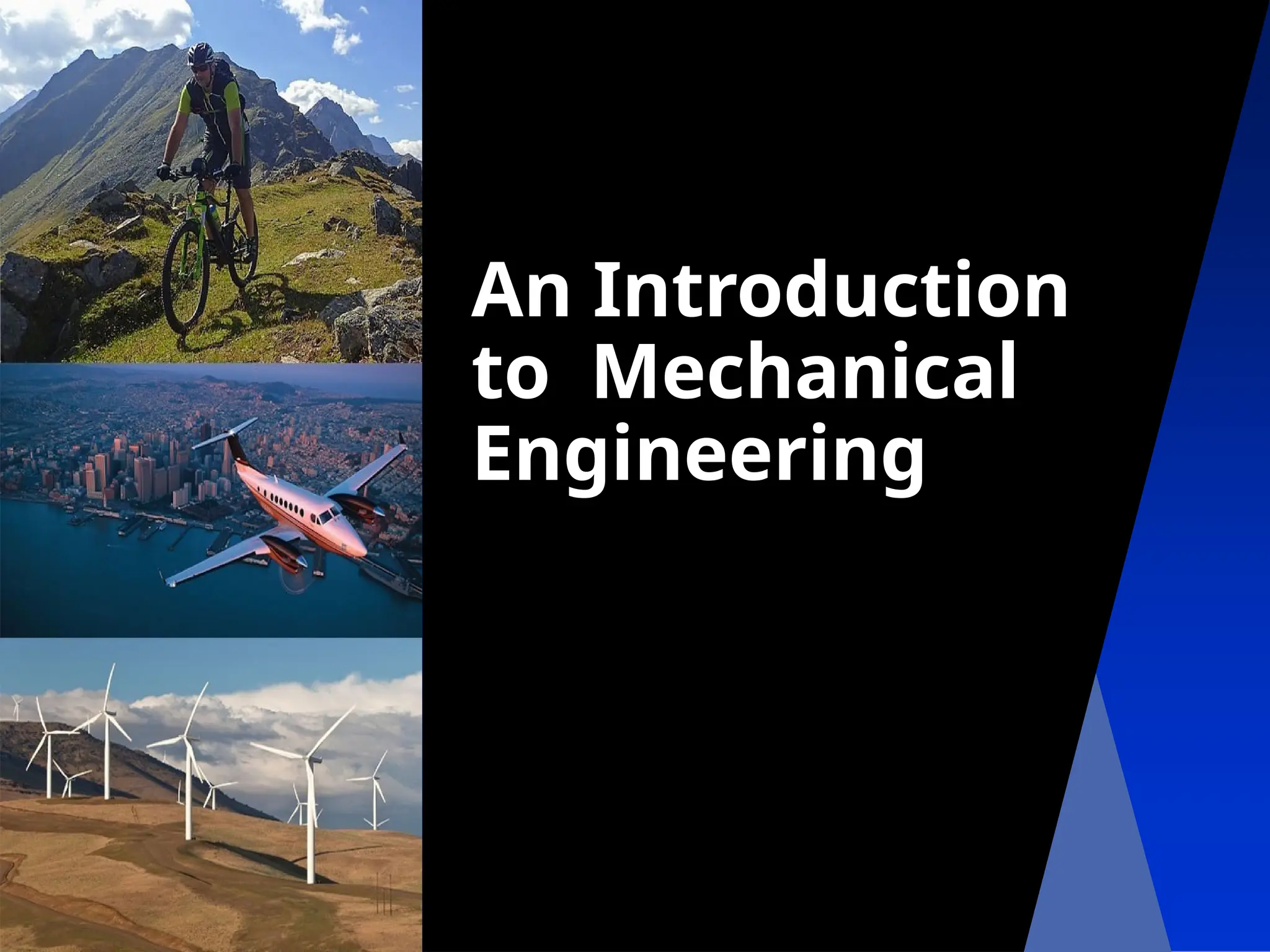
An Introduction
to Mechanical
Engineering
Introduction to
Mechanical
Engineering
• What is engineering?
• What do mechanical engineers do?
• The basic engineering process
What is an Engineer?
• Engineering is the profession in which
knowledge of the mathematical and
natural sciences gained by study,
experience, and practice is applied with
judgement to develop ways to utilize,
economically, the materials and forces of
nature for the benefit of mankind.
[ABET]
What Engineers Do ?
• Build a Bridge?
• Make a Robot?
• Work on a Computer?
• Drive a Train?
• Repair Car Engines?
Engineering Job
Descriptions
• Analytical engineer
• Design engineer
• Test engineer
• Manufacturing engineer
• Development engineer
• Research engineer
• Sales engineer
• Engineering manager
• Consulting engineer
Why Be An
Engineer?
•Money
??
•Fame ??
•Fortune
??
Why might YOU want to be an Engineer?
• You have high goals in life and want to get a strong
college education!
• You like math and sciences, and would like to apply
them to real world problems!
• You enjoy hands-on work and tinkering with
things!
• You were told that engineers make a lot of money!
• You were told that you can get a good job with an
engineering degree!
• You want to help humanity!
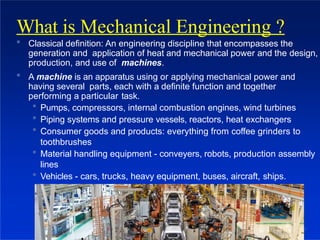
 Classical definition: An engineering discipline that encompasses the
generation and application of heat and mechanical power and the design,
production, and use of machines.
 A machine is an apparatus using or applying mechanical power and
having several parts, each with a definite function and together
performing a particular task.
 Pumps, compressors, internal combustion engines, wind turbines
 Piping systems and pressure vessels, reactors, heat exchangers
 Consumer goods and products: everything from coffee grinders to
toothbrushes
 Material handling equipment - conveyers, robots, production assembly
lines
 Vehicles - cars, trucks, heavy equipment, buses, aircraft, ships.
What is Mechanical Engineering ?
8
What is Mechanical Engineering?
• Mechanical engineering is the second largest
and one of the oldest disciplines; broadest of
all engineering disciplines.
• Mechanical engineers apply the principles
of mechanics and energy to the design of
machines and devices:
ENERGY and MOTION
What will you study as an ME
student?
• Forces, motion, structures: statics, dynamics, kinematics,
mechanics of solids and fluids.
• Energy: thermodynamics, heat transfer
• Materials: materials engineering & processing, manufacturing.
• Machines: graphics, design, machine elements, controls.
• Economics: engineering economic analysis, cost engineering.
• Human and Social Studies: arts, humanities, social
sciences, history, government, ethics, law.
• Overall foundation: math, physics, chemistry, biology, analysis
skills, communication skills, computation skills.
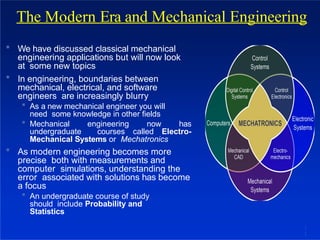
 We have discussed classical mechanical
engineering applications but will now look
at some new topics
 In engineering, boundaries between
mechanical, electrical, and software
engineers are increasingly blurry
 As a new mechanical engineer you will
need some knowledge in other fields
 Mechanical engineering now has
undergraduate courses called Electro-
Mechanical Systems or Mechatronics
 As modern engineering becomes more
precise both with measurements and
computer simulations, understanding the
error associated with solutions has become
a focus
 An undergraduate course of study
should include Probability and
Statistics
The Modern Era and Mechanical Engineering
1
1
Mech. Eng. Top 10: ASME Survey
Automobile: High-power lightweight engines, efficient mass-
manufacturing
Apollo: Saturn V launch vehicle (7.5 million pound thrust),
command and service module, lunar excursion module
Power generation: Conversion of stored energy into electricity,
manipulation of chemical-, kinetic, potential-, and nuclear-
energy, large-scale power production
Agriculture mechanization: Powered tractors, mechanized
harvesting, high-capacity irrigation pumps, computerized crops
management
Airplane: Propulsion (jet engines), lightweight materials,
electromechanical control systems
Mech. Eng. Top 10: ASME Survey
Integrated circuit mass production: IC
manufacturing machines, alignment systems,
temperature- and vibration control, motors, bearings
Air-conditioning and refrigeration: Compressors,
refrigerants, heat exchangers
Computer-aided engineering technology: Computer-
aided design, analysis, manufacturing, virtual collaboratives
Bioengineering: Imaging, prosthetics, minimally
invasive surgery, tissue engineering
Codes and standards: Interchangeability,
interoperability, interconnectivity
The Engineering Design
Process:
(Core of Engineering)
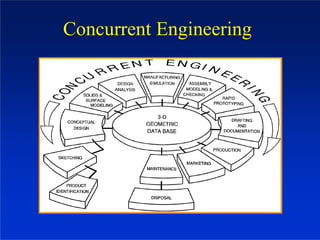
• Problem Identification: Get with Customer.
• Conceptual Design: Ideas, Sketches and Solution Lists.
• Refinement: Computer Modeling, Data Base
Development.
• Testing: Analysis and Simulation of All Design Aspects.
• Prototyping: Visualizing and Improving the Design.
• Communication: Engineering Drawings, Specifications.
• Production: Final Design, Manufacturing, Distribution.
Concurrent Engineering
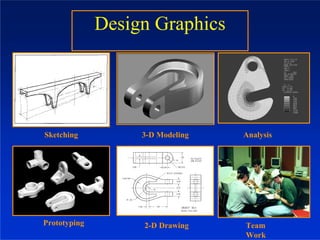
Design Graphics
Sketching 3-D Modeling Analysis
Prototyping 2-D Drawing Team
Work
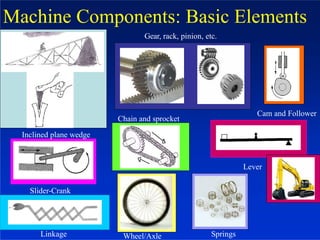
Machine Components: Basic Elements
Inclined plane wedge
Slider-Crank
Cam and Follower
Gear, rack, pinion, etc.
Chain and sprocket
Lever
Linkage Wheel/Axle Springs
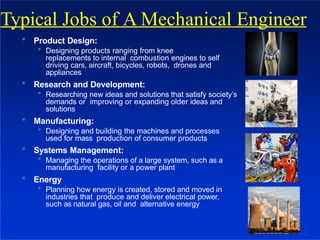
 Product Design:
 Designing products ranging from knee
replacements to internal combustion engines to self
driving cars, aircraft, bicycles, robots, drones and
appliances
 Research and Development:
 Researching new ideas and solutions that satisfy society’s
demands or improving or expanding older ideas and
solutions
 Manufacturing:
 Designing and building the machines and processes
used for mass production of consumer products
 Systems Management:
 Managing the operations of a large system, such as a
manufacturing facility or a power plant
 Energy
 Planning how energy is created, stored and moved in
industries that produce and deliver electrical power,
such as natural gas, oil and alternative energy
Typical Jobs of A Mechanical Engineer
1
8

Intro to Engineering lecture 11 (1).pptx

  • 1.
  • 2.
    Introduction to Mechanical Engineering • Whatis engineering? • What do mechanical engineers do? • The basic engineering process
  • 3.
    What is anEngineer? • Engineering is the profession in which knowledge of the mathematical and natural sciences gained by study, experience, and practice is applied with judgement to develop ways to utilize, economically, the materials and forces of nature for the benefit of mankind. [ABET]
  • 4.
    What Engineers Do? • Build a Bridge? • Make a Robot? • Work on a Computer? • Drive a Train? • Repair Car Engines?
  • 5.
    Engineering Job Descriptions • Analyticalengineer • Design engineer • Test engineer • Manufacturing engineer • Development engineer • Research engineer • Sales engineer • Engineering manager • Consulting engineer
  • 6.
  • 7.
    Why might YOUwant to be an Engineer? • You have high goals in life and want to get a strong college education! • You like math and sciences, and would like to apply them to real world problems! • You enjoy hands-on work and tinkering with things! • You were told that engineers make a lot of money! • You were told that you can get a good job with an engineering degree! • You want to help humanity!
  • 8.
     Classical definition:An engineering discipline that encompasses the generation and application of heat and mechanical power and the design, production, and use of machines.  A machine is an apparatus using or applying mechanical power and having several parts, each with a definite function and together performing a particular task.  Pumps, compressors, internal combustion engines, wind turbines  Piping systems and pressure vessels, reactors, heat exchangers  Consumer goods and products: everything from coffee grinders to toothbrushes  Material handling equipment - conveyers, robots, production assembly lines  Vehicles - cars, trucks, heavy equipment, buses, aircraft, ships. What is Mechanical Engineering ? 8
  • 9.
    What is MechanicalEngineering? • Mechanical engineering is the second largest and one of the oldest disciplines; broadest of all engineering disciplines. • Mechanical engineers apply the principles of mechanics and energy to the design of machines and devices: ENERGY and MOTION
  • 10.
    What will youstudy as an ME student? • Forces, motion, structures: statics, dynamics, kinematics, mechanics of solids and fluids. • Energy: thermodynamics, heat transfer • Materials: materials engineering & processing, manufacturing. • Machines: graphics, design, machine elements, controls. • Economics: engineering economic analysis, cost engineering. • Human and Social Studies: arts, humanities, social sciences, history, government, ethics, law. • Overall foundation: math, physics, chemistry, biology, analysis skills, communication skills, computation skills.
  • 11.
     We havediscussed classical mechanical engineering applications but will now look at some new topics  In engineering, boundaries between mechanical, electrical, and software engineers are increasingly blurry  As a new mechanical engineer you will need some knowledge in other fields  Mechanical engineering now has undergraduate courses called Electro- Mechanical Systems or Mechatronics  As modern engineering becomes more precise both with measurements and computer simulations, understanding the error associated with solutions has become a focus  An undergraduate course of study should include Probability and Statistics The Modern Era and Mechanical Engineering 1 1
  • 12.
    Mech. Eng. Top10: ASME Survey Automobile: High-power lightweight engines, efficient mass- manufacturing Apollo: Saturn V launch vehicle (7.5 million pound thrust), command and service module, lunar excursion module Power generation: Conversion of stored energy into electricity, manipulation of chemical-, kinetic, potential-, and nuclear- energy, large-scale power production Agriculture mechanization: Powered tractors, mechanized harvesting, high-capacity irrigation pumps, computerized crops management Airplane: Propulsion (jet engines), lightweight materials, electromechanical control systems
  • 13.
    Mech. Eng. Top10: ASME Survey Integrated circuit mass production: IC manufacturing machines, alignment systems, temperature- and vibration control, motors, bearings Air-conditioning and refrigeration: Compressors, refrigerants, heat exchangers Computer-aided engineering technology: Computer- aided design, analysis, manufacturing, virtual collaboratives Bioengineering: Imaging, prosthetics, minimally invasive surgery, tissue engineering Codes and standards: Interchangeability, interoperability, interconnectivity
  • 14.
    The Engineering Design Process: (Coreof Engineering) • Problem Identification: Get with Customer. • Conceptual Design: Ideas, Sketches and Solution Lists. • Refinement: Computer Modeling, Data Base Development. • Testing: Analysis and Simulation of All Design Aspects. • Prototyping: Visualizing and Improving the Design. • Communication: Engineering Drawings, Specifications. • Production: Final Design, Manufacturing, Distribution.
  • 15.
  • 16.
    Design Graphics Sketching 3-DModeling Analysis Prototyping 2-D Drawing Team Work
  • 17.
    Machine Components: BasicElements Inclined plane wedge Slider-Crank Cam and Follower Gear, rack, pinion, etc. Chain and sprocket Lever Linkage Wheel/Axle Springs
  • 18.
     Product Design: Designing products ranging from knee replacements to internal combustion engines to self driving cars, aircraft, bicycles, robots, drones and appliances  Research and Development:  Researching new ideas and solutions that satisfy society’s demands or improving or expanding older ideas and solutions  Manufacturing:  Designing and building the machines and processes used for mass production of consumer products  Systems Management:  Managing the operations of a large system, such as a manufacturing facility or a power plant  Energy  Planning how energy is created, stored and moved in industries that produce and deliver electrical power, such as natural gas, oil and alternative energy Typical Jobs of A Mechanical Engineer 1 8