























WELCOME

MEC Meeting #4 IBM 'Summer Edition
INTRODUCTION

Ronald Velten
High level overview IBM CMO
Study results

Three imperatives on the future
practice of marketing

Discussion and sharing
experiences
High level overview IBM CMO
Study results

Three imperatives on the future
practice of marketing

Discussion and sharing
experiences
IBM CMO Study
From Stretched to Strengthened
     Getting Fit for the Future
Deliver value to                    Capture value,
empowered                           measure results
customers


                   Foster lasting
                   connections


                                             © 2011 IBM Corporation
Which sources of
client information
are you using?
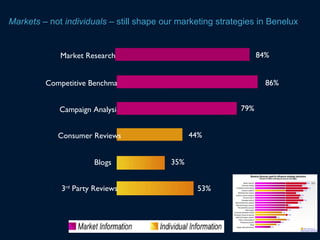
Markets – not individuals – still shape our marketing strategies in Benelux


             Market Research                                      84%


         Competitive Benchmarking                                   86%


             Campaign Analysis                              79%


            Consumer Reviews                    44%


                      Blogs               35%


             3rd Party Reviews                   53%
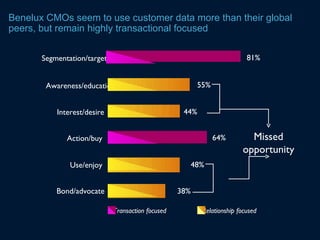
Benelux CMOs seem to use customer data more than their global
peers, but remain highly transactional focused


       Segmentation/targeting                                              81%


        Awareness/education                               55%


           Interest/desire                          44%


              Action/buy                                        64%        Missed
                                                                         opportunity
               Use/enjoy                                 48%


           Bond/advocate                           38%

                             Transaction focused           Relationship focused
What is your span
of control in managing
the end-to-end client
experience
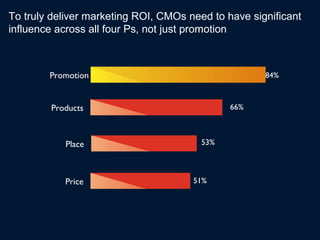
To truly deliver marketing ROI, CMOs need to have significant
influence across all four Ps, not just promotion


        Promotion                                    84%


        Products                              66%


           Place                        53%


           Price                      51%
What is your most
important brand
carrier?
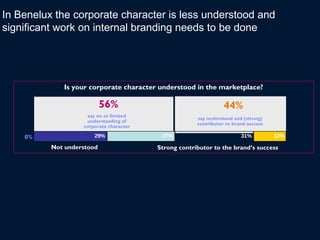
In Benelux the corporate character is less understood and
significant work on internal branding needs to be done


             Is your corporate character understood in the marketplace?

                           56%                                   44%
                    say no or limited
                                                      say understood and (strong)
                    understanding of
                                                      contributor to brand success
                   corporate character

    0%                 29%                27%                           31%          13%

          Not understood                 Strong contributor to the brand’s success
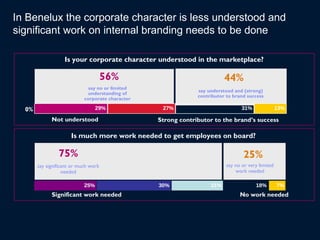
In Benelux the corporate character is less understood and
significant work on internal branding needs to be done

                   Is your corporate character understood in the marketplace?

                                      56%                                 44%
                             say no or limited
                                                               say understood and (strong)
                             understanding of
                                                               contributor to brand success
                            corporate character

  0%                              29%              27%                            31%               13%

             Not understood                       Strong contributor to the brand’s success

                      Is much more work needed to get employees on board?

                75%                                                               25%
       say significant or much work                                        say no or very limited
                   needed                                                      work needed

                            25%                   30%               21%                 18%         7%
             Significant work needed                                             No work needed
By 2015, the leading
measurement for
marketing will be …
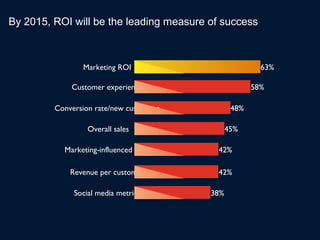
By 2015, ROI will be the leading measure of success


                Marketing ROI                           63%

             Customer experience                      58%

         Conversion rate/new customers          48%

                  Overall sales                45%

           Marketing-influenced sales     42%

             Revenue per customer         42%

              Social media metrics       38%
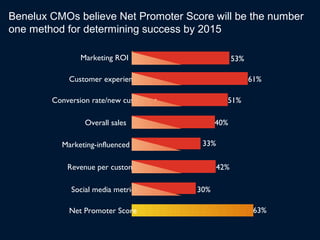
Benelux CMOs believe Net Promoter Score will be the number
one method for determining success by 2015

               Marketing ROI                         53%

            Customer experience                            61%

        Conversion rate/new customers            51%

                 Overall sales                40%

          Marketing-influenced sales     33%

            Revenue per customer               42%

             Social media metrics       30%

            Net Promoter Score                              63%
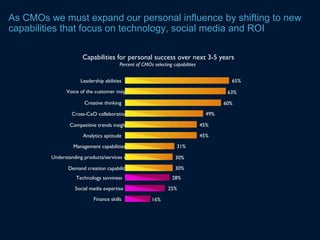
As CMOs we must expand our personal influence by shifting to new
capabilities that focus on technology, social media and ROI

                      Capabilities for personal success over next 3-5 years
                                         Percent of CMOs selecting capabilities


                      Leadership abilities                                                  65%

               Voice of the customer insights                                              63%
                       Creative thinking                                                  60%

                  Cross-CxO collaboration                                           49%

                 Competitive trends insights                                      45%

                       Analytics aptitude                                         45%

                  Management capabilities                            31%

         Understanding products/services value chain                30%

                Demand creation capabilities                        30%
                    Technology savviness                           28%

                   Social media expertise                        25%
                            Finance skills               16%
From Stretched to Strengthened
     Getting Fit for the Future
High level overview IBM CMO
Study results

Three imperatives on the future
practice of marketing

Discussion and sharing
experiences
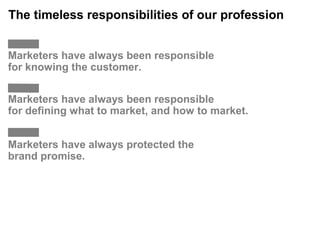
The timeless responsibilities of our profession


Marketers have always been responsible
for knowing the customer.


Marketers have always been responsible
for defining what to market, and how to market.


Marketers have always protected the
brand promise.
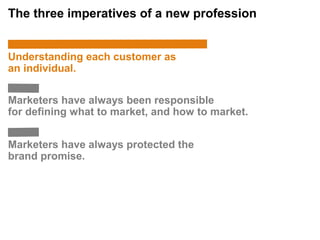
The three imperatives of a new profession


Understanding each customer as
an individual.

Marketers have always been responsible
for defining what to market, and how to market.


Marketers have always protected the
brand promise.
The three imperatives of a new profession


Understanding each customer as
an individual.


Creating a system of engagement that
maximizes value creation at every touch.

Marketers have always protected the
brand promise.
The three imperatives of a new profession


Understanding each customer as
an individual.


Creating a system of engagement that
maximizes value creation at every touch.

Designing your culture and brand so
they are authentically one.
Question:
How do you structure
client insights across
the engagement cycle
Question:
How strong are your
employees as brand
ambassadors to foster
your corporate character
Question
What are your learnings
or experiencing with
social enabling your
Sales population
MEC Meeting #4 - Summer Edition

MEC Meeting #4 - Summer Edition

  • 1.
    WELCOME MEC Meeting #4IBM 'Summer Edition
  • 2.
  • 4.
    High level overviewIBM CMO Study results Three imperatives on the future practice of marketing Discussion and sharing experiences
  • 5.
    High level overviewIBM CMO Study results Three imperatives on the future practice of marketing Discussion and sharing experiences
  • 17.
    IBM CMO Study FromStretched to Strengthened Getting Fit for the Future
  • 18.
    Deliver value to Capture value, empowered measure results customers Foster lasting connections © 2011 IBM Corporation
  • 19.
    Which sources of clientinformation are you using?
  • 21.
    Markets – notindividuals – still shape our marketing strategies in Benelux Market Research 84% Competitive Benchmarking 86% Campaign Analysis 79% Consumer Reviews 44% Blogs 35% 3rd Party Reviews 53%
  • 22.
    Benelux CMOs seemto use customer data more than their global peers, but remain highly transactional focused Segmentation/targeting 81% Awareness/education 55% Interest/desire 44% Action/buy 64% Missed opportunity Use/enjoy 48% Bond/advocate 38% Transaction focused Relationship focused
  • 23.
    What is yourspan of control in managing the end-to-end client experience
  • 24.
    To truly delivermarketing ROI, CMOs need to have significant influence across all four Ps, not just promotion Promotion 84% Products 66% Place 53% Price 51%
  • 25.
    What is yourmost important brand carrier?
  • 26.
    In Benelux thecorporate character is less understood and significant work on internal branding needs to be done Is your corporate character understood in the marketplace? 56% 44% say no or limited say understood and (strong) understanding of contributor to brand success corporate character 0% 29% 27% 31% 13% Not understood Strong contributor to the brand’s success
  • 27.
    In Benelux thecorporate character is less understood and significant work on internal branding needs to be done Is your corporate character understood in the marketplace? 56% 44% say no or limited say understood and (strong) understanding of contributor to brand success corporate character 0% 29% 27% 31% 13% Not understood Strong contributor to the brand’s success Is much more work needed to get employees on board? 75% 25% say significant or much work say no or very limited needed work needed 25% 30% 21% 18% 7% Significant work needed No work needed
  • 28.
    By 2015, theleading measurement for marketing will be …
  • 29.
    By 2015, ROIwill be the leading measure of success Marketing ROI 63% Customer experience 58% Conversion rate/new customers 48% Overall sales 45% Marketing-influenced sales 42% Revenue per customer 42% Social media metrics 38%
  • 30.
    Benelux CMOs believeNet Promoter Score will be the number one method for determining success by 2015 Marketing ROI 53% Customer experience 61% Conversion rate/new customers 51% Overall sales 40% Marketing-influenced sales 33% Revenue per customer 42% Social media metrics 30% Net Promoter Score 63%
  • 33.
    As CMOs wemust expand our personal influence by shifting to new capabilities that focus on technology, social media and ROI Capabilities for personal success over next 3-5 years Percent of CMOs selecting capabilities Leadership abilities 65% Voice of the customer insights 63% Creative thinking 60% Cross-CxO collaboration 49% Competitive trends insights 45% Analytics aptitude 45% Management capabilities 31% Understanding products/services value chain 30% Demand creation capabilities 30% Technology savviness 28% Social media expertise 25% Finance skills 16%
  • 34.
    From Stretched toStrengthened Getting Fit for the Future
  • 38.
    High level overviewIBM CMO Study results Three imperatives on the future practice of marketing Discussion and sharing experiences
  • 39.
    The timeless responsibilitiesof our profession Marketers have always been responsible for knowing the customer. Marketers have always been responsible for defining what to market, and how to market. Marketers have always protected the brand promise.
  • 40.
    The three imperativesof a new profession Understanding each customer as an individual. Marketers have always been responsible for defining what to market, and how to market. Marketers have always protected the brand promise.
  • 41.
    The three imperativesof a new profession Understanding each customer as an individual. Creating a system of engagement that maximizes value creation at every touch. Marketers have always protected the brand promise.
  • 42.
    The three imperativesof a new profession Understanding each customer as an individual. Creating a system of engagement that maximizes value creation at every touch. Designing your culture and brand so they are authentically one.
  • 43.
    Question: How do youstructure client insights across the engagement cycle
  • 44.
    Question: How strong areyour employees as brand ambassadors to foster your corporate character
  • 45.
    Question What are yourlearnings or experiencing with social enabling your Sales population

Editor's Notes

  • #2 SchaalX is gespecialiseerd in de bemiddeling van hoger opgeleid personeel in Communicatie, Marketing en Sales w dienst te komen: de vliegreis, de treinreis, het festival, het college of uw tentoonstelling. CFS Group ondersteunt uw klant deze weg soepel, veilig en comfortabel af kan leggen.
  • #19 To deal with this degree of change and complexity – CMOs ’ responses indicated there were three key domains – three imperatives – where they feel the need to improve: Deliver value to empowered customers The digital revolution has forever changed the balance of power between the individual and the institution. If CMOs are to understand and provide value to empowered customers and citizens, they will have to concentrate on getting to know individuals as well as markets. They will also have to invest in new technologies and advanced analytics to get a better grasp of how individual customers behave. Foster lasting connections To effectively cultivate meaningful relationships with their customers, CMOs will have to connect with them in ways their customers perceive as valuable. This entails engaging with customers throughout the entire customer lifecycle, building online and offline communities of interest and collaborating with the rest of the C-suite to fuse the internal and external faces of the enterprise. Capture value, measure results Lastly, CMOs will have to quantify and analyze the financial results of their marketing initiatives and communicate them to the wider organization to enhance the marketing function ’s credibility and effectiveness. They also will have to inject new skills into the marketing function by expanding the digital, analytical and financial capabilities of existing employees and by hiring staff or by partnering with specialists to fill the gaps. And since it’s important to lead by example, CMOs will need to invest in enhancing their own expertise in these areas as well.
  • #23 Yet, despite this stated priority, most CMOs are, in fact, still focusing on the transaction, and less so on the data required to build lasting relationships with the customer. When we look at the customer lifecycle, starting first with segmentation, then to awareness, interest, action, use, and bond – we see CMOs are using data primarily to segment and sell, not to generate awareness, stimulate interest and “ create customer tribes, ” as an industrial products CMO in Finland put it. This is partly because, historically, it usually has been easy to get segmentation and sales data. Market analysis firms have provided the former, and companies have collected the latter themselves. Obtaining data on the rest of the customer lifecycle has, by contrast, been much more difficult. Organizations that only look at segmentation and sales data are missing the opportunity to learn from the other phases of the customer lifecycle. And those phases are becoming increasingly important as customers connect with brands in totally new ways.
  • #25 One reason CMOs are concerned is their apparent lack of influence over those areas that effect marketing ROI. If CMOs are to be held responsible for the marketing returns they deliver, they must also have significant influence over all four Ps: promotion, products, place and price. Surprisingly, this is often not the case. CMOs told us they exert a strong influence over promotional activities such as advertising, external communications and social media initiatives. But, in general, they play a smaller role in shaping the other three Ps. Less than half of all respondents have much sway over key parts of the pricing process, for example. Similarly, less than half have much impact on new product development or cross-company pricing. As all CMOs know, price, product and place significantly influence customer preference. At the same time, actions taken by marketing impact the organization. A special promotion, for example, may drive up demand, with implications for the supply chain. The CMO is uniquely positioned to capture and disseminate such customer insights throughout the organization.
  • #40 For a long time, marketers have had three big marketing responsibilities: Marketers have always been responsible for knowing the customer. Marketers have always been responsible for defining what to market, and how to market. Marketers have always protected the brand promise. How are these responsibilities changing? Over the past year, IBM talked with more than 1,700 CMOs, analyzed academic writings, took a look at what content and ideas were shared through social media, and interviewed several CMO CIO Leadership Exchange participants. Based on that, this is where we collectively think our profession is going.
  • #41 Marketers have always been responsible for knowing the customer. Data and analytics enable us to know each customer in a way that goes far beyond segmentation, demographics and transaction patterns—they surface a much wider set of needs that we can try to fulfill. Our new role is to help the enterprise see each customer as an individual.
  • #42 Marketers have always been responsible for defining what to market, and how to market. Because we have a sense of individuals ’ wider needs, we can be much more strategic in how we fulfill them at every touchpoint. Certainly, with products and services—but far beyond that too: with knowledge, context, experiences, connections to others, a new peer set and more. This is about marketing driving not just marketing experiences, but the much broader set of experiences that a customer has with the company. Our role is to create a system of engagement that maximizes at each touchpoint.
  • #43 Marketers have always protected the brand promise. In a world of radical transparency, each experience with the company is a test of its promise. And while we once lived in a world where gaps between that promise and reality were experienced by, well, those who experienced them, in an interconnected world a poor experience travels into the realm of social media out to tens, hundreds, thousands or, in some cases, millions of other people’s lives. That magnification also works in the reverse—positive experiences are magnified. One CMO summed it up as: “How we are is who we are.” Our new role is to put the best insurance policy in place: to build a brand and culture that are authentically one.
  • #45 If we have done a great job of delivering on imperative 1 for our organization, then imperative 2 comes into play. A full view of a customer ’s needs means that we can then serve a broader set of his or needs. Enlightened by this full picture of what customers value, the business world divides into two types of companies: those that then approach customer engagement by being systemic in their approach and those that do it in pieces. The latter tend to approach marketing transformation project by project, supported by a proliferating array of tools. Projects, like cross-channel integration, geo-location, mobile strategy, campaign automation, cross-sell/up-sell and more, which are staffed by largely autonomous teams and approached in discrete initiatives. In contrast, systemic companies are intentional about their customer experience—at each moment and over time. They design how their company is experienced. They build a blueprint that makes sense of trends, developments and technologies as an integrated whole—how they fit together to accomplish the right outcome for the customer.
  • #46 In imperative 1, we talked about how we can collect data about each customer to know him or her as an individual. But, of course, the same tools are in the hands of our customers and they can collect a tremendous amount of data about our companies. They can know everything about us.