Technology in Architectures
Lecture 8
Cooling Loads
Cooling Degree Hours
Energy Performance Ratings
Annual Fuel Consumption
Cooling Loads
Computed for worst
case scenario:
 Late summer afternoon
at outdoor design dry
bulb temperature
Include:
 Insolation from sun
 Heat gain from people,
lights, and equipment
 Infiltration in residential
buildings
 Ventilation in
nonresidential buildings
SR-3
Summer Design Conditions
Design Dry Bulb Temperature
Mean Daily Range
S(10): T.B.1,
p. 1496
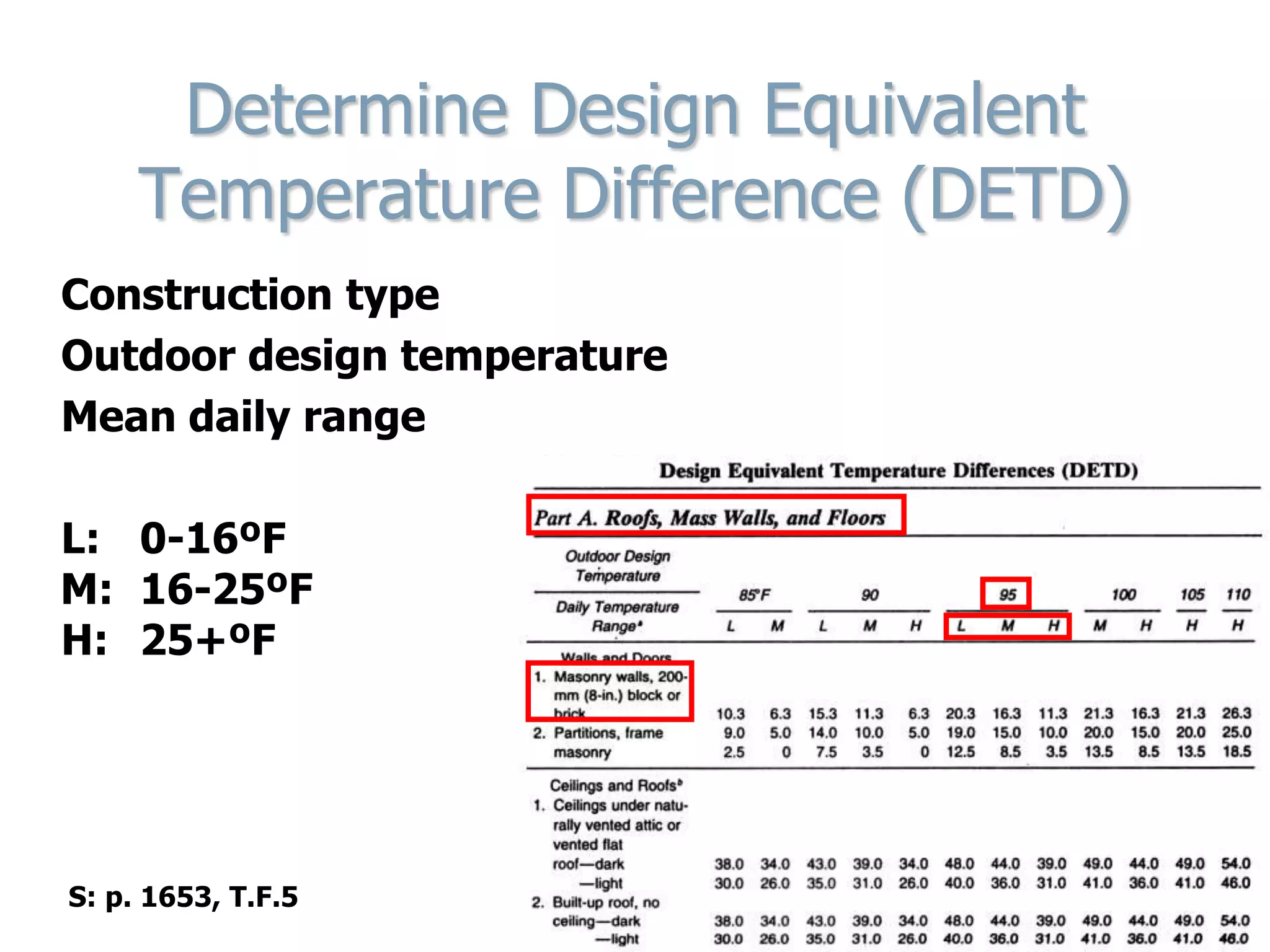
Determine Design Equivalent
Temperature Difference (DETD)
Construction type
Outdoor design temperature
Mean daily range
L: 0-16ºF
M: 16-25ºF
H: 25+ºF
S: p. 1653, T.F.5
Determine Envelope U-values
Calculate ΣR and then find U for walls
and roofs.
Note: this method ignores floors, doors,
and window U-values
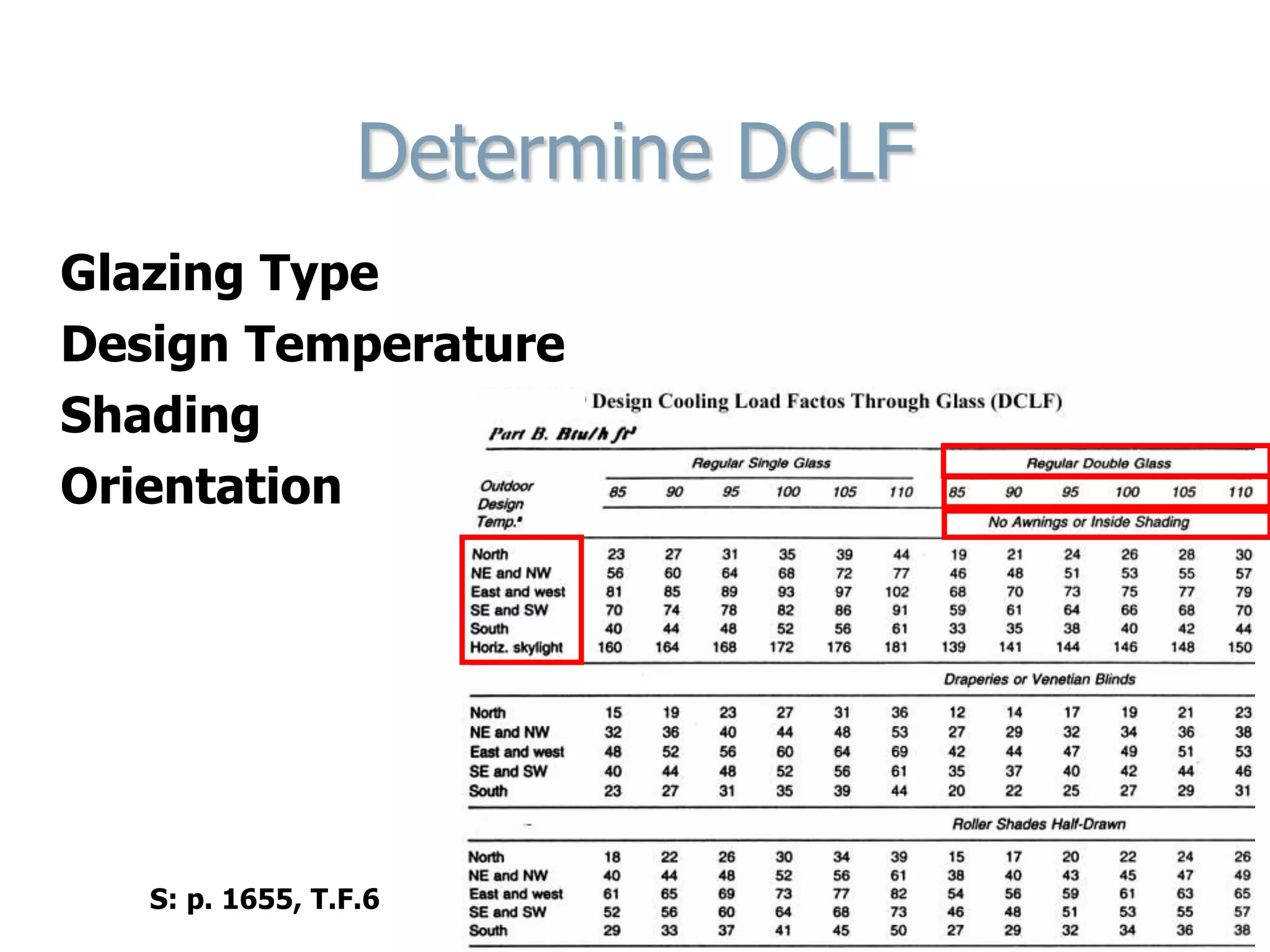
Determine DCLF
Glazing Type
Design Temperature
Shading
Orientation
S: p. 1655, T.F.6
Determine Area Quantities
Perform area takeoffs for
all building envelope
surfaces on each facade:
gross wall area
window area
door area
net wall area
4’
Elevation
4’
12’
100’
8’
1200 sf
64 sf
368 sf
768 sf
-
-
Infiltration
S: p. 1657, T.F.7
Ventilation Analysis
Non-residential buildings use ventilation to provide
fresh air and to offset infiltration effects.
ASHRAE Standard 62-2001 (S: p. 1598, T.E.25)
Estimates the number of people/1000 sf of usage type
Prescribes minimum ventilation/person for usage type
ASHRAE 62-2001
Defines space occupancy and ventilation loads
S: p. 1639, T.E.25
Ventilation—Sensible CLF
S: 1657, T.F.7
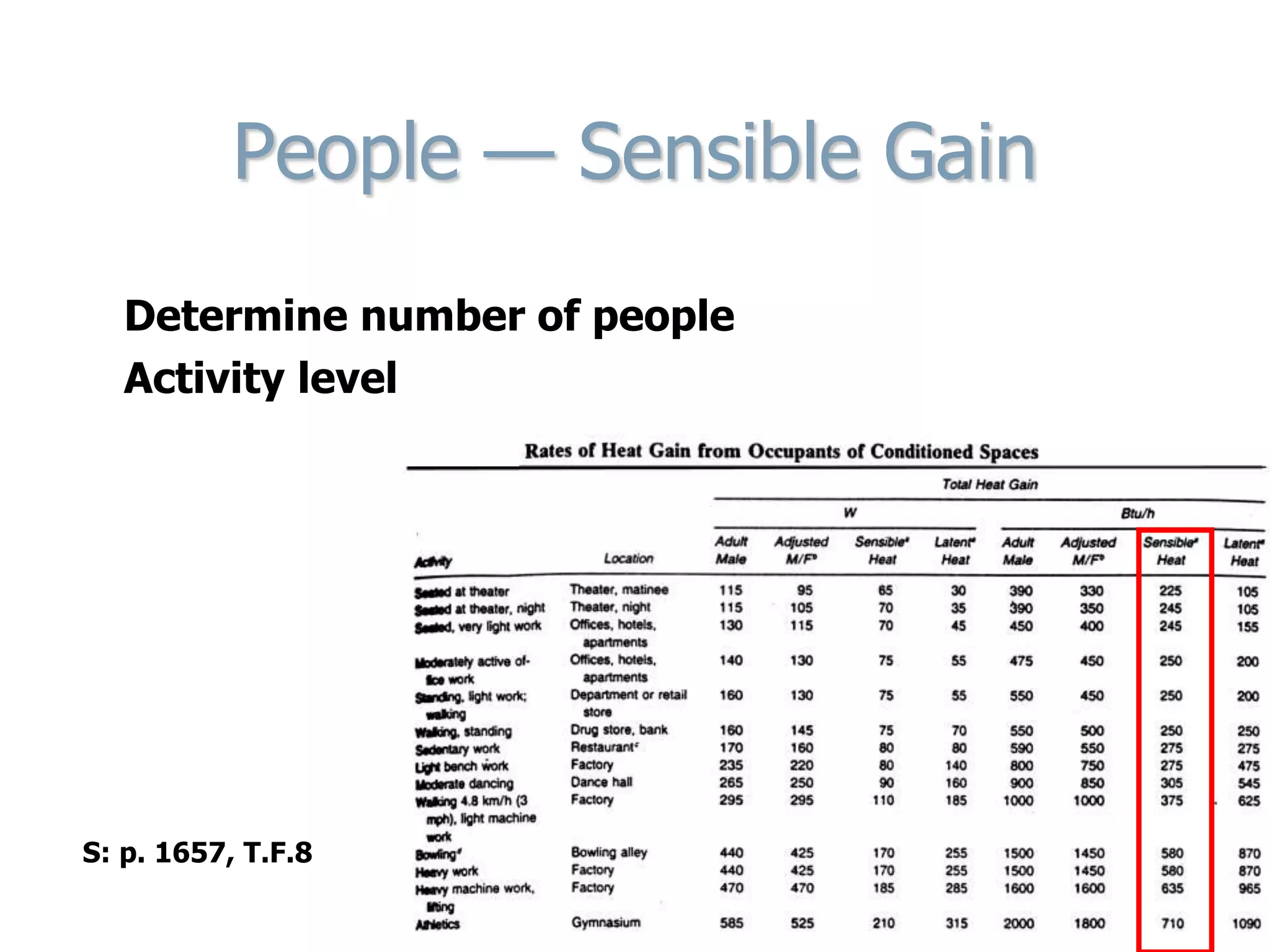
People — Sensible Gain
Determine number of people
Activity level
S: p. 1657, T.F.8
Lights
Determine wattage of lighting/square foot
 ASHRAE 90.1 prescriptive levels
 Count fixture loads and add together
Note: add 15% for ballasts where applicable
(e.g., fluorescent lights)
Equipment
Determine operating wattage of
equipment/square foot
 ASHRAE 90.1 prescriptive levels
 Count actual loads and add together
Note: include a diversity factor (20-30%) if
specific usage patterns are unknown.
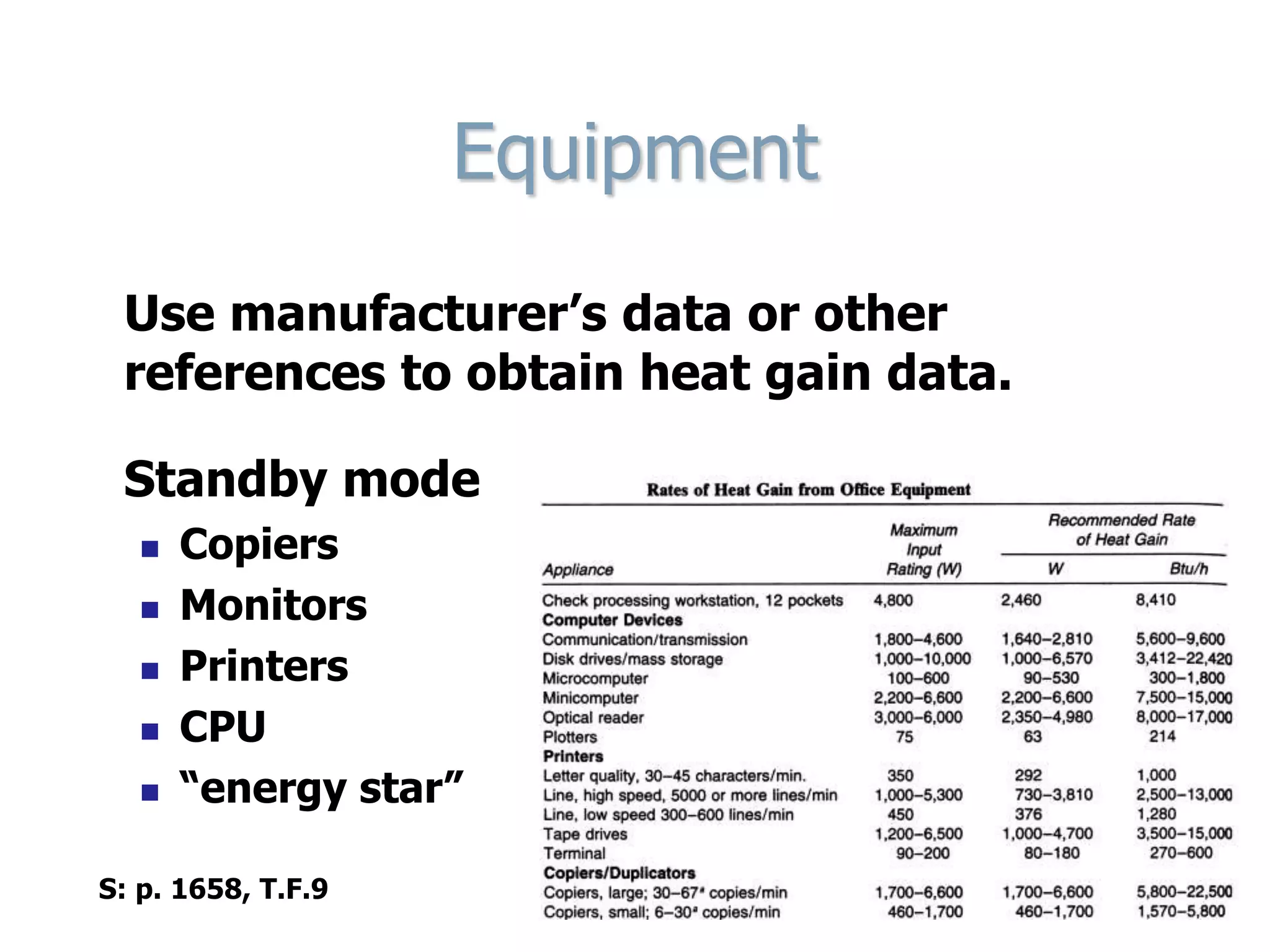
Equipment
Use manufacturer’s data or other
references to obtain heat gain data.
Standby mode
 Copiers
 Monitors
 Printers
 CPU
 “energy star”
S: p. 1658, T.F.9
Latent Load
Not calculated separately:
Apply a factor as a percentage of the total
sensible cooling load
Dry climates: 20%
Moist/Humid climates: 30%
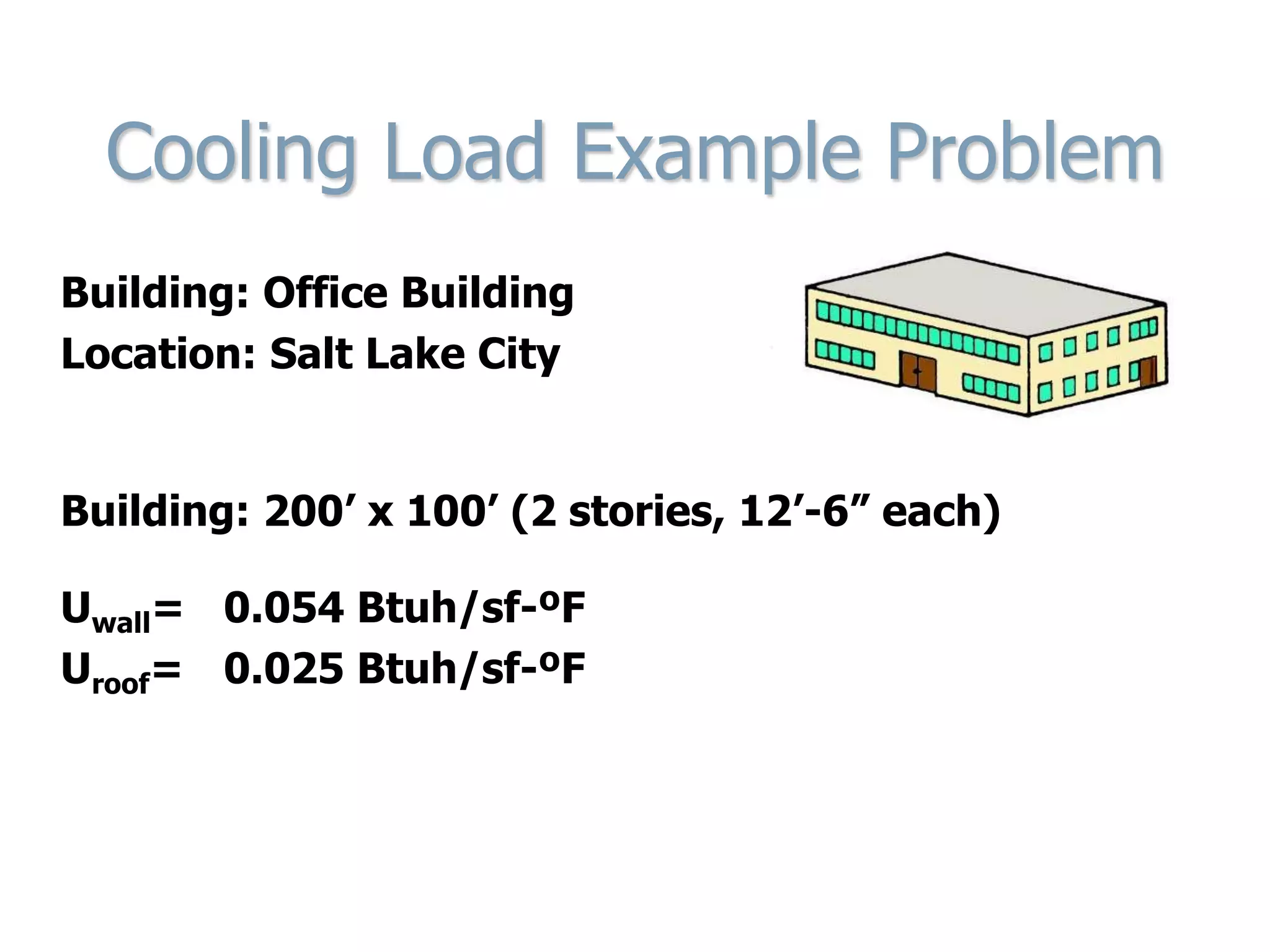
Cooling Load Example Problem
Building: Office Building
Location: Salt Lake City
Building: 200’ x 100’ (2 stories, 12’-6” each)
Uwall= 0.054 Btuh/sf-ºF
Uroof= 0.025 Btuh/sf-ºF
Cooling Load Example Problem
Determine Building Envelope Areas (SF)
Building: 200’ x 100’ (2 stories, 12’-6” each)
N E S W
Gross Wall 5,000 2,500 5,000 2,500
Windows 1,000 500 2,000 500
Doors 20 20 50 20
Net Wall 3,980 1,980 2,950 1,980
Roof/Floor Slab 20,000
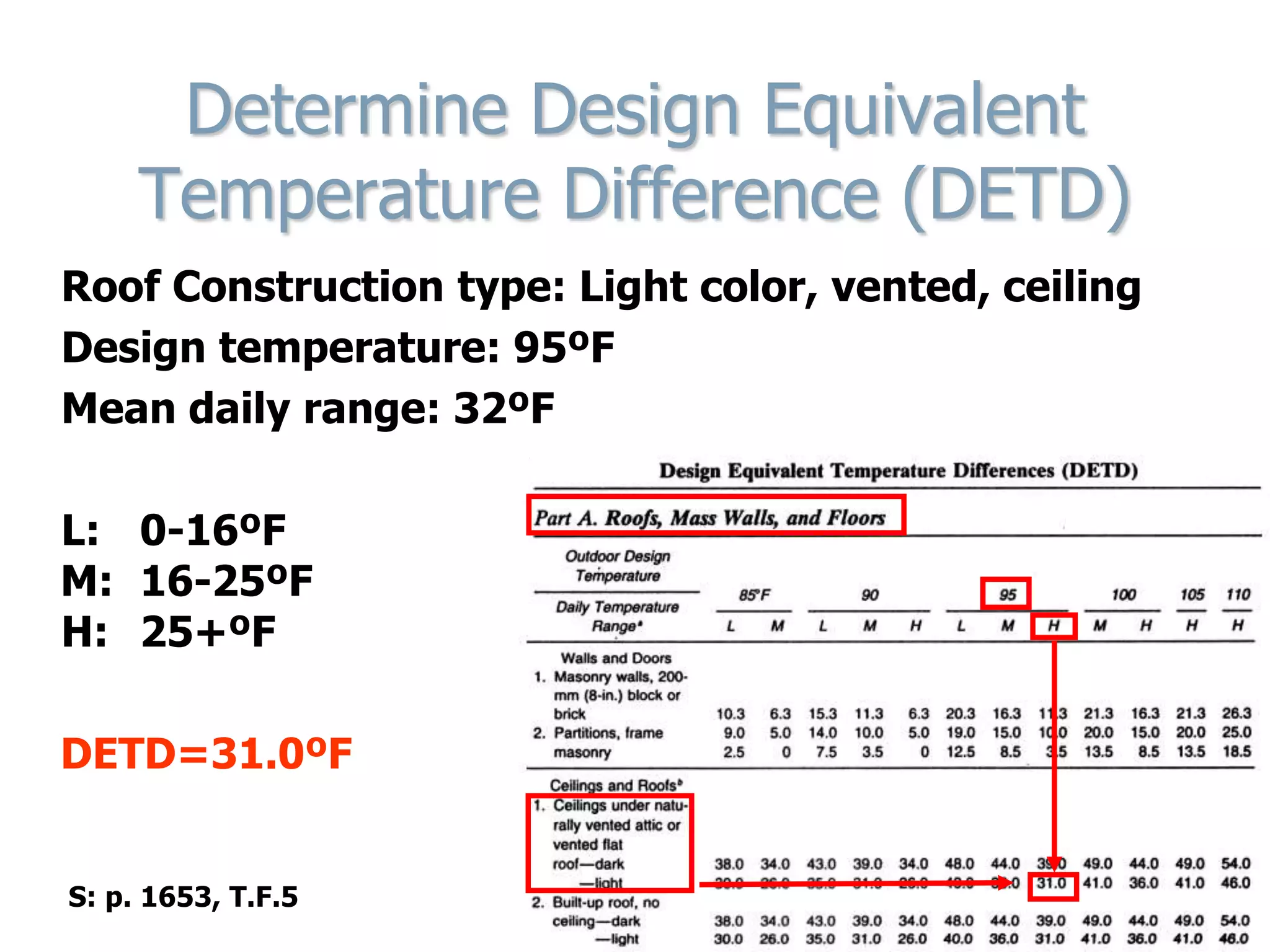
Determine Design Equivalent
Temperature Difference (DETD)
Roof Construction type: Light color, vented, ceiling
Design temperature: 95ºF
Mean daily range: 32ºF
L: 0-16ºF
M: 16-25ºF
H: 25+ºF
DETD=31.0ºF
S: p. 1653, T.F.5
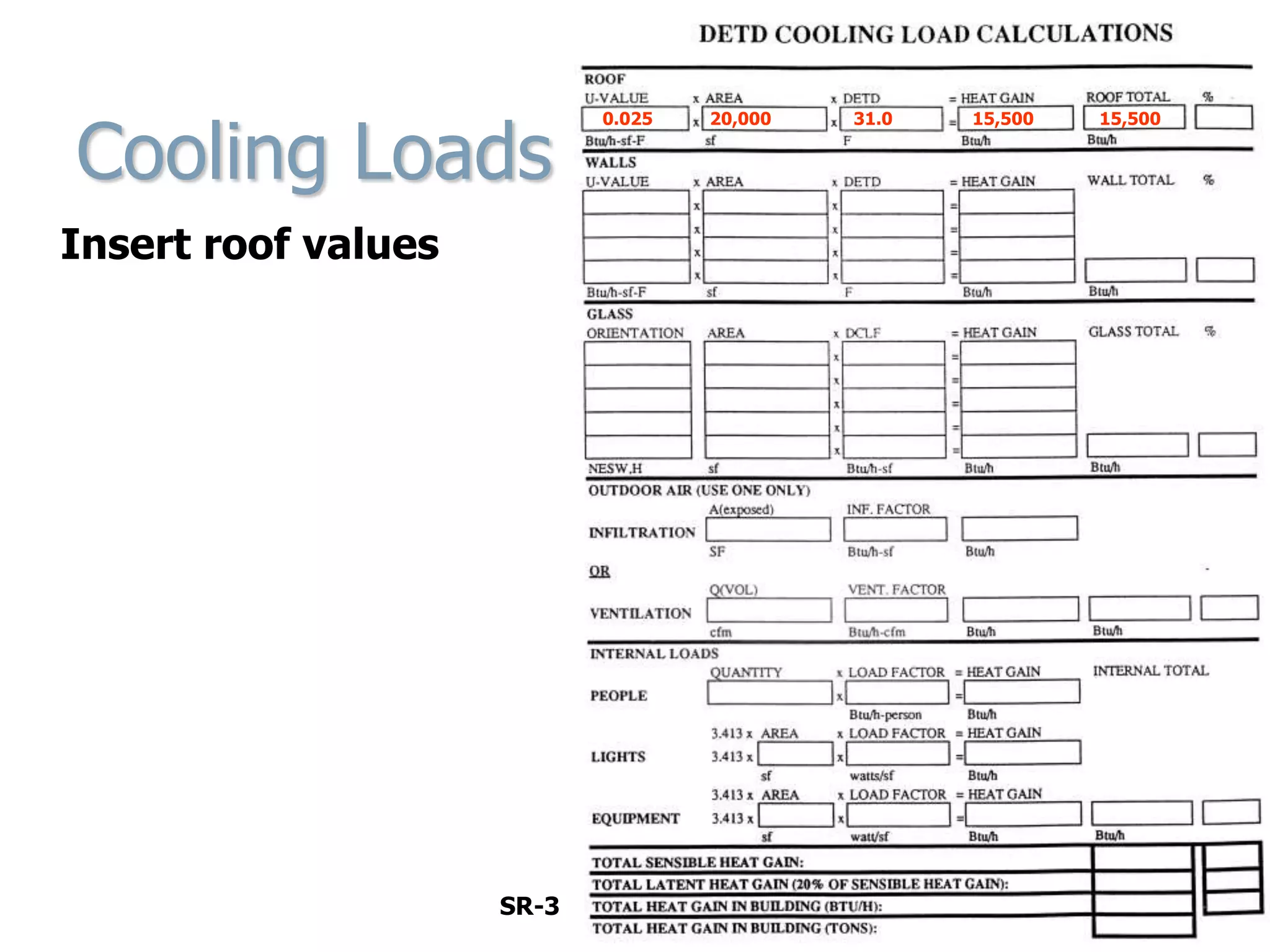
Cooling Loads
Insert roof values
SR-3
0.025 20,000 31.0 15,500 15,500
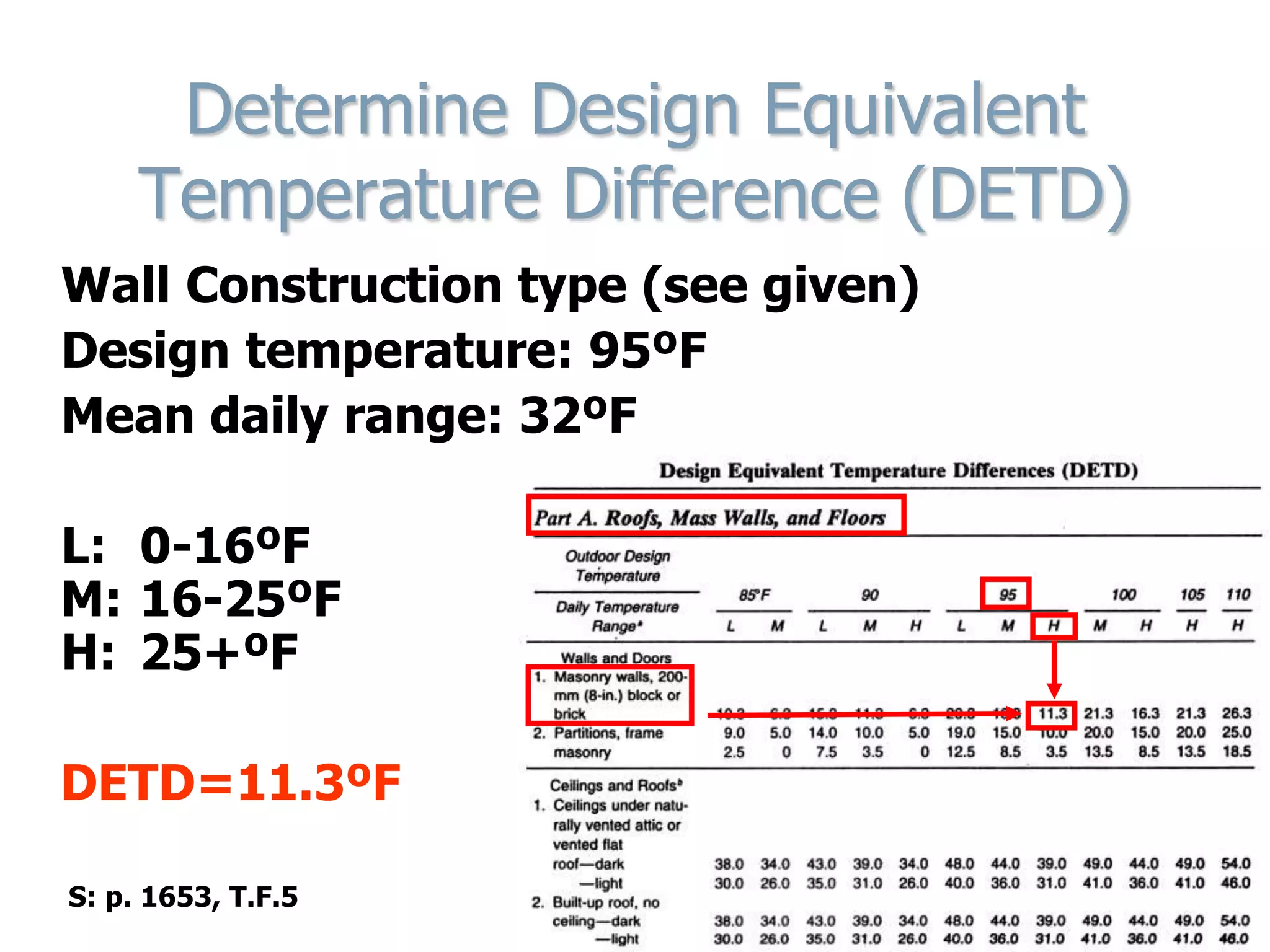
Determine Design Equivalent
Temperature Difference (DETD)
Wall Construction type (see given)
Design temperature: 95ºF
Mean daily range: 32ºF
L: 0-16ºF
M: 16-25ºF
H: 25+ºF
DETD=11.3ºF
S: p. 1653, T.F.5
Cooling Loads
Insert roof values
Insert wall values
SR-3
0.025 20,000 31.0 15,500 15,500
N 0.054 3,980 11.3 2.429
E 0.054 1,980 11.3 1.208
S 0.054 2,950 11.3 1,800
W 0.054 1,980 11.3 1,208 6,645
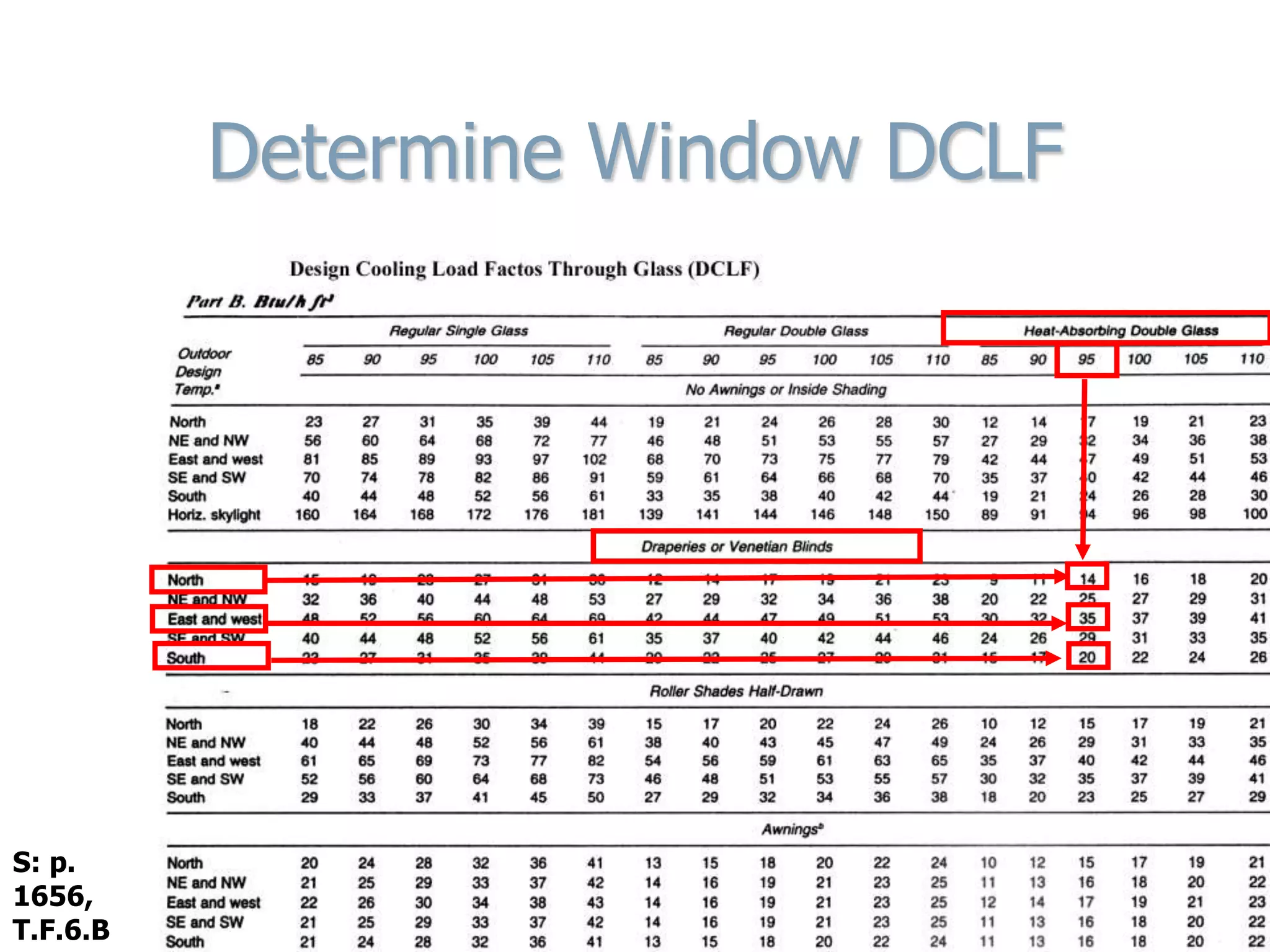
Glazing Type
Design Temperature
Shading
Orientation
Determine Window DCLF
S: p.
1656,
T.F.6.B
Cooling Loads
Insert roof values
Insert wall values
Insert glass values
SR-3
0.025 20,000 31.0 15,500 15,500
N 0.054 3,980 11.3 2.429
E 0.054 1,980 11.3 1.208
S 0.054 2,950 11.3 1,800
W 0.054 1,980 11.3 1,208 6,645
N 1,000 14 14,000
E 500 35 17,500
S 2,000 20 40,000
W 500 35 17,500
89,000
ASHRAE 62-2001
Defines space occupancy and ventilation loads
S: p. 1639, T.E.25
Ventilation Load — Sensible
40,000 sf x 5people/1,000sf = 200 people
200 people x 17 cfm/person = 3,400 cfm
Ventilation Load — Sensible CLF
Design Temperature: 95ºF
Commercial Building: Ventilation
S: p. 1657, T.F.7
Cooling Loads
Insert roof values
Insert wall values
Insert glass values
Insert outdoor air
values
SR-3
0.025 20,000 31.0 15,500 15,500
N 0.054 3,980 11.3 2.429
E 0.054 1,980 11.3 1.208
S 0.054 2,950 11.3 1,800
W 0.054 1,980 11.3 1,208 6,645
N 1,000 14 14,000
E 500 35 17,500
S 2,000 20 40,000
W 500 35 17,500
89,000
N/A N/A N/A
3,400 22.0 74,800 74,800
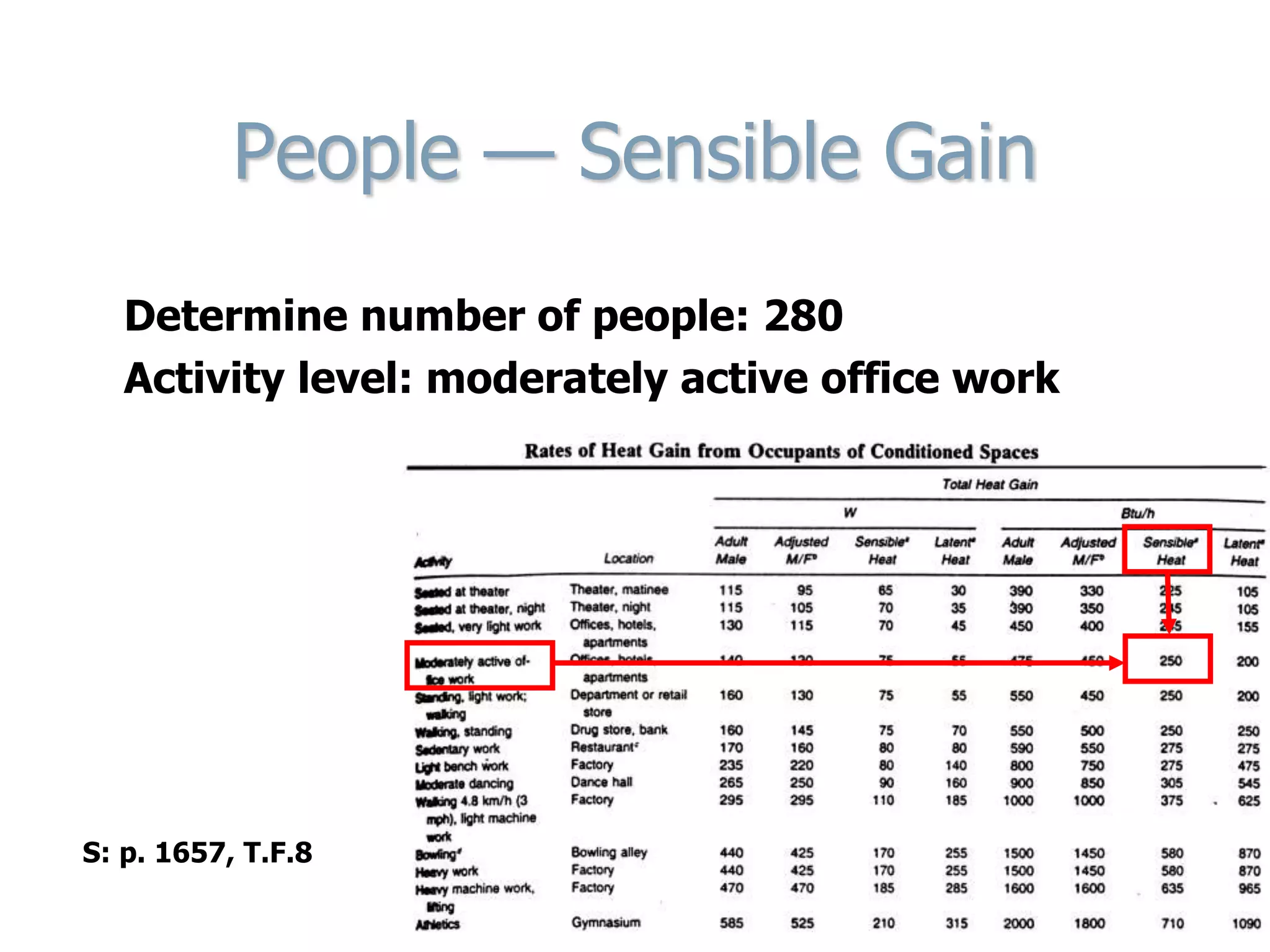
People — Sensible Gain
Determine number of people: 280
Activity level: moderately active office work
S: p. 1657, T.F.8
Cooling Loads
Insert roof values
Insert wall values
Insert glass values
Insert outdoor air
values
Insert people values
SR-3
0.025 20,000 31.0 15,500 15,500
N 0.054 3,980 11.3 2.429
E 0.054 1,980 11.3 1.208
S 0.054 2,950 11.3 1,800
W 0.054 1,980 11.3 1,208 6,645
N 1,000 14 14,000
E 500 35 17,500
S 2,000 20 40,000
W 500 35 17,500
89,000
N/A N/A N/A
3,400 22.0 74,800 74,800
200 250 50,000
Lighting Load
Lighting load: 1.5 w/sf
Equipment load: 0.5 w/sf
Cooling Loads
Insert roof values
Insert wall values
Insert glass values
Insert outdoor air
values
Insert people values
Insert lighting values
Insert equipment
values SR-3
0.025 20,000 31.0 15,500 15,500
N 0.054 3,980 11.3 2.429
E 0.054 1,980 11.3 1.208
S 0.054 2,950 11.3 1,800
W 0.054 1,980 11.3 1,208 6,645
N 1,000 14 14,000
E 500 35 17,500
S 2,000 20 40,000
W 500 35 17,500
89,000
N/A N/A N/A
3,400 22.0 74,800 74,800
200 250 50,000
40,000 1.5 204,780
40,000 0.5 68,260 323,040
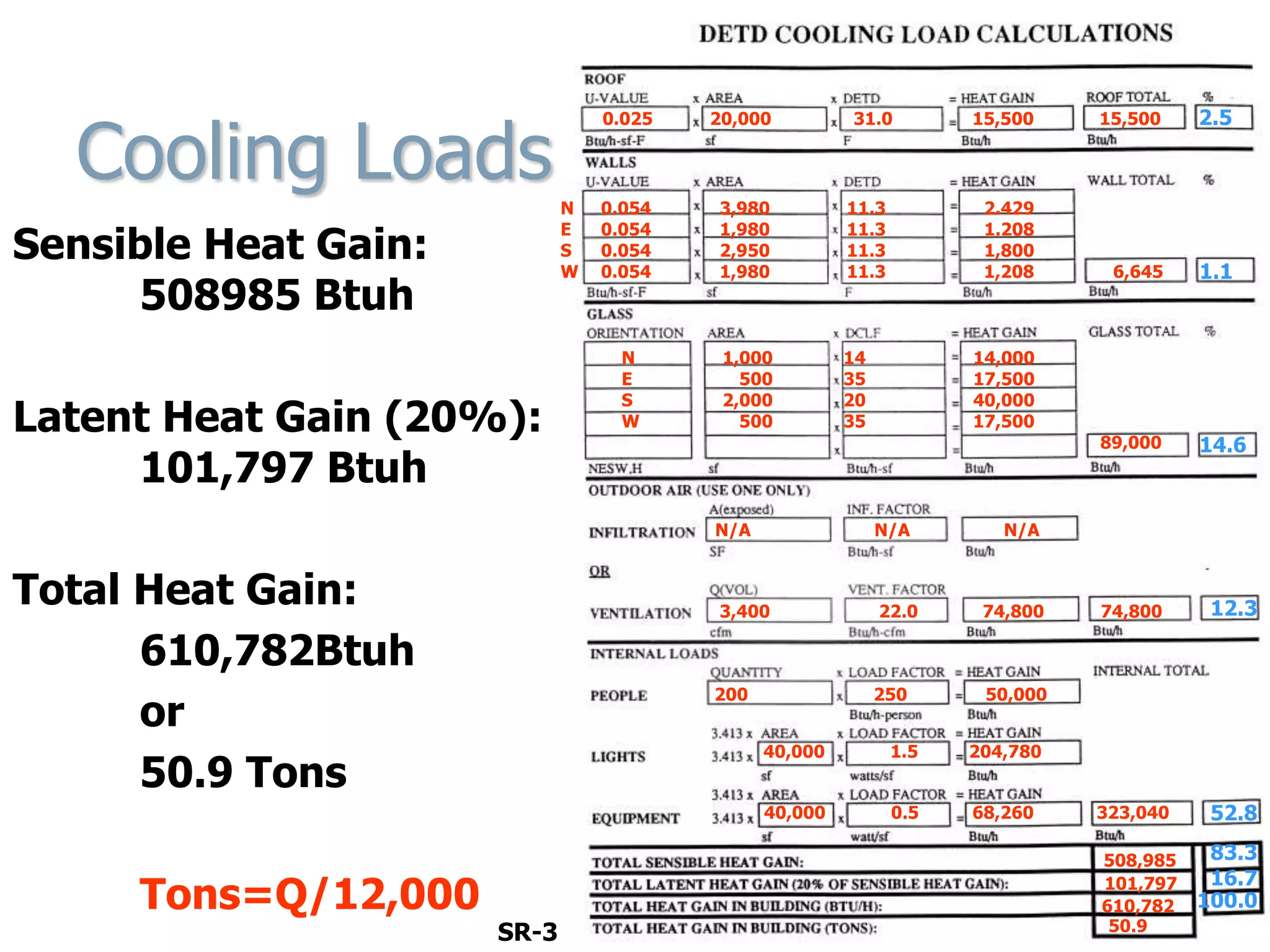
Cooling Loads
Sensible Heat Gain:
508985 Btuh
Latent Heat Gain (20%):
101,797 Btuh
Total Heat Gain:
610,782Btuh
or
50.9 Tons
Tons=Q/12,000
SR-3
0.025 20,000 31.0 15,500 15,500
N 0.054 3,980 11.3 2.429
E 0.054 1,980 11.3 1.208
S 0.054 2,950 11.3 1,800
W 0.054 1,980 11.3 1,208 6,645
N 1,000 14 14,000
E 500 35 17,500
S 2,000 20 40,000
W 500 35 17,500
89,000
N/A N/A N/A
3,400 22.0 74,800 74,800
200 250 50,000
40,000 1.5 204,780
40,000 0.5 68,260 323,040
508,985
101,797
610,782
50.9
2.5
1.1
14.6
16.7
83.3
52.8
12.3
100.0
Cooling Degree Hours
Relative indicator of warmth
S(10): T.B.1,
p. 1513
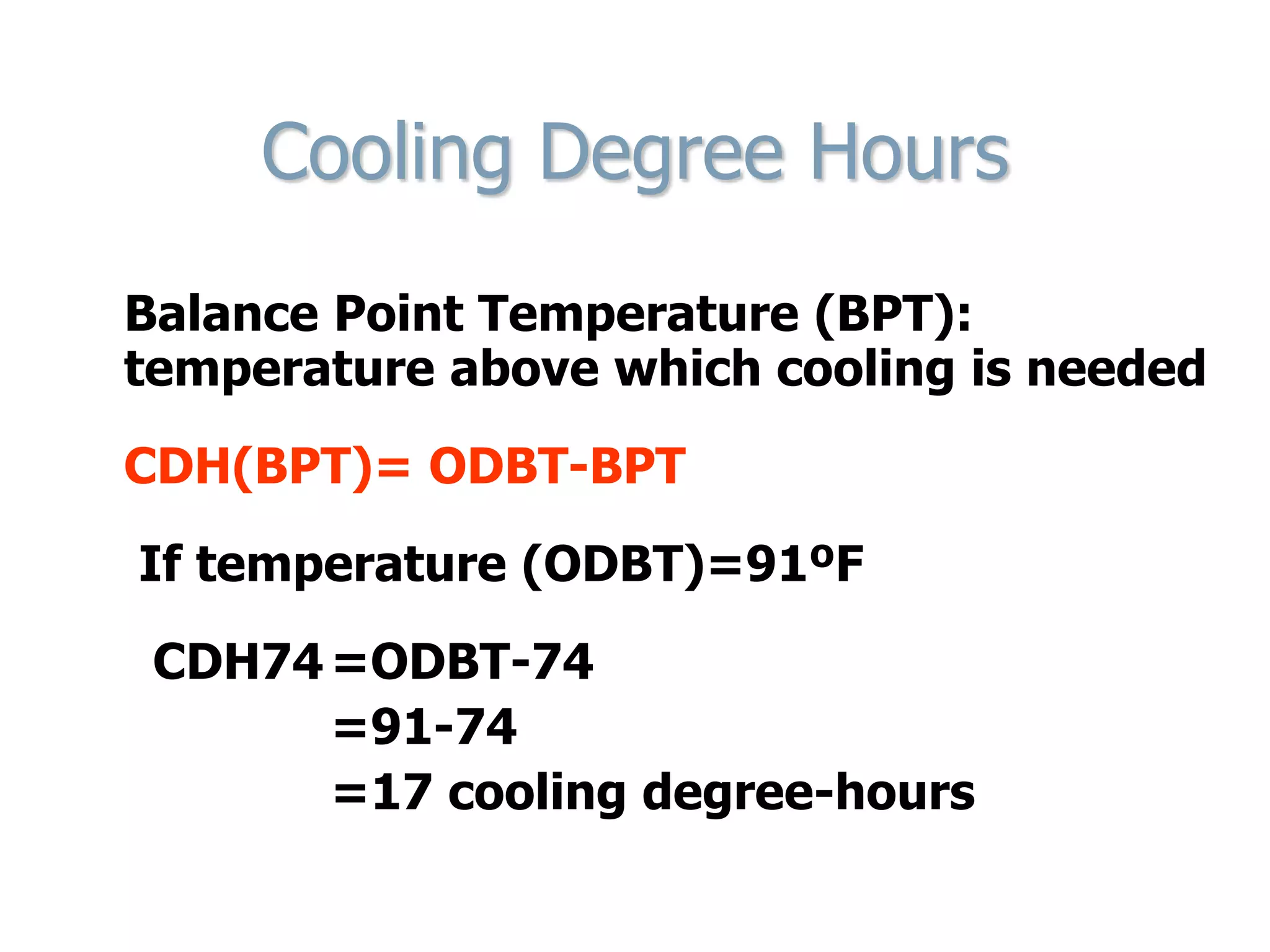
Cooling Degree Hours
Balance Point Temperature (BPT):
temperature above which cooling is needed
CDH(BPT)= ODBT-BPT
If temperature (ODBT)=91ºF
CDH74=ODBT-74
=91-74
=17 cooling degree-hours
Energy Performance Ratings
Performance Ratings
COP: coefficient of performance
EER: energy efficiency at full load
SEER: seasonal energy efficiency ratio
Note: SEER≈COP x 3.413
Annual Fuel Consumption
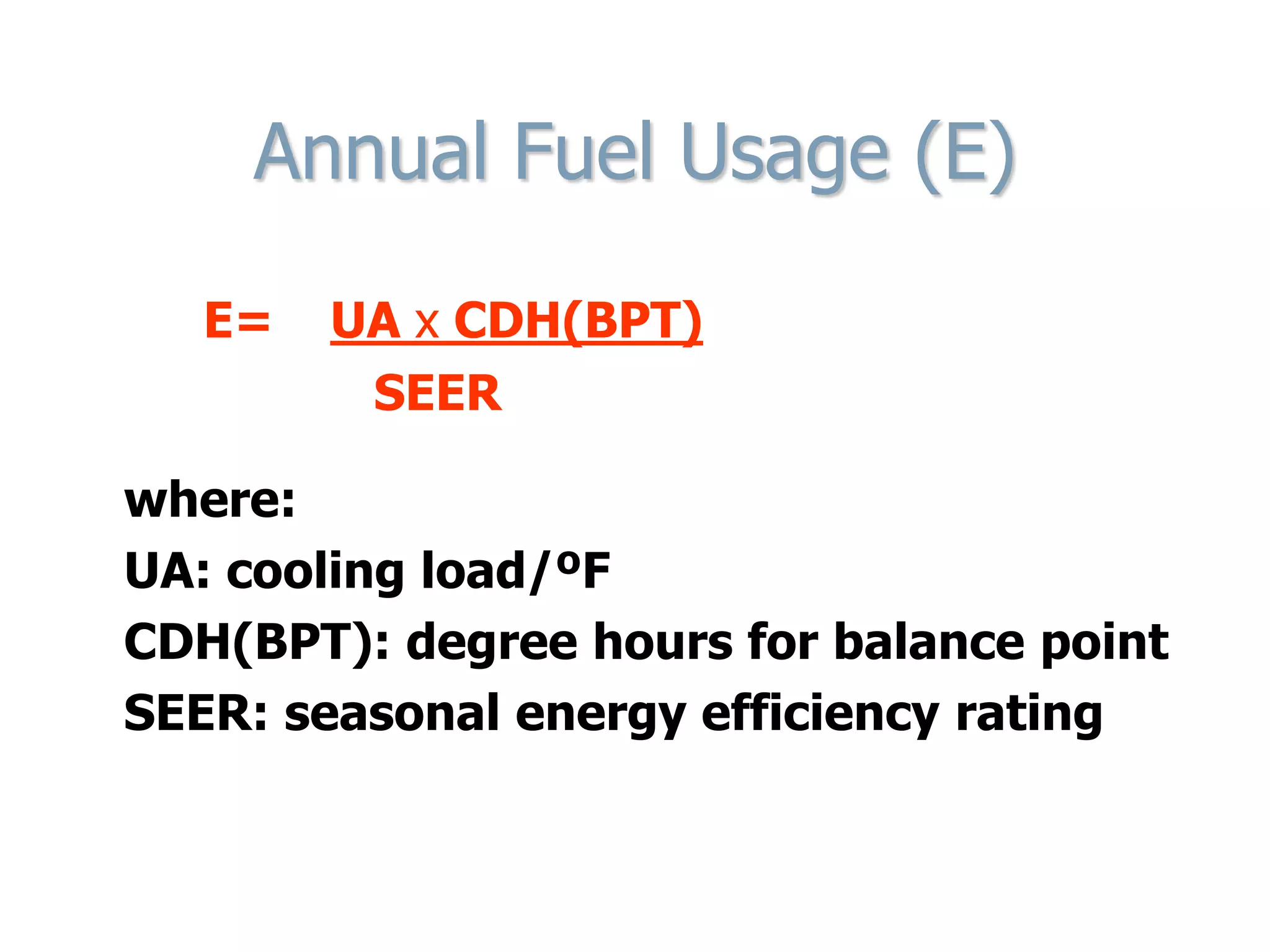
Annual Fuel Usage (E)
E= UA x CDH(BPT)
SEER
where:
UA: cooling load/ºF
CDH(BPT): degree hours for balance point
SEER: seasonal energy efficiency rating
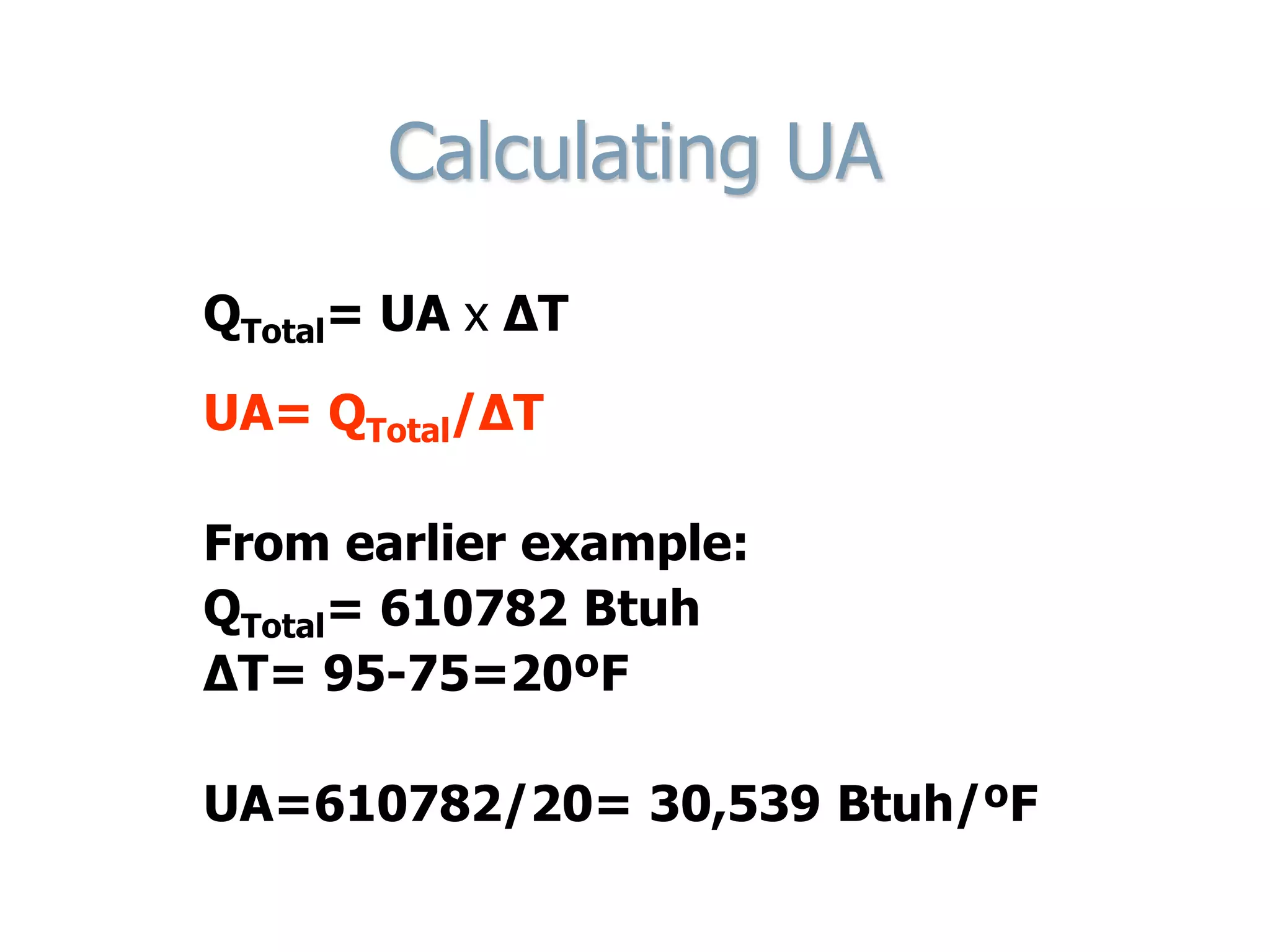
Calculating UA
QTotal= UA x ΔT
UA= QTotal/ΔT
From earlier example:
QTotal= 610782 Btuh
ΔT= 95-75=20ºF
UA=610782/20= 30,539 Btuh/ºF
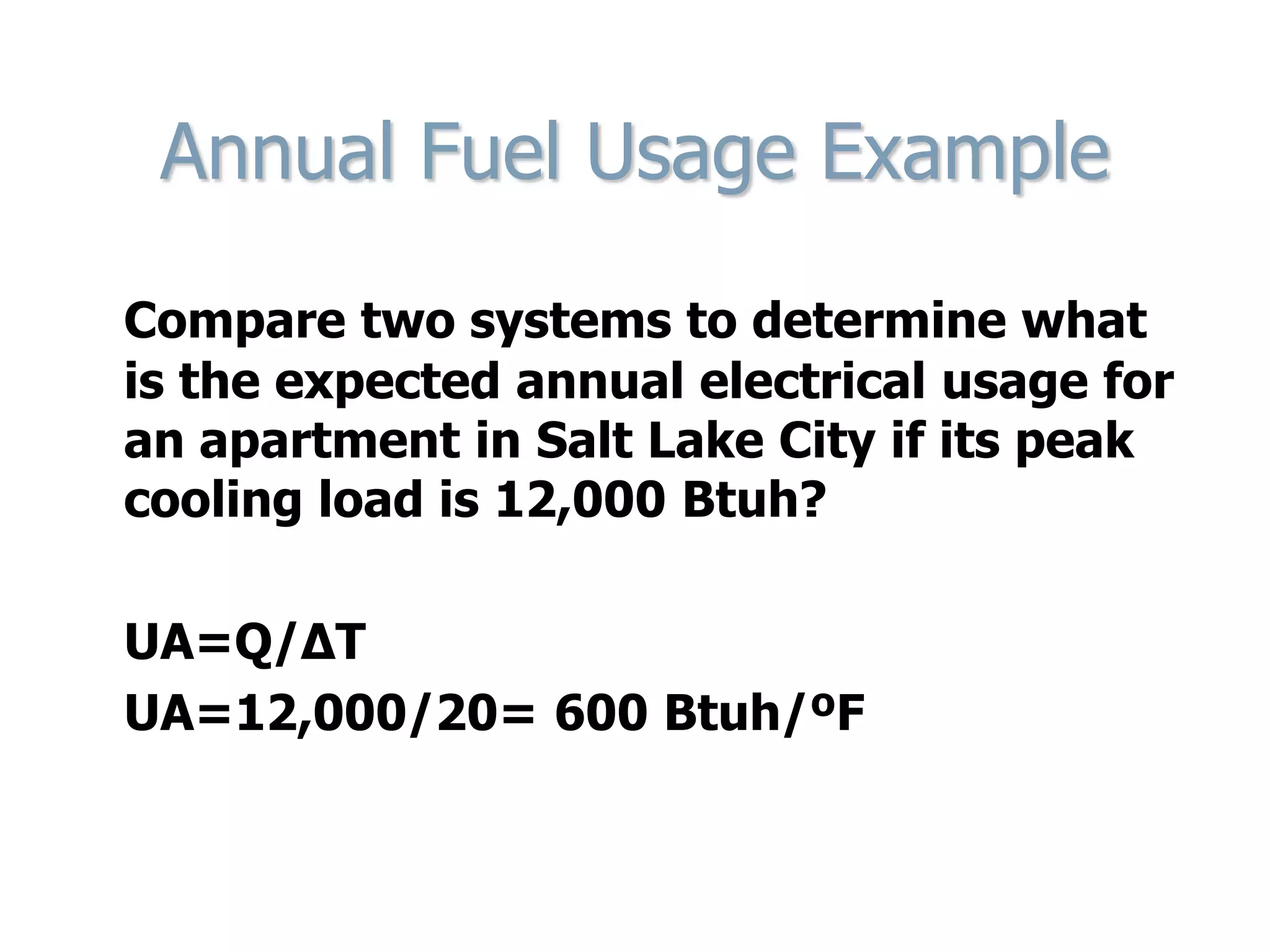
Annual Fuel Usage Example
Compare two systems to determine what
is the expected annual electrical usage for
an apartment in Salt Lake City if its peak
cooling load is 12,000 Btuh?
UA=Q/ΔT
UA=12,000/20= 600 Btuh/ºF
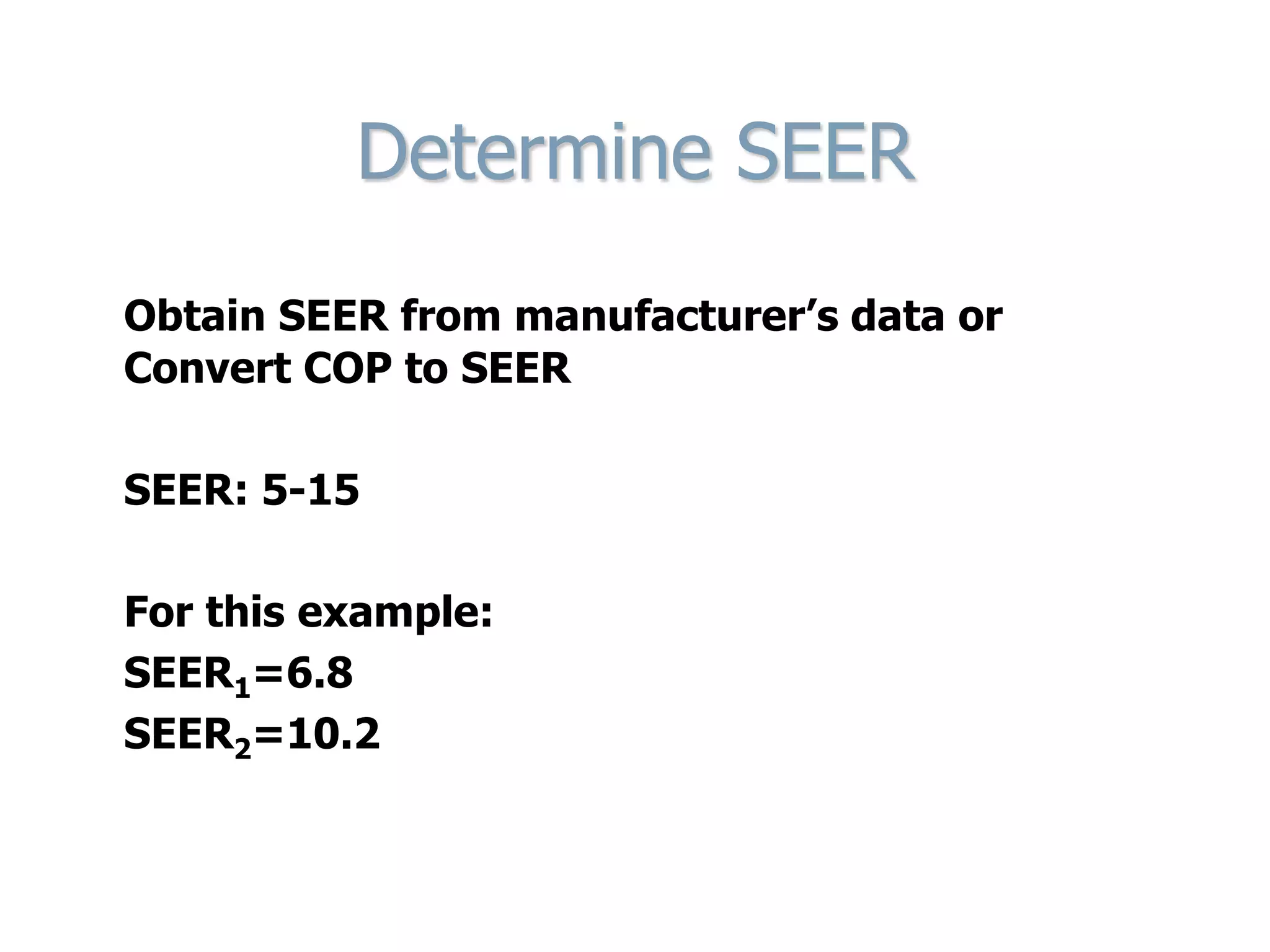
Determine SEER
Obtain SEER from manufacturer’s data or
Convert COP to SEER
SEER: 5-15
For this example:
SEER1=6.8
SEER2=10.2
Annual Fuel Usage — Electricity
E= UA x CDH74
SEER
E1 =(600)(9,898)/(6.8)
=873,353 wh/yr
=873 kwh/yr
If electricity is $0.0735/kwh, then
annual cost = $64
Annual Fuel Usage — Electricity
E= UA x CDH74
SEER
E2 =(600)(9,898)/(10.2)
=582,235 wh/yr
=582 kwh/yr
If electricity is $0.0735/kwh, then
annual cost = $43
Simple Payback Analysis
Simple Payback
Cooling System Cost Comparison
First
Cost
($)
System 1 500
System 2 600
Simple Payback
Cooling System Cost Comparison
First Annual Incremental Incremental Simple
Cost Fuel Cost First Cost Annual Savings Payback
($) ($/yr) ($) ($/yr) (yrs)
System 1 500 64 --- --- ---
System 2 600 43 100 21 4.8
Payback exceeds 3 years, select system 1
Other factors?
CoolingLoads.ppt

CoolingLoads.ppt

  • 1.
    Technology in Architectures Lecture8 Cooling Loads Cooling Degree Hours Energy Performance Ratings Annual Fuel Consumption
  • 2.
    Cooling Loads Computed forworst case scenario:  Late summer afternoon at outdoor design dry bulb temperature Include:  Insolation from sun  Heat gain from people, lights, and equipment  Infiltration in residential buildings  Ventilation in nonresidential buildings SR-3
  • 3.
    Summer Design Conditions DesignDry Bulb Temperature Mean Daily Range S(10): T.B.1, p. 1496
  • 4.
    Determine Design Equivalent TemperatureDifference (DETD) Construction type Outdoor design temperature Mean daily range L: 0-16ºF M: 16-25ºF H: 25+ºF S: p. 1653, T.F.5
  • 5.
    Determine Envelope U-values CalculateΣR and then find U for walls and roofs. Note: this method ignores floors, doors, and window U-values
  • 6.
    Determine DCLF Glazing Type DesignTemperature Shading Orientation S: p. 1655, T.F.6
  • 7.
    Determine Area Quantities Performarea takeoffs for all building envelope surfaces on each facade: gross wall area window area door area net wall area 4’ Elevation 4’ 12’ 100’ 8’ 1200 sf 64 sf 368 sf 768 sf - -
  • 8.
  • 9.
    Ventilation Analysis Non-residential buildingsuse ventilation to provide fresh air and to offset infiltration effects. ASHRAE Standard 62-2001 (S: p. 1598, T.E.25) Estimates the number of people/1000 sf of usage type Prescribes minimum ventilation/person for usage type
  • 10.
    ASHRAE 62-2001 Defines spaceoccupancy and ventilation loads S: p. 1639, T.E.25
  • 11.
  • 12.
    People — SensibleGain Determine number of people Activity level S: p. 1657, T.F.8
  • 13.
    Lights Determine wattage oflighting/square foot  ASHRAE 90.1 prescriptive levels  Count fixture loads and add together Note: add 15% for ballasts where applicable (e.g., fluorescent lights)
  • 14.
    Equipment Determine operating wattageof equipment/square foot  ASHRAE 90.1 prescriptive levels  Count actual loads and add together Note: include a diversity factor (20-30%) if specific usage patterns are unknown.
  • 15.
    Equipment Use manufacturer’s dataor other references to obtain heat gain data. Standby mode  Copiers  Monitors  Printers  CPU  “energy star” S: p. 1658, T.F.9
  • 16.
    Latent Load Not calculatedseparately: Apply a factor as a percentage of the total sensible cooling load Dry climates: 20% Moist/Humid climates: 30%
  • 17.
    Cooling Load ExampleProblem Building: Office Building Location: Salt Lake City Building: 200’ x 100’ (2 stories, 12’-6” each) Uwall= 0.054 Btuh/sf-ºF Uroof= 0.025 Btuh/sf-ºF
  • 18.
    Cooling Load ExampleProblem Determine Building Envelope Areas (SF) Building: 200’ x 100’ (2 stories, 12’-6” each) N E S W Gross Wall 5,000 2,500 5,000 2,500 Windows 1,000 500 2,000 500 Doors 20 20 50 20 Net Wall 3,980 1,980 2,950 1,980 Roof/Floor Slab 20,000
  • 19.
    Determine Design Equivalent TemperatureDifference (DETD) Roof Construction type: Light color, vented, ceiling Design temperature: 95ºF Mean daily range: 32ºF L: 0-16ºF M: 16-25ºF H: 25+ºF DETD=31.0ºF S: p. 1653, T.F.5
  • 20.
    Cooling Loads Insert roofvalues SR-3 0.025 20,000 31.0 15,500 15,500
  • 21.
    Determine Design Equivalent TemperatureDifference (DETD) Wall Construction type (see given) Design temperature: 95ºF Mean daily range: 32ºF L: 0-16ºF M: 16-25ºF H: 25+ºF DETD=11.3ºF S: p. 1653, T.F.5
  • 22.
    Cooling Loads Insert roofvalues Insert wall values SR-3 0.025 20,000 31.0 15,500 15,500 N 0.054 3,980 11.3 2.429 E 0.054 1,980 11.3 1.208 S 0.054 2,950 11.3 1,800 W 0.054 1,980 11.3 1,208 6,645
  • 23.
  • 24.
    Cooling Loads Insert roofvalues Insert wall values Insert glass values SR-3 0.025 20,000 31.0 15,500 15,500 N 0.054 3,980 11.3 2.429 E 0.054 1,980 11.3 1.208 S 0.054 2,950 11.3 1,800 W 0.054 1,980 11.3 1,208 6,645 N 1,000 14 14,000 E 500 35 17,500 S 2,000 20 40,000 W 500 35 17,500 89,000
  • 25.
    ASHRAE 62-2001 Defines spaceoccupancy and ventilation loads S: p. 1639, T.E.25
  • 26.
    Ventilation Load —Sensible 40,000 sf x 5people/1,000sf = 200 people 200 people x 17 cfm/person = 3,400 cfm
  • 27.
    Ventilation Load —Sensible CLF Design Temperature: 95ºF Commercial Building: Ventilation S: p. 1657, T.F.7
  • 28.
    Cooling Loads Insert roofvalues Insert wall values Insert glass values Insert outdoor air values SR-3 0.025 20,000 31.0 15,500 15,500 N 0.054 3,980 11.3 2.429 E 0.054 1,980 11.3 1.208 S 0.054 2,950 11.3 1,800 W 0.054 1,980 11.3 1,208 6,645 N 1,000 14 14,000 E 500 35 17,500 S 2,000 20 40,000 W 500 35 17,500 89,000 N/A N/A N/A 3,400 22.0 74,800 74,800
  • 29.
    People — SensibleGain Determine number of people: 280 Activity level: moderately active office work S: p. 1657, T.F.8
  • 30.
    Cooling Loads Insert roofvalues Insert wall values Insert glass values Insert outdoor air values Insert people values SR-3 0.025 20,000 31.0 15,500 15,500 N 0.054 3,980 11.3 2.429 E 0.054 1,980 11.3 1.208 S 0.054 2,950 11.3 1,800 W 0.054 1,980 11.3 1,208 6,645 N 1,000 14 14,000 E 500 35 17,500 S 2,000 20 40,000 W 500 35 17,500 89,000 N/A N/A N/A 3,400 22.0 74,800 74,800 200 250 50,000
  • 31.
    Lighting Load Lighting load:1.5 w/sf Equipment load: 0.5 w/sf
  • 32.
    Cooling Loads Insert roofvalues Insert wall values Insert glass values Insert outdoor air values Insert people values Insert lighting values Insert equipment values SR-3 0.025 20,000 31.0 15,500 15,500 N 0.054 3,980 11.3 2.429 E 0.054 1,980 11.3 1.208 S 0.054 2,950 11.3 1,800 W 0.054 1,980 11.3 1,208 6,645 N 1,000 14 14,000 E 500 35 17,500 S 2,000 20 40,000 W 500 35 17,500 89,000 N/A N/A N/A 3,400 22.0 74,800 74,800 200 250 50,000 40,000 1.5 204,780 40,000 0.5 68,260 323,040
  • 33.
    Cooling Loads Sensible HeatGain: 508985 Btuh Latent Heat Gain (20%): 101,797 Btuh Total Heat Gain: 610,782Btuh or 50.9 Tons Tons=Q/12,000 SR-3 0.025 20,000 31.0 15,500 15,500 N 0.054 3,980 11.3 2.429 E 0.054 1,980 11.3 1.208 S 0.054 2,950 11.3 1,800 W 0.054 1,980 11.3 1,208 6,645 N 1,000 14 14,000 E 500 35 17,500 S 2,000 20 40,000 W 500 35 17,500 89,000 N/A N/A N/A 3,400 22.0 74,800 74,800 200 250 50,000 40,000 1.5 204,780 40,000 0.5 68,260 323,040 508,985 101,797 610,782 50.9 2.5 1.1 14.6 16.7 83.3 52.8 12.3 100.0
  • 34.
  • 35.
    Cooling Degree Hours Relativeindicator of warmth S(10): T.B.1, p. 1513
  • 36.
    Cooling Degree Hours BalancePoint Temperature (BPT): temperature above which cooling is needed CDH(BPT)= ODBT-BPT If temperature (ODBT)=91ºF CDH74=ODBT-74 =91-74 =17 cooling degree-hours
  • 37.
  • 38.
    Performance Ratings COP: coefficientof performance EER: energy efficiency at full load SEER: seasonal energy efficiency ratio Note: SEER≈COP x 3.413
  • 39.
  • 40.
    Annual Fuel Usage(E) E= UA x CDH(BPT) SEER where: UA: cooling load/ºF CDH(BPT): degree hours for balance point SEER: seasonal energy efficiency rating
  • 41.
    Calculating UA QTotal= UAx ΔT UA= QTotal/ΔT From earlier example: QTotal= 610782 Btuh ΔT= 95-75=20ºF UA=610782/20= 30,539 Btuh/ºF
  • 42.
    Annual Fuel UsageExample Compare two systems to determine what is the expected annual electrical usage for an apartment in Salt Lake City if its peak cooling load is 12,000 Btuh? UA=Q/ΔT UA=12,000/20= 600 Btuh/ºF
  • 43.
    Determine SEER Obtain SEERfrom manufacturer’s data or Convert COP to SEER SEER: 5-15 For this example: SEER1=6.8 SEER2=10.2
  • 44.
    Annual Fuel Usage— Electricity E= UA x CDH74 SEER E1 =(600)(9,898)/(6.8) =873,353 wh/yr =873 kwh/yr If electricity is $0.0735/kwh, then annual cost = $64
  • 45.
    Annual Fuel Usage— Electricity E= UA x CDH74 SEER E2 =(600)(9,898)/(10.2) =582,235 wh/yr =582 kwh/yr If electricity is $0.0735/kwh, then annual cost = $43
  • 46.
  • 47.
    Simple Payback Cooling SystemCost Comparison First Cost ($) System 1 500 System 2 600
  • 48.
    Simple Payback Cooling SystemCost Comparison First Annual Incremental Incremental Simple Cost Fuel Cost First Cost Annual Savings Payback ($) ($/yr) ($) ($/yr) (yrs) System 1 500 64 --- --- --- System 2 600 43 100 21 4.8 Payback exceeds 3 years, select system 1 Other factors?

Editor's Notes