MEASURING INTERNAL
COMMUNICATIONS
Better Companies through Better Communication.
Institute for Public Relations
Report Excerpts


• Employee/Organizational
  Communications
   – By Bruce K. Berger, Ph.D.
     University of Alabama
   – November 17, 2008
            » http://www.instituteforpr.org/topics/employee-organizational-
              communications/
Measurable Benefits
Value of Internal Communications

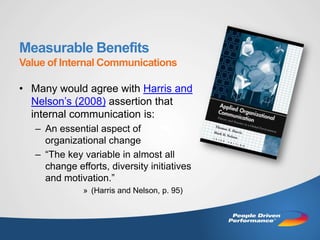
• Many would agree with Harris and
  Nelson’s (2008) assertion that
  internal communication is:
   – An essential aspect of
     organizational change
   – “The key variable in almost all
     change efforts, diversity initiatives
     and motivation.”
              » (Harris and Nelson, p. 95)
Measurable Benefits
Driver of Business Performance

• Some even argue that internal
  communication is the most
  “fundamental driver of business
  performance”
             » (Gay, Mahoney & Graves,
               2005, p. 11).
Measurable Benefits
Employees Thrive

• Effective internal communications help
   –   Increase employee job satisfaction
   –   Morale
   –   Productivity
   –   Commitment
   –   Trust and learning
   –   Enhance quality, revenues and earnings
Specific Examples
Driver of Business Performance

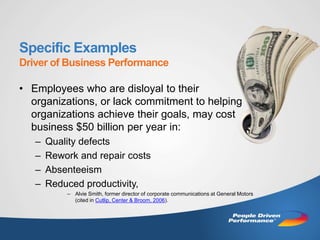
• Employees who are disloyal to their
  organizations, or lack commitment to helping
  organizations achieve their goals, may cost
  business $50 billion per year in:
   –   Quality defects
   –   Rework and repair costs
   –   Absenteeism
   –   Reduced productivity,
           – Alvie Smith, former director of corporate communications at General Motors
             (cited in Cutlip, Center & Broom, 2006).
Measurable Benefits
Improved Performance

• Improving the quality, adequacy and timeliness
  of information that employees receive about
   – customers,
   – the organization or
   – their own work
• Can improve their individual performance by
  as much as 20-50 percent
              » (Boyett & Boyett, 1998)
Internal Communications’
Big Impact

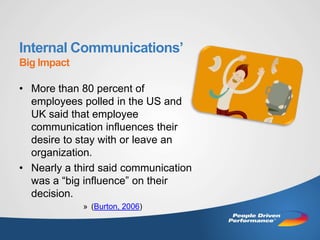
• More than 80 percent of
  employees polled in the US and
  UK said that employee
  communication influences their
  desire to stay with or leave an
  organization.
• Nearly a third said communication
  was a “big influence” on their
  decision.
             » (Burton, 2006)
Measurable Benefits
Most Admired vs. Least Admired

• The 200 “most admired” companies spent more
  than three times as much on employee
  communications as the 200 “least admired”
  companies.
            » (Seitel, 2004)
Measurable Benefits
Links to Productivity

• Employees’ satisfaction with
  communication in their
  organizations is linked to
   –   Organizational commitment
   –   Productivity
   –   Job performance and satisfaction
   –   Other significant outcomes
               » (Gray & Laidlaw, 2004)
Measurable Benefits
Retain Employees

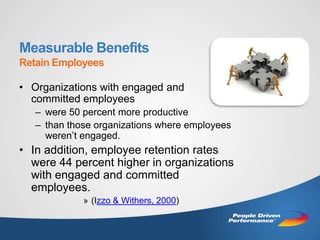
• Organizations with engaged and
  committed employees
   – were 50 percent more productive
   – than those organizations where employees
     weren’t engaged.
• In addition, employee retention rates
  were 44 percent higher in organizations
  with engaged and committed
  employees.
             » (Izzo & Withers, 2000)
Measurable Benefits
Retain Employees


• The cost of replacing an “average”
  employee is nearly 50% of annual
  salary.
• Losing a highly-skilled or experienced
  employees ups the ante to 150%.
            » Paulson Training


                             12
Measurable Benefits
Sustained Success

• Positive communication climate and
  effective employee communication
   – strengthen employees’ identification with
     their organizations,
   – contributes to an organization’s financial
     performance and sustained success.
              » (Smidts, Pruyn & van Riel, 2001)
Measurable Benefits
Industries Thrive or Die

• Decades ago, Sears Roebuck found that creating a more
  compelling place to work for employees led to
   – a significant increase in employee attitude scores
   – customer satisfaction scores and
   – revenues
              » (Rucci, Kim & Quinn, 1998)
Measurable Benefits
Industries Thrive or Die

• Starbucks, Limited
  Brands, Best Buy track
  engagement.
   – Best Buy knows the value of a
     0.1% increase in engagement
     at particular store
   – That value equates to more
     than $100K in store’s annual
     operating income.
Measurable Benefits
Increased Market Values

• A significant improvement in
  communication effectiveness in
  organizations was linked to a
  29.5 percent rise in market
  value.
            » (Watson Wyatt, 2004)
Measurable Benefits
Build Community and Trust

• Effective communication facilitates
  engagement and builds trust.
• Both critical ingredients in strong, viable
  organizations
              » (Grates, 2008)
Measurable Benefits
Better Companies through Better Communication

• Companies with highly effective
  internal communications
  experienced 47% higher returns to
  shareholders over companies with
  least effective communications.
            » (Tower Watson 2009/2010
              Communication ROI Study
              Report)

Measuring Internal Communications

  • 1.
  • 2.
    Institute for PublicRelations Report Excerpts • Employee/Organizational Communications – By Bruce K. Berger, Ph.D. University of Alabama – November 17, 2008 » http://www.instituteforpr.org/topics/employee-organizational- communications/
  • 3.
    Measurable Benefits Value ofInternal Communications • Many would agree with Harris and Nelson’s (2008) assertion that internal communication is: – An essential aspect of organizational change – “The key variable in almost all change efforts, diversity initiatives and motivation.” » (Harris and Nelson, p. 95)
  • 4.
    Measurable Benefits Driver ofBusiness Performance • Some even argue that internal communication is the most “fundamental driver of business performance” » (Gay, Mahoney & Graves, 2005, p. 11).
  • 5.
    Measurable Benefits Employees Thrive •Effective internal communications help – Increase employee job satisfaction – Morale – Productivity – Commitment – Trust and learning – Enhance quality, revenues and earnings
  • 6.
    Specific Examples Driver ofBusiness Performance • Employees who are disloyal to their organizations, or lack commitment to helping organizations achieve their goals, may cost business $50 billion per year in: – Quality defects – Rework and repair costs – Absenteeism – Reduced productivity, – Alvie Smith, former director of corporate communications at General Motors (cited in Cutlip, Center & Broom, 2006).
  • 7.
    Measurable Benefits Improved Performance •Improving the quality, adequacy and timeliness of information that employees receive about – customers, – the organization or – their own work • Can improve their individual performance by as much as 20-50 percent » (Boyett & Boyett, 1998)
  • 8.
    Internal Communications’ Big Impact •More than 80 percent of employees polled in the US and UK said that employee communication influences their desire to stay with or leave an organization. • Nearly a third said communication was a “big influence” on their decision. » (Burton, 2006)
  • 9.
    Measurable Benefits Most Admiredvs. Least Admired • The 200 “most admired” companies spent more than three times as much on employee communications as the 200 “least admired” companies. » (Seitel, 2004)
  • 10.
    Measurable Benefits Links toProductivity • Employees’ satisfaction with communication in their organizations is linked to – Organizational commitment – Productivity – Job performance and satisfaction – Other significant outcomes » (Gray & Laidlaw, 2004)
  • 11.
    Measurable Benefits Retain Employees •Organizations with engaged and committed employees – were 50 percent more productive – than those organizations where employees weren’t engaged. • In addition, employee retention rates were 44 percent higher in organizations with engaged and committed employees. » (Izzo & Withers, 2000)
  • 12.
    Measurable Benefits Retain Employees •The cost of replacing an “average” employee is nearly 50% of annual salary. • Losing a highly-skilled or experienced employees ups the ante to 150%. » Paulson Training 12
  • 13.
    Measurable Benefits Sustained Success •Positive communication climate and effective employee communication – strengthen employees’ identification with their organizations, – contributes to an organization’s financial performance and sustained success. » (Smidts, Pruyn & van Riel, 2001)
  • 14.
    Measurable Benefits Industries Thriveor Die • Decades ago, Sears Roebuck found that creating a more compelling place to work for employees led to – a significant increase in employee attitude scores – customer satisfaction scores and – revenues » (Rucci, Kim & Quinn, 1998)
  • 16.
    Measurable Benefits Industries Thriveor Die • Starbucks, Limited Brands, Best Buy track engagement. – Best Buy knows the value of a 0.1% increase in engagement at particular store – That value equates to more than $100K in store’s annual operating income.
  • 17.
    Measurable Benefits Increased MarketValues • A significant improvement in communication effectiveness in organizations was linked to a 29.5 percent rise in market value. » (Watson Wyatt, 2004)
  • 18.
    Measurable Benefits Build Communityand Trust • Effective communication facilitates engagement and builds trust. • Both critical ingredients in strong, viable organizations » (Grates, 2008)
  • 19.
    Measurable Benefits Better Companiesthrough Better Communication • Companies with highly effective internal communications experienced 47% higher returns to shareholders over companies with least effective communications. » (Tower Watson 2009/2010 Communication ROI Study Report)

Editor's Notes

  • #16 One of today’s more visible case histories is what is currently occurring with the transformation of JCPenney as led by former Target and Apple executive – Ron Johnson, the individual credited with the creation of the Apple Store experience. From a recent article in the online business publication, the Business Insider, the story of what appears to be an internal communication shut-down is occurring, which the numbers seem to support. The question is: With an employee culture that has coined the phrase, ‘JCPenney, where communication goes to die,” can the retailer stay afloat if the front line is fueled by rumor? Lives in fear of the next round of layoffs? Hasn’t a means by which to contribute ideas? “There are no memos or written directives anymore. The last one I saw was eight months ago. Everything gets communicated verbally and without too much detail.”The current pulse check: Widespread fear, anxiety and distrust of the new management team.