COST OF POOR
INTERNAL COMMUNICATIONS
A Business Case for Engaging Employees using
Effective Internal Communications, 2014
Better Companies through Better Communications
68 Point Swing
• "When employees understand their overall role in
the business,

• 91 percent will work towards that success
but…
68 Point Swing
• The number plummets to 23
don’t."

percent if they

– Bill Quirke. As noted by Melcrum.
Leading indicator of Financial Performance
• Companies that have highly effective internal
communications had 47%

higher total
returns to shareholders
– over the last five years compared to companies with the least effective
internal communications.
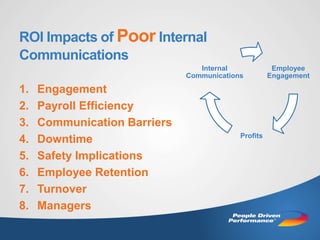
ROI Impacts of Poor Internal
Communications on:
1.
2.
3.
4.
5.
6.
7.
8.
9.

Engagement
Payroll Efficiency
Communication Barriers
Downtime
Safety
Employee Retention
Turnover
Managers’ Performance
Corporate Change

Internal
Communications

Profits

Employee
Engagement
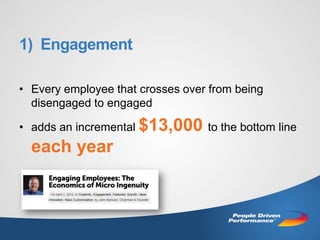
1) Engagement
• Every employee that crosses over from being
disengaged to engaged
• adds an incremental $13,000 to the bottom line

each year
Gallup Says!

• 70% of U.S. employees
are not engaged.
• Actively disengaged employees cost the U.S.

$450 to $550 billion per year in
lost productivity.
•

http://www.gallup.com/strategicconsulting/163007/state-american-workplace.aspx
Engagement = Opportunity
Operating Income
• In 2012, companies with high levels of
employee engagement reported an average
improvement of 19.2 percent in operating
income
– while companies with low levels of employee
engagement declined an average of 32.7
percent.
•

http://www.thankgoditsmonday.com/blog/2013/06/09/connectingengagement/?inf_contact_key=0b72a1e41ec9a7c991710a8b5436c03bd6e45f51d647
ba88a542eec43955369b
Engagement = Opportunity
Earning Per Share (EPS)
• Organizations with an average of 9.3
engaged employees for every actively
disengaged employee in 2010-2011
experienced 147% higher EPS
compared with their competition in 20112012.
– Those with an average of 2.6 engaged employees for
every actively disengaged employee experienced 2%
lower EPS compared with their competition during that
same time period.
Engagement = Opportunity
• A Work Foundation study showed that
organizations that increased practices related
to engagement by just 10 percent
• increased profits by an average of $2,400 per
employee per year.
• And the engaged organizations grew profits as
much as three times faster than their
competitors.
2) Payroll Efficiency Factor
• Payroll Efficiency Factor of disengaged
employees is on average 63%
• For every

$100,000 spent on payroll
there is only $63,000 worth of
work performed.

http://resourcedevelopmentsystems.com/seblog/2010/06/the-payroll-efficiency-factortm/
3) Communication Barriers

• $26,041 is the cumulative cost per
worker per year due to productivity
losses resulting from communications barriers.
– SMB Communications Study. Prepared by SIS International
Research, January 2009. Sponsored by Siemens Enterprise
Communications.
4) Downtime
• A business with 100 employees spends an

average downtime of 17 hours
a week clarifying communication.
• Translates to an annual cost of $528,443.
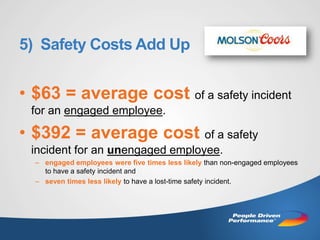
5) Safety Costs Add Up

• $63 = average cost of a safety incident for
an engaged employee.

• $392 = average cost of a safety incident for
an unengaged employee.
– engaged employees were five times less likely than non-engaged employees to
have a safety incident and
– seven times less likely to have a lost-time safety incident.
– By strengthening employee engagement, the company saved $1,721,760 in safety
costs during 2002.
– Engagement improved sales performance at Molson Coors: Low-engagement teams
fell far behind engaged teams in 2005 sales volumes.
– The difference in performance-related costs of low- vs. high-engagement
teams totaled $2,104,823.
6) Employee Retention
• Employees with the highest level of commitment

perform 20% better & are 87%
less likely to leave the organization.
– Paulson Training
7) Turnover
• The U.S. national turnover for
disengaged employees is 23%
Current Reality -- Turnover
• 70% of companies say that retaining talent is their
top HR challenge this year.
– (IO Partners, Employee Retention Report, 2013)

• 44% of employees in North America say they may or
will leave their current organization within the next 12
months.
– (Blessing White, 2013)

• Losing an employee can cost an organization up to
213% of the employee's salary.
– (Quantum Workplace Survey, 2013)
8) Managers’ Time

• 71% of employees feel managers do not
spend enough time explaining goals &
plans.
9) Corporate Change =
Communication Challenge

09 Jun 2013

Employees Don't Receive Enough Information During Corporate Change

• Two thirds of employees do not receive
enough information during corporate change.
• 84% of workers are caught up in some sort of
change.
• Poor communication during change increases
misconduct by 42%.
– which affects the bottom line and shareholder returns.
•
•

CEB
http://www.holmesreport.com/expertknowledge-info/13511/Employees-Dont-ReceiveEnough-Information-During-Corporate-Change.aspx#sthash.15F1P1xy.dpuf
Better Companies through Better
Communications
– Updated, January 2014
– www.pdpsolutions.com