MARKETINGMARKETING
MANAGEMENTMANAGEMENT
ByBy
Kush SaxenaKush Saxena
What is Marketing?
MarketingMarketing
Marketing is the process of communicating the value of
a product or service to customers for the purpose of
selling the product or service at the level of satisfaction.
It is a critical business function for attracting customers.
Process of marketing is not accidental, it is planned in a
appropriate manner.
DEFINITION OF MARKETINGDEFINITION OF MARKETING
“Marketing is a social process by which
individuals and groups obtained what they
need and wants by creating mutually
beneficial exchanges with one another.”
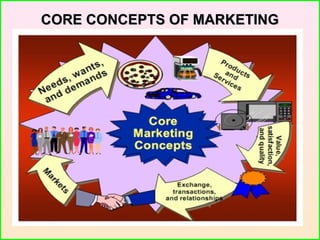
CORE CONCEPTS OF MARKETINGCORE CONCEPTS OF MARKETING
NEEDS,WANTS AND DEMANDNEEDS,WANTS AND DEMAND
NEEDS-Needs are the basic requirements of any
individual like air, water.
WANTS-If having specific requirement, then needs
turns into wants.
DEMAND- If a persons having enough money to fill
their wants them it turns in demand
Products and ServicesProducts and Services
Product:
 Anything that can be offered to a market to satisfy a
need or want.
 The concept of product is not limited to physical
objects – anything capable of satisfying a need can be
called a product.
Services:
 In addition to tangible goods, products also include
services, which are activities or benefits offered for
sale that are essentially intangible and do not result in
the ownership of anything.
Values, Satisfaction, and QualityValues, Satisfaction, and Quality
Values:
 Customer value is the difference between the values the
customer gains from owning and using a product and the costs
of obtaining the products.
 Customers often do not judge product value and costs
accurately or objectively. They act on perceived value.
Satisfaction:
 Customer satisfaction depends on a product’s perceived
performance in delivering value relative to a buyer’s expectation.
 If the product’s performance falls short of the customer’s
expectations, the buyer is dissatisfied.
Quality:
 Customer satisfaction is closely linked to quality.
 Quality has a direct impact on product performance.
 Quality can be defined as “freedom from defects”.
 TQM programs designed to constantly improve the quality of
products, services, and marketing processes.
Exchange, Transactions, and RelationshipsExchange, Transactions, and Relationships
Exchange :
 The act of obtaining a desired object from someone
by offering something in return
Transaction :
 A trade between two parties that involves at least
two things of value, agreed – upon conditions a time
of agreement, and a place of agreement.
Relationship marketing :
 The process of creating, maintaining, and
enhancing strong, value – laden relationships with
customers and other stakeholders
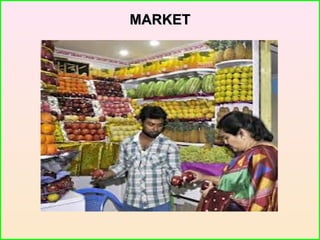
MARKETMARKET
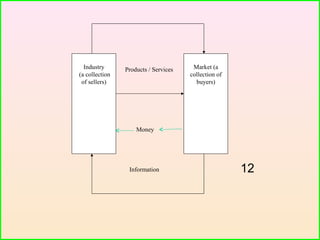
12
Industry
(a collection
of sellers)
Market (a
collection of
buyers)
Products / Services
Money
Information
COMPANY ORIENTATION TOWARDS THECOMPANY ORIENTATION TOWARDS THE
MARKETPLACEMARKETPLACE
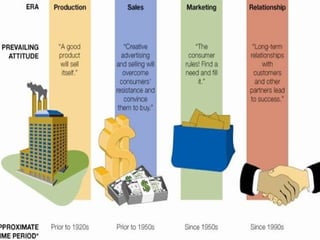
 PRODUCTION CONCEPT- This concept holds
that consumers will prefer products that are widely
available and inexpensive. Managers of production
oriented business concentrate on achieving high
production, low cost and mass distribution.
 PRODUCT CONCEPT- This concept
proposes that consumers favors products that
offer the most quality, innovative features.
Managers in these organizations focus on
superior products and improving over the
time.
 SELLING CONCEPT- The selling concept
holds that consumers and businesses, if left
alone, would not buy enough of the
organization’s products.
The main aim of this concept is to sell what
they make, rather than make what the market
wants.
 MARKETING CONCEPT-The marketing
concept emerged in mid 1950s.Instead of a
product centered “make & sell” philosophy,
business shifted to a customer centered
“sense & respond” philosophy.
The marketing concept holds that the key to
achieving organizational goals is being more
effective than competitors.
Selling Vs MarketingSelling Vs Marketing
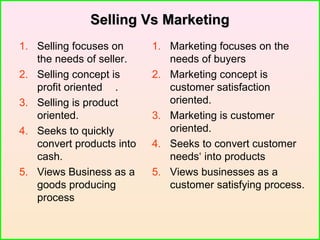
1. Selling focuses on
the needs of seller.
2. Selling concept is
profit oriented .
3. Selling is product
oriented.
4. Seeks to quickly
convert products into
cash.
5. Views Business as a
goods producing
process
1. Marketing focuses on the
needs of buyers
2. Marketing concept is
customer satisfaction
oriented.
3. Marketing is customer
oriented.
4. Seeks to convert customer
needs‘ into products
5. Views businesses as a
customer satisfying process.
Nature & Scope of Marketing:Nature & Scope of Marketing:
Marketing is an ancient art & is everywhere. Formally
or informally, people & organizations engage in a vast
numbers of activities that could be called marketing.
Good marketing has become an increasingly vital
ingredient for business success. It is embedded in
everything we do- from the clothes we wear, to the
web sites we click on, to the ads we see. Marketing
deals with identifying & meeting human & social
needs or it can be defined as ―meeting needs
profitably .‖
3 MISTAKES WHILE
DEFINING MARKETING
What is Marketing?What is Marketing?
Marketing is Selling
No, because
 Selling is part of Marketing
 Marketing starts long before the company has a product or service
 Marketing involves homework to asses needs, measure their extent, and
determine if a profitable opportunity exists
 Selling only occurs only after a product is manufactured or a service is
created
 Marketing continues throughout a product’s life, finding new customers,
improving product appeal and performance, and managing repeat sales
What is Marketing?What is Marketing?
Marketing is Advertising
No, because
 Advertising is part of Marketing
 Marketing starts long before the company places and ad
or develops an advertising strategy
 Advertising becomes part of an over-all Marketing Plan
 Advertising only occurs only after a product is
manufactured or a service is created
What is Marketing?What is Marketing?
Marketing is Mainly a Department
No, because:
 Yes, companies do have Marketing Departments, but,
 All departments should be at least customer oriented if not
customer driven
 In highly competitive markets, all departments must focus
on winning customer preference
CUSTOMER VALUE PROPOSITIONCUSTOMER VALUE PROPOSITION
In marketing, a customer value proposition (CVP) consists of the
sum total of benefits which a vendor promises a customer will
receive in return for the customer's associated payment (or other
value-transfer). A customer value proposition is a business or
marketing statement that describes why a customer should buy
a product or use a service. It is specifically targeted towards
potential customers rather than other constituent groups such as
employees, partners or suppliers. It is a clearly defined
statement that is designed to convince customers that one
particular product or service will add more value or better solve a
problem than others in its competitive set. EXAMPLE
Eg………
Marketing EnvironmentMarketing Environment
 All businesses are not alone in the market place.
 There are many factors that influence
businesses
 These factors are called the “ Marketing
Environment”
Marketing EnvironmentMarketing Environment
 All businesses are not alone in the market place.
 There are many factors that influence
businesses
 These factors are called the “ Marketing
Environment”
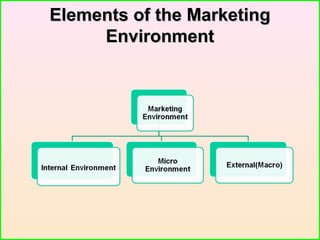
Elements of the MarketingElements of the Marketing
EnvironmentEnvironment
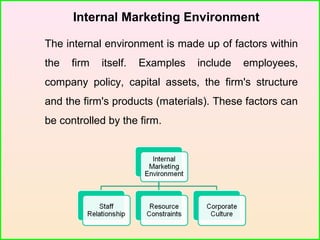
Internal Marketing Environment
The internal environment is made up of factors within
the firm itself. Examples include employees,
company policy, capital assets, the firm's structure
and the firm's products (materials). These factors can
be controlled by the firm.
Staff RelationshipsStaff Relationships
 Relationship among the staff affects the
operations of the organization.
 Management should develop a conducive
environment to develop staff relationships
 Employees should not convey a negative
image of the organization to external sources.
 Staff members
 The message that is conveyed by staff to others ( third parties) have
a big impact rather than the paid advertisements of the organisation
 Members of the public consider staff members as the authoritative
and they are far more likely to believe what staff members say
 Therefore an organization must do its internal marketing well to
inform the company’s policies, and obtain the commitment and
loyalty of the staff
 Staff is paid salaries by the organisation and staff should act to
safeguard the organisation’s interest for their own benefit too.
Corporate cultureCorporate culture
 Culture is a set of shared values, rules, and
perceptions in a given society.
 It has a powerful influence on the actions and
behaviors of the members of the staff
 It is not an easy task to change the organizations
culture if it is not conducive for an efficient operation
Resource ConstraintsResource Constraints
 All organizations operate within a limited
amount of resources
 Men. Material, Money, Machines and
Technology are the limiting resources
 Organization should use systems where they
could get the maximum out of the existing
resources
 The effective and efficient way of adopting
resources is the key to success.
Micro Environment
The micro environment is made up of factors that are close to the
firm and affect it on a 'day to day' basis; usually these factors interact
with the firm or are involved in the same industry Micro environment
examples include customers, banks and trade unions as they all
interact with the firm.. Some of the factors within the micro
environment can be controlled whilst other's can not.
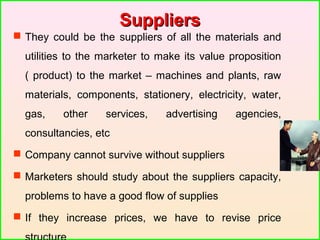
SuppliersSuppliers
 They could be the suppliers of all the materials and
utilities to the marketer to make its value proposition
( product) to the market – machines and plants, raw
materials, components, stationery, electricity, water,
gas, other services, advertising agencies,
consultancies, etc
 Company cannot survive without suppliers
 Marketers should study about the suppliers capacity,
problems to have a good flow of supplies
 If they increase prices, we have to revise price
CustomersCustomers
 Customers are the most important element in the
micro environment
 They can be individuals or organizations
 A persons who makes the decision to buy the product
is called the customer and the person who consumes
the product is called the consumer
 When customer and the consumer are different the
marketer have to consider the needs of both
 Many times customer and the consumer would be the
same.
 Marketer should study the constantly changing needs
of the customer and fine tune his value proposition
accordingly to satisfy/delight the customer.
Macro (External) EnvironmentMacro (External) Environment
The macro environment is made up of factors that
affect the firm on a long term basis. In general macro
environment factors are not close to the firm. Micro
environment factors could be national or global
measures and affect many industries and groups.
Macro environment examples include legislation, the
economy (e.g. recession, inflation, VAT changes), and
technological change such as the internet. Macro
environment factors are uncontrollable factors but still
influence company strategy.
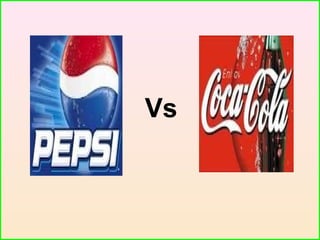
 Competitors
 Political
 Economic
 Social and cultural
 Technological
Macro Environmental FactorsMacro Environmental Factors
Vs
CompetitorsCompetitors
 Marketer is not alone in the market.
 Every action of the marketer has a reaction
from the competitors
 Knowing the competitors, their capacity,
ability, future moves, structure and operational
systems, objectives, strategies and tactics,
will provide so much of ammunition to the
marketer to face the challenges in the market
place.
 Simply a SWOT Analysis of Competitors is
needed
Political and Legal EnvironmentPolitical and Legal Environment
 Ploitical
 Political stability
 War and Peace
 Internal conflicts and struggles
 Strikes and stoppage of work
 Globalisation and opening up of markets
 Political affiliation and support to governments
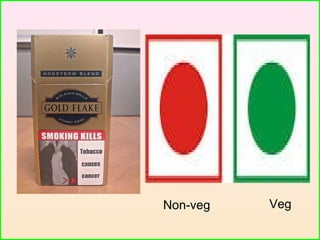
Non-veg Veg
Economic EnvironmentEconomic Environment
 General economic condition of the world and the
country
 Income distribution -
 Employment levels and its structure
 Prices and inflation
 Boom and recession
 Balance of trade – surplus / deficit
 Exchange rate and fluctuation
 Stock market
 Import and export duties
 Saving and investment
Social and Cultural EnvironmentSocial and Cultural Environment
 Society consists of large group of people with shared
customs and laws
 Culture consists of art, thought, and customs,
religions, practices of a society at any given time
 Any society will have its own culture. May be unique
or shared or mixed with other cultures.
 Peoples relationships and behavior will have a major
influence of the societies beliefs, values and norms
 There could be different cultural groups within a
society
Socio Cultural EnvironmentSocio Cultural Environment
Demographic factors- population structure- age,
family size, ethnicity, income,
Social Cultural behaviors- languages, religious
beliefs, mythology, gender roles, gift giving habits,
Social responsibility and ethics
The impact of war
Role of women in society
Attitudes towards credit
Concern about health
 The socio- cultural affect will influence
peoples attitudes towards buying patterns,
living patterns, dress codes, fashion, sports,
savings, social behaviors, music, credit,
marriage, and many areas of life styles.
 Marketers have to be aware of them to
understand the customers and their behavior.
Example
TechnologicalTechnological
 Technology is changing always
 Marketers have to be vigilant about it and
adapt to change
 There are so many innovations taking place in
the world.
 Some innovations make products and
processors improve dynamically and some
times they even replaces the old products and
make them obsolete
Examples of Technological advancementExamples of Technological advancement
 What happened to typewriters, LP records,
audio and video cassettes, analogue phones
 What happened to standard post with email
and SMS
 What will happened to CDs
 Nano technology is knocking doors
DIGITALIZATION
Digitalization in MarketingDigitalization in Marketing
 Digital marketing is a marketing process which leads to the
development of any organization or brand by using a variety of
digital channels such as email, social networks etc.
 Digital Marketing can be defined as promoting of brands or
products and services using all forms of digital advertising.
Digital marketing uses Television, Radio, Internet, mobile and
any form of digital media to reach customers in a timely,
relevant, personal and cost-effective manner
Apart from using many of the techniques and practices
contained within the category of Internet Marketing, digital
marketing extends beyond this by including other channels
that do not require the use of the Internet. Due to non-
dependence on the Internet, the field of digital marketing
includes a whole lot of elements such as mobile phones or
cell phones, display / banner ads, sms /mms, digital
outdoor, and many more.
PRODUCTPRODUCT
Product is anything that can be offered to a
market to satisfy a need & wants of
customers.
Product is a bundle of benefits offered to a
customer.
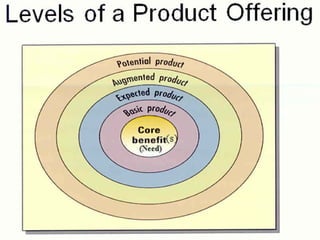
 Core Benefits-The service or benefit the
customer is really buying.
 Basic Product- At the second level, the
marketer must turn core benefits into basic
product.
 Expected Product-At the third level, the
marketer prepares an expected product, a set
of attributes buyers normally expect when
they purchase this product.
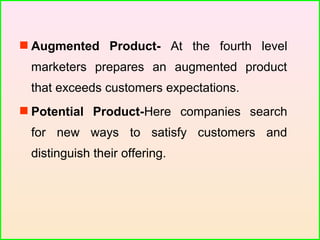
 Augmented Product- At the fourth level
marketers prepares an augmented product
that exceeds customers expectations.
 Potential Product-Here companies search
for new ways to satisfy customers and
distinguish their offering.
WHAT IS PRODUCTWHAT IS PRODUCT
Product is anything that can offered to market toProduct is anything that can offered to market to
satisfy a want or need, including physicalsatisfy a want or need, including physical
goods, services ,experinces,events,persons.goods, services ,experinces,events,persons.
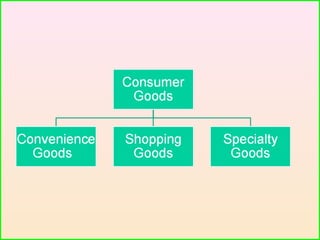
Consumer ProductConsumer Product
ClassificationClassification
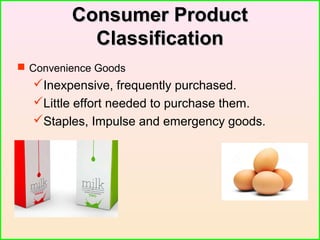
 Convenience Goods
Inexpensive, frequently purchased.
Little effort needed to purchase them.
Staples, Impulse and emergency goods.
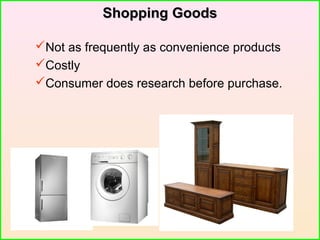
Shopping GoodsShopping Goods
Not as frequently as convenience products
Costly
Consumer does research before purchase.
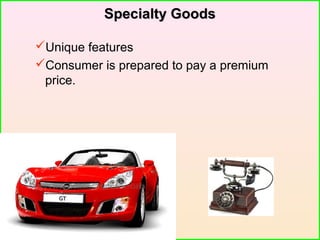
Specialty GoodsSpecialty Goods
Unique features
Consumer is prepared to pay a premium
price.
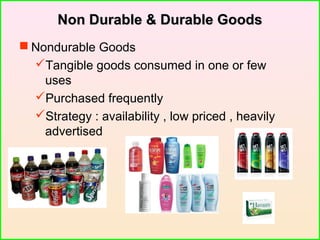
Non Durable & Durable GoodsNon Durable & Durable Goods
 Nondurable Goods
Tangible goods consumed in one or few
uses
Purchased frequently
Strategy : availability , low priced , heavily
advertised
Durable GoodsDurable Goods
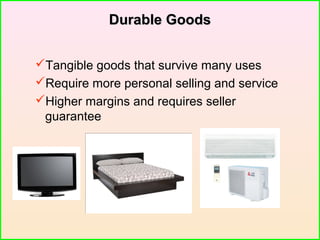
Tangible goods that survive many uses
Require more personal selling and service
Higher margins and requires seller
guarantee
Industrial-Goods ClassificationIndustrial-Goods Classification
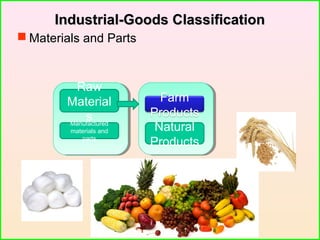
 Materials and Parts
Raw
Material
sManufactured
materials and
parts
Farm
Products
Natural
Products
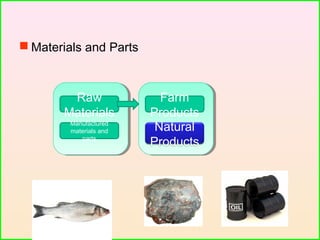
 Materials and Parts
Raw
Materials
Manufactured
materials and
parts
Farm
Products
Natural
Products
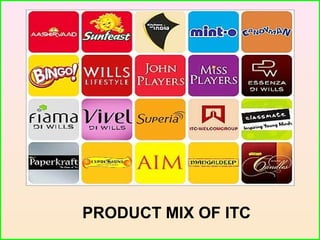
PRODUCT MIXPRODUCT MIX
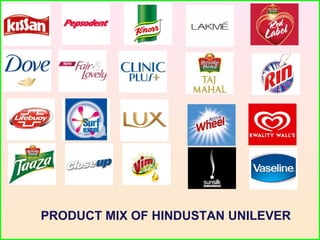
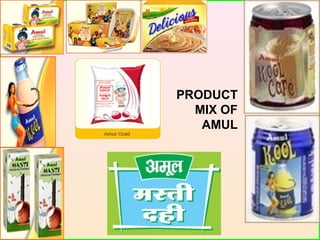
Product mix is the sum total of all products
that a company offers for sale.
PRODUCT MIX OF HINDUSTAN UNILEVER
PRODUCT
MIX OF
AMUL
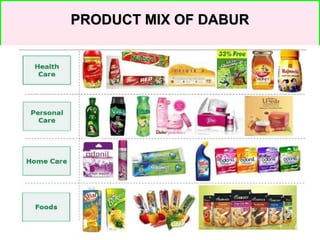
PRODUCT MIX OF DABURPRODUCT MIX OF DABUR
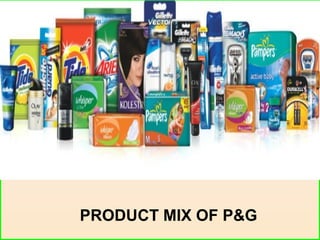
PRODUCT MIX OF P&G
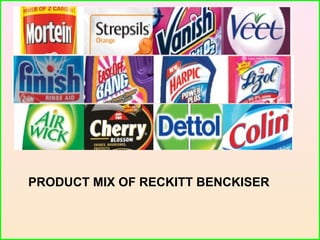
PRODUCT MIX OF RECKITT BENCKISER
PRODUCT MIX OF ITC
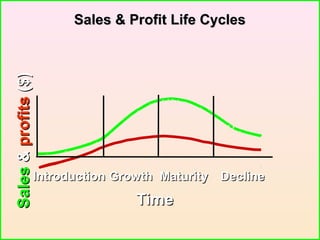
3.Product Life Cycles (PLC)3.Product Life Cycles (PLC)
 The course of a product’s sale and profit over
it lifetime. It involves five distinct
stages:introduction,growth,maturity,and
decline.
Sales & Profit Life CyclesSales & Profit Life Cycles
IntroductionIntroduction GrowthGrowth MaturityMaturity DeclineDecline
TimeTime
SalesSales&&profitsprofits($)($)
 Introduction-A period of slow sales growth as
the product is introduced in the market. Profits
are nonexistent because of the heavy
expense of product introduction.
 Growth-A period of rapid market acceptance
and profit improvement.
 Maturity-Stable profit.
 Decline-Sales shows a downward drift and
profit erode.
STRATEGIES UNDER
DIFFERENT STAGES
OF PRODUCT LIFE
CYCLE(PLC)
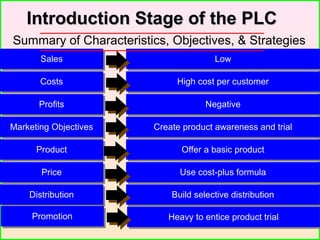
SalesSales
CostsCosts
ProfitsProfits
Marketing ObjectivesMarketing Objectives
ProductProduct
PricePrice
LowLow
High cost per customerHigh cost per customer
NegativeNegative
Create product awareness and trialCreate product awareness and trial
Offer a basic productOffer a basic product
Use cost-plus formulaUse cost-plus formula
DistributionDistribution Build selective distributionBuild selective distribution
PromotionPromotion Heavy to entice product trialHeavy to entice product trial
Summary of Characteristics, Objectives, & Strategies
Introduction Stage of the PLCIntroduction Stage of the PLC
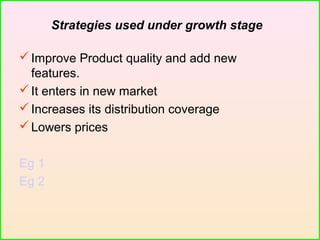
Improve Product quality and add new
features.
It enters in new market
Increases its distribution coverage
Lowers prices
Eg 1
Eg 2
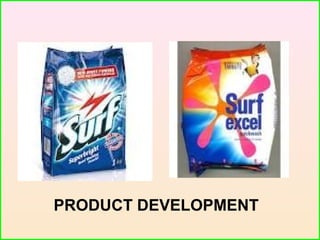
Strategies used under growth stage
PRODUCT DEVELOPMENT
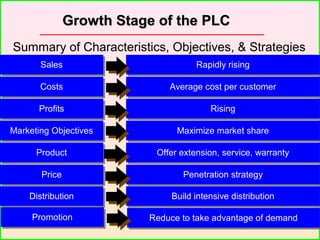
SalesSales
CostsCosts
ProfitsProfits
Marketing ObjectivesMarketing Objectives
ProductProduct
PricePrice
Rapidly risingRapidly rising
Average cost per customerAverage cost per customer
RisingRising
Maximize market shareMaximize market share
Offer extension, service, warrantyOffer extension, service, warranty
Penetration strategyPenetration strategy
DistributionDistribution Build intensive distributionBuild intensive distribution
PromotionPromotion Reduce to take advantage of demandReduce to take advantage of demand
Summary of Characteristics, Objectives, & Strategies
Growth Stage of the PLCGrowth Stage of the PLC
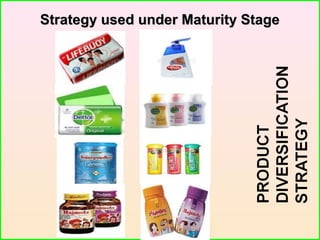
Strategy used under Maturity StageStrategy used under Maturity Stage
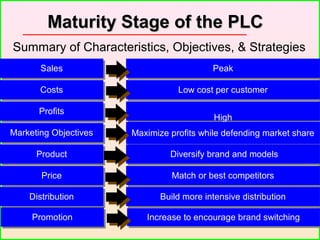
SalesSales
CostsCosts
ProfitsProfits
Marketing ObjectivesMarketing Objectives
ProductProduct
PricePrice
PeakPeak
Low cost per customerLow cost per customer
HighHigh
Maximize profits while defending market shareMaximize profits while defending market share
Diversify brand and modelsDiversify brand and models
Match or best competitorsMatch or best competitors
DistributionDistribution Build more intensive distributionBuild more intensive distribution
PromotionPromotion Increase to encourage brand switchingIncrease to encourage brand switching
Summary of Characteristics, Objectives, & Strategies
Maturity Stage of the PLCMaturity Stage of the PLC
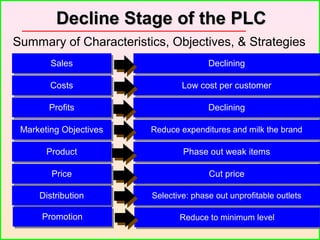
SalesSales
CostsCosts
ProfitsProfits
Marketing ObjectivesMarketing Objectives
ProductProduct
PricePrice
DecliningDeclining
Low cost per customerLow cost per customer
DecliningDeclining
Reduce expenditures and milk the brandReduce expenditures and milk the brand
Phase out weak itemsPhase out weak items
Cut priceCut price
DistributionDistribution Selective: phase out unprofitable outletsSelective: phase out unprofitable outlets
PromotionPromotion Reduce to minimum levelReduce to minimum level
Summary of Characteristics, Objectives, & Strategies
Decline Stage of the PLCDecline Stage of the PLC
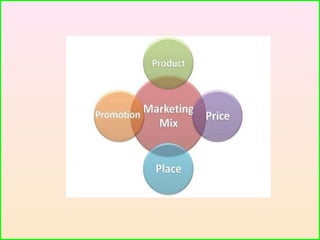
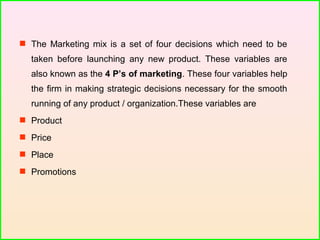
 The Marketing mix is a set of four decisions which need to be
taken before launching any new product. These variables are
also known as the 4 P’s of marketing. These four variables help
the firm in making strategic decisions necessary for the smooth
running of any product / organization.These variables are
 Product
 Price
 Place
 Promotions
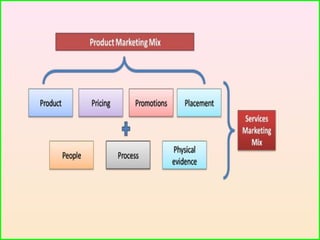
 Marketing mix is mainly of two types.
 1) Product marketing Mix – Comprised of Product, price, place
and promotions. This marketing mix is mainly used in case of
Tangible goods.
 2) Service Marketing Mix – The service marketing mix has
three further variables included which are people, physical
evidence and process. .
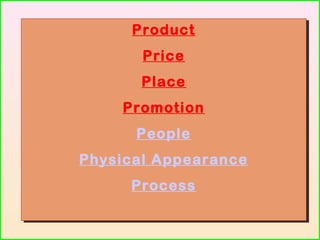
Product
Price
Place
Promotion
People
Physical Appearance
Process
Product
Price
Place
Promotion
People
Physical Appearance
Process
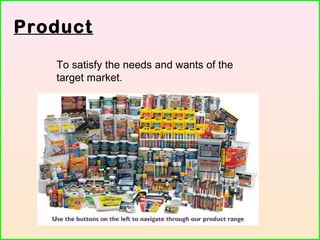
Product
To satisfy the needs and wants of the
target market.
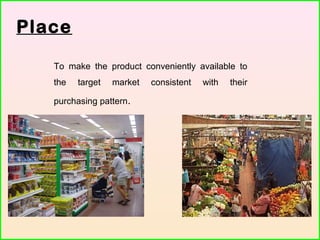
Place
To make the product conveniently available to
the target market consistent with their
purchasing pattern.
Promotions
To build and improve consumer demand.
Promotions has four components called the
Promotions Mix as follows:
•Advertising – to effectively inform and
persuade the target market
•Public Relations – to offer a positive image of
the company and the brand
•Selling – to get the customers buy
•Sales Promotions – to convince customers to
buy immediately
Price
To make the product affordable to the
target market and reflect the value of
benefits provided.
People
 People – People is one of the elements of service marketing
mix. People define a service. In case of service marketing,
people can make or break an organization. Thus many
companies nowadays are involved into specially getting their
staff trained in interpersonal skills and customer service with a
focus towards customer satisfaction
Physical
Appearance Physical Evidence – The last element in the service marketing
mix is a very important element. As said before, services are
intangible in nature. However, to create a better customer
experience tangible elements are also delivered with the service.
Take an example of a restaurant which has only chairs and
tables and good food, or a restaurant which has ambient lighting,
nice music along with good seating arrangement and this also
serves good food. Which one will you prefer? The one with the
nice ambience. That’s physical evidence
Process
Service process is the way in which a service is
delivered to the end customer. Lets take the example
of two very good companies – Mcdonalds and Fedex.
Both the companies are known for their quick services
and the reason they can do that is their confidence on
their processes
•Product, place and people are considered as the strategic
Ps of marketing mix since they cannot be changed
overnight.
•Promotions, price, process and physical appearance are
considered as the tactical Ps of marketing mix because
these can be changed more easily.
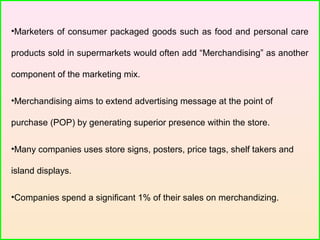
•Marketers of consumer packaged goods such as food and personal care
products sold in supermarkets would often add “Merchandising” as another
component of the marketing mix.
•Merchandising aims to extend advertising message at the point of
purchase (POP) by generating superior presence within the store.
•Many companies uses store signs, posters, price tags, shelf takers and
island displays.
•Companies spend a significant 1% of their sales on merchandizing.
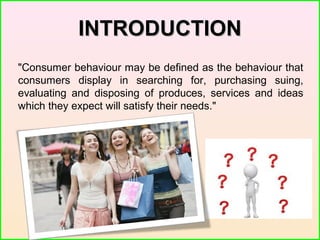
INTRODUCTIONINTRODUCTION
"Consumer behaviour may be defined as the behaviour that
consumers display in searching for, purchasing suing,
evaluating and disposing of produces, services and ideas
which they expect will satisfy their needs."
Characteristics Of Buyer BehaviourCharacteristics Of Buyer Behaviour
 Comprises both mental and physical activity of consumer.
 Buyer behaviour is a integral part of human behaviour
 Buyer behaviour is the process by which individuals decide whether,
what, when, from whom, where and how to buy.
 Buyer behaviour is very dynamic and complex
 In many cases, it is the sum total of the behaviour of a number of
persons
 It is influenced by internal factors such as needs, habit, attitudes etc..
And external factors like family, social group, culture etc…
 Consumer behaviour starts before buying and goes even after buying
NEED OR IMPORTANCE OF STUDY OFNEED OR IMPORTANCE OF STUDY OF
CONSUMER BEHAVIOURCONSUMER BEHAVIOUR
 It helps in formulating effective marketing strategy.
 It gives information regarding colour, design, and other
features that a consumer want in his product. Thus it
helps in formulating production policy.
 It is important for framing suitable pricing policies.
 Consumers demand more for quality products at
reasonable prices. Marketers should first study the
needs of consumers and then try to satisfy them.
NEED OR IMPORTANCE OF STUDY OFNEED OR IMPORTANCE OF STUDY OF
CONSUMER BEHAVIOURCONSUMER BEHAVIOUR
 Rapid technological advancement compels the
marketers to study consumer behaviour.
 Understanding of consumer behaviour helps avoid or
minimise market failures.
 For effective market segmentation and target marketing,
it is essential to have an understanding of consumer and
their behaviour.
Types Of Consumer BuyingTypes Of Consumer Buying
BehaviourBehaviour
 Complex buying behaviour
Eg: cars, homes, computers, education etc.
 Dissonance reducing buying behaviour- Cognitive Dissonance
Eg: Mobile phone
 Variety seeking buying behaviour
Eg: Soap, Detergent, tooth paste etc..
 Habitual buying behaviour
Eg: Salt, Matches, Oil etc..
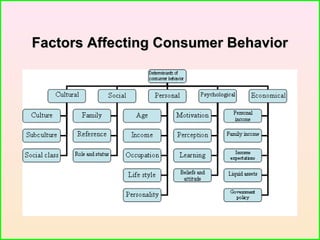
Factors Affecting Consumer BehaviorFactors Affecting Consumer Behavior
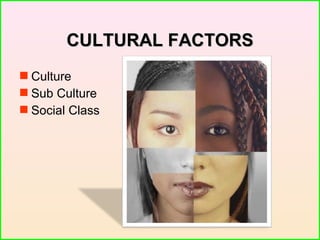
CULTURAL FACTORSCULTURAL FACTORS
 Culture
 Sub Culture
 Social Class
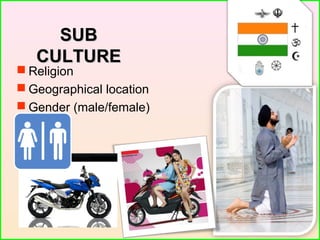
SUBSUB
CULTURECULTURE
 Religion
 Geographical location
 Gender (male/female)
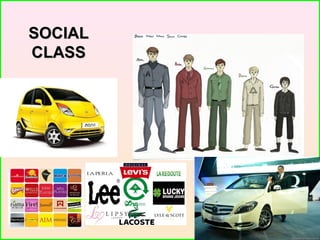
SOCIALSOCIAL
CLASSCLASS
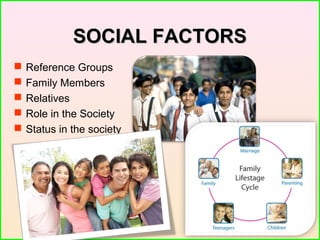
SOCIAL FACTORSSOCIAL FACTORS
 Reference Groups
 Family Members
 Relatives
 Role in the Society
 Status in the society
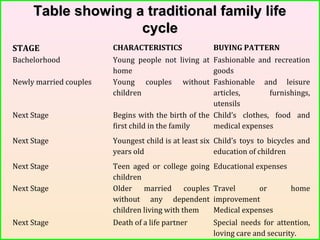
Table showing a traditional family lifeTable showing a traditional family life
cyclecycle
STAGE CHARACTERISTICS BUYING PATTERN
Bachelorhood Young people not living at
home
Fashionable and recreation
goods
Newly married couples Young couples without
children
Fashionable and leisure
articles, furnishings,
utensils
Next Stage Begins with the birth of the
first child in the family
Child’s clothes, food and
medical expenses
Next Stage Youngest child is at least six
years old
Child’s toys to bicycles and
education of children
Next Stage Teen aged or college going
children
Educational expenses
Next Stage Older married couples
without any dependent
children living with them
Travel or home
improvement
Medical expenses
Next Stage Death of a life partner Special needs for attention,
loving care and security.
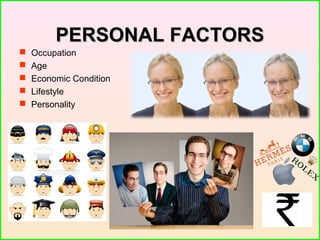
PERSONAL FACTORSPERSONAL FACTORS
 Occupation
 Age
 Economic Condition
 Lifestyle
 Personality
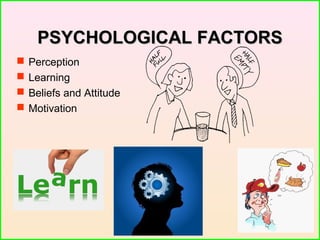
PSYCHOLOGICAL FACTORSPSYCHOLOGICAL FACTORS
 Perception
 Learning
 Beliefs and Attitude
 Motivation
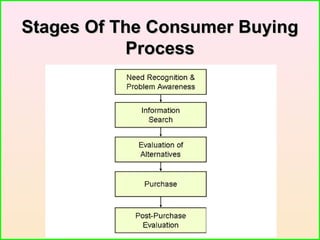
Stages Of The Consumer BuyingStages Of The Consumer Buying
ProcessProcess
The Buyer DecisionThe Buyer Decision
ProcessProcess
Need Recognition
Need recognition occurs when the
buyer recognizes a problem or need
triggered by:
 Internal stimuli
 External stimuli
5-38
5-39
Information Search
Information search is the amount of
information needed in the buying process
and depends on the strength of the drive, the
amount of information you start with, the
ease of obtaining the information, the value
placed on the additional information, and the
satisfaction from searching
5-40
Information Search
Sources of information:
Personal sources—family and friends
Commercial sources—advertising, Internet
Public sources—mass media, consumer
organizations
Experiential sources—handling, examining,
using the product
5-41
Evaluation of Alternatives
Evaluation of alternatives is how the
consumer processes information to
arrive at brand choices
5-42
Purchase Decision
The purchase decision is the act by
the consumer to buy the most preferred
brand
The purchase decision can be affected
by:
 Attitudes of others
 Unexpected situational factors
5-43
Post-Purchase Decision
The post-purchase decision is the
satisfaction or dissatisfaction the
consumer feels about the purchase
Relationship between:
 Consumer’s expectations
 Product’s perceived performance

Marketing mgmt

  • 1.
  • 2.
  • 4.
    MarketingMarketing Marketing is the processof communicating the value of a product or service to customers for the purpose of selling the product or service at the level of satisfaction. It is a critical business function for attracting customers. Process of marketing is not accidental, it is planned in a appropriate manner.
  • 5.
    DEFINITION OF MARKETINGDEFINITIONOF MARKETING “Marketing is a social process by which individuals and groups obtained what they need and wants by creating mutually beneficial exchanges with one another.”
  • 6.
    CORE CONCEPTS OFMARKETINGCORE CONCEPTS OF MARKETING
  • 7.
    NEEDS,WANTS AND DEMANDNEEDS,WANTSAND DEMAND NEEDS-Needs are the basic requirements of any individual like air, water. WANTS-If having specific requirement, then needs turns into wants. DEMAND- If a persons having enough money to fill their wants them it turns in demand
  • 8.
    Products and ServicesProductsand Services Product:  Anything that can be offered to a market to satisfy a need or want.  The concept of product is not limited to physical objects – anything capable of satisfying a need can be called a product. Services:  In addition to tangible goods, products also include services, which are activities or benefits offered for sale that are essentially intangible and do not result in the ownership of anything.
  • 9.
    Values, Satisfaction, andQualityValues, Satisfaction, and Quality Values:  Customer value is the difference between the values the customer gains from owning and using a product and the costs of obtaining the products.  Customers often do not judge product value and costs accurately or objectively. They act on perceived value. Satisfaction:  Customer satisfaction depends on a product’s perceived performance in delivering value relative to a buyer’s expectation.  If the product’s performance falls short of the customer’s expectations, the buyer is dissatisfied. Quality:  Customer satisfaction is closely linked to quality.  Quality has a direct impact on product performance.  Quality can be defined as “freedom from defects”.  TQM programs designed to constantly improve the quality of products, services, and marketing processes.
  • 10.
    Exchange, Transactions, andRelationshipsExchange, Transactions, and Relationships Exchange :  The act of obtaining a desired object from someone by offering something in return Transaction :  A trade between two parties that involves at least two things of value, agreed – upon conditions a time of agreement, and a place of agreement. Relationship marketing :  The process of creating, maintaining, and enhancing strong, value – laden relationships with customers and other stakeholders
  • 11.
  • 12.
    12 Industry (a collection of sellers) Market(a collection of buyers) Products / Services Money Information
  • 13.
    COMPANY ORIENTATION TOWARDSTHECOMPANY ORIENTATION TOWARDS THE MARKETPLACEMARKETPLACE  PRODUCTION CONCEPT- This concept holds that consumers will prefer products that are widely available and inexpensive. Managers of production oriented business concentrate on achieving high production, low cost and mass distribution.
  • 14.
     PRODUCT CONCEPT-This concept proposes that consumers favors products that offer the most quality, innovative features. Managers in these organizations focus on superior products and improving over the time.
  • 15.
     SELLING CONCEPT-The selling concept holds that consumers and businesses, if left alone, would not buy enough of the organization’s products. The main aim of this concept is to sell what they make, rather than make what the market wants.
  • 16.
     MARKETING CONCEPT-Themarketing concept emerged in mid 1950s.Instead of a product centered “make & sell” philosophy, business shifted to a customer centered “sense & respond” philosophy. The marketing concept holds that the key to achieving organizational goals is being more effective than competitors.
  • 17.
    Selling Vs MarketingSellingVs Marketing 1. Selling focuses on the needs of seller. 2. Selling concept is profit oriented . 3. Selling is product oriented. 4. Seeks to quickly convert products into cash. 5. Views Business as a goods producing process 1. Marketing focuses on the needs of buyers 2. Marketing concept is customer satisfaction oriented. 3. Marketing is customer oriented. 4. Seeks to convert customer needs‘ into products 5. Views businesses as a customer satisfying process.
  • 18.
    Nature & Scopeof Marketing:Nature & Scope of Marketing: Marketing is an ancient art & is everywhere. Formally or informally, people & organizations engage in a vast numbers of activities that could be called marketing. Good marketing has become an increasingly vital ingredient for business success. It is embedded in everything we do- from the clothes we wear, to the web sites we click on, to the ads we see. Marketing deals with identifying & meeting human & social needs or it can be defined as ―meeting needs profitably .‖
  • 20.
  • 21.
    What is Marketing?Whatis Marketing? Marketing is Selling No, because  Selling is part of Marketing  Marketing starts long before the company has a product or service  Marketing involves homework to asses needs, measure their extent, and determine if a profitable opportunity exists  Selling only occurs only after a product is manufactured or a service is created  Marketing continues throughout a product’s life, finding new customers, improving product appeal and performance, and managing repeat sales
  • 22.
    What is Marketing?Whatis Marketing? Marketing is Advertising No, because  Advertising is part of Marketing  Marketing starts long before the company places and ad or develops an advertising strategy  Advertising becomes part of an over-all Marketing Plan  Advertising only occurs only after a product is manufactured or a service is created
  • 23.
    What is Marketing?Whatis Marketing? Marketing is Mainly a Department No, because:  Yes, companies do have Marketing Departments, but,  All departments should be at least customer oriented if not customer driven  In highly competitive markets, all departments must focus on winning customer preference
  • 24.
    CUSTOMER VALUE PROPOSITIONCUSTOMERVALUE PROPOSITION In marketing, a customer value proposition (CVP) consists of the sum total of benefits which a vendor promises a customer will receive in return for the customer's associated payment (or other value-transfer). A customer value proposition is a business or marketing statement that describes why a customer should buy a product or use a service. It is specifically targeted towards potential customers rather than other constituent groups such as employees, partners or suppliers. It is a clearly defined statement that is designed to convince customers that one particular product or service will add more value or better solve a problem than others in its competitive set. EXAMPLE Eg………
  • 26.
    Marketing EnvironmentMarketing Environment All businesses are not alone in the market place.  There are many factors that influence businesses  These factors are called the “ Marketing Environment”
  • 27.
    Marketing EnvironmentMarketing Environment All businesses are not alone in the market place.  There are many factors that influence businesses  These factors are called the “ Marketing Environment”
  • 28.
    Elements of theMarketingElements of the Marketing EnvironmentEnvironment
  • 29.
    Internal Marketing Environment Theinternal environment is made up of factors within the firm itself. Examples include employees, company policy, capital assets, the firm's structure and the firm's products (materials). These factors can be controlled by the firm.
  • 30.
    Staff RelationshipsStaff Relationships Relationship among the staff affects the operations of the organization.  Management should develop a conducive environment to develop staff relationships  Employees should not convey a negative image of the organization to external sources.
  • 31.
     Staff members The message that is conveyed by staff to others ( third parties) have a big impact rather than the paid advertisements of the organisation  Members of the public consider staff members as the authoritative and they are far more likely to believe what staff members say  Therefore an organization must do its internal marketing well to inform the company’s policies, and obtain the commitment and loyalty of the staff  Staff is paid salaries by the organisation and staff should act to safeguard the organisation’s interest for their own benefit too.
  • 32.
    Corporate cultureCorporate culture Culture is a set of shared values, rules, and perceptions in a given society.  It has a powerful influence on the actions and behaviors of the members of the staff  It is not an easy task to change the organizations culture if it is not conducive for an efficient operation
  • 33.
    Resource ConstraintsResource Constraints All organizations operate within a limited amount of resources  Men. Material, Money, Machines and Technology are the limiting resources  Organization should use systems where they could get the maximum out of the existing resources  The effective and efficient way of adopting resources is the key to success.
  • 34.
    Micro Environment The microenvironment is made up of factors that are close to the firm and affect it on a 'day to day' basis; usually these factors interact with the firm or are involved in the same industry Micro environment examples include customers, banks and trade unions as they all interact with the firm.. Some of the factors within the micro environment can be controlled whilst other's can not.
  • 35.
    SuppliersSuppliers  They couldbe the suppliers of all the materials and utilities to the marketer to make its value proposition ( product) to the market – machines and plants, raw materials, components, stationery, electricity, water, gas, other services, advertising agencies, consultancies, etc  Company cannot survive without suppliers  Marketers should study about the suppliers capacity, problems to have a good flow of supplies  If they increase prices, we have to revise price
  • 36.
    CustomersCustomers  Customers arethe most important element in the micro environment  They can be individuals or organizations  A persons who makes the decision to buy the product is called the customer and the person who consumes the product is called the consumer  When customer and the consumer are different the marketer have to consider the needs of both  Many times customer and the consumer would be the same.  Marketer should study the constantly changing needs of the customer and fine tune his value proposition accordingly to satisfy/delight the customer.
  • 37.
    Macro (External) EnvironmentMacro(External) Environment The macro environment is made up of factors that affect the firm on a long term basis. In general macro environment factors are not close to the firm. Micro environment factors could be national or global measures and affect many industries and groups. Macro environment examples include legislation, the economy (e.g. recession, inflation, VAT changes), and technological change such as the internet. Macro environment factors are uncontrollable factors but still influence company strategy.
  • 38.
     Competitors  Political Economic  Social and cultural  Technological Macro Environmental FactorsMacro Environmental Factors
  • 39.
  • 40.
    CompetitorsCompetitors  Marketer isnot alone in the market.  Every action of the marketer has a reaction from the competitors  Knowing the competitors, their capacity, ability, future moves, structure and operational systems, objectives, strategies and tactics, will provide so much of ammunition to the marketer to face the challenges in the market place.  Simply a SWOT Analysis of Competitors is needed
  • 41.
    Political and LegalEnvironmentPolitical and Legal Environment  Ploitical  Political stability  War and Peace  Internal conflicts and struggles  Strikes and stoppage of work  Globalisation and opening up of markets  Political affiliation and support to governments
  • 42.
  • 43.
    Economic EnvironmentEconomic Environment General economic condition of the world and the country  Income distribution -  Employment levels and its structure  Prices and inflation  Boom and recession  Balance of trade – surplus / deficit  Exchange rate and fluctuation  Stock market  Import and export duties  Saving and investment
  • 44.
    Social and CulturalEnvironmentSocial and Cultural Environment  Society consists of large group of people with shared customs and laws  Culture consists of art, thought, and customs, religions, practices of a society at any given time  Any society will have its own culture. May be unique or shared or mixed with other cultures.  Peoples relationships and behavior will have a major influence of the societies beliefs, values and norms  There could be different cultural groups within a society
  • 45.
    Socio Cultural EnvironmentSocioCultural Environment Demographic factors- population structure- age, family size, ethnicity, income, Social Cultural behaviors- languages, religious beliefs, mythology, gender roles, gift giving habits, Social responsibility and ethics The impact of war Role of women in society Attitudes towards credit Concern about health
  • 46.
     The socio-cultural affect will influence peoples attitudes towards buying patterns, living patterns, dress codes, fashion, sports, savings, social behaviors, music, credit, marriage, and many areas of life styles.  Marketers have to be aware of them to understand the customers and their behavior. Example
  • 47.
    TechnologicalTechnological  Technology ischanging always  Marketers have to be vigilant about it and adapt to change  There are so many innovations taking place in the world.  Some innovations make products and processors improve dynamically and some times they even replaces the old products and make them obsolete
  • 48.
    Examples of TechnologicaladvancementExamples of Technological advancement  What happened to typewriters, LP records, audio and video cassettes, analogue phones  What happened to standard post with email and SMS  What will happened to CDs  Nano technology is knocking doors
  • 49.
  • 50.
    Digitalization in MarketingDigitalizationin Marketing  Digital marketing is a marketing process which leads to the development of any organization or brand by using a variety of digital channels such as email, social networks etc.  Digital Marketing can be defined as promoting of brands or products and services using all forms of digital advertising. Digital marketing uses Television, Radio, Internet, mobile and any form of digital media to reach customers in a timely, relevant, personal and cost-effective manner
  • 51.
    Apart from usingmany of the techniques and practices contained within the category of Internet Marketing, digital marketing extends beyond this by including other channels that do not require the use of the Internet. Due to non- dependence on the Internet, the field of digital marketing includes a whole lot of elements such as mobile phones or cell phones, display / banner ads, sms /mms, digital outdoor, and many more.
  • 53.
    PRODUCTPRODUCT Product is anythingthat can be offered to a market to satisfy a need & wants of customers. Product is a bundle of benefits offered to a customer.
  • 55.
     Core Benefits-Theservice or benefit the customer is really buying.  Basic Product- At the second level, the marketer must turn core benefits into basic product.  Expected Product-At the third level, the marketer prepares an expected product, a set of attributes buyers normally expect when they purchase this product.
  • 56.
     Augmented Product-At the fourth level marketers prepares an augmented product that exceeds customers expectations.  Potential Product-Here companies search for new ways to satisfy customers and distinguish their offering.
  • 57.
    WHAT IS PRODUCTWHATIS PRODUCT Product is anything that can offered to market toProduct is anything that can offered to market to satisfy a want or need, including physicalsatisfy a want or need, including physical goods, services ,experinces,events,persons.goods, services ,experinces,events,persons.
  • 60.
    Consumer ProductConsumer Product ClassificationClassification Convenience Goods Inexpensive, frequently purchased. Little effort needed to purchase them. Staples, Impulse and emergency goods.
  • 61.
    Shopping GoodsShopping Goods Notas frequently as convenience products Costly Consumer does research before purchase.
  • 62.
    Specialty GoodsSpecialty Goods Uniquefeatures Consumer is prepared to pay a premium price.
  • 63.
    Non Durable &Durable GoodsNon Durable & Durable Goods  Nondurable Goods Tangible goods consumed in one or few uses Purchased frequently Strategy : availability , low priced , heavily advertised
  • 64.
    Durable GoodsDurable Goods Tangiblegoods that survive many uses Require more personal selling and service Higher margins and requires seller guarantee
  • 65.
    Industrial-Goods ClassificationIndustrial-Goods Classification Materials and Parts Raw Material sManufactured materials and parts Farm Products Natural Products
  • 66.
     Materials andParts Raw Materials Manufactured materials and parts Farm Products Natural Products
  • 67.
    PRODUCT MIXPRODUCT MIX Productmix is the sum total of all products that a company offers for sale.
  • 70.
    PRODUCT MIX OFHINDUSTAN UNILEVER
  • 72.
  • 74.
    PRODUCT MIX OFDABURPRODUCT MIX OF DABUR
  • 75.
  • 76.
    PRODUCT MIX OFRECKITT BENCKISER
  • 77.
  • 79.
    3.Product Life Cycles(PLC)3.Product Life Cycles (PLC)  The course of a product’s sale and profit over it lifetime. It involves five distinct stages:introduction,growth,maturity,and decline.
  • 80.
    Sales & ProfitLife CyclesSales & Profit Life Cycles IntroductionIntroduction GrowthGrowth MaturityMaturity DeclineDecline TimeTime SalesSales&&profitsprofits($)($)
  • 81.
     Introduction-A periodof slow sales growth as the product is introduced in the market. Profits are nonexistent because of the heavy expense of product introduction.  Growth-A period of rapid market acceptance and profit improvement.  Maturity-Stable profit.  Decline-Sales shows a downward drift and profit erode.
  • 82.
    STRATEGIES UNDER DIFFERENT STAGES OFPRODUCT LIFE CYCLE(PLC)
  • 83.
    SalesSales CostsCosts ProfitsProfits Marketing ObjectivesMarketing Objectives ProductProduct PricePrice LowLow Highcost per customerHigh cost per customer NegativeNegative Create product awareness and trialCreate product awareness and trial Offer a basic productOffer a basic product Use cost-plus formulaUse cost-plus formula DistributionDistribution Build selective distributionBuild selective distribution PromotionPromotion Heavy to entice product trialHeavy to entice product trial Summary of Characteristics, Objectives, & Strategies Introduction Stage of the PLCIntroduction Stage of the PLC
  • 84.
    Improve Product qualityand add new features. It enters in new market Increases its distribution coverage Lowers prices Eg 1 Eg 2 Strategies used under growth stage
  • 85.
  • 86.
    SalesSales CostsCosts ProfitsProfits Marketing ObjectivesMarketing Objectives ProductProduct PricePrice RapidlyrisingRapidly rising Average cost per customerAverage cost per customer RisingRising Maximize market shareMaximize market share Offer extension, service, warrantyOffer extension, service, warranty Penetration strategyPenetration strategy DistributionDistribution Build intensive distributionBuild intensive distribution PromotionPromotion Reduce to take advantage of demandReduce to take advantage of demand Summary of Characteristics, Objectives, & Strategies Growth Stage of the PLCGrowth Stage of the PLC
  • 87.
    Strategy used underMaturity StageStrategy used under Maturity Stage
  • 88.
    SalesSales CostsCosts ProfitsProfits Marketing ObjectivesMarketing Objectives ProductProduct PricePrice PeakPeak Lowcost per customerLow cost per customer HighHigh Maximize profits while defending market shareMaximize profits while defending market share Diversify brand and modelsDiversify brand and models Match or best competitorsMatch or best competitors DistributionDistribution Build more intensive distributionBuild more intensive distribution PromotionPromotion Increase to encourage brand switchingIncrease to encourage brand switching Summary of Characteristics, Objectives, & Strategies Maturity Stage of the PLCMaturity Stage of the PLC
  • 89.
    SalesSales CostsCosts ProfitsProfits Marketing ObjectivesMarketing Objectives ProductProduct PricePrice DecliningDeclining Lowcost per customerLow cost per customer DecliningDeclining Reduce expenditures and milk the brandReduce expenditures and milk the brand Phase out weak itemsPhase out weak items Cut priceCut price DistributionDistribution Selective: phase out unprofitable outletsSelective: phase out unprofitable outlets PromotionPromotion Reduce to minimum levelReduce to minimum level Summary of Characteristics, Objectives, & Strategies Decline Stage of the PLCDecline Stage of the PLC
  • 92.
     The Marketingmix is a set of four decisions which need to be taken before launching any new product. These variables are also known as the 4 P’s of marketing. These four variables help the firm in making strategic decisions necessary for the smooth running of any product / organization.These variables are  Product  Price  Place  Promotions
  • 93.
     Marketing mixis mainly of two types.  1) Product marketing Mix – Comprised of Product, price, place and promotions. This marketing mix is mainly used in case of Tangible goods.  2) Service Marketing Mix – The service marketing mix has three further variables included which are people, physical evidence and process. .
  • 95.
  • 96.
    Product To satisfy theneeds and wants of the target market.
  • 97.
    Place To make theproduct conveniently available to the target market consistent with their purchasing pattern.
  • 98.
    Promotions To build andimprove consumer demand. Promotions has four components called the Promotions Mix as follows: •Advertising – to effectively inform and persuade the target market •Public Relations – to offer a positive image of the company and the brand •Selling – to get the customers buy •Sales Promotions – to convince customers to buy immediately
  • 99.
    Price To make theproduct affordable to the target market and reflect the value of benefits provided.
  • 100.
    People  People –People is one of the elements of service marketing mix. People define a service. In case of service marketing, people can make or break an organization. Thus many companies nowadays are involved into specially getting their staff trained in interpersonal skills and customer service with a focus towards customer satisfaction
  • 101.
    Physical Appearance Physical Evidence– The last element in the service marketing mix is a very important element. As said before, services are intangible in nature. However, to create a better customer experience tangible elements are also delivered with the service. Take an example of a restaurant which has only chairs and tables and good food, or a restaurant which has ambient lighting, nice music along with good seating arrangement and this also serves good food. Which one will you prefer? The one with the nice ambience. That’s physical evidence
  • 102.
    Process Service process isthe way in which a service is delivered to the end customer. Lets take the example of two very good companies – Mcdonalds and Fedex. Both the companies are known for their quick services and the reason they can do that is their confidence on their processes
  • 103.
    •Product, place andpeople are considered as the strategic Ps of marketing mix since they cannot be changed overnight. •Promotions, price, process and physical appearance are considered as the tactical Ps of marketing mix because these can be changed more easily.
  • 104.
    •Marketers of consumerpackaged goods such as food and personal care products sold in supermarkets would often add “Merchandising” as another component of the marketing mix. •Merchandising aims to extend advertising message at the point of purchase (POP) by generating superior presence within the store. •Many companies uses store signs, posters, price tags, shelf takers and island displays. •Companies spend a significant 1% of their sales on merchandizing.
  • 107.
    INTRODUCTIONINTRODUCTION "Consumer behaviour maybe defined as the behaviour that consumers display in searching for, purchasing suing, evaluating and disposing of produces, services and ideas which they expect will satisfy their needs."
  • 108.
    Characteristics Of BuyerBehaviourCharacteristics Of Buyer Behaviour  Comprises both mental and physical activity of consumer.  Buyer behaviour is a integral part of human behaviour  Buyer behaviour is the process by which individuals decide whether, what, when, from whom, where and how to buy.  Buyer behaviour is very dynamic and complex  In many cases, it is the sum total of the behaviour of a number of persons  It is influenced by internal factors such as needs, habit, attitudes etc.. And external factors like family, social group, culture etc…  Consumer behaviour starts before buying and goes even after buying
  • 109.
    NEED OR IMPORTANCEOF STUDY OFNEED OR IMPORTANCE OF STUDY OF CONSUMER BEHAVIOURCONSUMER BEHAVIOUR  It helps in formulating effective marketing strategy.  It gives information regarding colour, design, and other features that a consumer want in his product. Thus it helps in formulating production policy.  It is important for framing suitable pricing policies.  Consumers demand more for quality products at reasonable prices. Marketers should first study the needs of consumers and then try to satisfy them.
  • 110.
    NEED OR IMPORTANCEOF STUDY OFNEED OR IMPORTANCE OF STUDY OF CONSUMER BEHAVIOURCONSUMER BEHAVIOUR  Rapid technological advancement compels the marketers to study consumer behaviour.  Understanding of consumer behaviour helps avoid or minimise market failures.  For effective market segmentation and target marketing, it is essential to have an understanding of consumer and their behaviour.
  • 111.
    Types Of ConsumerBuyingTypes Of Consumer Buying BehaviourBehaviour  Complex buying behaviour Eg: cars, homes, computers, education etc.  Dissonance reducing buying behaviour- Cognitive Dissonance Eg: Mobile phone  Variety seeking buying behaviour Eg: Soap, Detergent, tooth paste etc..  Habitual buying behaviour Eg: Salt, Matches, Oil etc..
  • 112.
    Factors Affecting ConsumerBehaviorFactors Affecting Consumer Behavior
  • 113.
    CULTURAL FACTORSCULTURAL FACTORS Culture  Sub Culture  Social Class
  • 114.
    SUBSUB CULTURECULTURE  Religion  Geographicallocation  Gender (male/female)
  • 115.
  • 116.
    SOCIAL FACTORSSOCIAL FACTORS Reference Groups  Family Members  Relatives  Role in the Society  Status in the society
  • 117.
    Table showing atraditional family lifeTable showing a traditional family life cyclecycle STAGE CHARACTERISTICS BUYING PATTERN Bachelorhood Young people not living at home Fashionable and recreation goods Newly married couples Young couples without children Fashionable and leisure articles, furnishings, utensils Next Stage Begins with the birth of the first child in the family Child’s clothes, food and medical expenses Next Stage Youngest child is at least six years old Child’s toys to bicycles and education of children Next Stage Teen aged or college going children Educational expenses Next Stage Older married couples without any dependent children living with them Travel or home improvement Medical expenses Next Stage Death of a life partner Special needs for attention, loving care and security.
  • 118.
    PERSONAL FACTORSPERSONAL FACTORS Occupation  Age  Economic Condition  Lifestyle  Personality
  • 119.
    PSYCHOLOGICAL FACTORSPSYCHOLOGICAL FACTORS Perception  Learning  Beliefs and Attitude  Motivation
  • 121.
    Stages Of TheConsumer BuyingStages Of The Consumer Buying ProcessProcess
  • 122.
    The Buyer DecisionTheBuyer Decision ProcessProcess Need Recognition Need recognition occurs when the buyer recognizes a problem or need triggered by:  Internal stimuli  External stimuli 5-38
  • 123.
    5-39 Information Search Information searchis the amount of information needed in the buying process and depends on the strength of the drive, the amount of information you start with, the ease of obtaining the information, the value placed on the additional information, and the satisfaction from searching
  • 124.
    5-40 Information Search Sources ofinformation: Personal sources—family and friends Commercial sources—advertising, Internet Public sources—mass media, consumer organizations Experiential sources—handling, examining, using the product
  • 125.
    5-41 Evaluation of Alternatives Evaluationof alternatives is how the consumer processes information to arrive at brand choices
  • 126.
    5-42 Purchase Decision The purchasedecision is the act by the consumer to buy the most preferred brand The purchase decision can be affected by:  Attitudes of others  Unexpected situational factors
  • 127.
    5-43 Post-Purchase Decision The post-purchasedecision is the satisfaction or dissatisfaction the consumer feels about the purchase Relationship between:  Consumer’s expectations  Product’s perceived performance

Editor's Notes

  • #61 Introduction Consumer goods are products which are purchased for personal consumption. Consumer goods are classified into three areas: Convenience goods, shopping goods and speciality goods. Convenience Goods Convenience products are inexpensive frequent purchases, there is little effort needed to purchase them. Examples include fast food, toiletries and confectionery products. Convenience products are split into staples, such as milk, eggs and emergency products which are purchased when the need arises e.g. Umbrellas. Shopping Goods Shopping goods are products that consumers do not buy as frequently as convenience goods. They usually cost more than convenience goods and consumers expect to have them for longer, so they will do some research prior to purchase. The research will include comparing product features and price. Examples of shopping goods include white goods (such as fridge/freezers and washing machines), clothing and furniture. Speciality Goods Speciality goods are products with unique features or branding. Consumers do not compare them with other products as the goods have features unique to them. Instead they will spend time searching for for the place selling the product they want. Consumers are often prepared to travel to purchase their product and pay a premium. Speciality goods include designer clothes, luxury cars, antiques. Professional services provided by a person known for the effectiveness and quality of their work can also come under this category. For example a lawyer or public relations "guru" such as Max Clifford. Summary It is important for marketers to know what classification their products come under, as the classification determines how consumers behave when they are purchasing their product. Marketing can then be designed around the specific buying behaviour.