Measures of effect
Rukman Manapurath
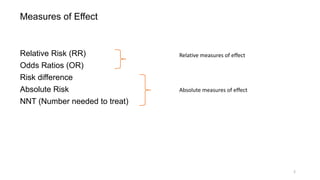
Measures of Effect
Relative Risk (RR)
Odds Ratios (OR)
Risk difference
Absolute Risk
NNT (Number needed to treat)
Relative measures of effect
Absolute measures of effect
2
Absolute risk
The incidence of a disease in a population is termed the absolute
risk.
Actual risk in a given population
Expressed as a percentage or a proportion of the number of
cases that develop the outcome divided by the total number of
people in the population
3
Why absolute risk
The RR and the OR should always be examined in the context of the
absolute risk.
For example, in a case-control study, use of a nutritional supplement on
metabolic marker (OR=5.7; 95% CI, 1.6–20.7)
If this is rare in the population, the OR and the RR would probably be
similar.
Eg: 0.02%, the 5-fold increased risk would result in an incidence of 0.1% (almost
negligible risk at person level)
If the absolute risk is high, then even a small increase in the RR or OR
could be clinically important.
E.g. 30% in the reference population, then an RR of 1.2 means that this risk will
increase by 20% after exposure to the risk factor. (= 6%) could be of concern.
4
Obesity among children who consume a high intake of high protein diet in
infancy compared to the risk among those infants with a low intake.
Obese Non Obese Total
Received high
protein diet
8 32 40
Received low/
normal protein diet
3 33 36
Total 11 65 76
Absolute risk with high protein diet = 8/40 =20%
5
Odds and Risk
Risk of Disease =
#with Disease
# with and without Disease
Risk Odds
6
7
Risk = 2/ 12
Odds = 2/ 10
8
years
Rate = 2 cases per 37 person-years at risk
= 0.05 cases per person-years at risk
9
Risk = 17/ 50 = 0.34
Risk = 12/ 25= 0.48
12 13
5 20
25
25
17 33
Risk =5/ 25= 0.2
Relative Risk = Exp/Unexp
= 0.48 /0.2
= 2.4
10
Risk = 12/ 25= 0.48
12 13
5 20
25
25
17 33
Risk =5/ 25= 0.2
Relative Risk = Exp/Unexp
= 0.48 /0.2
= 2.4
Risk = Exp - Unexp
= 0.48 - 0.2
= 0.28
RD = Excess risk
Measure of the effect that compares the probability of an event
(developing a disease) occurring in exposed people compared to
the probability of the event in nonexposed people
In nutritional trials, relative risk is often used to assess the impact
of a specific nutrient or dietary pattern on a health outcome.
Relative Risk
11
RR > 1 Risk of the outcome is higher in the exposed group than in
the unexposed group
RR < 1 Risk of the outcome is lower in the exposed group
RR = 1 No difference in risk between the exposed and unexposed
groups
12
Eg. Risk of obesity among children who consume a high intake of high
protein diet in infancy compared to the risk among those infants with a
low intake.
Obese Non Obese Total
Received high
protein diet
8 32 40
Received low/
normal protein diet
3 33 36
Total 11 65 76
RR = 8/40 ÷ 3/36 = 2.4
Receiving high protein diet relative to normal protein diet is associated with 2.4 fold increased risk of
childhood obesity at 12 months
13
RR = 73/132 ÷ 59/105 = 1.48
Obese Non Obese Total
Vit D
deficient
73 59 132
Vit D normal 39 66 105
112 125
The relative risk for the association between vit D
deficiency and obesity is 1.38
Rajakumar, Kumaravel et al. “Vitamin D status, adiposity, and lipids in black American and Caucasian children.” The Journal of clinical endocrinology
and metabolism vol. 96,5 (2011) 14
15
Efficacy of daily zinc supplementation for 4 months in
prevention of pneumonia
Pneumonia Total
Yes No
Zinc 60 940 1000
Placebo 100 900 1000
Incidence in zinc group = 60/1000 = 0.06
Incidence in placebo group = 100/1000 = 0.1
Relative risk = 0.06/0.1 = 0.6
16
Suppose the method to diagnose pneumonia is 100% specific
but only 50% sensitive
Pneumonia Total
Yes No
Zinc 30 940+30 1000
Placebo 50 900+50 1000
Incidence in zinc group = 30/1000 = 0.03
Incidence in placebo group = 50/1000 = 0.05
Relative risk = 0.03/0.05 = 0.6
17
Suppose the method to diagnose pneumonia is 100% sensitive
but only 50% specific
Pneumonia Total
Yes No
Zinc 60+470 470 1000
Placebo 100+450 450 1000
Incidence in zinc group = 530/1000 = 0.53
Incidence in placebo group = 550/1000 = 0.55
Relative risk = 0.53/0.55 = 0.96
RR is a measure of the strength of an association; no causal
relationship
RCTs: Less preferable measure to assess the clinical impact
of treatment (ARR more preferable)
Cohort studies: Not a very useful measure of the impact of
the risk factor in the population (Pop. Attributable Risk more
preferable)
RR can be affected by the sensitivity and specificity of the
outcome measure
18
Odds ratio (OR) is a measure of effect that compares the odds of a certain
outcome (e.g. disease or death) among individuals who are exposed to a
certain risk factor (e.g. a specific nutrient or dietary pattern) to the odds
of that outcome among those who are not exposed.
Odds Ratio
19
OR >1 odds of the outcome are higher in the exposed group than in the
unexposed group (positive association)
OR <1 odds of the outcome are lower in the exposed group than in the
unexposed group (negative association)
OR = 1 no association between the exposure and the outcome.
Causality ??
20
Eg. Risk of obesity among children who consume a high intake of high
protein diet in infancy compared to the risk among those infants with a
low intake.
Obese Non Obese Total
Protein rich diet 8 32 40
Normal protein diet 3 33 36
Total 11 65 76
OR = 8/32÷ 3/33= 2.75
The odds of having obesity among children consuming high protein diet is 2.75 times higher compared
to those consuming normal protein diet.
21
Measure of effect that compares the absolute difference in risk of a certain
outcome between two groups of individuals
Positive RD = Risk of the outcome exposed > unexposed group
Negative RD = Risk of the outcome in exposed group < unexposed group
Zero RD indicates that there is no difference in risk between the groups.
Relevant for finding clinical significance of the results, especially when the
outcome is rare
22
Risk Difference
Relative Risk Reduction (RRR)
The proportion of the baseline risk that is removed an intervention/treatment
OR a measure of the effectiveness of a particular intervention.
Indicates by how much in relative terms the event rate is decreased
To compare different treatments or interventions, and to assess the
effectiveness of a particular intervention.
Calculated as RRR = 1 – RR
27
Absolute Risk Reduction (ARR)
Absolute Risk Reduction also called risk difference
28
The Number Needed To Treat (NNT)
The number of patients who would need to be treated to prevent an adverse event
NNT = 1 / ARR
NNT depends on the efficacy of the intervention (= RRR) and the underlying baseline risk
29
30
Risk Difference (RD):
Can also be used as an indicator of effectiveness of different types of
treatments/interventions in a trial set up
1 / RD = Number Needed to Treat (NNT)
Number of patients who would need to receive specific type of
treatment in order for one patient to benefit from the treatment
More the benefit of a treatment, less the NNT
30

Measures of effect.pptx

  • 1.
  • 2.
    Measures of Effect RelativeRisk (RR) Odds Ratios (OR) Risk difference Absolute Risk NNT (Number needed to treat) Relative measures of effect Absolute measures of effect 2
  • 3.
    Absolute risk The incidenceof a disease in a population is termed the absolute risk. Actual risk in a given population Expressed as a percentage or a proportion of the number of cases that develop the outcome divided by the total number of people in the population 3
  • 4.
    Why absolute risk TheRR and the OR should always be examined in the context of the absolute risk. For example, in a case-control study, use of a nutritional supplement on metabolic marker (OR=5.7; 95% CI, 1.6–20.7) If this is rare in the population, the OR and the RR would probably be similar. Eg: 0.02%, the 5-fold increased risk would result in an incidence of 0.1% (almost negligible risk at person level) If the absolute risk is high, then even a small increase in the RR or OR could be clinically important. E.g. 30% in the reference population, then an RR of 1.2 means that this risk will increase by 20% after exposure to the risk factor. (= 6%) could be of concern. 4
  • 5.
    Obesity among childrenwho consume a high intake of high protein diet in infancy compared to the risk among those infants with a low intake. Obese Non Obese Total Received high protein diet 8 32 40 Received low/ normal protein diet 3 33 36 Total 11 65 76 Absolute risk with high protein diet = 8/40 =20% 5
  • 6.
    Odds and Risk Riskof Disease = #with Disease # with and without Disease Risk Odds 6
  • 7.
    7 Risk = 2/12 Odds = 2/ 10
  • 8.
    8 years Rate = 2cases per 37 person-years at risk = 0.05 cases per person-years at risk
  • 9.
    9 Risk = 17/50 = 0.34 Risk = 12/ 25= 0.48 12 13 5 20 25 25 17 33 Risk =5/ 25= 0.2 Relative Risk = Exp/Unexp = 0.48 /0.2 = 2.4
  • 10.
    10 Risk = 12/25= 0.48 12 13 5 20 25 25 17 33 Risk =5/ 25= 0.2 Relative Risk = Exp/Unexp = 0.48 /0.2 = 2.4 Risk = Exp - Unexp = 0.48 - 0.2 = 0.28 RD = Excess risk
  • 11.
    Measure of theeffect that compares the probability of an event (developing a disease) occurring in exposed people compared to the probability of the event in nonexposed people In nutritional trials, relative risk is often used to assess the impact of a specific nutrient or dietary pattern on a health outcome. Relative Risk 11
  • 12.
    RR > 1Risk of the outcome is higher in the exposed group than in the unexposed group RR < 1 Risk of the outcome is lower in the exposed group RR = 1 No difference in risk between the exposed and unexposed groups 12
  • 13.
    Eg. Risk ofobesity among children who consume a high intake of high protein diet in infancy compared to the risk among those infants with a low intake. Obese Non Obese Total Received high protein diet 8 32 40 Received low/ normal protein diet 3 33 36 Total 11 65 76 RR = 8/40 ÷ 3/36 = 2.4 Receiving high protein diet relative to normal protein diet is associated with 2.4 fold increased risk of childhood obesity at 12 months 13
  • 14.
    RR = 73/132÷ 59/105 = 1.48 Obese Non Obese Total Vit D deficient 73 59 132 Vit D normal 39 66 105 112 125 The relative risk for the association between vit D deficiency and obesity is 1.38 Rajakumar, Kumaravel et al. “Vitamin D status, adiposity, and lipids in black American and Caucasian children.” The Journal of clinical endocrinology and metabolism vol. 96,5 (2011) 14
  • 15.
    15 Efficacy of dailyzinc supplementation for 4 months in prevention of pneumonia Pneumonia Total Yes No Zinc 60 940 1000 Placebo 100 900 1000 Incidence in zinc group = 60/1000 = 0.06 Incidence in placebo group = 100/1000 = 0.1 Relative risk = 0.06/0.1 = 0.6
  • 16.
    16 Suppose the methodto diagnose pneumonia is 100% specific but only 50% sensitive Pneumonia Total Yes No Zinc 30 940+30 1000 Placebo 50 900+50 1000 Incidence in zinc group = 30/1000 = 0.03 Incidence in placebo group = 50/1000 = 0.05 Relative risk = 0.03/0.05 = 0.6
  • 17.
    17 Suppose the methodto diagnose pneumonia is 100% sensitive but only 50% specific Pneumonia Total Yes No Zinc 60+470 470 1000 Placebo 100+450 450 1000 Incidence in zinc group = 530/1000 = 0.53 Incidence in placebo group = 550/1000 = 0.55 Relative risk = 0.53/0.55 = 0.96
  • 18.
    RR is ameasure of the strength of an association; no causal relationship RCTs: Less preferable measure to assess the clinical impact of treatment (ARR more preferable) Cohort studies: Not a very useful measure of the impact of the risk factor in the population (Pop. Attributable Risk more preferable) RR can be affected by the sensitivity and specificity of the outcome measure 18
  • 19.
    Odds ratio (OR)is a measure of effect that compares the odds of a certain outcome (e.g. disease or death) among individuals who are exposed to a certain risk factor (e.g. a specific nutrient or dietary pattern) to the odds of that outcome among those who are not exposed. Odds Ratio 19
  • 20.
    OR >1 oddsof the outcome are higher in the exposed group than in the unexposed group (positive association) OR <1 odds of the outcome are lower in the exposed group than in the unexposed group (negative association) OR = 1 no association between the exposure and the outcome. Causality ?? 20
  • 21.
    Eg. Risk ofobesity among children who consume a high intake of high protein diet in infancy compared to the risk among those infants with a low intake. Obese Non Obese Total Protein rich diet 8 32 40 Normal protein diet 3 33 36 Total 11 65 76 OR = 8/32÷ 3/33= 2.75 The odds of having obesity among children consuming high protein diet is 2.75 times higher compared to those consuming normal protein diet. 21
  • 22.
    Measure of effectthat compares the absolute difference in risk of a certain outcome between two groups of individuals Positive RD = Risk of the outcome exposed > unexposed group Negative RD = Risk of the outcome in exposed group < unexposed group Zero RD indicates that there is no difference in risk between the groups. Relevant for finding clinical significance of the results, especially when the outcome is rare 22 Risk Difference
  • 23.
    Relative Risk Reduction(RRR) The proportion of the baseline risk that is removed an intervention/treatment OR a measure of the effectiveness of a particular intervention. Indicates by how much in relative terms the event rate is decreased To compare different treatments or interventions, and to assess the effectiveness of a particular intervention. Calculated as RRR = 1 – RR 27
  • 24.
    Absolute Risk Reduction(ARR) Absolute Risk Reduction also called risk difference 28
  • 25.
    The Number NeededTo Treat (NNT) The number of patients who would need to be treated to prevent an adverse event NNT = 1 / ARR NNT depends on the efficacy of the intervention (= RRR) and the underlying baseline risk 29
  • 26.
    30 Risk Difference (RD): Canalso be used as an indicator of effectiveness of different types of treatments/interventions in a trial set up 1 / RD = Number Needed to Treat (NNT) Number of patients who would need to receive specific type of treatment in order for one patient to benefit from the treatment More the benefit of a treatment, less the NNT 30