MEASLES
OUTLINE
• DEFINITION
• ETIOLOGY
• Epidemiology
• PATHOGENESIS
• CLINICAL MANIFESTATION
• COMPLICATIONS
• DIAGNOSIS
• TREATMENT
• Prevention
DEFINITION
Suspected case:
Any person with fever, and maculopapular (non-vesicular) rash.
OR
Any person in whom a HCW suspects measles.
All suspected cases should be identified and reported by the
healthcare providers.
Laboratory Confirmed case:
suspected case of measles that has been confirmed positive by testing
in a proficient laboratory, and vaccine-associated illness has been
ruled out.
ETIOLOGY
1. Para myxovirus
• One antigenic type
• Rapidly inactivated by heat,
• sunlight, acidic pH, ether and trypsin.
EPIDEMIOLOGY
• Reservoir
Human
• Transmission
Person-to-person via large respiratory droplets
Airborne in closed areas for up to 2 hours
• Temporal pattern
Primarily late winter and spring
• Communicability
4 days before through 4 days after rash onset
PATHOGENESIS
The primary site of infection is alveolar macrophages or
dendritic cells.2 to 3 days after replication in the lung,
measles virus spreads to regional lymphoid tissues and
cause systemic infection.
Further viral replication in regional and distal
reticuloendothelial sites, a second viremia occurs 5 to 7
days after initial infection.
During this phase, infected lymphocytes and dendritic cells
migrate into the subepithelial cell layer and transmit measles
to epithelial cells from there the virus into the respiratory
tract.
CLINICAL MANIFESTATIONS
Incubation period (8 to 12 days)
from Exposure to appearance of rash
Prodrome lasts (2 to 4 days)
• Stepwise increase in fever to 103°F–105°F
• Cough, coryza, and conjunctivitis
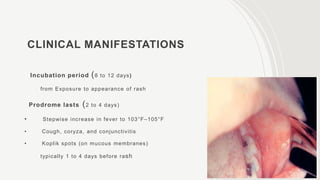
• Koplik spots (on mucous membranes)
typically 1 to 4 days before rash
Rash
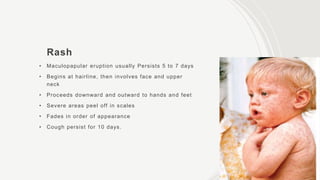
• Maculopapular eruption usually Persists 5 to 7 days
• Begins at hairline, then involves face and upper
neck
• Proceeds downward and outward to hands and feet
• Severe areas peel off in scales
• Fades in order of appearance
• Cough persist for 10 days.
Diagnosis
characteristic clinical picture
• Measles contact, Koplik spot,
• Features of the skin rash
• The relation between the eruption and fever
• Laboratory findings
• detection of measles virus RNA in nasopharyngeal
aspirates, throat swabs, or urine by (RT-PCR).
• Measle specific IgM in serum samples by enzyme
immunoassay (EIA)
Measles Complications
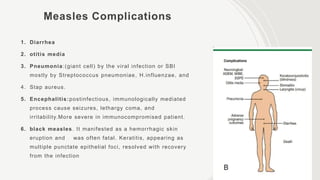
1. Diarrhea
2. otitis media
3. Pneumonia:(giant cell) by the viral infection or SBI
mostly by Streptococcus pneumoniae, H.influenzae, and
4. Stap aureus.
5. Encephalitis:postinfectious, immunologically mediated
process cause seizures, lethargy coma, and
irritability.More severe in immunocompromised patient.
6. black measles. It manifested as a hemorrhagic skin
eruption and was often fatal. Keratitis, appearing as
multiple punctate epithelial foci, resolved with recovery
from the infection
7. SSPE:chronic complication of measles with a delayed
onset that is nearly always fatal.An altered measles virus
that is harbored intracellularly in the CNS for several years.
After 7-10 years the virus apparently regains virulence and
attacks the cells.leads to an inexorable neurodegenerative
process.
8. Death
Treatment
There is no specific treatment for measles and most people
recover within 2–3 weeks.
However particularly in malnourished children and people
with reduced immunity; measles can cause
serious complications, including blindness, encephalitis,
severe diarrhoea, ear infection and
pneumonia.
Measles can be prevented by immunization.
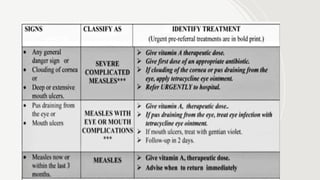
Uncomplicated Cases:
Give Vitamin A and advise to treat the child at home if no
complications develop (control fever,
treat mouth ulcers, conjunctivitis,provide nutritional feeding.
COMPLICATED CASES:
1. Treat dehydration with ORS.
2. Antibiotics should be prescribed to treat eye and ear
infections, and pneumonia
3. 2 doses of vit-A, given 24h apart.Vit-A dec the
mortality by 50%.
• <6months: 50,0001U
• 6 to 11 months: 100,000 IU
• >12 months: 200,0001U
• Third dose is given at 14 day.
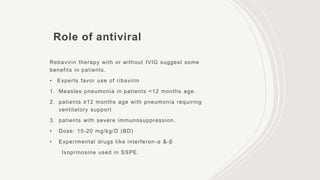
Role of antiviral
Rebavirin therapy with or without IVIG suggest some
benefits in patients.
• Experts favor use of ribavirin
1. Measles pneumonia in patients <12 months age.
2. patients ≥12 months age with pneumonia requiring
ventilatory support
3. patients with severe immunosuppression.
• Dose: 15-20 mg/kg/D (BD)
• Experimental drugs like interferon-α &-β
Isoprinosine used in SSPE.
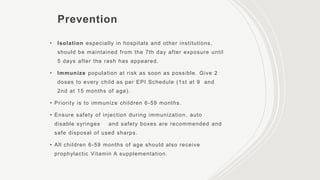
Prevention
• Isolation especially in hospitals and other institutions,
should be maintained from the 7th day after exposure until
5 days after the rash has appeared.
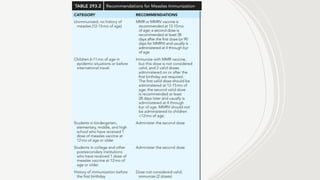
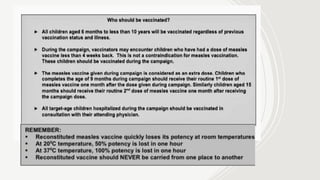
• Immunize population at risk as soon as possible. Give 2
doses to every child as per EPI Schedule (1st at 9 and
2nd at 15 months of age).
• Priority is to immunize children 6-59 months.
• Ensure safety of injection during immunization, auto
disable syringes and safety boxes are recommended and
safe disposal of used sharps.
• All children 6-59 months of age should also receive
prophylactic Vitamin A supplementation.
Postexposure Prophylaxis
• Infections in exposed to measles may be protected from
infection either by vaccine or with Ig.
Vaccine effective in case of < 72h after exposure.
• Ig may be given upto 6 days after exposure.
• IVIG recommend in severely immunocompromised children
and pregnant woman without evidence of measles
immunity at 400 mg/kg (in those who can’t be vaccinated)
CONTRAINDICATIONS
OF VACCINATION
• Severe allergic reaction to vaccine component.
• Severe immunocompromise or severe systemic illness
• Systemic high-dose corticosteroid therapy for 14
days or more.
• HIV infection only in severe immunodeficiency, leukemia,
lymphomas or on immusupressive therapy
• Family history of congenital or heredity immunodeficienc
in first-degree relatives
• Pregnancy
measles pathogenesis and prevention.pptx

measles pathogenesis and prevention.pptx

  • 1.
  • 2.
    OUTLINE • DEFINITION • ETIOLOGY •Epidemiology • PATHOGENESIS • CLINICAL MANIFESTATION • COMPLICATIONS • DIAGNOSIS • TREATMENT • Prevention
  • 3.
    DEFINITION Suspected case: Any personwith fever, and maculopapular (non-vesicular) rash. OR Any person in whom a HCW suspects measles. All suspected cases should be identified and reported by the healthcare providers. Laboratory Confirmed case: suspected case of measles that has been confirmed positive by testing in a proficient laboratory, and vaccine-associated illness has been ruled out.
  • 4.
    ETIOLOGY 1. Para myxovirus •One antigenic type • Rapidly inactivated by heat, • sunlight, acidic pH, ether and trypsin.
  • 5.
    EPIDEMIOLOGY • Reservoir Human • Transmission Person-to-personvia large respiratory droplets Airborne in closed areas for up to 2 hours • Temporal pattern Primarily late winter and spring • Communicability 4 days before through 4 days after rash onset
  • 6.
    PATHOGENESIS The primary siteof infection is alveolar macrophages or dendritic cells.2 to 3 days after replication in the lung, measles virus spreads to regional lymphoid tissues and cause systemic infection. Further viral replication in regional and distal reticuloendothelial sites, a second viremia occurs 5 to 7 days after initial infection. During this phase, infected lymphocytes and dendritic cells migrate into the subepithelial cell layer and transmit measles to epithelial cells from there the virus into the respiratory tract.
  • 7.
    CLINICAL MANIFESTATIONS Incubation period(8 to 12 days) from Exposure to appearance of rash Prodrome lasts (2 to 4 days) • Stepwise increase in fever to 103°F–105°F • Cough, coryza, and conjunctivitis • Koplik spots (on mucous membranes) typically 1 to 4 days before rash
  • 8.
    Rash • Maculopapular eruptionusually Persists 5 to 7 days • Begins at hairline, then involves face and upper neck • Proceeds downward and outward to hands and feet • Severe areas peel off in scales • Fades in order of appearance • Cough persist for 10 days.
  • 9.
    Diagnosis characteristic clinical picture •Measles contact, Koplik spot, • Features of the skin rash • The relation between the eruption and fever • Laboratory findings • detection of measles virus RNA in nasopharyngeal aspirates, throat swabs, or urine by (RT-PCR). • Measle specific IgM in serum samples by enzyme immunoassay (EIA)
  • 10.
    Measles Complications 1. Diarrhea 2.otitis media 3. Pneumonia:(giant cell) by the viral infection or SBI mostly by Streptococcus pneumoniae, H.influenzae, and 4. Stap aureus. 5. Encephalitis:postinfectious, immunologically mediated process cause seizures, lethargy coma, and irritability.More severe in immunocompromised patient. 6. black measles. It manifested as a hemorrhagic skin eruption and was often fatal. Keratitis, appearing as multiple punctate epithelial foci, resolved with recovery from the infection
  • 11.
    7. SSPE:chronic complicationof measles with a delayed onset that is nearly always fatal.An altered measles virus that is harbored intracellularly in the CNS for several years. After 7-10 years the virus apparently regains virulence and attacks the cells.leads to an inexorable neurodegenerative process. 8. Death
  • 12.
    Treatment There is nospecific treatment for measles and most people recover within 2–3 weeks. However particularly in malnourished children and people with reduced immunity; measles can cause serious complications, including blindness, encephalitis, severe diarrhoea, ear infection and pneumonia. Measles can be prevented by immunization.
  • 13.
    Uncomplicated Cases: Give VitaminA and advise to treat the child at home if no complications develop (control fever, treat mouth ulcers, conjunctivitis,provide nutritional feeding. COMPLICATED CASES: 1. Treat dehydration with ORS. 2. Antibiotics should be prescribed to treat eye and ear infections, and pneumonia 3. 2 doses of vit-A, given 24h apart.Vit-A dec the mortality by 50%. • <6months: 50,0001U • 6 to 11 months: 100,000 IU • >12 months: 200,0001U • Third dose is given at 14 day.
  • 14.
    Role of antiviral Rebavirintherapy with or without IVIG suggest some benefits in patients. • Experts favor use of ribavirin 1. Measles pneumonia in patients <12 months age. 2. patients ≥12 months age with pneumonia requiring ventilatory support 3. patients with severe immunosuppression. • Dose: 15-20 mg/kg/D (BD) • Experimental drugs like interferon-α &-β Isoprinosine used in SSPE.
  • 16.
    Prevention • Isolation especiallyin hospitals and other institutions, should be maintained from the 7th day after exposure until 5 days after the rash has appeared. • Immunize population at risk as soon as possible. Give 2 doses to every child as per EPI Schedule (1st at 9 and 2nd at 15 months of age). • Priority is to immunize children 6-59 months. • Ensure safety of injection during immunization, auto disable syringes and safety boxes are recommended and safe disposal of used sharps. • All children 6-59 months of age should also receive prophylactic Vitamin A supplementation.
  • 18.
    Postexposure Prophylaxis • Infectionsin exposed to measles may be protected from infection either by vaccine or with Ig. Vaccine effective in case of < 72h after exposure. • Ig may be given upto 6 days after exposure. • IVIG recommend in severely immunocompromised children and pregnant woman without evidence of measles immunity at 400 mg/kg (in those who can’t be vaccinated)
  • 20.
    CONTRAINDICATIONS OF VACCINATION • Severeallergic reaction to vaccine component. • Severe immunocompromise or severe systemic illness • Systemic high-dose corticosteroid therapy for 14 days or more. • HIV infection only in severe immunodeficiency, leukemia, lymphomas or on immusupressive therapy • Family history of congenital or heredity immunodeficienc in first-degree relatives • Pregnancy