Reference No.: OMSC-Form-COL-13 Effectivity Date: November 20, 2018 RevisionNo.01
Page 1 of 5
Republic of the Philippines
OCCIDENTAL MINDORO STATE COLLEGE
San Jose, Occidental Mindoro 5100
Website: www.omsc.edu.ph E-Mail address: omsc_9747@yahoo.com
Telefax No.: (043) 457-0259
GraduateSchool
Labangan Campus
MASTER OF ARTS IN EDUCATION
OBE COURSE SYLLABUS
OMSC VISION
Occidental Mindoro State College is envisioned to be an agent of change for the development of the total person responsive to the challenges of globalization.
OMSC MISSION
To train and develop a new breed of highly competitive, innovative, resourceful and values-oriented graduates through quality instruction, relevant research,
community-based extension, and sustainable production.
GRADUATE SCHOOL GOAL
Graduate education is at the apex of educational system. In the field of education, graduate studies is one of more effective means of improving the capacities of
education professionals who aim to contribute to the continued improvement of teaching and learning in the classroom, delivery of student services and management
of educational programs. Graduate education is also one of the most effective means of developing capacities related to doing research that will improve educational
theory and practice in different aspects of education process. (CMO No. 53, s. 2007).
COURSE TITLE : Statistics in Education
COURSE DESCRIPTION :
This is a three-unit course that shall provide the students with the knowledge on the fundamental areas of Statistics such as measures of Central Tendency, Means,
Variability, Correlation and Simple Prediction as applied to researches in Education. Important statistical tools and analyses to be learned are: hypothesis testing
such as correlated and uncorrelated t–test, z – test, Analysis of Variance, chi – square, among others. Interpretation of findings is an important knowledge to be
achieved in this course.
COURSE CODE : ME101
CREDIT UNITS : 3
PREREQUISITE/S : None
Reference No.: OMSC-Form-COL-13 Effectivity Date: November 20, 2018 RevisionNo.01
Page 2 of 5
PROGRAM GOAL:
An individual who completes a master’s degree in education is able to demonstrate:
 in-depth understanding of a complex and coherent body of knowledge and skills in an area of study in education, which may be applied in many types of
schools or other educational environments
 a higher order level of skill in the analysis, critical assessment, and application and communication of knowledge in the field
 an ability to apply knowledge and skills in the field to new situations in more creative and flexible ways, and to solve complex problems in the field in ways
that involve rigorous thinking and independent work.
PROGRAM OUTCOMES:
An individual who completes a master’s degree in education is able to demonstrate:
 in-depth understanding of a complex and coherent body of knowledge and skills in an area of study in education, which may be applied in many types of
schools or other educational environments
 a higher order level of skill in the analysis, critical assessment, and application and communication of knowledge in the field
 an ability to apply knowledge and skills in the field to new situations in more creative and flexible ways, and to solve complex problems in the field in ways
that involve rigorous thinking and independent work.
Course Outline
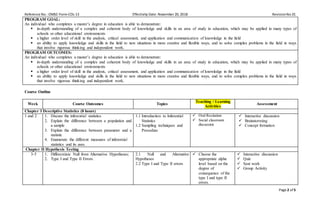
Week Course Outcomes Topics
Teaching / Learning
Activities
Assessment
Chapter I Descriptive Statistics (8 hours)
1 and 2 1. Discuss the inferential statistics
2. Explain the difference between a population and
a sample
3. Explain the difference between parameter and a
statistic
4. Enumerate the different measures of inferential
statistics and its uses.
1.1 Introduction to Inferential
Statistics
1.2 Sampling techniques and
Procedure
 Oral Recitation
 Social classroom
discussion
 Interactive discussion
 Brainstorming
 Concept formation
Chapter II Hypothesis Testing
3-5 1. Differentiate Null from Alternative Hypotheses;
2. Type I and Type II Errors.
2.1 Null and Alternative
Hypotheses
2.2 Type I and Type II errors
 Choose the
appropriate alpha
level based on the
degree of
consequence of the
type I and type II
errors.
 Interactive discussion
 Quiz
 Seat work
 Group Activity
Reference No.: OMSC-Form-COL-13 Effectivity Date: November 20, 2018 RevisionNo.01
Page 3 of 5
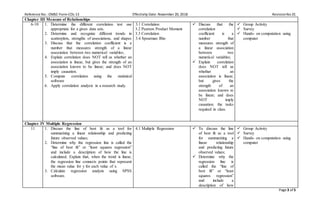
Chapter III Measure of Relationships
6-10 1. Determine the different correlation test use
appropriate for a given data sets.
2. Determine and recognize different trends in
scatterplots, strengths of associations, and shapes
3. Discuss that the correlation coefficient is a
number that measures strength of a linear
association between two numerical variables;
4. Explain correlation does NOT tell us whether an
association is linear, but gives the strength of an
association known to be linear; and does NOT
imply causation.
5. Compute correlation using the statistical
software
6. Apply correlation analysis in a research study.
3.1 Correlation
3.2 Pearson Product Moment
3.3 Correlation
3.4 Spearman Rho
 Discuss that the
correlation
coefficient is a
number that
measures strength of
a linear association
between two
numerical variables;
 Explain correlation
does NOT tell us
whether an
association is linear,
but gives the
strength of an
association known to
be linear; and does
NOT imply
causation. the tasks
required in class.
 Group Activity
 Survey
 Hands- on computation using
computer
Chapter IV Multiple Regression
11 1. Discuss the line of best fit as a tool for
summarizing a linear relationship and predicting
future observed values;
2. Determine why the regression line is called the
“line of best fit” or “least squares regression”
and include a description of how the line is
calculated; Explain that, when the trend is linear,
the regression line connects points that represent
the mean value for y for each value of x.
3. Calculate regression analysis using SPSS
software.
4.1 Multiple Regression  To discuss the line
of best fit as a tool
for summarizing a
linear relationship
and predicting future
observed values;
 Determine why the
regression line is
called the “line of
best fit” or “least
squares regression”
and include a
description of how
 Group Activity
 Survey
 Hands- on computation using
computer
Reference No.: OMSC-Form-COL-13 Effectivity Date: November 20, 2018 RevisionNo.01
Page 4 of 5
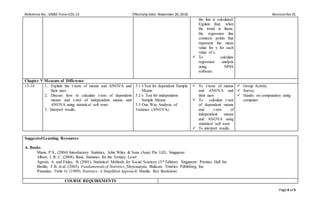
the line is calculated;
Explain that, when
the trend is linear,
the regression line
connects points that
represent the mean
value for y for each
value of x.
 To calculate
regression analysis
using SPSS
software.
Chapter V Measure of Difference
13-14 1. Explain the t-tests of means and ANOVA and
their uses
2. Discuss how to calculate t-test of dependent
means and t-test of independent means and
ANOVA using statistical soft ware
3. Interpret results.
5.1 t-Test for dependent Sample
Means
5.2 t- Test for independent
Sample Means
5.3 One Way Analysis of
Variance (ANOVA)
 To t-tests of means
and ANOVA and
their uses
 To calculate t-test
of dependent means
and t-test of
independent means
and ANOVA using
statistical soft ware
 To interpret results.
 Group Activity
 Survey
 Hands- on computation using
computer
SuggestedLearning Resources
A. Books
Mann, P.S., (2004) Introductory Statistics, John Wiley & Sons (Asia) Pte. LtD., Singapore
Albert, J. R. C. (2008). Basic Statistics for the Tertiary Level
Agresti, A. and Finlay, B. (2001). Statistical Methods for Social Sciences (3rd Edition). Singapore: Prentice Hall Int.
Basilio, F.B. et.al. (2003). Fundamentals of Statistics. Meycauayan, Bulacan: Trinities Publishing Inc.
Punsalan, Twila G. (1989). Statistics: A Simplified Approach. Manila: Rex Bookstore
COURSE REQUIREMENTS
Reference No.: OMSC-Form-COL-13 Effectivity Date: November 20, 2018 RevisionNo.01
Page 5 of 5
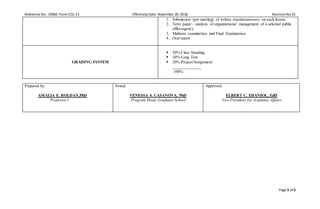
1. Submission (per meeting) of written reaction/answers on each lesson.
2. Term paper – analysis of organizational management of a selected public
office/agency
3. Midterm examination and Final Examination
4. Oral report
GRADING SYSTEM
 50% Class Standing
 30% Long Test
 20% Project/Assignment
______________
100%
Prepared by:
AMALIA E. ROLDAN,PhD
Professor I
Noted:
VENESSA S. CASANOVA, PhD
Program Head, Graduate School
Approved:
ELBERT C. EDANIOL, EdD
Vice President for Academic Affairs

Me101

  • 1.
    Reference No.: OMSC-Form-COL-13Effectivity Date: November 20, 2018 RevisionNo.01 Page 1 of 5 Republic of the Philippines OCCIDENTAL MINDORO STATE COLLEGE San Jose, Occidental Mindoro 5100 Website: www.omsc.edu.ph E-Mail address: omsc_9747@yahoo.com Telefax No.: (043) 457-0259 GraduateSchool Labangan Campus MASTER OF ARTS IN EDUCATION OBE COURSE SYLLABUS OMSC VISION Occidental Mindoro State College is envisioned to be an agent of change for the development of the total person responsive to the challenges of globalization. OMSC MISSION To train and develop a new breed of highly competitive, innovative, resourceful and values-oriented graduates through quality instruction, relevant research, community-based extension, and sustainable production. GRADUATE SCHOOL GOAL Graduate education is at the apex of educational system. In the field of education, graduate studies is one of more effective means of improving the capacities of education professionals who aim to contribute to the continued improvement of teaching and learning in the classroom, delivery of student services and management of educational programs. Graduate education is also one of the most effective means of developing capacities related to doing research that will improve educational theory and practice in different aspects of education process. (CMO No. 53, s. 2007). COURSE TITLE : Statistics in Education COURSE DESCRIPTION : This is a three-unit course that shall provide the students with the knowledge on the fundamental areas of Statistics such as measures of Central Tendency, Means, Variability, Correlation and Simple Prediction as applied to researches in Education. Important statistical tools and analyses to be learned are: hypothesis testing such as correlated and uncorrelated t–test, z – test, Analysis of Variance, chi – square, among others. Interpretation of findings is an important knowledge to be achieved in this course. COURSE CODE : ME101 CREDIT UNITS : 3 PREREQUISITE/S : None
  • 2.
    Reference No.: OMSC-Form-COL-13Effectivity Date: November 20, 2018 RevisionNo.01 Page 2 of 5 PROGRAM GOAL: An individual who completes a master’s degree in education is able to demonstrate:  in-depth understanding of a complex and coherent body of knowledge and skills in an area of study in education, which may be applied in many types of schools or other educational environments  a higher order level of skill in the analysis, critical assessment, and application and communication of knowledge in the field  an ability to apply knowledge and skills in the field to new situations in more creative and flexible ways, and to solve complex problems in the field in ways that involve rigorous thinking and independent work. PROGRAM OUTCOMES: An individual who completes a master’s degree in education is able to demonstrate:  in-depth understanding of a complex and coherent body of knowledge and skills in an area of study in education, which may be applied in many types of schools or other educational environments  a higher order level of skill in the analysis, critical assessment, and application and communication of knowledge in the field  an ability to apply knowledge and skills in the field to new situations in more creative and flexible ways, and to solve complex problems in the field in ways that involve rigorous thinking and independent work. Course Outline Week Course Outcomes Topics Teaching / Learning Activities Assessment Chapter I Descriptive Statistics (8 hours) 1 and 2 1. Discuss the inferential statistics 2. Explain the difference between a population and a sample 3. Explain the difference between parameter and a statistic 4. Enumerate the different measures of inferential statistics and its uses. 1.1 Introduction to Inferential Statistics 1.2 Sampling techniques and Procedure  Oral Recitation  Social classroom discussion  Interactive discussion  Brainstorming  Concept formation Chapter II Hypothesis Testing 3-5 1. Differentiate Null from Alternative Hypotheses; 2. Type I and Type II Errors. 2.1 Null and Alternative Hypotheses 2.2 Type I and Type II errors  Choose the appropriate alpha level based on the degree of consequence of the type I and type II errors.  Interactive discussion  Quiz  Seat work  Group Activity
  • 3.
    Reference No.: OMSC-Form-COL-13Effectivity Date: November 20, 2018 RevisionNo.01 Page 3 of 5 Chapter III Measure of Relationships 6-10 1. Determine the different correlation test use appropriate for a given data sets. 2. Determine and recognize different trends in scatterplots, strengths of associations, and shapes 3. Discuss that the correlation coefficient is a number that measures strength of a linear association between two numerical variables; 4. Explain correlation does NOT tell us whether an association is linear, but gives the strength of an association known to be linear; and does NOT imply causation. 5. Compute correlation using the statistical software 6. Apply correlation analysis in a research study. 3.1 Correlation 3.2 Pearson Product Moment 3.3 Correlation 3.4 Spearman Rho  Discuss that the correlation coefficient is a number that measures strength of a linear association between two numerical variables;  Explain correlation does NOT tell us whether an association is linear, but gives the strength of an association known to be linear; and does NOT imply causation. the tasks required in class.  Group Activity  Survey  Hands- on computation using computer Chapter IV Multiple Regression 11 1. Discuss the line of best fit as a tool for summarizing a linear relationship and predicting future observed values; 2. Determine why the regression line is called the “line of best fit” or “least squares regression” and include a description of how the line is calculated; Explain that, when the trend is linear, the regression line connects points that represent the mean value for y for each value of x. 3. Calculate regression analysis using SPSS software. 4.1 Multiple Regression  To discuss the line of best fit as a tool for summarizing a linear relationship and predicting future observed values;  Determine why the regression line is called the “line of best fit” or “least squares regression” and include a description of how  Group Activity  Survey  Hands- on computation using computer
  • 4.
    Reference No.: OMSC-Form-COL-13Effectivity Date: November 20, 2018 RevisionNo.01 Page 4 of 5 the line is calculated; Explain that, when the trend is linear, the regression line connects points that represent the mean value for y for each value of x.  To calculate regression analysis using SPSS software. Chapter V Measure of Difference 13-14 1. Explain the t-tests of means and ANOVA and their uses 2. Discuss how to calculate t-test of dependent means and t-test of independent means and ANOVA using statistical soft ware 3. Interpret results. 5.1 t-Test for dependent Sample Means 5.2 t- Test for independent Sample Means 5.3 One Way Analysis of Variance (ANOVA)  To t-tests of means and ANOVA and their uses  To calculate t-test of dependent means and t-test of independent means and ANOVA using statistical soft ware  To interpret results.  Group Activity  Survey  Hands- on computation using computer SuggestedLearning Resources A. Books Mann, P.S., (2004) Introductory Statistics, John Wiley & Sons (Asia) Pte. LtD., Singapore Albert, J. R. C. (2008). Basic Statistics for the Tertiary Level Agresti, A. and Finlay, B. (2001). Statistical Methods for Social Sciences (3rd Edition). Singapore: Prentice Hall Int. Basilio, F.B. et.al. (2003). Fundamentals of Statistics. Meycauayan, Bulacan: Trinities Publishing Inc. Punsalan, Twila G. (1989). Statistics: A Simplified Approach. Manila: Rex Bookstore COURSE REQUIREMENTS
  • 5.
    Reference No.: OMSC-Form-COL-13Effectivity Date: November 20, 2018 RevisionNo.01 Page 5 of 5 1. Submission (per meeting) of written reaction/answers on each lesson. 2. Term paper – analysis of organizational management of a selected public office/agency 3. Midterm examination and Final Examination 4. Oral report GRADING SYSTEM  50% Class Standing  30% Long Test  20% Project/Assignment ______________ 100% Prepared by: AMALIA E. ROLDAN,PhD Professor I Noted: VENESSA S. CASANOVA, PhD Program Head, Graduate School Approved: ELBERT C. EDANIOL, EdD Vice President for Academic Affairs