Course Syllabus 1st
Semester A.Y. 2021 - 2022
Course Title Statistics as Applied to Education
Course
Credit/Units
3 units
Hours/Week 3 Unit Lecture, 3 Hours a Week
Pre-requisite(s) None
Lecturer’s
Information
Imelu G. Mordeno, PhD, RPsy, RPm
Course
Description
The course aims to familiarize the students with the statistical methods on selected multivariate parametric tests and skills on the application of these techniques to
research in psychology. This course introduces multiple regression and related methods and applies their principles to the analysis of data from correlational and
experimental studies in the behavioral sciences. This course is designed to provide experience in correlational theory and multiple regression for prediction and
explanation, including applied uses of the methods. Focus is on classical regression and univariate ANOVA methods as an introduction.
Learning Outcome Demonstrate appropriate statistical procedures through actual analyses and interpretation of data particularly in the field of human behavior.
Student
Outcomes
(SO)
Level of
Emphasis
Core Values Competencies
SO1 Introductory
Excellence, Commitment,
Integrity
Understand basic statistical concepts, including sampling and measurement that are applicable in practical
situations.
SO2 Introductory
Excellence, Integrity,
Accountability
Utilize and apply an appropriate statistical analysis or modeling methods to solve problems arising in
different research fields, most especially on psychological research.
SO3 Introductory
Excellence, Integrity,
Commitment, Teamwork
Engage in critical thinking and interpretation of a wide range of information from a variety of disciplines
including quantitative analysis.
SO4 Introductory
Excellence, Accountability,
Commitment, Integrity
Generate a rational, consistent and well supported argument and output that shows appropriate use of
critical thinking, analysis and decision making.
MINDANAO STATE UNIVERSITY - ILIGAN INSTITUTE OF TECHNOLOGY
COLLEGE OF EDUCATION
(CHED Center of Excellence for Teacher Education)
Department of Professional Education
Course Scope and Outline
Learning Outcomes Unit Content/Topic
Strategies and
Instructional
Materials/Devices Used
Assessment
Activities/Tasks
(Output)
Evaluation
Measures &
Tools
Evidence of
Attainment
(Outcomes)
Time Allotment
 Identify the different methods
applied in research.
 Understand the basic statistical
terms used in analyses and
interpretation.
 Identify the ethical concepts,
principles, tools and methods that
are important in making decisions
in research.
I. Research Methods
Background
a. Introduction to Research
b. The Scientific Method
c. The Research Process
d. Operational Definitions
e. Selecting Research
Participants
f. Experimental Strategies
g. Quasi-Experiment,
Correlation, Descriptive
Methods
h. Research Ethics
Lecture/Discussion
Group Discussion
Oral Participation
Quiz Bowl
Oral Examination
Written Examination
Paper-Pencil
Test
Rubric
SPSS
100% participation
and 90% rating in the
chapter test
90% rating in the
performance on SPSS
100% participation
and 90% overall rating
in the rubric
90% rating in the
performance on SPSS
8 hours
 Identify few basic ideas in SPSS
such as data entry and data
cleaning.
 Become familiar with the essential
steps in conducting a statistical
analysis.
II. Introduction to SPSS
Statistics
a. A brief introduction to
SPSS
b. SPSS Basics: Data entry
and Analysis
SPSS Demonstration
Basic SPSS Hands-on
Activity
Written Examination
SPSS Output
Paper-Pencil
Test
SPSS
100% participation
and 90% rating in the
chapter test
90% rating in the
performance on SPSS
8 hours
 Distinguish descriptive statistics
from inferential statistics
 Identify the different types of
variables/data used in different
statistical problems
 Learn to organize and illustrate
frequencies through graphs and
tables.
 Make frequency tables and graphs
using SPSS.
III. Psychological Statistics
Introduction
a. Defining Descriptive and
Inferential Statistics
b. Identifying different
types of data/variables
c. Frequency Distributions:
Graphs and Shapes
d. Using SPSS
Lecture/Discussion
Group Discussion
Board work
Quiz Bowl
SPSS Demonstration
SPSS Hands-on Activity
Oral Participation
Exercise/Practice
Problems
Written Examination
SPSS Output
Paper-Pencil
Test
Rubric
SPSS
100% participation
and 90% rating in the
chapter test
90% rating in the
performance on SPSS
100% participation
and 90% overall rating
in the rubric
90% rating in the
performance on SPSS
8 hours
 Learn the basic concept of central
tendency and variability as applied
to practical and statistical
problems.
 Learn to calculate the different
measures of central tendency and
variability given particular data
sets.
 Calculate the measures of central
tendency and variability using
SPSS.
IV.Central Tendency and
Variability
a. Measures of Central
Tendency
b. Variability
c. Using SPSS
Lecture/Discussion
Group Discussion
Board work
SPSS Demonstration
SPSS Hands-on Activity
Oral Participation
Exercise/Practice
Problems
Written Examination
SPSS Output
Paper-Pencil
Test
Rubric
SPSS
100% participation
and 90% rating in the
chapter test
90% rating in the
performance on SPSS
100% participation
and 90% overall rating
in the rubric
90% rating in the
performance on SPSS
8 hours
 Recognize the concept of z scores.
 Describe the characteristics of a
normal curve and explain the
different features of a z
distribution.
 Distinguish “Sample” from
“Population”.
 Understand the logic behind the
central limit theorem.
 Identify the concept of Standard
Error and Probability
V. Key Ingredients for
Inferential Statistics
a. Z Scores
b. The Normal Curve
c. Sample and Population
d. Central Limit Theorem
e. The Standard Error
f. Probability
Lecture/Discussion
Group Discussion
Board work
Oral Participation
Exercise/Practice
Problems
Paper-Pencil
Test
Rubric
100% participation
and 90% rating in the
chapter test
100% participation
and 90% overall rating
in the rubric
8 hours
 Understand the basic concept of
hypothesis testing as applied to
different research situations.
 Differentiate null hypotheses from
alternative hypotheses.
 Identify necessary cut-off scores
 Learn to test hypotheses using
necessary steps in computation.
 Know when to decide for a one- or
two-tailed probability evaluation.
VI. Introduction to Hypothesis
Testing
a. The Logic in Hypothesis
Testing
b. Null Hypotheses and
Alternative/Research
Hypotheses
c. One-Tailed and Two-
Tailed Hypothesis Tests
d. Steps in Hypothesis
Testing
Lecture/Discussion
Group Discussion
Board work
Quiz Bowl
Oral Participation
Exercise/Practice
Problems
Written Examination
Paper-Pencil
Test
Rubric
SPSS
100% participation
and 90% rating in the
chapter test
100% participation
and 90% overall rating
in the rubric
8 hours
 Consider hypothesis testing with a
sample of more than one
individual.
 Understand the concept of z
scores and its importance in
statistical analysis.
 Figuring out confidence intervals
and its implication in hypothesis
testing.
VII. Hypothesis Tests with
Means of Samples
a. The Distribution of
Means
b. Standard scores (z
scores)
c. The z Test/ Testing The
Difference Between Two
Means
d. The 95% and 99%
Confidence Intervals
Lecture/Discussion
Group Discussion
Board work
Oral Participation
Exercise/Practice
Problems
Written Examination
Paper-Pencil
Test
Rubric
SPSS
100% participation
and 90% rating in the
chapter test
100% participation
and 90% overall rating
in the rubric
8 hours
 Learning and identifying three
interrelated issues that are
involved in understanding
statistical significance (decision
errors, effect size, and statistical
power).
VIII.Making Sense of Statistical
Significance
a. Decision Errors
b. Type I Error
c. Type II Error
d. Effect Size
e. Statistical Power
Lecture/Discussion
Group Discussion
Quiz Bowl
Oral Participation
Exercise/Practice
Problems
Written Examination
Paper-Pencil
Test
Rubric
SPSS
100% participation
and 90% rating in the
chapter test
100% participation
and 90% overall rating
in the rubric
8 hours
 Learning how to test hypotheses in
comparing two or more group of
scores, without any direct
information about populations.
 Using One-Sample t-test and
Paired-Samples t-test on SPSS.
IX. Introduction to t Tests
a. Hypothesis Testing with
a t Test for Single
Sample
b. Degrees of Freedom
c. The t Distribution
d. The t Score
e. Hypothesis Testing with
a t Test for Dependent
Means
f. Using SPSS
Lecture/Discussion
Group Discussion
Board work
SPSS Demonstration
SPSS Hands-on Activity
Oral Participation
Exercise Problems
Written Examination
SPSS Output
Paper-Pencil
Test
Rubric
SPSS
100% participation
and 90% rating in the
chapter test
90% rating in the
performance on SPSS
100% participation
and 90% overall rating
in the rubric
90% rating in the
performance on SPSS
8 hours
 Apply hypothesis testing with
a sample having two sets of
scores one from each of two
X. The t Test for Independent
Means
Lecture/Discussion Oral Participation Paper-Pencil
Test
100% participation
and 90% rating in the
chapter test
8 hours
entirely separate groups of
people.
 Identify the differences among
the three kinds of t tests
 Use SPSS in performing t test
for independent means.
a. Hypothesis Testing with
a t Test for Independent
Means
b. The Distribution of
Differences Between
Means
c. Estimating the
Population Variances
d. The Variance and
Standard Deviation of
the Distribution of
Differences Between
Means
e. Review and Comparisons
of the Three Kinds of t
Tests
f. Using SPSS
Group Discussion
Board Work
SPSS Demonstration
SPSS Hands-on Activity
Exercise Problems
Written Examination
SPSS Output
Rubric
SPSS
90% rating in the
performance on SPSS
100% participation
and 90% overall rating
in the rubric
90% rating in the
performance on SPSS
 Understand the logic behind the
Analysis of Variance and F test
 Identify the significance of within-
and between-groups estimates of
population of variance.
 Specify the difference between
planned and post hoc comparisons.
 Use SPSS in carrying out ANOVA.
XI. Introduction to the
Analysis of Variance
a. Logic of ANOVA
b. Comparing Within-
Groups and Between-
Groups Estimates of
Population Variance
c. The F Ratio
d. Assumptions
e. Planned Contrasts
f. The Bonferonni
Procedure
g. Post Hoc Comparisons
h. Using SPSS
Lecture/Discussion
Group Discussion
SPSS Demonstration
SPSS Hands-on Activity
Oral Participation
Exercise Problems
Written Examination
SPSS Output
Paper-Pencil
Test
Rubric
SPSS
100% participation
and 90% rating in the
chapter test
90% rating in the
performance on SPSS
100% participation
and 90% overall rating
in the rubric
90% rating in the
performance on SPSS
8 hours
 Examines the relationship
between two groups of scores, as
applied in practical problems.
XII. Correlation
a. Patterns of Correlation
b. Strength of the
Correlation
Lecture/Discussion
Group Discussion
Oral Participation
Exercise Problems
Paper-Pencil
Test
Rubric
100% participation
and 90% rating in the
chapter test
8 hours
 Learn how to identify the strength
of a correlation.
 Compute the correlation
coefficient.
 Identify the influence of effect size
and power on correlation.
 Compute for correlation using
SPSS.
c. The Correlation
Coefficient
d. Effect Size and Power for
the Correlation
Coefficient
e. Using SPSS
SPSS Demonstration
SPSS Hands-on Activity
Written Examination
SPSS Output
SPSS 90% rating in the
performance on SPSS
100% participation
and 90% overall rating
in the rubric
90% rating in the
performance on SPSS
 Learning to make predictions in
practical application.
 Specify the different condition(s) that
must be met to use linear regression.
 Explain the use of multiple
variables and their relationship to
prediction accuracy.
 Use SPSS in performing
regression.
XIII. Prediction
a. The Linear Prediction
Rule
b. The Regression Line
c. The Least Squared Error
Principle
d. Issues in Prediction
e. The Standardized
Regression Coefficient
and the Correlation
Coefficient
f. Multiple Regression
g. Using SPSS
Lecture/Discussion
Group Discussion
SPSS Demonstration
SPSS Hands-on Activity
Oral Participation
Exercise Problems
Written Examination
SPSS Output
Paper-Pencil
Test
Rubric
SPSS
100% participation
and 90% rating in the
chapter test
90% rating in the
performance on SPSS
100% participation
and 90% overall rating
in the rubric
90% rating in the
performance on SPSS
8 hours
 Specify the level of variable
scaling that chi-square requires
for its use.
 Understand that chi-square uses
sample frequencies and predicts
to population proportions.
XIV. Chi-Square Tests
a. The Chi-Square Statistic
and the Chi-Square Test
for Goodness of Fit
b. The Chi-Square
Distribution
c. Using SPSS
Lecture/Discussion
Group Discussion
SPSS Demonstration
SPSS Hands-on Activity
Oral Participation
Exercise Problems
Written Examination
SPSS Output
Paper-Pencil
Test
Rubric
SPSS
100% participation
and 90% rating in the
chapter test
90% rating in the
performance on SPSS
100% participation
and 90% overall rating
in the rubric
90% rating in the
performance on SPSS
8 hours
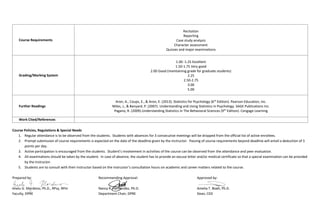
Course Requirements
Recitation
Reporting
Case study analysis
Character assessment
Quizzes and major examinations
Grading/Marking System
1.00 -1.25 Excellent
1.50-1.75 Very good
2.00 Good (maintaining grade for graduate students)
2.25
2.50-2.75
3.00
5.00
Further Readings
Aron, A., Coups, E., & Aron, E. (2013). Statistics for Psychology (6th
Edition). Pearson Education, Inc.
Miles, J., & Banyard, P. (2007). Understanding and Using Statistics in Psychology. SAGE Publications Inc.
Pagano, R. (2009).Understanding Statistics In The Behavioral Sciences (9th
Edition). Cengage Learning
Work Cited/References
Course Policies, Regulations & Special Needs
1. Regular attendance is to be observed from the students. Students with absences for 3 consecutive meetings will be dropped from the official list of active enrollees.
2. Prompt submission of course requirements is expected on the date of the deadline given by the instructor. Passing of course requirements beyond deadline will entail a deduction of 5
points per day.
3. Active participation is encouraged from the students. Student’s involvement in activities of the course can be observed from the attendance and peer evaluation.
4. All examinations should be taken by the student. In case of absence, the student has to provide an excuse letter and/or medical certificate so that a special examination can be provided
by the instructor.
5. Students are to consult with their instructor based on the instructor’s consultation hours on academic and career matters related to the course.
Prepared by: Recommending Approval: Approved by:
Imelu G. Mordeno, Ph.D., RPsy, RPm Nancy R. Hernandez, Ph.D. Amelia T. Buan, Ph.D.
Faculty, DPRE Department Chair, DPRE Dean, CED

Final-EDUC216-Statistics-A.Y.2021-2022.pdf

  • 1.
    Course Syllabus 1st SemesterA.Y. 2021 - 2022 Course Title Statistics as Applied to Education Course Credit/Units 3 units Hours/Week 3 Unit Lecture, 3 Hours a Week Pre-requisite(s) None Lecturer’s Information Imelu G. Mordeno, PhD, RPsy, RPm Course Description The course aims to familiarize the students with the statistical methods on selected multivariate parametric tests and skills on the application of these techniques to research in psychology. This course introduces multiple regression and related methods and applies their principles to the analysis of data from correlational and experimental studies in the behavioral sciences. This course is designed to provide experience in correlational theory and multiple regression for prediction and explanation, including applied uses of the methods. Focus is on classical regression and univariate ANOVA methods as an introduction. Learning Outcome Demonstrate appropriate statistical procedures through actual analyses and interpretation of data particularly in the field of human behavior. Student Outcomes (SO) Level of Emphasis Core Values Competencies SO1 Introductory Excellence, Commitment, Integrity Understand basic statistical concepts, including sampling and measurement that are applicable in practical situations. SO2 Introductory Excellence, Integrity, Accountability Utilize and apply an appropriate statistical analysis or modeling methods to solve problems arising in different research fields, most especially on psychological research. SO3 Introductory Excellence, Integrity, Commitment, Teamwork Engage in critical thinking and interpretation of a wide range of information from a variety of disciplines including quantitative analysis. SO4 Introductory Excellence, Accountability, Commitment, Integrity Generate a rational, consistent and well supported argument and output that shows appropriate use of critical thinking, analysis and decision making. MINDANAO STATE UNIVERSITY - ILIGAN INSTITUTE OF TECHNOLOGY COLLEGE OF EDUCATION (CHED Center of Excellence for Teacher Education) Department of Professional Education
  • 2.
    Course Scope andOutline Learning Outcomes Unit Content/Topic Strategies and Instructional Materials/Devices Used Assessment Activities/Tasks (Output) Evaluation Measures & Tools Evidence of Attainment (Outcomes) Time Allotment  Identify the different methods applied in research.  Understand the basic statistical terms used in analyses and interpretation.  Identify the ethical concepts, principles, tools and methods that are important in making decisions in research. I. Research Methods Background a. Introduction to Research b. The Scientific Method c. The Research Process d. Operational Definitions e. Selecting Research Participants f. Experimental Strategies g. Quasi-Experiment, Correlation, Descriptive Methods h. Research Ethics Lecture/Discussion Group Discussion Oral Participation Quiz Bowl Oral Examination Written Examination Paper-Pencil Test Rubric SPSS 100% participation and 90% rating in the chapter test 90% rating in the performance on SPSS 100% participation and 90% overall rating in the rubric 90% rating in the performance on SPSS 8 hours  Identify few basic ideas in SPSS such as data entry and data cleaning.  Become familiar with the essential steps in conducting a statistical analysis. II. Introduction to SPSS Statistics a. A brief introduction to SPSS b. SPSS Basics: Data entry and Analysis SPSS Demonstration Basic SPSS Hands-on Activity Written Examination SPSS Output Paper-Pencil Test SPSS 100% participation and 90% rating in the chapter test 90% rating in the performance on SPSS 8 hours  Distinguish descriptive statistics from inferential statistics  Identify the different types of variables/data used in different statistical problems  Learn to organize and illustrate frequencies through graphs and tables.  Make frequency tables and graphs using SPSS. III. Psychological Statistics Introduction a. Defining Descriptive and Inferential Statistics b. Identifying different types of data/variables c. Frequency Distributions: Graphs and Shapes d. Using SPSS Lecture/Discussion Group Discussion Board work Quiz Bowl SPSS Demonstration SPSS Hands-on Activity Oral Participation Exercise/Practice Problems Written Examination SPSS Output Paper-Pencil Test Rubric SPSS 100% participation and 90% rating in the chapter test 90% rating in the performance on SPSS 100% participation and 90% overall rating in the rubric 90% rating in the performance on SPSS 8 hours
  • 3.
     Learn thebasic concept of central tendency and variability as applied to practical and statistical problems.  Learn to calculate the different measures of central tendency and variability given particular data sets.  Calculate the measures of central tendency and variability using SPSS. IV.Central Tendency and Variability a. Measures of Central Tendency b. Variability c. Using SPSS Lecture/Discussion Group Discussion Board work SPSS Demonstration SPSS Hands-on Activity Oral Participation Exercise/Practice Problems Written Examination SPSS Output Paper-Pencil Test Rubric SPSS 100% participation and 90% rating in the chapter test 90% rating in the performance on SPSS 100% participation and 90% overall rating in the rubric 90% rating in the performance on SPSS 8 hours  Recognize the concept of z scores.  Describe the characteristics of a normal curve and explain the different features of a z distribution.  Distinguish “Sample” from “Population”.  Understand the logic behind the central limit theorem.  Identify the concept of Standard Error and Probability V. Key Ingredients for Inferential Statistics a. Z Scores b. The Normal Curve c. Sample and Population d. Central Limit Theorem e. The Standard Error f. Probability Lecture/Discussion Group Discussion Board work Oral Participation Exercise/Practice Problems Paper-Pencil Test Rubric 100% participation and 90% rating in the chapter test 100% participation and 90% overall rating in the rubric 8 hours  Understand the basic concept of hypothesis testing as applied to different research situations.  Differentiate null hypotheses from alternative hypotheses.  Identify necessary cut-off scores  Learn to test hypotheses using necessary steps in computation.  Know when to decide for a one- or two-tailed probability evaluation. VI. Introduction to Hypothesis Testing a. The Logic in Hypothesis Testing b. Null Hypotheses and Alternative/Research Hypotheses c. One-Tailed and Two- Tailed Hypothesis Tests d. Steps in Hypothesis Testing Lecture/Discussion Group Discussion Board work Quiz Bowl Oral Participation Exercise/Practice Problems Written Examination Paper-Pencil Test Rubric SPSS 100% participation and 90% rating in the chapter test 100% participation and 90% overall rating in the rubric 8 hours
  • 4.
     Consider hypothesistesting with a sample of more than one individual.  Understand the concept of z scores and its importance in statistical analysis.  Figuring out confidence intervals and its implication in hypothesis testing. VII. Hypothesis Tests with Means of Samples a. The Distribution of Means b. Standard scores (z scores) c. The z Test/ Testing The Difference Between Two Means d. The 95% and 99% Confidence Intervals Lecture/Discussion Group Discussion Board work Oral Participation Exercise/Practice Problems Written Examination Paper-Pencil Test Rubric SPSS 100% participation and 90% rating in the chapter test 100% participation and 90% overall rating in the rubric 8 hours  Learning and identifying three interrelated issues that are involved in understanding statistical significance (decision errors, effect size, and statistical power). VIII.Making Sense of Statistical Significance a. Decision Errors b. Type I Error c. Type II Error d. Effect Size e. Statistical Power Lecture/Discussion Group Discussion Quiz Bowl Oral Participation Exercise/Practice Problems Written Examination Paper-Pencil Test Rubric SPSS 100% participation and 90% rating in the chapter test 100% participation and 90% overall rating in the rubric 8 hours  Learning how to test hypotheses in comparing two or more group of scores, without any direct information about populations.  Using One-Sample t-test and Paired-Samples t-test on SPSS. IX. Introduction to t Tests a. Hypothesis Testing with a t Test for Single Sample b. Degrees of Freedom c. The t Distribution d. The t Score e. Hypothesis Testing with a t Test for Dependent Means f. Using SPSS Lecture/Discussion Group Discussion Board work SPSS Demonstration SPSS Hands-on Activity Oral Participation Exercise Problems Written Examination SPSS Output Paper-Pencil Test Rubric SPSS 100% participation and 90% rating in the chapter test 90% rating in the performance on SPSS 100% participation and 90% overall rating in the rubric 90% rating in the performance on SPSS 8 hours  Apply hypothesis testing with a sample having two sets of scores one from each of two X. The t Test for Independent Means Lecture/Discussion Oral Participation Paper-Pencil Test 100% participation and 90% rating in the chapter test 8 hours
  • 5.
    entirely separate groupsof people.  Identify the differences among the three kinds of t tests  Use SPSS in performing t test for independent means. a. Hypothesis Testing with a t Test for Independent Means b. The Distribution of Differences Between Means c. Estimating the Population Variances d. The Variance and Standard Deviation of the Distribution of Differences Between Means e. Review and Comparisons of the Three Kinds of t Tests f. Using SPSS Group Discussion Board Work SPSS Demonstration SPSS Hands-on Activity Exercise Problems Written Examination SPSS Output Rubric SPSS 90% rating in the performance on SPSS 100% participation and 90% overall rating in the rubric 90% rating in the performance on SPSS  Understand the logic behind the Analysis of Variance and F test  Identify the significance of within- and between-groups estimates of population of variance.  Specify the difference between planned and post hoc comparisons.  Use SPSS in carrying out ANOVA. XI. Introduction to the Analysis of Variance a. Logic of ANOVA b. Comparing Within- Groups and Between- Groups Estimates of Population Variance c. The F Ratio d. Assumptions e. Planned Contrasts f. The Bonferonni Procedure g. Post Hoc Comparisons h. Using SPSS Lecture/Discussion Group Discussion SPSS Demonstration SPSS Hands-on Activity Oral Participation Exercise Problems Written Examination SPSS Output Paper-Pencil Test Rubric SPSS 100% participation and 90% rating in the chapter test 90% rating in the performance on SPSS 100% participation and 90% overall rating in the rubric 90% rating in the performance on SPSS 8 hours  Examines the relationship between two groups of scores, as applied in practical problems. XII. Correlation a. Patterns of Correlation b. Strength of the Correlation Lecture/Discussion Group Discussion Oral Participation Exercise Problems Paper-Pencil Test Rubric 100% participation and 90% rating in the chapter test 8 hours
  • 6.
     Learn howto identify the strength of a correlation.  Compute the correlation coefficient.  Identify the influence of effect size and power on correlation.  Compute for correlation using SPSS. c. The Correlation Coefficient d. Effect Size and Power for the Correlation Coefficient e. Using SPSS SPSS Demonstration SPSS Hands-on Activity Written Examination SPSS Output SPSS 90% rating in the performance on SPSS 100% participation and 90% overall rating in the rubric 90% rating in the performance on SPSS  Learning to make predictions in practical application.  Specify the different condition(s) that must be met to use linear regression.  Explain the use of multiple variables and their relationship to prediction accuracy.  Use SPSS in performing regression. XIII. Prediction a. The Linear Prediction Rule b. The Regression Line c. The Least Squared Error Principle d. Issues in Prediction e. The Standardized Regression Coefficient and the Correlation Coefficient f. Multiple Regression g. Using SPSS Lecture/Discussion Group Discussion SPSS Demonstration SPSS Hands-on Activity Oral Participation Exercise Problems Written Examination SPSS Output Paper-Pencil Test Rubric SPSS 100% participation and 90% rating in the chapter test 90% rating in the performance on SPSS 100% participation and 90% overall rating in the rubric 90% rating in the performance on SPSS 8 hours  Specify the level of variable scaling that chi-square requires for its use.  Understand that chi-square uses sample frequencies and predicts to population proportions. XIV. Chi-Square Tests a. The Chi-Square Statistic and the Chi-Square Test for Goodness of Fit b. The Chi-Square Distribution c. Using SPSS Lecture/Discussion Group Discussion SPSS Demonstration SPSS Hands-on Activity Oral Participation Exercise Problems Written Examination SPSS Output Paper-Pencil Test Rubric SPSS 100% participation and 90% rating in the chapter test 90% rating in the performance on SPSS 100% participation and 90% overall rating in the rubric 90% rating in the performance on SPSS 8 hours
  • 7.
    Course Requirements Recitation Reporting Case studyanalysis Character assessment Quizzes and major examinations Grading/Marking System 1.00 -1.25 Excellent 1.50-1.75 Very good 2.00 Good (maintaining grade for graduate students) 2.25 2.50-2.75 3.00 5.00 Further Readings Aron, A., Coups, E., & Aron, E. (2013). Statistics for Psychology (6th Edition). Pearson Education, Inc. Miles, J., & Banyard, P. (2007). Understanding and Using Statistics in Psychology. SAGE Publications Inc. Pagano, R. (2009).Understanding Statistics In The Behavioral Sciences (9th Edition). Cengage Learning Work Cited/References Course Policies, Regulations & Special Needs 1. Regular attendance is to be observed from the students. Students with absences for 3 consecutive meetings will be dropped from the official list of active enrollees. 2. Prompt submission of course requirements is expected on the date of the deadline given by the instructor. Passing of course requirements beyond deadline will entail a deduction of 5 points per day. 3. Active participation is encouraged from the students. Student’s involvement in activities of the course can be observed from the attendance and peer evaluation. 4. All examinations should be taken by the student. In case of absence, the student has to provide an excuse letter and/or medical certificate so that a special examination can be provided by the instructor. 5. Students are to consult with their instructor based on the instructor’s consultation hours on academic and career matters related to the course. Prepared by: Recommending Approval: Approved by: Imelu G. Mordeno, Ph.D., RPsy, RPm Nancy R. Hernandez, Ph.D. Amelia T. Buan, Ph.D. Faculty, DPRE Department Chair, DPRE Dean, CED