Date : 11.01.2021
Session : 04
Topic : Statistics for
Managers
(Preface Discussion)
Time : 12.15 PM
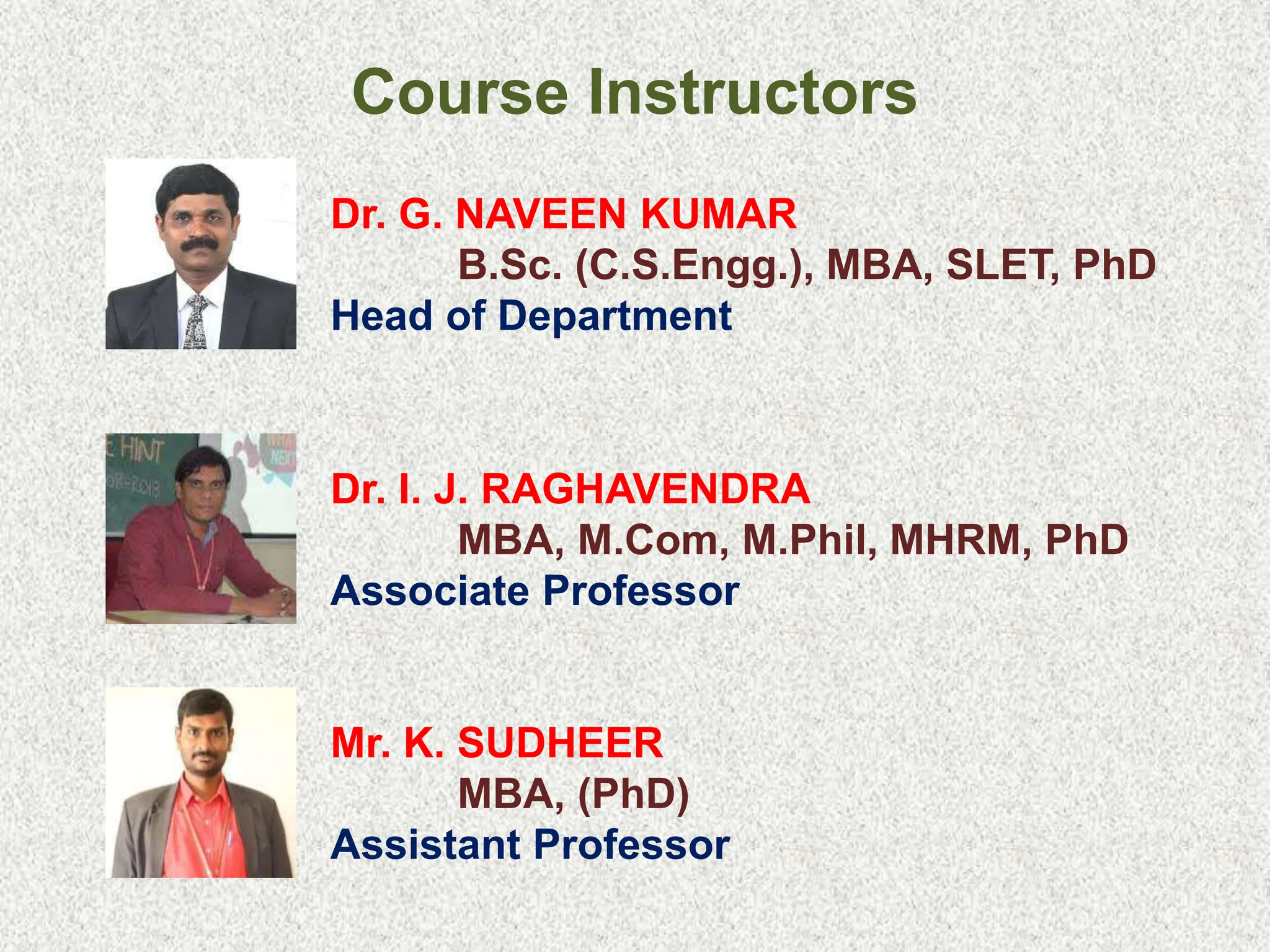
Course Instructors
Dr. G. NAVEEN KUMAR
B.Sc. (C.S.Engg.), MBA, SLET, PhD
Head of Department
Dr. I. J. RAGHAVENDRA
MBA, M.Com, M.Phil, MHRM, PhD
Associate Professor
Mr. K. SUDHEER
MBA, (PhD)
Assistant Professor
COURSE AIM/S
• The course aims to encourage thinking
statistically.
• It will encourage you to develop your abilities
to understand and use data.
• It is designed to equip managers with the
skills to make effective use of data in the
workplace, to develop expertise in a standard
set of statistical and graphical techniques
that will be useful in analyzing data, and to
learn to apply these techniques in a number
of areas of management.
COURSE OUTCOME/S
• Appreciate that the collection and statistical
analysis of data improves business
decisions and reduces the risk of
implementing solutions that waste resources
and effort.
• Select and deploy the correct statistical
method for a given data analysis
requirement.
• Achieve a practical level of competence in
building statistical models that suit business
applications.
• Recognize, develop and distinguish between
UNIT-I
INTRODUCTION TO STATISTICS
Overview:
Origin and Development - Managerial
Applications of Statistics - Statistics and the
Branches of the Study - Statistics & Computers
- Limitations of Statistics.
Objective: To know the origin and development
of statistics and their linkage to management
applications.
Outcome: To understand the importance and
usage of statistics.
Overview: Statistics, quite simply, is about
learning from sample data. You face a group of
individuals - perhaps people, but maybe cans
of tomatoes, or automobiles, or fish in a lake,
or even something as nebulous as calendar
weeks. Thus statistics is a set of concepts,
rules, and procedures that help us to organize
UNIT-II
MEASURES OF CENTRAL
TENDENCY
Measures of Central Tendency: Mean - Median
– Mode.
Measures of Dispersion: Range - Quartile
Deviation - Mean Deviation - Standard
Deviation and Co-efficient of Variation.
Skewness: Karl Pearson Co-efficient - Bowley’s
Co-efficient - Kelley's Co-efficient. (Theory and
Objective: To know the concepts and their
calculation methods.
Outcomes: To learn the basic calculations and
usage of statistical methods in current
scenario.
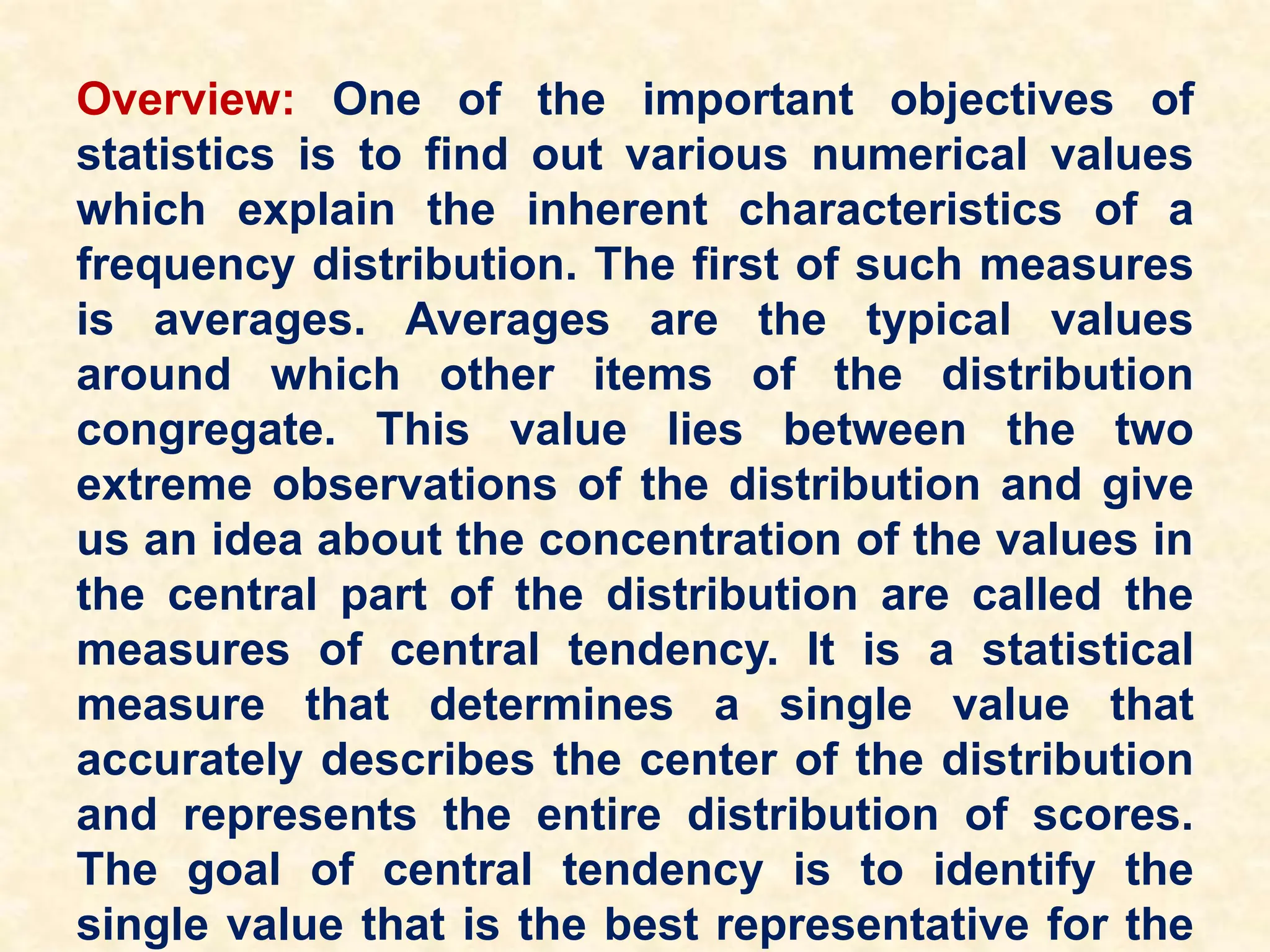
Overview: One of the important objectives of
statistics is to find out various numerical values
which explain the inherent characteristics of a
frequency distribution. The first of such measures
is averages. Averages are the typical values
around which other items of the distribution
congregate. This value lies between the two
extreme observations of the distribution and give
us an idea about the concentration of the values in
the central part of the distribution are called the
measures of central tendency. It is a statistical
measure that determines a single value that
accurately describes the center of the distribution
and represents the entire distribution of scores.
The goal of central tendency is to identify the
single value that is the best representative for the
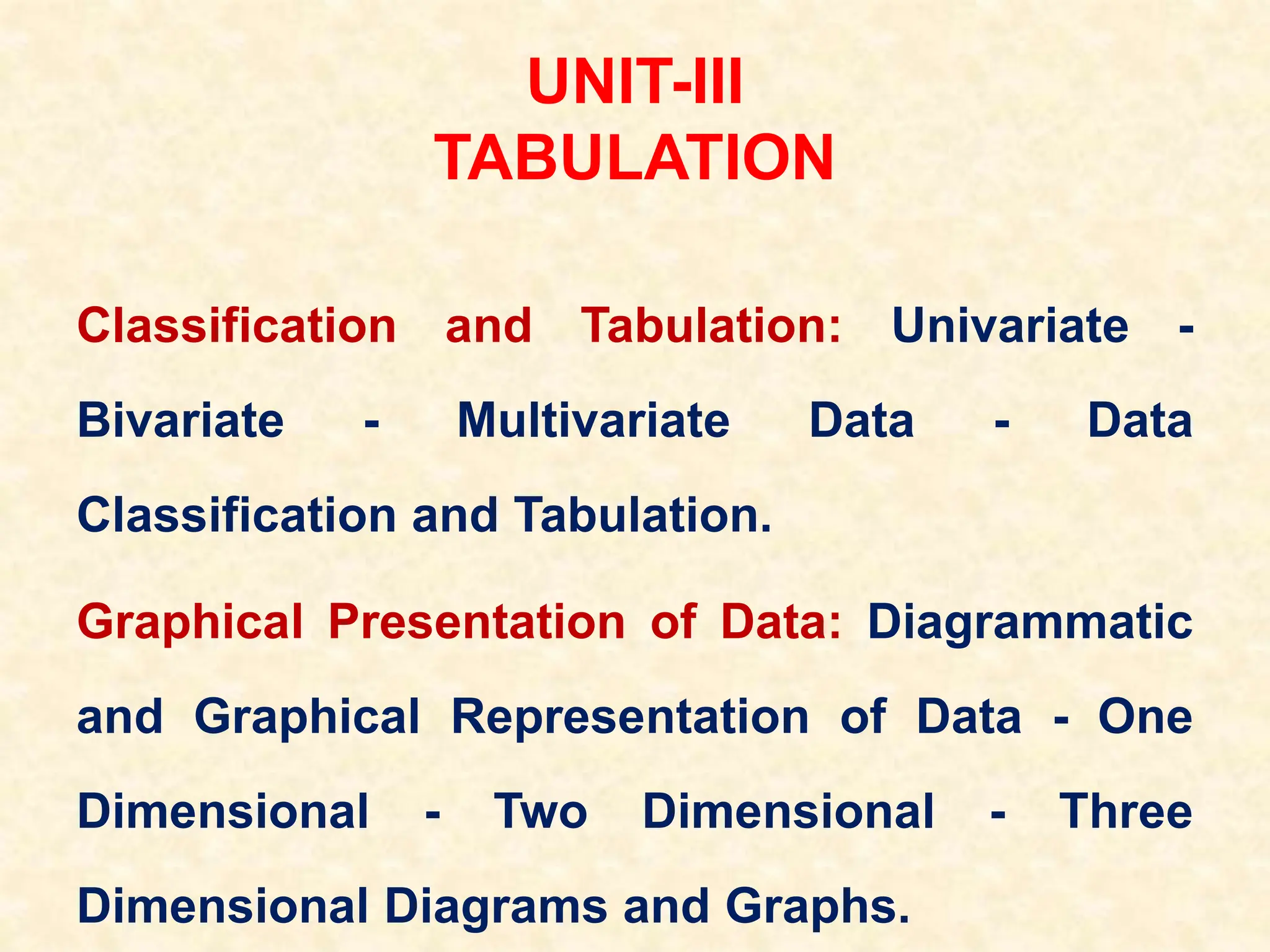
UNIT-III
TABULATION
Classification and Tabulation: Univariate -
Bivariate - Multivariate Data - Data
Classification and Tabulation.
Graphical Presentation of Data: Diagrammatic
and Graphical Representation of Data - One
Dimensional - Two Dimensional - Three
Dimensional Diagrams and Graphs.
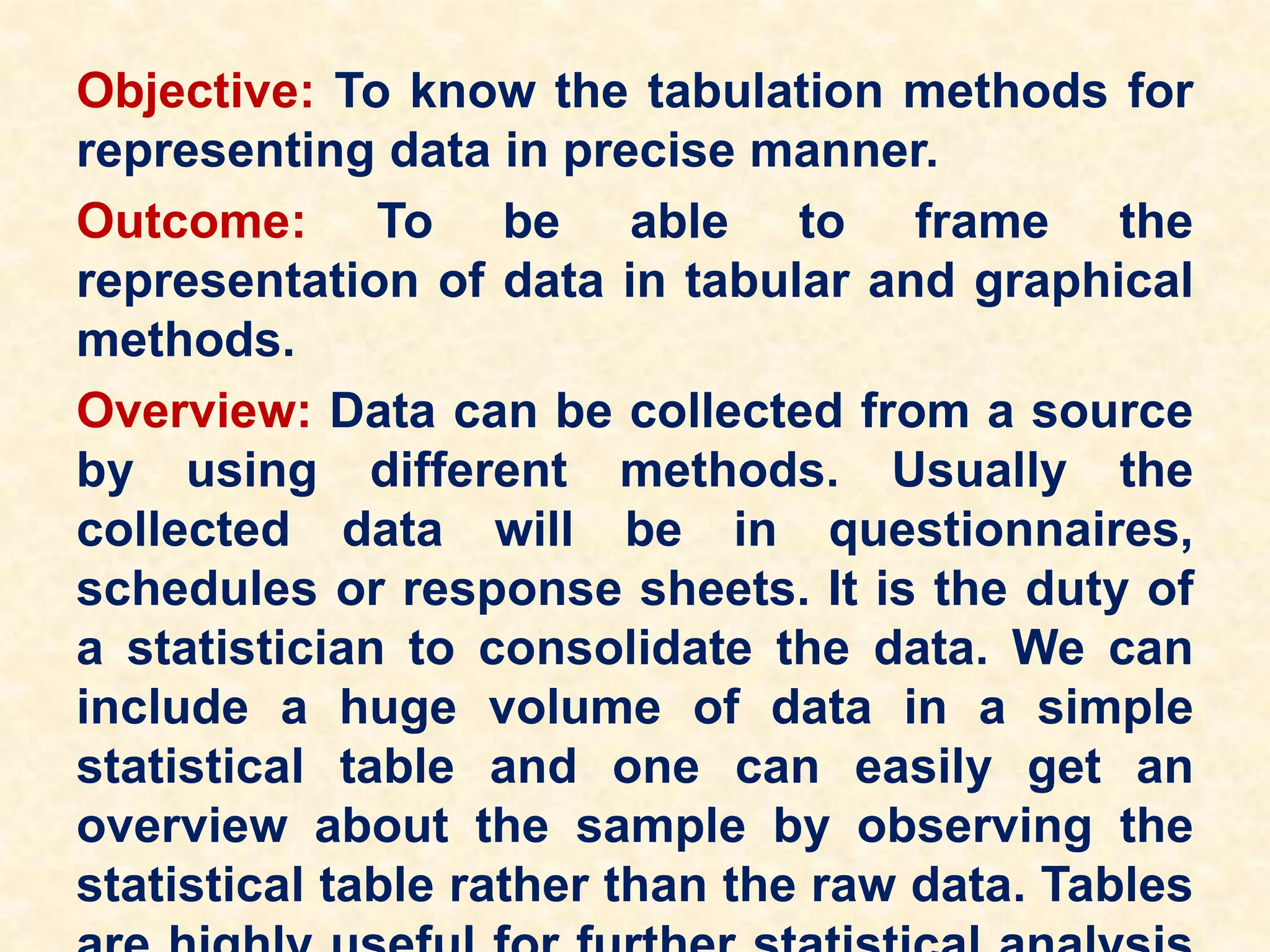
Objective: To know the tabulation methods for
representing data in precise manner.
Outcome: To be able to frame the
representation of data in tabular and graphical
methods.
Overview: Data can be collected from a source
by using different methods. Usually the
collected data will be in questionnaires,
schedules or response sheets. It is the duty of
a statistician to consolidate the data. We can
include a huge volume of data in a simple
statistical table and one can easily get an
overview about the sample by observing the
statistical table rather than the raw data. Tables
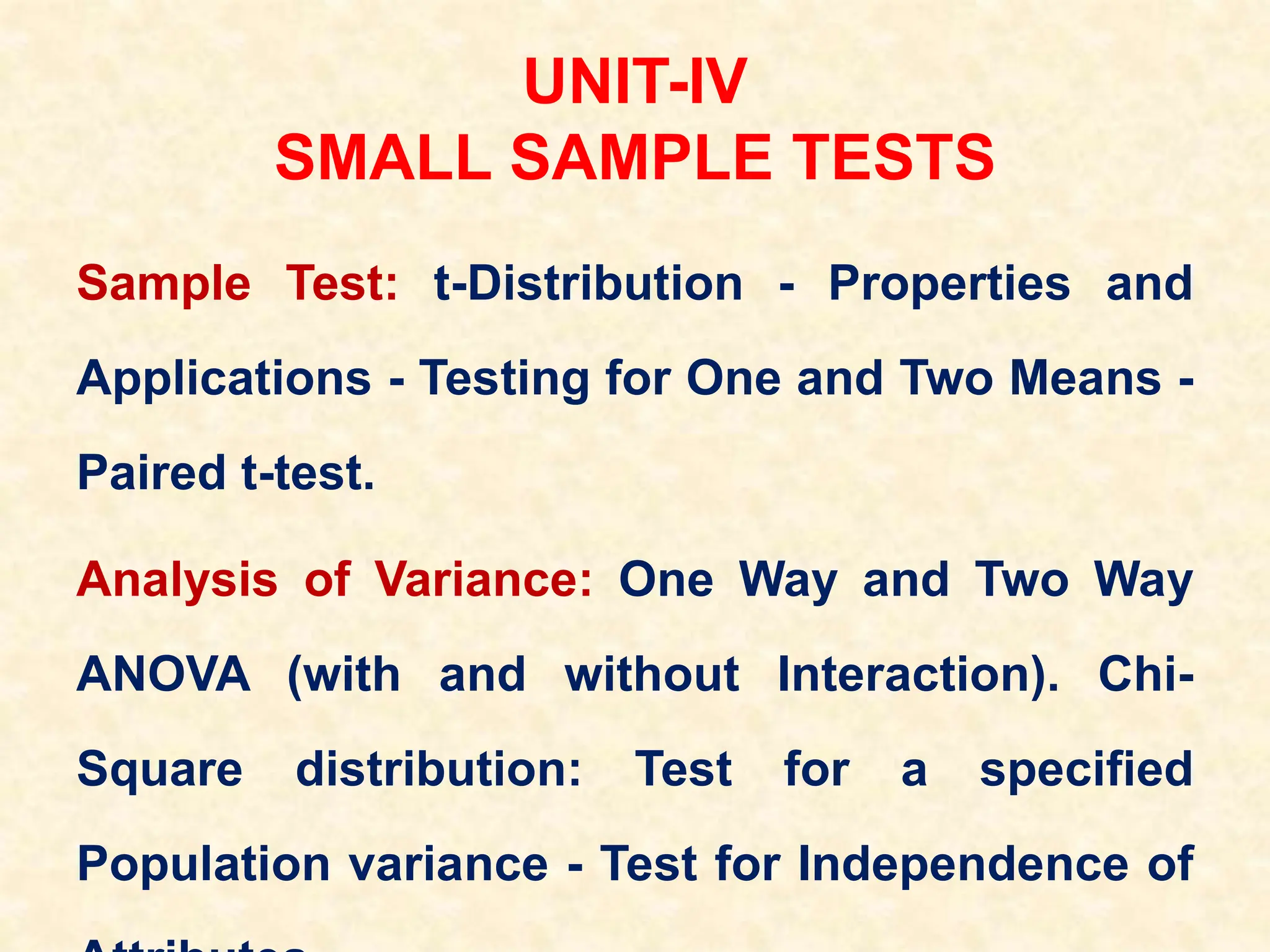
UNIT-IV
SMALL SAMPLE TESTS
Sample Test: t-Distribution - Properties and
Applications - Testing for One and Two Means -
Paired t-test.
Analysis of Variance: One Way and Two Way
ANOVA (with and without Interaction). Chi-
Square distribution: Test for a specified
Population variance - Test for Independence of
Objective: To know various sample tests.
Outcome: Students are able to test the data by using
various techniques this can represent data in useful
manner.
Overview: Sampling problems dealt with means and
proportions. Evaluation of the sampling errors was
based on the normal distribution. A small sample
distribution, known as the t-distribution, has to be used
in this case. When samples are small and the
distribution of the variable in the population is not
normal, there is no readily available sampling
distribution. In the case of the mean, the sampling
distribution was normal because the variable was
distributed normally in the population or because the
Central Limit Theorem ensured normality for large
samples. In the case of proportions, the normal
UNIT-V
CORRELATION AND REGRESSION
ANALYSIS
Correlation Analysis: Scatter Diagram -
Positive and Negative Correlation - Limits for
Coefficient of Correlation - Karl Pearson’s
Coefficient of Correlation - Spearman’s Rank
Correlation - Concept of Multiple and Partial
Correlation.
Regression Analysis: Concept - Least Square
Method - Two Lines of Regression - Properties
of Regression Coefficients. Time Series
Analysis: Trend analysis - Free Hand Curve -
Moving Averages.
Objective: To know the correlation and regression
analysis of data.
Outcome: To be able to analyze the data by using time
series, correlation, regression, etc. and their usage
importance for taking decisions.
Overview : Correlation is statistical Analysis which
measures and analyses the degree or extent to which
the two variables fluctuate with reference to each other.
It indicates that there is some connection between the
variables. It does not indicate cause and effect
relationship. Price and supply, income and expenditure
are correlated. Regression analysis reveals average
relationship between two variables and this makes
possible estimation or prediction. The relationship
between two variables can be considered between, say,
rainfall and agricultural production, price of an input
and the overall cost of product consumer expenditure

Statistics for Managers pptS for better understanding

  • 1.
    Date : 11.01.2021 Session: 04 Topic : Statistics for Managers (Preface Discussion) Time : 12.15 PM
  • 2.
    Course Instructors Dr. G.NAVEEN KUMAR B.Sc. (C.S.Engg.), MBA, SLET, PhD Head of Department Dr. I. J. RAGHAVENDRA MBA, M.Com, M.Phil, MHRM, PhD Associate Professor Mr. K. SUDHEER MBA, (PhD) Assistant Professor
  • 3.
    COURSE AIM/S • Thecourse aims to encourage thinking statistically. • It will encourage you to develop your abilities to understand and use data. • It is designed to equip managers with the skills to make effective use of data in the workplace, to develop expertise in a standard set of statistical and graphical techniques that will be useful in analyzing data, and to learn to apply these techniques in a number of areas of management.
  • 4.
    COURSE OUTCOME/S • Appreciatethat the collection and statistical analysis of data improves business decisions and reduces the risk of implementing solutions that waste resources and effort. • Select and deploy the correct statistical method for a given data analysis requirement. • Achieve a practical level of competence in building statistical models that suit business applications. • Recognize, develop and distinguish between
  • 5.
    UNIT-I INTRODUCTION TO STATISTICS Overview: Originand Development - Managerial Applications of Statistics - Statistics and the Branches of the Study - Statistics & Computers - Limitations of Statistics.
  • 6.
    Objective: To knowthe origin and development of statistics and their linkage to management applications. Outcome: To understand the importance and usage of statistics. Overview: Statistics, quite simply, is about learning from sample data. You face a group of individuals - perhaps people, but maybe cans of tomatoes, or automobiles, or fish in a lake, or even something as nebulous as calendar weeks. Thus statistics is a set of concepts, rules, and procedures that help us to organize
  • 7.
    UNIT-II MEASURES OF CENTRAL TENDENCY Measuresof Central Tendency: Mean - Median – Mode. Measures of Dispersion: Range - Quartile Deviation - Mean Deviation - Standard Deviation and Co-efficient of Variation. Skewness: Karl Pearson Co-efficient - Bowley’s Co-efficient - Kelley's Co-efficient. (Theory and
  • 8.
    Objective: To knowthe concepts and their calculation methods. Outcomes: To learn the basic calculations and usage of statistical methods in current scenario.
  • 9.
    Overview: One ofthe important objectives of statistics is to find out various numerical values which explain the inherent characteristics of a frequency distribution. The first of such measures is averages. Averages are the typical values around which other items of the distribution congregate. This value lies between the two extreme observations of the distribution and give us an idea about the concentration of the values in the central part of the distribution are called the measures of central tendency. It is a statistical measure that determines a single value that accurately describes the center of the distribution and represents the entire distribution of scores. The goal of central tendency is to identify the single value that is the best representative for the
  • 10.
    UNIT-III TABULATION Classification and Tabulation:Univariate - Bivariate - Multivariate Data - Data Classification and Tabulation. Graphical Presentation of Data: Diagrammatic and Graphical Representation of Data - One Dimensional - Two Dimensional - Three Dimensional Diagrams and Graphs.
  • 11.
    Objective: To knowthe tabulation methods for representing data in precise manner. Outcome: To be able to frame the representation of data in tabular and graphical methods. Overview: Data can be collected from a source by using different methods. Usually the collected data will be in questionnaires, schedules or response sheets. It is the duty of a statistician to consolidate the data. We can include a huge volume of data in a simple statistical table and one can easily get an overview about the sample by observing the statistical table rather than the raw data. Tables
  • 12.
    UNIT-IV SMALL SAMPLE TESTS SampleTest: t-Distribution - Properties and Applications - Testing for One and Two Means - Paired t-test. Analysis of Variance: One Way and Two Way ANOVA (with and without Interaction). Chi- Square distribution: Test for a specified Population variance - Test for Independence of
  • 13.
    Objective: To knowvarious sample tests. Outcome: Students are able to test the data by using various techniques this can represent data in useful manner. Overview: Sampling problems dealt with means and proportions. Evaluation of the sampling errors was based on the normal distribution. A small sample distribution, known as the t-distribution, has to be used in this case. When samples are small and the distribution of the variable in the population is not normal, there is no readily available sampling distribution. In the case of the mean, the sampling distribution was normal because the variable was distributed normally in the population or because the Central Limit Theorem ensured normality for large samples. In the case of proportions, the normal
  • 14.
    UNIT-V CORRELATION AND REGRESSION ANALYSIS CorrelationAnalysis: Scatter Diagram - Positive and Negative Correlation - Limits for Coefficient of Correlation - Karl Pearson’s Coefficient of Correlation - Spearman’s Rank Correlation - Concept of Multiple and Partial Correlation. Regression Analysis: Concept - Least Square Method - Two Lines of Regression - Properties of Regression Coefficients. Time Series Analysis: Trend analysis - Free Hand Curve - Moving Averages.
  • 15.
    Objective: To knowthe correlation and regression analysis of data. Outcome: To be able to analyze the data by using time series, correlation, regression, etc. and their usage importance for taking decisions. Overview : Correlation is statistical Analysis which measures and analyses the degree or extent to which the two variables fluctuate with reference to each other. It indicates that there is some connection between the variables. It does not indicate cause and effect relationship. Price and supply, income and expenditure are correlated. Regression analysis reveals average relationship between two variables and this makes possible estimation or prediction. The relationship between two variables can be considered between, say, rainfall and agricultural production, price of an input and the overall cost of product consumer expenditure