Presenters:
Yohan D’souza – 12
Joe Xavier - 33
Soumil Nath – 34
Elaine Pereira - 39
Spicy Success
Indian spice market
• Largely unorganised market & the branded segment makes about Rs.6500
• Market is dominated by players such as MTR, Badshaah, Catch, Everest, Ramdev, etc
• Tata Chemicals has launched its spices brand Tata Sampann spices
• India exports close to 52 different spices & exports grew to USD 626.8 million during
the first quarter of 2015-16
• India exported 215,215 tonnes of spices during the first quarter of 2016 as compared
with 213,443 tonnes in the same period last year
• The market is projected to reach approximately USD 18 billion by 2020, the growth is
expected to be led by branded spices and spice mixes
• Aggressive promotion of spice exports through various initiatives such as setting up of
Spice parks
• Spice parks offer common processing facilities to both producers and exporters.
Exports
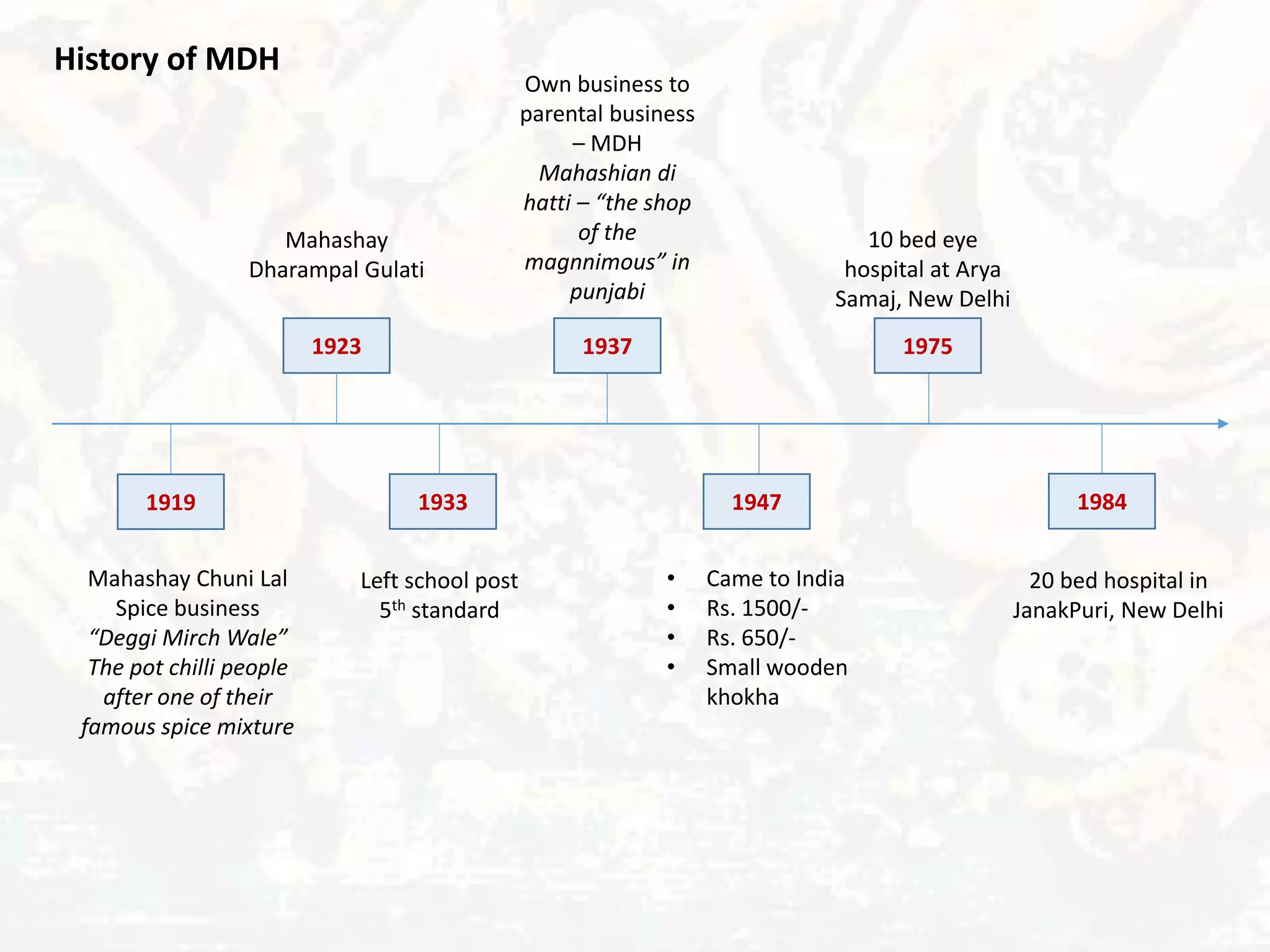
History of MDH
1923
Mahashay
Dharampal Gulati
1933
Left school post
5th standard
1937
Own business to
parental business
– MDH
Mahashian di
hatti – “the shop
of the
magnnimous” in
punjabi
1947
• Came to India
• Rs. 1500/-
• Rs. 650/-
• Small wooden
khokha
1975
10 bed eye
hospital at Arya
Samaj, New Delhi
1984
20 bed hospital in
JanakPuri, New Delhi
1919
Mahashay Chuni Lal
Spice business
“Deggi Mirch Wale”
The pot chilli people
after one of their
famous spice mixture
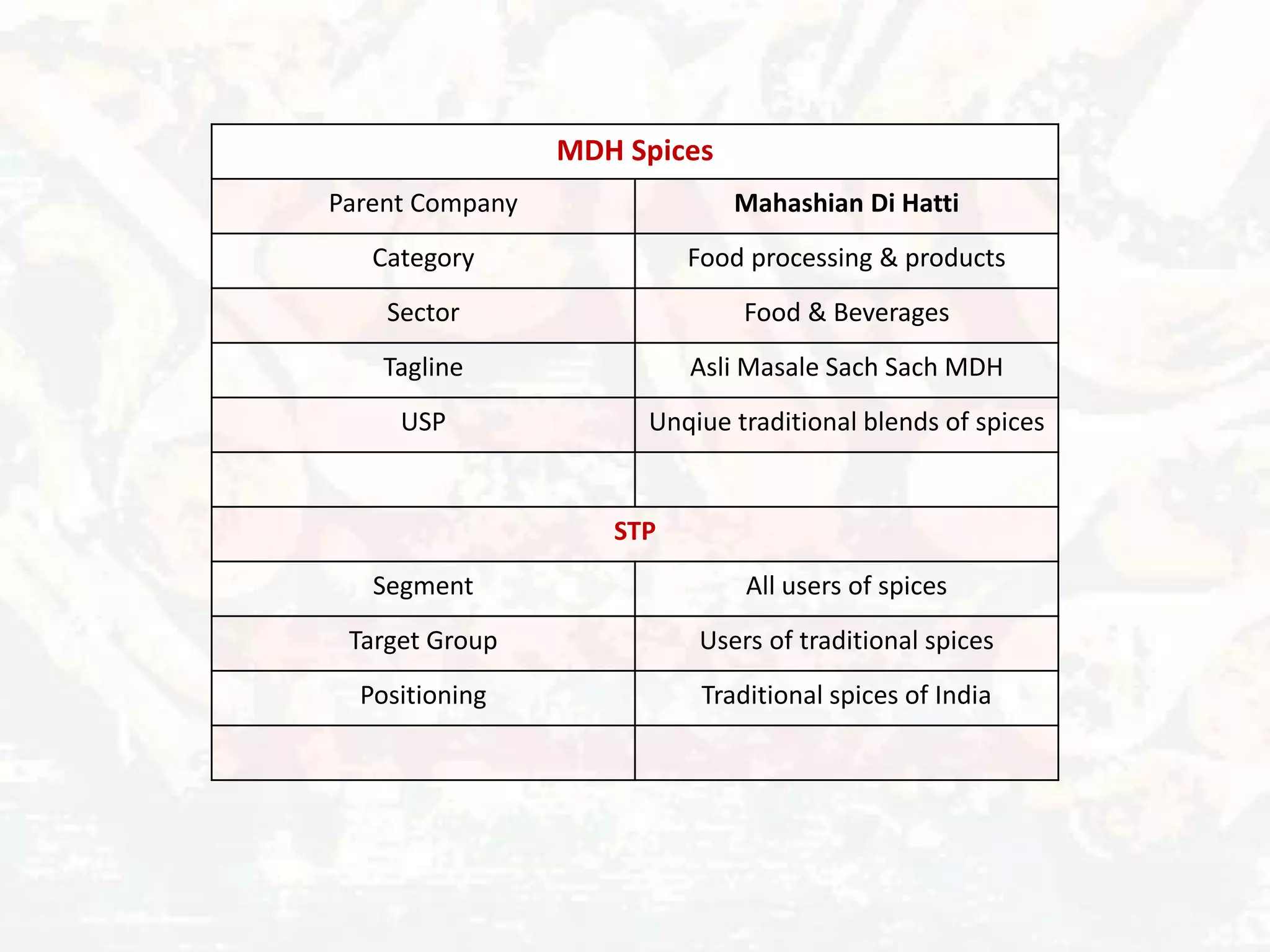
MDH Spices
Parent Company Mahashian Di Hatti
Category Food processing & products
Sector Food & Beverages
Tagline Asli Masale Sach Sach MDH
USP Unqiue traditional blends of spices
STP
Segment All users of spices
Target Group Users of traditional spices
Positioning Traditional spices of India
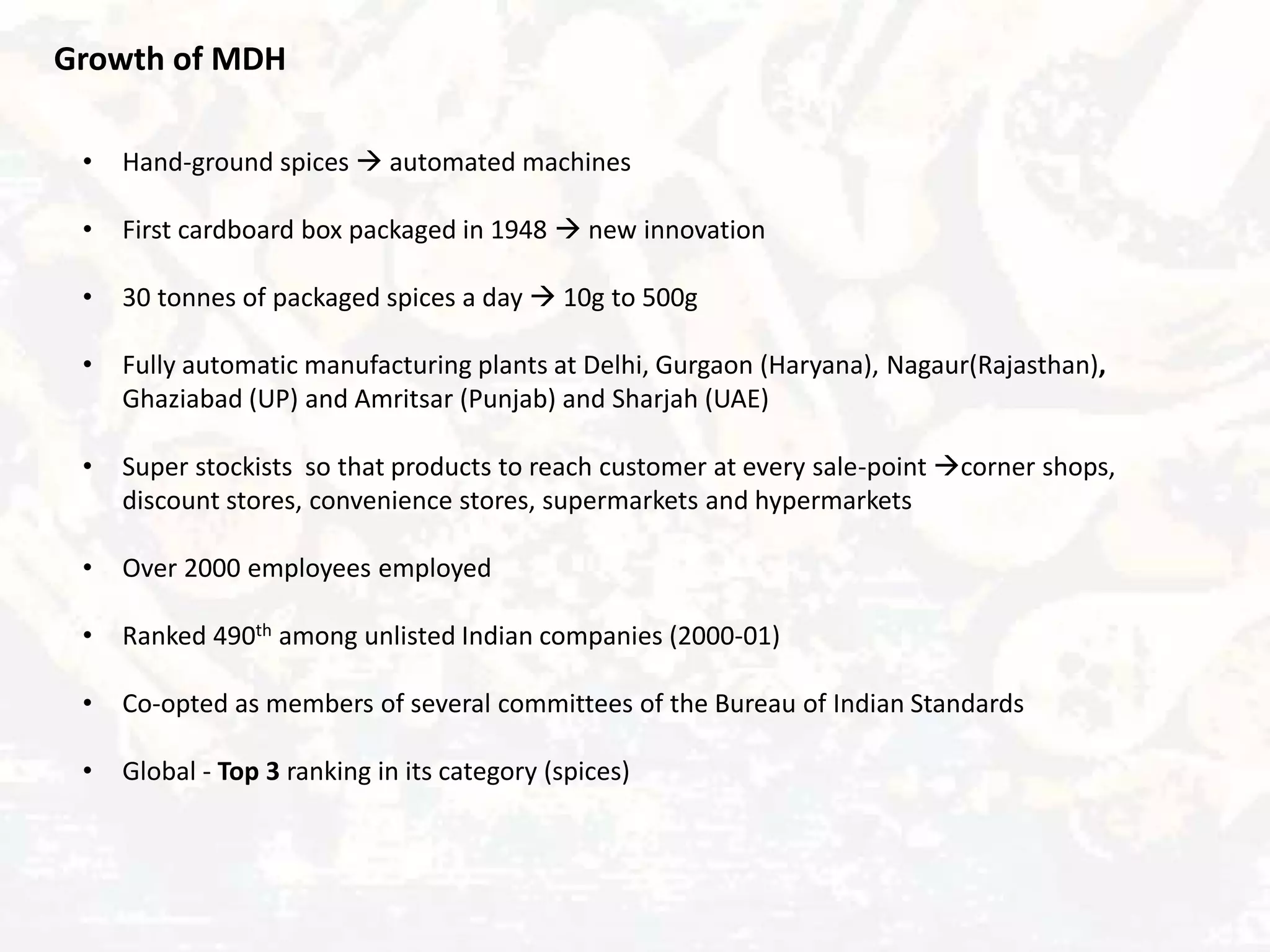
Growth of MDH
• Hand-ground spices  automated machines
• First cardboard box packaged in 1948  new innovation
• 30 tonnes of packaged spices a day  10g to 500g
• Fully automatic manufacturing plants at Delhi, Gurgaon (Haryana), Nagaur(Rajasthan),
Ghaziabad (UP) and Amritsar (Punjab) and Sharjah (UAE)
• Super stockists so that products to reach customer at every sale-point corner shops,
discount stores, convenience stores, supermarkets and hypermarkets
• Over 2000 employees employed
• Ranked 490th among unlisted Indian companies (2000-01)
• Co-opted as members of several committees of the Bureau of Indian Standards
• Global - Top 3 ranking in its category (spices)
About the owner
• Dadaji makes daily rounds of factories markets and dealers
• His motivation to work is being sincere in product quality sold at affordable prices
• He owns 80% stake in MDH
• He took more than 21 crores of salary in 2016-17, higher than Adi Godrej and Vivek
Gambhir of Godrej Consumer, Sanjiv Mehta of Hindustan Unilever and ITC’s YC
Deveshwar
• 90% of his salary goes to charity
Distribution Network
• 15 factories supplying to a network of over 1000 stockists and 8 lakh retail dealers in India
• Raw material acquired directly from contract famers to maintain uniform taste and quality
• Also sourcing spices from Karnataka, Rajasthan to Afghanistan
• Over 60 spices and blends are exported to over 500+ countries like United States of
America, Canada, United Kingdom, Europe, South East Asia, Japan, U.A.E. and Saudi Arabia
Finances
• The commodity market is fast converting to branded business and even MDH is growth is
directly proportional
• 15% jump in revenues to INR 924 crores with a 24% increase in net profits, INR 213
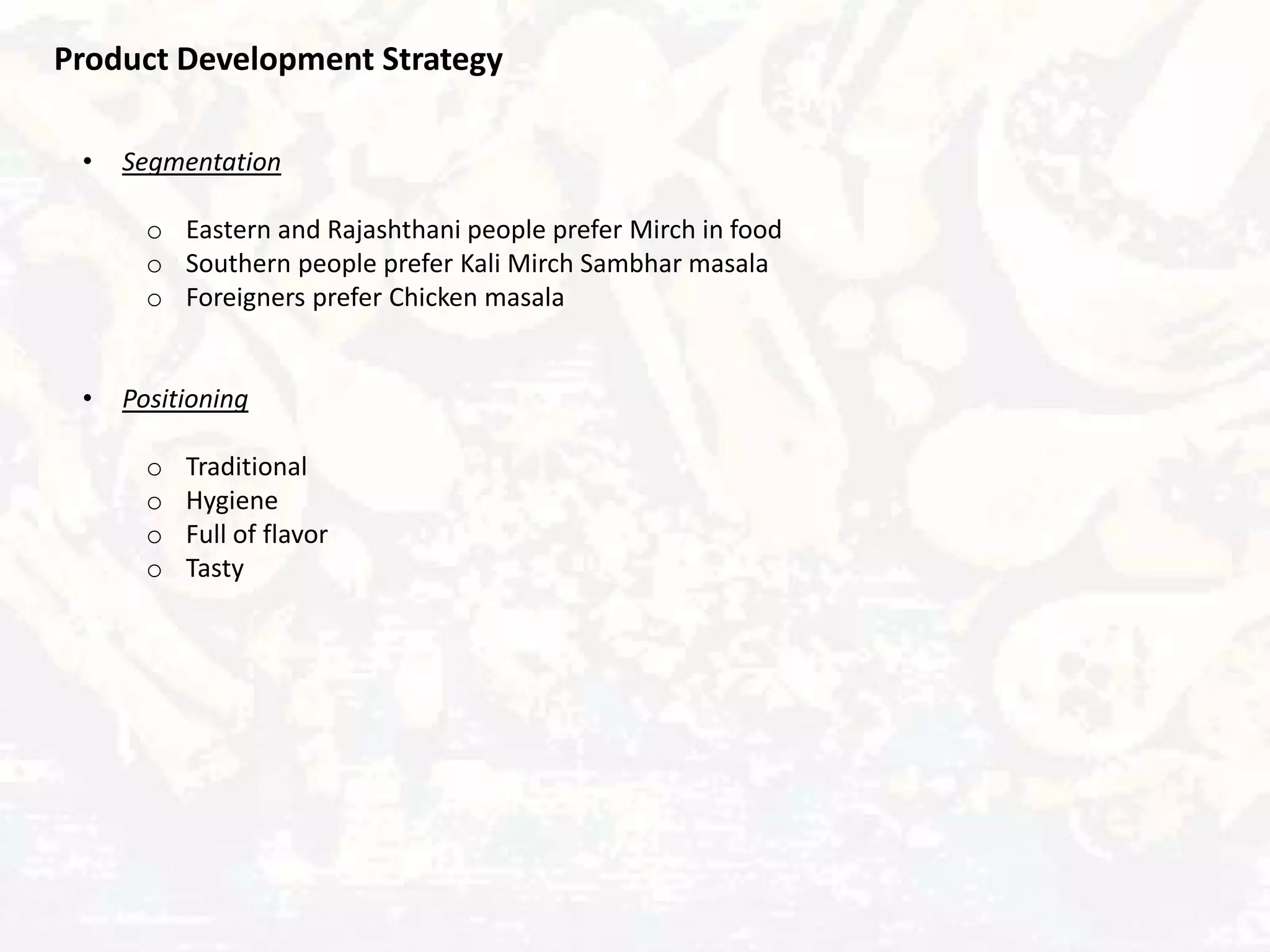
Product Development Strategy
• Segmentation
o Eastern and Rajashthani people prefer Mirch in food
o Southern people prefer Kali Mirch Sambhar masala
o Foreigners prefer Chicken masala
• Positioning
o Traditional
o Hygiene
o Full of flavor
o Tasty
Market Share
• MDH is the second largest leader in the Indian market and has market share of 12%
• Whereas its competitor, Everest has a market share of 13% (leader)
• MDH is the undisputed leader in North India with more than 70% market share
Marketing Dimension
• Successful product launches
• Brand extension
• Good relation with suppliers
• Extensive and attractive advertisements
Product Mix
GROUN
D SPICES
MDH BLACK
PEPPER
MDH DHANIA
POWDER
MDH HALDI
POWDER
MDH JEERA
POWDER
KASHMIRI
MIRCH
POWDER
MDH KASOORI
METHI
MDH LALMIRCH
MDH WHITE
PEPPER
BLEND
SPICES
MDH
AMCHOOR
POWDER
MDH BIRYANI
MASALA
MDH BUTTER
CHICKEN
MDH CHANA
MASALA
MDH CHICKEN
MASALA
MDH CHUNKY
CHAT MASALA
MDH CHUTNEY
PODINA
MASALA
MDH CURRY
POWDER
MDH
DAHIVADA
RAITA
MDH
DALMAKHANI
MASALA
MDH JAL JEERA
OTHER
PRODUC
TS
KESAR
MDH DANT
MANJAN
MDH HAVAN
SAMAGRI
• The speciality of MDH is its traditional and unique blend of
different spices that are used for specific product items
• MDH offers a recipe for products on its related spice box
and on its website for interested customers
• Bulk of the sales comes from – Deggi Mirch, Chat Masala
and Chana Masala – over a crore packets of each every month
Packaging
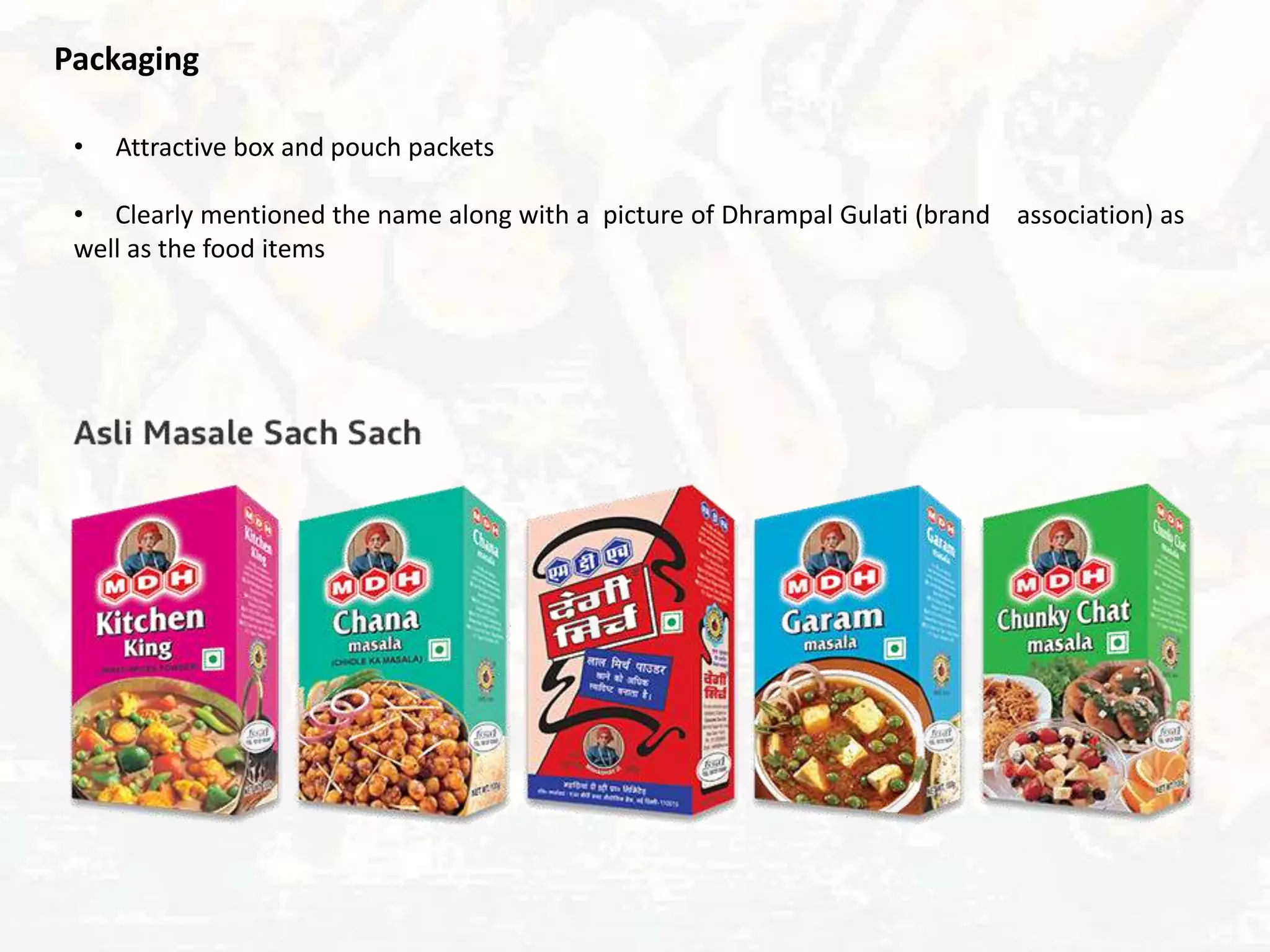
• Attractive box and pouch packets
• Clearly mentioned the name along with a picture of Dhrampal Gulati (brand association) as
well as the food items
Advertising promotions
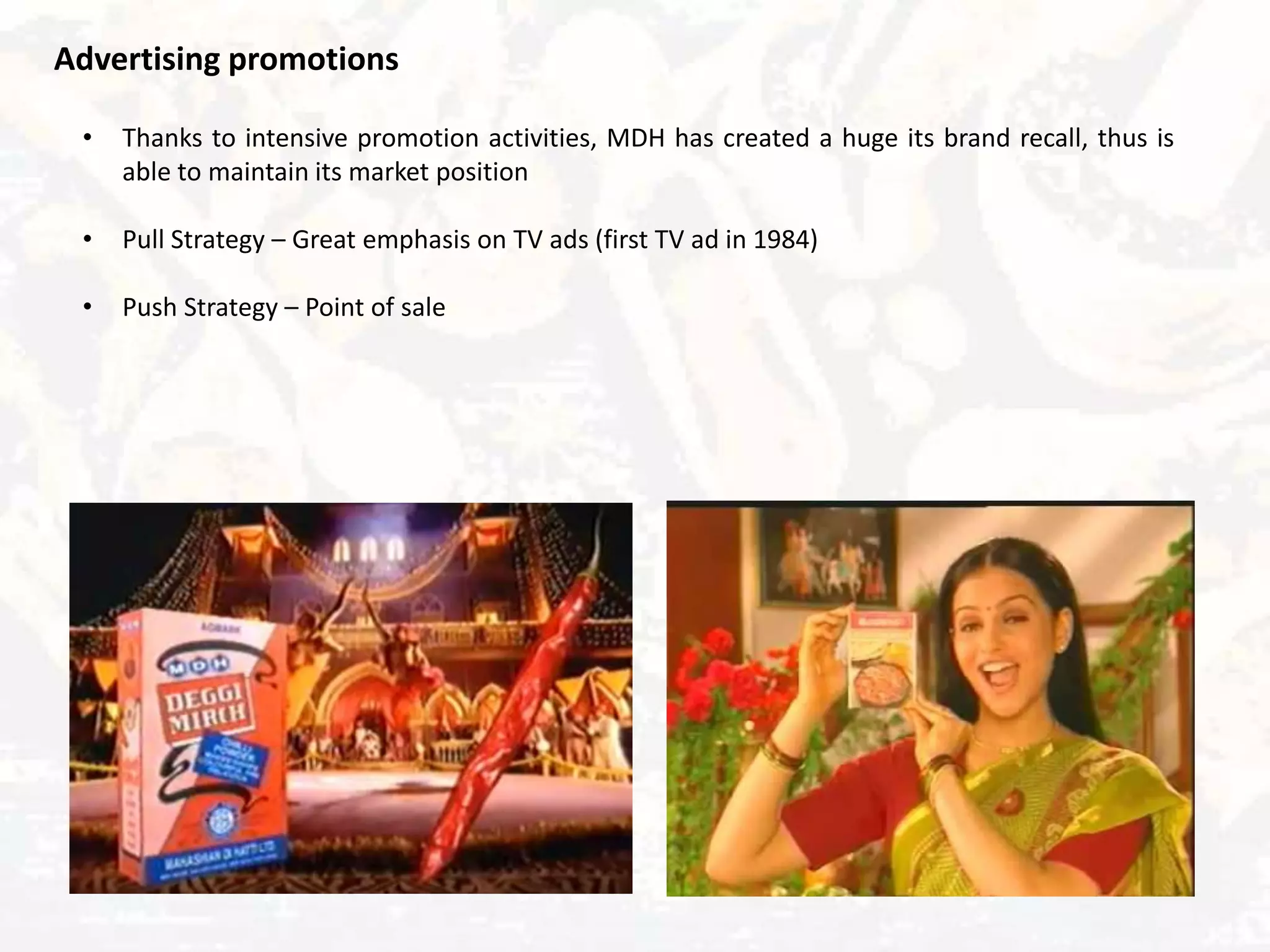
• Thanks to intensive promotion activities, MDH has created a huge its brand recall, thus is
able to maintain its market position
• Pull Strategy – Great emphasis on TV ads (first TV ad in 1984)
• Push Strategy – Point of sale
Competitors
Competitors
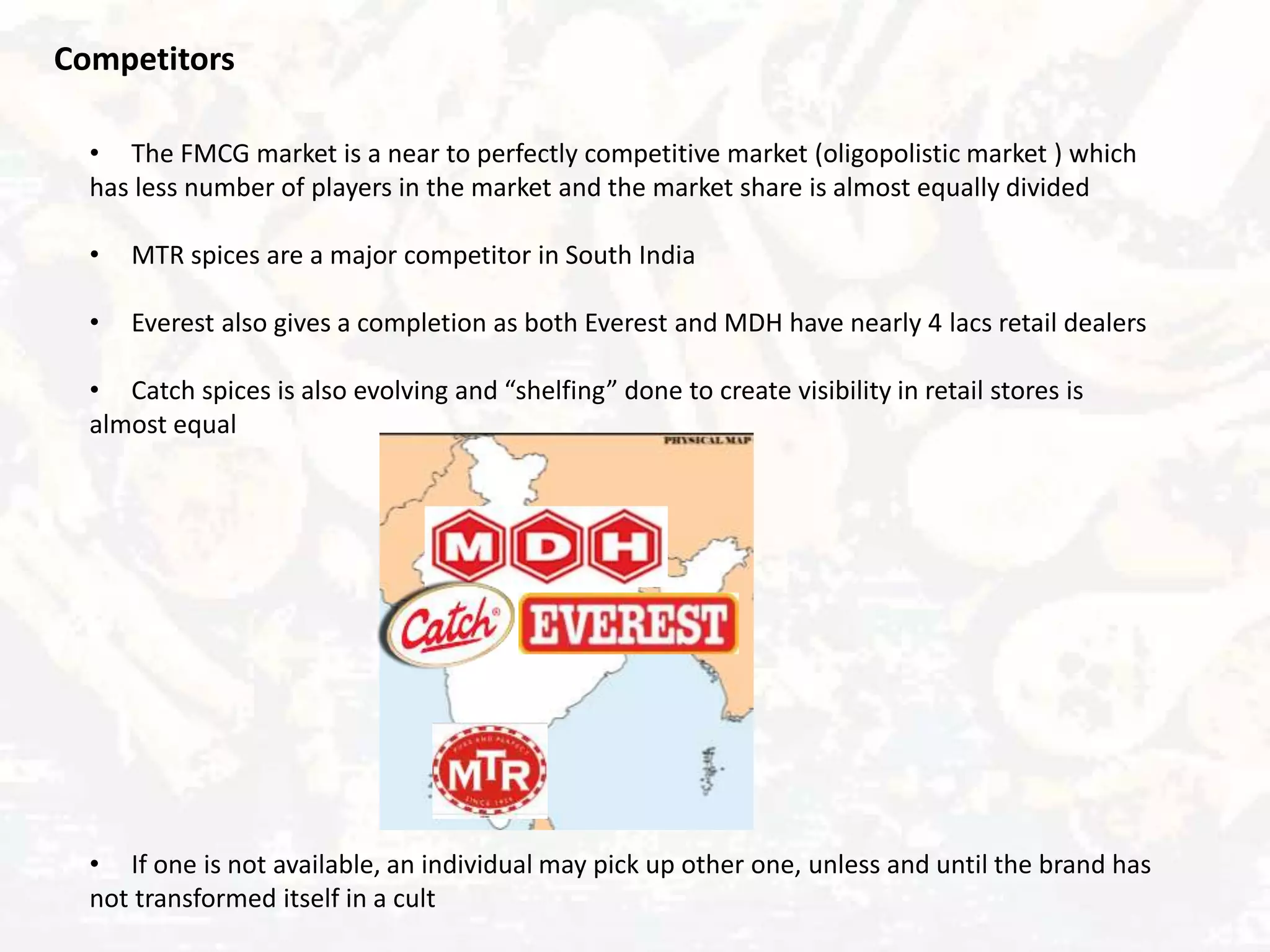
• The FMCG market is a near to perfectly competitive market (oligopolistic market ) which
has less number of players in the market and the market share is almost equally divided
• MTR spices are a major competitor in South India
• Everest also gives a completion as both Everest and MDH have nearly 4 lacs retail dealers
• Catch spices is also evolving and “shelfing” done to create visibility in retail stores is
almost equal
• If one is not available, an individual may pick up other one, unless and until the brand has
not transformed itself in a cult
CSR Activities
• MahashayChuniLal Charitable Trust - maintains trust amongst its loyal customer base
• The trust operates a 250-bed hospital, a mobile hospital for slums, and four schools in
New Delhi
• Various social organizations can get need-based grants from the trust
• Sandesh - focusing on traditional family values of India.
Future scope
• Widen the Indian spice market and convert consumer from unbranded products
• Besides dry blends, produce wet blends (pastes like Garlic, etc)
• Rework advertising strategy and also focus on the markets in the south
• Extension in the ready-to-eat segment
• They can focus on global cuisine like Chinese, Thai and Italian
• Seasonal promotions (during Diwali)
Demand in China : The Chinese Market
• There is a lot of attraction for Indian foods and many other products all over China
• They are sold by hundreds of Chinese traders through online stores and physical shops
• Almost every city has a shop selling Indian goods and some like Shanghai, Guangzhou, Yiwu
and Beijing have 2-3 each
• The most sought-after Indian goods are spices followed by cosmetics
• Buyers include the vast community of Indians, Pakistanis, Japanese, Arabs, Africans and even
Europeans who are fond of curried food, more than a million of them live in different Chinese
cities.
Demand in China : The Chinese Market
• Indian products usually sell at a premium ranging from 100 percent to 300 percent over the
printed prices but this does not deter buyers who want quality products from India
• The quality of Indian spices like cardamom and cumin seeds is far superior in India as
compared to those sold in local Chinese markets
• The use of ready-made spice mixtures comprising turmeric and other Indian masalas have
become very popular
• Many Chinese housewives also cook curry at home
References 
• https://www.hindustantimes.com/delhi-news/the-spice-of-success/story-
0VFHcJhEvDNdHr7Jpy4PPJ.html
• https://en.wikipedia.org/wiki/MDH_(spice_company)#cite_note-FY_results-1
• https://www.marketing91.com/marketing-mix-of-mdh-masala/
• https://timesofindia.indiatimes.com/business/india-business/fmcg-sectors-highest-paid-
ceo-is-a-94-year-old-school-drop-out/articleshow/56613386.cms

MDH Masala: Spicy Success (Brand Management)

  • 1.
    Presenters: Yohan D’souza –12 Joe Xavier - 33 Soumil Nath – 34 Elaine Pereira - 39 Spicy Success
  • 2.
    Indian spice market •Largely unorganised market & the branded segment makes about Rs.6500 • Market is dominated by players such as MTR, Badshaah, Catch, Everest, Ramdev, etc • Tata Chemicals has launched its spices brand Tata Sampann spices • India exports close to 52 different spices & exports grew to USD 626.8 million during the first quarter of 2015-16 • India exported 215,215 tonnes of spices during the first quarter of 2016 as compared with 213,443 tonnes in the same period last year • The market is projected to reach approximately USD 18 billion by 2020, the growth is expected to be led by branded spices and spice mixes • Aggressive promotion of spice exports through various initiatives such as setting up of Spice parks • Spice parks offer common processing facilities to both producers and exporters. Exports
  • 3.
    History of MDH 1923 Mahashay DharampalGulati 1933 Left school post 5th standard 1937 Own business to parental business – MDH Mahashian di hatti – “the shop of the magnnimous” in punjabi 1947 • Came to India • Rs. 1500/- • Rs. 650/- • Small wooden khokha 1975 10 bed eye hospital at Arya Samaj, New Delhi 1984 20 bed hospital in JanakPuri, New Delhi 1919 Mahashay Chuni Lal Spice business “Deggi Mirch Wale” The pot chilli people after one of their famous spice mixture
  • 4.
    MDH Spices Parent CompanyMahashian Di Hatti Category Food processing & products Sector Food & Beverages Tagline Asli Masale Sach Sach MDH USP Unqiue traditional blends of spices STP Segment All users of spices Target Group Users of traditional spices Positioning Traditional spices of India
  • 5.
    Growth of MDH •Hand-ground spices  automated machines • First cardboard box packaged in 1948  new innovation • 30 tonnes of packaged spices a day  10g to 500g • Fully automatic manufacturing plants at Delhi, Gurgaon (Haryana), Nagaur(Rajasthan), Ghaziabad (UP) and Amritsar (Punjab) and Sharjah (UAE) • Super stockists so that products to reach customer at every sale-point corner shops, discount stores, convenience stores, supermarkets and hypermarkets • Over 2000 employees employed • Ranked 490th among unlisted Indian companies (2000-01) • Co-opted as members of several committees of the Bureau of Indian Standards • Global - Top 3 ranking in its category (spices)
  • 6.
    About the owner •Dadaji makes daily rounds of factories markets and dealers • His motivation to work is being sincere in product quality sold at affordable prices • He owns 80% stake in MDH • He took more than 21 crores of salary in 2016-17, higher than Adi Godrej and Vivek Gambhir of Godrej Consumer, Sanjiv Mehta of Hindustan Unilever and ITC’s YC Deveshwar • 90% of his salary goes to charity
  • 7.
    Distribution Network • 15factories supplying to a network of over 1000 stockists and 8 lakh retail dealers in India • Raw material acquired directly from contract famers to maintain uniform taste and quality • Also sourcing spices from Karnataka, Rajasthan to Afghanistan • Over 60 spices and blends are exported to over 500+ countries like United States of America, Canada, United Kingdom, Europe, South East Asia, Japan, U.A.E. and Saudi Arabia
  • 8.
    Finances • The commoditymarket is fast converting to branded business and even MDH is growth is directly proportional • 15% jump in revenues to INR 924 crores with a 24% increase in net profits, INR 213
  • 9.
    Product Development Strategy •Segmentation o Eastern and Rajashthani people prefer Mirch in food o Southern people prefer Kali Mirch Sambhar masala o Foreigners prefer Chicken masala • Positioning o Traditional o Hygiene o Full of flavor o Tasty
  • 10.
    Market Share • MDHis the second largest leader in the Indian market and has market share of 12% • Whereas its competitor, Everest has a market share of 13% (leader) • MDH is the undisputed leader in North India with more than 70% market share
  • 11.
    Marketing Dimension • Successfulproduct launches • Brand extension • Good relation with suppliers • Extensive and attractive advertisements
  • 12.
    Product Mix GROUN D SPICES MDHBLACK PEPPER MDH DHANIA POWDER MDH HALDI POWDER MDH JEERA POWDER KASHMIRI MIRCH POWDER MDH KASOORI METHI MDH LALMIRCH MDH WHITE PEPPER BLEND SPICES MDH AMCHOOR POWDER MDH BIRYANI MASALA MDH BUTTER CHICKEN MDH CHANA MASALA MDH CHICKEN MASALA MDH CHUNKY CHAT MASALA MDH CHUTNEY PODINA MASALA MDH CURRY POWDER MDH DAHIVADA RAITA MDH DALMAKHANI MASALA MDH JAL JEERA OTHER PRODUC TS KESAR MDH DANT MANJAN MDH HAVAN SAMAGRI • The speciality of MDH is its traditional and unique blend of different spices that are used for specific product items • MDH offers a recipe for products on its related spice box and on its website for interested customers • Bulk of the sales comes from – Deggi Mirch, Chat Masala and Chana Masala – over a crore packets of each every month
  • 13.
    Packaging • Attractive boxand pouch packets • Clearly mentioned the name along with a picture of Dhrampal Gulati (brand association) as well as the food items
  • 14.
    Advertising promotions • Thanksto intensive promotion activities, MDH has created a huge its brand recall, thus is able to maintain its market position • Pull Strategy – Great emphasis on TV ads (first TV ad in 1984) • Push Strategy – Point of sale
  • 15.
  • 16.
    Competitors • The FMCGmarket is a near to perfectly competitive market (oligopolistic market ) which has less number of players in the market and the market share is almost equally divided • MTR spices are a major competitor in South India • Everest also gives a completion as both Everest and MDH have nearly 4 lacs retail dealers • Catch spices is also evolving and “shelfing” done to create visibility in retail stores is almost equal • If one is not available, an individual may pick up other one, unless and until the brand has not transformed itself in a cult
  • 17.
    CSR Activities • MahashayChuniLalCharitable Trust - maintains trust amongst its loyal customer base • The trust operates a 250-bed hospital, a mobile hospital for slums, and four schools in New Delhi • Various social organizations can get need-based grants from the trust • Sandesh - focusing on traditional family values of India.
  • 18.
    Future scope • Widenthe Indian spice market and convert consumer from unbranded products • Besides dry blends, produce wet blends (pastes like Garlic, etc) • Rework advertising strategy and also focus on the markets in the south • Extension in the ready-to-eat segment • They can focus on global cuisine like Chinese, Thai and Italian • Seasonal promotions (during Diwali)
  • 19.
    Demand in China: The Chinese Market • There is a lot of attraction for Indian foods and many other products all over China • They are sold by hundreds of Chinese traders through online stores and physical shops • Almost every city has a shop selling Indian goods and some like Shanghai, Guangzhou, Yiwu and Beijing have 2-3 each • The most sought-after Indian goods are spices followed by cosmetics • Buyers include the vast community of Indians, Pakistanis, Japanese, Arabs, Africans and even Europeans who are fond of curried food, more than a million of them live in different Chinese cities.
  • 20.
    Demand in China: The Chinese Market • Indian products usually sell at a premium ranging from 100 percent to 300 percent over the printed prices but this does not deter buyers who want quality products from India • The quality of Indian spices like cardamom and cumin seeds is far superior in India as compared to those sold in local Chinese markets • The use of ready-made spice mixtures comprising turmeric and other Indian masalas have become very popular • Many Chinese housewives also cook curry at home
  • 21.
    References  • https://www.hindustantimes.com/delhi-news/the-spice-of-success/story- 0VFHcJhEvDNdHr7Jpy4PPJ.html •https://en.wikipedia.org/wiki/MDH_(spice_company)#cite_note-FY_results-1 • https://www.marketing91.com/marketing-mix-of-mdh-masala/ • https://timesofindia.indiatimes.com/business/india-business/fmcg-sectors-highest-paid- ceo-is-a-94-year-old-school-drop-out/articleshow/56613386.cms