CASE STUDY ON
INDIAN SPICES
COMPANIES
Aziz Shaikh
CONTENTS
 Introduction​
 Indian Food Processing Industry
 Indian Spice Market
 ​MDH Masala
 Everest Spices
 MTR Foods Ltd
INTRODUCTION
India is the global spice market producing tones of spice each year.
India is also know as the Home of Spice. No Indian food is
complete with the uses of spices in it. We Indians have a liking
towards food which are really spiced up. As for me I also fall into
that category.
Spices can be used to produce aroma, taste and some to
compliment other spices. In ancient times India used to export large
quantities of spices. Even British East India Company used to
export spices in late 17th century. In Hindi it can also be called
masala.
Spices are of various types basic, aromatic and complimentary.
Apart from using them in cooking, some spices also have medicinal
use. Most of them have healing and therapeutic process.
 It offers Packaged Food and Beverages.
 It accounts for 32% of country’s total food market.
 It ranked 5th in terms of production, consumption, export &
expected growth among other Indian Industries.
 Demand of Ready-To-Eat items have increased recently
due to :
 Increasing Income Level
 Hectic lifestyle (Convenience Factor)
 Rapid Urbanization
 Increase of women’s employment
INDIAN FOOD
PROCESSING
INDUSTRY
Indian Spice Market
 The India spices market reached a value of INR 142,569.3 Crores in 2021. Looking forward, the
publisher expects the market to reach INR 270,928.4 Crores by 2027, exhibiting a CAGR of 11.29%
during 2021-2027.
 Market is dominated by players such as MTR, BAADSHAH, CATCH, EVEREST, MDH etc.
 Tata Chemicals has launched its spices brand TATA Sampann Spices.
Exports
 India exports close to 52 different spices & exports grew to USD 626.8 million during the first quarter
of 2015-16.
 India exported 215,215 tones if spices during the first quarter of 2016 as compared with 213,443
tones in the same period last year.
 The market is projected to reach approximately USD 18 billion by 2020, the growth is expected to be
led by branded spices and spice mixes.
 Aggressive promotion of spice exports through various initiatives such as setting up of spice parks.
 Spice parks offer common processing facilities to both producers and exporters.
MDH MASALA
India’s one of the largest spice producer with a 12% market share.
A range of 62 products available in over 150 different packages.
Production capacity: 30 tonnes of packaged spices a day.
5 manufacturing plants
Distribution network of over 1000 Stockist and over 4 Lac retail dealers in India and
abroad.
Exports to 100+ countries
MDH is valued at Rs 300 crore, 80% stocks are owned by Mahashay Ji.
Highest paid CEO, 21 crore.
HUL’s Acquisition Of MDH
 Hindustan Unilever Ltd is in talks with Mahashian Di Hatti Pvt. Ltd (MDH) to buy a majority stake in the
maker of MDH Spices, newspaper Mint reported on March 22, 2022. MDH could be valued between Rs
10,000-15,000 crore, the report added.
 With Rs 1,191 crore in yearly sales (FY2021) and Rs 507 crore operating profit MDH is already
enjoying a 42.5 per cent EBITDA margin -- much higher than HUL's 25.2 per cent. Thus, if the deal
goes through addition of MDH in HUL's vast portfolio would not only help it entered an uncharted
territory of branded spices but it would also help improve its margins further.
 MDH has huge land parcels in prime locations in the capital worth crores, which makes it a more
attractive proposition.
 While HUL's massive presence across physical retail outlets -- nearly 8 million in total and higher than
any other FMCG player -- leaves headroom for growth for the brand MDH.
Growth of MDH
 Hand-ground spices -> automated machines
 First cardboard box packaged in 1948 -> new innovation
 30 tonnes of packaged spices a days > 10g to 500g
 Fully automatic manufacturing plants at Delhi, Gurgaon (Haryana), Nagaur(Rajasthan), Ghaziabad (UP)
and Amritsar (Punjab) and Sharjah (UAE)
 Super stockists so that products to reach customer at every sale-point -> corner shops, discount stores,
convenience stores, supermarkets and hypermarkets
 Over 2000 employees employed
 Ranked 490th among unlisted Indian companies (2000-01)
 Co-opted as members of several committees of the Bureau of Indian Standards
 Global - Top 3 ranking in its category (spices)
Distribution Network
 15 factories supplying to a network of over 1000 stockists and 8 lakh retail dealers in India
 Raw material acquired directly from contract famers to maintain uniform taste and quality.
 Also sourcing spices from Karnataka, Rajasthan to Afghanistan.
 Over 60 spices and blends are exported to over 500+ countries like United States of
America, Canada, United Kingdom, Europe, South East Asia, Japan, U.A.E. and Saudi
Arabia.
Product Development Strategy
• Target Segmentation
o North Indian, Eastern and Rajasthani people prefer Spicy food.
o Southern people prefer Kali Mirch and Sambhar Masala.
o Foreigners prefer Chicken Masala.
• Target Positioning
o Traditional
o Hygienic
o Full Of Flavour
o Tasty
Market Share
 MDH is the second largest leader in the Indian market share of 12%.
 Whereas its competitor, Everest has a market share of 13%(leader).
 MDH is the undisputed leader in North India with more than 70% market
share.
Marketing Dimension
 Most of the marketing of the company is done through TV ads with a tagline
“Asli Masale Sach Sach MDH”.
 Brand extension.
 Good relation with suppliers.
 Extensive and attractive advertisements.
Product Mix
 The specialty of MDH is its traditional and unique blend of different spices
that are used for specific product items.
 MDH offers a recipe for products on its related spice box and on its website
for interested customers.
 Bulk of the sales comes from - Deggi Mirch, Chat Masala and Chana Masala
Packaging
 Attractive box and pouch packets.
 Clearly mentioned the name along with a picture of Dharam Pal Gulati as well as the food items.
Advertising Promotion
 Thanks to intensive promotion activities, MDH has created a huge its brand recall, thus is able to maintain
its market position.
 Pull Strategy - Great emphasis on TV ads (first TV ad in 1984).
 Push Strategy - Point of sale.
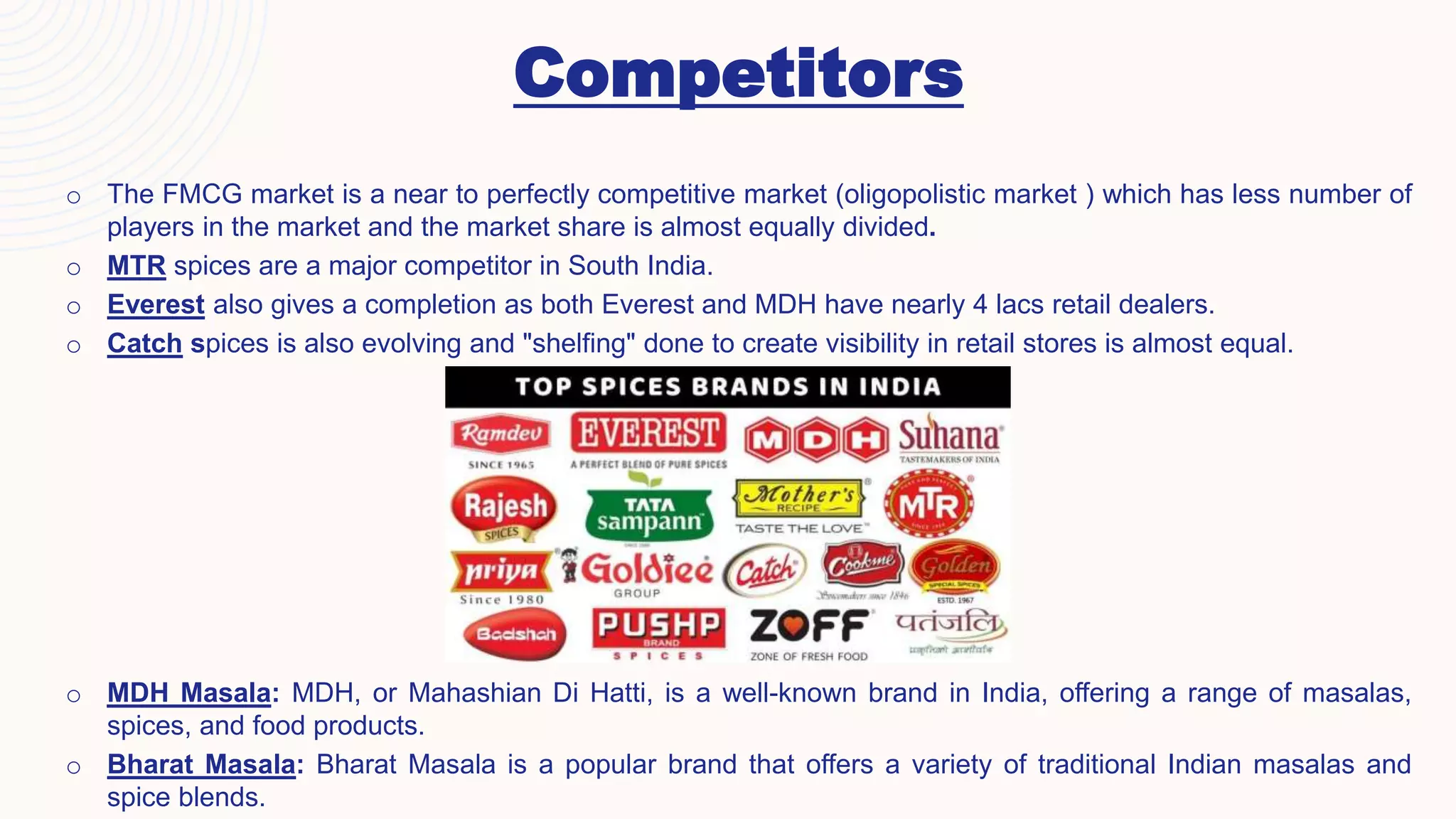
Competitors
o The FMCG market is a near to perfectly competitive market (oligopolistic market ) which has less number of
players in the market and the market share is almost equally divided.
o MTR spices are a major competitor in South India.
o Everest also gives a completion as both Everest and MDH have nearly 4 lacs retail dealers.
o Catch spices is also evolving and "shelfing" done to create visibility in retail stores is almost equal.
o MDH Masala: MDH, or Mahashian Di Hatti, is a well-known brand in India, offering a range of masalas,
spices, and food products.
o Bharat Masala: Bharat Masala is a popular brand that offers a variety of traditional Indian masalas and
spice blends.
EVEREST
Everest is India’s No.1 spice brand as per ACNielsen.
More than 370 crore (3.705 billion) packs of Everest product were sold each year.
It has a wide range of 45 variety of spices.
Everest has reached homes of all non resident Indians and Indian kitchens of all
restaurants in more than 58 countries.
It has the world's largest spice factory" at Umbergaon, Gujarat.
Proud recipient of the Super brand status five times in succession - 2003, 2006, 2009,
2012 and 2015.
It has also won the Consumer Reaction award instituted by the Bharti Vidyapeeth
Institute of Management Studies and Research and DNA twice in both 2004 and 2005.
BRAND BUILDING TOOLS 15
 Producing a signature quality video
For Instance Everest masala uses videos to create awareness about using of good quality chili powder to
build rand of the product
 Conduct a ground breaking research report to understand the
demand of consumers
For instance rural areas are very much price sensitive and in a recent study it has been found that Kashmiri
Lal Chili Powder are consumed more in rural areas than the Tikhalal Chili Powder because of the price
BRANDING ELEMENTS AND
BASES OF BRANDING
Brand Communication :-
 Everest was the first brand in the category to use Television as a medium for its communications.
 Everest understood that the richness of food could only be conveyed in color and quickly exploited it.
 Everest's communication has always targeted the upper end of consumers giving the brand a very
premium image.
 The company has also endeavored to package its communications to create an emotional bond with its
consumers.
Brand Positioning :-
 The unique selling proposition for Everest is the distinct pan-Indian taste it brings to the table.
 The positioning has been based on the key areas of the company’s expertise – sourcing, separating and
blending.
 Everest positions their chili powder as a blend of various spices that increases the authentic taste of the
various dishes.
17
Brand Awareness :-
 The company created two commercials to communicate the proposition of great taste.
 In one sought the association of a ‘Maharaj’ – the traditional Indian cook.
 In the other it used the nostalgia Indians often display of remembering ‘Ma ke haatho ka swaad’ which
roughly translates as ‘Food like mom made’.
Brand Packaging:-
 It used bright colors to make the packs look modern and lively to create awareness and push sales.
18
 Customization
 Everest gathered the crucial insight that different people had different preferences for chili powder.
 Everest catered to this market need by creating and launching three varieties of chili powders – Teekha
Lal, Kashmiri Lal and Kuti Lal.
 While some liked it very hot, others preferred the milder form, still others liked it ground fine while many
liked it to be coarse. This was the key insight.
 Quality Certification
Trademarks and other food safety certifications are more important to attract the customers towards the
brand which helps in brand building.
MTR FOODS LTD
ABOUT
 Estimated as 700cr company with CAGR of 18%.
 Exports account for 20% & 60% of total revenue is from south India.
 Adopted marketing penetration pricing policy.
 Launched web portal to cut down distribution cost.
 Implemented promotional policies and offer incentives.
 Opened fast food Restaurants on franchising concept in Major cities.
WITH A VISION OF – “Your Friend In Everyday Life”
 MTR Foods has consolidated its market leadership in the south and is all set for a
strong pan India presence.
 It has a export market in 23 countries including USA, Canada, Australia, Middle east
and so on.
 MTR’S values include
- Brave
- Trustworthy
- Inspiring
STRENGTH
• Healthy,
portable &
Time Saving
• Certified with
HACCP &
ISO 9002
• MTR’s USP
is quality of
its product.
OPPORTUNITY
• 32% of food
market
captured by
processed
food.
• E-Commerce
platform.
• Govt.
Initiatives.
THREAT
• Other
Competitors
.
• Customer
Perception.
• Health
Concern.
WEAKNESS
• Need of Hot
Water.
• Only vegetarian
product.
Product Portfolio
 MTR currently has 140+ products on offer under the following categories:
- Meals
- Mixes
-> Sambhar/Rasam
- Ready To Eat
-> Dal Makhani
-> Chana Masala
-> Veg Kadhal
- Pickles
-> Lime/Mango/Red Chilly
- Beverages
- Spices and Masalas
-> Haldi Powder
-> Chilly Powder
-> Jeera Powder
Product Packaging
• For the single-use solution, they have developed a LUP pack pouch.
• In urban centers, the consumer needs their breakfast on-the-go for the paucity of time. For this,
they have developed a Plastic cup with roto-lock cap made of polypropylene (PP). The cup is
equipped with tamper evident induction seal with a pull tab for easy opening. The foldable spoon
gives an added convenience on-the-go. (It Cost Rs. 11 per cup)
• For the family or a group of people, they have developed a box which is similar to that of a
Western cereal box.
• In totality, the portfolio mix consists of rigid, semi-rigid and flexible packaging formats, along with
wider space for product branding.
Product Pricing
 In FY17, the ready-to-cook breakfast business brought in 10% of MIR's revenue.
 And it expected to increase to 25% in next five years due to 3minute breakfast line.
 CAGR14%
 20% of revenue from exports.
 Sales in Southern stares contribute 60% of its total revenues.
Follows the following pricing strategies:
 Pocket-friendly and affordable rates.
 Web Portal to reduce its distribution costs.
 Market penetration policy.
 Cup -> 80 gm - Rs 50.00(serves 1)
 Pouch -> 60 gm – Rs 20.00(serves 1)
-> 230 gm – Rs 160.00(serves 3 to 4)
 Launched in April 2017, the platform helped generate more than 225 crore in the first year of its launch.
Distribution
• 900+ Distributors.
• 220,000+ Retail Outlets.
• 35000+ Retail Outlets In North.
• In Delhi-NCR region there are 14000+ retail outlets.
• Adopted Route To Market Strategy.
• Metros and Tier 1 cities.
• Availability at their own stores and in super markets, hyper markets, discount stores,
convenience store and grocery store.
Distribution Channel
• Traditional Trade(Indirect)
o Distribution Margin 8%
o Retail Margin 12%
• Modern Trade
o Profit Margin 20%
MTR
MANUFACTURIN
G
C&F
TRADITIO
NAL
TRADE
MODERN TRADE
DISTRIBUTORS
WHOLESA
LERS
RETAILERS
END CUSTOMER
Budget
• Rs 40 crores for the promotion, 30% going into
digital initiatives.
Major Challenges
• Low Penetration.
• Perceived Taste.
Online Promotion
• Target Customers For Promotion
o To cater urban population, the young with busy
lifestyle as well as seniors living alone.
• Pursued an aggressive and intensive marketing
strategy at different levels.
• Launched several ad campaigns via TV,
magazines, news paper & social media.
• Collaborated with Jiggs Kalra, celebrity chef to
increase brand visibility.
• First company to receive award for technology
absorption by prime minister.
THANK YOU

Case study on Indian spices companies.pptx

  • 1.
    CASE STUDY ON INDIANSPICES COMPANIES Aziz Shaikh
  • 2.
    CONTENTS  Introduction​  IndianFood Processing Industry  Indian Spice Market  ​MDH Masala  Everest Spices  MTR Foods Ltd
  • 3.
    INTRODUCTION India is theglobal spice market producing tones of spice each year. India is also know as the Home of Spice. No Indian food is complete with the uses of spices in it. We Indians have a liking towards food which are really spiced up. As for me I also fall into that category. Spices can be used to produce aroma, taste and some to compliment other spices. In ancient times India used to export large quantities of spices. Even British East India Company used to export spices in late 17th century. In Hindi it can also be called masala. Spices are of various types basic, aromatic and complimentary. Apart from using them in cooking, some spices also have medicinal use. Most of them have healing and therapeutic process.
  • 4.
     It offersPackaged Food and Beverages.  It accounts for 32% of country’s total food market.  It ranked 5th in terms of production, consumption, export & expected growth among other Indian Industries.  Demand of Ready-To-Eat items have increased recently due to :  Increasing Income Level  Hectic lifestyle (Convenience Factor)  Rapid Urbanization  Increase of women’s employment INDIAN FOOD PROCESSING INDUSTRY
  • 5.
    Indian Spice Market The India spices market reached a value of INR 142,569.3 Crores in 2021. Looking forward, the publisher expects the market to reach INR 270,928.4 Crores by 2027, exhibiting a CAGR of 11.29% during 2021-2027.  Market is dominated by players such as MTR, BAADSHAH, CATCH, EVEREST, MDH etc.  Tata Chemicals has launched its spices brand TATA Sampann Spices. Exports  India exports close to 52 different spices & exports grew to USD 626.8 million during the first quarter of 2015-16.  India exported 215,215 tones if spices during the first quarter of 2016 as compared with 213,443 tones in the same period last year.  The market is projected to reach approximately USD 18 billion by 2020, the growth is expected to be led by branded spices and spice mixes.  Aggressive promotion of spice exports through various initiatives such as setting up of spice parks.  Spice parks offer common processing facilities to both producers and exporters.
  • 6.
    MDH MASALA India’s oneof the largest spice producer with a 12% market share. A range of 62 products available in over 150 different packages. Production capacity: 30 tonnes of packaged spices a day. 5 manufacturing plants Distribution network of over 1000 Stockist and over 4 Lac retail dealers in India and abroad. Exports to 100+ countries MDH is valued at Rs 300 crore, 80% stocks are owned by Mahashay Ji. Highest paid CEO, 21 crore.
  • 7.
    HUL’s Acquisition OfMDH  Hindustan Unilever Ltd is in talks with Mahashian Di Hatti Pvt. Ltd (MDH) to buy a majority stake in the maker of MDH Spices, newspaper Mint reported on March 22, 2022. MDH could be valued between Rs 10,000-15,000 crore, the report added.  With Rs 1,191 crore in yearly sales (FY2021) and Rs 507 crore operating profit MDH is already enjoying a 42.5 per cent EBITDA margin -- much higher than HUL's 25.2 per cent. Thus, if the deal goes through addition of MDH in HUL's vast portfolio would not only help it entered an uncharted territory of branded spices but it would also help improve its margins further.  MDH has huge land parcels in prime locations in the capital worth crores, which makes it a more attractive proposition.  While HUL's massive presence across physical retail outlets -- nearly 8 million in total and higher than any other FMCG player -- leaves headroom for growth for the brand MDH.
  • 8.
    Growth of MDH Hand-ground spices -> automated machines  First cardboard box packaged in 1948 -> new innovation  30 tonnes of packaged spices a days > 10g to 500g  Fully automatic manufacturing plants at Delhi, Gurgaon (Haryana), Nagaur(Rajasthan), Ghaziabad (UP) and Amritsar (Punjab) and Sharjah (UAE)  Super stockists so that products to reach customer at every sale-point -> corner shops, discount stores, convenience stores, supermarkets and hypermarkets  Over 2000 employees employed  Ranked 490th among unlisted Indian companies (2000-01)  Co-opted as members of several committees of the Bureau of Indian Standards  Global - Top 3 ranking in its category (spices)
  • 9.
    Distribution Network  15factories supplying to a network of over 1000 stockists and 8 lakh retail dealers in India  Raw material acquired directly from contract famers to maintain uniform taste and quality.  Also sourcing spices from Karnataka, Rajasthan to Afghanistan.  Over 60 spices and blends are exported to over 500+ countries like United States of America, Canada, United Kingdom, Europe, South East Asia, Japan, U.A.E. and Saudi Arabia.
  • 10.
    Product Development Strategy •Target Segmentation o North Indian, Eastern and Rajasthani people prefer Spicy food. o Southern people prefer Kali Mirch and Sambhar Masala. o Foreigners prefer Chicken Masala. • Target Positioning o Traditional o Hygienic o Full Of Flavour o Tasty
  • 11.
    Market Share  MDHis the second largest leader in the Indian market share of 12%.  Whereas its competitor, Everest has a market share of 13%(leader).  MDH is the undisputed leader in North India with more than 70% market share. Marketing Dimension  Most of the marketing of the company is done through TV ads with a tagline “Asli Masale Sach Sach MDH”.  Brand extension.  Good relation with suppliers.  Extensive and attractive advertisements. Product Mix  The specialty of MDH is its traditional and unique blend of different spices that are used for specific product items.  MDH offers a recipe for products on its related spice box and on its website for interested customers.  Bulk of the sales comes from - Deggi Mirch, Chat Masala and Chana Masala
  • 12.
    Packaging  Attractive boxand pouch packets.  Clearly mentioned the name along with a picture of Dharam Pal Gulati as well as the food items. Advertising Promotion  Thanks to intensive promotion activities, MDH has created a huge its brand recall, thus is able to maintain its market position.  Pull Strategy - Great emphasis on TV ads (first TV ad in 1984).  Push Strategy - Point of sale.
  • 13.
    Competitors o The FMCGmarket is a near to perfectly competitive market (oligopolistic market ) which has less number of players in the market and the market share is almost equally divided. o MTR spices are a major competitor in South India. o Everest also gives a completion as both Everest and MDH have nearly 4 lacs retail dealers. o Catch spices is also evolving and "shelfing" done to create visibility in retail stores is almost equal. o MDH Masala: MDH, or Mahashian Di Hatti, is a well-known brand in India, offering a range of masalas, spices, and food products. o Bharat Masala: Bharat Masala is a popular brand that offers a variety of traditional Indian masalas and spice blends.
  • 14.
    EVEREST Everest is India’sNo.1 spice brand as per ACNielsen. More than 370 crore (3.705 billion) packs of Everest product were sold each year. It has a wide range of 45 variety of spices. Everest has reached homes of all non resident Indians and Indian kitchens of all restaurants in more than 58 countries. It has the world's largest spice factory" at Umbergaon, Gujarat. Proud recipient of the Super brand status five times in succession - 2003, 2006, 2009, 2012 and 2015. It has also won the Consumer Reaction award instituted by the Bharti Vidyapeeth Institute of Management Studies and Research and DNA twice in both 2004 and 2005.
  • 15.
    BRAND BUILDING TOOLS15  Producing a signature quality video For Instance Everest masala uses videos to create awareness about using of good quality chili powder to build rand of the product  Conduct a ground breaking research report to understand the demand of consumers For instance rural areas are very much price sensitive and in a recent study it has been found that Kashmiri Lal Chili Powder are consumed more in rural areas than the Tikhalal Chili Powder because of the price
  • 16.
    BRANDING ELEMENTS AND BASESOF BRANDING Brand Communication :-  Everest was the first brand in the category to use Television as a medium for its communications.  Everest understood that the richness of food could only be conveyed in color and quickly exploited it.  Everest's communication has always targeted the upper end of consumers giving the brand a very premium image.  The company has also endeavored to package its communications to create an emotional bond with its consumers. Brand Positioning :-  The unique selling proposition for Everest is the distinct pan-Indian taste it brings to the table.  The positioning has been based on the key areas of the company’s expertise – sourcing, separating and blending.  Everest positions their chili powder as a blend of various spices that increases the authentic taste of the various dishes.
  • 17.
    17 Brand Awareness :- The company created two commercials to communicate the proposition of great taste.  In one sought the association of a ‘Maharaj’ – the traditional Indian cook.  In the other it used the nostalgia Indians often display of remembering ‘Ma ke haatho ka swaad’ which roughly translates as ‘Food like mom made’. Brand Packaging:-  It used bright colors to make the packs look modern and lively to create awareness and push sales.
  • 18.
    18  Customization  Everestgathered the crucial insight that different people had different preferences for chili powder.  Everest catered to this market need by creating and launching three varieties of chili powders – Teekha Lal, Kashmiri Lal and Kuti Lal.  While some liked it very hot, others preferred the milder form, still others liked it ground fine while many liked it to be coarse. This was the key insight.  Quality Certification Trademarks and other food safety certifications are more important to attract the customers towards the brand which helps in brand building.
  • 19.
    MTR FOODS LTD ABOUT Estimated as 700cr company with CAGR of 18%.  Exports account for 20% & 60% of total revenue is from south India.  Adopted marketing penetration pricing policy.  Launched web portal to cut down distribution cost.  Implemented promotional policies and offer incentives.  Opened fast food Restaurants on franchising concept in Major cities. WITH A VISION OF – “Your Friend In Everyday Life”  MTR Foods has consolidated its market leadership in the south and is all set for a strong pan India presence.  It has a export market in 23 countries including USA, Canada, Australia, Middle east and so on.  MTR’S values include - Brave - Trustworthy - Inspiring
  • 20.
    STRENGTH • Healthy, portable & TimeSaving • Certified with HACCP & ISO 9002 • MTR’s USP is quality of its product. OPPORTUNITY • 32% of food market captured by processed food. • E-Commerce platform. • Govt. Initiatives. THREAT • Other Competitors . • Customer Perception. • Health Concern. WEAKNESS • Need of Hot Water. • Only vegetarian product.
  • 21.
    Product Portfolio  MTRcurrently has 140+ products on offer under the following categories: - Meals - Mixes -> Sambhar/Rasam - Ready To Eat -> Dal Makhani -> Chana Masala -> Veg Kadhal - Pickles -> Lime/Mango/Red Chilly - Beverages - Spices and Masalas -> Haldi Powder -> Chilly Powder -> Jeera Powder
  • 22.
    Product Packaging • Forthe single-use solution, they have developed a LUP pack pouch. • In urban centers, the consumer needs their breakfast on-the-go for the paucity of time. For this, they have developed a Plastic cup with roto-lock cap made of polypropylene (PP). The cup is equipped with tamper evident induction seal with a pull tab for easy opening. The foldable spoon gives an added convenience on-the-go. (It Cost Rs. 11 per cup) • For the family or a group of people, they have developed a box which is similar to that of a Western cereal box. • In totality, the portfolio mix consists of rigid, semi-rigid and flexible packaging formats, along with wider space for product branding.
  • 23.
    Product Pricing  InFY17, the ready-to-cook breakfast business brought in 10% of MIR's revenue.  And it expected to increase to 25% in next five years due to 3minute breakfast line.  CAGR14%  20% of revenue from exports.  Sales in Southern stares contribute 60% of its total revenues. Follows the following pricing strategies:  Pocket-friendly and affordable rates.  Web Portal to reduce its distribution costs.  Market penetration policy.  Cup -> 80 gm - Rs 50.00(serves 1)  Pouch -> 60 gm – Rs 20.00(serves 1) -> 230 gm – Rs 160.00(serves 3 to 4)  Launched in April 2017, the platform helped generate more than 225 crore in the first year of its launch.
  • 24.
    Distribution • 900+ Distributors. •220,000+ Retail Outlets. • 35000+ Retail Outlets In North. • In Delhi-NCR region there are 14000+ retail outlets. • Adopted Route To Market Strategy. • Metros and Tier 1 cities. • Availability at their own stores and in super markets, hyper markets, discount stores, convenience store and grocery store. Distribution Channel • Traditional Trade(Indirect) o Distribution Margin 8% o Retail Margin 12% • Modern Trade o Profit Margin 20% MTR MANUFACTURIN G C&F TRADITIO NAL TRADE MODERN TRADE DISTRIBUTORS WHOLESA LERS RETAILERS END CUSTOMER
  • 25.
    Budget • Rs 40crores for the promotion, 30% going into digital initiatives. Major Challenges • Low Penetration. • Perceived Taste. Online Promotion • Target Customers For Promotion o To cater urban population, the young with busy lifestyle as well as seniors living alone. • Pursued an aggressive and intensive marketing strategy at different levels. • Launched several ad campaigns via TV, magazines, news paper & social media. • Collaborated with Jiggs Kalra, celebrity chef to increase brand visibility. • First company to receive award for technology absorption by prime minister.
  • 26.