Millennium Development Goal #2:Achieve universal primary educationSituation in 2010By Daniela Nita
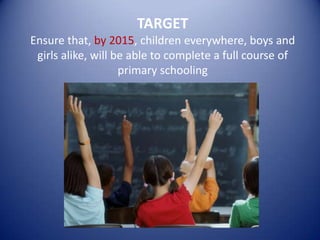
TARGET Ensure that, by 2015, children everywhere, boys and girls alike, will be able to complete a full course of primary schooling
Situation in 2010 at-a-glance:There is clear evidence that targeted interventions,  sustained by adequate funding and political commitment, have resulted in rapid progress in some areas. In others, the poorest groups, those without education or living in more remote areas, have been neglected and not provided the conditions to improve their lives.Getting children into school is a vital first step, but in order to receive the full benefits of education they must continue to attend classes.Even as the number of school-age children continues to rise, the total number of children out of school is decreasing, from 106 million in 1999 to 69 million in 2008.
“Hope dims for universal education by 2015, even as many poor countries make tremendous strides”– UN MDG 2010 ReportEnrolment in primary education has continued to rise, reaching 89 per cent in the developing world. The pace of progress is insufficient to ensure that, by 2015, all girls and boys complete a full course of primary schooling.
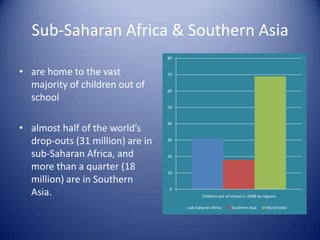
Sub-Saharan Africa & Southern Asiaare home to the vast majority of children out of schoolalmost half of the world’s drop-outs (31 million) are in sub-Saharan Africa, and more than a quarter (18 million) are in Southern Asia.
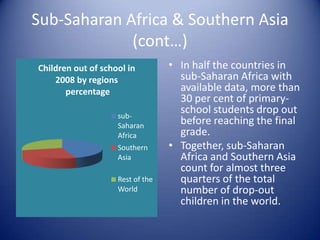
Sub-Saharan Africa & Southern Asia (cont…)In half the countries in sub-Saharan Africa with available data, more than 30 per cent of primary-school students drop out before reaching the final grade.Together, sub-Saharan Africa and Southern Asia count for almost three quarters of the total number of drop-out children in the world.
Risk factors for school drop-outThe socio-economic conditions: the poorest quintile (20%) account for almost 40% of total school drop-outsRural areas:  rural children are twice as likely to be out of school as children living in urban areasGender: girls are more likely to drop out from school than boys.Social and cultural barriers to education: in many countries, educating girls is widely perceived as being of less value than educating boys.
The right to education	http://www.youtube.com/watch?v=QzKOzLsaKaY
ReferencesUnited Nations Millennium Development Goals Report 2010 - http://mdgs.un.org/unsd/mdg/Resources/Static/Products/Progress2010/MDG_Report_2010_En_low%20res.pdf

Daniela nita mgd#2 2010

  • 1.
    Millennium Development Goal#2:Achieve universal primary educationSituation in 2010By Daniela Nita
  • 2.
    TARGET Ensure that,by 2015, children everywhere, boys and girls alike, will be able to complete a full course of primary schooling
  • 3.
    Situation in 2010at-a-glance:There is clear evidence that targeted interventions, sustained by adequate funding and political commitment, have resulted in rapid progress in some areas. In others, the poorest groups, those without education or living in more remote areas, have been neglected and not provided the conditions to improve their lives.Getting children into school is a vital first step, but in order to receive the full benefits of education they must continue to attend classes.Even as the number of school-age children continues to rise, the total number of children out of school is decreasing, from 106 million in 1999 to 69 million in 2008.
  • 4.
    “Hope dims foruniversal education by 2015, even as many poor countries make tremendous strides”– UN MDG 2010 ReportEnrolment in primary education has continued to rise, reaching 89 per cent in the developing world. The pace of progress is insufficient to ensure that, by 2015, all girls and boys complete a full course of primary schooling.
  • 5.
    Sub-Saharan Africa &Southern Asiaare home to the vast majority of children out of schoolalmost half of the world’s drop-outs (31 million) are in sub-Saharan Africa, and more than a quarter (18 million) are in Southern Asia.
  • 6.
    Sub-Saharan Africa &Southern Asia (cont…)In half the countries in sub-Saharan Africa with available data, more than 30 per cent of primary-school students drop out before reaching the final grade.Together, sub-Saharan Africa and Southern Asia count for almost three quarters of the total number of drop-out children in the world.
  • 7.
    Risk factors forschool drop-outThe socio-economic conditions: the poorest quintile (20%) account for almost 40% of total school drop-outsRural areas: rural children are twice as likely to be out of school as children living in urban areasGender: girls are more likely to drop out from school than boys.Social and cultural barriers to education: in many countries, educating girls is widely perceived as being of less value than educating boys.
  • 8.
    The right toeducation http://www.youtube.com/watch?v=QzKOzLsaKaY
  • 9.
    ReferencesUnited Nations MillenniumDevelopment Goals Report 2010 - http://mdgs.un.org/unsd/mdg/Resources/Static/Products/Progress2010/MDG_Report_2010_En_low%20res.pdf