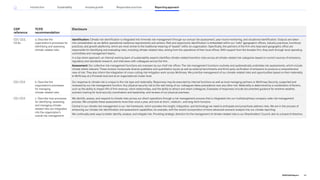
2022 ESG Report
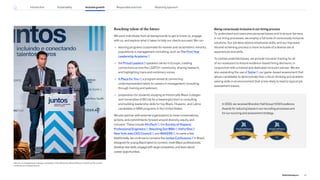
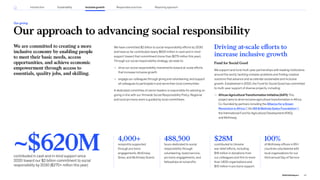
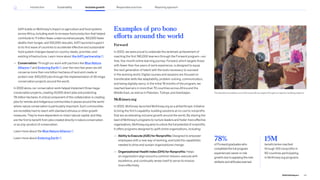
Creating a more
sustainable,
inclusive, and growing
future for all
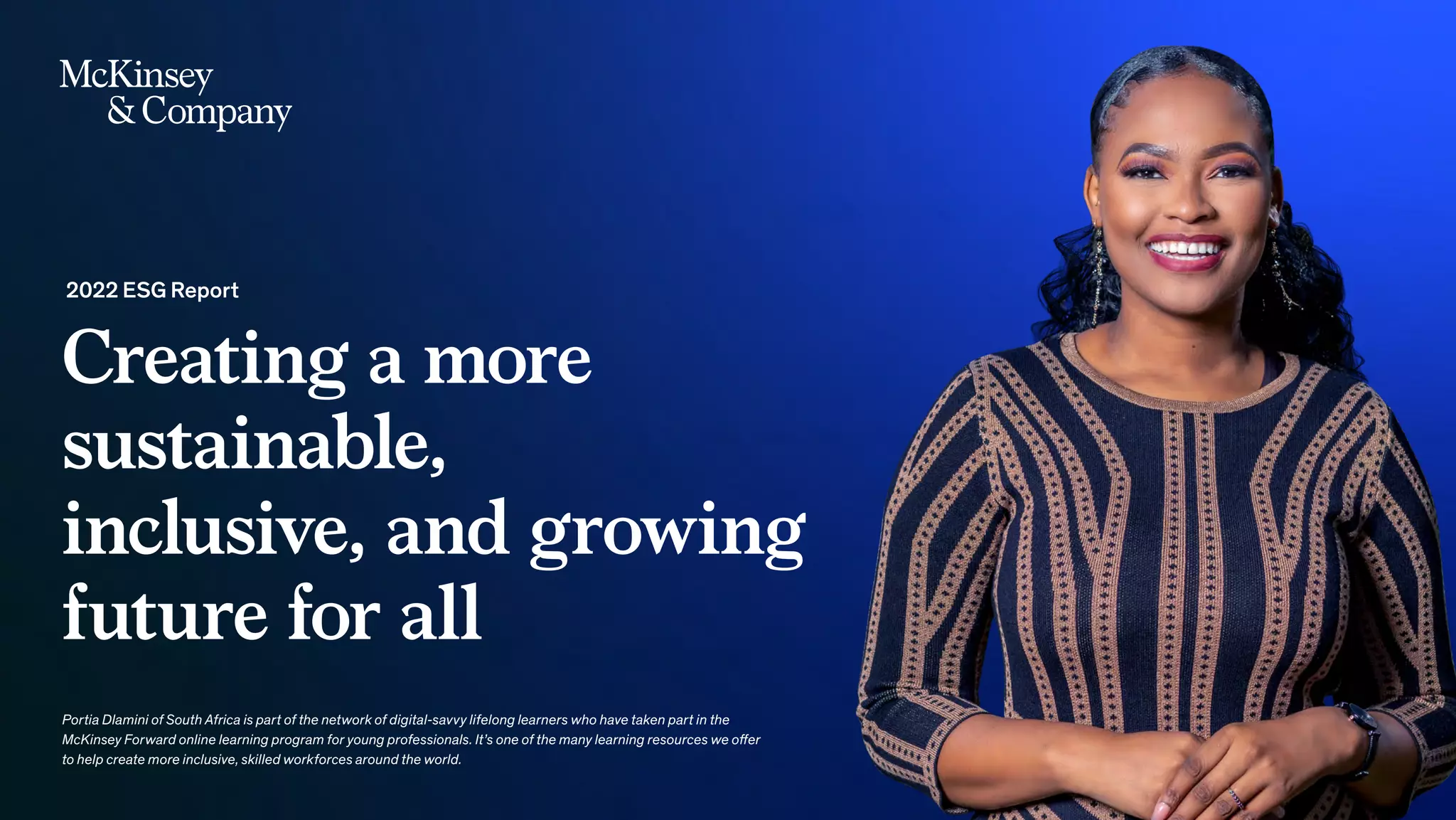
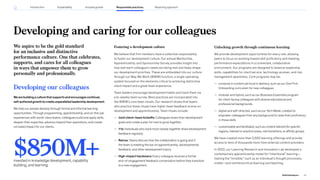
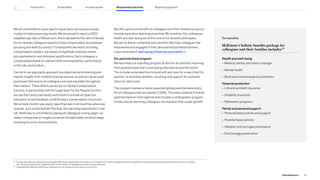
Portia Dlamini of South Africa is part of the network of digital-savvy lifelong learners who have taken part in the
McKinsey Forward online learning program for young professionals. It’s one of the many learning resources we offer
to help create more inclusive, skilled workforces around the world.
Introduction
3			 Message from our global
managing partner
5			 About McKinsey
10		
Our approach to ESG
13		
2022 progress highlights
14		
Our response to the war
in Ukraine
Sustainability
16 Sustainability at a glance
Our clients
17		
Our approach
Our insights
22		
Key publications
Our actions
24		 Our path to net zero
Inclusive growth
33 Inclusive growth
at a glance
Our clients
35		 Our approach
Our insights
43		
Key publications
Our actions
45		 Our approach to people
Our giving
52		
Our approach to advancing
social responsibility
Responsible practices
56 	Responsible practices
at a glance
57		
Developing and caring
for our colleagues
62		 Ethics and compliance
65		 Risk management
66		
Working with clients
67		
Working with suppliers
70		
Human rights
72		
Data privacy and
information security
Reporting approach
74		
Report scope
75		 Stakeholder engagement
80		 Materiality assessment
81		 How we create value
82		 Performance data
88		 GRI content index
93		 WEF IBC index
95		 TCFD index
101	
Independent assurance
statement
Introduction Sustainability Reporting approach
Responsible practices
Inclusive growth
2
2022 ESG Report
Message from our global managing partner
Accelerating sustainable and
inclusive growth for the world
A letter to all our stakeholders
The events of 2022—the start of a tragic war, food and energy crises,
severe climate events, global supply chain issues, and continuing
market volatility—challenged governments, businesses, and citizens
alike, requiring the world’s immediate and focused attention. As
always, we partnered with our clients and our communities to
respond—remaining ever committed to our firm’s long-term aspiration:
accelerating sustainable and inclusive growth for the world.
We have done the analysis to assess how we are actually doing against
this aspiration. I am incredibly proud of how—together with our clients—
we are driving measurable, society-wide impact. Our clients contribute
20 percent to global GDP growth, create one million jobs per year,
and make up 80 percent of reported CO2 emissions reductions.
While we are excited by this, we are even more motivated by it.
Seeing the measurable impact in the societies where we live and
work is what compels us to accelerate. We are continually raising our
sights, with every client engagement, every day: How can we engage
even more deeply with our clients on decarbonizing? How many more
people can we help reskill or upskill? How can we drive even more
economic growth and innovation?
We are catalyzing decarbonization
In 2022, 3,500 of our colleagues worked on more than 1,600
sustainability engagements with 600 clients across nearly 60
countries and in every industry. We are unashamed to say that this
includes working with heavy emitters—because that’s where the
emissions are. We also continue to make progress against our own
net-zero goals (including the introduction of a carbon fee on all air
travel) while convening leaders and other organizations to embark
on fresh solutions like Frontier, an advance market commitment for
carbon removal, and Catalyst Zero, for calculating carbon footprints.
We are accelerating inclusive growth
Last year, our Leap by McKinsey colleagues helped our clients build
nearly 200 new businesses—creating more than 20,000 jobs and
$140 billion in value. Our 10 Actions toward racial equity, launched in
2020, have accelerated change within our firm and are helping combat
racism worldwide. Among the many advances this year: we’ve engaged
more than 67,000 Black, Asian, Hispanic, and Latino professionals in our
Connected Leaders Academy and published 30 insight pieces through
the newly established McKinsey Institute for Black Economic Mobility.
And, to ensure we are doing what we can to create a more inclusive
economy, we have committed $2 billion to social responsibility efforts
by 2030 and have so far contributed nearly $620 million in cash and
in-kind support toward that commitment (more than $275 million this
year). Individually, our colleagues have spent nearly a half million hours
on volunteering, board service, and pro bono engagements.
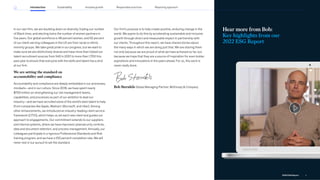
Bob (center) speaking to colleagues at a town hall in Poznań, Poland.
3
2022 ESG Report
Introduction Sustainability Reporting approach
Responsible practices
Inclusive growth
Hear more from Bob:
Key highlights from our
2022 ESG Report
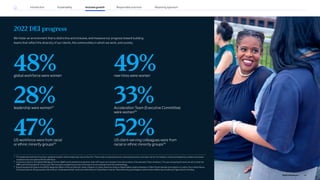
In our own firm, we are doubling down on diversity, tripling our number
of Black hires, and electing twice the number of women partners in
five years. Our global workforce is 48 percent women, and 52 percent
of our client-serving colleagues in the US are from racial or ethnic
minority groups. We take great pride in our progress, but we want to
make sure we are distinctively diverse and have more than tripled our
talent recruitment sources from 540 in 2021 to more than 1,700 this
past year to ensure that everyone with the skills and talent has a shot
at our firm.
We are setting the standard on
accountability and compliance
Accountability and compliance are deeply embedded in our processes,
mindsets—and in our culture. Since 2018, we have spent nearly
$700 million on strengthening our risk management teams,
capabilities, and processes as part of our ambition to lead our
industry—and we have recruited some of the world’s best talent to help
(from companies like Apple, Walmart, Microsoft, and Uber). Among
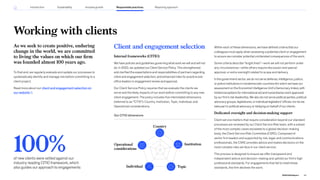
other enhancements, we introduced an industry-leading client service
framework (CITIO), which helps us vet each new client and guides our
approach to engagements. Our commitment extends to our suppliers
and internal systems, where we have improved cybersecurity controls,
data and document retention, and process management. Annually, our
colleagues participate in a rigorous Professional Standards and Risk
training program, and we have a 100 percent completion rate. We will
never rest in our pursuit to set the standard.
Our firm’s purpose is to help create positive, enduring change in the
world. We aspire to do this by accelerating sustainable and inclusive
growth through direct and measurable impact in partnership with
our clients. Throughout this report, we have shared stories about
the many ways in which we are doing just that. We are sharing them
not only because we are proud of what we have achieved so far, but
because we hope that they are a source of inspiration for even bolder
aspirations and innovations in the years ahead. For us, this work is
never really done.
Bob Sternfels Global Managing Partner, McKinsey  Company
Introduction Sustainability Reporting approach
Responsible practices
Inclusive growth
4
2022 ESG Report
About McKinsey
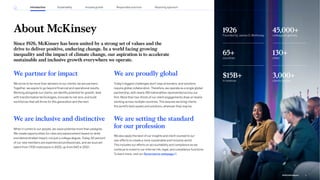
Since 1926, McKinsey has been united by a strong set of values and the
drive to deliver positive, enduring change. In a world facing growing
inequality and the impact of climate change, our aspiration is to accelerate
sustainable and inclusive growth everywhere we operate.
1926
Founded by James O. McKinsey
45,000+
colleagues globally
65+
countries
130+
cities
$15B+
in revenue
3,000+
clients served
We are proudly global
Today’s biggest challenges don’t stop at borders, and solutions
require global collaboration. Therefore, we operate as a single global
partnership, with nearly 160 nationalities represented across our
firm. More than two-thirds of our client engagements draw on teams
working across multiple countries. This assures we bring clients
the world’s best assets and solutions, wherever they may be.
We are setting the standard
for our profession
We also apply the best of our insights and client counsel to our
own efforts to create a more sustainable and inclusive world.
This includes our efforts on accountability and compliance as we
continue to invest in our internal risk, legal, and compliance functions.
To learn more, visit our Governance webpage .
We partner for impact
We strive to be more than advisers to our clients; we are partners.
Together, we aspire to go beyond financial and operational results.
Working alongside our clients, we identify potential for growth, lead
with transformative technologies, innovate to net zero, and build
workforces that will thrive for this generation and the next.
We are inclusive and distinctive
When it comes to our people, we value potential more than pedigree.
We create opportunities for roles and advancement based on skills
and demonstrated impact, not just a college degree. Today, 50 percent
of our new members are experienced professionals, and we sourced
talent from 1,700 institutions in 2022, up from 540 in 2021.
5
2022 ESG Report
Introduction Sustainability Reporting approach
Responsible practices
Inclusive growth
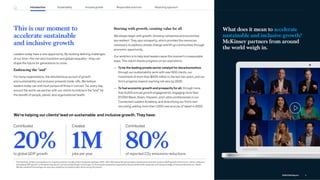
Contributed
20%
to global GDP growth
Created
1M
jobs per year
Contributed
80%
of reported CO2 emissions reductions
We’re helping our clients1 lead on sustainable and inclusive growth. They have:
1
The following numbers are based on our ongoing analysis of publicly held companies between 2015–2021. We assess the percentage of global gross domestic product (GDP) growth driven by our clients, relative to
total global GDP growth. In the same time period, we look at total Scope 1 and Scope 2 CO2 emissions reductions reported by these publicly held companies, and the percentage of those achieved by our clients.
We also establish the average net new jobs created by our publicly held clients during this period.
What does it mean to accelerate
sustainable and inclusive growth?
McKinsey partners from around
the world weigh in.
This is our moment to
accelerate sustainable
and inclusive growth
Leaders today have a rare opportunity. By tackling defining challenges
of our time—the net-zero transition and global inequality—they can
shape the future for generations to come.
Embracing the “and”
For many organizations, the simultaneous pursuit of growth
and sustainability and inclusion presents trade-offs. We believe
leaders today can and must pursue all three in concert. So, every day,
around the world, we partner with our clients to embrace the “and” for
the benefit of people, planet, and organizational health.
Starting with growth, creating value for all
We always begin with growth. Growing companies and economies
are resilient. They spur prosperity, which provides the resources
necessary to address climate change and lift up communities through
economic opportunity.
Our ambition is to help bold leaders seize this moment in measurable
ways. This report shares progress on our aspirations:
— To be the leading private sector catalyst for decarbonization,
through our sustainability work with over 600 clients, our
investment of more than $400 million in the last two years, and our
firm’s progress toward reaching net zero by 2030.
— To fuel economic growth and prosperity for all, through more
than 5,000 annual growth engagements, engaging more than
67,000 Black, Asian, Hispanic, and Latino professionals in our
Connected Leaders Academy, and diversifying our firm’s own
recruiting, adding more than 1,000 new sources of talent in 2022.
6
2022 ESG Report
Introduction Sustainability Reporting approach
Responsible practices
Inclusive growth
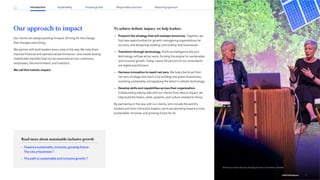
McKinsey’s Green Business Building Summit in Stockholm, Sweden.
Read more about sustainable inclusive growth
» Toward a sustainable, inclusive, growing future:
The role of business
» The path to sustainable and inclusive growth
Our approach to impact
Our clients are always pushing forward. Striving for the change
that changes everything.
We partner with bold leaders every step of the way. We help them
improve financial and operational performance—and create lasting
stakeholder benefits that can be measured across customers,
employees, the environment, and investors.
We call this holistic impact.
To achieve holistic impact, we help leaders:
— Pinpoint the strategy that will reshape tomorrow. Together, we
find new opportunities for growth, reimagining organizations for
success, and designing, building, and scaling new businesses.
— Transform through technology. Artificial intelligence (AI) and
technology suffuse all our work, forming the engine for sustainable
and inclusive growth. Today, nearly 40 percent of our consultants
are digital practitioners.
— Harness innovation to reach net zero. We help clients set their
net-zero strategy and reach it by building new green businesses,
investing sustainably, and applying the latest in climate technology.
— Develop skills and capabilities across their organization.
Collaborating side by side with our clients from idea to impact, we
help build the teams, skills, systems, and culture needed to thrive.
By partnering in this way with our clients, who include the world’s
boldest and most influential leaders, we’re accelerating toward a more
sustainable, inclusive, and growing future for all.
7
2022 ESG Report
Introduction Sustainability Reporting approach
Responsible practices
Inclusive growth
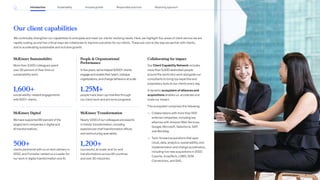
McKinsey Sustainability
More than 3,500 colleagues spent
over 30 percent of their time on
sustainability work.
1,600+
sustainability-related engagements
with 600+ clients.
McKinsey Digital
We have supported 80 percent of the
largest tech companies in digital and
AI transformations.
500+
clients partnered with us on tech delivery in
2022, and Forrester ranked us a Leader for
our work in digital transformation and AI.
People  Organizational
Performance
Infiveyears,we’vehelped9,000+clients
engageandenabletheirtalent,reshape
organizations,andchangebehaviorsatscale.
1.25M+
people have been up/reskilled through
our client work and pro bono programs.
McKinsey Transformation
Nearly 1,000 of our colleagues are experts
in holistic transformation, including
experienced chief transformation offices
and restructuring specialists.
1,200+
successful, at-scale, end-to-end
transformations across 93 countries
and over 30 industries.
Collaborating for impact
Our Client Capability Network includes
more than 5,000 dedicated people
around the world who work alongside our
consultants to bring top expertise and
proprietary tools to our clients every day.
A dynamic ecosystem of alliances and
acquisitions enables us accelerate and
scale our impact.
This ecosystem comprises the following:
— Collaborations with more than 500
external companies, including key
alliances with Amazon Web Services,
Google, Microsoft, Salesforce, SAP,
and Workday.
— Tech-forward acquisitions that span
cloud, data, analytics, sustainability, and
implementation and change acceleration,
including five new acquisitions in 2022:
Caserta, IncepTech, LOBO, SCM
Connections, and S4G.
Our client capabilities
We continually strengthen our capabilities to anticipate and meet our clients’ evolving needs. Here, we highlight four areas of client service we are
rapidly scaling up and two critical ways we collaborate to improve outcomes for our clients. These are core to the way we partner with clients,
and to accelerating sustainable and inclusive growth.
8
2022 ESG Report
Introduction Sustainability Reporting approach
Responsible practices
Inclusive growth
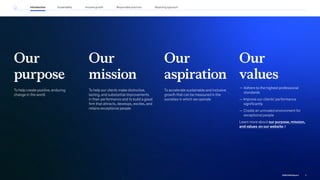
Our
purpose
To help create positive, enduring
change in the world
Our
aspiration
To accelerate sustainable and inclusive
growth that can be measured in the
societies in which we operate
Our
values
— Adhere to the highest professional
standards
— Improve our clients’ performance
significantly
— Create an unrivaled environment for
exceptional people
Learn more about our purpose, mission,
and values on our website
Our
mission
To help our clients make distinctive,
lasting, and substantial improvements
in their performance and to build a great
firm that attracts, develops, excites, and
retains exceptional people
9
2022 ESG Report
Introduction Sustainability Reporting approach
Responsible practices
Inclusive growth
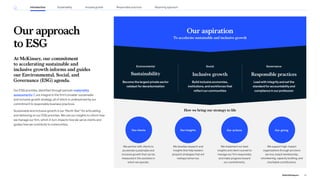
Our approach
to ESG
At McKinsey, our commitment
to accelerating sustainable and
inclusive growth informs and guides
our Environmental, Social, and
Governance (ESG) agenda.
Our ESG priorities, identified through periodic materiality
assessments , are integral to the firm’s broader sustainable
and inclusive growth strategy, all of which is underpinned by our
commitment to responsible business practices.
Sustainable and inclusive growth is our “North Star” for articulating
and delivering on our ESG priorities. We use our insights to inform how
we manage our firm, which in turn impacts how we serve clients and
guides how we contribute to communities.
Our aspiration
To accelerate sustainable and inclusive growth
How we bring our strategy to life
Our clients Our insights Our actions Our giving
We partner with clients to
accelerate sustainable and
inclusive growth that can be
measured in the societies in
which we operate.
We develop research and
insights that help leaders
pinpoint strategies that will
reshape tomorrow.
We implement our best
insights and client counsel to
manage our firm responsibly
and make progress toward
our commitments.
We support high-impact
organizations through pro bono
service, board membership,
volunteering, capacity building, and
charitable contributions.
Become the largest private sector
catalyst for decarbonization
Build inclusive economies,
institutions, and workforces that
reflect our communities
Lead with integrity and set the
standard for accountability and
compliance in our profession
Environmental
Sustainability
Social
Inclusive growth
Governance
Responsible practices
10
2022 ESG Report
Introduction Sustainability Reporting approach
Responsible practices
Inclusive growth
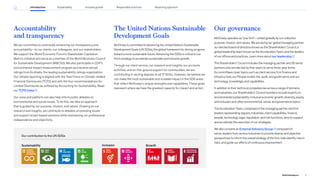
The United Nations Sustainable
Development Goals
McKinseyiscommittedtoadvancingtheUnitedNationsSustainable
DevelopmentGoals(UNSDGs),theglobalframeworkfordrivingprogress
towardamoresustainablefuture.AdvancingtheSDGsiscriticaltoour
firm’sstrategytoacceleratesustainableandinclusivegrowth.
Through our client service, our research and insights, our pro bono
activities, and on-the-ground support for communities, we are
contributing in varying degrees to all 17 SDGs. However, we believe we
can make the most sustainable and scalable impact in the SDG areas
that reflect McKinsey’s unique strengths and capabilities. These goals
represent where we have the greatest capacity for impact and action.
Our contribution to the UN SDGs
Sustainability Growth
Inclusion
Accountability
and transparency
We are committed to continually enhancing our transparency and
accountability—to our clients, our colleagues, and our stakeholders.
We support the World Economic Forum’s Stakeholder Capitalism
Metrics initiative and serve as a member of the World Business Council
for Sustainable Development (WBCSD). We also participate in CDP’s
environmental impact measurement program and receive annual
ratings from EcoVadis, the leading sustainability ratings organization.
Our climate reporting is aligned with the Task Force on Climate-related
Financial Disclosures (TCFD) and with the four recommendations for
Limited Disclosures as outlined by Accounting for Sustainability. Read
our TCFD index .
Our voice and platform can also help inform public debates on
environmental and social issues. To do this, we take an approach
that is guided by our purpose, mission, and values. Drawing on our
research and insights, we contribute to debates on pressing issues
and support broad-based solutions while maintaining our professional
independence and objectivity.
Our governance
McKinseyoperatesas“onefirm”—unitedgloballybyourcollective
purpose,mission,andvalues.Weareledbyourglobalmanagingpartner,
ourelectedboardofdirectorsknownastheShareholders’Council,a
globalleadershipteamknownastheAccelerationTeam,andtheleaders
ofourofficesandpractices.Learnmoreaboutour leadership .
TheShareholders’Councilincludesthemanagingpartnerand30senior
partnerswhoareelectedbytheirpeerstoservethree-yearterms.
Itscommitteescovertopicssuchasclientservice;firmfinanceand
infrastructure;ourPeoplemodel;risk,audit,andgovernance;andour
technology,knowledge,andcapabilities.
Inadditiontotheirtechnicalcompetenciesacrossarangeofdomains
andindustries,ourShareholders’Councilmembersincludeexpertson
environmentalsustainability;inclusiveeconomicgrowth;diversity,equity,
andinclusion;andotherenvironmental,social,andgovernancetopics.
TheAccelerationTeam,composedofthemanagingpartnerandfirm
leadersrepresentingregions,industries,clientcapabilities,finance,
people,technology,legal,reputation,andriskfunctions,aimstosupport
andacceleratetheexecutionofourstrategies.
WealsoconveneanExternal Advisory Group composedof
seniorleadersfromvariousindustriestoprovidediverseandobjective
perspectivestoinformtheoverallstrategyofthefirm,helpidentifymacro
risks,andguideoureffortsofcontinuousimprovement.
11
2022 ESG Report
Introduction Sustainability Reporting approach
Responsible practices
Inclusive growth
Our Governance Committees
Committee Focus areas
Administrative Handling administrative and ministerial functions,
and assisting with implementation of actions
previously approved by the Shareholders’ Council
or one of the Shareholders’ Council committees.
Client Setting strategic direction, policies, and
standards for overall client service and
monitoring performance.
Finance and
Infrastructure
Overseeing financial policies and providing
stewardship of the firm’s financial and
infrastructure resources.
People Setting our People mission, strategy, and policies
and monitoring performance.
Developing standards and criteria for election to
partner, and electing partners.
Risk,
Audit, and
Governance
Providing strategic direction to and oversight
of the firm’s risk management and compliance
activities and overall governance.
Providing oversight of internal audit.
Technology,
Knowledge,
 Capabilities
Setting strategic direction and policies to help
build preeminent capabilities, technology assets,
and knowledge to deliver against the firm’s
aspirations and mission, and further innovate the
client service.
ESG oversight
The McKinsey ESG Council consists of senior firm function, client service,
and regional leaders across sustainability, people, risk, communications,
and legal. The ESG Council provides oversight of our agenda by defining
our priorities, setting our direction, and monitoring progress. In 2022,
the ESG Council met periodically to review progress against our ESG
commitments and initiatives, approve updates to our Human Rights
Policy and human rights program, and provide guidance on how to
prepare the firm for compliance with upcoming ESG regulations.
At the board level, the Risk, Audit, and Governance Committee of the
Shareholders’Council(RAGC)providesstrategicdirectiontoandoversight
of our ESG priorities and commitments, including our environmental
sustainabilitystrategyandclimate-relatedefforts,oursocialresponsibility
program, and our risk, ethics, and compliance programs. Our Global
Managing Partner and several members of the RAGC and ESG Council
review and approve the content of our annual ESG Report.
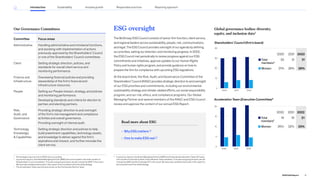
Global governance bodies: diversity,
equity, and inclusion data2
2020 2021 2022
Total
members3
30 31 31
Women 21% 26% 26%
2020 2021 2022
Total
members5
19 19 21
Women 26% 32% 33%
0
5
10
15
20
2020 2021 2022
0
10
20
30
40
2020 2021 2022
Shareholders’ Council (firm’s board)
Acceleration Team (Executive Committee)4
Read more about ESG
» Why ESG matters
» How to make ESG real
2
Percentages may not sum to 100% due to rounding.
3
In previous reports, the Global Managing Partner (GMP) was not included in the total number of
Shareholders’ Council members. This year and going forward, we will include the GMP in the count.
We have also restated historicals in this report to be consistent with this methodology.
4
The Acceleration Team was formerly known as the Partnership Service Team.
5
In previous reports, the Global Managing Partner (GMP) and Extended Acceleration Team (AT) were
not included in the total number of Acceleration Team members. This year and going forward, we will
include the GMP and the Extended AT in the count. We have also restated historicals in this report to
be consistent with this methodology.
12
2022 ESG Report
Introduction Sustainability Reporting approach
Responsible practices
Inclusive growth
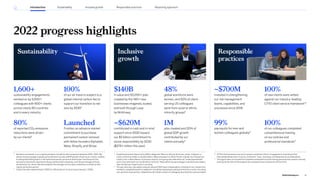
1,600+
sustainability engagements
worked on by 3,500+
colleagues with 600+ clients
across nearly 60 countries
and in every industry
80%
of reported CO2 emissions
reductions were driven
by our clients6
$140B
in value and 20,000+ jobs
created by the 190+ new
businesses imagined, scaled,
and built through Leap
by McKinsey
~$620M
contributed in cash and in-kind
support since 2020 toward
our $2 billion commitment to
social responsibility by 2030
($275+ million this year)
~$700M
invested in strengthening
our risk management
teams, capabilities, and
processes since 2018
99%
pay equity for men and
women colleagues globally9
100%
of our air travel is subject to a
global internal carbon fee to
support our transition to net
zero by 20307
Launched
Frontier, an advance market
commitment to purchase
permanent carbon removal
with fellow founders Alphabet,
Meta, Shopify, and Stripe
48%
global workforce were
women, and 52% of client-
serving US colleagues
were from racial or ethnic
minority groups8
1M
jobs created and 20% of
global GDP growth
contributed by our
clients annually6
100%
of new clients were vetted
against our industry-leading
CITIO client service framework10
100%
of our colleagues completed
comprehensive training
on our policies and
professional standards11
Sustainability Inclusive
growth
Responsible
practices
2022 progress highlights
6
Numbers are based on our ongoing analysis of publicly held companies between 2015–2021. We
assess the percentage of global gross domestic product (GDP) growth driven by our clients, relative
to total global GDP growth. In the same time period, we look at total Scope 1 and Scope 2 CO2
emissions reductions reported by these publicly held companies, and the percentage of those
achieved by our clients. We also establish the average net new jobs created by our publicly held
clients during this period.
7
Carbon fee was implemented in 2022 for official launch on all air travel January 1, 2023.
EMAIL
8
Equal Employment Opportunity (EEO) categories: Black or African American, Asian, Hispanic or
Latino, American Indian or Alaska Native, Native Hawaiian or Other Pacific Islander (not Hispanic or
Latino), Two or More Races. In previous reports, this group was referred to as “underrepresented”
and is now referred to as “racial/ethnic minority.” Race/ethnicity percentages in performance tables
may not add up to figure due to rounding.
9
The pay ratio was calculated using annualized 2022 total compensation of female to non-female firm
members, weighted based on segments including employee grouping and level by country, including
non-partners and partners. Segments with a total number of colleagues less than ten were excluded.
10
CITIO is the framework we use to assess a potential client or engagement consisting of five
interrelated dimensions: Country, Institution, Topic, Individual, and Operational considerations.
11
This figure does not include firm members exempted from the training because they weren’t actively
working at the time of the program (for example, leave of absence, left the firm).
13
2022 ESG Report
Introduction Sustainability Reporting approach
Responsible practices
Inclusive growth PDF COPY
MIRO
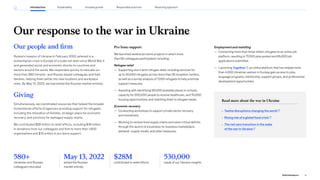
580+
Ukrainian and Russian
colleagues relocated
May 13, 2022
exited the Russian
market entirely
$28M
contributed to relief efforts
530,000
reads of our Ukraine insights
Our people and firm
Russia’s invasion of Ukraine in February 2022 ushered in a
humanitarian crisis in Europe of a scale not seen since World War II
and generated social and economic shocks to countries and
sectors around the world. We responded quickly to relocate our
more than 580 Ukraine- and Russia-based colleagues and their
families, helping them settle into new locations and workplace
roles. By May 13, 2022, we had exited the Russian market entirely.
Giving
Simultaneously, we coordinated resources that helped the broader
humanitarian efforts of agencies providing support for refugees,
including the relocation of families, strategic plans for economic
recovery, and solutions for damaged supply chains.
We contributed $28 million to relief efforts, including $18 million
in donations from our colleagues and firm to more than 1,600
organizations and $10 million in pro bono support.
Pro bono support
We launched several pro bono projects in which more
than 50 colleagues participated, including:
Refugee relief
— Supporting short-term refugee relief, including services for
up to 30,000 refugees across more than 25 reception centers,
as well as a survey analysis of 7,000 refugees to help prioritize
support measures.
— Assisting with identifying 90,000 available places in schools,
capacity for 200,000 people to receive healthcare, and 70,000
housing opportunities, and matching them to refugee needs.
Economic recovery
— Conducting workshops to support private sector recovery
and investment.
— Working to restore food supply chains and solve critical deficits
through the launch of a business-to-business marketplace,
demand–supply model, and other measures.
Our response to the war in Ukraine
Employment and reskilling
— Connecting more than three million refugees to an online job
platform, resulting in 17,000 jobs posted and 65,000 job
applications submitted.
— Launching Together , an online platform that has helped more
than 4,000 Ukrainian women in Europe gain access to jobs,
language programs, mentorship, support groups, and professional
development opportunities.
Read more about the war in Ukraine
» Twelve disruptions changing the world
» Rising risk of a global food crisis
» The net-zero transition in the wake
of the war in Ukraine
14
2022 ESG Report
Introduction Sustainability Reporting approach
Responsible practices
Inclusive growth
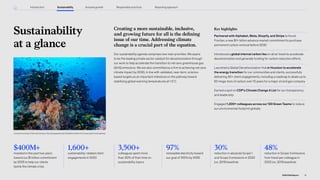
Sustainability
In this chapter, we share our progress
toward achieving net-zero climate impact
and how we partner with clients to catalyze
and accelerate decarbonization globally.
In this chapter
16 Sustainability at a glance
Our clients
17		
Our approach
Our insights
22		
Key publications
Our actions
24		 Our path to net zero
Introduction Sustainability Reporting approach
Responsible practices
Inclusive growth
15
2022 ESG Report
1,600+
sustainability-related client
engagements in 2022
$400M+
invested in the past two years
toward our $1 billion commitment
by 2025 to help our clients
tackle the climate crisis
3,500+
colleagues spent more
than 30% of their time on
sustainability topics
97%
renewable electricity toward
our goal of 100% by 2025
30%
reduction in absolute Scope 1
and Scope 2 emissions in 2022
(vs. 2019 baseline)
48%
reduction in Scope 3 emissions
from travel per colleague in
2022 (vs. 2019 baseline)
Sustainability
at a glance
Key highlights
Partnered with Alphabet, Meta, Shopify, and Stripe to found
Frontier, a new $1+ billion advance market commitmentto purchase
permanent carbon removal before 2030
Introduced a global internal carbon fee on all air travel to accelerate
decarbonization and generate funding for carbon reduction efforts
Launched a Global Decarbonization Hubin Houston to accelerate
the energy transition for our communities and clients, successfully
delivering 30+ client engagements, including a roadmap to abate up to
50 mega-tons of carbon over 10 years for a major oil and gas company
Earned a spot on CDP’s Climate Change A List for our transparency
and leadership
Engaged 1,200+ colleagues across our 120 Green Teams to reduce
our environmental footprint globally
Creating a more sustainable, inclusive,
and growing future for all is the defining
issue of our time. Addressing climate
change is a crucial part of the equation.
Our sustainability agenda comprises two main priorities. We aspire
to be the leading private sector catalyst for decarbonization through
our work to help accelerate the transition to net-zero greenhouse gas
(GHG) emissions. We are also committed as a firm to achieving net-zero
climate impact by 2030, in line with validated, near-term, science-
based targets as an important milestone on the pathway toward
stabilizing global warming temperatures at 1.5˚C.
Coral and schools of fish swimming in Fiji; photographed by Rodolphe Holler for Conservation International.
16
2022 ESG Report
Introduction Sustainability Reporting approach
Responsible practices
Inclusive growth
Our approach
We partner with leaders
to accelerate sustainability
and growth.
More than 3,000 companies have made net-zero commitments. Faced
with the twin imperatives of advancing climate solutions and ensuring
growth, some leaders could be tempted into either/or choices.
We believe that the best response to this moment is to create strategies
that square the dual needs for growth and a climate transition. That’s why
we are driving sustainable innovation that unlocks the next horizon of
growth. By pursuing net-zero and nature commitments, the private and
public sectors can address the climate crisis while ensuring the net-zero
transition is affordable, secure, and reliable.
Our clients
1,600+
sustainability-related client engagements in 2022
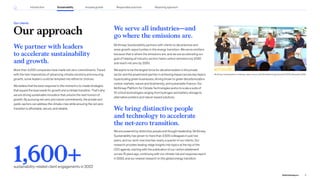
McKinsey-hostedpaneloncreatingaclean,secure,andaffordableenergyfutureatCOP27,November2022.
We serve all industries—and
go where the emissions are.
McKinsey Sustainability partners with clients to decarbonize and
seize growth opportunities in the energy transition. We serve emitters
because that is where the emissions are, and we are accelerating our
goal of helping all industry sectors halve carbon emissions by 2030
and reach net zero by 2050.
We aspire to be the largest force for decarbonization in the private
sector and the preeminent partner in achieving impact across key topics:
hyperscaling green businesses, driving brown to green decarbonization,
carbon markets, nature and biodiversity, and sustainable finance. Our
McKinsey Platform for Climate Technologies works to scale a suite of
10 critical technologies ranging from hydrogen and battery storage to
alternative proteins and nature-based solutions.
We bring distinctive people
and technology to accelerate
the net-zero transition.
We are powered by distinctive people and thought leadership. McKinsey
Sustainability has grown to more than 3,500 colleagues in just two
years, and our work now touches nearly a quarter of our clients. Our
research provides leading-edge insights into topics at the top of the
CEO agenda, starting with the publication of our carbon abatement
curves 15 years ago, continuing with our climate risk and response report
in 2020, and our newest research on the global energy transition.
17
2022 ESG Report
Introduction Sustainability Reporting approach
Responsible practices
Inclusive growth
Our key actions in 2022
Convening leaders to catalyze climate action
McKinsey works side by side with leading institutions to convene
global partnerships that tackle problems that any one institution alone
could not. In 2022, McKinsey launched a new series of global Green
Business Building summits with a flagship convening in Stockholm
that brought together more than 300 C-suite executives from green
tech disruptors, incumbents with ambitious green growth agenda, and
sustainability investors.
As the Opening Ceremony Partner for Climate Week NYC, McKinsey
led conversations on progress toward net-zero goals amid
economic uncertainty.
At COP27 in Egypt, McKinsey Sustainability hosted a series of
in-person and live-streamed events that reached more than 100,000
people. These events focused on the practical steps leaders can take
to achieve sustainability and growth across key areas such as energy,
nature, materials, adaptation, and finance.
Replay these discussions on our website .
Accelerating decarbonization transformations
with Microsoft and Catalyst Zero
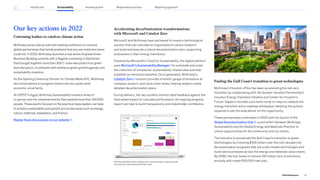
Microsoft and McKinsey have partnered to create a technological
solution that can calculate an organization’s carbon footprint
and build and execute a robust decarbonization plan, supporting
businesses in their energy transitions.
Powered by Microsoft’s Cloud for Sustainability, the digital platform
uses Microsoft’s Sustainability Manager to automate and scale
the collection of companies’ sustainability-related data and help
establish an emissions baseline. Once generated, McKinsey’s
Catalyst Zero solution provides a holistic gauge of emissions at
company, product, and value chain levels, helping leaders create
detailed decarbonization plans.
During delivery, the two systems monitor data feedback against the
forecasted impact to calculate performance. An ongoing progress
report can help to build transparency and stakeholder confidence.
Fueling the Gulf Coast’s transition to green technologies
McKinsey’s Houston office has been accelerating the net-zero
transition by collaborating with the Greater Houston Partnership’s
Houston Energy Transition Initiative and Center for Houston’s
Future. Support includes a pro bono study on ways to catalyze the
energy transition and a roadmap whitepaper detailing the actions
required to see the area deliver on this opportunity.
These partnerships culminated in 2022 with the launch of the
Global Decarbonization Hub , a joint effort between McKinsey
Sustainability and the Global Energy and Materials Practice to
unlock opportunities for the community and our clients.
The hub aims to accelerate the Gulf Coast’s transition to green
technologies by investing $100 million over the next decade into
decarbonization programs that will scale climate technologies and
build new businesses across the energy and materials value chains.
By 2050, the hub seeks to remove 100 million tons of emissions
annually and create 500,000 new jobs.
McKinsey and Microsoft’s Catalyst Zero solution helps companies build
and execute a robust decarbonization plan.
18
2022 ESG Report
Introduction Sustainability Reporting approach
Responsible practices
Inclusive growth
Enduring Earth: Advancing
global conservation efforts
In 2022, McKinsey joined the Enduring Earth initiative, a collaboration
between The Nature Conservancy, The Pew Charitable Trusts, World
Wildlife Fund, and ZOMALAB to accelerate ocean, land, and freshwater
conservation and support community development worldwide.
The effort brings together governments, local communities,
Indigenous peoples, and funders to develop accountable, actionable,
and science-based conservation plans that create opportunities for
sustainable economic growth.
Enduring Earth uses Project Finance for Permanence—also
known as a PFP—an innovative and proven model that fully
funds conservation efforts to ensure durable and scalable
impact. The approach closely follows the project financing
methodology commonly used in large infrastructure projects.
It ensures all funding and pre-conditions for success are
committed in a single-deal moment before funding is released.
That means the commitments of one stakeholder can leverage the
commitments of others, like philanthropists or the private sector,
and vice versa. Early community buy-in and involvement are critical
elements of the process, and this approach ensures communities can
be in the driver’s seat every step of the way.
McKinsey is contributing to this model through the analysis and
optimization of socioeconomic impact, identifying sustainable
financing mechanisms, and enabling access to carbon markets.
To date, nearly 90 million hectares across five nations have been
conserved with the goal of protecting another 600 million hectares
across 20 nations by 2030.
Impact story
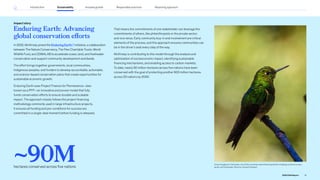
A hummingbird in Colombia, one of the countries where Enduring Earth is helping conserve ocean,
lands, and freshwater. ©Jonny James/Unsplash
~90M
hectares conserved across five nations
19
2022 ESG Report
Introduction Sustainability Reporting approach
Responsible practices
Inclusive growth
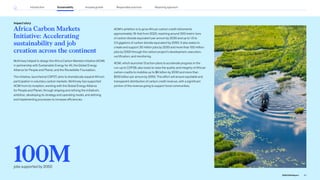
Africa Carbon Markets
Initiative: Accelerating
sustainability and job
creation across the continent
McKinsey helped to design the Africa Carbon Markets Initiative (ACMI)
in partnership with Sustainable Energy for All, the Global Energy
Alliance for People and Planet, and the Rockefeller Foundation.
The initiative, launched at COP27, aims to dramatically expand Africa’s
participation in voluntary carbon markets. McKinsey has supported
ACMI from its inception, working with the Global Energy Alliance
for People and Planet, through shaping and refining the initiative’s
ambition, developing its strategy and operating model, and defining
and implementing processes to increase efficiencies.
Impact story
ACMI’s ambition is to grow African carbon credit retirements
approximately 19-fold from 2020, reaching around 300 metric tons
of carbon dioxide equivalent per annum by 2030 and up to 1.5 to
2.5 gigatons of carbon dioxide equivalent by 2050. It also seeks to
create and support 30 million jobs by 2030 and more than 100 million
jobs by 2050 through the carbon project’s development, execution,
certification, and monitoring.
ACMI, which launched 13 action plans to accelerate progress in the
run-up to COP28, also looks to raise the quality and integrity of African
carbon credits to mobilize up to $6 billion by 2030 and more than
$100 billion per annum by 2050. This effort will ensure equitable and
transparent distribution of carbon credit revenue, with a significant
portion of the revenue going to support local communities.
100M
jobs supported by 2050
20
2022 ESG Report
Introduction Sustainability Reporting approach
Responsible practices
Inclusive growth
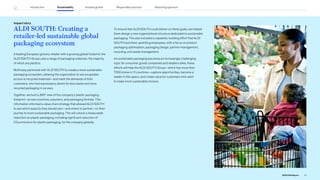
ALDI SOUTH: Creating a
retailer-led sustainable global
packaging ecosystem
A leading European grocery retailer with a growing global footprint, the
ALDI SOUTH Group uses a range of packaging materials, the majority
of which are plastics.
McKinsey partnered with ALDI SOUTH to create a more sustainable
packaging ecosystem, allowing the organization to secure greater
access to recycled materials—and meet the demands of their
customers, who had expressed a desire for less waste and more
recycled packaging in surveys.
Together, we built a 360° view of the company’s plastic packaging
footprint—across countries, polymers, and packaging formats. This
information informed a value chain strategy that allowed ALDI SOUTH
to see which aspects they should own—and where to partner—on their
journey to more sustainable packaging. This will unlock a measurable
reduction on plastic packaging, including significant reduction of
CO2 emissions for plastic packaging, for the company globally.
Impact story
To ensure that ALDI SOUTH could deliver on these goals, we helped
them design a new organizational structure dedicated to sustainable
packaging. This also included a capability-building effort that ALDI
SOUTH launched, upskilling employees, with a focus on product
packaging optimization, packaging design, partner management,
recycling, and waste management.
As sustainable packaging becomes an increasingly challenging
topic for consumer goods companies and retailers alike, these
efforts will help the ALDI SOUTH Group—which has more than
7,100 stores in 11 countries—capture opportunities, become a
leader in this space, and create value for customers who want
to make more sustainable choices.
21
2022 ESG Report
Introduction Sustainability Reporting approach
Responsible practices
Inclusive growth
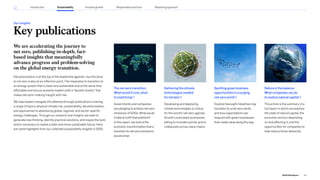
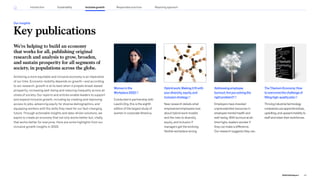
Key publications
Our insights
We are accelerating the journey to
net zero, publishing in-depth, fact-
based insights that meaningfully
advance progress and problem-solving
on the global energy transition.
Decarbonization is at the top of the leadership agenda—but the drive
to net zero is also at an inflection point. The imperative to transition to
an energy system that is clean and sustainable and at the same time
affordable and secure presents leaders with a “devilish duality” that
makes decision-making fraught with risk.
We help leaders navigate this dilemma through publications covering
a range of topics: physical climate risk, sustainability, decarbonization,
and approaches to addressing global, regional, and sector-specific
energy challenges. Through our research and insights, we seek to
generate new thinking, identify practical solutions, and inspire the bold
action necessary to realize a safer and more sustainable future. Here
are some highlights from our collected sustainability insights in 2022.
The net-zero transition:
What would it cost, what
it could bring
Governments and companies
are pledging to achieve net-zero
emissions of GHGs. What would
it take to fulfill that ambition?
In this report, we look at the
economic transformation that a
transition to net-zero emissions
would entail.
Spotting green business
opportunities in a surging
net-zero world
Explore how eight industries may
transition to a net-zero world,
and how organizations can
respond with green businesses
that create value along the way.
Nature in the balance:
What companies can do
to restore natural capital
This article is the summary of a
full report in which we examine
the state of natural capital, the
economic sectors depending
on and affecting it, and the
opportunities for companies to
help reduce those demands.
Delivering the climate
technologies needed
fornet zero
Developing and deploying
climate technologies is critical
for the world’s net-zero agenda.
Growth could await businesses
willing to innovate quickly and to
collaborate across value chains.
22
2022 ESG Report
Introduction Sustainability Reporting approach
Responsible practices
Inclusive growth
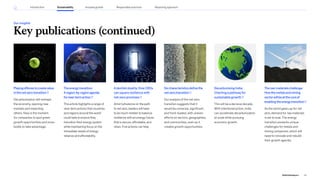
Playingoffensetocreatevalue
inthenet-zerotransition
Decarbonization will reshape
the economy, opening new
markets and imperiling
others. Now is the moment
for companies to spot green
growth opportunities and move
boldly to take advantage.
Theenergytransition:
Aregion-by-regionagenda
fornear-termaction
This article highlights a range of
near-term actions that countries
and regions around the world
could take to ensure they
transition their energy system
while maintaining focus on the
immediate needs of energy
reliance and affordability.
A devilish duality: How CEOs
can square resilience with
net-zero promises
Amid turbulence on the path
to net zero, leaders will have
to be much nimbler to balance
resilience with an energy future
that is secure, affordable, and
clean. Five actions can help.
Decarbonising India:
Charting a pathway for
sustainable growth
This will be a decisive decade.
With intentional action, India
can accelerate decarbonization
at scale while pursuing
economic growth.
Theraw-materialschallenge:
Howthemetalsandmining
sectorwillbeatthecoreof
enablingtheenergytransition
As the world gears up for net
zero, demand for raw materials
is set to soar. The energy
transition presents unique
challenges for metals and
mining companies, which will
need to innovate and rebuild
their growth agenda.
Sixcharacteristicsdefinethe
net-zerotransition
Our analysis of the net-zero
transition suggests that it
would be universal, significant,
and front-loaded, with uneven
effects on sectors, geographies,
and communities, even as it
creates growth opportunities.
Key publications (continued)
Our insights
23
2022 ESG Report
Introduction Sustainability Reporting approach
Responsible practices
Inclusive growth
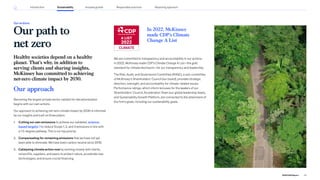
Our path to
net zero
Our actions
Healthy societies depend on a healthy
planet. That’s why, in addition to
serving clients and sharing insights,
McKinsey has committed to achieving
net-zero climate impact by 2030.
Our approach
Becoming the largest private sector catalyst for decarbonization
begins with our own actions.
Our approach to achieving net-zero climate impact by 2030 is informed
by our insights and built on three pillars:
1. Cutting our own emissions to achieve our validated, science-
based targets to reduce Scope 1, 2, and 3 emissions in line with
a 1.5-degree pathway. This is our top priority.
2. Compensating for remaining emissions that we have not yet
been able to eliminate. We have been carbon neutral since 2018.
3. Catalyzing climate action now by working closely with clients,
nonprofits, suppliers, and peers to protect nature, accelerate new
technologies, and ensure crucial financing.
In 2022, McKinsey
made CDP’s Climate
Change A List
We are committed to transparency and accountability in our actions.
In 2022, McKinsey made CDP’s Climate Change A List—the gold
standard for climate disclosure—for our transparency and leadership.
The Risk, Audit, and Governance Committee (RAGC), a sub-committee
of McKinsey’s Shareholders’ Council (our board), provides strategic
direction, oversight, and accountability for climate-related issues.
Performance ratings, which inform bonuses for the leaders of our
Shareholders’ Council, Acceleration Team (our global leadership team),
and Sustainability Growth Platform, are connected to the attainment of
the firm’s goals, including our sustainability goals.
24
2022 ESG Report
Introduction Sustainability Reporting approach
Responsible practices
Inclusive growth
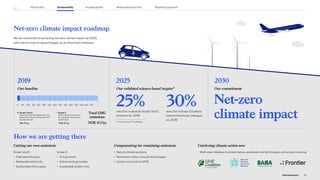
Net-zero climate impact roadmap
We are committed to achieving net-zero climate impact by 2030,
with interim science-based targets as an important milestone.
Our validated science-based targets12
Our commitment
Net-zero
climate impact
25%
reduction in absolute Scope 1 and 2
emissions (vs. 2019)
2030
2025
2019
How we are getting there
Compensating for remaining emissions Catalyzing climate action now
Our baseline
Total GHG
emissions
743K tCO2e
0 50 100 150 200 250 300 350 400 450 500 550 600 650 700
Cutting our own emissions
Scope 1 and 2:
Direct and indirect emissions—for
example, from our offices and firm-
owned vehicles
Scope 3:
Other indirect emissions—
for example, internal and
client travel
725K tCO2e
18K tCO2e
30%
reduction in Scope 3 business
travel emissions per colleague
(vs. 2019)
• Multi-year initiatives to protect nature, accelerate new technologies, and ensure financing
• Natural climate solutions
• Permanent carbon removal technologies
• Carbon neutral since 2018
Scope 1 and 2:
• Fleet electrification
• Renewable electricity
• Sustainable office space
Scope 3:
• Virtual events
• Hybrid working models
• Sustainable aviation fuel
12
In line with a 1.5°C pathway.
25
2022 ESG Report
Introduction Sustainability Reporting approach
Responsible practices
Inclusive growth
ALDI SOUTH: Creating a
retailer-led sustainable global
packaging ecosystem
A leading European grocery retailer with a growing global footprint, the
ALDI SOUTH Group uses a range of packaging materials, the majority
of which are plastics. Today, ALDI SOUTH’s plastic packaging portfolio
consists of a wide variety of formats and different polymers, without
any consistent standards—often, discarding that plastic waste also
poses a logistics challenge.
McKinsey partnered with ALDI SOUTH to create a more sustainable
packaging ecosystem, allowing the organization to secure greater
access to recycled materials—and meet the demands of their
customers, who had expressed a desire for less waste and more
recycled packaging in surveys.
Together, we built a 360° view of the company’s plastic packaging
footprint—across countries, polymers, and packaging formats. This
information informed a value chain strategy that allowed ALDI SOUTH
to see which aspects they should own—and where to partner—on their
journey to more sustainable packaging. It also led to 15 percent savings
on packaging for the company globally.
Cutting our
own emissions
Compensating for
remaining emissions
Catalyzing climate
action now
Shifting to 50% carbon removals by 2025 to reach 100% by 2030
Invested in a portfolio of natural climate solutions projects , for example:
— The Delta Blue Carbon project in Pakistan has restored and protected 224,000+ hectares of mangroves,
benefiting 10,400+ people.
— The Southern Cardamom REDD+ Project in Cambodia has helped 16,000+ people build more sustainable
livelihoods by protecting 442,000 hectares of forests home to 35 threatened species.
— The CO2OL Tropical Mix reforestation project in Panama has planted 7.5 million trees and helped local
residents benefit from increased employment, higher wages, and health and pension benefits.
Launched Frontier with Alphabet, Meta, Shopify, and Stripe, a new $1+ billion advance market
commitment to purchase permanent carbon removal before 2030
— We signed multi-year offtake agreements with multiple carbon removal providers worth ~$10 million
for our own footprint as part of our commitment to scale the tech-based carbon removal market and
compensate for our remaining emissions.
Joined the Enduring Earth initiative to accelerate ocean, land, and freshwater conservation
Continued to partner with the LEAF Coalition to scale jurisdictional carbon credits and with the
Sustainable Aviation Buyers Alliance to scale the sustainable aviation fuel market
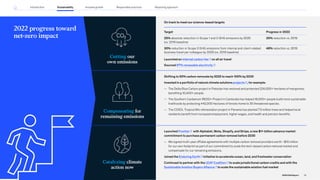
2022 progress toward
net-zero impact
Target Progress in 2022
25% absolute reduction in Scope 1 and 2 GHG emissions by 2025
(vs. 2019 baseline)
30% reduction vs. 2019
30% reduction in Scope 3 GHG emissions from internal and client-related
business travel per colleague by 2025 (vs. 2019 baseline)
48% reduction vs. 2019
Launched an internal carbon fee on all air travel
On track to meet our science-based targets
Sourced 97% renewable electricity
26
2022 ESG Report
Introduction Sustainability Reporting approach
Responsible practices
Inclusive growth
13
Our GHG emissions inventory methodology follows best practices, such as using scientifically
robust and up-to-date emission factors and including a radiative forcing index of 1.9 for air travel.
Our reporting covers all material emission sources and complies with the criteria of South Pole’s
Climate Neutral Company label. Scope 1 covers all direct GHG emissions, such as fugitive emissions
and those from combustion in owned or controlled boilers, diesel backup generators, and vehicles.
Scope 2 covers indirect GHG emissions from the generation of purchased electricity, heat, or steam.
Scope 3 encompasses other indirect emissions, such as those from business travel, upstream,
emissions from purchased fuels and electricity (for example, well-to-tank emissions, transmission,
and distribution losses), purchased goods, vehicles not owned or controlled, outsourced activities,
waste disposal, and use of video conferencing and other digital services as well as the use of
electricity and heating at home during work. Scope 1 and 2 emissions were calculated using survey
data covering 94% of our offices. Scope 3 emissions were calculated based on mileage (air travel,
ground transportation, and employee commuting), stay duration (hotels), energy consumption
(related to work from home, cloud computing, and upstream emissions from purchased fuels and
electricity), spend (purchased goods and outsourced activities), and survey data (waste disposal and
consumption of water bottles). Wherever data was missing, estimates were used for all scopes.
14
We have set science-based targets and have committed to reduce absolute Scope 1 and 2 GHG
emissions 25% and Scope 3 GHG emissions from business travel 30% per employee by 2025 from a
2019 baseline year.
15
Within commercial interiors or office buildings.
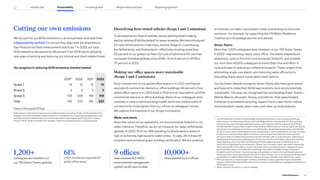
Cutting our own emissions
We account for our GHG emissions on an annual basis and have them
independently verified to ensure they align with the Greenhouse
Gas Protocol and best measurement practices.13
In 2022, our total
GHG emissions decreased by 28 percent from 2019 due to adopting
new ways of working and reducing our internal and client-related travel.
Electrifying firm-owned vehicles (Scope 1 and 2 emissions)
Todecarbonizeourfleetofvehicles,weareworkingtowardmaking
electricvehicles (EVs) the default for lease renewals. We have introduced
EV-only vehicle policies in Germany, Austria, Belgium, Luxembourg,
the Netherlands, and Switzerland—effectively covering more than
50 percent of our global car fleet. Our use of hybrid and EV cars has
increased threefold globally since 2019—from 9 percent in 2019 to
27 percent in 2022.
Making our office spaces more sustainable
(Scope 1 and 2 emissions)
Sixty-one percent of our global office space is in LEED certified (or
equivalent) commercial interiors or office buildings; 49 percent of our
global office space is in LEED Gold or Platinum (or equivalent) certified
commercial interiors or office buildings. Many of our colleagues work
remotely or have a hybrid working model, which has shifted some of
our electricity consumption from our offices to colleagues’ homes.
We capture this transition in our Scope 3 emissions.
Water and waste
Given the nature of our operations, our environmental footprint is not
water intensive. Therefore, we do not measure our water withdrawals
globally. In 2022, 61 of our 189 operating locations were in areas of
high or extremely high baseline water stress. To date, 24 of these 61
locations have achieved green building certification. We will continue
1,200+
colleagues are members of
our 120 Green Teams globally
9 offices
havereceivedISO14001
environmentalmanagement
systemcertificationtodate
10,000+
trees planted by six offices
61%
LEED certified (or equivalent)15
global office space
to minimize our water consumption while contributing to structural
solutions—for example, by supporting the UN Water Resilience
Coalition as a knowledge partner and adviser.
Green Teams
More than 1,200 colleagues were members of our 120 Green Teams
in 2022—representing nearly every office. The teams helped build
awareness, reduce the firm’s environmental footprint, and mobilize
our more than 45,000 colleagues to invest their time and effort in
local activities to reduce our collective footprint. These ranged from
eliminating single-use plastic and improving water efficiency to
educating teams about sustainable travel options.
Our Go Green Awards recognize Green Teams who have gone above
and beyond to make their McKinsey locations more environmentally
sustainable. This year, we recognized five outstanding Green Teams—
Manila, Mexico, Brussels, Tampa, and Detroit—that spearheaded
initiatives to accelerate recycling, support local urban farms, reduce
food and plastic waste, plant trees, and clean up local beaches.
201914
2020 2021 2022
Scope 1 15 12 12 10
Scope 2 3 3 3 3
Scope 3 725 208 169 519
Total 743 223 183 532
Data in thousand tCO2e
Note: Figures in this section may not sum to total because of rounding. Scope 1: Direct emissions (for
example, from the combustion of fuels in owned or controlled boilers, diesel backup generators, and
vehicles); Scope 2: Indirect emissions from the generation of purchased electricity, heat, or steam;
Scope 3: Other indirect emissions (for example, related to business travel or purchased goods).
Our progress in reducing GHG emissions (market-based)
27
2022 ESG Report
Introduction Sustainability Reporting approach
Responsible practices
Inclusive growth
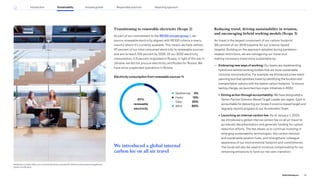
Transitioning to renewable electricity (Scope 2)
As part of our commitment to the RE100 climate group , we
source renewable electricity aligned with RE100 criteria in every
country where it’s currently available. This means we have shifted
97 percent of our total consumed electricity to renewable sources
and aim to reach 100 percent by 2025. Of our 2022 electricity
consumption, 0.5 percent originated in Russia. In light of the war in
Ukraine, we did not procure electricity certificates for Russia. We
have since suspended operations in Russia.
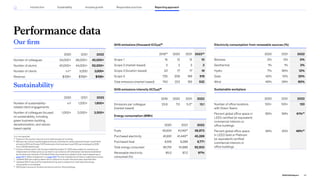
Electricity consumption from renewable sources %
Geothermal 3%
Hydro 12%
Solar 25%
Wind 60%
Reducing travel, driving sustainability in aviation,
and encouraging hybrid working models (Scope 3)
Air travel is the largest component of our carbon footprint
(82 percent of our 2019 baseline for our science-based
targets). Building on the approach adopted during pandemic-
related restrictions, we are reimagining our travel and
making necessary travel more sustainable by:
— Embracing new ways of working: Our teams are implementing
hybrid and remote working models that are more sustainable,
inclusive, and productive. For example, we introduced a new event
planning tool that optimizes travel by identifying the location and
transportation options with the lowest carbon footprint. To ensure
lasting change, we launched two major initiatives in 2022:
• Driving action through accountability: We have designated a
Senior Partner Science-Based Target Leader per region. Each is
accountable for delivering our Scope 3 science-based target and
regularly reports progress to our Acceleration Team.
• Launching an internal carbon fee: As of January 1, 2023,
we introduced a global internal carbon fee on all air travel to
accelerate decarbonization and generate funding for carbon
reduction efforts. The fee allows us to continue investing in
emerging sustainability technologies, like carbon removal
and sustainable aviation fuels, and strengthens colleague
awareness of our environmental footprint and commitments.
The funds will also be used to continue compensating for our
remaining emissions to fund our net-zero transition.
We introduced a global internal
carbon fee on all air travel
McKinsey’s London office, one of several that have received ISO 14001 environmental management
system certification.
97%
renewable
electricity
28
2022 ESG Report
Introduction Sustainability Reporting approach
Responsible practices
Inclusive growth
— Recruiting in a digital environment: The use of technology
throughout our recruiting process allows for greater accessibility
and convenience for applicants. In 2022, we held more than
115,000 virtual interviews and recruiting events, allowing potential
candidates to learn more about us and the work we do from their
homes, reducing our carbon footprint.
— Driving sustainability in aviation: We are committed to helping
scale up the use of sustainable aviation fuel (SAF). We are founding
members of the Sustainable Aviation Buyers Alliance and
signatories to the World Economic Forum’s Clean Skies for
Tomorrow 2030 Ambition Statement , targeting 10 percent
SAF by 2030. We are partnering with clients to enable SAF
production and offtake.
Reducing our supply chain emissions (Scope 3)
We are committed to engaging with our suppliers to help them
improve the social and environmental impact of the goods and
services they offer. Because indirect emissions from travel account
for more than 90 percent of our carbon footprint, we have made
engaging with our travel-related suppliers on sustainability
issues a focus of our sustainable procurement efforts.16
In 2022, we launched the CDP Supply Chain program
with suppliers accounting for more than 80 percent of our
Scope 3 business travel emissions. Engaging our suppliers
through the CDP Supply Chain program will enable us to more
easily identify risks and opportunities related to emissions
reductions in our own supply chain and will support and
encourage our suppliers to reduce their own emissions.
We continue to discuss opportunities with our suppliers to
provide our colleagues with more sustainable options.
Learn more about driving supplier environmental sustainability .
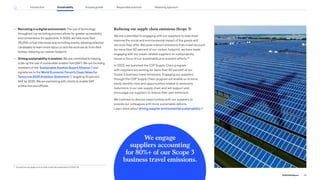
We engage
suppliers accounting
for 80%+ of our Scope 3
business travel emissions.
16
Exceptions may apply such as when travel decreased due to COVID-19.
29
2022 ESG Report
Introduction Sustainability Reporting approach
Responsible practices
Inclusive growth
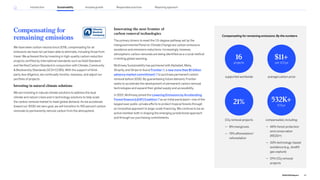
Compensating for remaining emissions: By the numbers
Compensating for
remaining emissions
We have been carbon neutral since 2018, compensating for all
emissions we have not yet been able to eliminate, including those from
travel. We achieved this by investing in high-quality carbon reduction
projects certified by international standards such as Gold Standard
and Verified Carbon Standard in conjunction with Climate, Community
 Biodiversity Standards (VCS+CCBS). With the support of third-
party due diligence, we continually monitor, reassess, and adjust our
portfolio of projects.
Investing in natural climate solutions
We are investing in natural climate solutions to address the dual
climate and nature crises and in technology solutions to help scale
the carbon removal market to meet global demand. As we accelerate
toward our 2030 net-zero goal, we will transition to 100 percent carbon
removals to permanently remove carbon from the atmosphere.
Innovating the next frontier of
carbon removal technologies
The primary drivers to meet the 1.5-degree pathway set by the
Intergovernmental Panel on Climate Change are carbon emissions
avoidance and emissions reductions. Increasingly, however,
atmospheric carbon removals are being identified as a crucial method
in limiting global warming.
McKinsey Sustainability has partnered with Alphabet, Meta,
Shopify, and Stripe to found Frontier , a new more than $1 billion
advance market commitment to purchase permanent carbon
removal before 2030. By guaranteeing future demand, Frontier
seeks to accelerate the development of permanent carbon removal
technologies and expand their global supply and accessibility.
In 2021, McKinsey joined the Lowering Emissions by Accelerating
Forest finance (LEAF) Coalition as an initial participant—one of the
largest ever public-private efforts to protect tropical forests through
an innovative approach to large-scale financing. We continue to be an
active member both in shaping the emerging jurisdictional approach
and through our purchasing commitments.
16
projects
21%
$11+
per tCO2e
532K+
tC02e
supported worldwide average carbon price
CO2 removal projects
— 8% mangroves
— 13% afforestation/
reforestation
compensated, including:
— 46% forest protection
and conservation
(REDD+)
— 33% technology-based
avoidance (e.g., landfill
gas capture)
— 21% CO2 removal
projects
30
2022 ESG Report
Introduction Sustainability Reporting approach
Responsible practices
Inclusive growth
This includes our support for:
The Sustainable Aviation Buyers
Alliance (SABA), which is working to
scale and standardize high-quality SAF
Frontier , a $1+ billion advance market
commitment with fellow founding
members Alphabet, Meta, Shopify, and
Stripe to purchase permanent carbon
removal before 2030
RE100 , a coalition of 380+
organizations committed to using
100% renewable electricity
Delterra , which is building rapidly
scalable, self-sustaining recycling
ecosystems in emerging economies
to help communities redirect waste to
productive uses
The World Economic Forum and its
Clean Skies for Tomorrow Coalition ,
which works toward reforming the
aviation industry
Natural Climate Solutions Alliance ,
which aims to increase private sector
investment in natural climate solutions
by 1 gigaton of CO2e per year by 2025
The World Business Council for
Sustainable Development andits
effortstoaccelerateanet-zero,nature-
positive,andequitablefuture
The LEAFCoalition , a public-private
partnership to protect tropical forests
through large-scale financing
Improving recycling programs and livelihoods
Delterra is an independent nonprofit founded and
supported by McKinsey that is redesigning waste
management and recycling systems in Argentina, Brazil,
and Indonesia. Up to 70 percent of participants in its
flagship program, Rethinking Recycling, now separate
their waste, leading to improved material recovery and
the diversion of thousands of tons of waste. Delterra
has established a second program, Plastic IQ, to help
companies rethink their packaging strategies, and is
piloting a material traceability tool in Argentina to enable
ethical, transparent supply chains. Delterra plans to scale
its operations across Asia, Latin America, and Africa in the
coming years and is on track to reach 1.5 million people by
the end of 2023.
Catalyzing climate action now
We work with our clients, nonprofits, and other peer organizations
around the world on multi-year conservation initiatives that help
protect nature and reduce biodiversity loss. To amplify our impact,
we work with these groups to scale the solutions we need to limit
global warming to 1.5°C.
31
2022 ESG Report
Introduction Sustainability Reporting approach
Responsible practices
Inclusive growth
In this chapter, we share how we’re
accelerating inclusion and growth as we
aspire to bring about an economy that
works better and for more people.
Inclusive growth
In this chapter
33 Inclusive growth
at a glance
Our clients
35		 Our approach
Our insights
43		
Key publications
Our actions
45		 Our approach to people
Our giving
52		
Our approach to advancing
social responsibility Jeremy Jenkins applied learnings from the McKinsey Black Leadership Academy to
accelerate sustainability in his role at Dow Chemical. Hear Jeremy’s story here .
Inclusive growth
32
2022 ESG Report
Introduction Sustainability Reporting approach
Responsible practices
$140B
in value and 20,000+ jobs
created by the 190+ new
businesses imagined,
scaled, and built through
Leap by McKinsey
67,000+
Black, Asian, Hispanic,
and Latino leaders have
enrolled in our Connected
Leaders Academy to date
48%
of our global workforce
were women and 52% of
client-serving US colleagues
were from racial or ethnic
minority groups17
~$620M
contributed in cash and in-kind
support since 2020 toward
our $2 billion commitment to
social responsibility by 2030
($275+ million this year)
5,000+
growth engagements
completed per year globally
1,700
institutions we sourced talent
from globally in 2022, up from
540 institutions in 2021
Economic growth is at its best
when it is inclusive.
Growth has the power to accelerate inclusion. Top-performing
companies can uplift communities, create jobs, and expand markets in
ways that generate more opportunity for everyone. And inclusion can
be a driver for lasting growth. When leaders include people from all
walks of life in their search for exceptional talent and new customers,
they tap a source of enduring advantage.
We partner with our clients on both sides of this equation, leaving
their organizations stronger, more productive, and more resilient. The
result? Inclusive economies, institutions, and workforces that reflect
our communities.
As a firm, we strive to foster an environment that is distinctive and
inclusive. We create opportunities based on skills and demonstrated
impact, and we encourage self-authorship, challenging colleagues to
reach their fullest potential in an empowering, caring meritocracy.
Inclusive growth
at a glance
17
Equal Employment Opportunity (EEO) categories: Black or African American, Asian, Hispanic or Latino, American Indian or Alaska Native, Native Hawaiian or Other Pacific Islander (not Hispanic or Latino), Two or More
Races. In previous reports, this group was referred to as “underrepresented” and is now referred to as “racial/ethnic minority.” Race/ethnicity percentages in performance tables may not add up to figure due to rounding.
Key highlights
Launched McKinsey Sciences for Growth, bringing together the
best tech-enabled capabilities and people to help the boldest leaders
accelerate their growth ambitions
Received Brandon Hall Group HCM Excellence Awards for
reducing biases in our recruiting processes and for our sourcing
and assessment strategy
Enhanced support for our firmwide support network for colleagues
with visible and invisible disabilities, Access McKinsey, in close
consultation with colleagues
Reached 100,000 learners from 60+ countries across Africa, the
Middle East, and beyond through our Forward program, a free five-
month online learning journey equipping the next generation with the
skills necessary to succeed in the future of work
33
2022 ESG Report
Introduction Sustainability Inclusive growth Reporting approach
Responsible practices
Our 10 Actions
toward racial equity
In 2020,we publicly committed to support anti-racism initiatives and
racial equity, outlining how we plan to accelerate change within our
firm and help combat racism around the world.18
Drawing on our areas of core expertise, we focused on short-, medium-,
and long-term actions to build Black leadership within McKinsey and
beyond, conducting data-based research to identify barriers and
solutions, and investing in greater racial equity and inclusion for Black
communities in the United States and around the globe.
We are proud to support the leaders, businesses, and communities
working for a more just, inclusive, and equitable society. While we are
making progress, having achieved half of our actions, we—and the rest
of the world—still have a long way to go.
Find out more about the impact we are having through our 10 Actions
initiative throughout this report and read more about our commitment
to diversity, equity, and inclusion for details on other actions we are
taking to advance diverse and inclusive workplaces.
~70%
of the way to our goal to double
Black leadership
30 articles
published by McKinsey’s Institute for
Black Economic Mobility
Achieved Achieved
Achieved Achieved
5,000+
anti-biastrainingscompletedtohelp
supporttheattractionandadvancement
ofBlackanddiversecolleagues
~$30M
invested in completed pro bono
engagements toward our $200 million
commitment by 2030
~55,000
leaders enrolled in our Black
Leadership Academy
Achieved
1
Double Black
leadership and hiring 6
Launch McKinsey
Institute for Black
Economic Mobility
2
Equity and inclusion
learning program 7
Double spend with
diverse suppliers
in three years
3 
Day of Service
8
$2 million to
Generation19
4Minimize bias in
people processes 9
$200 million in pro
bono support over
ten years
5 Create a Black
Leadership Academy
(BLA)
10 $5 million
in charitable giving
18
10 Actions progress updates on this page refer to the period June 2020 to December 2022.
19
For more information on Generation, see Our approach to advancing social responsibility .
Statusupdate
Actioncommitment Statusupdate
Actioncommitment
34
2022 ESG Report
Introduction Sustainability Inclusive growth Reporting approach
Responsible practices
Our approach
Our clients
We build strategies that unlock the potential of our
clients’ people and open the way to new markets.
By strengthening our clients in this way, we strive to advance and accelerate long-term, inclusive growth
globally. Our approach focuses on:
McKinsey Academy
Our capability-building programs unlock potential across all levels
of an organization—from the executive team to middle management
to frontline employees—to support broad transformation efforts and
add value to their bottom lines.
Digital Capability Centers
These advanced tech-enabled innovation and learning hubs
guide the realization of an organization’s digital future, allowing
companies to experience the latest digital and analytics
opportunities and build the skills they need to apply them.
Organizational Health Index (OHI)
We apply analytical rigor to organizational health management.
Our quantitative diagnostics and proven recipes for success
empower senior leaders to measure and achieve the organizational
health required to sustain long-term performance.
Building on our expertise and research, we employ proprietary assessments, analytics-powered
digital solutions, and facilitated programs to deliver results for our clients that accelerate inclusive
growth. Examples include:
Growth is the oxygen that
organizations and economies
need to thrive. Leaders who
build companies that grow
help to empower households,
promote equitable opportunity,
and serve a wide range of
stakeholders.
The best leaders find ways
to put the right people to
work in the right ways. We
help our clients unleash the
power of inclusive workforces,
translating strategy into action
through technology.
Growth opportunities lie
in underserved markets at
home and abroad. We bring
people and technology together
to help new enterprises—and
new customers—thrive.
Seeing new
potential for
growth
Fostering
greater
inclusion in
customer bases
Expanding
inclusion
in skilled
workforces
35
2022 ESG Report
Introduction Sustainability Inclusive growth Reporting approach
Responsible practices
Our key actions in 2022
McKinsey Center for CEO Excellence
Companies have only one truly peerless role—that of the CEO. As
much as 45 percent of what drives a company’s performance falls into
the chief executive’s hands. Today, the role demands increasing ethical
accountability, social responsibility, and environmental stewardship.
The decisions a CEO is responsible for have grown twice as predictive
of a company’s overall performance over the last 50 years. Launched
in 2022 after the publication of our bestselling book—CEO Excellence:
The Six Mindsets That Distinguish the Best Leaders from the Rest—
the McKinsey Center for CEO Excellence seeks to provide leaders
with meaningful support and guidance to help them perform at their
highest level, maximize their potential, and successfully navigate a
complex and constantly evolving world.
QuantumBlack, McKinsey’s integrated AI arm
QuantumBlack, a London-based startup we acquired in 2015, has been
an accelerating force for our work in analytics. In 2022, it entered a new
chapter by officially becoming the integrated AI arm of McKinsey. The
QuantumBlack community has achieved a number of feats: building
then donating Kedro, an industry-leading developer tool, to the open-
source community; being named a Leader in AI; and supporting women
in technology through community efforts and mentorship. Two years
ago, most of our AI work was single-use cases. Today, roughly half is
transformational—and delivered by QuantumBlack’s more than 1,000
technical practitioners across the globe.
McKinsey Health Institute
Since it was founded in 2022 on the conviction that humanity could
add up to 45 billion additional years of high-quality life, the McKinsey
Health Institute (MHI) has established itself as a global leader in health.
MHI rapidly achieved impact at scale by publishing industry-leading
research in areas like brain health, employee health, and healthy aging,
and collaborating with partners to build momentum for health as an
all-sector priority. Among its accomplishments, MHI co-founded the
World Wellbeing Movement, a coalition of global leaders advancing
well-being in the public and private sectors; deployed training to help
educators around the world better understand child trauma, reaching
approximately 30,000 students; and supported the scaling of 988,
a nationwide suicide and crisis hotline that saw calls increased by
47 percent, reaching nearly five million people in need. Learn more
about MHI’s work to catalyze progress .
Supporting social, healthcare, and public entities
For more than 70 years, we have worked alongside many of the world’s
leading social, healthcare, and public sector organizations, enabling
those who do so much good in the world to operate at the highest level.
We are humbled to have the opportunity to support tackling some of
the most pressing challenges of our time and are proud of the impact
that our clients deliver.
Our mission is central in everything that we do and informs every choice
we make. The institutions and topics we engage with are determined by
whether our partnership can improve lives, livelihoods, and health. We
choose to invest knowledge, research, and capabilities where we believe
the most significant opportunities exist for such improvements.
We approach each engagement holistically, conscious that our clients
often make complex choices that have far-reaching consequences.
We invest in research on critical economic, government health, and
social, economic, and government topics through dedicated research
centers, including the McKinsey Center for Government and the
Center for US Health Systems Reform.
All of this supports leaders to help them make good decisions that drive
the positive changes—across their organization, operations, technology,
and other capabilities—necessary to deliver against their mission.
36
2022 ESG Report
Introduction Sustainability Inclusive growth Reporting approach
Responsible practices
Advancing racial equity
Connected Leaders Academy
Following the murder of George Floyd in 2020, we shared our 10
Actions toward racial equity as our plan to accelerate change
within our firm and to help combat racism across the world. One of
the actions was to launch our Black Leadership Academy, which we
achieved the same year. Responding to participant feedback, the
initiative grew the following year to become the Connected Leaders
Academy and welcomed Asian, Latino, and Hispanic cohorts. More
than 67,000 participants have enrolled in the academy, and in
2022 we added a program for early career leaders to support self-
identified people of color as they advance to managerial roles from
entry-level jobs. More than 18,000 participants have enrolled in this
program, which is available at no cost to attendees.
Black Economic Mobility
OurannualBlackEconomicForumeventconvenesBlackleaders
fromthepublic,private,andsocialsectors,partneringtoincrease
economicmobilityinUSBlackcommunitiesandsupportthenext
generationofBlackbusinessesandentrepreneurs.In2022,theforum
celebrateditsfifthanniversary,withmorethan200leadersattending.
WearedeeplycommittedtoacceleratingBlackeconomicgrowth.
TheMcKinseyInstituteforBlackEconomicMobility,forexample,isa
researchinstituteandthinktankdedicatedtoadvancingracialequity
andinclusivegrowth.Itsmissionistohelpprivate-,public-,andsocial-
sectorleadersaccelerateBlackeconomicdevelopmentbyproviding
in-depthresearch,conveningwithstakeholders,andtranslating
researchintopracticalassetsandcapabilities.
Jim Lowery, right, the first Black consultant at McKinsey, at the Black Economic Forum with Princeton University’s Dr. Eddie S. Glaude, Jr.
37
2022 ESG Report
Introduction Sustainability Inclusive growth Reporting approach
Responsible practices
Tearing the “paper ceiling”: Driving upward
mobility for millions of workers
One of the ways we brought our strategy to life in 2022 was
by taking a full system view of one of inclusive growth’s key
elements—broadening the talent pool.
Based on our insights and extensive research on skills-based
hiring and human capital , we cast a spotlight on a talent pool
that employers may overlook—the more than 70 million workers
in the US who are STARs, or workers “skilled through alternative
routes.” While STARs have the skills for higher-wage work, many
are often automatically screened out from job postings that require
college degrees.
We first applied these insights to our own firm, making significant
investments in recruiting, hiring, and growing STARs through a
comprehensive approach that recognizes candidates’ skills and
experience, problem-solving ability, and intrinsic capabilities.
For example, by moving from traditional case studies to a game-
based assessment, nearly 150,000 candidates over the past two
years have been able to demonstrate their critical-thinking and
leadership traits even if they don’t have prior business or case-
study experience.
Our People  Organizational Performance technology organization
led by McKinsey Partner, and a STAR, Carolyn Pierce, is at the
forefront of putting outdated systems to the test, with many
entry-level roles already open to STARs who have the relevant
experience and skills.
We then took what we learned from our own work to our
engagements with clients, building data-driven solutions that help
other employers implement new ways of screening for knowledge,
skills, and capacity to learn.
To accelerate progress beyond our firm, in 2022 we began
providing pro bono data and analytics support to
Opportunity@Work for a national campaign with the Ad Council
to “Tear the Paper Ceiling ,” the invisible barrier that keeps
millions of Americans from jobs that allow upward mobility—an
advance into higher economic and social positions. By partnering
to demonstrate the value and transfer of skills developed through
work experience, we encourage more employers to reimagine
their hiring practices and build better ways to screen for talent and
create opportunities for STARs.
“
We know there are better ways to
screen for talent and now we have the
research and tools to back that up.”
Carolyn Pierce, McKinsey partner
LaShana Lewis, CEO, entrepreneur, and a STAR.
38
2022 ESG Report
Introduction Sustainability Inclusive growth Reporting approach
Responsible practices
JobsOhio: Revitalizing the
state’s economy through
innovative solutions
After the Great Recession, Ohio’s economy needed help to counter
deep losses in manufacturing jobs. In 2011, using profits from the
beverage industry, the state formed JobsOhio, a first-of-its-kind
nonprofit to stimulate economic growth through new industries. To
date, Ohio has seen nearly one million jobs created or protected.
As a key early partner, McKinsey helped develop JobsOhio’s growth
plan. Ten sectors were identified for their employment potential. These
included aerospace and aviation, healthcare, logistics and distribution,
and technology.
In 2018, McKinsey partnered with JobsOhio to evaluate performance.
Insights informed the growth strategy for JobsOhio 2.0, which
broadened its focus to building innovation districts in Cleveland,
Columbus, and Cincinnati. These multi-organization partnerships
created 60,000 jobs and established Ohio as a global leader in
healthcare, life sciences, and technology.
Impact story
In 2020, as COVID-19 began to spread, McKinsey again partnered
with JobsOhio to create Ohio to Work, to assist displaced workers.
The partners also designed a program through which JobsOhio
pays tuition costs for technical degrees. Enrollees who secure jobs
paying good wages gradually repay JobsOhio through a marginal
percentage of their income. JobsOhio then reinvests the funds in
its next enrollee group.
A decade of growth and economic investment in Ohio has helped
to attract the largest single private sector company investment in
the state. In 2022, Intel announced that it would open a new chip
manufacturing plant in Central Ohio, creating 3,000 new jobs at
the plant with an average salary of $135,000.
“
We’ve valued McKinsey’s partnership
over the last several years. Their
data-driven approach, combined with
creative thinking, led to solutions that
supported our success in creating
hundreds of thousands of jobs.”
JP Nauseef, President and CEO of JobsOhio
~60,000
jobs created through multi-organization partnerships
39
2022 ESG Report
Introduction Sustainability Inclusive growth Reporting approach
Responsible practices
Manufacturing Africa:
Strengthening Africa’s
manufacturing sector and
creating jobs for a fast-
growing population
Africa’s population is growing faster than any other continent’s and is
set to double by 2050. New generations of young people will require
economic opportunities—an estimated 18 million new jobs will be
needed annually until 2035.
A competitive manufacturing sector would help address this gap and
also provide Africa with a clearer strategic role in the global economy.
Yet across the continent, many countries have struggled to develop
their manufacturing base and move into high-value services due to a
lack of investment resources.
Manufacturing Africa is a multi-year program created by the UK
government’s Foreign, Commonwealth  Development Office. It seeks
to bring £1.2 billion in foreign investment to Africa’s manufacturing
sector, creating 90,000 new jobs and enabling an inclusive economic
transformation across five countries—Ethiopia, Kenya, Nigeria,
Senegal, and Rwanda.
As part of Manufacturing Africa, McKinsey has worked closely
on efforts to develop and support various manufacturing sectors,
including global health and vaccine manufacturing, food security and
agri-processing, and ESG and sustainability efforts.
This work has expanded the capacity of investment promotion
agencies, which has contributed to manufacturing deals. For example,
Manufacturing Africa worked with a major East African waste
management company to update and test its model for business
expansion, refine its investment thesis, and focus on developing
innovative products to drive revenue.
Through additional foreign investment and strategic expansion, the
company plans to increase the amount of organic waste collected and
treated annually from 12,000 tons to one million. The waste will then
be converted into valuable products like animal feed, fertilizer, and
biomass fuel briquettes.
Now in its third year, Manufacturing Africa has helped to close 26
manufacturing deals, attracting more than $800 million in foreign direct
investment, which has the potential to create more than 14,000 jobs.
Impact story
$800M+
attracted through 26 manufacturing deals
40
2022 ESG Report
Introduction Sustainability Inclusive growth Reporting approach
Responsible practices
DRNSW: Upskilling in
rural corners of Australia
Upskilling and reskilling today’s workforce—in non-degree, skill-
building programs—is critical to attracting and retaining talent while
driving market competitiveness. One organization that understands
this is Australia’s Department of Regional New South Wales
(DRNSW), a government agency supporting regional communities
through agriculture, local infrastructure projects, soil conservation,
environmental stewardship, economic development, and more .
At the onset of the pandemic, DRNSW took stock of its employees’ digital
capabilities. The department uncovered a range of opportunities to
increase the team’s digital fluency and partnered with McKinsey to do so.
The first step was to reframe DRNSW’s transformation from a learning
and development opportunity to skills training—which does not
happen in a classroom but while employees are on the job and able to
immediately operationalize it. McKinsey created a program rooted in
human-centered design, informed by a deep study of the individual’s and
organization’s needs, addressed in small groups and individual coaching.
Another core element of the DRNSW Digital Skills Program is the
“skills hub,” critical for engaging the broader DRNSW organization
and ensuring sustained impact as the program scaled. This new
operational unit consists of a DRNSW squad with capability-building
specialists, human-centered designers, instructional designers, and
program delivery experts.
“Other agencies couldn’t believe we built, piloted, and started scaling
this entire new approach to capability building in six months when
this can typically take two or three years in government,” says Donna
Mcleod, director of workforce capability and talent at DRNSW. “It was
a phenomenal delivery.”
The program won the Best in Class award in the public sector
category from Good Design Australia, one of the most prestigious
design awards in the world. But the biggest testament to its success
is the difference it has made in the careers of the employees.
Impact story
92%
employee satisfaction with
the skills program
80%
of learners reported productivity improvement
and increased capability within their role
41
2022 ESG Report
Introduction Sustainability Inclusive growth Reporting approach
Responsible practices
Minuto de Dios University:
Bridging the education
access gap for thousands
of Colombian students
McKinsey is supporting the transformation of Colombia’s leading
university, Minuto de Dios. An institution with more than 100,000
students, Minuto de Dios has historically targeted underserved
communities throughout the country to tackle profound inequalities
in education access.
The engagement has advanced the university’s mission of providing
affordable higher education for all Colombians, offering additional and
better programs to more people, in more places. The transformation
has included over 140 impact initiatives to simultaneously strengthen
the quality of the academic programs and enhance the overall financial
performance of the organization to foster sustainable growth.
This includes setting up a National Center for Innovative Pedagogy
and a portfolio of national virtual and hybrid courses, which ensures
students from remote regions across the country have access to the
best educators at the university. In its pilot phase, these courses are
already benefiting over 25,000 students. The university has also
worked to improve their information systems to bolster operational
efficiency, and capability-building programs for the organization to
execute a sustainable transformation.
Through the effort, the university aims to increase its student
population by 41 percent to 140,000 students over the next two years,
improve its standing in Colombia’s national standardized tests, and
achieve positive financial impact of more than $30 million. In the first
period under the implementation, 16,400 new students joined the
university, representing 14 percent growth versus the previous cycle.
The transformation has been underpinned by an ambitious endeavor
to cultivate the university’s talent. Over 2,000 people have benefited
from McKinsey’s Ability to Execute program, which is designed
to build individuals’ capabilities at scale to drive and sustain
transformational change.
Impact story
2,000+
people upskilled across the university
42
2022 ESG Report
Introduction Sustainability Inclusive growth Reporting approach
Responsible practices
We’re helping to build an economy
that works for all, publishing original
research and analysis to grow, broaden,
and sustain prosperity for all segments of
society, in populations across the globe.
Achieving a more equitable and inclusive economy is an imperative
of our time. Economic mobility depends on growth—and according
to our research, growth is at its best when it propels broad-based
prosperity, increasing well-being and reducing inequality across all
strata of society. Our reports and articles enable leaders to support
and expand inclusive growth, including by creating and improving
access to jobs, advancing equity for diverse demographics, and
equipping workers with the skills they need for our fast-changing
future. Through actionable insights and data-driven solutions, we
aspire to create an economy that not only works better but, vitally,
that works better for everyone. Here are some highlights from our
inclusive growth insights in 2022.
Womeninthe
Workplace2022
Conducted in partnership with
LeanIn.Org, this is the eighth
edition of the largest study of
women in corporate America.
Addressingemployee
burnout:Areyousolvingthe
rightproblem?
Employers have invested
unprecedented resources in
employee mental health and
well-being. With burnout at all-
time highs, leaders wonder if
they can make a difference.
Our research suggests they can.
TheTitaniumEconomy:How
toovercomethechallengeof
fillinghigh-qualityjobs
Thrivingindustrialtechnology
companiesuseapprenticeships,
upskilling,andupwardmobilityto
staffandretaintheirworkforces.
Hybridwork:Makingitfitwith
yourdiversity,equity,and
inclusionstrategy
New research details what
empowered employees love
about hybrid work models
and the risks to diversity,
equity, and inclusion if
managers get the evolving
flexible workplace wrong.
Key publications
Our insights
43
2022 ESG Report
Introduction Sustainability Inclusive growth Reporting approach
Responsible practices
Thechildcareconundrum:How
cancompanieseaseworking
parents’returntotheoffice?
The status quo work culture no
longer works for most families—
particularly those with very
young children. But companies’
support for childcare can turn
worker attrition into attraction.
Theeconomicstateof
LatinosintheUS:
Determinedtothrive
US Latinos are a driving force
of the US economy and account
for the fastest-growing portion
of US GDP.
Theoverlookedcontributions
andhiddenchallengesofAsian
Americans[Podcast]
Asian Americans play a
key role in creating a more
sustainable and inclusive
economy. This report explores
the challenges this group
faces and how companies can
better support them.
Closingtheracialwealthgapby
investinginBlackconsumers
[Podcast]
Organizations that incorporate
racial equity into their
strategic agenda can promote
growth and advance Black
economic mobility. How can
business leaders realize this
transformative growth?
Whatisdiversity,equity,
andinclusion?
Companies that are diverse,
equitable, and inclusive are
better able to respond to
challenges, win top talent, and
meet the needs of different
customer bases.
Meetingthechallengeof
moms’“doubledoubleshift”
athomeandwork[Podcast]
As the United States emerges
from the pandemic, how
can businesses build a more
inclusive working environment
to improve outcomes for women
in the workforce?
Key publications (continued)
Our insights
44
2022 ESG Report
Introduction Sustainability Inclusive growth Reporting approach
Responsible practices
Our approach to people
Our actions
During COVID-19, the worker-
employer contract fundamentally
and permanently changed.
We are deeply committed to examining and reinvigorating our
People approach to create inclusive opportunities for people of all
backgrounds to both serve clients and run our firm.
We operate as a single global partnership, united by a common
purpose, shared values, and a two-part mission that includes creating
an unrivalled environment for exceptional people. Our values reflect
our expectation that every colleague works to make our firm both
distinctive and inclusive. Those values are:
— be nonhierarchical and inclusive
— sustain a caring meritocracy
— develop one another through apprenticeship and mentoring
— uphold the obligation to engage as well as dissent
— embrace diverse perspectives with curiosity and respect
— govern ourselves as a “one firm” partnership
During COVID-19 and since, we and our clients have seen three
workplace trends accelerate : the search for meaning, the desire for
flexibility, and the pace of technological transformation.
Building a distinctive and
inclusive workforce
These trends led us to reexamine our talent model in 2022 and
revitalize our People mission. We established new foundational pillars:
the personalization of work to encourage flexibility and “self-authored”
career paths, skills development, and demonstrated impact. The
result is a diverse, inclusive, and caring approach to people in which
individuals can pursue their own ambitions.
Our People strategy touches every aspect of how we recruit, motivate,
develop, and retain exceptional talent. Using a rapidly growing number
of cutting-edge tools and techniques, we are assessing for exceptional
skills, regardless of academic background. Our formal and informal
skills-development systems increasingly aim to help participants
succeed in a growing range of roles. We are placing more emphasis on
coaching and daily feedback.
We tripled our
recruitment
sources from 540
to 1,700 globally.
45
2022 ESG Report
Introduction Sustainability Inclusive growth Reporting approach
Responsible practices
Attracting top talent
Our approach to attracting talent is
central to McKinsey’s dual mission—to
help our clients substantially improve
their performance, and to build a
firm that attracts, develops, excites,
and retains exceptional people.
Diversifying our talent sources
We look at talent differently. We don’t assess potential candidates
by where they are or where they studied—but rather by their skills
and their potential. The exceptional people we need may come from
anywhere, and we are dedicated to attracting distinctive and diverse
talent to our teams. We want those teams to reflect the diversity of our
clients, the communities in which we work, and society.
Building a firm of colleagues from different backgrounds and profiles
is critical for us to deliver distinctive client service while making our
firm a richer and better place. We are expanding our talent pools and
evolving our recruiting and assessment processes while continuously
working to mitigate the potential for bias.
2022 progress highlights
— Almost half our new joiners today were experienced professionals.
— 49% of new hires were women.
— 53% of US new hires and 47% of our US workforce were from racial
or ethnic minority groups.20
— InNorthAmerica,welaunchedtheBusinessInsightsLeadership
DevelopmentProgram(BUILD),atwo-yearrotationalprogramoffered
tostudentsfromNewYorkpubliccollegesanduniversitiescreatedto
supportourcommitmenttotheNewYorkJobsCEOCouncil.
— In Latin America, we supported colleagues in developing their
English proficiency through classes and coaching offered in
programs like our Women Tech Academy in Brazil.
— We tripled our recruitment sources from 540 to 1,700
institutions globally.
49%
of new hires were women
20
Equal Employment Opportunity (EEO) categories: Black or African American, Asian, Hispanic or
Latino, American Indian or Alaska Native, Native Hawaiian or Other Pacific Islander (not Hispanic or
Latino), Two or More Races. In previous reports, this group was referred to as “underrepresented”
and is now referred to as “racial/ethnic minority.” Race/ethnicity percentages in performance tables
may not add up to figure due to rounding.
Ranked 1# in Germany and #4 in the US on
Glassdoor’s Best Places to Work list 2023
46
2022 ESG Report
Introduction Sustainability Inclusive growth Reporting approach
Responsible practices
Reaching talent of the future
We want individuals from all backgrounds to get to know us, engage
with us, and explore what it takes to help our clients succeed. We run:
— learning programs customized for women and racial/ethnic minority
populations in management consulting, such as The First Year
Leadership Academy
— the Proud Leaders speakers series in Europe, creating
connections across the LGBTQ+ community, sharing research,
and highlighting trans and nonbinary voices
— A Place for You , a program aimed at connecting
underrepresented talent to careers in management consulting
through training and webinars
— preparation for students studying at Historically Black Colleges
and Universities (HBCUs) for a meaningful start in consulting
and building leadership skills for top Black, Hispanic, and Latino
candidates in MBA programs in the United States
We also partner with external organizations to move conversations,
actions, and commitments forward around diversity, equity, and
inclusion. These include AfroTech , the Society of Hispanic
Professional Engineers , Reaching Out MBA , HeForShe ,
New York Jobs CEO Council , and MAKERS , to name a few.
Additionally, we continue to convene the Juntos Conference in Brazil,
designed foryoungBlacktalenttoconnect,meetBlackprofessionals,
developnewskills,engagewithlargecompanies,andlearnabout
careeropportunities.
Being consciously inclusive in our hiring process
To understand and overcome personal biases and to ensure fairness
in our hiring processes, we employ a full suite of consciously inclusive
solutions. Our job descriptions emphasize skills, and our improved
résumé screening process is more inclusive of a diverse set of
experiences and skills.
To combat potential biases, we provide inclusion training for all
of our assessors to ensure evidence-based hiring decisions, in
conjunction with a trained and dedicated inclusion adviser. We are
also expanding the use of Solve , our game-based assessment that
allows candidates to demonstrate their critical-thinking and problem-
solving skills in an environment that is less likely to lead to typical job
assessment biases.
In2022,wereceivedBrandonHallGroupHCMExcellence
Awardsforreducingbiasesinourrecruitingprocessesand
foroursourcingandassessmentstrategy.
Alberto, an engagement manager and leader of the McKinsey Black Network in Brazil, at the Juntos
Conference he helped found.
47
2022 ESG Report
Introduction Sustainability Inclusive growth Reporting approach
Responsible practices
48%
global workforce were women
49%
new hires were women
33%
Acceleration Team (Executive Committee)
were women22
28%
leadership were women21
52%
US client-serving colleagues were from
racial or ethnic minority groups23
47%
US workforce were from racial
or ethnic minority groups23
21
The leadership definition has been updated to better reflect leadership roles at the firm. These roles include all partners, associate partners, and other senior firm leaders. Historical leadership numbers have been
restated to be consistent with this definition.
22
In previous reports, the Global Managing Partner (GMP) and Extended Acceleration Team (AT) were not included in the total number of Acceleration Team members. This year and going forward, we will include the
GMP and the Extended AT in the count. We have also restated historicals in this report to be consistent with this methodology.
23
EqualEmploymentOpportunity(EEO)categories:BlackorAfricanAmerican,Asian,HispanicorLatino,AmericanIndianorAlaskaNative,NativeHawaiianorOtherPacificIslander(notHispanicorLatino),TwoorMoreRaces.
Inpreviousreports,thisgroupwasreferredtoas“underrepresented”andisnowreferredtoas“racial/ethnicminority.”Race/ethnicitypercentagesinperformancetablesmaynotadduptofigureduetorounding.
2022 DEI progress
We foster an environment that is distinctive and inclusive, and measure our progress toward building
teams that reflect the diversity of our clients, the communities in which we work, and society.
48
2022 ESG Report
Introduction Sustainability Inclusive growth Reporting approach
Responsible practices
Diversity, equity, and inclusion
McKinsey has long been committed
to advancing diversity, equity, and
inclusion (DEI) in our own firm, for
our clients, and in broader society.
This commitment is integral to building a firm that attracts, develops,
and excites exceptional people. It is also key to our client service
strategy. Our research underscores that diversity and inclusion are
connected to better business performance and talent retention. We
understand that advancing DEI requires long-term commitment and
dedication and that progress can be slow. Like many of our peers, we
are not where we aspire to be. Yet we are proud of the progress we
have made to date and are determined to continue our journey.
Championing DEI within our firm and with our clients
First, we aim to deliver on our talent ambition by attracting, developing,
and retaining exceptional people from racial or ethnic minority
groups. We support this work by creating and maintaining a caring
meritocracy where all colleagues feel included and can thrive. We seek
to foster an inclusive culture in which colleagues representing a vast
range of diverse backgrounds and perspectives can find meaning
in their work experiences, team collaboration, and professional
development opportunities.
Second, we aim to better serve our clients with diverse teams,
convening key stakeholders to advance the DEI agenda globally. We
build capabilities along with our clients’ diverse populations and advise
them on their own DEI journeys.
Third, we aim to highlight the importance of taking a role in societal
change by leading the knowledge agenda on DEI, building value-
adding partnerships, and contributing toward a more just and
equitable society through supplier diversity, pro bono work, and more.
Learn more about our DEI client work , supplier diversity and
pro bono work .
Driving measurable progress
Across McKinsey, led by our own research, we have increased our
leadership accountability for our change efforts, created greater data
transparency,24
and advanced various programmatic efforts to tackle
key obstacles. Since launching our 10 actions in June 2020, we’ve
more than tripled the number of Black hires in the US. Our pro bono
efforts, including our partnerships with Homeboy Industries ,
and the Greater Washington Partnership in the US and Black
Equity Organisation in the UK, have made a great impact on
local communities.
Our groups and communities continue to grow and include, among
many others, the McKinsey Black Network, Hispanic and Latino
Network, Asians at McKinsey, GLAM (for LGBTQ+ colleagues), Access
McKinsey (for colleagues with disabilities, chronic illnesses, and
mental health challenges), and PRISM (Progressing Representation
and Inclusion in Social Mobility).
24
Where permitted by law.
Today, women represent nearly half of our colleagues and new hires
globally. By our 100th anniversary in 2026, we aspire for half of all firm
members to be women. For more information, review our detailed
DEI data .
Delivering on our DEI talent ambition
Our DEI leadership is driving a comprehensive program to:
— have senior leaders who are visible, committed role models and
who hold themselves accountable for DEI progress
— set clear and ambitious DEI aspirations and track progress to
permit course correction when necessary
— find and attract the most exceptional and diverse talent
— drive programmatic solutions tailored to root causes and integrate
them into existing processes and colleagues’ journeys
Select recognition for our support
of LGBTQ+ colleagues
49
2022 ESG Report
Introduction Sustainability Inclusive growth Reporting approach
Responsible practices
Acting to tackle bias
We strive to follow the best practices that we champion in our research
and we are diligently minimizing unconscious bias across our people
processes. Learn more about our approach to being consciously
inclusive in our hiring process .
Supporting colleagues with disabilities, chronic illnesses,
and mental health challenges
In 2022, we enhanced support for Access McKinsey—a group
founded to support colleagues with disabilities, chronic illnesses, and
mental health challenges. In close consultation with some Access
McKinsey members, we assembled a broad task force, which included
Access McKinsey members, to identify and implement accessibility
enhancements and increase firm awareness of issues central to the
community. Early initiatives included creating a centralized website for
accessibility resources and extending tailored learning programs to
colleagues in the group. We sought to improve colleagues’ experience
with the accommodations process and the Human Resources team
consolidated general accommodations process guidelines, which
are being adapted to local legal conditions, to support colleagues
more consistently. In 2022, McKinsey celebrated International Day of
Persons with Disabilities, with colleagues joining panel discussions
to better understand disability and accessibility needs, and how to
be better accessibility allies. Learn more about how we are caring for
our colleagues .
We aim to be distinctive and inclusive,
and we value potential more than pedigree
Building inclusion and allyship
We believe that inclusion is every individual’s responsibility as well as
a critical leadership skill. We continue to embed this expectation in our
systems and culture by integrating inclusion principles into learning
programs and offering focused training for colleagues at all levels.
Learn more about colleague development and talent attraction .
Almost 14,000 colleagues are part of our Inclusion Allies program,
designed to develop, connect, and activate a global cohort of inclusive
leaders through training, initiatives, mentoring, and research. In 2022,
we launched our “Inclusion Champions Badges” program that formally
acknowledges and makes visible our most active allies contributing to
building a more inclusive firm.
2018
hired our first Chief Diversity and Inclusion Officer
Creating accountability
We know from research that senior leaders play critical roles
in creating inclusive environments and configuring teams that
will benefit from a diversity of perspectives, experiences, and
expertise. To encourage such developments, we have embedded
in every employee’s evaluation specific expectations, tailored
to roles, for inclusive behavior. We have equipped evaluators
with individualized performance reports on inclusive leadership
performance where relevant.
Building careers through sponsorship
Our research also highlights that formal sponsorship and actively
working to create opportunities significantly improve the chances
for advancement success. We approach sponsorship rigorously by
measuring each colleague for how much and how well they perform
as sponsors. We then design individual interventions to ensure all
colleagues receive the support they need to be successful.
Additionally, we have tailored training and professional development
programs focused on sponsorship for women and diverse colleagues.
These include role-based programs, like Pathway to Partner, and
programs designed to support specific groups, like Women’s
Leadership Workshop and the McKinsey Black Network
sponsorship program. These programs focus on skill building,
creating robust support networks, and providing tailored personal
coaching and training.
50
2022 ESG Report
Introduction Sustainability Inclusive growth Reporting approach
Responsible practices
Taking a role in societal change
We are committed to being role models for the prioritization of DEI
efforts. We hope that others will follow and ultimately drive positive
societal change. Our collective DEI efforts include producing cutting-
edge knowledge, building value-adding partnerships, ensuring
supplier diversity, and conducting pro bono work. With our best-in-
class partners across the globe, we share a commitment to expand
economic opportunity and support communities. Learn more about
our supplier diversity and pro bono work .
Developing insights to accelerate action
Our broad portfolio of DEI research continues to be a leading voice
on the subject and catalyzes change across industries. In 2022, our
Women in the Workplace report was the largest study on the state
of women in corporate America and was one of our top three most
read reports of the year globally.
We have deepened our research focus on the experience of racial
or ethnic minority groups in North America, and possible ways to
maximize their economic opportunities. Recent work includes the
economic state of Latinos in the US , the invisible challenges
faced by Asian Americans in the workplace , and a series of
detailed articles on the Black consumer experience .
We plan to expand our global research. In 2022, we were proud to
present research on socioeconomic Diversity Matters in Latin
America , as well as our latest report in Germany on how
new careers can potentially enable more diverse leadership .
Our Women Matters series continued to bring focus to different
markets, for example, investigating the progress of gender parity in
Mexico . We went beyond gender parity to examine how successful
French companies have been in their search for executives with
diverse national origins and socioeconomic backgrounds .
Partnering to drive impact
We collaborate with partners, such as HeForShe, Women’s Forum,
Aspen Institute, and The Trevor Project, to expand our impact. In 2022,
we teamed up with Openly , a global news platform dedicated to
underreported global news for and about LGBTQ+ people. We also
partnered with the World Economic Forum to launch the Global Parity
Alliance , a cross-industry group of companies taking action to
accelerate DEI in the workplace and beyond.
Better serving our clients
The business case for DEI is growing stronger. An increasing number
of companies recognize diverse teams and leadership as critical for
enabling talent acquisition, enhancing innovation, and improving
customer insights.
We strive to serve our clients by example. We make a priority of bringing
diverse perspectives to our clients through our teams. We also convene
experts and key stakeholders to advance DEI thought leadership
globally. By helping our clients build the next generation of diverse
leaders and advising them on their DEI efforts, we support our clients’
efforts to make substantial, lasting performance improvements.
Convening LGBTQ+ leaders
After two years of the global pandemic, we were finally able to bring
together a record number of global LGBTQ+ senior leaders for The
Alliance in Athens, Greece. This gathering focused on LGBTQ+
inclusion in the workplace. It featured McKinsey’s research on
transgender/nonbinary inclusion; intersectional identities in the US,
the UK, and Brazil; and the condition of LGBTQ+ individuals in high-
risk geographies (concentrating on LGBTQ+ refugees).
Senior LGBTQ+ leaders from around the world gathered in Athens, Greece, to discuss
inclusion in the workplace.
Read more about accessible leadership
» How parenting through a medical diagnosis inspired
a new way to lead and live
» Leadership lessons from the world’s
best CEOs [Podcast]
51
2022 ESG Report
Introduction Sustainability Inclusive growth Reporting approach
Responsible practices
We are committed to creating a more
inclusive economy by enabling people
to meet their basic needs, access
opportunities, and achieve economic
empowerment through access to
essentials, quality jobs, and skilling.
We have committed $2 billion to social responsibility efforts by 2030
and have so far contributed nearly $620 million in cash and in-kind
support toward that commitment (more than $275 million this year).
Through our social responsibility strategy, we seek to:
— drive our social responsibility investments toward at-scale efforts
that increase inclusive growth
— engage our colleagues through giving and volunteering, and support
all colleagues to participate in and serve their local communities
A dedicated committee of senior leaders is responsible for advising on
giving in line with our firmwide Social Responsibility Policy. Regional
and local pro bono work is guided by local committees.
Our approach to advancing social responsibility
Our giving
Driving at-scale efforts to
increase inclusive growth
Fund for Social Good
We support and fund multi-year partnerships with leading institutions
around the world, tackling complex problems and finding creative
solutions that advance and accelerate sustainable and inclusive
growth. Established in 2020, the Fund for Social Good has committed
to multi-year support of diverse projects, including:
— African Agricultural Transformation Initiative (AATI): This
project aims to drive inclusive agricultural transformation in Africa.
Co-founded by partners including the Alliance for a Green
Revolution in Africa , the Bill  Melinda Gates Foundation ,
the International Fund for Agricultural Development (IFAD),
and McKinsey.
4,000+
nonprofits supported
through pro bono
engagements, McKinsey
Gives, and McKinsey Grants
488,500
hours dedicated to social
responsibility through
volunteering, board service,
pro bono engagements, and
fellowships at nonprofits
$28M
contributed to Ukraine
war relief efforts, including
$18 million in donations from
our colleagues and firm to more
than 1,600 organizations and
$10 million in pro bono support
100%
of McKinsey offices in 65+
countries volunteered with
local organizations for our
third annual Day of Service
~$620M
contributed in cash and in-kind support since
2020 toward our $2 billion commitment to social
responsibility by 2030 ($275+ million this year)
52
2022 ESG Report
Introduction Sustainability Inclusive growth Reporting approach
Responsible practices
AATI builds on McKinsey’s impact on agriculture and food systems
across Africa, including work to increase food production that helped
contribute to 11 million fewer undernourished people, 150,000 fewer
deaths from hunger, and 100,000 new jobs. AATI launched support
to its first wave of countries to accelerate effective and sustainable
food system changes based on country needs, priorities, and
existing infrastructure. Learn more about the AATI partnership .
— Conservation: Through our work with partners like Blue Nature
Alliance and Enduring Earth , over the next few years we will
conserve more than one billion hectares of land and create or
protect over 200,000 jobs through the implementation of 30 mega
conservation projects around the world.
In 2022 alone, our conservation work helped implement three mega
conservation projects, creating 10,000 direct jobs and protecting
78 million hectares. A critical component of this collaboration is creating
jobs for remote and Indigenous communities in places around the world
where nature conservation is particularly important. Such communities
are incredibly hard to reach with standard stimulus or other growth
measures. They’re more dependent on intact natural capital, and they
are the first to benefit from jobs created directly in nature conservation
or as a by-product of conservation.
Learn more about the Blue Nature Alliance .
Learn more about Enduring Earth .
Examples of pro bono
efforts around the world
Forward
In 2022, we were proud to celebrate the landmark achievement of
reaching the first 190,000 learners through the Forward program—our
free, five-month online learning journey. Forward, which targets those
with fewer than five years of work experience, is designed to equip
the next generation of talent with the tools necessary to succeed
in the working world. Digital courses and sessions are focused on
transferable skills like adaptability, problem-solving, communication,
and being digitally savvy. In the initial 18 months of the program, we
reached learners in more than 70 countries across Africa and the
Middle East, as well as in Pakistan, Türkiye, and Azerbaijan.
McKinsey.org
In 2022, McKinsey launched McKinsey.org as a philanthropic initiative
to bring the firm’s capability-building solutions at no cost to nonprofits
that are accelerating inclusive growth around the world. By sharing the
best of McKinsey’s programs to nurture leaders and foster more effective
organizations, McKinsey.org aims to unlock the full potential of nonprofits.
It offers programs designed to uplift entire organizations, including:
— Ability to Execute (A2E) for Nonprofits: Designed to empower
employees with a new way of working, and build the capabilities
needed to drive and sustain organizational change.
— Organizational Health Index (OHI) for Nonprofits: Helps
an organization align around a common mission, execute with
excellence, and continually renew itself to serve its mission
more effectively.
The Akanksha Foundation, one of the nonprofits we support through our capacity-building programs.
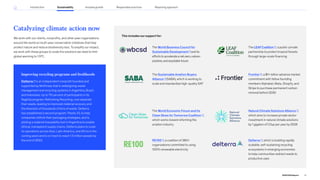
78%
ofForwardgraduateswho
completedthefullprogram
experiencedcareerorrole
growthduetoapplyingthenew
skillsetsandattitudeslearned
15M
beneficiaries reached
through 100 nonprofits in
60 countries participating
in McKinsey.org programs
53
2022 ESG Report
Introduction Sustainability Inclusive growth Reporting approach
Responsible practices
Generation
In 2014, we founded Generation , an independent nonprofit
organization that transforms the education to employment system
to prepare, place, and support people into life-changing careers
that would otherwise be inaccessible. Our continued support for
Generation is one of the ways we’re helping foster a more inclusive
economy. Together, we’re enabling people to meet their basic
needs, access opportunities, and achieve economic empowerment
through quality jobs and skilling. In 2022, 22,000 participants
graduated from Generation, a 185 percent increase from 2021.
In partnership with about 11,000 nonprofits, governments, and
employers, Generation has helped train and place more than
75,000 people into jobs across 35 professions in 17 countries. Its
global graduates have earned $630 million in wages to date.
Juntos
In 2018, we created the Juntos Conference in Brazil to address
the disparity between the representation of Black Brazilians in senior
roles in the private sector compared to the general population. It works
to create a platform for networking and professional development
in partnership with other large companies committed to racial
justice. Through training, panels, and career fairs, the annual Juntos
Conference supports the creation of an inclusive environment to help
Black professionals succeed.
Our 2022 conference was the largest to date, offering virtual and
in-person sessions for the first time. In total, over 4,000 participants
registered for the conference, with over 1,000 in attendance at our
in-person events in São Paulo, Salvador, and Porto Alegre in Brazil.
The conference is supported year-round by the Juntos Ecosystem ,
an online platform that offers further development solutions.
Ownership Works
Along with more than 60 organizations across the private,
public, and social sectors in the United States, McKinsey helped
to launch Ownership Works . This nonprofit is dedicated to
implementing broad-based employee programs to generate
at least $20 billion of wealth for working families by 2030.
The initiative aims to improve awareness of shared stock
ownership programs and equip more organizations with the
necessary tools to implement these for their employees. As a
result, Ownership Works provides low- and moderate-income
households and people of color with access to the single
largest source of wealth in America: stock ownership.
Participants at McKinsey’s annual Juntos Conference in Brazil.
75,000
people across 17 countries trained and placed
in jobs through Generation
54
2022 ESG Report
Introduction Sustainability Inclusive growth Reporting approach
Responsible practices
In this chapter, we describe how
we’re meeting our commitment
to lead with integrity and set the
standard for accountability and
compliance in our profession.
Responsible practices
In this chapter
56 	Responsible practices
at a glance
57		
Developing and caring
for our colleagues
62		 Ethics and compliance
65		 Risk management
66		
Working with clients
67		
Working with suppliers
70		
Human rights
72		
Data privacy and
information security
55
2022 ESG Report
Responsible practices
Inclusive growth
Introduction Sustainability Reporting approach
Our aspiration at McKinsey is to lead
with integrity and set the standard for
accountability and compliance in our
profession—and then to keep raising it.
To achieve this, we are proactively building and maintaining a culture
of responsible practices, informed by our values. Our values are
integral to everything we do—from how we assess risks and ensure
data privacy, to the buying choices and practices we employ to drive
positive impact across our supply chain. We have built and refined a
model of ethical business that blends global best practices with the
best of McKinsey’s high standards for client-service professionalism,
including improvements to our professional standards, client service
policies, and firm culture.
Responsible
practices at
a glance
~$700M
invested in strengthening our risk
management teams, capabilities,
and processes since 2018
100%
of new clients were vetted
against our industry-leading
CITIO client service framework25
99%
pay equity for men and women
colleagues globally27
100%
of colleagues completed
annual Professional Standards
and Risk training26
25
CITIO is the framework we use to assess a potential client or engagement consisting of five
interrelated dimensions: Country, Institution, Topic, Individual, and Operational considerations.
26
This figure does not include firm members exempted from the training because they weren't actively
working at the time of the program (for example, leave of absence, left the firm).
27
The pay ratio was calculated using annualized 2022 total compensation of female to non-female firm
members, weighted based on segments including employee grouping and level by country, including
non-partners and partners. Segments with a total number of colleagues less than ten were excluded.
Key highlights
At least three hours of ethics, integrity, and/or compliance learning
completed per colleague
Shared our new global parental leave policy, which extends firmwide
parental leave (in most regions) and includes a reintegration program
to support colleagues’ career growth upon their return to work
Achieved our 10 Actions goal to double our spending with diverse
suppliers within three years
Established a cross-functional Human Rights Working Group
to operationalize our approach to human rights due diligence
and management
Updated our Acceptable Use of Technology Policy and implemented
enhanced cybersecurity measures and controls
56
2022 ESG Report
Reporting approach
Responsible practices
Introduction Sustainability Inclusive growth
Developing our colleagues
Wearebuildingaculturethatsupportsandencouragescontinual,
self-authoredgrowthtocreateunparalleledleadershipdevelopment.
We help our people develop through formal and informal learning
opportunities. Through programming, apprenticeship, and on-the-job
experiences with world-class teams, colleagues build and apply skills,
deepen their expertise, advance toward their aspirations, and create
unrivaled impact for our clients.
Fostering a development culture
We believe that firm members have a collective responsibility
to foster our development culture. Our annual Mentorship,
Apprenticeship, and Sponsorship Survey provides insight into
how well each colleague’s needs are being met and helps shape
our development priorities. These are embedded into our culture
through our Way We Work (WWW) function, a single operating
system focused on the elements critical to achieving distinctive
client impact and a great team experience.
Team leaders encourage development habits and track them via
a bi-weekly team survey. Best practices are incorporated into
the WWW’s core team rituals. Our research shows that teams
who practice these rituals have higher team feedback scores on
development and apprenticeship. Team rituals include:
— Joint client–team kickoffs: Colleagues share their development
goals and create a plan for how to grow together.
— 1:1s: Individuals who work most closely together share development
feedback regularly.
— Retros: Teams discuss how the collaboration is going and if
the team is meeting the bar on apprenticeship, developmental
feedback, and other development topics.
— High-impact handovers: Every colleague receives a formal
end-of-engagement feedback conversation before they transition
to a new engagement.
Developing and caring for our colleagues
Unlocking growth through continuous learning
We provide development opportunities for every role, allowing
peers to focus on working toward skill proficiency and meeting
performance expectations in a connected, collaborative
environment. Our programs are designed to balance leadership
skills, capabilities for client service, technology acumen, and risk
management awareness. Core programs may be:
— universal in content yet local in delivery, such as our One Firm
Onboarding curriculum for new colleagues
— modular and hybrid, such as our Business Essentials program
for client-facing colleagues with diverse educational and
professional backgrounds
— digital and self-directed, such as our Tech Week, created to
empower colleagues from any background to raise their proficiency
in those skills
— customizable and facilitated, such as content tailored for specific
regions, interest or practice areas, role transitions, or affinity groups
We have created more than 2,500 learning offerings and provide
access to tens of thousands more from external content providers.
In 2022, our Learning Research and Innovation Lab developed a
contemporary apprenticeship model for “intentional” learning—
making the “invisible,” such as an individual’s thought processes,
visible—and nonhierarchical learning and teaching.
We aspire to be the gold standard
for an inclusive and distinctive
performance culture. One that celebrates,
supports, and cares for all colleagues
in ways that empower them to grow
personally and professionally.
$850M+
invested in knowledge development, capability
building, and learning
57
2022 ESG Report
Reporting approach
Responsible practices
Introduction Sustainability Inclusive growth
Self-authored journeys
We have reimagined Leadership Growth Plans for each colleague
to provide them with an evolving set of aspirations, next steps, and
support partners that will grow as they grow. We are also restructuring
our career paths to encourage more flexibility using rotations and
global mobility, as well as the ability to leave for, and return from,
external growth opportunities.
We empower our colleagues to personalize their jobs and their
development in ways that support flexibility and well-being, so they
may find success through building skills, deepening expertise, and
achieving impact.
Skills and impact-based advancement
We are moving to a model of professional advancement based on
demonstrated skill proficiency and impact. Our leadership model
is rooted in a universal skill taxonomy that sets clear expectations,
recognizes experience, and gives colleagues in every role
opportunities to identify strengths and next steps. At the same time,
our technological competency models offer a map for deepening
expertise in specific areas.
Pairing the two models, plus learning and applying skills in the course
of work, empowers colleagues to develop their unique profiles and
advance, based on development inputs and outputs rather than tenure.
Mobility and global expertise
We encourage growth and development by providing opportunities for
professional experiences across our client practices, firm functions,
and geographies. Mobility offers colleagues the chance to experience
new cultures and client contexts, expand their networks, and develop
global mindsets within our one-firm community.
We work closely with leaders across our firm to identify needs and
move partners with relevant expertise. In 2022, five percent of our
firm moved internationally across more than 65 countries. Our mobility
programs provided nearly 300 early-tenure colleagues with short-
term global experience and apprenticeships.
Growing after McKinsey
When colleagues choose to grow beyond our firm, we provide
extensive help. We also celebrate the increasing number of alumni
rejoining our firm with new skills and expertise.
Today, our alumni network includes more than 50,000 former
colleagues across 140 countries. Nearly 1,000 are CEOs or C-suite
leaders in leading private, public, and social sector organizations
globally, and one in four have founded their own companies—including
nearly 50 technology “unicorns.”
Every year, tens of thousands of alumni and firm members engage
and collaborate through our alumni website, career services,
communications, and knowledge and connectivity events.
23
average annual training hours
per nonconsulting colleague
62
average annual training hours
per consulting colleague
2,500+
McKinsey-created learning
offerings available
100%
of colleagues had access to
career- or skills-related training
100%
of our people received regular
performance and career
development reviews
58
2022 ESG Report
Reporting approach
Responsible practices
Introduction Sustainability Inclusive growth
Caring for our colleagues
Astheeffectsofmentalandemotionalstresshavebecome
moreprominentelementsofeveryorganization’sworkplace,we
demonstratecareforourpeopleandpromoteacultureofsupportive,
diverse,andempoweringmeritocracy.
We approach health and well-being holistically—with benefits and
programs that support mind, body, and financial well-being. We ask for
feedback around different People topics in our weekly, firmwide Pulse
survey, leveraging text analytics on anonymized data to improve the
design of our initiatives for the populations that need them most.
Championing mental health
Our Mind Matters program aims to advance the discussion about
mental health and provide support for colleagues where and when
they need it. The program is designed to support our people by
proactively managing mental health disorders and challenges.
Colleagues and their families can access early intervention and
clinical resources, such as free, independent, and confidential
support from trained professionals through an Employee
Assistance Program.
We have appointed contacts in all our locations to address mental
health issues, creating a safe option for discreet initial discussions
and to find internal and external resources. Additionally, multiple
learning programs and an ongoing storytelling campaign serve
to increase awareness, remove taboos, and destigmatize mental
health topics across the firm.
We are also members of One Mind At Work and the
MindForward Alliance . These organizations provide access to
guides, toolkits, and resources, as well as events and networking
opportunities, to develop and implement a gold standard for mental
health and well-being in the workplace.
Promoting resilience and well-being
We equip colleagues with skills, mindsets, and behaviors to build
resilience through balanced well-being and personal health. We
established a global well-being initiative to help individuals manage
their well-being through a focus on mind, body, and purpose. These
concepts have now been formally integrated into our learning
programs and embedded in day-to-day activities via our WWW
operating system. Our well-being offerings span a range of topics,
including basics such as nutrition, physical fitness, meaning, and
connection to others.
These topics appear in our flagship programs, office learning and
function-specific initiatives, and through designated learning days.
Well-being is also a core part of our leadership framework for team
leaders and partners.
To care for our people, we devote long-term focus on well-being and
tracking organizational health through metrics. Our WWW function
drives team habits and rituals for well-being. We believe that these
approaches make a real difference in an individual’s experience and,
by extension, have a positive impact on serving our clients.
59
2022 ESG Report
Reporting approach
Responsible practices
Introduction Sustainability Inclusive growth
Ourbi-weeklyengagementteamsurveyservestotakethepulseof
ourteam’sperformanceandindividualwell-being.Forexample,atthe
beginningofaproject,wetestwhetherteammembershaveashared
understandingofhowtheywillsetboundariesandmanagetheirwell-
being,andhowtheywillfosterasenseofbelongingforallteammembers.
Our ongoing research shows that teams who practice WWW rituals
enjoy lifestyles that are significantly more sustainable, a factor we
believe is critical to well-being. Sustainability benefits our clients as well.
Evidence points to the fact that McKinsey teams reporting the highest
sustainability scores are more likely to report higher client satisfaction
scores. Finally, we also see a correlation between the WWW rituals and
an individual’s sense of connectivity, care, and respect.
We embrace hybrid work. For most of our firm members and teams,
hybrid work offers the ideal balance to achieve the best outcomes.
We continue to research hybrid work, including encouraging teams
to learn what works well in remote versus in-person settings. By
leveraging data and input from our teams around the world, we can
make better co-location decisions, refine models, and better inform
workplace practices and team experiences that work for client, team,
and individual needs.
Ensuring colleagues’ safety
We believe that all colleagues should always feel safe and secure.
From our offices in metropolitan areas to remote or higher-risk
work sites, McKinsey proactively seeks to safeguard the well-being
and personal security of colleagues.
Our Firm Security Team (FST), staffed by experienced professionals
across the globe, partners with our offices and our Human
Resources, Real Estate, Travel, and Technology teams. Together,
they build internal resiliency and respond to incidents. Typically,
the security team focuses on four contexts: workplaces, travel,
client service, and events. We partner with leading providers in the
industry to help ensure that colleagues can get security, medical,
and counseling support, regardless of location.
Providing competitive compensation and benefits
Our compensation decisions are guided by a total rewards philosophy
to provide competitive pay and valuable benefits.
Ensuring that compensation and benefits are equitable is central to our
People strategy. Our Compensation Policy Committee supports the
strategy through the design and implementation of compensation, by
overseeing our benefits, and by ensuring integrity and compliance with
tax legislation and local requirements.
60
2022 ESG Report
Reporting approach
Responsible practices
Introduction Sustainability Inclusive growth
28
The pay ratio was calculated using annualized 2022 total compensation of female to non-female firm members, weighted based on segments including employee grouping and level by country, including
non-partners and partners. Segments with a total number of colleagues less than ten were excluded.
29
Listed benefits offered to McKinsey colleagues are not exhaustive and may vary by country.
We are committed to equal pay for equal work; we have processes
in place to help ensure pay equity. We are proud to report a 2022
weighted pay ratio of 99 percent, which represents the ratio of female
to non-female colleagues based on total compensation by employee
grouping and level by country.28
Employment decisions, including
compensation matters, are based on legitimate business needs,
job requirements, and individual qualifications. Each colleague is
compensated based on relevant skills and experience, performance
in the role, and location.
Central to our pay equity approach are objective benchmarking and
market insights from multiple external sources, as well as robust audit
processes that ensure all colleagues are paid equitably throughout
their careers. These efforts are led by our Global Compensation
function. In partnership with the Legal team for the People function,
we use third-party pay equity audit tools to provide an objective
evaluation of and feedback on McKinsey’s compensation structures.
We actively monitor pay equity reporting laws in all countries where we
operate, such as the Gender Pay Gap, the reporting requirement in the
UK. McKinsey is committed to paying all colleagues a living wage; our
lowest compensation ranges are above the applicable minimum wage,
including for entry-level positions.
We offer generous benefits to colleagues and their families across our
diverse population spanning more than 65 countries. Our colleagues’
health and well-being are at the core of our benefits philosophy.
We aim to deliver comprehensive benefits that help colleagues feel
empowered and engaged in their personal and professional lives.
Learn more about well-being initiatives and habits .
Our parental leave program
We launched a re-boarding program at the firm for partners returning
from parental leave that is now being extended around the world.
This includes extended time to bond with and care for a new infant for
parents, re-boarding benefits, coaching, and support for a phased
return to client work.
The program inspired a newly expanded global parental leave policy
for all colleagues that we shared in 2022. This policy extends firmwide
parental leave (in most regions) and includes a reintegration program
to help ensure returning colleagues can maintain their career growth.
Our benefits
McKinsey’s holistic benefits package for
colleagues and their families includes:29
Health and well-being
» Medical, dental, and vision coverage
» Mental health
» Business travel emergency protection
Financial protection
» Life and accident insurance
» Disability insurance
» Retirement programs
Family and personal support
» Personal leave policies and support
» Parental leave policies
» Adoption and surrogacy assistance
» Elective egg preservation
61
2022 ESG Report
Reporting approach
Responsible practices
Introduction Sustainability Inclusive growth
Ethics and compliance
McKinsey has a proud history
as a professional services firm
committed to our values.
We aim to lead our profession with a world-class Ethics and
Compliance program that builds and maintains the trust of our clients
and colleagues and society more broadly. We believe that the trust
we earn enables our firm to drive impact for our clients and our
communities. We continually invest in a culture that educates and
supports our colleagues to do what’s right and that inspires a shared
commitment to ethics, integrity, and professionalism in our daily
actions. We do this by maintaining and proactively building a culture of
ethics, integrity, and compliance across our firm.
Governance and oversight
Building and maintaining a culture of integrity are the responsibilities
of every firm member. Our ethics and compliance program is led
by our global chief ethics and compliance officer and an Ethics and
Compliance team dedicated to:
— fostering a firmwide culture of ethics and integrity
— identifying, analyzing, and addressing legal and regulatory risks
— establishing proper governance and controls for those risks
— developing and delivering relevant and risk-based learning in
conjunction with dedicated risk learning experts
— monitoring compliance with policies and controls and continuously
improving our program
The Ethics and Compliance team works closely with key stakeholders
across our firm globally to ensure our risk-based programs are
effective and sustainable. At the board level, these efforts are
overseen by the Risk, Audit, and Governance Committee of
McKinsey’s Shareholders’ Council.
Other global committees and groups are in place to support our
governance structure, including our Professional Standards
Committee, which addresses potential violations of firm policies
or values by partners, and a network of trained professionals who
manage and review personal conduct issues.
We proactively
maintain a culture of
ethics, integrity, and
compliance across our firm.
62
2022 ESG Report
Reporting approach
Responsible practices
Introduction Sustainability Inclusive growth
Our Code of Professional
Conduct and policies
Our Code of Professional Conduct (Code) defines a set of
behavioral expectations for all firm members. It helps colleagues
understand the core elements of our policies and how those elements
are anchored in our values. We expect all colleagues to comply with,
and others working on our behalf—such as contractors, advisers, and
other suppliers—to act in a manner consistent with, our Code.
We do not offer, accept, solicit, or pay a bribe, in any form or of
any value, to any person—including to get business or secure
any advantage in connection with our business—and we never
ask a third party to do so on our behalf. Our firm is committed to
compliance with the anti-corruption laws of all jurisdictions in which
we operate, including the US Foreign Corrupt Practices Act and the
UK Bribery Act. Our Code and Global Anti-Corruption Policy reflect
our commitment and hold our firm members, and the third parties we
engage, accountable for maintaining those standards.
Ethics and compliance programs
McKinsey’s ethics and compliance programs are
designed to address the risks that reflect the breadth and
complexity of our clients’ needs, the scope and scale of our
operations, and our commitment to the highest standards
of integrity and professionalism. Risk areas addressed by
our programs include:
» anti-corruption and bribery
» antitrust and competition
» civil rights
» conflicts of interest
» data protection and privacy
» immigration
» information security
» personal investments
» recruiting and hiring
Our Anti-Corruption Compliance program, overseen by our Ethics
and Compliance team, is designed to effectively address our risks and
incorporates regulatory guidance and best practices. We educate our
firm members on our policies and procedures and provide them with
multiple avenues for escalation, including seeking guidance from our
Ethics and Compliance and Legal professionals, our Got a Concern?
helpline and our Ask Risk system. Any violation of policy or law must
be reported and carries appropriate consequences.
We work to build and maintain the trust of our clients, the communities
in which we operate, and the talented colleagues who join our firm.
We also expect our suppliers to adhere to our Supplier Code of
Conduct, which includes standards related to anti-corruption.
We have embedded risk-based anti-corruption due diligence
procedures in third-party onboarding processes. Learn more about
working with suppliers .
63
2022 ESG Report
Reporting approach
Responsible practices
Introduction Sustainability Inclusive growth
30
This figure does not include firm members who qualified for an exemption
(such as a leave of absence).
Training and
compliance certification
We support our firm members through training and communication
efforts to keep our commitment to ethics, integrity, and compliance top
of mind. Upon joining the firm, all new hires are required to:
— understand and adhere to McKinsey’s Code and policies
— participate in an in-person or virtual onboarding session
where they learn about our firm values and what’s expected of
them as colleagues
All active McKinsey colleagues are required to participate in
Professional Standards and Risk training and certify compliance
with firm policies on an annual basis. Some of the topics covered
in annual mandatory learning include anti-corruption, conflicts of
interest, information security, anti-harassment, workplace conduct,
environmental sustainability, and human rights.
In 2022, 100 percent of our active colleagues were assigned and
completed the annual learning and certification.30
In addition to
firmwide training, colleagues receive additional learning tailored to
their functions and roles. Our annual Values Day, a celebrated global
event for all colleagues, is an opportunity for us to reflect on what it
means to live our values.
Raising concerns
Every firm member has the obligation to raise concerns about values,
ethics, and professional conduct without the fear of retaliation. We
aspire to create an environment where everyone feels comfortable
seeking advice or raising concerns directly with a colleague.
However, we recognize there are times when colleagues may feel the
need for an opportunity to raise a concern or ask a question without
coming forward directly to a colleague. For those instances, our
Got a Concern? global helpline allows colleagues to raise concerns
in a confidential manner and, where legally permissible, anonymously.
All good faith allegations of violations of the firm’s standards are subject
to review. Violation of our Code or policies can lead to disciplinary action,
up to and including termination. To increase transparency and build
trust, firm members are provided information on the types of concerns
submitted and the discipline imposed for violations.
100%
of colleagues completed annual Professional Standards
and Risk training and certified compliance with firm
policies and McKinsey Code30
64
2022 ESG Report
Reporting approach
Responsible practices
Introduction Sustainability Inclusive growth
Risk management
McKinsey assesses risks to our
firm in the short, medium, and
long term across many areas.
This includes risks in areas such as legal, regulatory environment,
market, and technology, as well as those arising from the physical
impact of climate change. We also continually seek opportunities to
better identify, analyze, and mitigate risk. Central to our approach
is our risk framework, which provides the insight, controls, and
technology we need to anticipate and proactively address risks.
We routinely and systematically undertake risk assessments. These
assessments incorporate diverse qualitative and quantitative inputs,
as well as external benchmarks, to produce a comprehensive view
of risk by considering our potential exposure to elements of our Risk
Taxonomy.31
The Risk Taxonomy is itself regularly refreshed to ensure
that we have an up-to-date view on new or emerging risk types. Risk
assessments help us to understand the nature of the risks we face
and what policies and controls we have in place to mitigate those risks.
Assessment outcomes are shared with firm leadership, including the
Shareholders’ Council, our elected board of directors, and provide
insights as to where further efforts or investment in risk mitigation
would be most important.
Our collective risk management functions cover a broad spectrum
of risks facing our firm and include groups focused on:
— Client Service Risk
— Enterprise Risk Management, Cyber and Data Risk
— Geopolitical Risk, Ethics  Compliance
— Physical Security
McKinsey’s chief risk officer oversees these groups. Our Internal Audit
group provides an independent assessment of the effectiveness
of our controls in mitigating important risks, reporting its findings
directly to the Risk, Audit, and Governance Committee (RAGC) of the
Shareholders’ Council.
Engaging our colleagues
Our risk management program’s success depends greatly upon
colleagues understanding what is expected of them in terms of
protecting our clients, our people, and our firm. To ensure such
understanding, we also have a team dedicated to making risk
management efficient and effective. We support this effort with
technology and process and through the work of colleagues in our firm
learning group dedicated to creating engaging and comprehensive
risk training. Colleagues receive regular messaging from the global
managing partner, the chief risk officer, the chair of the RAGC, and
regional leaders on what is expected of them and where and how to
seek guidance in complex situations, including reaching out to our
internal “Ask Risk” helpline.
Read more about risk management
» Seizing the momentum to build resilience for a future
of sustainable inclusive growth
» How Europe’s CEOs can build resilience to grow in
today’s economic maelstrom
31
McKinsey’s Official Risk Taxonomy covers 12 Level 1 risk areas, each of which is further divided into
a number of Level 2 risk areas. Responsibility for risk ownership of most areas lies with the chief
risk officer, with some elements lying with the chief financial officer, chief people officer, or the firm’s
general counsel.
65
2022 ESG Report
Reporting approach
Responsible practices
Introduction Sustainability Inclusive growth
Working with clients
As we seek to create positive, enduring
change in the world, we are committed
to living the values on which our firm
was founded almost 100 years ago.
To that end, we regularly evaluate and update our processes to
systematically identify and manage risk before committing to a
client project.
Read more about our client and engagement selection on
our website .
Client and engagement selection
Internal frameworks (CITIO)
We have policies and guidelines governing what work we will and will not
do. In 2022, we updated our Client Service Policy. This strengthened
and clarified the expectations and responsibilities of partners regarding
client and engagement selection, and enhanced roles for practice and
office leaders in engagement review and approval.
Our Client Service Policy requires that we evaluate the clients we
serve and the likely impacts of our work before committing to any new
client engagement. The policy includes five interrelated dimensions
(referred to as “CITIO”): Country, Institution, Topic, Individual, and
Operational considerations.
Within each of these dimensions, we have defined criteria that our
colleagues must apply when assessing a potential client or engagement
to ensure we consider potential unintended consequences of the work.
Some criteria describe “bright lines”—work we will not perform under
any circumstances—while others require discussion and special
approval, or extra oversight related to scope and delivery.
In the government sector, we do not serve defense, intelligence, justice,
or police institutions in nondemocratic countries (for which we base our
assessment on the Economist Intelligence Unit’s Democracy Index), with
limited exceptions for international aid and humanitarian work approved
by our firm’s risk leadership. We also do not serve political parties, political
advocacy groups, legislatures, or individual legislators’ offices; nor do we
take part in political advocacy or lobbying on behalf of our clients.
Dedicated oversight and decision-making support
Client service matters that require consideration beyond our standard
processes are reviewed by our Client Service Risk team, with a subset
of the most complex cases escalated to a global decision-making
body, the Client Service Risk Committee (CSRC). Composed of
senior firm leaders and supported by risk, legal, and communications
professionals, the CSRC provides advice and makes decisions on the
most complex risks we face in our client service.
This process is designed to ensure we offer transparent and
independent advice and decision-making and uphold our firm’s high
professional standards. For engagements that fail to meet these
standards, the firm declines the work.
Our CITIO dimensions
Country
Institution
Operational
considerations
Topic
Individual
100%
of new clients were vetted against our
industry-leading CITIO framework, which
also guides our approach to engagements
66
2022 ESG Report
Reporting approach
Responsible practices
Introduction Sustainability Inclusive growth
Working with suppliers
As a global firm with offices in more
than 65 countries, we have a significant
opportunity and responsibility to drive
positive social and environmental
impact through our procurement
operations and buying decisions.
We enable this by striving to source from and partner with suppliers
that share our values and commitment to responsible conduct.
Our approach
McKinsey’s Sustainable Procurement program sits within our
Responsible Buying program, which is led by our Optimize team
with oversight from our chief financial officer and input from a range
of firm leaders. Optimize enables our Responsible Buying program
through various services covering travel, events, real estate, sourcing,
technology, purchasing, and more.
The Responsible Buying program integrates ESG, risk, and operations
requirements into our procurement processes. It includes training for
our colleagues and engagement with our suppliers on key topics. The
program is designed to be holistic and to make it easy for colleagues
and suppliers to make more responsible buying decisions.
Supplier standards and values
McKinsey’s global Sustainable Procurement and Responsible
Buying Policy outlines our ambition to deliver positive social and
environmental impact through our selection, purchase, use, and
disposal of products and services, and through how we work with our
suppliers to improve the social and environmental impact of the goods
and services they offer.
Since we strive to partner with suppliers that share our values and
commitment to responsible conduct, we ask suppliers to agree
to our Supplier Code of Conduct.32
This code sets the standards
and values we expect of all our suppliers and is embedded in our
standard contract template. The code is available to download on
our Supplier Standards webpage in 12 languages.
Supplier due diligence
Our supplier due diligence process is part of a risk-based approach
to identify, prevent, mitigate, account for, and support remediation of
any adverse ESG impacts in our supply chain. It supports McKinsey’s
commitmenttotheUNGuidingPrinciplesonBusinessandHumanRights.
As one component of our due diligence process, during supplier
sourcing and selection stages the standard request for proposal
templates used by our sourcing team includes questions used
to screen potential suppliers on practices and policies in areas
including environmental sustainability, diversity, and data privacy.
New suppliers go through an onboarding process that includes risk-
based screening to ensure the supplier follows applicable laws and
meets our standards.33
This process includes additional questions for
suppliers with potentially higher ESG risk based on considerations
such as spend level, country risk, and category risk. Our process is to
carry out periodic diligence checks to assess changes in suppliers’
circumstances at intervals determined by the suppliers’ risk profile.
32
Some exceptions apply.
33
Some exceptions apply (e.g., suppliers for which an alternative third-party vetting process is utilized).
We strive to partner
with suppliers that
share our values and
commitment to
responsible conduct.
67
2022 ESG Report
Reporting approach
Responsible practices
Introduction Sustainability Inclusive growth
In 2022, we strengthened our supplier due diligence processes by
adding a supplementary ESG-specific risk analysis tool and launching
collaboration with a third-party supplier assessment platform. The
supplier assessments conducted through this platform require
document verification and review by an independent third party
against globally recognized standards and frameworks. Moving
forward, based on assessment results, McKinsey may request
corrective actions from suppliers to address ESG improvement areas.
Training for procurement colleagues
In 2022, we deployed a training program to all colleagues on our
procurement team. The mandatory training covered information
on sustainable procurement fundamentals and expectations of our
procurement colleagues related to our Sustainable Procurement
and Responsible Buying Policy. By the end of the year, 100 percent
of eligible Optimize colleagues had completed this training.
Advancing supplier diversity
We believe that our supply chain should reflect the diversity of the
communities in which we live and work. In 2020, as part of McKinsey’s
10 Actions, we announced Action 7: the goal to double spending with
diverse suppliers34
within three years. In 2022, we are proud to have
surpassed this goal.35
To make progress toward our Action 7 goal, we built and implemented
category-specific strategies, grew our network of supplier
diversity champions, expanded the integration of supplier diversity
considerations into our sourcing processes, increased external
engagement with diverse suppliers and nonprofit certification
agencies, and more.
We continue to identify opportunities to expand our engagement
of diverse-owned businesses through our outreach with advocacy
and community-based diverse supplier organizations. We are proud
corporate members of nine nonprofit organizations dedicated to
supporting diverse suppliers. Our membership and outreach better
position us to identify and engage diverse suppliers, participate in
valuable programming, share in best practices, and maintain awareness
about the needs of diverse suppliers. For a full list of our nonprofit
partners, please visit our Supplier Diversity Program webpage .
Beyond our procurement practices, we use McKinsey’s unique
capabilities and resources to help strengthen diverse-owned
businesses. Since 2020, the McKinsey Inclusive Business
Accelerator has supported Black-owned businesses, convening
over 1,100 Black business leaders via conferences and networking
events, delivering over 500 hours of capability building, and touching
more than 3,000 employees through impact partnerships.
Moving forward, we will continue to grow and strengthen our supplier
diversity efforts globally, including in geographies that are currently
less represented in our program.
34
Diverse suppliers are defined as those that are 51%+ owned, operated, controlled, and
managed by diverse individuals—for example, minority-, woman-, veteran-, disability-, and LGBTQ+-
owned businesses.
35
Applies to specific categories of diverse suppliers. Improved tracking contributed to progress
against the goal.
We doubled our spending with
diverse suppliers within three years,
achieving our Action 7 goal
Inside McKinsey’s Denver office, furnished by Corporate Concepts, a woman-owned business that
creates better workplace experiences.
15+
of our nondiverse suppliers
reported on their own spend
with diverse suppliers in
collaboration with McKinsey
25%+
total spend with diverse
suppliers achieved with
Black-owned businesses
100%
of eligible Optimize colleagues
completed Sustainable
Procurement and Responsible
Buying Policy training
68
2022 ESG Report
Reporting approach
Responsible practices
Introduction Sustainability Inclusive growth
Driving supplier
environmental sustainability
We are committed to engaging with our suppliers to promote
environmental sustainability. Because indirect emissions from travel
typically account for more than 80 percent of our carbon footprint,36
we have made engaging with our travel-related suppliers a priority.
For example, in 2022, we launched the CDP Supply Chain program
with suppliers accounting for more than 80 percent of our Scope 3
business travel emissions. Engaging our suppliers through the CDP
Supply Chain program will enable us to more easily identify risks and
opportunities related to emissions reductions in our own supply chain
and will support and encourage our suppliers on their own emissions
reduction journeys. In addition to our CDP Supply Chain launch, we
also hosted our first supplier summit, attended by representatives
from more than 25 suppliers, to share our expectations and explore
areas for further collaboration and innovation on environmental
sustainability. Finally, our Green Hotels program engages over 1,000
hotel properties on sustainability topics annually, using information
collected from the process to encourage our colleagues to select
environmentally sustainable properties.
A- score
on CDP’s Supplier Engagement
Rating, reflecting our
commitment to engaging
suppliers on climate change
1,000+
hotel properties engaged
on sustainability
Top 1%
EcoVadis Sustainable Procurement
score in our industry
Read more about supply chain management
» Expand diversity among your suppliers—and add
value to your organization
» Future-proofing the supply chain
36
Exceptions may apply such as when travel decreased due to COVID-19.
69
2022 ESG Report
Reporting approach
Responsible practices
Introduction Sustainability Inclusive growth
Human rights
We strive to create a work environment
that supports, inspires, and respects
all colleagues, applicants, clients, and
our suppliers and their employees.
Our policies and governance
We adhere to the principles set forth in the United Nations Global
Compact (UNGC), the Universal Declaration of Human Rights, the
International Labor Organization’s Declaration on Fundamental
Principles and Rights at Work, and the United Nations Guiding
Principles on Business and Human Rights.
Our Human Rights Statement affirms our commitment to
respecting human rights across our entire value chain. We stand
against the use of child, forced, or exploited labor, as well as forced
or exploitative working conditions. We will not assist clients in such
practices in any way in any part of the world.
Our Code of Professional Conduct defines a set of expectations for
the behavior of all firm members and for those working on our behalf.
Our Workplace Conduct Policy outlines our commitment to and
expectation that all firm members be able to work in an environment
free from harassment and discrimination. Our Recruiting and Hiring
Policy establishes the requirement for all personnel processes to be
merit-based and applied without discrimination.
We expect all suppliers to comply with McKinsey’s Supplier Code of
Conduct , which prohibits all forms of forced labor, child labor, and
human trafficking and requires compliance with all laws regarding
discrimination, harassment, and retaliation.
McKinsey’s ESG Council oversees our approach to respecting
human rights across the value chain. In 2022, we established
a cross-functional Human Rights Working Group made up of
representatives from Ethics and Compliance, Client Service Risk,
Global Social Responsibility, Legal, People, and Procurement
functions to operationalize our approach to human rights due
diligence and management.
Human rights due diligence
As a firm, we have processes in place to identify, assess, and address
potential human rights violations—whether among our colleagues, in
our client work, or in the supply chain. Learn more about ethics and
compliance , working with clients , and working with suppliers ,
at McKinsey.
In our own operations
Our Workplace Conduct Policy enables reporting of all incidents of
discrimination, harassment, or retaliation, regardless of the offender’s
identity or position, via clearly designated reporting channels.
Individuals found responsible for harassment, discrimination, or
retaliation will be subject to disciplinary action, up to and including
termination of employment.
70
2022 ESG Report
Reporting approach
Responsible practices
Introduction Sustainability Inclusive growth
We support our human rights-related policies with regular
awareness building and training. New colleagues must adhere to
our Code of Professional Conduct and participate in an onboarding
session on the firm’s values, including inclusion, anti-discrimination,
and anti-harassment. Annually, all colleagues must certify
compliance with the firm’s core policies and complete Professional
Standards and Risk training.
As a UNGC participant, we uphold the freedom of association and the
effective recognition of the right to collective bargaining. We adapt our
practices to different locations based on local legislation. Learn more
about our commitment to diversity, equity, and inclusion and
compensation and benefits .
In our client work
We will not perform client work that supports or enables human
rights violations. As outlined in our client service approach , our
commitment to human rights informs whom we serve and on what
topics. All work undertaken by the firm, including new and existing
clients, undergoes a CITIO risk review in which human rights are
embedded in every aspect of the following:
— Country (of work), for example, does the country in question have
specific human rights concerns we need to consider?
— Institution (client), for example, has the institution been
associated with enabling or engaging in human rights violations in
any form?
— Topic (scope of work), for example, does the topic create any risk
of human rights impact (that is, impact on vulnerable populations)?
— Individual (within the client with whom we’ll be working), for
example, do any of the individuals with whom we would work have
an association with human rights concerns?
— Operational considerations (consistency with firm policies)
Should we identify red flags based on initial diligence research, we
can undertake supplemental diligence that may include more in-depth
public record research, a review of an entity’s policies and procedures,
and communications with the entity to solicit more information.
In our supply chain
Our supplier due diligence process supports McKinsey’s commitment
to the UN Guiding Principles on Business and Human Rights.
This report contains the full description of our supplier due
diligence process .
Raising concerns
Every firm member has the right to report human rights concerns
without fear of retaliation. We do not tolerate retaliation of any kind
against anyone who, in good faith, reports potential or actual ethical
or legal violations. In addition to clearly defined internal channels, we
have a global Got a Concern? helpline that enables colleagues to
raise concerns relating to any human rights issues confidentially and,
where legally permissible, anonymously.
In addition, external parties—in particular, our suppliers and those
working with them—can report any human rights concerns. We
review all complaints and ensure that further inquiry and review are
handled in accordance with applicable laws. For additional information,
please see the Ethics and compliance section of this report and
McKinsey’s Human Rights Statement .
We do not tolerate
retaliation of any kind
against anyone who,
in good faith, reports
potential or actual ethical
or legal violations.
71
2022 ESG Report
Reporting approach
Responsible practices
Introduction Sustainability Inclusive growth
Data privacy and information security
We are committed to meeting high
standards of data privacy and information
security, whether the data belongs to our
clients, partners, or firm members.

Our approach to
data privacy
Wefollowregulatoryrequirementsandbestpracticestomeetourdata
privacyobligations.OurapproachisgovernedbyourDataProtectionand
PrivacyPolicy,whichbuildsontherequirementsoftheEuropeanGeneral
DataProtectionRegulationandotherdataprotectionlawsglobally.
This policy applies to all our data processing activities. It is reviewed
annually, and all firm members are required to confirm their compliance
yearly. The policy requires that personal data is:
— onlycollected,accessed,used,andsharedstrictlyasnecessaryto
supportthefirm’sandourclients’fairandlawfulprocessingpurposes
— deleted when there is no longer a legitimate purpose for retaining
them, in accordance with applicable laws
In 2022, we improved our data archival and retention programs to
enhance our client data and document management policy. We also
updated our Acceptable Use of Technology Policy and improved
cybersecurity measures and controls.
As part of our annual Professional Standards and Risk training, all
colleagues must complete data privacy training and certify compliance
with our policies. Our cyber awareness program provides ongoing
training and best practice reminders, including phishing detection.

Our approach to
information security
Our strategy focuses on the people, processes, and technology
that we have in place to maintain our clients’ trust and protect their
information. We have had no reportable cybersecurity incidents
resulting in a data breach or loss event since 2020. Our program takes
a risk-based approach to implement strong defenses built upon:
— industry-leadingtechnologies
— regulartrainingforourpeople
— designingproductsandsystemswithbuilt-insecurity
Our Security Operations Center offers best-in-class security
incident detection, analysis, containment, and mitigation. All systems
and controls are designed to meet International Organization for
Standardization/International Electrotechnical Commission 27001
standards and are assessed annually by an independent third party.
Assessing vendor security
We also assess third-party vendors to confirm they apply adequate
measurestoprotectthepersonaldatatheyprocessonbehalfofMcKinsey.
Contracts with appropriate protections are ensured by our Legal team.
100%
of colleagues completed cybersecurity
and data privacy training37
37
This is part of our Professional Standards and Risk training, which is also referenced in the Ethics and
compliance section. This figure does not include firm members exempted from the training because
they weren't actively working at the time of the program (for example, leave of absence, left the firm).
Read more about data privacy
and information security
» Why digital trust truly matters
» Creating a technology risk and cyber
risk appetite framework
72
2022 ESG Report
Reporting approach
Responsible practices
Introduction Sustainability Inclusive growth
In this chapter, we share our
approach to reporting, from
engaging our stakeholders
to creating value.
Reporting approach
In this chapter
74		
Report scope
75		 Stakeholder engagement
80		 Materiality assessment
81		 How we create value
82		 Performance data
88		 GRI content index
93		 WEF IBC index
95		 TCFD index
101	
Independent assurance
statement
Reporting approach
Responsible practices
Inclusive growth
Introduction Sustainability
73
2022 ESG Report
Report scope
McKinsey  Company’s 2022 Environmental, Social, and Governance
(ESG) Report (“the Report”) is our annual report detailing our
commitments, programs, and performance on ESG priorities. All
information reflects McKinsey  Company’s worldwide operations,
covering the period from 1 January 2022 to 31 December 2022, unless
otherwise noted.
The Report has been prepared in accordance with the Global
Reporting Initiative (GRI) Standards for this reporting period. It also
includes our disclosure against World Economic Forum International
Business Council’s (WEF IBC) Stakeholder Capitalism metrics, and
serves as our fifth Communication on Progress (CoP) to the UN
Global Compact alongside—for the first time this year—the CoP
questionnaire. We are also reporting in line with the recommendations
of the Task Force on Climate-related Financial Disclosures (TCFD).
Our GHG emissions inventory and renewable energy use data as
well as select social responsibility contributions data were
independently verified by Grant Thornton at a limited assurance
level. See Grant Thornton’s Report of Independent Public
Accountants on page 101.
For questions about this report, please contact us at
social_responsibility@mckinsey.com
Disclaimer: The analyses and conclusions contained in this report refer to the period of the calendar
2022 and to information and data available to McKinsey and do not purport to contain or incorporate all
the information. Although its content reflects McKinsey’s current expectations regarding future events,
the analyses and conclusions contained in this report are based on various assumptions, being based
upon factors and events subject to uncertainty. Statements of expectation, forecasts, and projections
relate to such future events and are based on assumptions that may not remain valid for the whole of the
relevant period. Future results could be materially different from any forecast contained in the analyses.
The analyses contained herein were undertaken by McKinsey as of the dates noted herein. McKinsey
undertakes no obligation to revise or update any such analyses or any forward-looking statements.
© 2023. McKinsey  Company. All rights reserved.
74
2022 ESG Report
Reporting approach
Responsible practices
Introduction Sustainability Inclusive growth
Our firm, and the decisions that
we make, affect a range of external
and internal stakeholders. We use
information from engaging these
stakeholders to inform our firm’s strategy,
practices, and external reporting.
These tables summarize the most common ways we engage
our stakeholders, what we heard from them in 2022, and how
we responded.
Clients
What we heard McKinsey should do in 2022 How we responded
Upskilling
Provide support with upskilling and capacity-building Introduced our new Sustainability Academy to help clients upskill workers for the net-zero transition
Climate action
Use its position as a trusted partner to accelerate clean energy
efforts
Opened a new Global Decarbonization Hub in Houston to accelerate clean energy efforts as part of our
ambition to be the largest private sector catalyst for decarbonization
Innovate bold, state-of-the-art ideas, tools, and technologies to
help clients accelerate climate action
Launched Catalyst Zero , a new decarbonization solution designed to help clients find and remove carbon
across their businesses, backed by data intelligence from Microsoft
Racial equity
Continue to champion racial equity Trained 10,000+ Black leaders through the Black Leadership Academy , developed research on 20+ topics to
date and worked with 20+ partner nonprofits to launch 25+ projects
Continued publishing original research on diversity, equity, and inclusion (DEI) and economic mobility
Engaging our stakeholders
Ongoing
• Client request for proposals
(RFPs)
• Client engagements
• Client impact survey
• Industry collaborations
• Client requests/inquiries
• Virtual events and webinars
Stakeholder engagement
75
2022 ESG Report
Reporting approach
Responsible practices
Introduction Sustainability Inclusive growth
Colleagues
What we heard McKinsey should do in 2022 How we responded
Personal and professional challenges
Some colleagues experienced acute personal challenges due
to disruptions such as the invasion of Ukraine and the second
COVID-19 wave in India
Early tenure consulting colleagues noted a decline in their
professional development experience due to COVID-19-related
limitations
Identified impacted locations and populations so the Mind Matters team could enact interventions to better
support colleagues
Launched mentorship programs across firm targeting new joiners, and worked with initiative leaders to identify
opportunities to intervene and improve their experience
Sustainable workplaces
Colleagues were interested in the environmental implications of
returning to the office after the pandemic
Assured colleagues that sustainability was crucial to McKinsey’s return-to-office equation, including embracing
hybrid working models and sustainable office infrastructure
Top ESG topics for firm according to colleagues worldwide: Continue using the all-colleague ESG survey results to prioritize action on material ESG topics
• climate change and emissions
• employee well-being
• DEI
• enabling clients’ environmental
and social impact
• resource efficiency
ESG considerations
Colleagues of all tenures expressed interest in contributing to the
firm’s ambition to accelerate sustainable and inclusive growth for
the world
Shared ways for colleagues to get involved with the sustainability practice in direct-to-colleague channels
Engaging our stakeholders
Regularly
• Pulse survey (weekly)
• People survey (annually)
• All-colleague survey on
priority ESG topics for
the firm
Ongoing
• Recruiting engagements
Efforts from Bob Sternfels,
Global Managing Partner
• “What’s on your mind”
sessions (bi-monthly)
• “What’s on your mind” emails
(monthly)
• Dedicated sessions with
partners and colleague
meetings around the world
76
2022 ESG Report
Reporting approach
Responsible practices
Introduction Sustainability Inclusive growth
Suppliers
What we heard McKinsey should do in 2022 How we responded
Supplier engagement
Increase direct supplier engagement and capacity-building
Communicate the importance of emissions reductions to suppliers
Increase visibility at supplier diversity advocacy events
Hosted McKinsey’s first virtual Supplier Sustainability Summit on ESG and science-based target expectations
Launched CDP Supply Chain and invited 80+ suppliers to participate
Supplier diversity
Share supplier diversity successes and learnings Participated in four national supplier diversity conferences, global monthly and quarterly member meetings, and
Women of Color Bi-Monthly Seminars
Communicated progress against supplier diversity goals
Supplier due diligence
Continue to strengthen supplier due diligence processes to further
align with the UN Guiding Principles on Business and Human Rights
Launched an ESG risk supplier assessment and corrective action platform
Engaging our stakeholders
Ongoing
• Supplier RFPs
• Qualification and onboarding
(ESG risk screen)
• Supplier Code of Conduct
expectations
• ESG supplier assessments
• Capability conversations
with diverse suppliers
• Tier 2 reporting from select
nondiverse suppliers
Select suppliers
• Quarterly business reviews
• Supplier summits/training
• ESG supplier assessments
• Science-based target
expectations
77
2022 ESG Report
Reporting approach
Responsible practices
Introduction Sustainability Inclusive growth
Communities
What we heard McKinsey should do in 2022 How we responded
Giving back
Continue to equip colleagues to give back to their local communities Increased efforts to educate colleagues about company donation matching and paid volunteer time off ,
resulting in global increases
Community presence
Increased transparency around work in communities and with
nonprofit partners
Shared more stories about work with community partners, such as Homeboy Industries and Greater
Washington Partnership
Humanitarian crises
Continue to step up to support humanitarian crises beyond support
for those affected by the war in Ukraine
Increased efforts to deliver longer-term support to refugees of the war in Ukraine
Developed a global crisis response framework to improve ability to provide effective and fast support for
humanitarian crises in the future
ESG leadership
Continue playing a leadership role in ESG and advancing
conservation, engaging alumni in these efforts
Prioritized ESG content in alumni communications and events strategy to help them serve as ambassadors and
change agents in their organizations and communities
Engaging our stakeholders
Ongoing
• Local McKinsey office
engagement in 130+ cities
• Partnership with 4K+
nonprofits
• Webcasts, in-person and
virtual events for alumni
• Alumni newsletters/emails
for affinity groups
• Global monthly alumni
newsletter, including
alumni features and recent
McKinsey research
78
2022 ESG Report
Reporting approach
Responsible practices
Introduction Sustainability Inclusive growth
Civil society
What we heard McKinsey should do in 2022 How we responded
Decarbonization
Enhance and verify its disclosure around climate change
Accelerate investment in high-quality natural climate solutions
credits in addition to decarbonization efforts
Provide a clear market (demand) signal to drive progress for
Sustainable Aviation Fuel (SAF) and carbon removals
Recognized as part of CDP’s Climate Change A List—the gold standard for climate disclosure—for transparency
and leadership
Disclosed anticipated demand for sustainable aviation fuel/carbon removals as a market signal
Employed third-party due diligence on carbon offsetting program to ensure the integrity of these carbon credits
Diversity, equity and inclusion (DEI)
Design a global solution for advancing DEI beyond the firm
Re-engage communities and colleagues on DEI following the
pandemic-induced setback on progress
LaunchedtheGlobalParityAlliance toaccelerateDEIoutcomesinpartnershipwiththeWorldEconomicForum
Convened the Alliance in person to unite leaders and continue driving DEI priorities and LGBTQ+ equality and
greater acceptance in the workplace and society
Engaging our stakeholders
Ongoing
Continued engagement with
various organizations on topics
including:
• gender equality
• responsible business
practices
• climate change
and environmental
sustainability
• economic inclusion
Visit our website for a list of
our key memberships .
79
2022 ESG Report
Reporting approach
Responsible practices
Introduction Sustainability Inclusive growth
Our world is constantly evolving—
as must our approach to our impacts
as a company, in line with our
purpose, mission and values.
We conduct periodic materiality assessments to identify and prioritize
ESG topics, both those that are most significant to our stakeholders
and those where we can have the greatest positive impact. The results
inform our ESG priorities and reporting.
In 2020, we conducted a comprehensive assessment to refine our
understanding of internal and external stakeholder expectations of
us as a firm, and to drive meaningful progress on our ESG priorities.
Below is a summary of our 2020 materiality assessment methodology.
For full details, read our 2020 Social Responsibility Report .
We continue to perform light-touch materiality updates annually to
capture any shifts in stakeholder expectations. In 2022, we conducted
a survey asking our colleagues to prioritize the ESG topics that matter
most to them. The results informed this report.
Materiality assessment
Public stance on social issues Supplier sustainability and diversity Diversity and inclusion
Human rights
Climate change and emissions
Ethics and anti-corruption
Enabling client impact
Client selection
Research and insights
ESG standards
Data privacy and security
Recruiting, training, and development
Community engagement and pro bono
Employee well-being
Compensation and benefits Resource efficiency
Economic performance
Responsible innovation
Importance to McKinsey
Importance
to
external
stakeholders
Engagement
Conducted interviews and surveys with internal and
external stakeholders
Reviewed emerging trends to understand how
these topics may evolve and help inform how we
address the boundaries for these topics
Prioritization
Defined the issue weighting by stakeholder groups,
which generated our preliminary materiality matrix
Reviewandfinalization
Reviewed and finalized the material topics,
generating the 18 topics in our final materiality
matrix
Topicidentification
Identified 23 significant issues through external
research, industry benchmarking, a review of
leading global reporting standards, and a review
of internal documents
Our materiality assessment process at a glance
80
2022 ESG Report
Reporting approach
Responsible practices
Introduction Sustainability Inclusive growth
By realizing our ambition to accelerate
sustainable and inclusive growth for
the world, we will create value for
our stakeholders and our firm.
As a global professional services firm, our client service is where
we have the greatest opportunity for impact. To enable client
impact, our more than 45,000 colleagues around the world work
with organizations across the private, public, and social sectors to
solve complex problems and create positive change for all
their stakeholders.
Our partnership-based business model along with McKinsey’s
unique capabilities, technology assets and external collaborations all
contribute to how we create holistic impact with clients. Our research
and insights help shape public debate, accelerate action, and enable
solutions across the most pressing issues, including ESG topics.
At the same time, we create value as a firm by attracting, developing,
exciting, and retaining exceptional people. We do this by thoughtfully
recruiting and training colleagues, by creating opportunities to support
local communities through volunteerism and pro bono work, and by
providing resources and support for employee well-being. All of this
is underpinned by our commitment to lead with integrity and set the
standard for accountability and compliance for our profession.
How we
create value
Our guideposts
Our impact
Clients
Sustainably enhance clients’ financial performance,
growth, organizational health, and capabilities
Enable inclusive workforces and support livelihoods of
those impacted by our clients’ operations
Support those connected to client work, including
clients’ customers, workforces, and communities
Climate
Support environmental sustainability and a just
transition to a net-zero economy
With our clients, lead a wave of innovation and growth
to reach net zero by 2050
Pursue our own decarbonization to achieve net zero
by 2030
Colleagues
Support well-being and foster a culture of continuous
learning and a diverse and inclusive workplace
Communities
Strengthen communities through giving back, pro
bono activities, and other social responsibility efforts
Our foundations
Client service and
relationships
“One firm”
partnership model
Capabilities, insights,
and technology assets
External
collaborations
Expertise of
our colleagues
Purpose
Create positive, enduring change in the world
Mission
Help our clients make distinctive, lasting, and substantial
improvements in their performance and build a great firm that
attracts, develops, excites, and retains exceptional people
Aspiration
To accelerate
sustainable
and inclusive
growth
81
2022 ESG Report
Reporting approach
Responsible practices
Introduction Sustainability Inclusive growth
Our firm
2020 2021 2022
Number of colleagues 34,000+ 38,000+ 45,000+
Number of alumni 40,000+ 44,000+ 50,000+
Number of clients n/r* 3,000 3,000+
Revenue $12B+ $15B+ $15B+
2020 2021 2022
Number of sustainability-
related client engagements
n/r 1,200+ 1,600+
Number of colleagues focused
on sustainability, including
green business-building,
decarbonization, and nature-
based capital
1,000+ 2,000+ 3,500+
GHG emissions (thousand tCO2e)38
201939
2020 2021 202240
Scope 1 15 12 12 10
Scope 2 (market-based) 3 3 3 3
Scope 2 (location-based) 23 17 17 19
Scope 3 725 208 169 519
Total emissions (market-based) 743 223 183 532
GHG emissions intensity (tCO2e)38
2019 2020 2021 2022
Emissions per colleague
(market-based)
23.8 7.0 5.341
13.1
Energy consumption (MWh)
2020 2021 2022
Fuels 45,624 41,14942
38,873
Purchased electricity 40,651 41,44942
45,289
Purchased heat 9,516 9,288 8,771
Total energy consumed 95,791 91,886 92,933
Renewable electricity
consumed (%)
95.0 97.2 97%
Sustainability
Performance data
*n/r: not reported.
38
Figures in this section may not sum to total because of rounding.
39
We have set science-based targets and have committed to reduce absolute Scope 1 and 2 GHG
emissions 25% and Scope 3 GHG emissions from business travel 30% per employee by 2025
from a 2019 baseline year.
40
Certain of these metrics for the year ended December 31, 2022 were subject to review by our
independent certified public accountants in accordance with attestation standards established
by the American Institute of Certified Public Accountants as stated in their report appearing on
page 101 . Refer to Appendix 1 on page 102 for the complete list of metrics subjected to review.
41
Updated 2021 per capita number due to a data error found in the previously reported stats.
42
Updated 2021 Fuels and Purchased electricity due to a data error; total reported energy
consumption is unchanged.
43
2022 data inclusive of commercial interiors and/or office buildings.
Electricity consumption from renewable sources (%)
2020 2021 2022
Biomass 2% 5% 0%
Geothermal 1% 1% 3%
Hydro 7% 56% 12%
Solar 42% 10% 25%
Wind 48% 29% 60%
Sustainable workplace
2020 2021 2022
Number of office locations
with Green Teams
100+ 100+ 120
Percent global office space in
LEED certified (or equivalent)
commercial interiors or
office buildings
65% 59% 61%43
Percent global office space
in LEED Gold or Platinum
(or equivalent) certified
commercial interiors or
office buildings
46% 45% 49%43
82
2022 ESG Report
Reporting approach
Responsible practices
Introduction Sustainability Inclusive growth
Inclusive Growth
Diversity, equity, and inclusion44
Global governance bodies
2020 2021 2022
Shareholders’ Council
(firm’s board)45
Total members 30 31 31
Women 21% 26% 26%
Acceleration Team
(Executive Committee)46
Total members 19 19 21
Women 26% 32% 33%
Global workforce
2020 2021 2022
Women, all colleagues 46% 48% 48%
Women, managers 42% 45% 45%
Women, leadership47
25% 26% 28%
Women, new hires 47% 49% 49%
Women, client-serving
colleagues48
35% 37% 38%
Women, client-serving
new hires48
42% 42% 41%
US workforce
2020 2021 2022
Total number of colleagues 9,713 11,342 14,791
Women 49% 49% 50%
Race/ethnicity
Black or African American 5% 6% 7%
Asian 27% 28% 29%
White 57% 54% 52%
Hispanic or Latino 7% 8% 8%
Other49
3% 3% 3%
Undefined49
1% 0% 0%
Other diversity groups
Veteran 2% 3% 3%
LGBTQ+ 5% 6% 6%
Disability 3% 3% 6%
We allow colleagues to self-identify as women, men, or
nonbinary (used to indicate a gender identity other than
exclusively man or woman, recognizing an individual may
identify with another term to best express their identity). The
share of women’s representation describes the number of
colleagues identifying as women out of the total population
of colleagues identifying as women, male, or nonbinary. The
current percentage of nonbinary colleagues is less than 1%.
44
All figures have been updated from last year’s report to reflect more accurate information. Race/
ethnicity data captured in this report is based on self-identification and reflects new survey data as
of January 1st, 2023. Percentages may not sum to 100% due to rounding.
45
In previous reports, the Global Managing Partner (GMP) was not included in the total number of
Shareholders’ Council members. This year and going forward, we will include the GMP in the count.
We have also restated historicals in this report to be consistent with this methodology.
46
In previous reports, the Global Managing Partner (GMP) and Extended Acceleration Team (AT) were
not included in the total number of Acceleration Team members. This year and going forward, we will
include the GMP and the Extended AT in the count. We have also restated historicals in this report to
be consistent with this methodology.
47
The leadership definition has been updated to better reflect leadership roles at the firm. These roles
include all partners, associate partners, and other senior firm leaders. Historical leadership numbers
have been restated to be consistent with this definition.
48
This population was referred to in previous reports as “client-facing” and is now referred to as “client-
serving.” All historical and current data records have been updated to reflect the updated definition.
49
“Other” includes colleagues who identify as American Indian, Hawaiian or Pacific Islander (not
Hispanic or Latino), or Two or More Races; “Undefined” refers to colleagues who have not disclosed
their race or ethnicity.
83
2022 ESG Report
Reporting approach
Responsible practices
Introduction Sustainability Inclusive growth
US workforce, managers
2020 2021 2022
Women 47% 50% 49%
Race/ethnicity
Black or African American 3% 4% 5%
Asian 29% 30% 29%
White 59% 57% 57%
Hispanic or Latino 5% 6% 6%
Other51
3% 3% 3%
Undefined51
0% 0% 0%
Other diversity group
Veteran 2% 3% 3%
LGBTQ+ 4% 5% 5%
Disability 2% 3% 5%
US workforce, leadership52
2020 2021 2022
Women 31% 32% 34%
Race/ethnicity
Black or African American 2% 2% 3%
Asian 26% 26% 26%
White 65% 65% 64%
Hispanic or Latino 5% 5% 6%
Other51
1% 2% 2%
Undefined51
1% 0% 0%
Other diversity group
Veteran 2% 2% 2%
LGBTQ+ 4% 4% 4%
Disability 3% 3% 4%
US workforce, intersectionality of gender + race/ethnicity50
2020 2021 2022
Women
Black or African American 6% 7% 8%
Asian 24% 27% 27%
White 59% 55% 53%
Hispanic or Latino 7% 8% 8%
Other51
3% 3% 4%
Undefined51
0% 0% 0%
Men
Black or African American 4% 5% 6%
Asian 30% 30% 31%
White 56% 54% 52%
Hispanic or Latino 8% 8% 8%
Other51
2% 3% 3%
Undefined51
1% 0% 0%
Diversity, equity, and inclusion (continued)
50
Nonbinary colleagues represent less than 1% of total US workforce and are not included in the
intersectional view.
51
“Other” includes colleagues who identify as American Indian, Hawaiian or Pacific Islander (not
Hispanic or Latino), or Two or More Races; “Undefined” refers to colleagues who have not disclosed
their race or ethnicity.
52
The leadership definition has been updated to better reflect leadership roles at the firm. These roles
include all partners, associate partners, and other senior firm leaders. Historical leadership numbers
have been restated to be consistent with this definition.
84
2022 ESG Report
Reporting approach
Responsible practices
Introduction Sustainability Inclusive growth
US workforce, client-serving new hires only54
2020 2021 2022
Number of colleagues 1,080 2,335 3,080
Women 47% 40% 44%
Race/ethnicity
Black or African American 7% 9% 8%
Asian 36% 37% 36%
White 45% 42% 37%
Hispanic or Latino 7% 7% 8%
Other53
4% 4% 4%
Undefined53
1% 3% 6%
US workforce, new hires
2020 2021 2022
Number of colleagues 1,491 3,193 4,568
Women 50% 47% 51%
Race/ethnicity
Black or African American 6% 10% 10%
Asian 33% 32% 30%
White 48% 43% 42%
Hispanic or Latino 7% 7% 9%
Other53
4% 4% 4%
Undefined53
2% 3% 5%
Other diversity group
Veteran 4% 3% 3%
LGBTQ+ 8% 6% 8%
Disability 5% 5% 2%
US workforce, client-serving colleagues only54
2020 2021 2022
Number of colleagues 6,182 7,335 9,714
Women 38% 39% 41%
Race/ethnicity
Black or African American 4% 5% 6%
Asian 34% 35% 35%
White 52% 50% 48%
Hispanic or Latino 6% 7% 7%
Other53
3% 3% 3%
Undefined53
1% 0% 0%
53
“Other” includes colleagues who identify as American Indian, Hawaiian or Pacific Islander
(not Hispanic or Latino), or Two or More Races; “Undefined” refers to colleagues who have not
disclosed their race or ethnicity.
54
This population was referred to in previous reports as “client-facing” and is now referred to as “client-
serving.” All historical and current data records have been updated to reflect the updated definition.
Diversity, equity, and inclusion (continued)
85
2022 ESG Report
Reporting approach
Responsible practices
Introduction Sustainability Inclusive growth
Learning and development
2020 2021 2022
Investment in knowledge
development, capability
building, and learning
$700M+ $850M+ $850M+
Average training hours per
consulting colleague
43 52 62
Average training hours per
nonconsulting colleague
18 22 23
Percent colleagues receiving
regular performance and
career development reviews
100% 100% 100%
Percent colleagues with
access to career- or skills-
related training
100% 100% 100%
Our giving
2020 2021 2022
Number of pro bono
engagements
150+ 150+ 170+
Number of pro bono clients
served
n/r* 130+ 150+
Spend toward $2 billion
commitment to social
responsibility by 2030
(in cash and in-kind)
$151M+ $190M+ $275M+55
Hours dedicated to social
responsibility initiatives
222,000 321,000 488,50055
Number of nonprofits
supported through pro bono
engagements, McKinsey
Gives, and McKinsey Grants
n/r 3,900+ 4,000+
Turnover
2020 2021 2022
Turnover rate, all colleagues 12.6% 17% 13.9%
*n/r: not reported.
55
This metric for the year ended December 31, 2022 was reviewed by our independent certified public
accountants in accordance with attestation standards established by the American Institute of
Certified Public Accountants as stated in their report appearing on page 101 .
86
2022 ESG Report
Reporting approach
Responsible practices
Introduction Sustainability Inclusive growth
Working with suppliers
2020 2021 2022
Supplier diversity
Percent of diverse spend
achieved with Black-owned
businesses
n/r n/r 25%+
Number of nondiverse
suppliers collaborating
on Tier 2 reporting
n/r 15+ 15+
Supplier environmental sustainability
Number of hotel properties
engaged on sustainability
n/r 1,000+ 1,000+
Percent of Scope 3 business
travel emissions represented
by suppliers engaged on
sustainability
n/r n/r 80%+
Training
Percent of Optimize colleagues
completed Sustainable
Procurement and Responsible
Buying Policy training
n/r 93% 100%
Ethics and compliance
2020 2021 2022
Percent colleagues completing
annual Professional Standards
and Risk training56
100% 100% 100%
Investment in strengthening
our risk management teams
and capabilities (since 2018)
n/r* $600M+ ~$700M
Responsible Business Practices
*n/r: not reported.
56
	This figure does not include firm members exempted from the training because they weren’t actively
working at the time of the program (for example, leave of absence, left the firm).
87
2022 ESG Report
Reporting approach
Responsible practices
Introduction Sustainability Inclusive growth
GRI content index
McKinsey  Company has reported in accordance with the GRI Standards for the period January 1, 2022 to December 31, 2022.
Disclosure
number
Disclosure title Location of McKinsey response
GRI 1 Foundation 2021
GRI 2 General disclosures 2021
2-1 Organizational details Introduction/About McKinsey
About us
Our offices
2-2 Entities included in the
organization’s sustainability reporting
Reporting approach/Report scope
2-3 Reporting period, frequency and
contact point
Reporting approach/Report scope
2-4 Restatements of information No significant restatements required.
2-5 External assurance Reporting approach/Report scope
Reporting approach/Independent assurance statement
2-6 Activities, value chain and other
business relationships
Introduction/About McKinsey
Responsible practices/Working with suppliers
Responsible practices/Working with clients
Industries
2-7 Employees Reporting approach/Performance data
2-8 Workers who are not employees Not reported due to confidentiality constraints.
2-9 Governance structure and
composition
Introduction/Our governance
Our leadership
Disclosure
number
Disclosure title Location of McKinsey response
2-10 Nomination and selection of the
highest governance body
Introduction/Our governance
Our leadership
2-11 Chair of the highest governance body Introduction/Our governance
Our leadership
2-12 Role of the highest governance
body in overseeing the management
of impacts
Introduction/ESG oversight
2-13 Delegation of responsibility for
managing impacts
Introduction/ESG oversight
Reporting approach/TCFD index
2-14 Role of the highest governance
body in sustainability reporting
Introduction/ESG oversight
2-15 Conflicts of interest Client service policies
Code of Professional Conduct
2-16 Communication of critical concerns Responsible practices/Raising concerns
2-17 Collective knowledge of the highest
governance body
Introduction/Our governance
2-18 Evaluation of the performance of the
highest governance body
Introduction/Our governance
Not all disclosures are reported due to confidentiality constraints.
2-19 Remuneration policies Sustainability/Our path to net zero
Responsible practices/Providing competitive compensation
and benefits
88
2022 ESG Report
Reporting approach
Responsible practices
Introduction Sustainability Inclusive growth
Disclosure
number
Disclosure title Location of McKinsey response
2-20 Process to determine remuneration Responsible practices/Providing competitive compensation
and benefits
2-21 Annual total compensation ratio Responsible practices/Providing competitive compensation
and benefits
Not all disclosures are reported due to confidentiality constraints.
2-22 Statement on sustainable
development strategy
Introduction/Message from our global managing partner
Introduction/Accelerating sustainable and inclusive growth
for the world
Introduction/Our approach to impact
Introduction/Our approach to ESG
2-23 Policy commitments Code of Professional Conduct
Supplier Code of Conduct
Supplier Standards
Environmental statement
Human rights statement
Client service policies
2-24 Embedding policy commitments Details for how we embed our policy commitments are included
throughout the report for relevant material topics.
2-25 Processes to remediate negative
impacts
Responsible practices/Ethics and compliance
Responsible practices/Raising concerns
Responsible practices/Human rights
Human rights statement
2-26 Mechanisms for seeking advice and
raising concerns
Responsible practices/Raising concerns
Code of Professional Conduct
Supplier Code of Conduct
Human rights statement
2-27 Compliance with laws and regulations Not reported due to confidentiality constraints.
Disclosure
number
Disclosure title Location of McKinsey response
2-28 Membership associations Highlighted throughout the report.
Sustainability/Our key actions in 2022
Sustainability/Catalyzing climate action now
Our commitment to environmental sustainability
2-29 Approach to stakeholder engagement Reporting approach/Stakeholder engagement
2-30 Collective bargaining agreements This information is not tracked globally as most McKinsey
colleagues are not covered by collective bargaining agreements.
GRI 3 Material topics 2021
3-1 Process to determine material topics Reporting approach/Materiality assessment
3-2 List of material topics Reporting approach/Materiality assessment
GRI 201 Economic Performance 2016
3-3 Management of material topics Introduction/About McKinsey
201-2 Financial implications and other
risks and opportunities due to
climate change
Reporting approach/TCFD index
GRI 205 Anti-Corruption 2016
3-3 Management of material topics Responsible practices/Ethics and compliance
205-1 Operations assessed for risks
related to corruption
Responsible practices/Risk management
205-2 Communication and training
about anti-corruption policies and
procedures
Responsible practices/Responsible practices at a glance
Responsible practices/Ethics and compliance
Responsible practices/Working with suppliers
89
2022 ESG Report
Reporting approach
Responsible practices
Introduction Sustainability Inclusive growth
Disclosure
number
Disclosure title Location of McKinsey response
GRI 302 Energy 2016
3-3 Management of material topics Sustainability/Our path to net zero
Environmental statement
302-1 Energy consumption within the
organization
Sustainability/Sustainability at a glance
Sustainability/Cutting our own emissions
Reporting approach/Performance data
GRI 303 Water and Effluents 2018
3-3 Management of material topics Sustainability/Cutting our own emissions
303-1 Interactions with water as a
shared resource
Sustainability/Cutting our own emissions
GRI 305 Emissions 2016
3-3 Management of material topics Sustainability/Our path to net zero
Reporting approach/TCFD index
305-1 Direct (Scope 1) GHG emissions Sustainability/Cutting our own emissions
Reporting approach/Performance data
305-2 Energy indirect (Scope 2)
GHG emissions
Sustainability/Cutting our own emissions
Reporting approach/Performance data
305-3 Other indirect (Scope 3)
GHG emissions
Sustainability/Cutting our own emissions
Reporting approach/Performance data
305-4 GHG emissions intensity Sustainability/Cutting our own emissions
Reporting approach/Performance data
305-5 Reduction of GHG emissions Sustainability/Sustainability at a glance
Sustainability/Our path to net zero
Sustainability/Cutting our own emissions
Disclosure
number
Disclosure title Location of McKinsey response
GRI 306 Waste 2020
3-3 Management of material topics Sustainability/Cutting our own emissions
Environmental statement
306-2 Management of significant
waste-related impacts
Sustainability/Cutting our own emissions
GRI 308 Supplier Environmental Assessment 2016
3-3 Management of material topics Responsible practices/Working with suppliers
Supplier Code of Conduct
308-1 New suppliers that were screened
using environmental criteria
Responsible practices/Working with suppliers
GRI 401 Employment 2016
3-3 Management of material topics Inclusive growth/Our approach to people
Inclusive growth/Attracting top talent
Responsible practices/Caring for our colleagues
401-1 New employee hires and employee
turnover
Reporting approach/Performance data
401-2 Benefits provided to full-time
employees that are not provided to
temporary or part-time employees
Responsible practices/Providing competitive compensation
and benefits
401-3 Parental leave Responsible practices/Providing competitive compensation
and benefits
GRI 403 Occupational Health and Safety 2018
3-3 Management of material topics Responsible practices/Caring for our colleagues
403-1 Occupational health and safety
management system
Responsible practices/Caring for our colleagues
403-6 Promotion of worker health Responsible practices/Caring for our colleagues
90
2022 ESG Report
Reporting approach
Responsible practices
Introduction Sustainability Inclusive growth
Disclosure
number
Disclosure title Location of McKinsey response
GRI 404 Training and Education 2016
3-3 Management of material topics Responsible practices/Developing our colleagues
404-1 Average hours of training per year
per employee
Responsible practices/Developing our colleagues
Reporting approach/Performance data
404-2 Programs for upgrading
employee skills and transition
assistance programs
Responsible practices/Developing our colleagues
404-3 Percentage of employees receiving
regular performance and career
development reviews
Responsible practices/Developing our colleagues
Reporting approach/Performance data
GRI 405 Diversity and Equal Opportunity 2016
3-3 Management of material topics Inclusive growth/Diversity, equity, and inclusion
405-1 Diversity of governance bodies
and employees
Introduction/Our governance
Inclusive growth/Diversity, equity, and inclusion
Reporting approach/Performance data
405-2 Ratio of basic salary and
remuneration of women to men
Responsible practices/Providing competitive compensation
and benefits
GRI 412 Human Rights Assessment 2016
3-3 Management of material topics Responsible practices/Human rights
Human rights statement
412-2 Employee training on human rights
policies or procedures
Responsible practices/Human rights
Disclosure
number
Disclosure title Location of McKinsey response
GRI 413 Local Communities 2016
3-3 Management of material topics Inclusive growth/Our approach to advancing social
responsibility
413-1 Operations with local community
engagement, impact assessment
and development programs
Inclusive growth/Our approach to advancing social
responsibility
Reporting approach/Performance data
GRI 414 Supplier Social Assessment 2016
3-3 Management of material topics Responsible practices/Working with suppliers
Supplier Code of Conduct
414-1 New suppliers that were screened
using social criteria
Responsible practices/Working with suppliers
GRI 418 Customer Privacy 2016
3-3 Management of material topics Responsible practices/Data privacy and information security
Code of Professional Conduct
Supplier Code of Conduct
418-1 Substantiated complaints
concerning breaches of customer
privacy and losses of customer data
Responsible practices/Responsible practices at a glance
Responsible practices/Data privacy and information security
McKinsey-specific material topics
Client selection
3-3 Management of material topics Responsible practices/Working with clients
Client service policies
91
2022 ESG Report
Reporting approach
Responsible practices
Introduction Sustainability Inclusive growth
Disclosure
number
Disclosure title Location of McKinsey response
Enabling clients’ social and environmental impact
3-3 Management of material topics Sustainability/Sustainability at a glance
Sustainability/Our clients
Sustainability/Our insights
Inclusive growth/Inclusive growth at a glance
Inclusive growth/Our clients
Inclusive growth/Our insights
McKinsey sustainability
Insights on sustainability
ESG standards
3-3 Management of material topics Introduction/Our approach to ESG
Research and Insights
3-3 Management of material topics Examples included throughout the report.
Sustainability/Our insights
Inclusive growth/Our insights
Featured insights
Responsible innovation
3-3 Management of material topics Introduction/Our approach to impact
Our solutions
Public stance on social issues
3-3 Management of material topics Introduction/Accountability and transparency
92
2022 ESG Report
Reporting approach
Responsible practices
Introduction Sustainability Inclusive growth
WEF IBC index
McKinsey has signed on to the Stakeholder Capitalism Metrics defined by the World Economic Forum’s International Business Council.
These metrics are designed to encourage comparable disclosures related to governance, planet, people, and prosperity.
Theme Core metric Location of McKinsey response
Principles of Governance
Governing purpose 1. Setting purpose Introduction/About McKinsey
Quality of
governing body
2. Governance body composition Introduction/Our governance
Reporting approach/Performance data
Our leadership
Stakeholder
engagement
3. Material issues impacting
stakeholders
Reporting approach/Stakeholder engagement
Reporting approach/Materiality assessment
Ethical behavior 4. Anti-corruption Responsible practices/Ethics and compliance
Code of Professional Conduct
5. Protected ethics advice and
reporting mechanisms
Responsible practices/Raising concerns
Code of Professional Conduct
Supplier Code of Conduct
Supplier Standards
Risk and
opportunity
oversight
6. Integrating risk and opportunity
into business process
Responsible practices/Risk management
Reporting approach/TCFD index
Planet
Climate change 7. Greenhouse gas (GHG)
emissions
Sustainability/Cutting our own emissions
Reporting approach/Performance data
8. TCFD implementation Reporting approach/TCFD index
Theme Core metric Location of McKinsey response
Nature loss 9. Land use and ecological
sensitivity
We recognize the importance of nature and biodiversity
conservation. While we believe McKinsey’s direct impact
on land use and biodiversity is limited due to the nature of
our services (i.e., offices located primarily in urban areas),
we are committed to understanding and minimizing any
potential impacts. We continue contributing to structural
solutions related to nature and biodiversity through our
research and insights and client work.
Freshwater
availability
10. Water consumption and
withdrawal in water-stressed areas
Sustainability/Cutting our own emissions
People
Dignity and equality 11. Diversity and inclusion Inclusive growth/Diversity, equity, and inclusion
Reporting approach/Performance data
12. Pay equality Responsible practices/Providing competitive
compensation and benefits
13. Wage level Responsible practices/Providing competitive
compensation and benefits
14. Risk for incidents of child,
forced or compulsory labor
Responsible practices/Human rights
Health and
wellbeing
15. Health and safety Responsible practices/Caring for our colleagues
Skills for the future 16. Training provided Responsible practices/Developing our colleagues
Reporting approach/Performance data
93
2022 ESG Report
Reporting approach
Responsible practices
Introduction Sustainability Inclusive growth
Theme Core metric Location of McKinsey response
Prosperity
Employment and
wealth generation
17. Absolute number and rate of
employment
Reporting approach/Performance data
18. Economic contribution Introduction/About McKinsey
19. Financial investment
contribution
As a private firm, this metric is not relevant for McKinsey.
Innovation of better
products and
services
20. Total RD expenses Responsible practices/Developing our colleagues
Community and
social vitality
21. Total tax paid As a private firm, we do not extensively report financial
information.
94
2022 ESG Report
Reporting approach
Responsible practices
Introduction Sustainability Inclusive growth
The Task Force on Climate-related Financial Disclosures (TCFD) recommendations are designed to help companies disclose information about the risks and opportunities presented by climate change. Developed around four
core elements—governance, strategy, risk management, and metrics and targets—the recommendations enable a company to show how it is responding to change and the resilience of its strategies. The disclosure below is
based on information reported in McKinsey’s 2021 CDP Climate Report (submitted in 2022). For our full 2021 CDP Climate Report, see our policies, statements, and disclosures section on our 2022 ESG Report page .
CDP
reference
TCFD
recommendation
Disclosure
Governance
C1.1a, C1.1b a. Describe the board’s
oversight of climate-related
risks and opportunities
The Risk, Audit, and Governance Committee (RAGC), a sub-committee of McKinsey’s Shareholders’ Council (our senior governing body, akin to a board), provides strategic direction, oversight,
and accountability for climate-related issues within the organization. The RAGC (or a subset of its representatives such as the chief financial officer) is responsible for creating the framework and
supporting policies that are necessary to address climate-related issues. This includes reviewing and guiding the strategy and annual budgets, setting performance objectives, monitoring and
overseeing progress against climate-related goals and targets, reviewing material climate-related risks, and approving global policies relating to social responsibility.
Furthermore, our air-travel emissions footprint is reviewed quarterly by the Acceleration Team (AT) for progress against our science-based targets (SBTs), and the AT discusses actions needed and
decisions required from the RAGC. The AT is our global leadership body composed of the managing partner and firm leaders representing regions, industries, client capabilities, finance, people, and
risk functions.
The ESG Council, represented by senior firm function and client service leaders, oversees our ESG agenda, including environmental sustainability topics, by defining our priorities, setting our
direction, and monitoring progress. A member of the ESG Council sits on the Shareholders’ Council, and the leader of the Council (senior partner of ESG/Social Responsibility) reports directly and
frequently into the RAGC.
C1.2 b. Describe management’s
role in assessing and
managing climate-related
risks and opportunities
Our chief financial officer, who is a member of both the RAGC and the AT, has standing quarterly meetings with the Environmental Sustainability Team, the global senior partner leader of our client-
facing sustainability growth platform, and the senior partner of ESG/Social Responsibility to review progress against our targets as well as discuss, review, and decide on topics such as carbon
budgets, carbon prices, sustainable aviation fuels, and carbon removals.
The global leader of McKinsey Sustainability and the North America Sustainability leader (senior partners) are responsible for McKinsey Sustainability: our client-service platform with the goal of
helping all industry sectors transform to get to net zero by 2050 and to cut carbon emissions by half by 2030.
The senior partner of ESG/Social Responsibility is responsible for the design and implementation of McKinsey’s sustainability strategy. They are supported by the leader of Global Social
Responsibility, as well as the director of Environmental Sustainability who has overall day-to-day responsibility for addressing climate change and sustainability more broadly within the firm.
Within each of our offices, the local managing partner (senior partner level) has responsibility for the impact of climate change on the office’s operations. Furthermore, each region has an SBT
regional leader (senior partner level) who is accountable for achieving our 2025 near-term SBTs. The director of Environmental Sustainability convenes the SBT regional leaders on a quarterly basis
to review progress and discuss best practices, roadblocks, and actions planned. The results of the quarterly meeting are reported out to the AT (see above).
TCFD index
95
2022 ESG Report
Reporting approach
Responsible practices
Introduction Sustainability Inclusive growth
CDP
reference
TCFD
recommendation
Disclosure
Strategy
C2.1a, C2.3,
C2.3a, C2.4,
C2.4a
a. Describe the
climate-related risks
and opportunities the
organization has identified
over the short, medium,
and long term
We consider climate-related risks and opportunities in the short (0–2 years), medium (2–5 years), and long (5+ years) term as part of our business strategy.
Risks
In our climate-related risk assessments, we have considered current regulation, emerging regulation, legal, market, technological, and reputational risks, as well as acute and chronic physical risks.
Based on input from McKinsey’s internal functions, sustainability practice experts, and others, we have not identified inherent climate-related risks with the potential to have a substantive financial
or strategic impact on the firm.
Physical risks: As a global firm that operates in 65+ countries, we have offices that are likely to be exposed to both acute and chronic physical risks in the near, medium, and long term. In our
analysis, we assessed the impact of physical risks, including riverine and coastal flooding, extreme heat, and hurricanes, aligned to different climate pathways (1.5 and 2 degrees Celsius). We used
McKinsey Climate Resilience Analytics downscaled CMIP5 models, as well as data from the World Resources Institute (WRI) and WindRisk Tech. The forecasted future impacts do not represent a
substantive safety, financial, or strategic impact above the 4% threshold on revenues.
Transition risks: We have assessed current regulation, emerging regulation, legal, market, reputational, and technological risks across short, medium, and long-term horizons and different scenarios
(including the UN Principles for Responsible Investment’s (UNPRI) Inevitable Policy Response’s “Required Policy Scenario”) where relevant. We do not expect the cost of the transition risks to have a
substantive financial or strategic impact on our business as they do not cross the materiality threshold of 4% of overall revenues.
Opportunities
In April 2021, we launched McKinsey Sustainability, our new client service platform to better support all industries as they undergo the transformation needed to cut carbon emissions by half
by 2030 and reach net zero by 2050. We anticipate further opportunities to deliver sustainability consulting to clients across industries (for example, energy and finance) and geographies
(for example, US and Europe) as decarbonization fundamentally reshapes the economy. As we continue to partner with our clients on their climate transition journeys, we believe that sustainability
consulting represents $1+ billion per year for us over the next three years. In 2022, McKinsey Sustainability supported clients on their climate transition journey on 1,600+ engagements. More
than 3,500 colleagues spend 30%+ of their time on sustainability-related engagements, including green business building, decarbonization, and nature-based capital. Learn more about how we
supported clients on sustainability in 2022 .
96
2022 ESG Report
Reporting approach
Responsible practices
Introduction Sustainability Inclusive growth
57
	Exceptions may apply such as when travel decreased due to COVID-19.
CDP
reference
TCFD
recommendation
Disclosure
C2.3a, C2.4a,
C3.1, C3.2a,
C3.2b, C3.3,
C3.4
b. Describe the impact
of climate-related risks
and opportunities on the
organization’s businesses,
strategy, and financial
planning
Business strategy
Products and services: In 2021, we launched our new client service platform, “McKinsey Sustainability,” with the goal of helping all industry sectors transform to reach net zero by 2050 along with
other sustainability goals and tailored to regional contexts. We use our thought leadership, innovative tools and solutions, top talent, and a vibrant ecosystem of industry associations and knowledge
platforms focused on innovating to net zero. Our plans focus on four key levers of decarbonization: helping clients drive a “brown to green” transition of the global economy’s installed base; building
new green businesses and innovations; retiring and repurposing the highest carbon intensity assets; and scaling nature-based solutions.
Supply chain and/or value chain: Climate-related risks and opportunities—including reputational (for example, expectations of colleagues and clients), regulatory (for example, carbon tax),
and physical (for example, risk to our buildings due to severe weather)—have influenced our strategy. These risks and opportunities will continue to impact our supply chain strategy in the short,
medium, and long term. Because indirect emissions from travel typically account for more than 80% of our carbon footprint,57
we have made engaging with our travel-related suppliers a priority.
Learn more about our supplier engagement in 2022 .
Investment in research and development (RD): We believe that the climate crisis is a defining issue of our time, so in 2021, we committed to investing $1 billion in our capabilities over the next
five years to help our clients lead a wave of innovation and growth to safeguard our planet. We work with leading institutions to develop distinctive thought leadership and convene partnerships that
tackle problems that institutions cannot tackle alone.
Operations: As a global firm, we have set 2025 validated SBTs and committed to net-zero climate impact by 2030. Each region has an SBT regional leader (senior partner level) who is accountable
for achieving our 2025 near-term SBTs to ensure we meet our commitments.
Financial planning
Revenue
Climate change is leading companies to manage risks and seize opportunities, driving increased demand for management consultancy and advisory services on sustainability. This increased demand
for our expertise has a positive impact on our client service and revenue. The impact is currently moderate and is expected to increase in line with the global transition to a low-carbon economy,
although it has not been deemed to have a substantive financial or strategic impact on the firm. This is evaluated in short-term financial planning. We are actively engaged with this challenge every
day. In 2022, 3,500+ colleagues partnered with 600+ clients on 1,600+ sustainability-related client engagements across nearly 60 countries.
Assets: As an advisory firm, our “assets” are not physical locations or business units in the traditional sense, but our proprietary knowledge and our reputation. We continue to make a substantial
investment in research and knowledge building. This is factored into our financial planning, in developing an understanding of a wide range of sustainability and resource productivity topics with the
aim of informing and progressing the debate with an independent fact base, tools and frameworks, and analysis of risks and opportunities. The impact of these activities is low in comparison to the
company-wide financial planning process and has not been deemed to have a substantive financial or strategic impact on the firm in the short term.
Capital expenditure: We have committed to 2025 SBTs and net-zero climate impact by 2030. We have also been carbon neutral since 2018. Therefore, capital expenditures and investments in
energy-efficient buildings are included in the financial planning process.
Acquisitions and divestments: McKinsey acquired Sweden-based Material Economics, experts in sustainability and circularity in December 2021. In March 2021, McKinsey acquired Vivid
Economics and Planetrics to help clients navigate climate change, bringing us significant additional analytical capabilities.
97
2022 ESG Report
Reporting approach
Responsible practices
Introduction Sustainability Inclusive growth
CDP
reference
TCFD
recommendation
Disclosure
C3.2, C3.2a,
C3.2b
c. Describe the resilience of
the organization’s strategy,
taking into consideration
different climate-related
scenarios, including a 2°C
or lower scenario
In 2022, a cross-functional team composed of McKinsey climate scientists, consultants, economists, leaders in the sustainability practice, and risk and finance professionals conducted climate-
related scenario analysis to project the financial and strategic implications of evolving physical and transition impacts of our firm’s strategy and business model (using 2021 data). Our choice of
climate scenarios weighed alignment to temperature pathways and policy actions. These scenarios were assessed across multiple timeframes to capture near-, medium-, and long-term impacts.
Parameters and assumptions used in our climate-related scenario analysis depending on temperature alignment of scenario included:
• 
The 1.5ºC scenario, which uses UNPRI’s Inevitable Policy Response “Required Policy Scenario,” capping warming to 1.5 degrees Celsius over pre-industrial levels by 2100. It quantifies strong
impacts from transitional risks (for example, carbon prices) and innovation, and is included to reflect the net-zero pathway many governments and companies have publicly committed to.
• 
The 1.6ºC–2ºC scenario, which uses UNPRI’s “Forecast Policy Scenario,” capping warming to 1.8 degrees Celsius over pre-industrial levels by 2100. This is based on a high-conviction forecast of
forceful policy in response to climate change and related implications for energy, vehicles, and carbon prices.
Results of the climate-related scenario analysis
Cost of emissions change: Based on evolving carbon prices globally, carbon emissions are likely to become increasingly expensive over time. Our scenario analysis included three point-in-time
calculations in 2025, 2030, and 2050. The main source of these emissions is business travel (approximately 80% of firm emissions in 2019). As part of our analysis, forecasted carbon prices from
UNPRI’s “Required Policy Scenario” were weighted across geographies based on our emissions. According to UNPRI’s, “Required Policy Scenario”, carbon prices of $45–85 per ton and
$87–175 per ton will be needed by 2030 and 2050 respectively. Carbon pricing from regulations are not likely to have a substantive financial or strategic impact on our business as we do not
operate in an emissions-intensive industry and we have committed to reaching net zero by 2030.
People and physical assets most exposed: As a global firm that operates in 65+ countries, we have offices that are likely to be exposed to both acute and chronic physical risks in the near,
medium, and long term. In our scenario analysis, we assessed the impact of physical risks, including riverine and coastal flooding, extreme heat, and hurricanes, aligned to different climate pathways
(1.5 and 2 degrees Celsius). We used McKinsey Climate Resilience Analytics downscaled CMIP5 models, as well as data from WRI and WindRisk Tech. Our analysis found that approximately 31.5K
colleagues are based in metropolitan areas that may be exposed to severe flooding globally and approximately 12.5K to hurricanes, especially in the Eastern US and Western Pacific. Despite these
exposures, our investments in business continuity planning and the nature of our business mean these acute physical events do not present a substantive safety, financial, or strategic impact on our
business.
Effect on sectors we serve: We work with clients across sectors, sizes, and geographies. To assess the climate transition and physical impacts on the companies we serve, we conducted scenario
analysis using Planetrics, our climate analytics suite. The analysis evaluated the impacts of decarbonization on the average valuations of companies in the sectors and regional industries that we
serve. The analysis included three scenarios: the Required Policy Response (to limit warming to 1.5 degrees Celsius above pre-industrial levels by 2100), the Forecasted Policy Response (to limit
warming to 1.8 degrees Celsius above pre-industrial levels by 2100), and Network for Greening the Financial System’s (NGFS) “Hot-house World,” where little policy action is taken. We found
downside risk from carbon pricing and demand destruction to be mostly concentrated in hard-to-abate sectors after 2040. However, we believe that our work in decarbonization, climate resilience,
and in helping grow new green industries may help our clients identify opportunities and take bold action.
McKinsey has developed a suite
of climate risk analysis tools and
capabilities that assisted in our
climate scenario analysis:
Climate Resilience Analytics
Climate Resilience Analytics is
McKinsey’s core team of experts who
analyze and generate insights from the
quantitative impact of climate change for
our clients. The team works across nearly
all sectors at McKinsey that are being
impacted by climate change, such as the
public, energy, and financial sectors.
Vivid Economics
Vivid Economics is a strategic
economics consultancy with broad
sustainability and macroeconomics
capabilities McKinsey acquired in 2021.
Planetrics
The Planetrics team, part of McKinsey
Sustainability, is a specialist in the
design of climate-change risk and
opportunity modeling at the level of
regions, sectors, and assets.
98
2022 ESG Report
Reporting approach
Responsible practices
Introduction Sustainability Inclusive growth
CDP
reference
TCFD
recommendation
Disclosure
C2.1, C2.2,
C2.2a
a. Describe the
organization’s processes for
identifying and assessing
climate-related risks
Identification: Climate risk identification is integrated into firmwide risk management through our annual risk assessment, year-round monitoring, and situational identification. Outputs are taken
into consideration as we define operational resilience requirements and actions. Risk and opportunity identification is embedded within our “cells” (geographic offices, industry practices, functional
practices, and growth platforms), which are most similar to the traditional meaning of “assets” within an organization. Specifically, the partners of the firm who lead each geographic office are
responsible for identifying and evaluating risks, including climate-related risks, arising from the operations of their local offices. With support from the broader firm, they work through local operating
committees and management teams.
In a top-down approach, an internal working team of sustainability experts identifies climate-related transition risks across all climate-related risk categories based on current sources of emissions,
regulatory and standards research, and interviews with colleagues across the firm.
Assessment: Our collective risk management functions are overseen by our chief risk officer. The risk management functions routinely and systematically undertake risk assessments, which include
climate where relevant. These reviews incorporate diverse qualitative and quantitative inputs as well as external benchmarks and third-party verification of emissions to produce a comprehensive
view of risk. They also inform the integration of cross-cutting risk mitigation work across McKinsey. We prioritize management of our climate-related risks and opportunities based on their materiality
to McKinsey at a firmwide level and at an organizational cluster level.
C2.1, C2.2 b. Describe the
organization’s processes
for managing
climate-related risks
Our response to climate risk is unique to the risk type and materiality. Responses may be executed by internal functions as well as local managing partners or McKinsey Security, supported and
reviewed by our risk management function. Any physical security risk to the well-being of our colleagues takes precedence over any other risk. Materiality is determined by a combination of factors,
such as the ability to impact 4% of firm revenue, client relationships, and the ability to attract and retain colleagues. Examples of responses include documented guidance for extreme weather,
scenario training for local security coordinators and leadership, and reviews of our physical premises.
C2.1, C2.2 c. Describe how processes
for identifying, assessing,
and managing climate-
related risks are integrated
into the organization’s
overall risk management
We identify, assess, and respond to climate risks across our direct operations through a risk management process that is integrated into our multidisciplinary company-wide risk management
process. We complete these assessments more than once a year, and look at short-, medium-, and long-term horizons.
Central to our climate risk management is our risk framework, which provides the insight, integration, and technology we need to anticipate and proactively address risks. We are in the process of
enhancing our climate risk identification and assessment capabilities, for example, with the recent incorporation of more advanced scenario analysis into our climate reporting.
We continually seek ways to better identify, analyze, and mitigate risk. Providing strategic direction for the management of climate-related risks is our Shareholders’ Council, akin to a board of directors.
99
2022 ESG Report
Reporting approach
Responsible practices
Introduction Sustainability Inclusive growth
CDP
reference
TCFD
recommendation
Disclosure
Metrics and Targets
C4.2, C4.2a,
C4.2b, C9.1
a. Disclose the metrics
used by the organization
to assess climate-related
risks and opportunities in
line with its strategy and risk
management process
We provide annual updates on climate-related metrics, including Scope 1, 2, and 3 greenhouse gas (GHG) emissions, emissions intensity (market-based GHG emissions per capita), and energy
and electricity use, including renewable electricity use, in our annual Environmental, Social, and Governance (ESG) Report. For a historical view on metrics and description of GHG accounting
methodology, please see the Sustainability/Our actions section of this report .
C6.1, C6.3,
C6.5, C6.5a
b. Disclose Scope 1,
Scope 2, and, if appropriate,
Scope 3 greenhouse gas
(GHG) emissions, and the
related risks
Please see the Sustainability/Our actions section of this report for our GHG emissions reporting.
C4.1, C4.1a,
C4.1b, C4.2,
C4.2a, C4.2b
c. Describe the targets
used by the organization
to manage climate-related
risks and opportunities and
performance against targets
We have committed to reducing our emissions to achieve net-zero climate impact by 2030. As a critical milestone on that journey, we have set science-based targets that have been validated by the
Science Based Targets initiative (SBTi) in line with a 1.5-degree pathway. From a 2019 baseline, by 2025, we aim to:
• reduce our Scope 1 and 2 GHG emissions by 25%, mainly through electrifying our fleet, transitioning to renewable electricity, and making our global office space more sustainable
• reduce our Scope 3 GHG emissions from internal and client-related travel by 30% per colleague, mostly through hybrid working models and sustainable aviation fuels
In 2018, we became the first global consultancy to join RE100, a coalition of organizations committed to using 100% renewable electricity. We contract directly with local providers or purchase
energy attribute certificates, such as renewable energy certificates, in line with RE100’s technical criteria.
As a firm, we can and need to go beyond to meet our 2030 commitment. See the Sustainability/Our actions section of this report for more information on our firm’s path to net zero.
100
2022 ESG Report
Reporting approach
Responsible practices
Introduction Sustainability Inclusive growth
Independent assurance statement
Report of independent
certified public accountants
Management
McKinsey  Company
We have reviewed management of McKinsey  Company’s assertion
that the environmental and social responsibility metrics set forth
in Appendix 1 are presented in accordance with the criteria set
forth therein. McKinsey  Company’s management is responsible
for its assertion. Our responsibility is to express a conclusion on
management’s assertion based on our review.
Our review was conducted in accordance with attestation standards
established by the American Institute of Certified Public Accountants.
Those standards require that we plan and perform the review to obtain
limited assurance about whether any material modifications should be
made to management’s assertion in order for it to be fairly stated. The
procedures performed in a review vary in nature and timing from, and
are substantially less in extent than, an examination, the objective of
which is to obtain reasonable assurance about whether management’s
assertion is fairly stated, in all material respects, in order to express an
opinion. Accordingly, we do not express such an opinion. Because of
the limited nature of the engagement, the level of assurance obtained
in a review is substantially lower than the assurance that would have
been obtained had an examination been performed. We believe that
the review evidence obtained is sufficient and appropriate to provide a
reasonable basis for our conclusion.
We are required to be independent and to meet our other ethical
responsibilities in accordance with relevant ethical requirements
related to the engagement. The procedures we performed were based
on our professional judgment and consisted primarily of analytical
procedures and inquiries. In addition, we obtained an understanding of
McKinsey  Company’s business processes relevant to the review in
order to design appropriate procedures.
The preparation of the Subject Matter requires management to
evaluate the criteria set forth in Appendix 1, make determinations as to
the relevancy of information to be included, and make estimates and
assumptions that affect reported information.
Measurement of certain amounts, some of which may be referred to as
estimates, is subject to substantial inherent measurement uncertainty.
Obtaining sufficient appropriate review evidence to support our
conclusion does not reduce the inherent uncertainty in the amounts
and metrics. The selection by management of different but acceptable
measurement techniques could result in materially different amounts
or metrics being reported.
Based on our review, we are not aware of any material modifications
that should be made to management of McKinsey  Company’s
assertion that the environmental and social responsibility metrics
set forth in Appendix 1 of McKinsey  Company for the year ended
December 31, 2022, are presented in accordance with the criteria set
forth therein, in order for it to be fairly stated.
GRANT THORNTON LLP
New York, New York
June 7, 2023
GRANT THORNTON LLP
757 Third Ave., 9th Floor
New York, NY 10017-2013
D +1 212 599 0100
F +1 212 370 4520
REPORT OF
Managemen
McKinsey 
GRANT THORNTON LLP
757 Third Ave., 9th Floor
New York, NY 10017-2013
D +1 212 599 0100
F +1 212 370 4520
REPORT O
Managemen
McKinsey 
We have rev
forth in Appe
responsible
Our review w
Accountants
Grant Thornton
are separate leg
GT.COM
forth in Ap
responsibl
Our review
Accountan
modificatio
vary in nat
reasonable
opinion. Ac
obtained in
We believe
We are req
related to t
analytical p
relevant to
The prepa
as to the re
Measurem
uncertainty
the amoun
materially
Based on our review, we are not aware of any material modificatio
Company’s assertion that the environmental and social responsib
the year ended December 31, 2022, are presented in accordance
New York, New York
June 7, 2023
101
2022 ESG Report
Reporting approach
Responsible practices
Introduction Sustainability Inclusive growth
Appendix 1: McKinsey  Company management assertion
Management of McKinsey  Company is responsible for the
completeness, accuracy, and validity of the performance metrics
included in the tables below as of or for the year ended December 31,
2022 (the reporting year). The metrics have been rounded to the
nearest whole number unless otherwise indicated.
Management asserts that the metrics reported in the tables are
presented in accordance with the assessment criteria set forth below.
Management is responsible for the selection of the criteria, which
management believes provide an objective basis for measuring
and reporting on these performance metrics. The preparation of
the metrics requires management to establish the criteria, make
determinations as to the relevancy of information to be included, and
make estimates and assumptions that affect reported information.
McKinsey  Company bases its estimates and methodologies
on historical experience, available information, and various other
assumptions that it believes to be reasonable. Emissions data
presented are subject to measurement uncertainties resulting from
limitations inherent in the nature and the methods used for determining
such data. The selection of different but acceptable measurement
techniques can result in materially different measurements. The
precision of different measurement techniques may also vary.
Data relied upon in reporting on performance metrics was obtained
from financial reporting systems, time-tracking systems, accounts
payable records, and other internal records.
Metrics related to contribution toward $2B commitment to
social responsibility by 2030
Metric description and assessment criteria
Metric value
USD ‘000
Charitable donations and cash expenses
Includes all monetary donations made to
nonprofit entities during the reporting year.
This category includes cash expenses such
as meals, travel reimbursement, supplies, and
related costs associated with delivering social
responsibility activities
50,575
In-kind contributions
Pro-bono
Value of time for the work recorded by McKinsey
team members on pro bono engagements58
is
captured using market rates for similar services
in local market
206,388
Social responsibility activities
Value of time recorded by McKinsey team
members on volunteering initiatives such as
volunteers time off, Day of Service, fellowships,
and Connected Leaders Academy using an
estimate of the payroll and related costs
associated with personnel participating in
social responsibility activities
20,740
Metric description and assessment criteria
Metric value
USD ‘000
Total in-kind contributions 227,128
Total value of 2022 contribution toward $2B
commitment to social responsibility by 2030
277,703
In 2022, a total of 488,526 hours were contributed to pro-bono and
social responsibility activities.
Metrics related to greenhouse gas emissions
58
	
Pro bono engagements include services provided at no cost or significantly reduced cost to
qualifying organizations (e.g., nonprofits).
59
	
Measured using the World Resources Institute and World Business Council for Sustainability
Development Greenhouse Gas Protocol: A Corporate Accounting and Reporting Standard (Revised
Edition), GHG Protocol Scope 2 Guidance, and Corporate Value Chain (Scope 3) Accounting and
Reporting Standard (collectively, the “GHG Protocol”).
Metric description and assessment criteria
Metric value
tCO2e
(in ‘000s)
Scope 159
10
Scope 2, market-based59
3
Scope 2, location-based59
19
Scope 3, business travel59
469
Scope 3, purchased goods and services59
28
In 2022, a total of 532 thousand tCO2e of carbon offsets were
purchased to cover the firm’s total emissions reported for the year and
achieve carbon neutrality.
102
2022 ESG Report
Reporting approach
Responsible practices
Introduction Sustainability Inclusive growth
Learn more online at:
McKinsey.com/esg-report
We welcome your comments and questions regarding this
report. Please contact us at:
social_responsibility@mckinsey.com

McKinsey_2022_ESG_Full_Report.pdf

  • 1.
    2022 ESG Report Creatinga more sustainable, inclusive, and growing future for all Portia Dlamini of South Africa is part of the network of digital-savvy lifelong learners who have taken part in the McKinsey Forward online learning program for young professionals. It’s one of the many learning resources we offer to help create more inclusive, skilled workforces around the world.
  • 2.
    Introduction 3 Message fromour global managing partner 5 About McKinsey 10 Our approach to ESG 13 2022 progress highlights 14 Our response to the war in Ukraine Sustainability 16 Sustainability at a glance Our clients 17 Our approach Our insights 22 Key publications Our actions 24 Our path to net zero Inclusive growth 33 Inclusive growth at a glance Our clients 35 Our approach Our insights 43 Key publications Our actions 45 Our approach to people Our giving 52 Our approach to advancing social responsibility Responsible practices 56 Responsible practices at a glance 57 Developing and caring for our colleagues 62 Ethics and compliance 65 Risk management 66 Working with clients 67 Working with suppliers 70 Human rights 72 Data privacy and information security Reporting approach 74 Report scope 75 Stakeholder engagement 80 Materiality assessment 81 How we create value 82 Performance data 88 GRI content index 93 WEF IBC index 95 TCFD index 101 Independent assurance statement Introduction Sustainability Reporting approach Responsible practices Inclusive growth 2 2022 ESG Report
  • 3.
    Message from ourglobal managing partner Accelerating sustainable and inclusive growth for the world A letter to all our stakeholders The events of 2022—the start of a tragic war, food and energy crises, severe climate events, global supply chain issues, and continuing market volatility—challenged governments, businesses, and citizens alike, requiring the world’s immediate and focused attention. As always, we partnered with our clients and our communities to respond—remaining ever committed to our firm’s long-term aspiration: accelerating sustainable and inclusive growth for the world. We have done the analysis to assess how we are actually doing against this aspiration. I am incredibly proud of how—together with our clients— we are driving measurable, society-wide impact. Our clients contribute 20 percent to global GDP growth, create one million jobs per year, and make up 80 percent of reported CO2 emissions reductions. While we are excited by this, we are even more motivated by it. Seeing the measurable impact in the societies where we live and work is what compels us to accelerate. We are continually raising our sights, with every client engagement, every day: How can we engage even more deeply with our clients on decarbonizing? How many more people can we help reskill or upskill? How can we drive even more economic growth and innovation? We are catalyzing decarbonization In 2022, 3,500 of our colleagues worked on more than 1,600 sustainability engagements with 600 clients across nearly 60 countries and in every industry. We are unashamed to say that this includes working with heavy emitters—because that’s where the emissions are. We also continue to make progress against our own net-zero goals (including the introduction of a carbon fee on all air travel) while convening leaders and other organizations to embark on fresh solutions like Frontier, an advance market commitment for carbon removal, and Catalyst Zero, for calculating carbon footprints. We are accelerating inclusive growth Last year, our Leap by McKinsey colleagues helped our clients build nearly 200 new businesses—creating more than 20,000 jobs and $140 billion in value. Our 10 Actions toward racial equity, launched in 2020, have accelerated change within our firm and are helping combat racism worldwide. Among the many advances this year: we’ve engaged more than 67,000 Black, Asian, Hispanic, and Latino professionals in our Connected Leaders Academy and published 30 insight pieces through the newly established McKinsey Institute for Black Economic Mobility. And, to ensure we are doing what we can to create a more inclusive economy, we have committed $2 billion to social responsibility efforts by 2030 and have so far contributed nearly $620 million in cash and in-kind support toward that commitment (more than $275 million this year). Individually, our colleagues have spent nearly a half million hours on volunteering, board service, and pro bono engagements. Bob (center) speaking to colleagues at a town hall in Poznań, Poland. 3 2022 ESG Report Introduction Sustainability Reporting approach Responsible practices Inclusive growth
  • 4.
    Hear more fromBob: Key highlights from our 2022 ESG Report In our own firm, we are doubling down on diversity, tripling our number of Black hires, and electing twice the number of women partners in five years. Our global workforce is 48 percent women, and 52 percent of our client-serving colleagues in the US are from racial or ethnic minority groups. We take great pride in our progress, but we want to make sure we are distinctively diverse and have more than tripled our talent recruitment sources from 540 in 2021 to more than 1,700 this past year to ensure that everyone with the skills and talent has a shot at our firm. We are setting the standard on accountability and compliance Accountability and compliance are deeply embedded in our processes, mindsets—and in our culture. Since 2018, we have spent nearly $700 million on strengthening our risk management teams, capabilities, and processes as part of our ambition to lead our industry—and we have recruited some of the world’s best talent to help (from companies like Apple, Walmart, Microsoft, and Uber). Among other enhancements, we introduced an industry-leading client service framework (CITIO), which helps us vet each new client and guides our approach to engagements. Our commitment extends to our suppliers and internal systems, where we have improved cybersecurity controls, data and document retention, and process management. Annually, our colleagues participate in a rigorous Professional Standards and Risk training program, and we have a 100 percent completion rate. We will never rest in our pursuit to set the standard. Our firm’s purpose is to help create positive, enduring change in the world. We aspire to do this by accelerating sustainable and inclusive growth through direct and measurable impact in partnership with our clients. Throughout this report, we have shared stories about the many ways in which we are doing just that. We are sharing them not only because we are proud of what we have achieved so far, but because we hope that they are a source of inspiration for even bolder aspirations and innovations in the years ahead. For us, this work is never really done. Bob Sternfels Global Managing Partner, McKinsey Company Introduction Sustainability Reporting approach Responsible practices Inclusive growth 4 2022 ESG Report
  • 5.
    About McKinsey Since 1926,McKinsey has been united by a strong set of values and the drive to deliver positive, enduring change. In a world facing growing inequality and the impact of climate change, our aspiration is to accelerate sustainable and inclusive growth everywhere we operate. 1926 Founded by James O. McKinsey 45,000+ colleagues globally 65+ countries 130+ cities $15B+ in revenue 3,000+ clients served We are proudly global Today’s biggest challenges don’t stop at borders, and solutions require global collaboration. Therefore, we operate as a single global partnership, with nearly 160 nationalities represented across our firm. More than two-thirds of our client engagements draw on teams working across multiple countries. This assures we bring clients the world’s best assets and solutions, wherever they may be. We are setting the standard for our profession We also apply the best of our insights and client counsel to our own efforts to create a more sustainable and inclusive world. This includes our efforts on accountability and compliance as we continue to invest in our internal risk, legal, and compliance functions. To learn more, visit our Governance webpage . We partner for impact We strive to be more than advisers to our clients; we are partners. Together, we aspire to go beyond financial and operational results. Working alongside our clients, we identify potential for growth, lead with transformative technologies, innovate to net zero, and build workforces that will thrive for this generation and the next. We are inclusive and distinctive When it comes to our people, we value potential more than pedigree. We create opportunities for roles and advancement based on skills and demonstrated impact, not just a college degree. Today, 50 percent of our new members are experienced professionals, and we sourced talent from 1,700 institutions in 2022, up from 540 in 2021. 5 2022 ESG Report Introduction Sustainability Reporting approach Responsible practices Inclusive growth
  • 6.
    Contributed 20% to global GDPgrowth Created 1M jobs per year Contributed 80% of reported CO2 emissions reductions We’re helping our clients1 lead on sustainable and inclusive growth. They have: 1 The following numbers are based on our ongoing analysis of publicly held companies between 2015–2021. We assess the percentage of global gross domestic product (GDP) growth driven by our clients, relative to total global GDP growth. In the same time period, we look at total Scope 1 and Scope 2 CO2 emissions reductions reported by these publicly held companies, and the percentage of those achieved by our clients. We also establish the average net new jobs created by our publicly held clients during this period. What does it mean to accelerate sustainable and inclusive growth? McKinsey partners from around the world weigh in. This is our moment to accelerate sustainable and inclusive growth Leaders today have a rare opportunity. By tackling defining challenges of our time—the net-zero transition and global inequality—they can shape the future for generations to come. Embracing the “and” For many organizations, the simultaneous pursuit of growth and sustainability and inclusion presents trade-offs. We believe leaders today can and must pursue all three in concert. So, every day, around the world, we partner with our clients to embrace the “and” for the benefit of people, planet, and organizational health. Starting with growth, creating value for all We always begin with growth. Growing companies and economies are resilient. They spur prosperity, which provides the resources necessary to address climate change and lift up communities through economic opportunity. Our ambition is to help bold leaders seize this moment in measurable ways. This report shares progress on our aspirations: — To be the leading private sector catalyst for decarbonization, through our sustainability work with over 600 clients, our investment of more than $400 million in the last two years, and our firm’s progress toward reaching net zero by 2030. — To fuel economic growth and prosperity for all, through more than 5,000 annual growth engagements, engaging more than 67,000 Black, Asian, Hispanic, and Latino professionals in our Connected Leaders Academy, and diversifying our firm’s own recruiting, adding more than 1,000 new sources of talent in 2022. 6 2022 ESG Report Introduction Sustainability Reporting approach Responsible practices Inclusive growth
  • 7.
    McKinsey’s Green BusinessBuilding Summit in Stockholm, Sweden. Read more about sustainable inclusive growth » Toward a sustainable, inclusive, growing future: The role of business » The path to sustainable and inclusive growth Our approach to impact Our clients are always pushing forward. Striving for the change that changes everything. We partner with bold leaders every step of the way. We help them improve financial and operational performance—and create lasting stakeholder benefits that can be measured across customers, employees, the environment, and investors. We call this holistic impact. To achieve holistic impact, we help leaders: — Pinpoint the strategy that will reshape tomorrow. Together, we find new opportunities for growth, reimagining organizations for success, and designing, building, and scaling new businesses. — Transform through technology. Artificial intelligence (AI) and technology suffuse all our work, forming the engine for sustainable and inclusive growth. Today, nearly 40 percent of our consultants are digital practitioners. — Harness innovation to reach net zero. We help clients set their net-zero strategy and reach it by building new green businesses, investing sustainably, and applying the latest in climate technology. — Develop skills and capabilities across their organization. Collaborating side by side with our clients from idea to impact, we help build the teams, skills, systems, and culture needed to thrive. By partnering in this way with our clients, who include the world’s boldest and most influential leaders, we’re accelerating toward a more sustainable, inclusive, and growing future for all. 7 2022 ESG Report Introduction Sustainability Reporting approach Responsible practices Inclusive growth
  • 8.
    McKinsey Sustainability More than3,500 colleagues spent over 30 percent of their time on sustainability work. 1,600+ sustainability-related engagements with 600+ clients. McKinsey Digital We have supported 80 percent of the largest tech companies in digital and AI transformations. 500+ clients partnered with us on tech delivery in 2022, and Forrester ranked us a Leader for our work in digital transformation and AI. People Organizational Performance Infiveyears,we’vehelped9,000+clients engageandenabletheirtalent,reshape organizations,andchangebehaviorsatscale. 1.25M+ people have been up/reskilled through our client work and pro bono programs. McKinsey Transformation Nearly 1,000 of our colleagues are experts in holistic transformation, including experienced chief transformation offices and restructuring specialists. 1,200+ successful, at-scale, end-to-end transformations across 93 countries and over 30 industries. Collaborating for impact Our Client Capability Network includes more than 5,000 dedicated people around the world who work alongside our consultants to bring top expertise and proprietary tools to our clients every day. A dynamic ecosystem of alliances and acquisitions enables us accelerate and scale our impact. This ecosystem comprises the following: — Collaborations with more than 500 external companies, including key alliances with Amazon Web Services, Google, Microsoft, Salesforce, SAP, and Workday. — Tech-forward acquisitions that span cloud, data, analytics, sustainability, and implementation and change acceleration, including five new acquisitions in 2022: Caserta, IncepTech, LOBO, SCM Connections, and S4G. Our client capabilities We continually strengthen our capabilities to anticipate and meet our clients’ evolving needs. Here, we highlight four areas of client service we are rapidly scaling up and two critical ways we collaborate to improve outcomes for our clients. These are core to the way we partner with clients, and to accelerating sustainable and inclusive growth. 8 2022 ESG Report Introduction Sustainability Reporting approach Responsible practices Inclusive growth

  • 9.
    Our purpose To help createpositive, enduring change in the world Our aspiration To accelerate sustainable and inclusive growth that can be measured in the societies in which we operate Our values — Adhere to the highest professional standards — Improve our clients’ performance significantly — Create an unrivaled environment for exceptional people Learn more about our purpose, mission, and values on our website Our mission To help our clients make distinctive, lasting, and substantial improvements in their performance and to build a great firm that attracts, develops, excites, and retains exceptional people 9 2022 ESG Report Introduction Sustainability Reporting approach Responsible practices Inclusive growth
  • 10.
    Our approach to ESG AtMcKinsey, our commitment to accelerating sustainable and inclusive growth informs and guides our Environmental, Social, and Governance (ESG) agenda. Our ESG priorities, identified through periodic materiality assessments , are integral to the firm’s broader sustainable and inclusive growth strategy, all of which is underpinned by our commitment to responsible business practices. Sustainable and inclusive growth is our “North Star” for articulating and delivering on our ESG priorities. We use our insights to inform how we manage our firm, which in turn impacts how we serve clients and guides how we contribute to communities. Our aspiration To accelerate sustainable and inclusive growth How we bring our strategy to life Our clients Our insights Our actions Our giving We partner with clients to accelerate sustainable and inclusive growth that can be measured in the societies in which we operate. We develop research and insights that help leaders pinpoint strategies that will reshape tomorrow. We implement our best insights and client counsel to manage our firm responsibly and make progress toward our commitments. We support high-impact organizations through pro bono service, board membership, volunteering, capacity building, and charitable contributions. Become the largest private sector catalyst for decarbonization Build inclusive economies, institutions, and workforces that reflect our communities Lead with integrity and set the standard for accountability and compliance in our profession Environmental Sustainability Social Inclusive growth Governance Responsible practices 10 2022 ESG Report Introduction Sustainability Reporting approach Responsible practices Inclusive growth
  • 11.
    The United NationsSustainable Development Goals McKinseyiscommittedtoadvancingtheUnitedNationsSustainable DevelopmentGoals(UNSDGs),theglobalframeworkfordrivingprogress towardamoresustainablefuture.AdvancingtheSDGsiscriticaltoour firm’sstrategytoacceleratesustainableandinclusivegrowth. Through our client service, our research and insights, our pro bono activities, and on-the-ground support for communities, we are contributing in varying degrees to all 17 SDGs. However, we believe we can make the most sustainable and scalable impact in the SDG areas that reflect McKinsey’s unique strengths and capabilities. These goals represent where we have the greatest capacity for impact and action. Our contribution to the UN SDGs Sustainability Growth Inclusion Accountability and transparency We are committed to continually enhancing our transparency and accountability—to our clients, our colleagues, and our stakeholders. We support the World Economic Forum’s Stakeholder Capitalism Metrics initiative and serve as a member of the World Business Council for Sustainable Development (WBCSD). We also participate in CDP’s environmental impact measurement program and receive annual ratings from EcoVadis, the leading sustainability ratings organization. Our climate reporting is aligned with the Task Force on Climate-related Financial Disclosures (TCFD) and with the four recommendations for Limited Disclosures as outlined by Accounting for Sustainability. Read our TCFD index . Our voice and platform can also help inform public debates on environmental and social issues. To do this, we take an approach that is guided by our purpose, mission, and values. Drawing on our research and insights, we contribute to debates on pressing issues and support broad-based solutions while maintaining our professional independence and objectivity. Our governance McKinseyoperatesas“onefirm”—unitedgloballybyourcollective purpose,mission,andvalues.Weareledbyourglobalmanagingpartner, ourelectedboardofdirectorsknownastheShareholders’Council,a globalleadershipteamknownastheAccelerationTeam,andtheleaders ofourofficesandpractices.Learnmoreaboutour leadership . TheShareholders’Councilincludesthemanagingpartnerand30senior partnerswhoareelectedbytheirpeerstoservethree-yearterms. Itscommitteescovertopicssuchasclientservice;firmfinanceand infrastructure;ourPeoplemodel;risk,audit,andgovernance;andour technology,knowledge,andcapabilities. Inadditiontotheirtechnicalcompetenciesacrossarangeofdomains andindustries,ourShareholders’Councilmembersincludeexpertson environmentalsustainability;inclusiveeconomicgrowth;diversity,equity, andinclusion;andotherenvironmental,social,andgovernancetopics. TheAccelerationTeam,composedofthemanagingpartnerandfirm leadersrepresentingregions,industries,clientcapabilities,finance, people,technology,legal,reputation,andriskfunctions,aimstosupport andacceleratetheexecutionofourstrategies. WealsoconveneanExternal Advisory Group composedof seniorleadersfromvariousindustriestoprovidediverseandobjective perspectivestoinformtheoverallstrategyofthefirm,helpidentifymacro risks,andguideoureffortsofcontinuousimprovement. 11 2022 ESG Report Introduction Sustainability Reporting approach Responsible practices Inclusive growth
  • 12.
    Our Governance Committees CommitteeFocus areas Administrative Handling administrative and ministerial functions, and assisting with implementation of actions previously approved by the Shareholders’ Council or one of the Shareholders’ Council committees. Client Setting strategic direction, policies, and standards for overall client service and monitoring performance. Finance and Infrastructure Overseeing financial policies and providing stewardship of the firm’s financial and infrastructure resources. People Setting our People mission, strategy, and policies and monitoring performance. Developing standards and criteria for election to partner, and electing partners. Risk, Audit, and Governance Providing strategic direction to and oversight of the firm’s risk management and compliance activities and overall governance. Providing oversight of internal audit. Technology, Knowledge, Capabilities Setting strategic direction and policies to help build preeminent capabilities, technology assets, and knowledge to deliver against the firm’s aspirations and mission, and further innovate the client service. ESG oversight The McKinsey ESG Council consists of senior firm function, client service, and regional leaders across sustainability, people, risk, communications, and legal. The ESG Council provides oversight of our agenda by defining our priorities, setting our direction, and monitoring progress. In 2022, the ESG Council met periodically to review progress against our ESG commitments and initiatives, approve updates to our Human Rights Policy and human rights program, and provide guidance on how to prepare the firm for compliance with upcoming ESG regulations. At the board level, the Risk, Audit, and Governance Committee of the Shareholders’Council(RAGC)providesstrategicdirectiontoandoversight of our ESG priorities and commitments, including our environmental sustainabilitystrategyandclimate-relatedefforts,oursocialresponsibility program, and our risk, ethics, and compliance programs. Our Global Managing Partner and several members of the RAGC and ESG Council review and approve the content of our annual ESG Report. Global governance bodies: diversity, equity, and inclusion data2 2020 2021 2022 Total members3 30 31 31 Women 21% 26% 26% 2020 2021 2022 Total members5 19 19 21 Women 26% 32% 33% 0 5 10 15 20 2020 2021 2022 0 10 20 30 40 2020 2021 2022 Shareholders’ Council (firm’s board) Acceleration Team (Executive Committee)4 Read more about ESG » Why ESG matters » How to make ESG real 2 Percentages may not sum to 100% due to rounding. 3 In previous reports, the Global Managing Partner (GMP) was not included in the total number of Shareholders’ Council members. This year and going forward, we will include the GMP in the count. We have also restated historicals in this report to be consistent with this methodology. 4 The Acceleration Team was formerly known as the Partnership Service Team. 5 In previous reports, the Global Managing Partner (GMP) and Extended Acceleration Team (AT) were not included in the total number of Acceleration Team members. This year and going forward, we will include the GMP and the Extended AT in the count. We have also restated historicals in this report to be consistent with this methodology. 12 2022 ESG Report Introduction Sustainability Reporting approach Responsible practices Inclusive growth
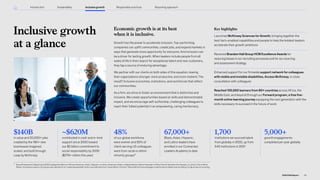
  • 13.
    1,600+ sustainability engagements worked onby 3,500+ colleagues with 600+ clients across nearly 60 countries and in every industry 80% of reported CO2 emissions reductions were driven by our clients6 $140B in value and 20,000+ jobs created by the 190+ new businesses imagined, scaled, and built through Leap by McKinsey ~$620M contributed in cash and in-kind support since 2020 toward our $2 billion commitment to social responsibility by 2030 ($275+ million this year) ~$700M invested in strengthening our risk management teams, capabilities, and processes since 2018 99% pay equity for men and women colleagues globally9 100% of our air travel is subject to a global internal carbon fee to support our transition to net zero by 20307 Launched Frontier, an advance market commitment to purchase permanent carbon removal with fellow founders Alphabet, Meta, Shopify, and Stripe 48% global workforce were women, and 52% of client- serving US colleagues were from racial or ethnic minority groups8 1M jobs created and 20% of global GDP growth contributed by our clients annually6 100% of new clients were vetted against our industry-leading CITIO client service framework10 100% of our colleagues completed comprehensive training on our policies and professional standards11 Sustainability Inclusive growth Responsible practices 2022 progress highlights 6 Numbers are based on our ongoing analysis of publicly held companies between 2015–2021. We assess the percentage of global gross domestic product (GDP) growth driven by our clients, relative to total global GDP growth. In the same time period, we look at total Scope 1 and Scope 2 CO2 emissions reductions reported by these publicly held companies, and the percentage of those achieved by our clients. We also establish the average net new jobs created by our publicly held clients during this period. 7 Carbon fee was implemented in 2022 for official launch on all air travel January 1, 2023. EMAIL 8 Equal Employment Opportunity (EEO) categories: Black or African American, Asian, Hispanic or Latino, American Indian or Alaska Native, Native Hawaiian or Other Pacific Islander (not Hispanic or Latino), Two or More Races. In previous reports, this group was referred to as “underrepresented” and is now referred to as “racial/ethnic minority.” Race/ethnicity percentages in performance tables may not add up to figure due to rounding. 9 The pay ratio was calculated using annualized 2022 total compensation of female to non-female firm members, weighted based on segments including employee grouping and level by country, including non-partners and partners. Segments with a total number of colleagues less than ten were excluded. 10 CITIO is the framework we use to assess a potential client or engagement consisting of five interrelated dimensions: Country, Institution, Topic, Individual, and Operational considerations. 11 This figure does not include firm members exempted from the training because they weren’t actively working at the time of the program (for example, leave of absence, left the firm). 13 2022 ESG Report Introduction Sustainability Reporting approach Responsible practices Inclusive growth PDF COPY MIRO
  • 14.
    580+ Ukrainian and Russian colleaguesrelocated May 13, 2022 exited the Russian market entirely $28M contributed to relief efforts 530,000 reads of our Ukraine insights Our people and firm Russia’s invasion of Ukraine in February 2022 ushered in a humanitarian crisis in Europe of a scale not seen since World War II and generated social and economic shocks to countries and sectors around the world. We responded quickly to relocate our more than 580 Ukraine- and Russia-based colleagues and their families, helping them settle into new locations and workplace roles. By May 13, 2022, we had exited the Russian market entirely. Giving Simultaneously, we coordinated resources that helped the broader humanitarian efforts of agencies providing support for refugees, including the relocation of families, strategic plans for economic recovery, and solutions for damaged supply chains. We contributed $28 million to relief efforts, including $18 million in donations from our colleagues and firm to more than 1,600 organizations and $10 million in pro bono support. Pro bono support We launched several pro bono projects in which more than 50 colleagues participated, including: Refugee relief — Supporting short-term refugee relief, including services for up to 30,000 refugees across more than 25 reception centers, as well as a survey analysis of 7,000 refugees to help prioritize support measures. — Assisting with identifying 90,000 available places in schools, capacity for 200,000 people to receive healthcare, and 70,000 housing opportunities, and matching them to refugee needs. Economic recovery — Conducting workshops to support private sector recovery and investment. — Working to restore food supply chains and solve critical deficits through the launch of a business-to-business marketplace, demand–supply model, and other measures. Our response to the war in Ukraine Employment and reskilling — Connecting more than three million refugees to an online job platform, resulting in 17,000 jobs posted and 65,000 job applications submitted. — Launching Together , an online platform that has helped more than 4,000 Ukrainian women in Europe gain access to jobs, language programs, mentorship, support groups, and professional development opportunities. Read more about the war in Ukraine » Twelve disruptions changing the world » Rising risk of a global food crisis » The net-zero transition in the wake of the war in Ukraine 14 2022 ESG Report Introduction Sustainability Reporting approach Responsible practices Inclusive growth
  • 15.
    Sustainability In this chapter,we share our progress toward achieving net-zero climate impact and how we partner with clients to catalyze and accelerate decarbonization globally. In this chapter 16 Sustainability at a glance Our clients 17 Our approach Our insights 22 Key publications Our actions 24 Our path to net zero Introduction Sustainability Reporting approach Responsible practices Inclusive growth 15 2022 ESG Report
  • 16.
    1,600+ sustainability-related client engagements in2022 $400M+ invested in the past two years toward our $1 billion commitment by 2025 to help our clients tackle the climate crisis 3,500+ colleagues spent more than 30% of their time on sustainability topics 97% renewable electricity toward our goal of 100% by 2025 30% reduction in absolute Scope 1 and Scope 2 emissions in 2022 (vs. 2019 baseline) 48% reduction in Scope 3 emissions from travel per colleague in 2022 (vs. 2019 baseline) Sustainability at a glance Key highlights Partnered with Alphabet, Meta, Shopify, and Stripe to found Frontier, a new $1+ billion advance market commitmentto purchase permanent carbon removal before 2030 Introduced a global internal carbon fee on all air travel to accelerate decarbonization and generate funding for carbon reduction efforts Launched a Global Decarbonization Hubin Houston to accelerate the energy transition for our communities and clients, successfully delivering 30+ client engagements, including a roadmap to abate up to 50 mega-tons of carbon over 10 years for a major oil and gas company Earned a spot on CDP’s Climate Change A List for our transparency and leadership Engaged 1,200+ colleagues across our 120 Green Teams to reduce our environmental footprint globally Creating a more sustainable, inclusive, and growing future for all is the defining issue of our time. Addressing climate change is a crucial part of the equation. Our sustainability agenda comprises two main priorities. We aspire to be the leading private sector catalyst for decarbonization through our work to help accelerate the transition to net-zero greenhouse gas (GHG) emissions. We are also committed as a firm to achieving net-zero climate impact by 2030, in line with validated, near-term, science- based targets as an important milestone on the pathway toward stabilizing global warming temperatures at 1.5˚C. Coral and schools of fish swimming in Fiji; photographed by Rodolphe Holler for Conservation International. 16 2022 ESG Report Introduction Sustainability Reporting approach Responsible practices Inclusive growth
  • 17.
    Our approach We partnerwith leaders to accelerate sustainability and growth. More than 3,000 companies have made net-zero commitments. Faced with the twin imperatives of advancing climate solutions and ensuring growth, some leaders could be tempted into either/or choices. We believe that the best response to this moment is to create strategies that square the dual needs for growth and a climate transition. That’s why we are driving sustainable innovation that unlocks the next horizon of growth. By pursuing net-zero and nature commitments, the private and public sectors can address the climate crisis while ensuring the net-zero transition is affordable, secure, and reliable. Our clients 1,600+ sustainability-related client engagements in 2022 McKinsey-hostedpaneloncreatingaclean,secure,andaffordableenergyfutureatCOP27,November2022. We serve all industries—and go where the emissions are. McKinsey Sustainability partners with clients to decarbonize and seize growth opportunities in the energy transition. We serve emitters because that is where the emissions are, and we are accelerating our goal of helping all industry sectors halve carbon emissions by 2030 and reach net zero by 2050. We aspire to be the largest force for decarbonization in the private sector and the preeminent partner in achieving impact across key topics: hyperscaling green businesses, driving brown to green decarbonization, carbon markets, nature and biodiversity, and sustainable finance. Our McKinsey Platform for Climate Technologies works to scale a suite of 10 critical technologies ranging from hydrogen and battery storage to alternative proteins and nature-based solutions. We bring distinctive people and technology to accelerate the net-zero transition. We are powered by distinctive people and thought leadership. McKinsey Sustainability has grown to more than 3,500 colleagues in just two years, and our work now touches nearly a quarter of our clients. Our research provides leading-edge insights into topics at the top of the CEO agenda, starting with the publication of our carbon abatement curves 15 years ago, continuing with our climate risk and response report in 2020, and our newest research on the global energy transition. 17 2022 ESG Report Introduction Sustainability Reporting approach Responsible practices Inclusive growth
  • 18.
    Our key actionsin 2022 Convening leaders to catalyze climate action McKinsey works side by side with leading institutions to convene global partnerships that tackle problems that any one institution alone could not. In 2022, McKinsey launched a new series of global Green Business Building summits with a flagship convening in Stockholm that brought together more than 300 C-suite executives from green tech disruptors, incumbents with ambitious green growth agenda, and sustainability investors. As the Opening Ceremony Partner for Climate Week NYC, McKinsey led conversations on progress toward net-zero goals amid economic uncertainty. At COP27 in Egypt, McKinsey Sustainability hosted a series of in-person and live-streamed events that reached more than 100,000 people. These events focused on the practical steps leaders can take to achieve sustainability and growth across key areas such as energy, nature, materials, adaptation, and finance. Replay these discussions on our website . Accelerating decarbonization transformations with Microsoft and Catalyst Zero Microsoft and McKinsey have partnered to create a technological solution that can calculate an organization’s carbon footprint and build and execute a robust decarbonization plan, supporting businesses in their energy transitions. Powered by Microsoft’s Cloud for Sustainability, the digital platform uses Microsoft’s Sustainability Manager to automate and scale the collection of companies’ sustainability-related data and help establish an emissions baseline. Once generated, McKinsey’s Catalyst Zero solution provides a holistic gauge of emissions at company, product, and value chain levels, helping leaders create detailed decarbonization plans. During delivery, the two systems monitor data feedback against the forecasted impact to calculate performance. An ongoing progress report can help to build transparency and stakeholder confidence. Fueling the Gulf Coast’s transition to green technologies McKinsey’s Houston office has been accelerating the net-zero transition by collaborating with the Greater Houston Partnership’s Houston Energy Transition Initiative and Center for Houston’s Future. Support includes a pro bono study on ways to catalyze the energy transition and a roadmap whitepaper detailing the actions required to see the area deliver on this opportunity. These partnerships culminated in 2022 with the launch of the Global Decarbonization Hub , a joint effort between McKinsey Sustainability and the Global Energy and Materials Practice to unlock opportunities for the community and our clients. The hub aims to accelerate the Gulf Coast’s transition to green technologies by investing $100 million over the next decade into decarbonization programs that will scale climate technologies and build new businesses across the energy and materials value chains. By 2050, the hub seeks to remove 100 million tons of emissions annually and create 500,000 new jobs. McKinsey and Microsoft’s Catalyst Zero solution helps companies build and execute a robust decarbonization plan. 18 2022 ESG Report Introduction Sustainability Reporting approach Responsible practices Inclusive growth
  • 19.
    Enduring Earth: Advancing globalconservation efforts In 2022, McKinsey joined the Enduring Earth initiative, a collaboration between The Nature Conservancy, The Pew Charitable Trusts, World Wildlife Fund, and ZOMALAB to accelerate ocean, land, and freshwater conservation and support community development worldwide. The effort brings together governments, local communities, Indigenous peoples, and funders to develop accountable, actionable, and science-based conservation plans that create opportunities for sustainable economic growth. Enduring Earth uses Project Finance for Permanence—also known as a PFP—an innovative and proven model that fully funds conservation efforts to ensure durable and scalable impact. The approach closely follows the project financing methodology commonly used in large infrastructure projects. It ensures all funding and pre-conditions for success are committed in a single-deal moment before funding is released. That means the commitments of one stakeholder can leverage the commitments of others, like philanthropists or the private sector, and vice versa. Early community buy-in and involvement are critical elements of the process, and this approach ensures communities can be in the driver’s seat every step of the way. McKinsey is contributing to this model through the analysis and optimization of socioeconomic impact, identifying sustainable financing mechanisms, and enabling access to carbon markets. To date, nearly 90 million hectares across five nations have been conserved with the goal of protecting another 600 million hectares across 20 nations by 2030. Impact story A hummingbird in Colombia, one of the countries where Enduring Earth is helping conserve ocean, lands, and freshwater. ©Jonny James/Unsplash ~90M hectares conserved across five nations 19 2022 ESG Report Introduction Sustainability Reporting approach Responsible practices Inclusive growth
  • 20.
    Africa Carbon Markets Initiative:Accelerating sustainability and job creation across the continent McKinsey helped to design the Africa Carbon Markets Initiative (ACMI) in partnership with Sustainable Energy for All, the Global Energy Alliance for People and Planet, and the Rockefeller Foundation. The initiative, launched at COP27, aims to dramatically expand Africa’s participation in voluntary carbon markets. McKinsey has supported ACMI from its inception, working with the Global Energy Alliance for People and Planet, through shaping and refining the initiative’s ambition, developing its strategy and operating model, and defining and implementing processes to increase efficiencies. Impact story ACMI’s ambition is to grow African carbon credit retirements approximately 19-fold from 2020, reaching around 300 metric tons of carbon dioxide equivalent per annum by 2030 and up to 1.5 to 2.5 gigatons of carbon dioxide equivalent by 2050. It also seeks to create and support 30 million jobs by 2030 and more than 100 million jobs by 2050 through the carbon project’s development, execution, certification, and monitoring. ACMI, which launched 13 action plans to accelerate progress in the run-up to COP28, also looks to raise the quality and integrity of African carbon credits to mobilize up to $6 billion by 2030 and more than $100 billion per annum by 2050. This effort will ensure equitable and transparent distribution of carbon credit revenue, with a significant portion of the revenue going to support local communities. 100M jobs supported by 2050 20 2022 ESG Report Introduction Sustainability Reporting approach Responsible practices Inclusive growth
  • 21.
    ALDI SOUTH: Creatinga retailer-led sustainable global packaging ecosystem A leading European grocery retailer with a growing global footprint, the ALDI SOUTH Group uses a range of packaging materials, the majority of which are plastics. McKinsey partnered with ALDI SOUTH to create a more sustainable packaging ecosystem, allowing the organization to secure greater access to recycled materials—and meet the demands of their customers, who had expressed a desire for less waste and more recycled packaging in surveys. Together, we built a 360° view of the company’s plastic packaging footprint—across countries, polymers, and packaging formats. This information informed a value chain strategy that allowed ALDI SOUTH to see which aspects they should own—and where to partner—on their journey to more sustainable packaging. This will unlock a measurable reduction on plastic packaging, including significant reduction of CO2 emissions for plastic packaging, for the company globally. Impact story To ensure that ALDI SOUTH could deliver on these goals, we helped them design a new organizational structure dedicated to sustainable packaging. This also included a capability-building effort that ALDI SOUTH launched, upskilling employees, with a focus on product packaging optimization, packaging design, partner management, recycling, and waste management. As sustainable packaging becomes an increasingly challenging topic for consumer goods companies and retailers alike, these efforts will help the ALDI SOUTH Group—which has more than 7,100 stores in 11 countries—capture opportunities, become a leader in this space, and create value for customers who want to make more sustainable choices. 21 2022 ESG Report Introduction Sustainability Reporting approach Responsible practices Inclusive growth
  • 22.
    Key publications Our insights Weare accelerating the journey to net zero, publishing in-depth, fact- based insights that meaningfully advance progress and problem-solving on the global energy transition. Decarbonization is at the top of the leadership agenda—but the drive to net zero is also at an inflection point. The imperative to transition to an energy system that is clean and sustainable and at the same time affordable and secure presents leaders with a “devilish duality” that makes decision-making fraught with risk. We help leaders navigate this dilemma through publications covering a range of topics: physical climate risk, sustainability, decarbonization, and approaches to addressing global, regional, and sector-specific energy challenges. Through our research and insights, we seek to generate new thinking, identify practical solutions, and inspire the bold action necessary to realize a safer and more sustainable future. Here are some highlights from our collected sustainability insights in 2022. The net-zero transition: What would it cost, what it could bring Governments and companies are pledging to achieve net-zero emissions of GHGs. What would it take to fulfill that ambition? In this report, we look at the economic transformation that a transition to net-zero emissions would entail. Spotting green business opportunities in a surging net-zero world Explore how eight industries may transition to a net-zero world, and how organizations can respond with green businesses that create value along the way. Nature in the balance: What companies can do to restore natural capital This article is the summary of a full report in which we examine the state of natural capital, the economic sectors depending on and affecting it, and the opportunities for companies to help reduce those demands. Delivering the climate technologies needed fornet zero Developing and deploying climate technologies is critical for the world’s net-zero agenda. Growth could await businesses willing to innovate quickly and to collaborate across value chains. 22 2022 ESG Report Introduction Sustainability Reporting approach Responsible practices Inclusive growth
  • 23.
    Playingoffensetocreatevalue inthenet-zerotransition Decarbonization will reshape theeconomy, opening new markets and imperiling others. Now is the moment for companies to spot green growth opportunities and move boldly to take advantage. Theenergytransition: Aregion-by-regionagenda fornear-termaction This article highlights a range of near-term actions that countries and regions around the world could take to ensure they transition their energy system while maintaining focus on the immediate needs of energy reliance and affordability. A devilish duality: How CEOs can square resilience with net-zero promises Amid turbulence on the path to net zero, leaders will have to be much nimbler to balance resilience with an energy future that is secure, affordable, and clean. Five actions can help. Decarbonising India: Charting a pathway for sustainable growth This will be a decisive decade. With intentional action, India can accelerate decarbonization at scale while pursuing economic growth. Theraw-materialschallenge: Howthemetalsandmining sectorwillbeatthecoreof enablingtheenergytransition As the world gears up for net zero, demand for raw materials is set to soar. The energy transition presents unique challenges for metals and mining companies, which will need to innovate and rebuild their growth agenda. Sixcharacteristicsdefinethe net-zerotransition Our analysis of the net-zero transition suggests that it would be universal, significant, and front-loaded, with uneven effects on sectors, geographies, and communities, even as it creates growth opportunities. Key publications (continued) Our insights 23 2022 ESG Report Introduction Sustainability Reporting approach Responsible practices Inclusive growth
  • 24.
    Our path to netzero Our actions Healthy societies depend on a healthy planet. That’s why, in addition to serving clients and sharing insights, McKinsey has committed to achieving net-zero climate impact by 2030. Our approach Becoming the largest private sector catalyst for decarbonization begins with our own actions. Our approach to achieving net-zero climate impact by 2030 is informed by our insights and built on three pillars: 1. Cutting our own emissions to achieve our validated, science- based targets to reduce Scope 1, 2, and 3 emissions in line with a 1.5-degree pathway. This is our top priority. 2. Compensating for remaining emissions that we have not yet been able to eliminate. We have been carbon neutral since 2018. 3. Catalyzing climate action now by working closely with clients, nonprofits, suppliers, and peers to protect nature, accelerate new technologies, and ensure crucial financing. In 2022, McKinsey made CDP’s Climate Change A List We are committed to transparency and accountability in our actions. In 2022, McKinsey made CDP’s Climate Change A List—the gold standard for climate disclosure—for our transparency and leadership. The Risk, Audit, and Governance Committee (RAGC), a sub-committee of McKinsey’s Shareholders’ Council (our board), provides strategic direction, oversight, and accountability for climate-related issues. Performance ratings, which inform bonuses for the leaders of our Shareholders’ Council, Acceleration Team (our global leadership team), and Sustainability Growth Platform, are connected to the attainment of the firm’s goals, including our sustainability goals. 24 2022 ESG Report Introduction Sustainability Reporting approach Responsible practices Inclusive growth
  • 25.
    Net-zero climate impactroadmap We are committed to achieving net-zero climate impact by 2030, with interim science-based targets as an important milestone. Our validated science-based targets12 Our commitment Net-zero climate impact 25% reduction in absolute Scope 1 and 2 emissions (vs. 2019) 2030 2025 2019 How we are getting there Compensating for remaining emissions Catalyzing climate action now Our baseline Total GHG emissions 743K tCO2e 0 50 100 150 200 250 300 350 400 450 500 550 600 650 700 Cutting our own emissions Scope 1 and 2: Direct and indirect emissions—for example, from our offices and firm- owned vehicles Scope 3: Other indirect emissions— for example, internal and client travel 725K tCO2e 18K tCO2e 30% reduction in Scope 3 business travel emissions per colleague (vs. 2019) • Multi-year initiatives to protect nature, accelerate new technologies, and ensure financing • Natural climate solutions • Permanent carbon removal technologies • Carbon neutral since 2018 Scope 1 and 2: • Fleet electrification • Renewable electricity • Sustainable office space Scope 3: • Virtual events • Hybrid working models • Sustainable aviation fuel 12 In line with a 1.5°C pathway. 25 2022 ESG Report Introduction Sustainability Reporting approach Responsible practices Inclusive growth
  • 26.
    ALDI SOUTH: Creatinga retailer-led sustainable global packaging ecosystem A leading European grocery retailer with a growing global footprint, the ALDI SOUTH Group uses a range of packaging materials, the majority of which are plastics. Today, ALDI SOUTH’s plastic packaging portfolio consists of a wide variety of formats and different polymers, without any consistent standards—often, discarding that plastic waste also poses a logistics challenge. McKinsey partnered with ALDI SOUTH to create a more sustainable packaging ecosystem, allowing the organization to secure greater access to recycled materials—and meet the demands of their customers, who had expressed a desire for less waste and more recycled packaging in surveys. Together, we built a 360° view of the company’s plastic packaging footprint—across countries, polymers, and packaging formats. This information informed a value chain strategy that allowed ALDI SOUTH to see which aspects they should own—and where to partner—on their journey to more sustainable packaging. It also led to 15 percent savings on packaging for the company globally. Cutting our own emissions Compensating for remaining emissions Catalyzing climate action now Shifting to 50% carbon removals by 2025 to reach 100% by 2030 Invested in a portfolio of natural climate solutions projects , for example: — The Delta Blue Carbon project in Pakistan has restored and protected 224,000+ hectares of mangroves, benefiting 10,400+ people. — The Southern Cardamom REDD+ Project in Cambodia has helped 16,000+ people build more sustainable livelihoods by protecting 442,000 hectares of forests home to 35 threatened species. — The CO2OL Tropical Mix reforestation project in Panama has planted 7.5 million trees and helped local residents benefit from increased employment, higher wages, and health and pension benefits. Launched Frontier with Alphabet, Meta, Shopify, and Stripe, a new $1+ billion advance market commitment to purchase permanent carbon removal before 2030 — We signed multi-year offtake agreements with multiple carbon removal providers worth ~$10 million for our own footprint as part of our commitment to scale the tech-based carbon removal market and compensate for our remaining emissions. Joined the Enduring Earth initiative to accelerate ocean, land, and freshwater conservation Continued to partner with the LEAF Coalition to scale jurisdictional carbon credits and with the Sustainable Aviation Buyers Alliance to scale the sustainable aviation fuel market 2022 progress toward net-zero impact Target Progress in 2022 25% absolute reduction in Scope 1 and 2 GHG emissions by 2025 (vs. 2019 baseline) 30% reduction vs. 2019 30% reduction in Scope 3 GHG emissions from internal and client-related business travel per colleague by 2025 (vs. 2019 baseline) 48% reduction vs. 2019 Launched an internal carbon fee on all air travel On track to meet our science-based targets Sourced 97% renewable electricity 26 2022 ESG Report Introduction Sustainability Reporting approach Responsible practices Inclusive growth
  • 27.
    13 Our GHG emissionsinventory methodology follows best practices, such as using scientifically robust and up-to-date emission factors and including a radiative forcing index of 1.9 for air travel. Our reporting covers all material emission sources and complies with the criteria of South Pole’s Climate Neutral Company label. Scope 1 covers all direct GHG emissions, such as fugitive emissions and those from combustion in owned or controlled boilers, diesel backup generators, and vehicles. Scope 2 covers indirect GHG emissions from the generation of purchased electricity, heat, or steam. Scope 3 encompasses other indirect emissions, such as those from business travel, upstream, emissions from purchased fuels and electricity (for example, well-to-tank emissions, transmission, and distribution losses), purchased goods, vehicles not owned or controlled, outsourced activities, waste disposal, and use of video conferencing and other digital services as well as the use of electricity and heating at home during work. Scope 1 and 2 emissions were calculated using survey data covering 94% of our offices. Scope 3 emissions were calculated based on mileage (air travel, ground transportation, and employee commuting), stay duration (hotels), energy consumption (related to work from home, cloud computing, and upstream emissions from purchased fuels and electricity), spend (purchased goods and outsourced activities), and survey data (waste disposal and consumption of water bottles). Wherever data was missing, estimates were used for all scopes. 14 We have set science-based targets and have committed to reduce absolute Scope 1 and 2 GHG emissions 25% and Scope 3 GHG emissions from business travel 30% per employee by 2025 from a 2019 baseline year. 15 Within commercial interiors or office buildings. Cutting our own emissions We account for our GHG emissions on an annual basis and have them independently verified to ensure they align with the Greenhouse Gas Protocol and best measurement practices.13 In 2022, our total GHG emissions decreased by 28 percent from 2019 due to adopting new ways of working and reducing our internal and client-related travel. Electrifying firm-owned vehicles (Scope 1 and 2 emissions) Todecarbonizeourfleetofvehicles,weareworkingtowardmaking electricvehicles (EVs) the default for lease renewals. We have introduced EV-only vehicle policies in Germany, Austria, Belgium, Luxembourg, the Netherlands, and Switzerland—effectively covering more than 50 percent of our global car fleet. Our use of hybrid and EV cars has increased threefold globally since 2019—from 9 percent in 2019 to 27 percent in 2022. Making our office spaces more sustainable (Scope 1 and 2 emissions) Sixty-one percent of our global office space is in LEED certified (or equivalent) commercial interiors or office buildings; 49 percent of our global office space is in LEED Gold or Platinum (or equivalent) certified commercial interiors or office buildings. Many of our colleagues work remotely or have a hybrid working model, which has shifted some of our electricity consumption from our offices to colleagues’ homes. We capture this transition in our Scope 3 emissions. Water and waste Given the nature of our operations, our environmental footprint is not water intensive. Therefore, we do not measure our water withdrawals globally. In 2022, 61 of our 189 operating locations were in areas of high or extremely high baseline water stress. To date, 24 of these 61 locations have achieved green building certification. We will continue 1,200+ colleagues are members of our 120 Green Teams globally 9 offices havereceivedISO14001 environmentalmanagement systemcertificationtodate 10,000+ trees planted by six offices 61% LEED certified (or equivalent)15 global office space to minimize our water consumption while contributing to structural solutions—for example, by supporting the UN Water Resilience Coalition as a knowledge partner and adviser. Green Teams More than 1,200 colleagues were members of our 120 Green Teams in 2022—representing nearly every office. The teams helped build awareness, reduce the firm’s environmental footprint, and mobilize our more than 45,000 colleagues to invest their time and effort in local activities to reduce our collective footprint. These ranged from eliminating single-use plastic and improving water efficiency to educating teams about sustainable travel options. Our Go Green Awards recognize Green Teams who have gone above and beyond to make their McKinsey locations more environmentally sustainable. This year, we recognized five outstanding Green Teams— Manila, Mexico, Brussels, Tampa, and Detroit—that spearheaded initiatives to accelerate recycling, support local urban farms, reduce food and plastic waste, plant trees, and clean up local beaches. 201914 2020 2021 2022 Scope 1 15 12 12 10 Scope 2 3 3 3 3 Scope 3 725 208 169 519 Total 743 223 183 532 Data in thousand tCO2e Note: Figures in this section may not sum to total because of rounding. Scope 1: Direct emissions (for example, from the combustion of fuels in owned or controlled boilers, diesel backup generators, and vehicles); Scope 2: Indirect emissions from the generation of purchased electricity, heat, or steam; Scope 3: Other indirect emissions (for example, related to business travel or purchased goods). Our progress in reducing GHG emissions (market-based) 27 2022 ESG Report Introduction Sustainability Reporting approach Responsible practices Inclusive growth
  • 28.
    Transitioning to renewableelectricity (Scope 2) As part of our commitment to the RE100 climate group , we source renewable electricity aligned with RE100 criteria in every country where it’s currently available. This means we have shifted 97 percent of our total consumed electricity to renewable sources and aim to reach 100 percent by 2025. Of our 2022 electricity consumption, 0.5 percent originated in Russia. In light of the war in Ukraine, we did not procure electricity certificates for Russia. We have since suspended operations in Russia. Electricity consumption from renewable sources % Geothermal 3% Hydro 12% Solar 25% Wind 60% Reducing travel, driving sustainability in aviation, and encouraging hybrid working models (Scope 3) Air travel is the largest component of our carbon footprint (82 percent of our 2019 baseline for our science-based targets). Building on the approach adopted during pandemic- related restrictions, we are reimagining our travel and making necessary travel more sustainable by: — Embracing new ways of working: Our teams are implementing hybrid and remote working models that are more sustainable, inclusive, and productive. For example, we introduced a new event planning tool that optimizes travel by identifying the location and transportation options with the lowest carbon footprint. To ensure lasting change, we launched two major initiatives in 2022: • Driving action through accountability: We have designated a Senior Partner Science-Based Target Leader per region. Each is accountable for delivering our Scope 3 science-based target and regularly reports progress to our Acceleration Team. • Launching an internal carbon fee: As of January 1, 2023, we introduced a global internal carbon fee on all air travel to accelerate decarbonization and generate funding for carbon reduction efforts. The fee allows us to continue investing in emerging sustainability technologies, like carbon removal and sustainable aviation fuels, and strengthens colleague awareness of our environmental footprint and commitments. The funds will also be used to continue compensating for our remaining emissions to fund our net-zero transition. We introduced a global internal carbon fee on all air travel McKinsey’s London office, one of several that have received ISO 14001 environmental management system certification. 97% renewable electricity 28 2022 ESG Report Introduction Sustainability Reporting approach Responsible practices Inclusive growth
  • 29.
    — Recruiting ina digital environment: The use of technology throughout our recruiting process allows for greater accessibility and convenience for applicants. In 2022, we held more than 115,000 virtual interviews and recruiting events, allowing potential candidates to learn more about us and the work we do from their homes, reducing our carbon footprint. — Driving sustainability in aviation: We are committed to helping scale up the use of sustainable aviation fuel (SAF). We are founding members of the Sustainable Aviation Buyers Alliance and signatories to the World Economic Forum’s Clean Skies for Tomorrow 2030 Ambition Statement , targeting 10 percent SAF by 2030. We are partnering with clients to enable SAF production and offtake. Reducing our supply chain emissions (Scope 3) We are committed to engaging with our suppliers to help them improve the social and environmental impact of the goods and services they offer. Because indirect emissions from travel account for more than 90 percent of our carbon footprint, we have made engaging with our travel-related suppliers on sustainability issues a focus of our sustainable procurement efforts.16 In 2022, we launched the CDP Supply Chain program with suppliers accounting for more than 80 percent of our Scope 3 business travel emissions. Engaging our suppliers through the CDP Supply Chain program will enable us to more easily identify risks and opportunities related to emissions reductions in our own supply chain and will support and encourage our suppliers to reduce their own emissions. We continue to discuss opportunities with our suppliers to provide our colleagues with more sustainable options. Learn more about driving supplier environmental sustainability . We engage suppliers accounting for 80%+ of our Scope 3 business travel emissions. 16 Exceptions may apply such as when travel decreased due to COVID-19. 29 2022 ESG Report Introduction Sustainability Reporting approach Responsible practices Inclusive growth
  • 30.
    Compensating for remainingemissions: By the numbers Compensating for remaining emissions We have been carbon neutral since 2018, compensating for all emissions we have not yet been able to eliminate, including those from travel. We achieved this by investing in high-quality carbon reduction projects certified by international standards such as Gold Standard and Verified Carbon Standard in conjunction with Climate, Community Biodiversity Standards (VCS+CCBS). With the support of third- party due diligence, we continually monitor, reassess, and adjust our portfolio of projects. Investing in natural climate solutions We are investing in natural climate solutions to address the dual climate and nature crises and in technology solutions to help scale the carbon removal market to meet global demand. As we accelerate toward our 2030 net-zero goal, we will transition to 100 percent carbon removals to permanently remove carbon from the atmosphere. Innovating the next frontier of carbon removal technologies The primary drivers to meet the 1.5-degree pathway set by the Intergovernmental Panel on Climate Change are carbon emissions avoidance and emissions reductions. Increasingly, however, atmospheric carbon removals are being identified as a crucial method in limiting global warming. McKinsey Sustainability has partnered with Alphabet, Meta, Shopify, and Stripe to found Frontier , a new more than $1 billion advance market commitment to purchase permanent carbon removal before 2030. By guaranteeing future demand, Frontier seeks to accelerate the development of permanent carbon removal technologies and expand their global supply and accessibility. In 2021, McKinsey joined the Lowering Emissions by Accelerating Forest finance (LEAF) Coalition as an initial participant—one of the largest ever public-private efforts to protect tropical forests through an innovative approach to large-scale financing. We continue to be an active member both in shaping the emerging jurisdictional approach and through our purchasing commitments. 16 projects 21% $11+ per tCO2e 532K+ tC02e supported worldwide average carbon price CO2 removal projects — 8% mangroves — 13% afforestation/ reforestation compensated, including: — 46% forest protection and conservation (REDD+) — 33% technology-based avoidance (e.g., landfill gas capture) — 21% CO2 removal projects 30 2022 ESG Report Introduction Sustainability Reporting approach Responsible practices Inclusive growth
  • 31.
    This includes oursupport for: The Sustainable Aviation Buyers Alliance (SABA), which is working to scale and standardize high-quality SAF Frontier , a $1+ billion advance market commitment with fellow founding members Alphabet, Meta, Shopify, and Stripe to purchase permanent carbon removal before 2030 RE100 , a coalition of 380+ organizations committed to using 100% renewable electricity Delterra , which is building rapidly scalable, self-sustaining recycling ecosystems in emerging economies to help communities redirect waste to productive uses The World Economic Forum and its Clean Skies for Tomorrow Coalition , which works toward reforming the aviation industry Natural Climate Solutions Alliance , which aims to increase private sector investment in natural climate solutions by 1 gigaton of CO2e per year by 2025 The World Business Council for Sustainable Development andits effortstoaccelerateanet-zero,nature- positive,andequitablefuture The LEAFCoalition , a public-private partnership to protect tropical forests through large-scale financing Improving recycling programs and livelihoods Delterra is an independent nonprofit founded and supported by McKinsey that is redesigning waste management and recycling systems in Argentina, Brazil, and Indonesia. Up to 70 percent of participants in its flagship program, Rethinking Recycling, now separate their waste, leading to improved material recovery and the diversion of thousands of tons of waste. Delterra has established a second program, Plastic IQ, to help companies rethink their packaging strategies, and is piloting a material traceability tool in Argentina to enable ethical, transparent supply chains. Delterra plans to scale its operations across Asia, Latin America, and Africa in the coming years and is on track to reach 1.5 million people by the end of 2023. Catalyzing climate action now We work with our clients, nonprofits, and other peer organizations around the world on multi-year conservation initiatives that help protect nature and reduce biodiversity loss. To amplify our impact, we work with these groups to scale the solutions we need to limit global warming to 1.5°C. 31 2022 ESG Report Introduction Sustainability Reporting approach Responsible practices Inclusive growth
  • 32.
    In this chapter,we share how we’re accelerating inclusion and growth as we aspire to bring about an economy that works better and for more people. Inclusive growth In this chapter 33 Inclusive growth at a glance Our clients 35 Our approach Our insights 43 Key publications Our actions 45 Our approach to people Our giving 52 Our approach to advancing social responsibility Jeremy Jenkins applied learnings from the McKinsey Black Leadership Academy to accelerate sustainability in his role at Dow Chemical. Hear Jeremy’s story here . Inclusive growth 32 2022 ESG Report Introduction Sustainability Reporting approach Responsible practices
  • 33.
    $140B in value and20,000+ jobs created by the 190+ new businesses imagined, scaled, and built through Leap by McKinsey 67,000+ Black, Asian, Hispanic, and Latino leaders have enrolled in our Connected Leaders Academy to date 48% of our global workforce were women and 52% of client-serving US colleagues were from racial or ethnic minority groups17 ~$620M contributed in cash and in-kind support since 2020 toward our $2 billion commitment to social responsibility by 2030 ($275+ million this year) 5,000+ growth engagements completed per year globally 1,700 institutions we sourced talent from globally in 2022, up from 540 institutions in 2021 Economic growth is at its best when it is inclusive. Growth has the power to accelerate inclusion. Top-performing companies can uplift communities, create jobs, and expand markets in ways that generate more opportunity for everyone. And inclusion can be a driver for lasting growth. When leaders include people from all walks of life in their search for exceptional talent and new customers, they tap a source of enduring advantage. We partner with our clients on both sides of this equation, leaving their organizations stronger, more productive, and more resilient. The result? Inclusive economies, institutions, and workforces that reflect our communities. As a firm, we strive to foster an environment that is distinctive and inclusive. We create opportunities based on skills and demonstrated impact, and we encourage self-authorship, challenging colleagues to reach their fullest potential in an empowering, caring meritocracy. Inclusive growth at a glance 17 Equal Employment Opportunity (EEO) categories: Black or African American, Asian, Hispanic or Latino, American Indian or Alaska Native, Native Hawaiian or Other Pacific Islander (not Hispanic or Latino), Two or More Races. In previous reports, this group was referred to as “underrepresented” and is now referred to as “racial/ethnic minority.” Race/ethnicity percentages in performance tables may not add up to figure due to rounding. Key highlights Launched McKinsey Sciences for Growth, bringing together the best tech-enabled capabilities and people to help the boldest leaders accelerate their growth ambitions Received Brandon Hall Group HCM Excellence Awards for reducing biases in our recruiting processes and for our sourcing and assessment strategy Enhanced support for our firmwide support network for colleagues with visible and invisible disabilities, Access McKinsey, in close consultation with colleagues Reached 100,000 learners from 60+ countries across Africa, the Middle East, and beyond through our Forward program, a free five- month online learning journey equipping the next generation with the skills necessary to succeed in the future of work 33 2022 ESG Report Introduction Sustainability Inclusive growth Reporting approach Responsible practices
  • 34.
    Our 10 Actions towardracial equity In 2020,we publicly committed to support anti-racism initiatives and racial equity, outlining how we plan to accelerate change within our firm and help combat racism around the world.18 Drawing on our areas of core expertise, we focused on short-, medium-, and long-term actions to build Black leadership within McKinsey and beyond, conducting data-based research to identify barriers and solutions, and investing in greater racial equity and inclusion for Black communities in the United States and around the globe. We are proud to support the leaders, businesses, and communities working for a more just, inclusive, and equitable society. While we are making progress, having achieved half of our actions, we—and the rest of the world—still have a long way to go. Find out more about the impact we are having through our 10 Actions initiative throughout this report and read more about our commitment to diversity, equity, and inclusion for details on other actions we are taking to advance diverse and inclusive workplaces. ~70% of the way to our goal to double Black leadership 30 articles published by McKinsey’s Institute for Black Economic Mobility Achieved Achieved Achieved Achieved 5,000+ anti-biastrainingscompletedtohelp supporttheattractionandadvancement ofBlackanddiversecolleagues ~$30M invested in completed pro bono engagements toward our $200 million commitment by 2030 ~55,000 leaders enrolled in our Black Leadership Academy Achieved 1 Double Black leadership and hiring 6 Launch McKinsey Institute for Black Economic Mobility 2 Equity and inclusion learning program 7 Double spend with diverse suppliers in three years 3 Day of Service 8 $2 million to Generation19 4Minimize bias in people processes 9 $200 million in pro bono support over ten years 5 Create a Black Leadership Academy (BLA) 10 $5 million in charitable giving 18 10 Actions progress updates on this page refer to the period June 2020 to December 2022. 19 For more information on Generation, see Our approach to advancing social responsibility . Statusupdate Actioncommitment Statusupdate Actioncommitment 34 2022 ESG Report Introduction Sustainability Inclusive growth Reporting approach Responsible practices
  • 35.
    Our approach Our clients Webuild strategies that unlock the potential of our clients’ people and open the way to new markets. By strengthening our clients in this way, we strive to advance and accelerate long-term, inclusive growth globally. Our approach focuses on: McKinsey Academy Our capability-building programs unlock potential across all levels of an organization—from the executive team to middle management to frontline employees—to support broad transformation efforts and add value to their bottom lines. Digital Capability Centers These advanced tech-enabled innovation and learning hubs guide the realization of an organization’s digital future, allowing companies to experience the latest digital and analytics opportunities and build the skills they need to apply them. Organizational Health Index (OHI) We apply analytical rigor to organizational health management. Our quantitative diagnostics and proven recipes for success empower senior leaders to measure and achieve the organizational health required to sustain long-term performance. Building on our expertise and research, we employ proprietary assessments, analytics-powered digital solutions, and facilitated programs to deliver results for our clients that accelerate inclusive growth. Examples include: Growth is the oxygen that organizations and economies need to thrive. Leaders who build companies that grow help to empower households, promote equitable opportunity, and serve a wide range of stakeholders. The best leaders find ways to put the right people to work in the right ways. We help our clients unleash the power of inclusive workforces, translating strategy into action through technology. Growth opportunities lie in underserved markets at home and abroad. We bring people and technology together to help new enterprises—and new customers—thrive. Seeing new potential for growth Fostering greater inclusion in customer bases Expanding inclusion in skilled workforces 35 2022 ESG Report Introduction Sustainability Inclusive growth Reporting approach Responsible practices
  • 36.
    Our key actionsin 2022 McKinsey Center for CEO Excellence Companies have only one truly peerless role—that of the CEO. As much as 45 percent of what drives a company’s performance falls into the chief executive’s hands. Today, the role demands increasing ethical accountability, social responsibility, and environmental stewardship. The decisions a CEO is responsible for have grown twice as predictive of a company’s overall performance over the last 50 years. Launched in 2022 after the publication of our bestselling book—CEO Excellence: The Six Mindsets That Distinguish the Best Leaders from the Rest— the McKinsey Center for CEO Excellence seeks to provide leaders with meaningful support and guidance to help them perform at their highest level, maximize their potential, and successfully navigate a complex and constantly evolving world. QuantumBlack, McKinsey’s integrated AI arm QuantumBlack, a London-based startup we acquired in 2015, has been an accelerating force for our work in analytics. In 2022, it entered a new chapter by officially becoming the integrated AI arm of McKinsey. The QuantumBlack community has achieved a number of feats: building then donating Kedro, an industry-leading developer tool, to the open- source community; being named a Leader in AI; and supporting women in technology through community efforts and mentorship. Two years ago, most of our AI work was single-use cases. Today, roughly half is transformational—and delivered by QuantumBlack’s more than 1,000 technical practitioners across the globe. McKinsey Health Institute Since it was founded in 2022 on the conviction that humanity could add up to 45 billion additional years of high-quality life, the McKinsey Health Institute (MHI) has established itself as a global leader in health. MHI rapidly achieved impact at scale by publishing industry-leading research in areas like brain health, employee health, and healthy aging, and collaborating with partners to build momentum for health as an all-sector priority. Among its accomplishments, MHI co-founded the World Wellbeing Movement, a coalition of global leaders advancing well-being in the public and private sectors; deployed training to help educators around the world better understand child trauma, reaching approximately 30,000 students; and supported the scaling of 988, a nationwide suicide and crisis hotline that saw calls increased by 47 percent, reaching nearly five million people in need. Learn more about MHI’s work to catalyze progress . Supporting social, healthcare, and public entities For more than 70 years, we have worked alongside many of the world’s leading social, healthcare, and public sector organizations, enabling those who do so much good in the world to operate at the highest level. We are humbled to have the opportunity to support tackling some of the most pressing challenges of our time and are proud of the impact that our clients deliver. Our mission is central in everything that we do and informs every choice we make. The institutions and topics we engage with are determined by whether our partnership can improve lives, livelihoods, and health. We choose to invest knowledge, research, and capabilities where we believe the most significant opportunities exist for such improvements. We approach each engagement holistically, conscious that our clients often make complex choices that have far-reaching consequences. We invest in research on critical economic, government health, and social, economic, and government topics through dedicated research centers, including the McKinsey Center for Government and the Center for US Health Systems Reform. All of this supports leaders to help them make good decisions that drive the positive changes—across their organization, operations, technology, and other capabilities—necessary to deliver against their mission. 36 2022 ESG Report Introduction Sustainability Inclusive growth Reporting approach Responsible practices
  • 37.
    Advancing racial equity ConnectedLeaders Academy Following the murder of George Floyd in 2020, we shared our 10 Actions toward racial equity as our plan to accelerate change within our firm and to help combat racism across the world. One of the actions was to launch our Black Leadership Academy, which we achieved the same year. Responding to participant feedback, the initiative grew the following year to become the Connected Leaders Academy and welcomed Asian, Latino, and Hispanic cohorts. More than 67,000 participants have enrolled in the academy, and in 2022 we added a program for early career leaders to support self- identified people of color as they advance to managerial roles from entry-level jobs. More than 18,000 participants have enrolled in this program, which is available at no cost to attendees. Black Economic Mobility OurannualBlackEconomicForumeventconvenesBlackleaders fromthepublic,private,andsocialsectors,partneringtoincrease economicmobilityinUSBlackcommunitiesandsupportthenext generationofBlackbusinessesandentrepreneurs.In2022,theforum celebrateditsfifthanniversary,withmorethan200leadersattending. WearedeeplycommittedtoacceleratingBlackeconomicgrowth. TheMcKinseyInstituteforBlackEconomicMobility,forexample,isa researchinstituteandthinktankdedicatedtoadvancingracialequity andinclusivegrowth.Itsmissionistohelpprivate-,public-,andsocial- sectorleadersaccelerateBlackeconomicdevelopmentbyproviding in-depthresearch,conveningwithstakeholders,andtranslating researchintopracticalassetsandcapabilities. Jim Lowery, right, the first Black consultant at McKinsey, at the Black Economic Forum with Princeton University’s Dr. Eddie S. Glaude, Jr. 37 2022 ESG Report Introduction Sustainability Inclusive growth Reporting approach Responsible practices
  • 38.
    Tearing the “paperceiling”: Driving upward mobility for millions of workers One of the ways we brought our strategy to life in 2022 was by taking a full system view of one of inclusive growth’s key elements—broadening the talent pool. Based on our insights and extensive research on skills-based hiring and human capital , we cast a spotlight on a talent pool that employers may overlook—the more than 70 million workers in the US who are STARs, or workers “skilled through alternative routes.” While STARs have the skills for higher-wage work, many are often automatically screened out from job postings that require college degrees. We first applied these insights to our own firm, making significant investments in recruiting, hiring, and growing STARs through a comprehensive approach that recognizes candidates’ skills and experience, problem-solving ability, and intrinsic capabilities. For example, by moving from traditional case studies to a game- based assessment, nearly 150,000 candidates over the past two years have been able to demonstrate their critical-thinking and leadership traits even if they don’t have prior business or case- study experience. Our People Organizational Performance technology organization led by McKinsey Partner, and a STAR, Carolyn Pierce, is at the forefront of putting outdated systems to the test, with many entry-level roles already open to STARs who have the relevant experience and skills. We then took what we learned from our own work to our engagements with clients, building data-driven solutions that help other employers implement new ways of screening for knowledge, skills, and capacity to learn. To accelerate progress beyond our firm, in 2022 we began providing pro bono data and analytics support to Opportunity@Work for a national campaign with the Ad Council to “Tear the Paper Ceiling ,” the invisible barrier that keeps millions of Americans from jobs that allow upward mobility—an advance into higher economic and social positions. By partnering to demonstrate the value and transfer of skills developed through work experience, we encourage more employers to reimagine their hiring practices and build better ways to screen for talent and create opportunities for STARs. “ We know there are better ways to screen for talent and now we have the research and tools to back that up.” Carolyn Pierce, McKinsey partner LaShana Lewis, CEO, entrepreneur, and a STAR. 38 2022 ESG Report Introduction Sustainability Inclusive growth Reporting approach Responsible practices
  • 39.
    JobsOhio: Revitalizing the state’seconomy through innovative solutions After the Great Recession, Ohio’s economy needed help to counter deep losses in manufacturing jobs. In 2011, using profits from the beverage industry, the state formed JobsOhio, a first-of-its-kind nonprofit to stimulate economic growth through new industries. To date, Ohio has seen nearly one million jobs created or protected. As a key early partner, McKinsey helped develop JobsOhio’s growth plan. Ten sectors were identified for their employment potential. These included aerospace and aviation, healthcare, logistics and distribution, and technology. In 2018, McKinsey partnered with JobsOhio to evaluate performance. Insights informed the growth strategy for JobsOhio 2.0, which broadened its focus to building innovation districts in Cleveland, Columbus, and Cincinnati. These multi-organization partnerships created 60,000 jobs and established Ohio as a global leader in healthcare, life sciences, and technology. Impact story In 2020, as COVID-19 began to spread, McKinsey again partnered with JobsOhio to create Ohio to Work, to assist displaced workers. The partners also designed a program through which JobsOhio pays tuition costs for technical degrees. Enrollees who secure jobs paying good wages gradually repay JobsOhio through a marginal percentage of their income. JobsOhio then reinvests the funds in its next enrollee group. A decade of growth and economic investment in Ohio has helped to attract the largest single private sector company investment in the state. In 2022, Intel announced that it would open a new chip manufacturing plant in Central Ohio, creating 3,000 new jobs at the plant with an average salary of $135,000. “ We’ve valued McKinsey’s partnership over the last several years. Their data-driven approach, combined with creative thinking, led to solutions that supported our success in creating hundreds of thousands of jobs.” JP Nauseef, President and CEO of JobsOhio ~60,000 jobs created through multi-organization partnerships 39 2022 ESG Report Introduction Sustainability Inclusive growth Reporting approach Responsible practices
  • 40.
    Manufacturing Africa: Strengthening Africa’s manufacturingsector and creating jobs for a fast- growing population Africa’s population is growing faster than any other continent’s and is set to double by 2050. New generations of young people will require economic opportunities—an estimated 18 million new jobs will be needed annually until 2035. A competitive manufacturing sector would help address this gap and also provide Africa with a clearer strategic role in the global economy. Yet across the continent, many countries have struggled to develop their manufacturing base and move into high-value services due to a lack of investment resources. Manufacturing Africa is a multi-year program created by the UK government’s Foreign, Commonwealth Development Office. It seeks to bring £1.2 billion in foreign investment to Africa’s manufacturing sector, creating 90,000 new jobs and enabling an inclusive economic transformation across five countries—Ethiopia, Kenya, Nigeria, Senegal, and Rwanda. As part of Manufacturing Africa, McKinsey has worked closely on efforts to develop and support various manufacturing sectors, including global health and vaccine manufacturing, food security and agri-processing, and ESG and sustainability efforts. This work has expanded the capacity of investment promotion agencies, which has contributed to manufacturing deals. For example, Manufacturing Africa worked with a major East African waste management company to update and test its model for business expansion, refine its investment thesis, and focus on developing innovative products to drive revenue. Through additional foreign investment and strategic expansion, the company plans to increase the amount of organic waste collected and treated annually from 12,000 tons to one million. The waste will then be converted into valuable products like animal feed, fertilizer, and biomass fuel briquettes. Now in its third year, Manufacturing Africa has helped to close 26 manufacturing deals, attracting more than $800 million in foreign direct investment, which has the potential to create more than 14,000 jobs. Impact story $800M+ attracted through 26 manufacturing deals 40 2022 ESG Report Introduction Sustainability Inclusive growth Reporting approach Responsible practices
  • 41.
    DRNSW: Upskilling in ruralcorners of Australia Upskilling and reskilling today’s workforce—in non-degree, skill- building programs—is critical to attracting and retaining talent while driving market competitiveness. One organization that understands this is Australia’s Department of Regional New South Wales (DRNSW), a government agency supporting regional communities through agriculture, local infrastructure projects, soil conservation, environmental stewardship, economic development, and more . At the onset of the pandemic, DRNSW took stock of its employees’ digital capabilities. The department uncovered a range of opportunities to increase the team’s digital fluency and partnered with McKinsey to do so. The first step was to reframe DRNSW’s transformation from a learning and development opportunity to skills training—which does not happen in a classroom but while employees are on the job and able to immediately operationalize it. McKinsey created a program rooted in human-centered design, informed by a deep study of the individual’s and organization’s needs, addressed in small groups and individual coaching. Another core element of the DRNSW Digital Skills Program is the “skills hub,” critical for engaging the broader DRNSW organization and ensuring sustained impact as the program scaled. This new operational unit consists of a DRNSW squad with capability-building specialists, human-centered designers, instructional designers, and program delivery experts. “Other agencies couldn’t believe we built, piloted, and started scaling this entire new approach to capability building in six months when this can typically take two or three years in government,” says Donna Mcleod, director of workforce capability and talent at DRNSW. “It was a phenomenal delivery.” The program won the Best in Class award in the public sector category from Good Design Australia, one of the most prestigious design awards in the world. But the biggest testament to its success is the difference it has made in the careers of the employees. Impact story 92% employee satisfaction with the skills program 80% of learners reported productivity improvement and increased capability within their role 41 2022 ESG Report Introduction Sustainability Inclusive growth Reporting approach Responsible practices
  • 42.
    Minuto de DiosUniversity: Bridging the education access gap for thousands of Colombian students McKinsey is supporting the transformation of Colombia’s leading university, Minuto de Dios. An institution with more than 100,000 students, Minuto de Dios has historically targeted underserved communities throughout the country to tackle profound inequalities in education access. The engagement has advanced the university’s mission of providing affordable higher education for all Colombians, offering additional and better programs to more people, in more places. The transformation has included over 140 impact initiatives to simultaneously strengthen the quality of the academic programs and enhance the overall financial performance of the organization to foster sustainable growth. This includes setting up a National Center for Innovative Pedagogy and a portfolio of national virtual and hybrid courses, which ensures students from remote regions across the country have access to the best educators at the university. In its pilot phase, these courses are already benefiting over 25,000 students. The university has also worked to improve their information systems to bolster operational efficiency, and capability-building programs for the organization to execute a sustainable transformation. Through the effort, the university aims to increase its student population by 41 percent to 140,000 students over the next two years, improve its standing in Colombia’s national standardized tests, and achieve positive financial impact of more than $30 million. In the first period under the implementation, 16,400 new students joined the university, representing 14 percent growth versus the previous cycle. The transformation has been underpinned by an ambitious endeavor to cultivate the university’s talent. Over 2,000 people have benefited from McKinsey’s Ability to Execute program, which is designed to build individuals’ capabilities at scale to drive and sustain transformational change. Impact story 2,000+ people upskilled across the university 42 2022 ESG Report Introduction Sustainability Inclusive growth Reporting approach Responsible practices
  • 43.
    We’re helping tobuild an economy that works for all, publishing original research and analysis to grow, broaden, and sustain prosperity for all segments of society, in populations across the globe. Achieving a more equitable and inclusive economy is an imperative of our time. Economic mobility depends on growth—and according to our research, growth is at its best when it propels broad-based prosperity, increasing well-being and reducing inequality across all strata of society. Our reports and articles enable leaders to support and expand inclusive growth, including by creating and improving access to jobs, advancing equity for diverse demographics, and equipping workers with the skills they need for our fast-changing future. Through actionable insights and data-driven solutions, we aspire to create an economy that not only works better but, vitally, that works better for everyone. Here are some highlights from our inclusive growth insights in 2022. Womeninthe Workplace2022 Conducted in partnership with LeanIn.Org, this is the eighth edition of the largest study of women in corporate America. Addressingemployee burnout:Areyousolvingthe rightproblem? Employers have invested unprecedented resources in employee mental health and well-being. With burnout at all- time highs, leaders wonder if they can make a difference. Our research suggests they can. TheTitaniumEconomy:How toovercomethechallengeof fillinghigh-qualityjobs Thrivingindustrialtechnology companiesuseapprenticeships, upskilling,andupwardmobilityto staffandretaintheirworkforces. Hybridwork:Makingitfitwith yourdiversity,equity,and inclusionstrategy New research details what empowered employees love about hybrid work models and the risks to diversity, equity, and inclusion if managers get the evolving flexible workplace wrong. Key publications Our insights 43 2022 ESG Report Introduction Sustainability Inclusive growth Reporting approach Responsible practices
  • 44.
    Thechildcareconundrum:How cancompanieseaseworking parents’returntotheoffice? The status quowork culture no longer works for most families— particularly those with very young children. But companies’ support for childcare can turn worker attrition into attraction. Theeconomicstateof LatinosintheUS: Determinedtothrive US Latinos are a driving force of the US economy and account for the fastest-growing portion of US GDP. Theoverlookedcontributions andhiddenchallengesofAsian Americans[Podcast] Asian Americans play a key role in creating a more sustainable and inclusive economy. This report explores the challenges this group faces and how companies can better support them. Closingtheracialwealthgapby investinginBlackconsumers [Podcast] Organizations that incorporate racial equity into their strategic agenda can promote growth and advance Black economic mobility. How can business leaders realize this transformative growth? Whatisdiversity,equity, andinclusion? Companies that are diverse, equitable, and inclusive are better able to respond to challenges, win top talent, and meet the needs of different customer bases. Meetingthechallengeof moms’“doubledoubleshift” athomeandwork[Podcast] As the United States emerges from the pandemic, how can businesses build a more inclusive working environment to improve outcomes for women in the workforce? Key publications (continued) Our insights 44 2022 ESG Report Introduction Sustainability Inclusive growth Reporting approach Responsible practices
  • 45.
    Our approach topeople Our actions During COVID-19, the worker- employer contract fundamentally and permanently changed. We are deeply committed to examining and reinvigorating our People approach to create inclusive opportunities for people of all backgrounds to both serve clients and run our firm. We operate as a single global partnership, united by a common purpose, shared values, and a two-part mission that includes creating an unrivalled environment for exceptional people. Our values reflect our expectation that every colleague works to make our firm both distinctive and inclusive. Those values are: — be nonhierarchical and inclusive — sustain a caring meritocracy — develop one another through apprenticeship and mentoring — uphold the obligation to engage as well as dissent — embrace diverse perspectives with curiosity and respect — govern ourselves as a “one firm” partnership During COVID-19 and since, we and our clients have seen three workplace trends accelerate : the search for meaning, the desire for flexibility, and the pace of technological transformation. Building a distinctive and inclusive workforce These trends led us to reexamine our talent model in 2022 and revitalize our People mission. We established new foundational pillars: the personalization of work to encourage flexibility and “self-authored” career paths, skills development, and demonstrated impact. The result is a diverse, inclusive, and caring approach to people in which individuals can pursue their own ambitions. Our People strategy touches every aspect of how we recruit, motivate, develop, and retain exceptional talent. Using a rapidly growing number of cutting-edge tools and techniques, we are assessing for exceptional skills, regardless of academic background. Our formal and informal skills-development systems increasingly aim to help participants succeed in a growing range of roles. We are placing more emphasis on coaching and daily feedback. We tripled our recruitment sources from 540 to 1,700 globally. 45 2022 ESG Report Introduction Sustainability Inclusive growth Reporting approach Responsible practices
  • 46.
    Attracting top talent Ourapproach to attracting talent is central to McKinsey’s dual mission—to help our clients substantially improve their performance, and to build a firm that attracts, develops, excites, and retains exceptional people. Diversifying our talent sources We look at talent differently. We don’t assess potential candidates by where they are or where they studied—but rather by their skills and their potential. The exceptional people we need may come from anywhere, and we are dedicated to attracting distinctive and diverse talent to our teams. We want those teams to reflect the diversity of our clients, the communities in which we work, and society. Building a firm of colleagues from different backgrounds and profiles is critical for us to deliver distinctive client service while making our firm a richer and better place. We are expanding our talent pools and evolving our recruiting and assessment processes while continuously working to mitigate the potential for bias. 2022 progress highlights — Almost half our new joiners today were experienced professionals. — 49% of new hires were women. — 53% of US new hires and 47% of our US workforce were from racial or ethnic minority groups.20 — InNorthAmerica,welaunchedtheBusinessInsightsLeadership DevelopmentProgram(BUILD),atwo-yearrotationalprogramoffered tostudentsfromNewYorkpubliccollegesanduniversitiescreatedto supportourcommitmenttotheNewYorkJobsCEOCouncil. — In Latin America, we supported colleagues in developing their English proficiency through classes and coaching offered in programs like our Women Tech Academy in Brazil. — We tripled our recruitment sources from 540 to 1,700 institutions globally. 49% of new hires were women 20 Equal Employment Opportunity (EEO) categories: Black or African American, Asian, Hispanic or Latino, American Indian or Alaska Native, Native Hawaiian or Other Pacific Islander (not Hispanic or Latino), Two or More Races. In previous reports, this group was referred to as “underrepresented” and is now referred to as “racial/ethnic minority.” Race/ethnicity percentages in performance tables may not add up to figure due to rounding. Ranked 1# in Germany and #4 in the US on Glassdoor’s Best Places to Work list 2023 46 2022 ESG Report Introduction Sustainability Inclusive growth Reporting approach Responsible practices
  • 47.
    Reaching talent ofthe future We want individuals from all backgrounds to get to know us, engage with us, and explore what it takes to help our clients succeed. We run: — learning programs customized for women and racial/ethnic minority populations in management consulting, such as The First Year Leadership Academy — the Proud Leaders speakers series in Europe, creating connections across the LGBTQ+ community, sharing research, and highlighting trans and nonbinary voices — A Place for You , a program aimed at connecting underrepresented talent to careers in management consulting through training and webinars — preparation for students studying at Historically Black Colleges and Universities (HBCUs) for a meaningful start in consulting and building leadership skills for top Black, Hispanic, and Latino candidates in MBA programs in the United States We also partner with external organizations to move conversations, actions, and commitments forward around diversity, equity, and inclusion. These include AfroTech , the Society of Hispanic Professional Engineers , Reaching Out MBA , HeForShe , New York Jobs CEO Council , and MAKERS , to name a few. Additionally, we continue to convene the Juntos Conference in Brazil, designed foryoungBlacktalenttoconnect,meetBlackprofessionals, developnewskills,engagewithlargecompanies,andlearnabout careeropportunities. Being consciously inclusive in our hiring process To understand and overcome personal biases and to ensure fairness in our hiring processes, we employ a full suite of consciously inclusive solutions. Our job descriptions emphasize skills, and our improved résumé screening process is more inclusive of a diverse set of experiences and skills. To combat potential biases, we provide inclusion training for all of our assessors to ensure evidence-based hiring decisions, in conjunction with a trained and dedicated inclusion adviser. We are also expanding the use of Solve , our game-based assessment that allows candidates to demonstrate their critical-thinking and problem- solving skills in an environment that is less likely to lead to typical job assessment biases. In2022,wereceivedBrandonHallGroupHCMExcellence Awardsforreducingbiasesinourrecruitingprocessesand foroursourcingandassessmentstrategy. Alberto, an engagement manager and leader of the McKinsey Black Network in Brazil, at the Juntos Conference he helped found. 47 2022 ESG Report Introduction Sustainability Inclusive growth Reporting approach Responsible practices
  • 48.
    48% global workforce werewomen 49% new hires were women 33% Acceleration Team (Executive Committee) were women22 28% leadership were women21 52% US client-serving colleagues were from racial or ethnic minority groups23 47% US workforce were from racial or ethnic minority groups23 21 The leadership definition has been updated to better reflect leadership roles at the firm. These roles include all partners, associate partners, and other senior firm leaders. Historical leadership numbers have been restated to be consistent with this definition. 22 In previous reports, the Global Managing Partner (GMP) and Extended Acceleration Team (AT) were not included in the total number of Acceleration Team members. This year and going forward, we will include the GMP and the Extended AT in the count. We have also restated historicals in this report to be consistent with this methodology. 23 EqualEmploymentOpportunity(EEO)categories:BlackorAfricanAmerican,Asian,HispanicorLatino,AmericanIndianorAlaskaNative,NativeHawaiianorOtherPacificIslander(notHispanicorLatino),TwoorMoreRaces. Inpreviousreports,thisgroupwasreferredtoas“underrepresented”andisnowreferredtoas“racial/ethnicminority.”Race/ethnicitypercentagesinperformancetablesmaynotadduptofigureduetorounding. 2022 DEI progress We foster an environment that is distinctive and inclusive, and measure our progress toward building teams that reflect the diversity of our clients, the communities in which we work, and society. 48 2022 ESG Report Introduction Sustainability Inclusive growth Reporting approach Responsible practices
  • 49.
    Diversity, equity, andinclusion McKinsey has long been committed to advancing diversity, equity, and inclusion (DEI) in our own firm, for our clients, and in broader society. This commitment is integral to building a firm that attracts, develops, and excites exceptional people. It is also key to our client service strategy. Our research underscores that diversity and inclusion are connected to better business performance and talent retention. We understand that advancing DEI requires long-term commitment and dedication and that progress can be slow. Like many of our peers, we are not where we aspire to be. Yet we are proud of the progress we have made to date and are determined to continue our journey. Championing DEI within our firm and with our clients First, we aim to deliver on our talent ambition by attracting, developing, and retaining exceptional people from racial or ethnic minority groups. We support this work by creating and maintaining a caring meritocracy where all colleagues feel included and can thrive. We seek to foster an inclusive culture in which colleagues representing a vast range of diverse backgrounds and perspectives can find meaning in their work experiences, team collaboration, and professional development opportunities. Second, we aim to better serve our clients with diverse teams, convening key stakeholders to advance the DEI agenda globally. We build capabilities along with our clients’ diverse populations and advise them on their own DEI journeys. Third, we aim to highlight the importance of taking a role in societal change by leading the knowledge agenda on DEI, building value- adding partnerships, and contributing toward a more just and equitable society through supplier diversity, pro bono work, and more. Learn more about our DEI client work , supplier diversity and pro bono work . Driving measurable progress Across McKinsey, led by our own research, we have increased our leadership accountability for our change efforts, created greater data transparency,24 and advanced various programmatic efforts to tackle key obstacles. Since launching our 10 actions in June 2020, we’ve more than tripled the number of Black hires in the US. Our pro bono efforts, including our partnerships with Homeboy Industries , and the Greater Washington Partnership in the US and Black Equity Organisation in the UK, have made a great impact on local communities. Our groups and communities continue to grow and include, among many others, the McKinsey Black Network, Hispanic and Latino Network, Asians at McKinsey, GLAM (for LGBTQ+ colleagues), Access McKinsey (for colleagues with disabilities, chronic illnesses, and mental health challenges), and PRISM (Progressing Representation and Inclusion in Social Mobility). 24 Where permitted by law. Today, women represent nearly half of our colleagues and new hires globally. By our 100th anniversary in 2026, we aspire for half of all firm members to be women. For more information, review our detailed DEI data . Delivering on our DEI talent ambition Our DEI leadership is driving a comprehensive program to: — have senior leaders who are visible, committed role models and who hold themselves accountable for DEI progress — set clear and ambitious DEI aspirations and track progress to permit course correction when necessary — find and attract the most exceptional and diverse talent — drive programmatic solutions tailored to root causes and integrate them into existing processes and colleagues’ journeys Select recognition for our support of LGBTQ+ colleagues 49 2022 ESG Report Introduction Sustainability Inclusive growth Reporting approach Responsible practices
  • 50.
    Acting to tacklebias We strive to follow the best practices that we champion in our research and we are diligently minimizing unconscious bias across our people processes. Learn more about our approach to being consciously inclusive in our hiring process . Supporting colleagues with disabilities, chronic illnesses, and mental health challenges In 2022, we enhanced support for Access McKinsey—a group founded to support colleagues with disabilities, chronic illnesses, and mental health challenges. In close consultation with some Access McKinsey members, we assembled a broad task force, which included Access McKinsey members, to identify and implement accessibility enhancements and increase firm awareness of issues central to the community. Early initiatives included creating a centralized website for accessibility resources and extending tailored learning programs to colleagues in the group. We sought to improve colleagues’ experience with the accommodations process and the Human Resources team consolidated general accommodations process guidelines, which are being adapted to local legal conditions, to support colleagues more consistently. In 2022, McKinsey celebrated International Day of Persons with Disabilities, with colleagues joining panel discussions to better understand disability and accessibility needs, and how to be better accessibility allies. Learn more about how we are caring for our colleagues . We aim to be distinctive and inclusive, and we value potential more than pedigree Building inclusion and allyship We believe that inclusion is every individual’s responsibility as well as a critical leadership skill. We continue to embed this expectation in our systems and culture by integrating inclusion principles into learning programs and offering focused training for colleagues at all levels. Learn more about colleague development and talent attraction . Almost 14,000 colleagues are part of our Inclusion Allies program, designed to develop, connect, and activate a global cohort of inclusive leaders through training, initiatives, mentoring, and research. In 2022, we launched our “Inclusion Champions Badges” program that formally acknowledges and makes visible our most active allies contributing to building a more inclusive firm. 2018 hired our first Chief Diversity and Inclusion Officer Creating accountability We know from research that senior leaders play critical roles in creating inclusive environments and configuring teams that will benefit from a diversity of perspectives, experiences, and expertise. To encourage such developments, we have embedded in every employee’s evaluation specific expectations, tailored to roles, for inclusive behavior. We have equipped evaluators with individualized performance reports on inclusive leadership performance where relevant. Building careers through sponsorship Our research also highlights that formal sponsorship and actively working to create opportunities significantly improve the chances for advancement success. We approach sponsorship rigorously by measuring each colleague for how much and how well they perform as sponsors. We then design individual interventions to ensure all colleagues receive the support they need to be successful. Additionally, we have tailored training and professional development programs focused on sponsorship for women and diverse colleagues. These include role-based programs, like Pathway to Partner, and programs designed to support specific groups, like Women’s Leadership Workshop and the McKinsey Black Network sponsorship program. These programs focus on skill building, creating robust support networks, and providing tailored personal coaching and training. 50 2022 ESG Report Introduction Sustainability Inclusive growth Reporting approach Responsible practices
  • 51.
    Taking a rolein societal change We are committed to being role models for the prioritization of DEI efforts. We hope that others will follow and ultimately drive positive societal change. Our collective DEI efforts include producing cutting- edge knowledge, building value-adding partnerships, ensuring supplier diversity, and conducting pro bono work. With our best-in- class partners across the globe, we share a commitment to expand economic opportunity and support communities. Learn more about our supplier diversity and pro bono work . Developing insights to accelerate action Our broad portfolio of DEI research continues to be a leading voice on the subject and catalyzes change across industries. In 2022, our Women in the Workplace report was the largest study on the state of women in corporate America and was one of our top three most read reports of the year globally. We have deepened our research focus on the experience of racial or ethnic minority groups in North America, and possible ways to maximize their economic opportunities. Recent work includes the economic state of Latinos in the US , the invisible challenges faced by Asian Americans in the workplace , and a series of detailed articles on the Black consumer experience . We plan to expand our global research. In 2022, we were proud to present research on socioeconomic Diversity Matters in Latin America , as well as our latest report in Germany on how new careers can potentially enable more diverse leadership . Our Women Matters series continued to bring focus to different markets, for example, investigating the progress of gender parity in Mexico . We went beyond gender parity to examine how successful French companies have been in their search for executives with diverse national origins and socioeconomic backgrounds . Partnering to drive impact We collaborate with partners, such as HeForShe, Women’s Forum, Aspen Institute, and The Trevor Project, to expand our impact. In 2022, we teamed up with Openly , a global news platform dedicated to underreported global news for and about LGBTQ+ people. We also partnered with the World Economic Forum to launch the Global Parity Alliance , a cross-industry group of companies taking action to accelerate DEI in the workplace and beyond. Better serving our clients The business case for DEI is growing stronger. An increasing number of companies recognize diverse teams and leadership as critical for enabling talent acquisition, enhancing innovation, and improving customer insights. We strive to serve our clients by example. We make a priority of bringing diverse perspectives to our clients through our teams. We also convene experts and key stakeholders to advance DEI thought leadership globally. By helping our clients build the next generation of diverse leaders and advising them on their DEI efforts, we support our clients’ efforts to make substantial, lasting performance improvements. Convening LGBTQ+ leaders After two years of the global pandemic, we were finally able to bring together a record number of global LGBTQ+ senior leaders for The Alliance in Athens, Greece. This gathering focused on LGBTQ+ inclusion in the workplace. It featured McKinsey’s research on transgender/nonbinary inclusion; intersectional identities in the US, the UK, and Brazil; and the condition of LGBTQ+ individuals in high- risk geographies (concentrating on LGBTQ+ refugees). Senior LGBTQ+ leaders from around the world gathered in Athens, Greece, to discuss inclusion in the workplace. Read more about accessible leadership » How parenting through a medical diagnosis inspired a new way to lead and live » Leadership lessons from the world’s best CEOs [Podcast] 51 2022 ESG Report Introduction Sustainability Inclusive growth Reporting approach Responsible practices
  • 52.
    We are committedto creating a more inclusive economy by enabling people to meet their basic needs, access opportunities, and achieve economic empowerment through access to essentials, quality jobs, and skilling. We have committed $2 billion to social responsibility efforts by 2030 and have so far contributed nearly $620 million in cash and in-kind support toward that commitment (more than $275 million this year). Through our social responsibility strategy, we seek to: — drive our social responsibility investments toward at-scale efforts that increase inclusive growth — engage our colleagues through giving and volunteering, and support all colleagues to participate in and serve their local communities A dedicated committee of senior leaders is responsible for advising on giving in line with our firmwide Social Responsibility Policy. Regional and local pro bono work is guided by local committees. Our approach to advancing social responsibility Our giving Driving at-scale efforts to increase inclusive growth Fund for Social Good We support and fund multi-year partnerships with leading institutions around the world, tackling complex problems and finding creative solutions that advance and accelerate sustainable and inclusive growth. Established in 2020, the Fund for Social Good has committed to multi-year support of diverse projects, including: — African Agricultural Transformation Initiative (AATI): This project aims to drive inclusive agricultural transformation in Africa. Co-founded by partners including the Alliance for a Green Revolution in Africa , the Bill Melinda Gates Foundation , the International Fund for Agricultural Development (IFAD), and McKinsey. 4,000+ nonprofits supported through pro bono engagements, McKinsey Gives, and McKinsey Grants 488,500 hours dedicated to social responsibility through volunteering, board service, pro bono engagements, and fellowships at nonprofits $28M contributed to Ukraine war relief efforts, including $18 million in donations from our colleagues and firm to more than 1,600 organizations and $10 million in pro bono support 100% of McKinsey offices in 65+ countries volunteered with local organizations for our third annual Day of Service ~$620M contributed in cash and in-kind support since 2020 toward our $2 billion commitment to social responsibility by 2030 ($275+ million this year) 52 2022 ESG Report Introduction Sustainability Inclusive growth Reporting approach Responsible practices
  • 53.
    AATI builds onMcKinsey’s impact on agriculture and food systems across Africa, including work to increase food production that helped contribute to 11 million fewer undernourished people, 150,000 fewer deaths from hunger, and 100,000 new jobs. AATI launched support to its first wave of countries to accelerate effective and sustainable food system changes based on country needs, priorities, and existing infrastructure. Learn more about the AATI partnership . — Conservation: Through our work with partners like Blue Nature Alliance and Enduring Earth , over the next few years we will conserve more than one billion hectares of land and create or protect over 200,000 jobs through the implementation of 30 mega conservation projects around the world. In 2022 alone, our conservation work helped implement three mega conservation projects, creating 10,000 direct jobs and protecting 78 million hectares. A critical component of this collaboration is creating jobs for remote and Indigenous communities in places around the world where nature conservation is particularly important. Such communities are incredibly hard to reach with standard stimulus or other growth measures. They’re more dependent on intact natural capital, and they are the first to benefit from jobs created directly in nature conservation or as a by-product of conservation. Learn more about the Blue Nature Alliance . Learn more about Enduring Earth . Examples of pro bono efforts around the world Forward In 2022, we were proud to celebrate the landmark achievement of reaching the first 190,000 learners through the Forward program—our free, five-month online learning journey. Forward, which targets those with fewer than five years of work experience, is designed to equip the next generation of talent with the tools necessary to succeed in the working world. Digital courses and sessions are focused on transferable skills like adaptability, problem-solving, communication, and being digitally savvy. In the initial 18 months of the program, we reached learners in more than 70 countries across Africa and the Middle East, as well as in Pakistan, Türkiye, and Azerbaijan. McKinsey.org In 2022, McKinsey launched McKinsey.org as a philanthropic initiative to bring the firm’s capability-building solutions at no cost to nonprofits that are accelerating inclusive growth around the world. By sharing the best of McKinsey’s programs to nurture leaders and foster more effective organizations, McKinsey.org aims to unlock the full potential of nonprofits. It offers programs designed to uplift entire organizations, including: — Ability to Execute (A2E) for Nonprofits: Designed to empower employees with a new way of working, and build the capabilities needed to drive and sustain organizational change. — Organizational Health Index (OHI) for Nonprofits: Helps an organization align around a common mission, execute with excellence, and continually renew itself to serve its mission more effectively. The Akanksha Foundation, one of the nonprofits we support through our capacity-building programs. 78% ofForwardgraduateswho completedthefullprogram experiencedcareerorrole growthduetoapplyingthenew skillsetsandattitudeslearned 15M beneficiaries reached through 100 nonprofits in 60 countries participating in McKinsey.org programs 53 2022 ESG Report Introduction Sustainability Inclusive growth Reporting approach Responsible practices
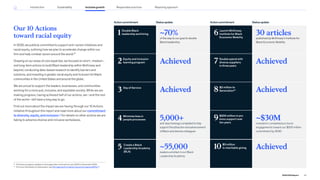
  • 54.
    Generation In 2014, wefounded Generation , an independent nonprofit organization that transforms the education to employment system to prepare, place, and support people into life-changing careers that would otherwise be inaccessible. Our continued support for Generation is one of the ways we’re helping foster a more inclusive economy. Together, we’re enabling people to meet their basic needs, access opportunities, and achieve economic empowerment through quality jobs and skilling. In 2022, 22,000 participants graduated from Generation, a 185 percent increase from 2021. In partnership with about 11,000 nonprofits, governments, and employers, Generation has helped train and place more than 75,000 people into jobs across 35 professions in 17 countries. Its global graduates have earned $630 million in wages to date. Juntos In 2018, we created the Juntos Conference in Brazil to address the disparity between the representation of Black Brazilians in senior roles in the private sector compared to the general population. It works to create a platform for networking and professional development in partnership with other large companies committed to racial justice. Through training, panels, and career fairs, the annual Juntos Conference supports the creation of an inclusive environment to help Black professionals succeed. Our 2022 conference was the largest to date, offering virtual and in-person sessions for the first time. In total, over 4,000 participants registered for the conference, with over 1,000 in attendance at our in-person events in São Paulo, Salvador, and Porto Alegre in Brazil. The conference is supported year-round by the Juntos Ecosystem , an online platform that offers further development solutions. Ownership Works Along with more than 60 organizations across the private, public, and social sectors in the United States, McKinsey helped to launch Ownership Works . This nonprofit is dedicated to implementing broad-based employee programs to generate at least $20 billion of wealth for working families by 2030. The initiative aims to improve awareness of shared stock ownership programs and equip more organizations with the necessary tools to implement these for their employees. As a result, Ownership Works provides low- and moderate-income households and people of color with access to the single largest source of wealth in America: stock ownership. Participants at McKinsey’s annual Juntos Conference in Brazil. 75,000 people across 17 countries trained and placed in jobs through Generation 54 2022 ESG Report Introduction Sustainability Inclusive growth Reporting approach Responsible practices
  • 55.
    In this chapter,we describe how we’re meeting our commitment to lead with integrity and set the standard for accountability and compliance in our profession. Responsible practices In this chapter 56 Responsible practices at a glance 57 Developing and caring for our colleagues 62 Ethics and compliance 65 Risk management 66 Working with clients 67 Working with suppliers 70 Human rights 72 Data privacy and information security 55 2022 ESG Report Responsible practices Inclusive growth Introduction Sustainability Reporting approach
  • 56.
    Our aspiration atMcKinsey is to lead with integrity and set the standard for accountability and compliance in our profession—and then to keep raising it. To achieve this, we are proactively building and maintaining a culture of responsible practices, informed by our values. Our values are integral to everything we do—from how we assess risks and ensure data privacy, to the buying choices and practices we employ to drive positive impact across our supply chain. We have built and refined a model of ethical business that blends global best practices with the best of McKinsey’s high standards for client-service professionalism, including improvements to our professional standards, client service policies, and firm culture. Responsible practices at a glance ~$700M invested in strengthening our risk management teams, capabilities, and processes since 2018 100% of new clients were vetted against our industry-leading CITIO client service framework25 99% pay equity for men and women colleagues globally27 100% of colleagues completed annual Professional Standards and Risk training26 25 CITIO is the framework we use to assess a potential client or engagement consisting of five interrelated dimensions: Country, Institution, Topic, Individual, and Operational considerations. 26 This figure does not include firm members exempted from the training because they weren't actively working at the time of the program (for example, leave of absence, left the firm). 27 The pay ratio was calculated using annualized 2022 total compensation of female to non-female firm members, weighted based on segments including employee grouping and level by country, including non-partners and partners. Segments with a total number of colleagues less than ten were excluded. Key highlights At least three hours of ethics, integrity, and/or compliance learning completed per colleague Shared our new global parental leave policy, which extends firmwide parental leave (in most regions) and includes a reintegration program to support colleagues’ career growth upon their return to work Achieved our 10 Actions goal to double our spending with diverse suppliers within three years Established a cross-functional Human Rights Working Group to operationalize our approach to human rights due diligence and management Updated our Acceptable Use of Technology Policy and implemented enhanced cybersecurity measures and controls 56 2022 ESG Report Reporting approach Responsible practices Introduction Sustainability Inclusive growth
  • 57.
    Developing our colleagues Wearebuildingaculturethatsupportsandencouragescontinual, self-authoredgrowthtocreateunparalleledleadershipdevelopment. Wehelp our people develop through formal and informal learning opportunities. Through programming, apprenticeship, and on-the-job experiences with world-class teams, colleagues build and apply skills, deepen their expertise, advance toward their aspirations, and create unrivaled impact for our clients. Fostering a development culture We believe that firm members have a collective responsibility to foster our development culture. Our annual Mentorship, Apprenticeship, and Sponsorship Survey provides insight into how well each colleague’s needs are being met and helps shape our development priorities. These are embedded into our culture through our Way We Work (WWW) function, a single operating system focused on the elements critical to achieving distinctive client impact and a great team experience. Team leaders encourage development habits and track them via a bi-weekly team survey. Best practices are incorporated into the WWW’s core team rituals. Our research shows that teams who practice these rituals have higher team feedback scores on development and apprenticeship. Team rituals include: — Joint client–team kickoffs: Colleagues share their development goals and create a plan for how to grow together. — 1:1s: Individuals who work most closely together share development feedback regularly. — Retros: Teams discuss how the collaboration is going and if the team is meeting the bar on apprenticeship, developmental feedback, and other development topics. — High-impact handovers: Every colleague receives a formal end-of-engagement feedback conversation before they transition to a new engagement. Developing and caring for our colleagues Unlocking growth through continuous learning We provide development opportunities for every role, allowing peers to focus on working toward skill proficiency and meeting performance expectations in a connected, collaborative environment. Our programs are designed to balance leadership skills, capabilities for client service, technology acumen, and risk management awareness. Core programs may be: — universal in content yet local in delivery, such as our One Firm Onboarding curriculum for new colleagues — modular and hybrid, such as our Business Essentials program for client-facing colleagues with diverse educational and professional backgrounds — digital and self-directed, such as our Tech Week, created to empower colleagues from any background to raise their proficiency in those skills — customizable and facilitated, such as content tailored for specific regions, interest or practice areas, role transitions, or affinity groups We have created more than 2,500 learning offerings and provide access to tens of thousands more from external content providers. In 2022, our Learning Research and Innovation Lab developed a contemporary apprenticeship model for “intentional” learning— making the “invisible,” such as an individual’s thought processes, visible—and nonhierarchical learning and teaching. We aspire to be the gold standard for an inclusive and distinctive performance culture. One that celebrates, supports, and cares for all colleagues in ways that empower them to grow personally and professionally. $850M+ invested in knowledge development, capability building, and learning 57 2022 ESG Report Reporting approach Responsible practices Introduction Sustainability Inclusive growth
  • 58.
    Self-authored journeys We havereimagined Leadership Growth Plans for each colleague to provide them with an evolving set of aspirations, next steps, and support partners that will grow as they grow. We are also restructuring our career paths to encourage more flexibility using rotations and global mobility, as well as the ability to leave for, and return from, external growth opportunities. We empower our colleagues to personalize their jobs and their development in ways that support flexibility and well-being, so they may find success through building skills, deepening expertise, and achieving impact. Skills and impact-based advancement We are moving to a model of professional advancement based on demonstrated skill proficiency and impact. Our leadership model is rooted in a universal skill taxonomy that sets clear expectations, recognizes experience, and gives colleagues in every role opportunities to identify strengths and next steps. At the same time, our technological competency models offer a map for deepening expertise in specific areas. Pairing the two models, plus learning and applying skills in the course of work, empowers colleagues to develop their unique profiles and advance, based on development inputs and outputs rather than tenure. Mobility and global expertise We encourage growth and development by providing opportunities for professional experiences across our client practices, firm functions, and geographies. Mobility offers colleagues the chance to experience new cultures and client contexts, expand their networks, and develop global mindsets within our one-firm community. We work closely with leaders across our firm to identify needs and move partners with relevant expertise. In 2022, five percent of our firm moved internationally across more than 65 countries. Our mobility programs provided nearly 300 early-tenure colleagues with short- term global experience and apprenticeships. Growing after McKinsey When colleagues choose to grow beyond our firm, we provide extensive help. We also celebrate the increasing number of alumni rejoining our firm with new skills and expertise. Today, our alumni network includes more than 50,000 former colleagues across 140 countries. Nearly 1,000 are CEOs or C-suite leaders in leading private, public, and social sector organizations globally, and one in four have founded their own companies—including nearly 50 technology “unicorns.” Every year, tens of thousands of alumni and firm members engage and collaborate through our alumni website, career services, communications, and knowledge and connectivity events. 23 average annual training hours per nonconsulting colleague 62 average annual training hours per consulting colleague 2,500+ McKinsey-created learning offerings available 100% of colleagues had access to career- or skills-related training 100% of our people received regular performance and career development reviews 58 2022 ESG Report Reporting approach Responsible practices Introduction Sustainability Inclusive growth
  • 59.
    Caring for ourcolleagues Astheeffectsofmentalandemotionalstresshavebecome moreprominentelementsofeveryorganization’sworkplace,we demonstratecareforourpeopleandpromoteacultureofsupportive, diverse,andempoweringmeritocracy. We approach health and well-being holistically—with benefits and programs that support mind, body, and financial well-being. We ask for feedback around different People topics in our weekly, firmwide Pulse survey, leveraging text analytics on anonymized data to improve the design of our initiatives for the populations that need them most. Championing mental health Our Mind Matters program aims to advance the discussion about mental health and provide support for colleagues where and when they need it. The program is designed to support our people by proactively managing mental health disorders and challenges. Colleagues and their families can access early intervention and clinical resources, such as free, independent, and confidential support from trained professionals through an Employee Assistance Program. We have appointed contacts in all our locations to address mental health issues, creating a safe option for discreet initial discussions and to find internal and external resources. Additionally, multiple learning programs and an ongoing storytelling campaign serve to increase awareness, remove taboos, and destigmatize mental health topics across the firm. We are also members of One Mind At Work and the MindForward Alliance . These organizations provide access to guides, toolkits, and resources, as well as events and networking opportunities, to develop and implement a gold standard for mental health and well-being in the workplace. Promoting resilience and well-being We equip colleagues with skills, mindsets, and behaviors to build resilience through balanced well-being and personal health. We established a global well-being initiative to help individuals manage their well-being through a focus on mind, body, and purpose. These concepts have now been formally integrated into our learning programs and embedded in day-to-day activities via our WWW operating system. Our well-being offerings span a range of topics, including basics such as nutrition, physical fitness, meaning, and connection to others. These topics appear in our flagship programs, office learning and function-specific initiatives, and through designated learning days. Well-being is also a core part of our leadership framework for team leaders and partners. To care for our people, we devote long-term focus on well-being and tracking organizational health through metrics. Our WWW function drives team habits and rituals for well-being. We believe that these approaches make a real difference in an individual’s experience and, by extension, have a positive impact on serving our clients. 59 2022 ESG Report Reporting approach Responsible practices Introduction Sustainability Inclusive growth
  • 60.
    Ourbi-weeklyengagementteamsurveyservestotakethepulseof ourteam’sperformanceandindividualwell-being.Forexample,atthe beginningofaproject,wetestwhetherteammembershaveashared understandingofhowtheywillsetboundariesandmanagetheirwell- being,andhowtheywillfosterasenseofbelongingforallteammembers. Our ongoing researchshows that teams who practice WWW rituals enjoy lifestyles that are significantly more sustainable, a factor we believe is critical to well-being. Sustainability benefits our clients as well. Evidence points to the fact that McKinsey teams reporting the highest sustainability scores are more likely to report higher client satisfaction scores. Finally, we also see a correlation between the WWW rituals and an individual’s sense of connectivity, care, and respect. We embrace hybrid work. For most of our firm members and teams, hybrid work offers the ideal balance to achieve the best outcomes. We continue to research hybrid work, including encouraging teams to learn what works well in remote versus in-person settings. By leveraging data and input from our teams around the world, we can make better co-location decisions, refine models, and better inform workplace practices and team experiences that work for client, team, and individual needs. Ensuring colleagues’ safety We believe that all colleagues should always feel safe and secure. From our offices in metropolitan areas to remote or higher-risk work sites, McKinsey proactively seeks to safeguard the well-being and personal security of colleagues. Our Firm Security Team (FST), staffed by experienced professionals across the globe, partners with our offices and our Human Resources, Real Estate, Travel, and Technology teams. Together, they build internal resiliency and respond to incidents. Typically, the security team focuses on four contexts: workplaces, travel, client service, and events. We partner with leading providers in the industry to help ensure that colleagues can get security, medical, and counseling support, regardless of location. Providing competitive compensation and benefits Our compensation decisions are guided by a total rewards philosophy to provide competitive pay and valuable benefits. Ensuring that compensation and benefits are equitable is central to our People strategy. Our Compensation Policy Committee supports the strategy through the design and implementation of compensation, by overseeing our benefits, and by ensuring integrity and compliance with tax legislation and local requirements. 60 2022 ESG Report Reporting approach Responsible practices Introduction Sustainability Inclusive growth
  • 61.
    28 The pay ratiowas calculated using annualized 2022 total compensation of female to non-female firm members, weighted based on segments including employee grouping and level by country, including non-partners and partners. Segments with a total number of colleagues less than ten were excluded. 29 Listed benefits offered to McKinsey colleagues are not exhaustive and may vary by country. We are committed to equal pay for equal work; we have processes in place to help ensure pay equity. We are proud to report a 2022 weighted pay ratio of 99 percent, which represents the ratio of female to non-female colleagues based on total compensation by employee grouping and level by country.28 Employment decisions, including compensation matters, are based on legitimate business needs, job requirements, and individual qualifications. Each colleague is compensated based on relevant skills and experience, performance in the role, and location. Central to our pay equity approach are objective benchmarking and market insights from multiple external sources, as well as robust audit processes that ensure all colleagues are paid equitably throughout their careers. These efforts are led by our Global Compensation function. In partnership with the Legal team for the People function, we use third-party pay equity audit tools to provide an objective evaluation of and feedback on McKinsey’s compensation structures. We actively monitor pay equity reporting laws in all countries where we operate, such as the Gender Pay Gap, the reporting requirement in the UK. McKinsey is committed to paying all colleagues a living wage; our lowest compensation ranges are above the applicable minimum wage, including for entry-level positions. We offer generous benefits to colleagues and their families across our diverse population spanning more than 65 countries. Our colleagues’ health and well-being are at the core of our benefits philosophy. We aim to deliver comprehensive benefits that help colleagues feel empowered and engaged in their personal and professional lives. Learn more about well-being initiatives and habits . Our parental leave program We launched a re-boarding program at the firm for partners returning from parental leave that is now being extended around the world. This includes extended time to bond with and care for a new infant for parents, re-boarding benefits, coaching, and support for a phased return to client work. The program inspired a newly expanded global parental leave policy for all colleagues that we shared in 2022. This policy extends firmwide parental leave (in most regions) and includes a reintegration program to help ensure returning colleagues can maintain their career growth. Our benefits McKinsey’s holistic benefits package for colleagues and their families includes:29 Health and well-being » Medical, dental, and vision coverage » Mental health » Business travel emergency protection Financial protection » Life and accident insurance » Disability insurance » Retirement programs Family and personal support » Personal leave policies and support » Parental leave policies » Adoption and surrogacy assistance » Elective egg preservation 61 2022 ESG Report Reporting approach Responsible practices Introduction Sustainability Inclusive growth
  • 62.
    Ethics and compliance McKinseyhas a proud history as a professional services firm committed to our values. We aim to lead our profession with a world-class Ethics and Compliance program that builds and maintains the trust of our clients and colleagues and society more broadly. We believe that the trust we earn enables our firm to drive impact for our clients and our communities. We continually invest in a culture that educates and supports our colleagues to do what’s right and that inspires a shared commitment to ethics, integrity, and professionalism in our daily actions. We do this by maintaining and proactively building a culture of ethics, integrity, and compliance across our firm. Governance and oversight Building and maintaining a culture of integrity are the responsibilities of every firm member. Our ethics and compliance program is led by our global chief ethics and compliance officer and an Ethics and Compliance team dedicated to: — fostering a firmwide culture of ethics and integrity — identifying, analyzing, and addressing legal and regulatory risks — establishing proper governance and controls for those risks — developing and delivering relevant and risk-based learning in conjunction with dedicated risk learning experts — monitoring compliance with policies and controls and continuously improving our program The Ethics and Compliance team works closely with key stakeholders across our firm globally to ensure our risk-based programs are effective and sustainable. At the board level, these efforts are overseen by the Risk, Audit, and Governance Committee of McKinsey’s Shareholders’ Council. Other global committees and groups are in place to support our governance structure, including our Professional Standards Committee, which addresses potential violations of firm policies or values by partners, and a network of trained professionals who manage and review personal conduct issues. We proactively maintain a culture of ethics, integrity, and compliance across our firm. 62 2022 ESG Report Reporting approach Responsible practices Introduction Sustainability Inclusive growth
  • 63.
    Our Code ofProfessional Conduct and policies Our Code of Professional Conduct (Code) defines a set of behavioral expectations for all firm members. It helps colleagues understand the core elements of our policies and how those elements are anchored in our values. We expect all colleagues to comply with, and others working on our behalf—such as contractors, advisers, and other suppliers—to act in a manner consistent with, our Code. We do not offer, accept, solicit, or pay a bribe, in any form or of any value, to any person—including to get business or secure any advantage in connection with our business—and we never ask a third party to do so on our behalf. Our firm is committed to compliance with the anti-corruption laws of all jurisdictions in which we operate, including the US Foreign Corrupt Practices Act and the UK Bribery Act. Our Code and Global Anti-Corruption Policy reflect our commitment and hold our firm members, and the third parties we engage, accountable for maintaining those standards. Ethics and compliance programs McKinsey’s ethics and compliance programs are designed to address the risks that reflect the breadth and complexity of our clients’ needs, the scope and scale of our operations, and our commitment to the highest standards of integrity and professionalism. Risk areas addressed by our programs include: » anti-corruption and bribery » antitrust and competition » civil rights » conflicts of interest » data protection and privacy » immigration » information security » personal investments » recruiting and hiring Our Anti-Corruption Compliance program, overseen by our Ethics and Compliance team, is designed to effectively address our risks and incorporates regulatory guidance and best practices. We educate our firm members on our policies and procedures and provide them with multiple avenues for escalation, including seeking guidance from our Ethics and Compliance and Legal professionals, our Got a Concern? helpline and our Ask Risk system. Any violation of policy or law must be reported and carries appropriate consequences. We work to build and maintain the trust of our clients, the communities in which we operate, and the talented colleagues who join our firm. We also expect our suppliers to adhere to our Supplier Code of Conduct, which includes standards related to anti-corruption. We have embedded risk-based anti-corruption due diligence procedures in third-party onboarding processes. Learn more about working with suppliers . 63 2022 ESG Report Reporting approach Responsible practices Introduction Sustainability Inclusive growth
  • 64.
    30 This figure doesnot include firm members who qualified for an exemption (such as a leave of absence). Training and compliance certification We support our firm members through training and communication efforts to keep our commitment to ethics, integrity, and compliance top of mind. Upon joining the firm, all new hires are required to: — understand and adhere to McKinsey’s Code and policies — participate in an in-person or virtual onboarding session where they learn about our firm values and what’s expected of them as colleagues All active McKinsey colleagues are required to participate in Professional Standards and Risk training and certify compliance with firm policies on an annual basis. Some of the topics covered in annual mandatory learning include anti-corruption, conflicts of interest, information security, anti-harassment, workplace conduct, environmental sustainability, and human rights. In 2022, 100 percent of our active colleagues were assigned and completed the annual learning and certification.30 In addition to firmwide training, colleagues receive additional learning tailored to their functions and roles. Our annual Values Day, a celebrated global event for all colleagues, is an opportunity for us to reflect on what it means to live our values. Raising concerns Every firm member has the obligation to raise concerns about values, ethics, and professional conduct without the fear of retaliation. We aspire to create an environment where everyone feels comfortable seeking advice or raising concerns directly with a colleague. However, we recognize there are times when colleagues may feel the need for an opportunity to raise a concern or ask a question without coming forward directly to a colleague. For those instances, our Got a Concern? global helpline allows colleagues to raise concerns in a confidential manner and, where legally permissible, anonymously. All good faith allegations of violations of the firm’s standards are subject to review. Violation of our Code or policies can lead to disciplinary action, up to and including termination. To increase transparency and build trust, firm members are provided information on the types of concerns submitted and the discipline imposed for violations. 100% of colleagues completed annual Professional Standards and Risk training and certified compliance with firm policies and McKinsey Code30 64 2022 ESG Report Reporting approach Responsible practices Introduction Sustainability Inclusive growth
  • 65.
    Risk management McKinsey assessesrisks to our firm in the short, medium, and long term across many areas. This includes risks in areas such as legal, regulatory environment, market, and technology, as well as those arising from the physical impact of climate change. We also continually seek opportunities to better identify, analyze, and mitigate risk. Central to our approach is our risk framework, which provides the insight, controls, and technology we need to anticipate and proactively address risks. We routinely and systematically undertake risk assessments. These assessments incorporate diverse qualitative and quantitative inputs, as well as external benchmarks, to produce a comprehensive view of risk by considering our potential exposure to elements of our Risk Taxonomy.31 The Risk Taxonomy is itself regularly refreshed to ensure that we have an up-to-date view on new or emerging risk types. Risk assessments help us to understand the nature of the risks we face and what policies and controls we have in place to mitigate those risks. Assessment outcomes are shared with firm leadership, including the Shareholders’ Council, our elected board of directors, and provide insights as to where further efforts or investment in risk mitigation would be most important. Our collective risk management functions cover a broad spectrum of risks facing our firm and include groups focused on: — Client Service Risk — Enterprise Risk Management, Cyber and Data Risk — Geopolitical Risk, Ethics Compliance — Physical Security McKinsey’s chief risk officer oversees these groups. Our Internal Audit group provides an independent assessment of the effectiveness of our controls in mitigating important risks, reporting its findings directly to the Risk, Audit, and Governance Committee (RAGC) of the Shareholders’ Council. Engaging our colleagues Our risk management program’s success depends greatly upon colleagues understanding what is expected of them in terms of protecting our clients, our people, and our firm. To ensure such understanding, we also have a team dedicated to making risk management efficient and effective. We support this effort with technology and process and through the work of colleagues in our firm learning group dedicated to creating engaging and comprehensive risk training. Colleagues receive regular messaging from the global managing partner, the chief risk officer, the chair of the RAGC, and regional leaders on what is expected of them and where and how to seek guidance in complex situations, including reaching out to our internal “Ask Risk” helpline. Read more about risk management » Seizing the momentum to build resilience for a future of sustainable inclusive growth » How Europe’s CEOs can build resilience to grow in today’s economic maelstrom 31 McKinsey’s Official Risk Taxonomy covers 12 Level 1 risk areas, each of which is further divided into a number of Level 2 risk areas. Responsibility for risk ownership of most areas lies with the chief risk officer, with some elements lying with the chief financial officer, chief people officer, or the firm’s general counsel. 65 2022 ESG Report Reporting approach Responsible practices Introduction Sustainability Inclusive growth
  • 66.
    Working with clients Aswe seek to create positive, enduring change in the world, we are committed to living the values on which our firm was founded almost 100 years ago. To that end, we regularly evaluate and update our processes to systematically identify and manage risk before committing to a client project. Read more about our client and engagement selection on our website . Client and engagement selection Internal frameworks (CITIO) We have policies and guidelines governing what work we will and will not do. In 2022, we updated our Client Service Policy. This strengthened and clarified the expectations and responsibilities of partners regarding client and engagement selection, and enhanced roles for practice and office leaders in engagement review and approval. Our Client Service Policy requires that we evaluate the clients we serve and the likely impacts of our work before committing to any new client engagement. The policy includes five interrelated dimensions (referred to as “CITIO”): Country, Institution, Topic, Individual, and Operational considerations. Within each of these dimensions, we have defined criteria that our colleagues must apply when assessing a potential client or engagement to ensure we consider potential unintended consequences of the work. Some criteria describe “bright lines”—work we will not perform under any circumstances—while others require discussion and special approval, or extra oversight related to scope and delivery. In the government sector, we do not serve defense, intelligence, justice, or police institutions in nondemocratic countries (for which we base our assessment on the Economist Intelligence Unit’s Democracy Index), with limited exceptions for international aid and humanitarian work approved by our firm’s risk leadership. We also do not serve political parties, political advocacy groups, legislatures, or individual legislators’ offices; nor do we take part in political advocacy or lobbying on behalf of our clients. Dedicated oversight and decision-making support Client service matters that require consideration beyond our standard processes are reviewed by our Client Service Risk team, with a subset of the most complex cases escalated to a global decision-making body, the Client Service Risk Committee (CSRC). Composed of senior firm leaders and supported by risk, legal, and communications professionals, the CSRC provides advice and makes decisions on the most complex risks we face in our client service. This process is designed to ensure we offer transparent and independent advice and decision-making and uphold our firm’s high professional standards. For engagements that fail to meet these standards, the firm declines the work. Our CITIO dimensions Country Institution Operational considerations Topic Individual 100% of new clients were vetted against our industry-leading CITIO framework, which also guides our approach to engagements 66 2022 ESG Report Reporting approach Responsible practices Introduction Sustainability Inclusive growth
  • 67.
    Working with suppliers Asa global firm with offices in more than 65 countries, we have a significant opportunity and responsibility to drive positive social and environmental impact through our procurement operations and buying decisions. We enable this by striving to source from and partner with suppliers that share our values and commitment to responsible conduct. Our approach McKinsey’s Sustainable Procurement program sits within our Responsible Buying program, which is led by our Optimize team with oversight from our chief financial officer and input from a range of firm leaders. Optimize enables our Responsible Buying program through various services covering travel, events, real estate, sourcing, technology, purchasing, and more. The Responsible Buying program integrates ESG, risk, and operations requirements into our procurement processes. It includes training for our colleagues and engagement with our suppliers on key topics. The program is designed to be holistic and to make it easy for colleagues and suppliers to make more responsible buying decisions. Supplier standards and values McKinsey’s global Sustainable Procurement and Responsible Buying Policy outlines our ambition to deliver positive social and environmental impact through our selection, purchase, use, and disposal of products and services, and through how we work with our suppliers to improve the social and environmental impact of the goods and services they offer. Since we strive to partner with suppliers that share our values and commitment to responsible conduct, we ask suppliers to agree to our Supplier Code of Conduct.32 This code sets the standards and values we expect of all our suppliers and is embedded in our standard contract template. The code is available to download on our Supplier Standards webpage in 12 languages. Supplier due diligence Our supplier due diligence process is part of a risk-based approach to identify, prevent, mitigate, account for, and support remediation of any adverse ESG impacts in our supply chain. It supports McKinsey’s commitmenttotheUNGuidingPrinciplesonBusinessandHumanRights. As one component of our due diligence process, during supplier sourcing and selection stages the standard request for proposal templates used by our sourcing team includes questions used to screen potential suppliers on practices and policies in areas including environmental sustainability, diversity, and data privacy. New suppliers go through an onboarding process that includes risk- based screening to ensure the supplier follows applicable laws and meets our standards.33 This process includes additional questions for suppliers with potentially higher ESG risk based on considerations such as spend level, country risk, and category risk. Our process is to carry out periodic diligence checks to assess changes in suppliers’ circumstances at intervals determined by the suppliers’ risk profile. 32 Some exceptions apply. 33 Some exceptions apply (e.g., suppliers for which an alternative third-party vetting process is utilized). We strive to partner with suppliers that share our values and commitment to responsible conduct. 67 2022 ESG Report Reporting approach Responsible practices Introduction Sustainability Inclusive growth
  • 68.
    In 2022, westrengthened our supplier due diligence processes by adding a supplementary ESG-specific risk analysis tool and launching collaboration with a third-party supplier assessment platform. The supplier assessments conducted through this platform require document verification and review by an independent third party against globally recognized standards and frameworks. Moving forward, based on assessment results, McKinsey may request corrective actions from suppliers to address ESG improvement areas. Training for procurement colleagues In 2022, we deployed a training program to all colleagues on our procurement team. The mandatory training covered information on sustainable procurement fundamentals and expectations of our procurement colleagues related to our Sustainable Procurement and Responsible Buying Policy. By the end of the year, 100 percent of eligible Optimize colleagues had completed this training. Advancing supplier diversity We believe that our supply chain should reflect the diversity of the communities in which we live and work. In 2020, as part of McKinsey’s 10 Actions, we announced Action 7: the goal to double spending with diverse suppliers34 within three years. In 2022, we are proud to have surpassed this goal.35 To make progress toward our Action 7 goal, we built and implemented category-specific strategies, grew our network of supplier diversity champions, expanded the integration of supplier diversity considerations into our sourcing processes, increased external engagement with diverse suppliers and nonprofit certification agencies, and more. We continue to identify opportunities to expand our engagement of diverse-owned businesses through our outreach with advocacy and community-based diverse supplier organizations. We are proud corporate members of nine nonprofit organizations dedicated to supporting diverse suppliers. Our membership and outreach better position us to identify and engage diverse suppliers, participate in valuable programming, share in best practices, and maintain awareness about the needs of diverse suppliers. For a full list of our nonprofit partners, please visit our Supplier Diversity Program webpage . Beyond our procurement practices, we use McKinsey’s unique capabilities and resources to help strengthen diverse-owned businesses. Since 2020, the McKinsey Inclusive Business Accelerator has supported Black-owned businesses, convening over 1,100 Black business leaders via conferences and networking events, delivering over 500 hours of capability building, and touching more than 3,000 employees through impact partnerships. Moving forward, we will continue to grow and strengthen our supplier diversity efforts globally, including in geographies that are currently less represented in our program. 34 Diverse suppliers are defined as those that are 51%+ owned, operated, controlled, and managed by diverse individuals—for example, minority-, woman-, veteran-, disability-, and LGBTQ+- owned businesses. 35 Applies to specific categories of diverse suppliers. Improved tracking contributed to progress against the goal. We doubled our spending with diverse suppliers within three years, achieving our Action 7 goal Inside McKinsey’s Denver office, furnished by Corporate Concepts, a woman-owned business that creates better workplace experiences. 15+ of our nondiverse suppliers reported on their own spend with diverse suppliers in collaboration with McKinsey 25%+ total spend with diverse suppliers achieved with Black-owned businesses 100% of eligible Optimize colleagues completed Sustainable Procurement and Responsible Buying Policy training 68 2022 ESG Report Reporting approach Responsible practices Introduction Sustainability Inclusive growth
  • 69.
    Driving supplier environmental sustainability Weare committed to engaging with our suppliers to promote environmental sustainability. Because indirect emissions from travel typically account for more than 80 percent of our carbon footprint,36 we have made engaging with our travel-related suppliers a priority. For example, in 2022, we launched the CDP Supply Chain program with suppliers accounting for more than 80 percent of our Scope 3 business travel emissions. Engaging our suppliers through the CDP Supply Chain program will enable us to more easily identify risks and opportunities related to emissions reductions in our own supply chain and will support and encourage our suppliers on their own emissions reduction journeys. In addition to our CDP Supply Chain launch, we also hosted our first supplier summit, attended by representatives from more than 25 suppliers, to share our expectations and explore areas for further collaboration and innovation on environmental sustainability. Finally, our Green Hotels program engages over 1,000 hotel properties on sustainability topics annually, using information collected from the process to encourage our colleagues to select environmentally sustainable properties. A- score on CDP’s Supplier Engagement Rating, reflecting our commitment to engaging suppliers on climate change 1,000+ hotel properties engaged on sustainability Top 1% EcoVadis Sustainable Procurement score in our industry Read more about supply chain management » Expand diversity among your suppliers—and add value to your organization » Future-proofing the supply chain 36 Exceptions may apply such as when travel decreased due to COVID-19. 69 2022 ESG Report Reporting approach Responsible practices Introduction Sustainability Inclusive growth
  • 70.
    Human rights We striveto create a work environment that supports, inspires, and respects all colleagues, applicants, clients, and our suppliers and their employees. Our policies and governance We adhere to the principles set forth in the United Nations Global Compact (UNGC), the Universal Declaration of Human Rights, the International Labor Organization’s Declaration on Fundamental Principles and Rights at Work, and the United Nations Guiding Principles on Business and Human Rights. Our Human Rights Statement affirms our commitment to respecting human rights across our entire value chain. We stand against the use of child, forced, or exploited labor, as well as forced or exploitative working conditions. We will not assist clients in such practices in any way in any part of the world. Our Code of Professional Conduct defines a set of expectations for the behavior of all firm members and for those working on our behalf. Our Workplace Conduct Policy outlines our commitment to and expectation that all firm members be able to work in an environment free from harassment and discrimination. Our Recruiting and Hiring Policy establishes the requirement for all personnel processes to be merit-based and applied without discrimination. We expect all suppliers to comply with McKinsey’s Supplier Code of Conduct , which prohibits all forms of forced labor, child labor, and human trafficking and requires compliance with all laws regarding discrimination, harassment, and retaliation. McKinsey’s ESG Council oversees our approach to respecting human rights across the value chain. In 2022, we established a cross-functional Human Rights Working Group made up of representatives from Ethics and Compliance, Client Service Risk, Global Social Responsibility, Legal, People, and Procurement functions to operationalize our approach to human rights due diligence and management. Human rights due diligence As a firm, we have processes in place to identify, assess, and address potential human rights violations—whether among our colleagues, in our client work, or in the supply chain. Learn more about ethics and compliance , working with clients , and working with suppliers , at McKinsey. In our own operations Our Workplace Conduct Policy enables reporting of all incidents of discrimination, harassment, or retaliation, regardless of the offender’s identity or position, via clearly designated reporting channels. Individuals found responsible for harassment, discrimination, or retaliation will be subject to disciplinary action, up to and including termination of employment. 70 2022 ESG Report Reporting approach Responsible practices Introduction Sustainability Inclusive growth
  • 71.
    We support ourhuman rights-related policies with regular awareness building and training. New colleagues must adhere to our Code of Professional Conduct and participate in an onboarding session on the firm’s values, including inclusion, anti-discrimination, and anti-harassment. Annually, all colleagues must certify compliance with the firm’s core policies and complete Professional Standards and Risk training. As a UNGC participant, we uphold the freedom of association and the effective recognition of the right to collective bargaining. We adapt our practices to different locations based on local legislation. Learn more about our commitment to diversity, equity, and inclusion and compensation and benefits . In our client work We will not perform client work that supports or enables human rights violations. As outlined in our client service approach , our commitment to human rights informs whom we serve and on what topics. All work undertaken by the firm, including new and existing clients, undergoes a CITIO risk review in which human rights are embedded in every aspect of the following: — Country (of work), for example, does the country in question have specific human rights concerns we need to consider? — Institution (client), for example, has the institution been associated with enabling or engaging in human rights violations in any form? — Topic (scope of work), for example, does the topic create any risk of human rights impact (that is, impact on vulnerable populations)? — Individual (within the client with whom we’ll be working), for example, do any of the individuals with whom we would work have an association with human rights concerns? — Operational considerations (consistency with firm policies) Should we identify red flags based on initial diligence research, we can undertake supplemental diligence that may include more in-depth public record research, a review of an entity’s policies and procedures, and communications with the entity to solicit more information. In our supply chain Our supplier due diligence process supports McKinsey’s commitment to the UN Guiding Principles on Business and Human Rights. This report contains the full description of our supplier due diligence process . Raising concerns Every firm member has the right to report human rights concerns without fear of retaliation. We do not tolerate retaliation of any kind against anyone who, in good faith, reports potential or actual ethical or legal violations. In addition to clearly defined internal channels, we have a global Got a Concern? helpline that enables colleagues to raise concerns relating to any human rights issues confidentially and, where legally permissible, anonymously. In addition, external parties—in particular, our suppliers and those working with them—can report any human rights concerns. We review all complaints and ensure that further inquiry and review are handled in accordance with applicable laws. For additional information, please see the Ethics and compliance section of this report and McKinsey’s Human Rights Statement . We do not tolerate retaliation of any kind against anyone who, in good faith, reports potential or actual ethical or legal violations. 71 2022 ESG Report Reporting approach Responsible practices Introduction Sustainability Inclusive growth
  • 72.
    Data privacy andinformation security We are committed to meeting high standards of data privacy and information security, whether the data belongs to our clients, partners, or firm members. Our approach to data privacy Wefollowregulatoryrequirementsandbestpracticestomeetourdata privacyobligations.OurapproachisgovernedbyourDataProtectionand PrivacyPolicy,whichbuildsontherequirementsoftheEuropeanGeneral DataProtectionRegulationandotherdataprotectionlawsglobally. This policy applies to all our data processing activities. It is reviewed annually, and all firm members are required to confirm their compliance yearly. The policy requires that personal data is: — onlycollected,accessed,used,andsharedstrictlyasnecessaryto supportthefirm’sandourclients’fairandlawfulprocessingpurposes — deleted when there is no longer a legitimate purpose for retaining them, in accordance with applicable laws In 2022, we improved our data archival and retention programs to enhance our client data and document management policy. We also updated our Acceptable Use of Technology Policy and improved cybersecurity measures and controls. As part of our annual Professional Standards and Risk training, all colleagues must complete data privacy training and certify compliance with our policies. Our cyber awareness program provides ongoing training and best practice reminders, including phishing detection. Our approach to information security Our strategy focuses on the people, processes, and technology that we have in place to maintain our clients’ trust and protect their information. We have had no reportable cybersecurity incidents resulting in a data breach or loss event since 2020. Our program takes a risk-based approach to implement strong defenses built upon: — industry-leadingtechnologies — regulartrainingforourpeople — designingproductsandsystemswithbuilt-insecurity Our Security Operations Center offers best-in-class security incident detection, analysis, containment, and mitigation. All systems and controls are designed to meet International Organization for Standardization/International Electrotechnical Commission 27001 standards and are assessed annually by an independent third party. Assessing vendor security We also assess third-party vendors to confirm they apply adequate measurestoprotectthepersonaldatatheyprocessonbehalfofMcKinsey. Contracts with appropriate protections are ensured by our Legal team. 100% of colleagues completed cybersecurity and data privacy training37 37 This is part of our Professional Standards and Risk training, which is also referenced in the Ethics and compliance section. This figure does not include firm members exempted from the training because they weren't actively working at the time of the program (for example, leave of absence, left the firm). Read more about data privacy and information security » Why digital trust truly matters » Creating a technology risk and cyber risk appetite framework 72 2022 ESG Report Reporting approach Responsible practices Introduction Sustainability Inclusive growth
  • 73.
    In this chapter,we share our approach to reporting, from engaging our stakeholders to creating value. Reporting approach In this chapter 74 Report scope 75 Stakeholder engagement 80 Materiality assessment 81 How we create value 82 Performance data 88 GRI content index 93 WEF IBC index 95 TCFD index 101 Independent assurance statement Reporting approach Responsible practices Inclusive growth Introduction Sustainability 73 2022 ESG Report
  • 74.
    Report scope McKinsey Company’s 2022 Environmental, Social, and Governance (ESG) Report (“the Report”) is our annual report detailing our commitments, programs, and performance on ESG priorities. All information reflects McKinsey Company’s worldwide operations, covering the period from 1 January 2022 to 31 December 2022, unless otherwise noted. The Report has been prepared in accordance with the Global Reporting Initiative (GRI) Standards for this reporting period. It also includes our disclosure against World Economic Forum International Business Council’s (WEF IBC) Stakeholder Capitalism metrics, and serves as our fifth Communication on Progress (CoP) to the UN Global Compact alongside—for the first time this year—the CoP questionnaire. We are also reporting in line with the recommendations of the Task Force on Climate-related Financial Disclosures (TCFD). Our GHG emissions inventory and renewable energy use data as well as select social responsibility contributions data were independently verified by Grant Thornton at a limited assurance level. See Grant Thornton’s Report of Independent Public Accountants on page 101. For questions about this report, please contact us at social_responsibility@mckinsey.com Disclaimer: The analyses and conclusions contained in this report refer to the period of the calendar 2022 and to information and data available to McKinsey and do not purport to contain or incorporate all the information. Although its content reflects McKinsey’s current expectations regarding future events, the analyses and conclusions contained in this report are based on various assumptions, being based upon factors and events subject to uncertainty. Statements of expectation, forecasts, and projections relate to such future events and are based on assumptions that may not remain valid for the whole of the relevant period. Future results could be materially different from any forecast contained in the analyses. The analyses contained herein were undertaken by McKinsey as of the dates noted herein. McKinsey undertakes no obligation to revise or update any such analyses or any forward-looking statements. © 2023. McKinsey Company. All rights reserved. 74 2022 ESG Report Reporting approach Responsible practices Introduction Sustainability Inclusive growth
  • 75.
    Our firm, andthe decisions that we make, affect a range of external and internal stakeholders. We use information from engaging these stakeholders to inform our firm’s strategy, practices, and external reporting. These tables summarize the most common ways we engage our stakeholders, what we heard from them in 2022, and how we responded. Clients What we heard McKinsey should do in 2022 How we responded Upskilling Provide support with upskilling and capacity-building Introduced our new Sustainability Academy to help clients upskill workers for the net-zero transition Climate action Use its position as a trusted partner to accelerate clean energy efforts Opened a new Global Decarbonization Hub in Houston to accelerate clean energy efforts as part of our ambition to be the largest private sector catalyst for decarbonization Innovate bold, state-of-the-art ideas, tools, and technologies to help clients accelerate climate action Launched Catalyst Zero , a new decarbonization solution designed to help clients find and remove carbon across their businesses, backed by data intelligence from Microsoft Racial equity Continue to champion racial equity Trained 10,000+ Black leaders through the Black Leadership Academy , developed research on 20+ topics to date and worked with 20+ partner nonprofits to launch 25+ projects Continued publishing original research on diversity, equity, and inclusion (DEI) and economic mobility Engaging our stakeholders Ongoing • Client request for proposals (RFPs) • Client engagements • Client impact survey • Industry collaborations • Client requests/inquiries • Virtual events and webinars Stakeholder engagement 75 2022 ESG Report Reporting approach Responsible practices Introduction Sustainability Inclusive growth
  • 76.
    Colleagues What we heardMcKinsey should do in 2022 How we responded Personal and professional challenges Some colleagues experienced acute personal challenges due to disruptions such as the invasion of Ukraine and the second COVID-19 wave in India Early tenure consulting colleagues noted a decline in their professional development experience due to COVID-19-related limitations Identified impacted locations and populations so the Mind Matters team could enact interventions to better support colleagues Launched mentorship programs across firm targeting new joiners, and worked with initiative leaders to identify opportunities to intervene and improve their experience Sustainable workplaces Colleagues were interested in the environmental implications of returning to the office after the pandemic Assured colleagues that sustainability was crucial to McKinsey’s return-to-office equation, including embracing hybrid working models and sustainable office infrastructure Top ESG topics for firm according to colleagues worldwide: Continue using the all-colleague ESG survey results to prioritize action on material ESG topics • climate change and emissions • employee well-being • DEI • enabling clients’ environmental and social impact • resource efficiency ESG considerations Colleagues of all tenures expressed interest in contributing to the firm’s ambition to accelerate sustainable and inclusive growth for the world Shared ways for colleagues to get involved with the sustainability practice in direct-to-colleague channels Engaging our stakeholders Regularly • Pulse survey (weekly) • People survey (annually) • All-colleague survey on priority ESG topics for the firm Ongoing • Recruiting engagements Efforts from Bob Sternfels, Global Managing Partner • “What’s on your mind” sessions (bi-monthly) • “What’s on your mind” emails (monthly) • Dedicated sessions with partners and colleague meetings around the world 76 2022 ESG Report Reporting approach Responsible practices Introduction Sustainability Inclusive growth
  • 77.
    Suppliers What we heardMcKinsey should do in 2022 How we responded Supplier engagement Increase direct supplier engagement and capacity-building Communicate the importance of emissions reductions to suppliers Increase visibility at supplier diversity advocacy events Hosted McKinsey’s first virtual Supplier Sustainability Summit on ESG and science-based target expectations Launched CDP Supply Chain and invited 80+ suppliers to participate Supplier diversity Share supplier diversity successes and learnings Participated in four national supplier diversity conferences, global monthly and quarterly member meetings, and Women of Color Bi-Monthly Seminars Communicated progress against supplier diversity goals Supplier due diligence Continue to strengthen supplier due diligence processes to further align with the UN Guiding Principles on Business and Human Rights Launched an ESG risk supplier assessment and corrective action platform Engaging our stakeholders Ongoing • Supplier RFPs • Qualification and onboarding (ESG risk screen) • Supplier Code of Conduct expectations • ESG supplier assessments • Capability conversations with diverse suppliers • Tier 2 reporting from select nondiverse suppliers Select suppliers • Quarterly business reviews • Supplier summits/training • ESG supplier assessments • Science-based target expectations 77 2022 ESG Report Reporting approach Responsible practices Introduction Sustainability Inclusive growth
  • 78.
    Communities What we heardMcKinsey should do in 2022 How we responded Giving back Continue to equip colleagues to give back to their local communities Increased efforts to educate colleagues about company donation matching and paid volunteer time off , resulting in global increases Community presence Increased transparency around work in communities and with nonprofit partners Shared more stories about work with community partners, such as Homeboy Industries and Greater Washington Partnership Humanitarian crises Continue to step up to support humanitarian crises beyond support for those affected by the war in Ukraine Increased efforts to deliver longer-term support to refugees of the war in Ukraine Developed a global crisis response framework to improve ability to provide effective and fast support for humanitarian crises in the future ESG leadership Continue playing a leadership role in ESG and advancing conservation, engaging alumni in these efforts Prioritized ESG content in alumni communications and events strategy to help them serve as ambassadors and change agents in their organizations and communities Engaging our stakeholders Ongoing • Local McKinsey office engagement in 130+ cities • Partnership with 4K+ nonprofits • Webcasts, in-person and virtual events for alumni • Alumni newsletters/emails for affinity groups • Global monthly alumni newsletter, including alumni features and recent McKinsey research 78 2022 ESG Report Reporting approach Responsible practices Introduction Sustainability Inclusive growth
  • 79.
    Civil society What weheard McKinsey should do in 2022 How we responded Decarbonization Enhance and verify its disclosure around climate change Accelerate investment in high-quality natural climate solutions credits in addition to decarbonization efforts Provide a clear market (demand) signal to drive progress for Sustainable Aviation Fuel (SAF) and carbon removals Recognized as part of CDP’s Climate Change A List—the gold standard for climate disclosure—for transparency and leadership Disclosed anticipated demand for sustainable aviation fuel/carbon removals as a market signal Employed third-party due diligence on carbon offsetting program to ensure the integrity of these carbon credits Diversity, equity and inclusion (DEI) Design a global solution for advancing DEI beyond the firm Re-engage communities and colleagues on DEI following the pandemic-induced setback on progress LaunchedtheGlobalParityAlliance toaccelerateDEIoutcomesinpartnershipwiththeWorldEconomicForum Convened the Alliance in person to unite leaders and continue driving DEI priorities and LGBTQ+ equality and greater acceptance in the workplace and society Engaging our stakeholders Ongoing Continued engagement with various organizations on topics including: • gender equality • responsible business practices • climate change and environmental sustainability • economic inclusion Visit our website for a list of our key memberships . 79 2022 ESG Report Reporting approach Responsible practices Introduction Sustainability Inclusive growth
  • 80.
    Our world isconstantly evolving— as must our approach to our impacts as a company, in line with our purpose, mission and values. We conduct periodic materiality assessments to identify and prioritize ESG topics, both those that are most significant to our stakeholders and those where we can have the greatest positive impact. The results inform our ESG priorities and reporting. In 2020, we conducted a comprehensive assessment to refine our understanding of internal and external stakeholder expectations of us as a firm, and to drive meaningful progress on our ESG priorities. Below is a summary of our 2020 materiality assessment methodology. For full details, read our 2020 Social Responsibility Report . We continue to perform light-touch materiality updates annually to capture any shifts in stakeholder expectations. In 2022, we conducted a survey asking our colleagues to prioritize the ESG topics that matter most to them. The results informed this report. Materiality assessment Public stance on social issues Supplier sustainability and diversity Diversity and inclusion Human rights Climate change and emissions Ethics and anti-corruption Enabling client impact Client selection Research and insights ESG standards Data privacy and security Recruiting, training, and development Community engagement and pro bono Employee well-being Compensation and benefits Resource efficiency Economic performance Responsible innovation Importance to McKinsey Importance to external stakeholders Engagement Conducted interviews and surveys with internal and external stakeholders Reviewed emerging trends to understand how these topics may evolve and help inform how we address the boundaries for these topics Prioritization Defined the issue weighting by stakeholder groups, which generated our preliminary materiality matrix Reviewandfinalization Reviewed and finalized the material topics, generating the 18 topics in our final materiality matrix Topicidentification Identified 23 significant issues through external research, industry benchmarking, a review of leading global reporting standards, and a review of internal documents Our materiality assessment process at a glance 80 2022 ESG Report Reporting approach Responsible practices Introduction Sustainability Inclusive growth
  • 81.
    By realizing ourambition to accelerate sustainable and inclusive growth for the world, we will create value for our stakeholders and our firm. As a global professional services firm, our client service is where we have the greatest opportunity for impact. To enable client impact, our more than 45,000 colleagues around the world work with organizations across the private, public, and social sectors to solve complex problems and create positive change for all their stakeholders. Our partnership-based business model along with McKinsey’s unique capabilities, technology assets and external collaborations all contribute to how we create holistic impact with clients. Our research and insights help shape public debate, accelerate action, and enable solutions across the most pressing issues, including ESG topics. At the same time, we create value as a firm by attracting, developing, exciting, and retaining exceptional people. We do this by thoughtfully recruiting and training colleagues, by creating opportunities to support local communities through volunteerism and pro bono work, and by providing resources and support for employee well-being. All of this is underpinned by our commitment to lead with integrity and set the standard for accountability and compliance for our profession. How we create value Our guideposts Our impact Clients Sustainably enhance clients’ financial performance, growth, organizational health, and capabilities Enable inclusive workforces and support livelihoods of those impacted by our clients’ operations Support those connected to client work, including clients’ customers, workforces, and communities Climate Support environmental sustainability and a just transition to a net-zero economy With our clients, lead a wave of innovation and growth to reach net zero by 2050 Pursue our own decarbonization to achieve net zero by 2030 Colleagues Support well-being and foster a culture of continuous learning and a diverse and inclusive workplace Communities Strengthen communities through giving back, pro bono activities, and other social responsibility efforts Our foundations Client service and relationships “One firm” partnership model Capabilities, insights, and technology assets External collaborations Expertise of our colleagues Purpose Create positive, enduring change in the world Mission Help our clients make distinctive, lasting, and substantial improvements in their performance and build a great firm that attracts, develops, excites, and retains exceptional people Aspiration To accelerate sustainable and inclusive growth 81 2022 ESG Report Reporting approach Responsible practices Introduction Sustainability Inclusive growth
  • 82.
    Our firm 2020 20212022 Number of colleagues 34,000+ 38,000+ 45,000+ Number of alumni 40,000+ 44,000+ 50,000+ Number of clients n/r* 3,000 3,000+ Revenue $12B+ $15B+ $15B+ 2020 2021 2022 Number of sustainability- related client engagements n/r 1,200+ 1,600+ Number of colleagues focused on sustainability, including green business-building, decarbonization, and nature- based capital 1,000+ 2,000+ 3,500+ GHG emissions (thousand tCO2e)38 201939 2020 2021 202240 Scope 1 15 12 12 10 Scope 2 (market-based) 3 3 3 3 Scope 2 (location-based) 23 17 17 19 Scope 3 725 208 169 519 Total emissions (market-based) 743 223 183 532 GHG emissions intensity (tCO2e)38 2019 2020 2021 2022 Emissions per colleague (market-based) 23.8 7.0 5.341 13.1 Energy consumption (MWh) 2020 2021 2022 Fuels 45,624 41,14942 38,873 Purchased electricity 40,651 41,44942 45,289 Purchased heat 9,516 9,288 8,771 Total energy consumed 95,791 91,886 92,933 Renewable electricity consumed (%) 95.0 97.2 97% Sustainability Performance data *n/r: not reported. 38 Figures in this section may not sum to total because of rounding. 39 We have set science-based targets and have committed to reduce absolute Scope 1 and 2 GHG emissions 25% and Scope 3 GHG emissions from business travel 30% per employee by 2025 from a 2019 baseline year. 40 Certain of these metrics for the year ended December 31, 2022 were subject to review by our independent certified public accountants in accordance with attestation standards established by the American Institute of Certified Public Accountants as stated in their report appearing on page 101 . Refer to Appendix 1 on page 102 for the complete list of metrics subjected to review. 41 Updated 2021 per capita number due to a data error found in the previously reported stats. 42 Updated 2021 Fuels and Purchased electricity due to a data error; total reported energy consumption is unchanged. 43 2022 data inclusive of commercial interiors and/or office buildings. Electricity consumption from renewable sources (%) 2020 2021 2022 Biomass 2% 5% 0% Geothermal 1% 1% 3% Hydro 7% 56% 12% Solar 42% 10% 25% Wind 48% 29% 60% Sustainable workplace 2020 2021 2022 Number of office locations with Green Teams 100+ 100+ 120 Percent global office space in LEED certified (or equivalent) commercial interiors or office buildings 65% 59% 61%43 Percent global office space in LEED Gold or Platinum (or equivalent) certified commercial interiors or office buildings 46% 45% 49%43 82 2022 ESG Report Reporting approach Responsible practices Introduction Sustainability Inclusive growth
  • 83.
    Inclusive Growth Diversity, equity,and inclusion44 Global governance bodies 2020 2021 2022 Shareholders’ Council (firm’s board)45 Total members 30 31 31 Women 21% 26% 26% Acceleration Team (Executive Committee)46 Total members 19 19 21 Women 26% 32% 33% Global workforce 2020 2021 2022 Women, all colleagues 46% 48% 48% Women, managers 42% 45% 45% Women, leadership47 25% 26% 28% Women, new hires 47% 49% 49% Women, client-serving colleagues48 35% 37% 38% Women, client-serving new hires48 42% 42% 41% US workforce 2020 2021 2022 Total number of colleagues 9,713 11,342 14,791 Women 49% 49% 50% Race/ethnicity Black or African American 5% 6% 7% Asian 27% 28% 29% White 57% 54% 52% Hispanic or Latino 7% 8% 8% Other49 3% 3% 3% Undefined49 1% 0% 0% Other diversity groups Veteran 2% 3% 3% LGBTQ+ 5% 6% 6% Disability 3% 3% 6% We allow colleagues to self-identify as women, men, or nonbinary (used to indicate a gender identity other than exclusively man or woman, recognizing an individual may identify with another term to best express their identity). The share of women’s representation describes the number of colleagues identifying as women out of the total population of colleagues identifying as women, male, or nonbinary. The current percentage of nonbinary colleagues is less than 1%. 44 All figures have been updated from last year’s report to reflect more accurate information. Race/ ethnicity data captured in this report is based on self-identification and reflects new survey data as of January 1st, 2023. Percentages may not sum to 100% due to rounding. 45 In previous reports, the Global Managing Partner (GMP) was not included in the total number of Shareholders’ Council members. This year and going forward, we will include the GMP in the count. We have also restated historicals in this report to be consistent with this methodology. 46 In previous reports, the Global Managing Partner (GMP) and Extended Acceleration Team (AT) were not included in the total number of Acceleration Team members. This year and going forward, we will include the GMP and the Extended AT in the count. We have also restated historicals in this report to be consistent with this methodology. 47 The leadership definition has been updated to better reflect leadership roles at the firm. These roles include all partners, associate partners, and other senior firm leaders. Historical leadership numbers have been restated to be consistent with this definition. 48 This population was referred to in previous reports as “client-facing” and is now referred to as “client- serving.” All historical and current data records have been updated to reflect the updated definition. 49 “Other” includes colleagues who identify as American Indian, Hawaiian or Pacific Islander (not Hispanic or Latino), or Two or More Races; “Undefined” refers to colleagues who have not disclosed their race or ethnicity. 83 2022 ESG Report Reporting approach Responsible practices Introduction Sustainability Inclusive growth
  • 84.
    US workforce, managers 20202021 2022 Women 47% 50% 49% Race/ethnicity Black or African American 3% 4% 5% Asian 29% 30% 29% White 59% 57% 57% Hispanic or Latino 5% 6% 6% Other51 3% 3% 3% Undefined51 0% 0% 0% Other diversity group Veteran 2% 3% 3% LGBTQ+ 4% 5% 5% Disability 2% 3% 5% US workforce, leadership52 2020 2021 2022 Women 31% 32% 34% Race/ethnicity Black or African American 2% 2% 3% Asian 26% 26% 26% White 65% 65% 64% Hispanic or Latino 5% 5% 6% Other51 1% 2% 2% Undefined51 1% 0% 0% Other diversity group Veteran 2% 2% 2% LGBTQ+ 4% 4% 4% Disability 3% 3% 4% US workforce, intersectionality of gender + race/ethnicity50 2020 2021 2022 Women Black or African American 6% 7% 8% Asian 24% 27% 27% White 59% 55% 53% Hispanic or Latino 7% 8% 8% Other51 3% 3% 4% Undefined51 0% 0% 0% Men Black or African American 4% 5% 6% Asian 30% 30% 31% White 56% 54% 52% Hispanic or Latino 8% 8% 8% Other51 2% 3% 3% Undefined51 1% 0% 0% Diversity, equity, and inclusion (continued) 50 Nonbinary colleagues represent less than 1% of total US workforce and are not included in the intersectional view. 51 “Other” includes colleagues who identify as American Indian, Hawaiian or Pacific Islander (not Hispanic or Latino), or Two or More Races; “Undefined” refers to colleagues who have not disclosed their race or ethnicity. 52 The leadership definition has been updated to better reflect leadership roles at the firm. These roles include all partners, associate partners, and other senior firm leaders. Historical leadership numbers have been restated to be consistent with this definition. 84 2022 ESG Report Reporting approach Responsible practices Introduction Sustainability Inclusive growth
  • 85.
    US workforce, client-servingnew hires only54 2020 2021 2022 Number of colleagues 1,080 2,335 3,080 Women 47% 40% 44% Race/ethnicity Black or African American 7% 9% 8% Asian 36% 37% 36% White 45% 42% 37% Hispanic or Latino 7% 7% 8% Other53 4% 4% 4% Undefined53 1% 3% 6% US workforce, new hires 2020 2021 2022 Number of colleagues 1,491 3,193 4,568 Women 50% 47% 51% Race/ethnicity Black or African American 6% 10% 10% Asian 33% 32% 30% White 48% 43% 42% Hispanic or Latino 7% 7% 9% Other53 4% 4% 4% Undefined53 2% 3% 5% Other diversity group Veteran 4% 3% 3% LGBTQ+ 8% 6% 8% Disability 5% 5% 2% US workforce, client-serving colleagues only54 2020 2021 2022 Number of colleagues 6,182 7,335 9,714 Women 38% 39% 41% Race/ethnicity Black or African American 4% 5% 6% Asian 34% 35% 35% White 52% 50% 48% Hispanic or Latino 6% 7% 7% Other53 3% 3% 3% Undefined53 1% 0% 0% 53 “Other” includes colleagues who identify as American Indian, Hawaiian or Pacific Islander (not Hispanic or Latino), or Two or More Races; “Undefined” refers to colleagues who have not disclosed their race or ethnicity. 54 This population was referred to in previous reports as “client-facing” and is now referred to as “client- serving.” All historical and current data records have been updated to reflect the updated definition. Diversity, equity, and inclusion (continued) 85 2022 ESG Report Reporting approach Responsible practices Introduction Sustainability Inclusive growth
  • 86.
    Learning and development 20202021 2022 Investment in knowledge development, capability building, and learning $700M+ $850M+ $850M+ Average training hours per consulting colleague 43 52 62 Average training hours per nonconsulting colleague 18 22 23 Percent colleagues receiving regular performance and career development reviews 100% 100% 100% Percent colleagues with access to career- or skills- related training 100% 100% 100% Our giving 2020 2021 2022 Number of pro bono engagements 150+ 150+ 170+ Number of pro bono clients served n/r* 130+ 150+ Spend toward $2 billion commitment to social responsibility by 2030 (in cash and in-kind) $151M+ $190M+ $275M+55 Hours dedicated to social responsibility initiatives 222,000 321,000 488,50055 Number of nonprofits supported through pro bono engagements, McKinsey Gives, and McKinsey Grants n/r 3,900+ 4,000+ Turnover 2020 2021 2022 Turnover rate, all colleagues 12.6% 17% 13.9% *n/r: not reported. 55 This metric for the year ended December 31, 2022 was reviewed by our independent certified public accountants in accordance with attestation standards established by the American Institute of Certified Public Accountants as stated in their report appearing on page 101 . 86 2022 ESG Report Reporting approach Responsible practices Introduction Sustainability Inclusive growth
  • 87.
    Working with suppliers 20202021 2022 Supplier diversity Percent of diverse spend achieved with Black-owned businesses n/r n/r 25%+ Number of nondiverse suppliers collaborating on Tier 2 reporting n/r 15+ 15+ Supplier environmental sustainability Number of hotel properties engaged on sustainability n/r 1,000+ 1,000+ Percent of Scope 3 business travel emissions represented by suppliers engaged on sustainability n/r n/r 80%+ Training Percent of Optimize colleagues completed Sustainable Procurement and Responsible Buying Policy training n/r 93% 100% Ethics and compliance 2020 2021 2022 Percent colleagues completing annual Professional Standards and Risk training56 100% 100% 100% Investment in strengthening our risk management teams and capabilities (since 2018) n/r* $600M+ ~$700M Responsible Business Practices *n/r: not reported. 56 This figure does not include firm members exempted from the training because they weren’t actively working at the time of the program (for example, leave of absence, left the firm). 87 2022 ESG Report Reporting approach Responsible practices Introduction Sustainability Inclusive growth
  • 88.
    GRI content index McKinsey Company has reported in accordance with the GRI Standards for the period January 1, 2022 to December 31, 2022. Disclosure number Disclosure title Location of McKinsey response GRI 1 Foundation 2021 GRI 2 General disclosures 2021 2-1 Organizational details Introduction/About McKinsey About us Our offices 2-2 Entities included in the organization’s sustainability reporting Reporting approach/Report scope 2-3 Reporting period, frequency and contact point Reporting approach/Report scope 2-4 Restatements of information No significant restatements required. 2-5 External assurance Reporting approach/Report scope Reporting approach/Independent assurance statement 2-6 Activities, value chain and other business relationships Introduction/About McKinsey Responsible practices/Working with suppliers Responsible practices/Working with clients Industries 2-7 Employees Reporting approach/Performance data 2-8 Workers who are not employees Not reported due to confidentiality constraints. 2-9 Governance structure and composition Introduction/Our governance Our leadership Disclosure number Disclosure title Location of McKinsey response 2-10 Nomination and selection of the highest governance body Introduction/Our governance Our leadership 2-11 Chair of the highest governance body Introduction/Our governance Our leadership 2-12 Role of the highest governance body in overseeing the management of impacts Introduction/ESG oversight 2-13 Delegation of responsibility for managing impacts Introduction/ESG oversight Reporting approach/TCFD index 2-14 Role of the highest governance body in sustainability reporting Introduction/ESG oversight 2-15 Conflicts of interest Client service policies Code of Professional Conduct 2-16 Communication of critical concerns Responsible practices/Raising concerns 2-17 Collective knowledge of the highest governance body Introduction/Our governance 2-18 Evaluation of the performance of the highest governance body Introduction/Our governance Not all disclosures are reported due to confidentiality constraints. 2-19 Remuneration policies Sustainability/Our path to net zero Responsible practices/Providing competitive compensation and benefits 88 2022 ESG Report Reporting approach Responsible practices Introduction Sustainability Inclusive growth
  • 89.
    Disclosure number Disclosure title Locationof McKinsey response 2-20 Process to determine remuneration Responsible practices/Providing competitive compensation and benefits 2-21 Annual total compensation ratio Responsible practices/Providing competitive compensation and benefits Not all disclosures are reported due to confidentiality constraints. 2-22 Statement on sustainable development strategy Introduction/Message from our global managing partner Introduction/Accelerating sustainable and inclusive growth for the world Introduction/Our approach to impact Introduction/Our approach to ESG 2-23 Policy commitments Code of Professional Conduct Supplier Code of Conduct Supplier Standards Environmental statement Human rights statement Client service policies 2-24 Embedding policy commitments Details for how we embed our policy commitments are included throughout the report for relevant material topics. 2-25 Processes to remediate negative impacts Responsible practices/Ethics and compliance Responsible practices/Raising concerns Responsible practices/Human rights Human rights statement 2-26 Mechanisms for seeking advice and raising concerns Responsible practices/Raising concerns Code of Professional Conduct Supplier Code of Conduct Human rights statement 2-27 Compliance with laws and regulations Not reported due to confidentiality constraints. Disclosure number Disclosure title Location of McKinsey response 2-28 Membership associations Highlighted throughout the report. Sustainability/Our key actions in 2022 Sustainability/Catalyzing climate action now Our commitment to environmental sustainability 2-29 Approach to stakeholder engagement Reporting approach/Stakeholder engagement 2-30 Collective bargaining agreements This information is not tracked globally as most McKinsey colleagues are not covered by collective bargaining agreements. GRI 3 Material topics 2021 3-1 Process to determine material topics Reporting approach/Materiality assessment 3-2 List of material topics Reporting approach/Materiality assessment GRI 201 Economic Performance 2016 3-3 Management of material topics Introduction/About McKinsey 201-2 Financial implications and other risks and opportunities due to climate change Reporting approach/TCFD index GRI 205 Anti-Corruption 2016 3-3 Management of material topics Responsible practices/Ethics and compliance 205-1 Operations assessed for risks related to corruption Responsible practices/Risk management 205-2 Communication and training about anti-corruption policies and procedures Responsible practices/Responsible practices at a glance Responsible practices/Ethics and compliance Responsible practices/Working with suppliers 89 2022 ESG Report Reporting approach Responsible practices Introduction Sustainability Inclusive growth
  • 90.
    Disclosure number Disclosure title Locationof McKinsey response GRI 302 Energy 2016 3-3 Management of material topics Sustainability/Our path to net zero Environmental statement 302-1 Energy consumption within the organization Sustainability/Sustainability at a glance Sustainability/Cutting our own emissions Reporting approach/Performance data GRI 303 Water and Effluents 2018 3-3 Management of material topics Sustainability/Cutting our own emissions 303-1 Interactions with water as a shared resource Sustainability/Cutting our own emissions GRI 305 Emissions 2016 3-3 Management of material topics Sustainability/Our path to net zero Reporting approach/TCFD index 305-1 Direct (Scope 1) GHG emissions Sustainability/Cutting our own emissions Reporting approach/Performance data 305-2 Energy indirect (Scope 2) GHG emissions Sustainability/Cutting our own emissions Reporting approach/Performance data 305-3 Other indirect (Scope 3) GHG emissions Sustainability/Cutting our own emissions Reporting approach/Performance data 305-4 GHG emissions intensity Sustainability/Cutting our own emissions Reporting approach/Performance data 305-5 Reduction of GHG emissions Sustainability/Sustainability at a glance Sustainability/Our path to net zero Sustainability/Cutting our own emissions Disclosure number Disclosure title Location of McKinsey response GRI 306 Waste 2020 3-3 Management of material topics Sustainability/Cutting our own emissions Environmental statement 306-2 Management of significant waste-related impacts Sustainability/Cutting our own emissions GRI 308 Supplier Environmental Assessment 2016 3-3 Management of material topics Responsible practices/Working with suppliers Supplier Code of Conduct 308-1 New suppliers that were screened using environmental criteria Responsible practices/Working with suppliers GRI 401 Employment 2016 3-3 Management of material topics Inclusive growth/Our approach to people Inclusive growth/Attracting top talent Responsible practices/Caring for our colleagues 401-1 New employee hires and employee turnover Reporting approach/Performance data 401-2 Benefits provided to full-time employees that are not provided to temporary or part-time employees Responsible practices/Providing competitive compensation and benefits 401-3 Parental leave Responsible practices/Providing competitive compensation and benefits GRI 403 Occupational Health and Safety 2018 3-3 Management of material topics Responsible practices/Caring for our colleagues 403-1 Occupational health and safety management system Responsible practices/Caring for our colleagues 403-6 Promotion of worker health Responsible practices/Caring for our colleagues 90 2022 ESG Report Reporting approach Responsible practices Introduction Sustainability Inclusive growth
  • 91.
    Disclosure number Disclosure title Locationof McKinsey response GRI 404 Training and Education 2016 3-3 Management of material topics Responsible practices/Developing our colleagues 404-1 Average hours of training per year per employee Responsible practices/Developing our colleagues Reporting approach/Performance data 404-2 Programs for upgrading employee skills and transition assistance programs Responsible practices/Developing our colleagues 404-3 Percentage of employees receiving regular performance and career development reviews Responsible practices/Developing our colleagues Reporting approach/Performance data GRI 405 Diversity and Equal Opportunity 2016 3-3 Management of material topics Inclusive growth/Diversity, equity, and inclusion 405-1 Diversity of governance bodies and employees Introduction/Our governance Inclusive growth/Diversity, equity, and inclusion Reporting approach/Performance data 405-2 Ratio of basic salary and remuneration of women to men Responsible practices/Providing competitive compensation and benefits GRI 412 Human Rights Assessment 2016 3-3 Management of material topics Responsible practices/Human rights Human rights statement 412-2 Employee training on human rights policies or procedures Responsible practices/Human rights Disclosure number Disclosure title Location of McKinsey response GRI 413 Local Communities 2016 3-3 Management of material topics Inclusive growth/Our approach to advancing social responsibility 413-1 Operations with local community engagement, impact assessment and development programs Inclusive growth/Our approach to advancing social responsibility Reporting approach/Performance data GRI 414 Supplier Social Assessment 2016 3-3 Management of material topics Responsible practices/Working with suppliers Supplier Code of Conduct 414-1 New suppliers that were screened using social criteria Responsible practices/Working with suppliers GRI 418 Customer Privacy 2016 3-3 Management of material topics Responsible practices/Data privacy and information security Code of Professional Conduct Supplier Code of Conduct 418-1 Substantiated complaints concerning breaches of customer privacy and losses of customer data Responsible practices/Responsible practices at a glance Responsible practices/Data privacy and information security McKinsey-specific material topics Client selection 3-3 Management of material topics Responsible practices/Working with clients Client service policies 91 2022 ESG Report Reporting approach Responsible practices Introduction Sustainability Inclusive growth
  • 92.
    Disclosure number Disclosure title Locationof McKinsey response Enabling clients’ social and environmental impact 3-3 Management of material topics Sustainability/Sustainability at a glance Sustainability/Our clients Sustainability/Our insights Inclusive growth/Inclusive growth at a glance Inclusive growth/Our clients Inclusive growth/Our insights McKinsey sustainability Insights on sustainability ESG standards 3-3 Management of material topics Introduction/Our approach to ESG Research and Insights 3-3 Management of material topics Examples included throughout the report. Sustainability/Our insights Inclusive growth/Our insights Featured insights Responsible innovation 3-3 Management of material topics Introduction/Our approach to impact Our solutions Public stance on social issues 3-3 Management of material topics Introduction/Accountability and transparency 92 2022 ESG Report Reporting approach Responsible practices Introduction Sustainability Inclusive growth
  • 93.
    WEF IBC index McKinseyhas signed on to the Stakeholder Capitalism Metrics defined by the World Economic Forum’s International Business Council. These metrics are designed to encourage comparable disclosures related to governance, planet, people, and prosperity. Theme Core metric Location of McKinsey response Principles of Governance Governing purpose 1. Setting purpose Introduction/About McKinsey Quality of governing body 2. Governance body composition Introduction/Our governance Reporting approach/Performance data Our leadership Stakeholder engagement 3. Material issues impacting stakeholders Reporting approach/Stakeholder engagement Reporting approach/Materiality assessment Ethical behavior 4. Anti-corruption Responsible practices/Ethics and compliance Code of Professional Conduct 5. Protected ethics advice and reporting mechanisms Responsible practices/Raising concerns Code of Professional Conduct Supplier Code of Conduct Supplier Standards Risk and opportunity oversight 6. Integrating risk and opportunity into business process Responsible practices/Risk management Reporting approach/TCFD index Planet Climate change 7. Greenhouse gas (GHG) emissions Sustainability/Cutting our own emissions Reporting approach/Performance data 8. TCFD implementation Reporting approach/TCFD index Theme Core metric Location of McKinsey response Nature loss 9. Land use and ecological sensitivity We recognize the importance of nature and biodiversity conservation. While we believe McKinsey’s direct impact on land use and biodiversity is limited due to the nature of our services (i.e., offices located primarily in urban areas), we are committed to understanding and minimizing any potential impacts. We continue contributing to structural solutions related to nature and biodiversity through our research and insights and client work. Freshwater availability 10. Water consumption and withdrawal in water-stressed areas Sustainability/Cutting our own emissions People Dignity and equality 11. Diversity and inclusion Inclusive growth/Diversity, equity, and inclusion Reporting approach/Performance data 12. Pay equality Responsible practices/Providing competitive compensation and benefits 13. Wage level Responsible practices/Providing competitive compensation and benefits 14. Risk for incidents of child, forced or compulsory labor Responsible practices/Human rights Health and wellbeing 15. Health and safety Responsible practices/Caring for our colleagues Skills for the future 16. Training provided Responsible practices/Developing our colleagues Reporting approach/Performance data 93 2022 ESG Report Reporting approach Responsible practices Introduction Sustainability Inclusive growth
  • 94.
    Theme Core metricLocation of McKinsey response Prosperity Employment and wealth generation 17. Absolute number and rate of employment Reporting approach/Performance data 18. Economic contribution Introduction/About McKinsey 19. Financial investment contribution As a private firm, this metric is not relevant for McKinsey. Innovation of better products and services 20. Total RD expenses Responsible practices/Developing our colleagues Community and social vitality 21. Total tax paid As a private firm, we do not extensively report financial information. 94 2022 ESG Report Reporting approach Responsible practices Introduction Sustainability Inclusive growth
  • 95.
    The Task Forceon Climate-related Financial Disclosures (TCFD) recommendations are designed to help companies disclose information about the risks and opportunities presented by climate change. Developed around four core elements—governance, strategy, risk management, and metrics and targets—the recommendations enable a company to show how it is responding to change and the resilience of its strategies. The disclosure below is based on information reported in McKinsey’s 2021 CDP Climate Report (submitted in 2022). For our full 2021 CDP Climate Report, see our policies, statements, and disclosures section on our 2022 ESG Report page . CDP reference TCFD recommendation Disclosure Governance C1.1a, C1.1b a. Describe the board’s oversight of climate-related risks and opportunities The Risk, Audit, and Governance Committee (RAGC), a sub-committee of McKinsey’s Shareholders’ Council (our senior governing body, akin to a board), provides strategic direction, oversight, and accountability for climate-related issues within the organization. The RAGC (or a subset of its representatives such as the chief financial officer) is responsible for creating the framework and supporting policies that are necessary to address climate-related issues. This includes reviewing and guiding the strategy and annual budgets, setting performance objectives, monitoring and overseeing progress against climate-related goals and targets, reviewing material climate-related risks, and approving global policies relating to social responsibility. Furthermore, our air-travel emissions footprint is reviewed quarterly by the Acceleration Team (AT) for progress against our science-based targets (SBTs), and the AT discusses actions needed and decisions required from the RAGC. The AT is our global leadership body composed of the managing partner and firm leaders representing regions, industries, client capabilities, finance, people, and risk functions. The ESG Council, represented by senior firm function and client service leaders, oversees our ESG agenda, including environmental sustainability topics, by defining our priorities, setting our direction, and monitoring progress. A member of the ESG Council sits on the Shareholders’ Council, and the leader of the Council (senior partner of ESG/Social Responsibility) reports directly and frequently into the RAGC. C1.2 b. Describe management’s role in assessing and managing climate-related risks and opportunities Our chief financial officer, who is a member of both the RAGC and the AT, has standing quarterly meetings with the Environmental Sustainability Team, the global senior partner leader of our client- facing sustainability growth platform, and the senior partner of ESG/Social Responsibility to review progress against our targets as well as discuss, review, and decide on topics such as carbon budgets, carbon prices, sustainable aviation fuels, and carbon removals. The global leader of McKinsey Sustainability and the North America Sustainability leader (senior partners) are responsible for McKinsey Sustainability: our client-service platform with the goal of helping all industry sectors transform to get to net zero by 2050 and to cut carbon emissions by half by 2030. The senior partner of ESG/Social Responsibility is responsible for the design and implementation of McKinsey’s sustainability strategy. They are supported by the leader of Global Social Responsibility, as well as the director of Environmental Sustainability who has overall day-to-day responsibility for addressing climate change and sustainability more broadly within the firm. Within each of our offices, the local managing partner (senior partner level) has responsibility for the impact of climate change on the office’s operations. Furthermore, each region has an SBT regional leader (senior partner level) who is accountable for achieving our 2025 near-term SBTs. The director of Environmental Sustainability convenes the SBT regional leaders on a quarterly basis to review progress and discuss best practices, roadblocks, and actions planned. The results of the quarterly meeting are reported out to the AT (see above). TCFD index 95 2022 ESG Report Reporting approach Responsible practices Introduction Sustainability Inclusive growth
  • 96.
    CDP reference TCFD recommendation Disclosure Strategy C2.1a, C2.3, C2.3a, C2.4, C2.4a a.Describe the climate-related risks and opportunities the organization has identified over the short, medium, and long term We consider climate-related risks and opportunities in the short (0–2 years), medium (2–5 years), and long (5+ years) term as part of our business strategy. Risks In our climate-related risk assessments, we have considered current regulation, emerging regulation, legal, market, technological, and reputational risks, as well as acute and chronic physical risks. Based on input from McKinsey’s internal functions, sustainability practice experts, and others, we have not identified inherent climate-related risks with the potential to have a substantive financial or strategic impact on the firm. Physical risks: As a global firm that operates in 65+ countries, we have offices that are likely to be exposed to both acute and chronic physical risks in the near, medium, and long term. In our analysis, we assessed the impact of physical risks, including riverine and coastal flooding, extreme heat, and hurricanes, aligned to different climate pathways (1.5 and 2 degrees Celsius). We used McKinsey Climate Resilience Analytics downscaled CMIP5 models, as well as data from the World Resources Institute (WRI) and WindRisk Tech. The forecasted future impacts do not represent a substantive safety, financial, or strategic impact above the 4% threshold on revenues. Transition risks: We have assessed current regulation, emerging regulation, legal, market, reputational, and technological risks across short, medium, and long-term horizons and different scenarios (including the UN Principles for Responsible Investment’s (UNPRI) Inevitable Policy Response’s “Required Policy Scenario”) where relevant. We do not expect the cost of the transition risks to have a substantive financial or strategic impact on our business as they do not cross the materiality threshold of 4% of overall revenues. Opportunities In April 2021, we launched McKinsey Sustainability, our new client service platform to better support all industries as they undergo the transformation needed to cut carbon emissions by half by 2030 and reach net zero by 2050. We anticipate further opportunities to deliver sustainability consulting to clients across industries (for example, energy and finance) and geographies (for example, US and Europe) as decarbonization fundamentally reshapes the economy. As we continue to partner with our clients on their climate transition journeys, we believe that sustainability consulting represents $1+ billion per year for us over the next three years. In 2022, McKinsey Sustainability supported clients on their climate transition journey on 1,600+ engagements. More than 3,500 colleagues spend 30%+ of their time on sustainability-related engagements, including green business building, decarbonization, and nature-based capital. Learn more about how we supported clients on sustainability in 2022 . 96 2022 ESG Report Reporting approach Responsible practices Introduction Sustainability Inclusive growth
  • 97.
    57 Exceptions may applysuch as when travel decreased due to COVID-19. CDP reference TCFD recommendation Disclosure C2.3a, C2.4a, C3.1, C3.2a, C3.2b, C3.3, C3.4 b. Describe the impact of climate-related risks and opportunities on the organization’s businesses, strategy, and financial planning Business strategy Products and services: In 2021, we launched our new client service platform, “McKinsey Sustainability,” with the goal of helping all industry sectors transform to reach net zero by 2050 along with other sustainability goals and tailored to regional contexts. We use our thought leadership, innovative tools and solutions, top talent, and a vibrant ecosystem of industry associations and knowledge platforms focused on innovating to net zero. Our plans focus on four key levers of decarbonization: helping clients drive a “brown to green” transition of the global economy’s installed base; building new green businesses and innovations; retiring and repurposing the highest carbon intensity assets; and scaling nature-based solutions. Supply chain and/or value chain: Climate-related risks and opportunities—including reputational (for example, expectations of colleagues and clients), regulatory (for example, carbon tax), and physical (for example, risk to our buildings due to severe weather)—have influenced our strategy. These risks and opportunities will continue to impact our supply chain strategy in the short, medium, and long term. Because indirect emissions from travel typically account for more than 80% of our carbon footprint,57 we have made engaging with our travel-related suppliers a priority. Learn more about our supplier engagement in 2022 . Investment in research and development (RD): We believe that the climate crisis is a defining issue of our time, so in 2021, we committed to investing $1 billion in our capabilities over the next five years to help our clients lead a wave of innovation and growth to safeguard our planet. We work with leading institutions to develop distinctive thought leadership and convene partnerships that tackle problems that institutions cannot tackle alone. Operations: As a global firm, we have set 2025 validated SBTs and committed to net-zero climate impact by 2030. Each region has an SBT regional leader (senior partner level) who is accountable for achieving our 2025 near-term SBTs to ensure we meet our commitments. Financial planning Revenue Climate change is leading companies to manage risks and seize opportunities, driving increased demand for management consultancy and advisory services on sustainability. This increased demand for our expertise has a positive impact on our client service and revenue. The impact is currently moderate and is expected to increase in line with the global transition to a low-carbon economy, although it has not been deemed to have a substantive financial or strategic impact on the firm. This is evaluated in short-term financial planning. We are actively engaged with this challenge every day. In 2022, 3,500+ colleagues partnered with 600+ clients on 1,600+ sustainability-related client engagements across nearly 60 countries. Assets: As an advisory firm, our “assets” are not physical locations or business units in the traditional sense, but our proprietary knowledge and our reputation. We continue to make a substantial investment in research and knowledge building. This is factored into our financial planning, in developing an understanding of a wide range of sustainability and resource productivity topics with the aim of informing and progressing the debate with an independent fact base, tools and frameworks, and analysis of risks and opportunities. The impact of these activities is low in comparison to the company-wide financial planning process and has not been deemed to have a substantive financial or strategic impact on the firm in the short term. Capital expenditure: We have committed to 2025 SBTs and net-zero climate impact by 2030. We have also been carbon neutral since 2018. Therefore, capital expenditures and investments in energy-efficient buildings are included in the financial planning process. Acquisitions and divestments: McKinsey acquired Sweden-based Material Economics, experts in sustainability and circularity in December 2021. In March 2021, McKinsey acquired Vivid Economics and Planetrics to help clients navigate climate change, bringing us significant additional analytical capabilities. 97 2022 ESG Report Reporting approach Responsible practices Introduction Sustainability Inclusive growth
  • 98.
    CDP reference TCFD recommendation Disclosure C3.2, C3.2a, C3.2b c. Describethe resilience of the organization’s strategy, taking into consideration different climate-related scenarios, including a 2°C or lower scenario In 2022, a cross-functional team composed of McKinsey climate scientists, consultants, economists, leaders in the sustainability practice, and risk and finance professionals conducted climate- related scenario analysis to project the financial and strategic implications of evolving physical and transition impacts of our firm’s strategy and business model (using 2021 data). Our choice of climate scenarios weighed alignment to temperature pathways and policy actions. These scenarios were assessed across multiple timeframes to capture near-, medium-, and long-term impacts. Parameters and assumptions used in our climate-related scenario analysis depending on temperature alignment of scenario included: • The 1.5ºC scenario, which uses UNPRI’s Inevitable Policy Response “Required Policy Scenario,” capping warming to 1.5 degrees Celsius over pre-industrial levels by 2100. It quantifies strong impacts from transitional risks (for example, carbon prices) and innovation, and is included to reflect the net-zero pathway many governments and companies have publicly committed to. • The 1.6ºC–2ºC scenario, which uses UNPRI’s “Forecast Policy Scenario,” capping warming to 1.8 degrees Celsius over pre-industrial levels by 2100. This is based on a high-conviction forecast of forceful policy in response to climate change and related implications for energy, vehicles, and carbon prices. Results of the climate-related scenario analysis Cost of emissions change: Based on evolving carbon prices globally, carbon emissions are likely to become increasingly expensive over time. Our scenario analysis included three point-in-time calculations in 2025, 2030, and 2050. The main source of these emissions is business travel (approximately 80% of firm emissions in 2019). As part of our analysis, forecasted carbon prices from UNPRI’s “Required Policy Scenario” were weighted across geographies based on our emissions. According to UNPRI’s, “Required Policy Scenario”, carbon prices of $45–85 per ton and $87–175 per ton will be needed by 2030 and 2050 respectively. Carbon pricing from regulations are not likely to have a substantive financial or strategic impact on our business as we do not operate in an emissions-intensive industry and we have committed to reaching net zero by 2030. People and physical assets most exposed: As a global firm that operates in 65+ countries, we have offices that are likely to be exposed to both acute and chronic physical risks in the near, medium, and long term. In our scenario analysis, we assessed the impact of physical risks, including riverine and coastal flooding, extreme heat, and hurricanes, aligned to different climate pathways (1.5 and 2 degrees Celsius). We used McKinsey Climate Resilience Analytics downscaled CMIP5 models, as well as data from WRI and WindRisk Tech. Our analysis found that approximately 31.5K colleagues are based in metropolitan areas that may be exposed to severe flooding globally and approximately 12.5K to hurricanes, especially in the Eastern US and Western Pacific. Despite these exposures, our investments in business continuity planning and the nature of our business mean these acute physical events do not present a substantive safety, financial, or strategic impact on our business. Effect on sectors we serve: We work with clients across sectors, sizes, and geographies. To assess the climate transition and physical impacts on the companies we serve, we conducted scenario analysis using Planetrics, our climate analytics suite. The analysis evaluated the impacts of decarbonization on the average valuations of companies in the sectors and regional industries that we serve. The analysis included three scenarios: the Required Policy Response (to limit warming to 1.5 degrees Celsius above pre-industrial levels by 2100), the Forecasted Policy Response (to limit warming to 1.8 degrees Celsius above pre-industrial levels by 2100), and Network for Greening the Financial System’s (NGFS) “Hot-house World,” where little policy action is taken. We found downside risk from carbon pricing and demand destruction to be mostly concentrated in hard-to-abate sectors after 2040. However, we believe that our work in decarbonization, climate resilience, and in helping grow new green industries may help our clients identify opportunities and take bold action. McKinsey has developed a suite of climate risk analysis tools and capabilities that assisted in our climate scenario analysis: Climate Resilience Analytics Climate Resilience Analytics is McKinsey’s core team of experts who analyze and generate insights from the quantitative impact of climate change for our clients. The team works across nearly all sectors at McKinsey that are being impacted by climate change, such as the public, energy, and financial sectors. Vivid Economics Vivid Economics is a strategic economics consultancy with broad sustainability and macroeconomics capabilities McKinsey acquired in 2021. Planetrics The Planetrics team, part of McKinsey Sustainability, is a specialist in the design of climate-change risk and opportunity modeling at the level of regions, sectors, and assets. 98 2022 ESG Report Reporting approach Responsible practices Introduction Sustainability Inclusive growth
  • 99.
    CDP reference TCFD recommendation Disclosure C2.1, C2.2, C2.2a a. Describethe organization’s processes for identifying and assessing climate-related risks Identification: Climate risk identification is integrated into firmwide risk management through our annual risk assessment, year-round monitoring, and situational identification. Outputs are taken into consideration as we define operational resilience requirements and actions. Risk and opportunity identification is embedded within our “cells” (geographic offices, industry practices, functional practices, and growth platforms), which are most similar to the traditional meaning of “assets” within an organization. Specifically, the partners of the firm who lead each geographic office are responsible for identifying and evaluating risks, including climate-related risks, arising from the operations of their local offices. With support from the broader firm, they work through local operating committees and management teams. In a top-down approach, an internal working team of sustainability experts identifies climate-related transition risks across all climate-related risk categories based on current sources of emissions, regulatory and standards research, and interviews with colleagues across the firm. Assessment: Our collective risk management functions are overseen by our chief risk officer. The risk management functions routinely and systematically undertake risk assessments, which include climate where relevant. These reviews incorporate diverse qualitative and quantitative inputs as well as external benchmarks and third-party verification of emissions to produce a comprehensive view of risk. They also inform the integration of cross-cutting risk mitigation work across McKinsey. We prioritize management of our climate-related risks and opportunities based on their materiality to McKinsey at a firmwide level and at an organizational cluster level. C2.1, C2.2 b. Describe the organization’s processes for managing climate-related risks Our response to climate risk is unique to the risk type and materiality. Responses may be executed by internal functions as well as local managing partners or McKinsey Security, supported and reviewed by our risk management function. Any physical security risk to the well-being of our colleagues takes precedence over any other risk. Materiality is determined by a combination of factors, such as the ability to impact 4% of firm revenue, client relationships, and the ability to attract and retain colleagues. Examples of responses include documented guidance for extreme weather, scenario training for local security coordinators and leadership, and reviews of our physical premises. C2.1, C2.2 c. Describe how processes for identifying, assessing, and managing climate- related risks are integrated into the organization’s overall risk management We identify, assess, and respond to climate risks across our direct operations through a risk management process that is integrated into our multidisciplinary company-wide risk management process. We complete these assessments more than once a year, and look at short-, medium-, and long-term horizons. Central to our climate risk management is our risk framework, which provides the insight, integration, and technology we need to anticipate and proactively address risks. We are in the process of enhancing our climate risk identification and assessment capabilities, for example, with the recent incorporation of more advanced scenario analysis into our climate reporting. We continually seek ways to better identify, analyze, and mitigate risk. Providing strategic direction for the management of climate-related risks is our Shareholders’ Council, akin to a board of directors. 99 2022 ESG Report Reporting approach Responsible practices Introduction Sustainability Inclusive growth
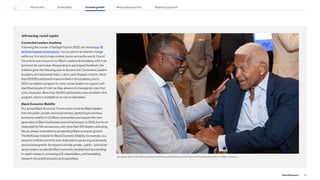
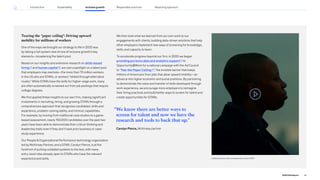
  • 100.
    CDP reference TCFD recommendation Disclosure Metrics and Targets C4.2,C4.2a, C4.2b, C9.1 a. Disclose the metrics used by the organization to assess climate-related risks and opportunities in line with its strategy and risk management process We provide annual updates on climate-related metrics, including Scope 1, 2, and 3 greenhouse gas (GHG) emissions, emissions intensity (market-based GHG emissions per capita), and energy and electricity use, including renewable electricity use, in our annual Environmental, Social, and Governance (ESG) Report. For a historical view on metrics and description of GHG accounting methodology, please see the Sustainability/Our actions section of this report . C6.1, C6.3, C6.5, C6.5a b. Disclose Scope 1, Scope 2, and, if appropriate, Scope 3 greenhouse gas (GHG) emissions, and the related risks Please see the Sustainability/Our actions section of this report for our GHG emissions reporting. C4.1, C4.1a, C4.1b, C4.2, C4.2a, C4.2b c. Describe the targets used by the organization to manage climate-related risks and opportunities and performance against targets We have committed to reducing our emissions to achieve net-zero climate impact by 2030. As a critical milestone on that journey, we have set science-based targets that have been validated by the Science Based Targets initiative (SBTi) in line with a 1.5-degree pathway. From a 2019 baseline, by 2025, we aim to: • reduce our Scope 1 and 2 GHG emissions by 25%, mainly through electrifying our fleet, transitioning to renewable electricity, and making our global office space more sustainable • reduce our Scope 3 GHG emissions from internal and client-related travel by 30% per colleague, mostly through hybrid working models and sustainable aviation fuels In 2018, we became the first global consultancy to join RE100, a coalition of organizations committed to using 100% renewable electricity. We contract directly with local providers or purchase energy attribute certificates, such as renewable energy certificates, in line with RE100’s technical criteria. As a firm, we can and need to go beyond to meet our 2030 commitment. See the Sustainability/Our actions section of this report for more information on our firm’s path to net zero. 100 2022 ESG Report Reporting approach Responsible practices Introduction Sustainability Inclusive growth
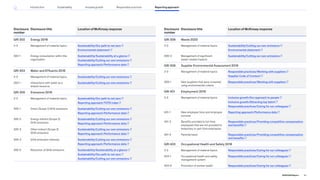
  • 101.
    Independent assurance statement Reportof independent certified public accountants Management McKinsey Company We have reviewed management of McKinsey Company’s assertion that the environmental and social responsibility metrics set forth in Appendix 1 are presented in accordance with the criteria set forth therein. McKinsey Company’s management is responsible for its assertion. Our responsibility is to express a conclusion on management’s assertion based on our review. Our review was conducted in accordance with attestation standards established by the American Institute of Certified Public Accountants. Those standards require that we plan and perform the review to obtain limited assurance about whether any material modifications should be made to management’s assertion in order for it to be fairly stated. The procedures performed in a review vary in nature and timing from, and are substantially less in extent than, an examination, the objective of which is to obtain reasonable assurance about whether management’s assertion is fairly stated, in all material respects, in order to express an opinion. Accordingly, we do not express such an opinion. Because of the limited nature of the engagement, the level of assurance obtained in a review is substantially lower than the assurance that would have been obtained had an examination been performed. We believe that the review evidence obtained is sufficient and appropriate to provide a reasonable basis for our conclusion. We are required to be independent and to meet our other ethical responsibilities in accordance with relevant ethical requirements related to the engagement. The procedures we performed were based on our professional judgment and consisted primarily of analytical procedures and inquiries. In addition, we obtained an understanding of McKinsey Company’s business processes relevant to the review in order to design appropriate procedures. The preparation of the Subject Matter requires management to evaluate the criteria set forth in Appendix 1, make determinations as to the relevancy of information to be included, and make estimates and assumptions that affect reported information. Measurement of certain amounts, some of which may be referred to as estimates, is subject to substantial inherent measurement uncertainty. Obtaining sufficient appropriate review evidence to support our conclusion does not reduce the inherent uncertainty in the amounts and metrics. The selection by management of different but acceptable measurement techniques could result in materially different amounts or metrics being reported. Based on our review, we are not aware of any material modifications that should be made to management of McKinsey Company’s assertion that the environmental and social responsibility metrics set forth in Appendix 1 of McKinsey Company for the year ended December 31, 2022, are presented in accordance with the criteria set forth therein, in order for it to be fairly stated. GRANT THORNTON LLP New York, New York June 7, 2023 GRANT THORNTON LLP 757 Third Ave., 9th Floor New York, NY 10017-2013 D +1 212 599 0100 F +1 212 370 4520 REPORT OF Managemen McKinsey GRANT THORNTON LLP 757 Third Ave., 9th Floor New York, NY 10017-2013 D +1 212 599 0100 F +1 212 370 4520 REPORT O Managemen McKinsey We have rev forth in Appe responsible Our review w Accountants Grant Thornton are separate leg GT.COM forth in Ap responsibl Our review Accountan modificatio vary in nat reasonable opinion. Ac obtained in We believe We are req related to t analytical p relevant to The prepa as to the re Measurem uncertainty the amoun materially Based on our review, we are not aware of any material modificatio Company’s assertion that the environmental and social responsib the year ended December 31, 2022, are presented in accordance New York, New York June 7, 2023 101 2022 ESG Report Reporting approach Responsible practices Introduction Sustainability Inclusive growth
  • 102.
    Appendix 1: McKinsey Company management assertion Management of McKinsey Company is responsible for the completeness, accuracy, and validity of the performance metrics included in the tables below as of or for the year ended December 31, 2022 (the reporting year). The metrics have been rounded to the nearest whole number unless otherwise indicated. Management asserts that the metrics reported in the tables are presented in accordance with the assessment criteria set forth below. Management is responsible for the selection of the criteria, which management believes provide an objective basis for measuring and reporting on these performance metrics. The preparation of the metrics requires management to establish the criteria, make determinations as to the relevancy of information to be included, and make estimates and assumptions that affect reported information. McKinsey Company bases its estimates and methodologies on historical experience, available information, and various other assumptions that it believes to be reasonable. Emissions data presented are subject to measurement uncertainties resulting from limitations inherent in the nature and the methods used for determining such data. The selection of different but acceptable measurement techniques can result in materially different measurements. The precision of different measurement techniques may also vary. Data relied upon in reporting on performance metrics was obtained from financial reporting systems, time-tracking systems, accounts payable records, and other internal records. Metrics related to contribution toward $2B commitment to social responsibility by 2030 Metric description and assessment criteria Metric value USD ‘000 Charitable donations and cash expenses Includes all monetary donations made to nonprofit entities during the reporting year. This category includes cash expenses such as meals, travel reimbursement, supplies, and related costs associated with delivering social responsibility activities 50,575 In-kind contributions Pro-bono Value of time for the work recorded by McKinsey team members on pro bono engagements58 is captured using market rates for similar services in local market 206,388 Social responsibility activities Value of time recorded by McKinsey team members on volunteering initiatives such as volunteers time off, Day of Service, fellowships, and Connected Leaders Academy using an estimate of the payroll and related costs associated with personnel participating in social responsibility activities 20,740 Metric description and assessment criteria Metric value USD ‘000 Total in-kind contributions 227,128 Total value of 2022 contribution toward $2B commitment to social responsibility by 2030 277,703 In 2022, a total of 488,526 hours were contributed to pro-bono and social responsibility activities. Metrics related to greenhouse gas emissions 58 Pro bono engagements include services provided at no cost or significantly reduced cost to qualifying organizations (e.g., nonprofits). 59 Measured using the World Resources Institute and World Business Council for Sustainability Development Greenhouse Gas Protocol: A Corporate Accounting and Reporting Standard (Revised Edition), GHG Protocol Scope 2 Guidance, and Corporate Value Chain (Scope 3) Accounting and Reporting Standard (collectively, the “GHG Protocol”). Metric description and assessment criteria Metric value tCO2e (in ‘000s) Scope 159 10 Scope 2, market-based59 3 Scope 2, location-based59 19 Scope 3, business travel59 469 Scope 3, purchased goods and services59 28 In 2022, a total of 532 thousand tCO2e of carbon offsets were purchased to cover the firm’s total emissions reported for the year and achieve carbon neutrality. 102 2022 ESG Report Reporting approach Responsible practices Introduction Sustainability Inclusive growth
  • 103.
    Learn more onlineat: McKinsey.com/esg-report We welcome your comments and questions regarding this report. Please contact us at: social_responsibility@mckinsey.com