Aaron McDowell
Instructional Design and Technology
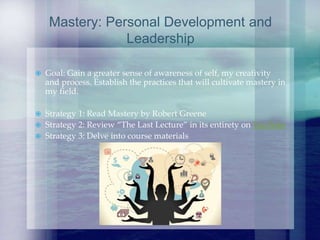
 Goal: Gain a greater sense of awareness of self, my creativity
and process. Establish the practices that will cultivate mastery in
my field.
 Strategy 1: Read Mastery by Robert Greene
 Strategy 2: Review “The Last Lecture” in its entirety on YouTube
 Strategy 3: Delve into course materials
Mastery: Personal Development and
Leadership
 Goal: I will learn how effective ways to hold the attention of
learners using techniques and content.
 Strategy 1: Review “Core Strategies for Teaching in Higher Ed”
on Lynda.com
 Strategy 2: View “Creative Insights: Renaldo Lawrence on
Elearning.
 Strategy 3: Review article, “The Online Theology Classroom:
Strategies for Engaging a Community of Distance Learners in A
Hybrid Model of Online Education.
Strategies for Learner Engagement
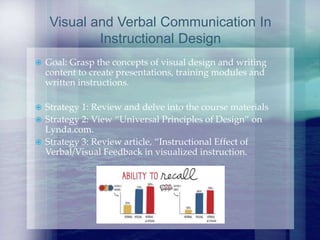
 Goal: Grasp the concepts of visual design and writing
content to create presentations, training modules and
written instructions.
 Strategy 1: Review and delve into the course materials
 Strategy 2: View “Universal Principles of Design” on
Lynda.com.
 Strategy 3: Review article, “Instructional Effect of
Verbal/Visual Feedback in visualized instruction.
Visual and Verbal Communication In
Instructional Design
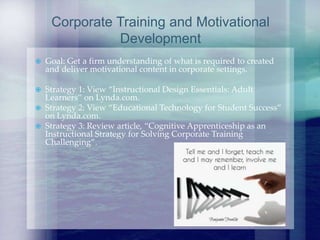
 Goal: Get a firm understanding of what is required to created
and deliver motivational content in corporate settings.
 Strategy 1: View “Instructional Design Essentials: Adult
Learners” on Lynda.com.
 Strategy 2: View “Educational Technology for Student Success”
on Lynda.com.
 Strategy 3: Review article, “Cognitive Apprenticeship as an
Instructional Strategy for Solving Corporate Training
Challenging”.
Corporate Training and Motivational
Development
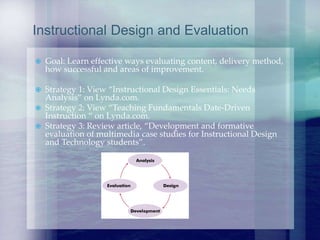
 Goal: Learn effective ways evaluating content, delivery method,
how successful and areas of improvement.
 Strategy 1: View “Instructional Design Essentials: Needs
Analysis” on Lynda.com.
 Strategy 2: View “Teaching Fundamentals Date-Driven
Instruction “ on Lynda.com.
 Strategy 3: Review article, “Development and formative
evaluation of multimedia case studies for Instructional Design
and Technology students”.
Instructional Design and Evaluation
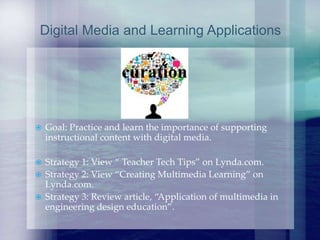
 Goal: Practice and learn the importance of supporting
instructional content with digital media.
 Strategy 1: View “ Teacher Tech Tips” on Lynda.com.
 Strategy 2: View “Creating Multimedia Learning” on
Lynda.com.
 Strategy 3: Review article, “Application of multimedia in
engineering design education”.
Digital Media and Learning Applications
 Goal: Create original music and audio for content and
learn the how it support learning.
 Strategy 1: View Synthesis and Sampling with Absynth”
on Lynda.com.
 Strategy 2: View “Advanced Instrumentation and Sound
Design with Kontakt” on Lynda.com
 Strategy 3: Review article, “Instructional Audio
Guidelines: Four Design Principles to Consider for Every
Instructional Audio Design Effort”.
Music and Audio for Instructional Design
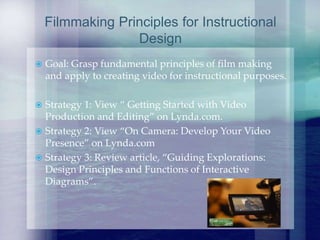
 Goal: Grasp fundamental principles of film making
and apply to creating video for instructional purposes.
 Strategy 1: View “ Getting Started with Video
Production and Editing” on Lynda.com.
 Strategy 2: View “On Camera: Develop Your Video
Presence” on Lynda.com
 Strategy 3: Review article, “Guiding Explorations:
Design Principles and Functions of Interactive
Diagrams”.
Filmmaking Principles for Instructional
Design
 Goal: Learn to design engaging games that support learning and
motivate students.
 Strategy 1: View “Gamification of Learning” on Lynda.com.
 Strategy 2: View “Captivate Projects: Building Elearning Games” on
Lynda.com.
 Strategy 3: Review article, “Improving learning achievements,
motivations and problem-solving skills through a peer assessment-
based game development approach”.
Game Strategies and Motivation
 Goal: Learn effective ways of deliver content to
groups of dedicated learners and manage the
progress.
 Strategy 1: View “ Classroom Management
Fundamentals” on Lynda.com.
 Strategy 2: View “Learning Management System
Fundamentals” on Lynda.com.
 Strategy 3: Review article, “Finding the Right LMS
Fit”.
Learning Management Systems and
Organizations
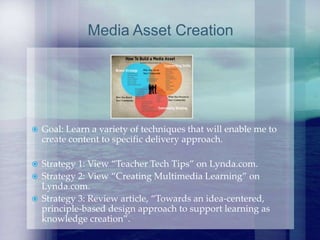
 Goal: Learn a variety of techniques that will enable me to
create content to specific delivery approach.
 Strategy 1: View “Teacher Tech Tips” on Lynda.com.
 Strategy 2: View “Creating Multimedia Learning” on
Lynda.com.
 Strategy 3: Review article, “Towards an idea-centered,
principle-based design approach to support learning as
knowledge creation”.
Media Asset Creation
 Goal: Collect all the lessons and tools practiced
throughout the program to create a project.
 Strategy 1: View “The Neuroscience of Learning” on
Lynda.com.
 Strategy 2: View “Flipping the Classroom” on Lynda.com.
 Strategy 3: Review articles, “Instructional-Design Theory
to Guide the Creation of Online Learning Communities
for Adults”.
Instructional Design and Technology Final
Project
Instructional Design and Technology
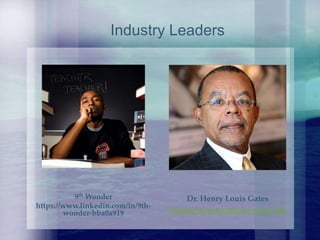
Dr. Henry Louis Gates
HutchinsCenter@fas.harvard.edu
9th Wonder
https://www.linkedin.com/in/9th-
wonder-bba0a919
Industry Leaders
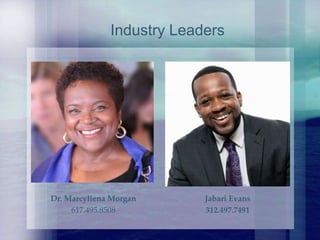
Jabari Evans
312.497.7491
Dr. Marcyliena Morgan
617.495.8508
Industry Leaders
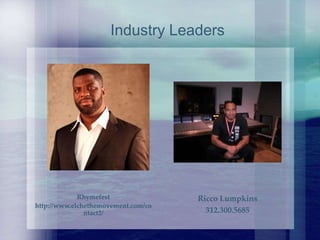
Ricco Lumpkins
312.300.5685
Rhymefest
http://www.elchethemovement.com/co
ntact2/
Industry Leaders
Instructional Design and Technology
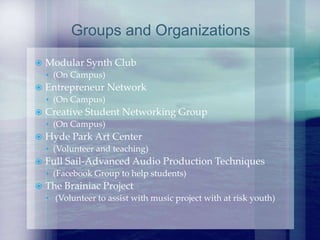
 Modular Synth Club
• (On Campus)
 Entrepreneur Network
• (On Campus)
 Creative Student Networking Group
• (On Campus)
 Hyde Park Art Center
• (Volunteer and teaching)
 Full Sail-Advanced Audio Production Techniques
• (Facebook Group to help students)
 The Brainiac Project
• (Volunteer to assist with music project with at risk youth)
Groups and Organizations
Instructional Design and Technology
The Brainiac ProjectSae Institute
Companies To Follow
The Art InstituteFull Sail University
Companies To Follow
Berklee OnlineDePaul University
Companies To Follow
Instructional Design and Technology
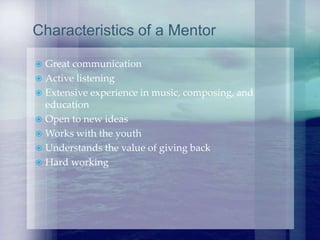
 Great communication
 Active listening
 Extensive experience in music, composing, and
education
 Open to new ideas
 Works with the youth
 Understands the value of giving back
 Hard working
Characteristics of a Mentor
Instructional Design and Technology
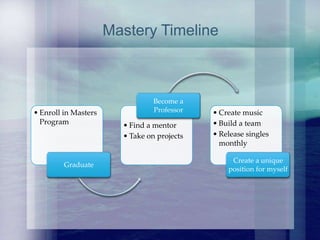
• Enroll in Masters
Program
Graduate
• Find a mentor
• Take on projects
Become a
Professor • Create music
• Build a team
• Release singles
monthly
Create a unique
position for myself
Mastery Timeline
Instruction Design and Technology
 https://s3.amazonaws.com/hiphopdx-production/2013/02/9th-wonder-300x300.jpg
 http://cache.boston.com/bonzai-
fba/Third_Party_Photo/2009/07/20/gates1__1248117974_8015.jpg
 http://www1.cuny.edu/mu/forum/files/2014/11/CROPPED-Marcyliena.png
 https://media.licdn.com/mpr/mpr/shrinknp_400_400/AAEAAQAAAAAAAAIHAAAA
JDQwMDg1YTE2LTUyMDUtNDNhMS05ZTdmLWM5MDcyMTE2ZDkwYQ.jpg
 http://www.bopcitybeats.com/wp-content/uploads/2010/12/Rhymefest.jpg
 http://usa.sae.edu/assets/Campuses/Chicago/_resampled/SetWidth324-
SAEStaff_Ricco_Lumpkins.jpg
 http://hutchinscenter.fas.harvard.edu/contact
 https://www.google.com/url?sa=i&rct=j&q=&esrc=s&source=images&cd=&cad=rja&uac
t=8&ved=0ahUKEwiHyMCS2qTJAhWDOyYKHeh3BEEQjRwIBw&url=http%3A%2F%2
Fwww.jocelynwallace.com%2F&psig=AFQjCNGJEkjWfJHTwLIXx6AsDiXZf6DQ1Q&us
t=1448304836587438
References
 https://www.google.com/url?sa=i&rct=j&q=&esrc=s&source=images&cd=&ved=0ahUKEwjLw6Xy26TJ
AhUK5SYKHaBWB1kQjRwIBw&url=http%3A%2F%2Fwww.slideshare.net%2FAlesandraBlakeston%
2Ftraining-learning-and-development-quotes-
20151289&psig=AFQjCNHRAomeV2YJKqZ7xPpMnmxkxkD9rQ&ust=1448305269465984
 https://www.google.com/url?sa=i&rct=j&q=&esrc=s&source=images&cd=&cad=rja&uact=8&ved=0ahU
KEwikhOC64KTJAhWCRyYKHQeGCKkQjRwIBw&url=https%3A%2F%2Fonlineteachingtoday.word
press.com%2F2013%2F08%2F23%2Fexploring-curation-as-a-core-competency-in-digital-and-media-
literacy-education-mihailidis-journal-of-interactive-media-in-
education%2F&psig=AFQjCNGM6xFvLhRzkkSLKntGGWfa83p-AQ&ust=1448306426595698
 http://www.lynda.com/Absynth-tutorials/Synthesis-Sampling-ABSYNTH/383038-2.html
 http://www.lynda.com/Kontakt-tutorials/Advanced-Instrumentation-Sound-Design-
KONTAKT/383039-2.html
 https://www.google.com/url?sa=i&rct=j&q=&esrc=s&source=images&cd=&cad=rja&uact=8&ved=0ahU
KEwiTmIGK46TJAhXGKCYKHb6FCMQQjRwIBw&url=https%3A%2F%2Fabout.me%2Fsearch%2Fke
yword%3Aorientation&psig=AFQjCNGH54-Lt5Po9GPqdtz923QuYNREzQ&ust=1448307185325739
 http://www.lynda.com/Video-DSLR-Video-tutorials/Getting-Started-Video-Production-
Editing/364443-2.html
References
 http://www.lynda.com/Video-Filmmaking-tutorials/Corporate-Documentary-Video-Lighting/361600-
2.html
 https://www.google.com/url?sa=i&rct=j&q=&esrc=s&source=images&cd=&cad=rja&uact=8&ved=0ahU
KEwj8186g8aTJAhXD7CYKHXZQD-EQjRwIBw&url=http%3A%2F%2Ffilmlifestyle.com%2F9-
principles-filmmaking-skill-
level%2F&psig=AFQjCNE66USRvrFbzbLWsouV8Nd9H4YqoQ&ust=1448310923711760
 http://www.lynda.com/Higher-Education-tutorials/Gamification-Learning/173211-2.html
 http://www.lynda.com/Instructional-Design-tutorials/Camera-Develop-Your-Video-Presence/108973-
2.html
 http://www.lynda.com/Captivate-tutorials/Captivate-Projects-Building-Elearning-Games/408869-
2.html
 https://www.google.com/url?sa=i&rct=j&q=&esrc=s&source=images&cd=&cad=rja&uact=8&ved=0ahU
KEwje5cex86TJAhXIOCYKHbtYDd0QjRwIBw&url=https%3A%2F%2Fvimeo.com%2F41819065&psig=
AFQjCNGAuhetlOTgdg62KjGYV36HdrBnDw&ust=1448311582469096
 http://www.lynda.com/Excel-tutorials/Teaching-Fundamentals-Data-Driven-Instruction/173755-2.html
References
 http://www.lynda.com/Education-Classroom-Management-tutorials/Classroom-Management-
Fundamentals/166841-2.html
 http://www.lynda.com/Business-Elearning-tutorials/Teacher-Tips/141465-2.html
 https://www.google.com/url?sa=i&rct=j&q=&esrc=s&source=images&cd=&cad=rja&uact=8&ved=0ahU
KEwjw27nT9aTJAhXGJiYKHdrVDgAQjRwIBw&url=https%3A%2F%2Fwww.td.org%2FPublications
%2FBlogs%2FLearning-Technologies-Blog%2F2010%2F10%2FThe-10-Commandments-of-
Implementing-An-LMS&psig=AFQjCNHemlqhGL0mZ72IvTFNl1TTTJPdTA&ust=1448312229541900
 http://www.lynda.com/Educational-Technology-tutorials/Teacher-Tech-Tips/373783-2.html
 http://www.lynda.com/Education-LMS-tutorials/Learning-Management-System-LMS-
Fundamentals/156622-2.html
 http://www.lynda.com/Education-Instructional-Design-tutorials/Instructional-Design-Essentials-
Creating-Video-Training/165443-2.html
 https://www.google.com/url?sa=i&rct=j&q=&esrc=s&source=images&cd=&cad=rja&uact=8&ved=0ahU
KEwis-8eEhaXJAhXHSyYKHVHvD9MQjRwIBw&url=http%3A%2F%2Fwww.newmedia-
communications.com%2Fgrow-with-our-services%2F&psig=AFQjCNGa--
mP_kefLDfnSuVUS6OBU_RciQ&ust=1448316356694971
 http://www.lynda.com/Education-Elearning-Classroom-Management-tutorials/Creating-Multimedia-
Learning/360033-2.html
 http://www.lynda.com/Business-tutorials/Flipping-Classroom/144198-2.html
 http://www.lynda.com/K-12-Education-tutorials/Creative-Insights-Renaldo-Lawrence-Elearning/371544-2.html
 http://www.lynda.com/Higher-Education-tutorials/Educational-Technology-Student-Success/415357-2.html
 https://www.google.com/url?sa=i&rct=j&q=&esrc=s&source=images&cd=&cad=rja&uact=8&ved=0ahUKEwir3K
THiqXJAhVC5iYKHXPCCiEQjRwIBw&url=http%3A%2F%2Fresources.xyleme.com%2Fh%2Fi%2F73499340-
when-the-learner-is-the-teacher-do-we-need-instructional-
designers&psig=AFQjCNEkrKeztVYSxTCttfnjn6SvwU02XQ&ust=1448317827135254
 Hege, B. R. (2011). The Online Theology Classroom: Strategies for Engaging a Community of Distance Learners
in a Hybrid Model of Online Education. Teaching Theology & Religion, 14(1), 13-20. doi:10.1111/j.1467-
9647.2010.00668.x
 Dwyer, F. M., & Arnold, T. A. (1976). THE INSTRUCTIONAL EFFECT OF VERBAL/VISUAL FEEDBACK IN
VISUALIZED INSRUCTION. Journal Of Psychology, 94(1), 39.
 Chan, P., Miller, R., & Monroe, E. (2009). Cognitive Apprenticeship as an Instructional Strategy for Solving
Corporate Training Challenges. Techtrends: Linking Research & Practice To Improve Learning, 53(6), 35-41.
doi:10.1007/s11528-009-0341-3
References
 Sugar, W. (2014). Development and formative evaluation of multimedia case studies for
Instructional Design and Technology students. Techtrends: Linking Research & Practice
To Improve Learning, 58(5), 36-52. doi:10.1007/s11528-014-0785-z
 Höhne, G., & Henkel, V. (2004). Application of multimedia in engineering design
education. European Journal Of Engineering Education, 29(1), 87-96.
doi:10.1080/0304379032000129278
 Carter, C. (2012). Instructional Audio Guidelines: Four Design Principles to Consider
for Every Instructional Audio Design Effort. Techtrends: Linking Research & Practice
To Improve Learning, 56(6), 54-58. doi:10.1007/s11528-012-0615-z
 Naftaliev, E., & Yerushalmy, M. (2013). Guiding Explorations: Design Principles and
Functions of Interactive Diagrams. Computers In The Schools, 30(1/2), 61-75.
doi:10.1080/07380569.2013.769084
 Hwang, G., Hung, C., & Chen, N. (2014). Improving learning achievements,
motivations and problem-solving skills through a peer assessment-based game
development approach. Educational Technology Research & Development, 62(2), 129-
145. doi:10.1007/s11423-013-9320-7
 LINDENBERG, S. (2014). Finding the Right LMS Fit. T+D, 68(4), 28-30.
References
 Hong, H., & Sullivan, F. (2009). Towards an idea-centered, principle-based design approach to support learning
as knowledge creation. Educational Technology Research & Development, 57(5), 613-627. doi:10.1007/s11423-
009-9122-0
 Snyder, M. M. (2009). Instructional-Design Theory to Guide the Creation of Online Learning Communities for
Adults. Techtrends: Linking Research & Practice To Improve Learning, 53(1), 45-57. doi:10.1007/s11528-009-
0237-2
 https://www.google.com/url?sa=i&rct=j&q=&esrc=s&source=images&cd=&cad=rja&uact=8&ved=0ahUKEwi0-
NqEmaXJAhWMWD4KHfLTBWYQjRwIBw&url=https%3A%2F%2Fen.wikipedia.org%2Fwiki%2FSAE_Institut
e&psig=AFQjCNHvqOIN8T1OGN3Gs-xIx1OJgwyhOg&ust=1448321445426758
 https://www.google.com/url?sa=i&rct=j&q=&esrc=s&source=images&cd=&cad=rja&uact=8&ved=0ahUKEwjo5d
SmmaXJAhVCVz4KHb-gDJ8QjRwIBw&url=http%3A%2F%2Fwww.naledgeevans.com%2Fthe-brainiac-
project.html&psig=AFQjCNHDBQXrJaTHt8Ol_pO-7tlQhFsXkA&ust=1448321804067361
 https://www.google.com/url?sa=i&rct=j&q=&esrc=s&source=images&cd=&cad=rja&uact=8&ved=0ahUKEwjAs7
v0maXJAhUDbT4KHZ5rDh8QjRwIBw&url=https%3A%2F%2Fwww.linkedin.com%2Fpulse%2F2014063019341
5-84599032-success-with-full-sail-university-fact-or-fiction&psig=AFQjCNEdkdzmWtH_eMVKy0dtGMJsVjT-
9w&ust=1448321963573842
 https://www.google.com/url?sa=i&rct=j&q=&esrc=s&source=images&cd=&cad=rja&uact=8&ved=0ahUKEwiOx
Z7YmqXJAhUK6yYKHQVUCuUQjRwIBw&url=http%3A%2F%2Fchicagoartmagazine.com%2F2011%2F10%2F
art-school-and-sexual-harassment-wheres-saics-policy%2F&psig=AFQjCNEdvjC-
WENgR5ic74dVBHSiU0rarg&ust=1448322160493829
References
 https://www.google.com/url?sa=i&rct=j&q=&esrc=s&source=images&cd=&cad=rja&uact=8&ved=0ahUKEwiCs
dqZm6XJAhVBNSYKHTBRALMQjRwIBw&url=https%3A%2F%2Fsocialpsychologydepaul.wordpress.com%2
F&psig=AFQjCNEJ_2dsyupQTuIDnUC5BF5lI0URGg&ust=1448322309519665
 https://www.google.com/url?sa=i&rct=j&q=&esrc=s&source=images&cd=&cad=rja&uact=8&ved=0ahUKEwiO9r
KDnKXJAhUJVyYKHXbwCYUQjRwIBw&url=https%3A%2F%2Fwww.berklee.edu%2Fnews%2Fberklee-
launches-online-degrees-music-business-production&psig=AFQjCNEFdDE4t2-DCFiNZFRoalfNuT-
Edg&ust=1448322525768052
 https://orgsync.com/106058/chapter
 https://orgsync.com/121511/chapter
 https://orgsync.com/57437/chapter
 http://www.hydeparkart.org
 https://www.google.com/url?sa=i&rct=j&q=&esrc=s&source=images&cd=&cad=rja&uact=8&ved=0ahUKEwjg6o
PEw6XJAhXKQiYKHam-C6gQjRwIBw&url=http%3A%2F%2Fleadbysoul.com%2Fleadership%2Fthe-myth-of-
mastery-leading-your-company-through-complexity%2F&psig=AFQjCNHUHM--
TE9X4seHJI9IHnI_lNRW9Q&ust=1448333113631926
 https://www.google.com/url?sa=i&rct=j&q=&esrc=s&source=images&cd=&cad=rja&uact=8&ved=0ahUKEwj2h7
TdxKXJAhUD7iYKHVLPD0YQjRwIBw&url=http%3A%2F%2Frce.csuchico.edu%2Fevent%2F2012-11%2Fhigh-
touch-pedagogy-strategies-improving-online-student-engagement-learning-
outcomes&psig=AFQjCNHCKKdzYu9lN_HdJ_OQ9D27gUgCZg&ust=1448333422133693
References

Mcdowellaaron_masteryjournaltimeline

  • 1.
  • 2.
  • 3.
     Goal: Gaina greater sense of awareness of self, my creativity and process. Establish the practices that will cultivate mastery in my field.  Strategy 1: Read Mastery by Robert Greene  Strategy 2: Review “The Last Lecture” in its entirety on YouTube  Strategy 3: Delve into course materials Mastery: Personal Development and Leadership
  • 4.
     Goal: Iwill learn how effective ways to hold the attention of learners using techniques and content.  Strategy 1: Review “Core Strategies for Teaching in Higher Ed” on Lynda.com  Strategy 2: View “Creative Insights: Renaldo Lawrence on Elearning.  Strategy 3: Review article, “The Online Theology Classroom: Strategies for Engaging a Community of Distance Learners in A Hybrid Model of Online Education. Strategies for Learner Engagement
  • 5.
     Goal: Graspthe concepts of visual design and writing content to create presentations, training modules and written instructions.  Strategy 1: Review and delve into the course materials  Strategy 2: View “Universal Principles of Design” on Lynda.com.  Strategy 3: Review article, “Instructional Effect of Verbal/Visual Feedback in visualized instruction. Visual and Verbal Communication In Instructional Design
  • 6.
     Goal: Geta firm understanding of what is required to created and deliver motivational content in corporate settings.  Strategy 1: View “Instructional Design Essentials: Adult Learners” on Lynda.com.  Strategy 2: View “Educational Technology for Student Success” on Lynda.com.  Strategy 3: Review article, “Cognitive Apprenticeship as an Instructional Strategy for Solving Corporate Training Challenging”. Corporate Training and Motivational Development
  • 7.
     Goal: Learneffective ways evaluating content, delivery method, how successful and areas of improvement.  Strategy 1: View “Instructional Design Essentials: Needs Analysis” on Lynda.com.  Strategy 2: View “Teaching Fundamentals Date-Driven Instruction “ on Lynda.com.  Strategy 3: Review article, “Development and formative evaluation of multimedia case studies for Instructional Design and Technology students”. Instructional Design and Evaluation
  • 8.
     Goal: Practiceand learn the importance of supporting instructional content with digital media.  Strategy 1: View “ Teacher Tech Tips” on Lynda.com.  Strategy 2: View “Creating Multimedia Learning” on Lynda.com.  Strategy 3: Review article, “Application of multimedia in engineering design education”. Digital Media and Learning Applications
  • 9.
     Goal: Createoriginal music and audio for content and learn the how it support learning.  Strategy 1: View Synthesis and Sampling with Absynth” on Lynda.com.  Strategy 2: View “Advanced Instrumentation and Sound Design with Kontakt” on Lynda.com  Strategy 3: Review article, “Instructional Audio Guidelines: Four Design Principles to Consider for Every Instructional Audio Design Effort”. Music and Audio for Instructional Design
  • 10.
     Goal: Graspfundamental principles of film making and apply to creating video for instructional purposes.  Strategy 1: View “ Getting Started with Video Production and Editing” on Lynda.com.  Strategy 2: View “On Camera: Develop Your Video Presence” on Lynda.com  Strategy 3: Review article, “Guiding Explorations: Design Principles and Functions of Interactive Diagrams”. Filmmaking Principles for Instructional Design
  • 11.
     Goal: Learnto design engaging games that support learning and motivate students.  Strategy 1: View “Gamification of Learning” on Lynda.com.  Strategy 2: View “Captivate Projects: Building Elearning Games” on Lynda.com.  Strategy 3: Review article, “Improving learning achievements, motivations and problem-solving skills through a peer assessment- based game development approach”. Game Strategies and Motivation
  • 12.
     Goal: Learneffective ways of deliver content to groups of dedicated learners and manage the progress.  Strategy 1: View “ Classroom Management Fundamentals” on Lynda.com.  Strategy 2: View “Learning Management System Fundamentals” on Lynda.com.  Strategy 3: Review article, “Finding the Right LMS Fit”. Learning Management Systems and Organizations
  • 13.
     Goal: Learna variety of techniques that will enable me to create content to specific delivery approach.  Strategy 1: View “Teacher Tech Tips” on Lynda.com.  Strategy 2: View “Creating Multimedia Learning” on Lynda.com.  Strategy 3: Review article, “Towards an idea-centered, principle-based design approach to support learning as knowledge creation”. Media Asset Creation
  • 14.
     Goal: Collectall the lessons and tools practiced throughout the program to create a project.  Strategy 1: View “The Neuroscience of Learning” on Lynda.com.  Strategy 2: View “Flipping the Classroom” on Lynda.com.  Strategy 3: Review articles, “Instructional-Design Theory to Guide the Creation of Online Learning Communities for Adults”. Instructional Design and Technology Final Project
  • 15.
  • 16.
    Dr. Henry LouisGates HutchinsCenter@fas.harvard.edu 9th Wonder https://www.linkedin.com/in/9th- wonder-bba0a919 Industry Leaders
  • 17.
    Jabari Evans 312.497.7491 Dr. MarcylienaMorgan 617.495.8508 Industry Leaders
  • 18.
  • 19.
  • 20.
     Modular SynthClub • (On Campus)  Entrepreneur Network • (On Campus)  Creative Student Networking Group • (On Campus)  Hyde Park Art Center • (Volunteer and teaching)  Full Sail-Advanced Audio Production Techniques • (Facebook Group to help students)  The Brainiac Project • (Volunteer to assist with music project with at risk youth) Groups and Organizations
  • 21.
  • 22.
    The Brainiac ProjectSaeInstitute Companies To Follow
  • 23.
    The Art InstituteFullSail University Companies To Follow
  • 24.
  • 25.
  • 26.
     Great communication Active listening  Extensive experience in music, composing, and education  Open to new ideas  Works with the youth  Understands the value of giving back  Hard working Characteristics of a Mentor
  • 27.
  • 28.
    • Enroll inMasters Program Graduate • Find a mentor • Take on projects Become a Professor • Create music • Build a team • Release singles monthly Create a unique position for myself Mastery Timeline
  • 29.
  • 30.
     https://s3.amazonaws.com/hiphopdx-production/2013/02/9th-wonder-300x300.jpg  http://cache.boston.com/bonzai- fba/Third_Party_Photo/2009/07/20/gates1__1248117974_8015.jpg http://www1.cuny.edu/mu/forum/files/2014/11/CROPPED-Marcyliena.png  https://media.licdn.com/mpr/mpr/shrinknp_400_400/AAEAAQAAAAAAAAIHAAAA JDQwMDg1YTE2LTUyMDUtNDNhMS05ZTdmLWM5MDcyMTE2ZDkwYQ.jpg  http://www.bopcitybeats.com/wp-content/uploads/2010/12/Rhymefest.jpg  http://usa.sae.edu/assets/Campuses/Chicago/_resampled/SetWidth324- SAEStaff_Ricco_Lumpkins.jpg  http://hutchinscenter.fas.harvard.edu/contact  https://www.google.com/url?sa=i&rct=j&q=&esrc=s&source=images&cd=&cad=rja&uac t=8&ved=0ahUKEwiHyMCS2qTJAhWDOyYKHeh3BEEQjRwIBw&url=http%3A%2F%2 Fwww.jocelynwallace.com%2F&psig=AFQjCNGJEkjWfJHTwLIXx6AsDiXZf6DQ1Q&us t=1448304836587438 References
  • 31.
     https://www.google.com/url?sa=i&rct=j&q=&esrc=s&source=images&cd=&ved=0ahUKEwjLw6Xy26TJ AhUK5SYKHaBWB1kQjRwIBw&url=http%3A%2F%2Fwww.slideshare.net%2FAlesandraBlakeston% 2Ftraining-learning-and-development-quotes- 20151289&psig=AFQjCNHRAomeV2YJKqZ7xPpMnmxkxkD9rQ&ust=1448305269465984  https://www.google.com/url?sa=i&rct=j&q=&esrc=s&source=images&cd=&cad=rja&uact=8&ved=0ahU KEwikhOC64KTJAhWCRyYKHQeGCKkQjRwIBw&url=https%3A%2F%2Fonlineteachingtoday.word press.com%2F2013%2F08%2F23%2Fexploring-curation-as-a-core-competency-in-digital-and-media- literacy-education-mihailidis-journal-of-interactive-media-in- education%2F&psig=AFQjCNGM6xFvLhRzkkSLKntGGWfa83p-AQ&ust=1448306426595698 http://www.lynda.com/Absynth-tutorials/Synthesis-Sampling-ABSYNTH/383038-2.html  http://www.lynda.com/Kontakt-tutorials/Advanced-Instrumentation-Sound-Design- KONTAKT/383039-2.html  https://www.google.com/url?sa=i&rct=j&q=&esrc=s&source=images&cd=&cad=rja&uact=8&ved=0ahU KEwiTmIGK46TJAhXGKCYKHb6FCMQQjRwIBw&url=https%3A%2F%2Fabout.me%2Fsearch%2Fke yword%3Aorientation&psig=AFQjCNGH54-Lt5Po9GPqdtz923QuYNREzQ&ust=1448307185325739  http://www.lynda.com/Video-DSLR-Video-tutorials/Getting-Started-Video-Production- Editing/364443-2.html References
  • 32.
     http://www.lynda.com/Video-Filmmaking-tutorials/Corporate-Documentary-Video-Lighting/361600- 2.html  https://www.google.com/url?sa=i&rct=j&q=&esrc=s&source=images&cd=&cad=rja&uact=8&ved=0ahU KEwj8186g8aTJAhXD7CYKHXZQD-EQjRwIBw&url=http%3A%2F%2Ffilmlifestyle.com%2F9- principles-filmmaking-skill- level%2F&psig=AFQjCNE66USRvrFbzbLWsouV8Nd9H4YqoQ&ust=1448310923711760 http://www.lynda.com/Higher-Education-tutorials/Gamification-Learning/173211-2.html  http://www.lynda.com/Instructional-Design-tutorials/Camera-Develop-Your-Video-Presence/108973- 2.html  http://www.lynda.com/Captivate-tutorials/Captivate-Projects-Building-Elearning-Games/408869- 2.html  https://www.google.com/url?sa=i&rct=j&q=&esrc=s&source=images&cd=&cad=rja&uact=8&ved=0ahU KEwje5cex86TJAhXIOCYKHbtYDd0QjRwIBw&url=https%3A%2F%2Fvimeo.com%2F41819065&psig= AFQjCNGAuhetlOTgdg62KjGYV36HdrBnDw&ust=1448311582469096  http://www.lynda.com/Excel-tutorials/Teaching-Fundamentals-Data-Driven-Instruction/173755-2.html References
  • 33.
     http://www.lynda.com/Education-Classroom-Management-tutorials/Classroom-Management- Fundamentals/166841-2.html  http://www.lynda.com/Business-Elearning-tutorials/Teacher-Tips/141465-2.html https://www.google.com/url?sa=i&rct=j&q=&esrc=s&source=images&cd=&cad=rja&uact=8&ved=0ahU KEwjw27nT9aTJAhXGJiYKHdrVDgAQjRwIBw&url=https%3A%2F%2Fwww.td.org%2FPublications %2FBlogs%2FLearning-Technologies-Blog%2F2010%2F10%2FThe-10-Commandments-of- Implementing-An-LMS&psig=AFQjCNHemlqhGL0mZ72IvTFNl1TTTJPdTA&ust=1448312229541900  http://www.lynda.com/Educational-Technology-tutorials/Teacher-Tech-Tips/373783-2.html  http://www.lynda.com/Education-LMS-tutorials/Learning-Management-System-LMS- Fundamentals/156622-2.html  http://www.lynda.com/Education-Instructional-Design-tutorials/Instructional-Design-Essentials- Creating-Video-Training/165443-2.html  https://www.google.com/url?sa=i&rct=j&q=&esrc=s&source=images&cd=&cad=rja&uact=8&ved=0ahU KEwis-8eEhaXJAhXHSyYKHVHvD9MQjRwIBw&url=http%3A%2F%2Fwww.newmedia- communications.com%2Fgrow-with-our-services%2F&psig=AFQjCNGa-- mP_kefLDfnSuVUS6OBU_RciQ&ust=1448316356694971
  • 34.
     http://www.lynda.com/Education-Elearning-Classroom-Management-tutorials/Creating-Multimedia- Learning/360033-2.html  http://www.lynda.com/Business-tutorials/Flipping-Classroom/144198-2.html http://www.lynda.com/K-12-Education-tutorials/Creative-Insights-Renaldo-Lawrence-Elearning/371544-2.html  http://www.lynda.com/Higher-Education-tutorials/Educational-Technology-Student-Success/415357-2.html  https://www.google.com/url?sa=i&rct=j&q=&esrc=s&source=images&cd=&cad=rja&uact=8&ved=0ahUKEwir3K THiqXJAhVC5iYKHXPCCiEQjRwIBw&url=http%3A%2F%2Fresources.xyleme.com%2Fh%2Fi%2F73499340- when-the-learner-is-the-teacher-do-we-need-instructional- designers&psig=AFQjCNEkrKeztVYSxTCttfnjn6SvwU02XQ&ust=1448317827135254  Hege, B. R. (2011). The Online Theology Classroom: Strategies for Engaging a Community of Distance Learners in a Hybrid Model of Online Education. Teaching Theology & Religion, 14(1), 13-20. doi:10.1111/j.1467- 9647.2010.00668.x  Dwyer, F. M., & Arnold, T. A. (1976). THE INSTRUCTIONAL EFFECT OF VERBAL/VISUAL FEEDBACK IN VISUALIZED INSRUCTION. Journal Of Psychology, 94(1), 39.  Chan, P., Miller, R., & Monroe, E. (2009). Cognitive Apprenticeship as an Instructional Strategy for Solving Corporate Training Challenges. Techtrends: Linking Research & Practice To Improve Learning, 53(6), 35-41. doi:10.1007/s11528-009-0341-3 References
  • 35.
     Sugar, W.(2014). Development and formative evaluation of multimedia case studies for Instructional Design and Technology students. Techtrends: Linking Research & Practice To Improve Learning, 58(5), 36-52. doi:10.1007/s11528-014-0785-z  Höhne, G., & Henkel, V. (2004). Application of multimedia in engineering design education. European Journal Of Engineering Education, 29(1), 87-96. doi:10.1080/0304379032000129278  Carter, C. (2012). Instructional Audio Guidelines: Four Design Principles to Consider for Every Instructional Audio Design Effort. Techtrends: Linking Research & Practice To Improve Learning, 56(6), 54-58. doi:10.1007/s11528-012-0615-z  Naftaliev, E., & Yerushalmy, M. (2013). Guiding Explorations: Design Principles and Functions of Interactive Diagrams. Computers In The Schools, 30(1/2), 61-75. doi:10.1080/07380569.2013.769084  Hwang, G., Hung, C., & Chen, N. (2014). Improving learning achievements, motivations and problem-solving skills through a peer assessment-based game development approach. Educational Technology Research & Development, 62(2), 129- 145. doi:10.1007/s11423-013-9320-7  LINDENBERG, S. (2014). Finding the Right LMS Fit. T+D, 68(4), 28-30. References
  • 36.
     Hong, H.,& Sullivan, F. (2009). Towards an idea-centered, principle-based design approach to support learning as knowledge creation. Educational Technology Research & Development, 57(5), 613-627. doi:10.1007/s11423- 009-9122-0  Snyder, M. M. (2009). Instructional-Design Theory to Guide the Creation of Online Learning Communities for Adults. Techtrends: Linking Research & Practice To Improve Learning, 53(1), 45-57. doi:10.1007/s11528-009- 0237-2  https://www.google.com/url?sa=i&rct=j&q=&esrc=s&source=images&cd=&cad=rja&uact=8&ved=0ahUKEwi0- NqEmaXJAhWMWD4KHfLTBWYQjRwIBw&url=https%3A%2F%2Fen.wikipedia.org%2Fwiki%2FSAE_Institut e&psig=AFQjCNHvqOIN8T1OGN3Gs-xIx1OJgwyhOg&ust=1448321445426758  https://www.google.com/url?sa=i&rct=j&q=&esrc=s&source=images&cd=&cad=rja&uact=8&ved=0ahUKEwjo5d SmmaXJAhVCVz4KHb-gDJ8QjRwIBw&url=http%3A%2F%2Fwww.naledgeevans.com%2Fthe-brainiac- project.html&psig=AFQjCNHDBQXrJaTHt8Ol_pO-7tlQhFsXkA&ust=1448321804067361  https://www.google.com/url?sa=i&rct=j&q=&esrc=s&source=images&cd=&cad=rja&uact=8&ved=0ahUKEwjAs7 v0maXJAhUDbT4KHZ5rDh8QjRwIBw&url=https%3A%2F%2Fwww.linkedin.com%2Fpulse%2F2014063019341 5-84599032-success-with-full-sail-university-fact-or-fiction&psig=AFQjCNEdkdzmWtH_eMVKy0dtGMJsVjT- 9w&ust=1448321963573842  https://www.google.com/url?sa=i&rct=j&q=&esrc=s&source=images&cd=&cad=rja&uact=8&ved=0ahUKEwiOx Z7YmqXJAhUK6yYKHQVUCuUQjRwIBw&url=http%3A%2F%2Fchicagoartmagazine.com%2F2011%2F10%2F art-school-and-sexual-harassment-wheres-saics-policy%2F&psig=AFQjCNEdvjC- WENgR5ic74dVBHSiU0rarg&ust=1448322160493829 References
  • 37.
     https://www.google.com/url?sa=i&rct=j&q=&esrc=s&source=images&cd=&cad=rja&uact=8&ved=0ahUKEwiCs dqZm6XJAhVBNSYKHTBRALMQjRwIBw&url=https%3A%2F%2Fsocialpsychologydepaul.wordpress.com%2 F&psig=AFQjCNEJ_2dsyupQTuIDnUC5BF5lI0URGg&ust=1448322309519665  https://www.google.com/url?sa=i&rct=j&q=&esrc=s&source=images&cd=&cad=rja&uact=8&ved=0ahUKEwiO9r KDnKXJAhUJVyYKHXbwCYUQjRwIBw&url=https%3A%2F%2Fwww.berklee.edu%2Fnews%2Fberklee- launches-online-degrees-music-business-production&psig=AFQjCNEFdDE4t2-DCFiNZFRoalfNuT- Edg&ust=1448322525768052 https://orgsync.com/106058/chapter  https://orgsync.com/121511/chapter  https://orgsync.com/57437/chapter  http://www.hydeparkart.org  https://www.google.com/url?sa=i&rct=j&q=&esrc=s&source=images&cd=&cad=rja&uact=8&ved=0ahUKEwjg6o PEw6XJAhXKQiYKHam-C6gQjRwIBw&url=http%3A%2F%2Fleadbysoul.com%2Fleadership%2Fthe-myth-of- mastery-leading-your-company-through-complexity%2F&psig=AFQjCNHUHM-- TE9X4seHJI9IHnI_lNRW9Q&ust=1448333113631926  https://www.google.com/url?sa=i&rct=j&q=&esrc=s&source=images&cd=&cad=rja&uact=8&ved=0ahUKEwj2h7 TdxKXJAhUD7iYKHVLPD0YQjRwIBw&url=http%3A%2F%2Frce.csuchico.edu%2Fevent%2F2012-11%2Fhigh- touch-pedagogy-strategies-improving-online-student-engagement-learning- outcomes&psig=AFQjCNHCKKdzYu9lN_HdJ_OQ9D27gUgCZg&ust=1448333422133693 References