Sebastian Müller and Thomas Fritz
Stuck and Frustrated or in Flow and Happy:
Sensing Developers’ Emotions and Progress
ICSE 2015, Florence, Italy
Benefits of Knowing
Emotions and Progress
4
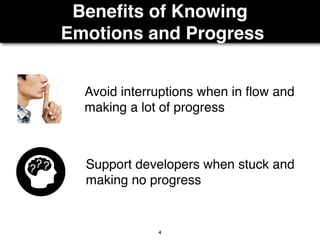
Support developers when stuck and
making no progress
Avoid interruptions when in flow and
making a lot of progress
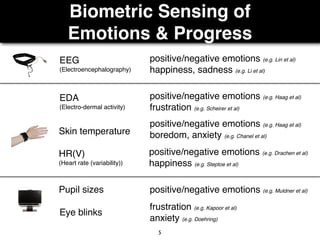
Biometric Sensing of

Emotions & Progress
5
positive/negative emotions (e.g. Lin et al)
happiness, sadness (e.g. Li et al)
positive/negative emotions (e.g. Haag et al)
frustration (e.g. Scheirer et al)
positive/negative emotions (e.g. Muldner et al)
EEG
(Electroencephalography)
frustration (e.g. Kapoor et al)
anxiety (e.g. Doehring)
Pupil sizes
Eye blinks
positive/negative emotions (e.g. Haag et al)
boredom, anxiety (e.g. Chanel et al)
positive/negative emotions (e.g. Drachen et al)
happiness (e.g. Steptoe et al)
EDA
(Electro-dermal activity)
Skin temperature
HR(V)
(Heart rate (variability))
Research Questions
6
Correlation of emotions and progress?
Aspects and practices that affect developers’ emotions
and progress?
Biometric sensors to determine developers’ emotions
and progress?
Study Participants & Tasks
17 participants: 6 professionals and 11 PhD students
• on average 7.1 years of prof. development experience
• only minor differences between professionals and students
Two change tasks
• Task 1: small program to interact with StackExchange API
• Task 2: new feature in JHotDraw
7
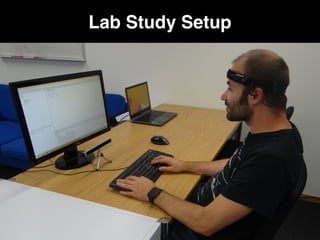
Lab Study Setup
8
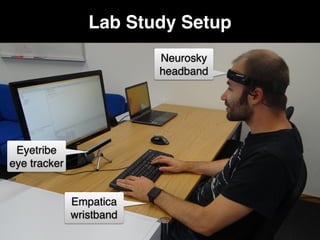
Lab Study Setup
8
Neurosky
headband
Empatica
wristband
Eyetribe
eye tracker
Study Method
9
Fish tank video as a baseline for biometric measurements
Study Method
9
Fish tank video as a baseline for biometric measurements
Work on two change tasks, each for 30 minutes
Study Method
9
Fish tank video as a baseline for biometric measurements
Work on two change tasks, each for 30 minutes
• progress
• valence: ‘’very unpleasant’’ to ‘’very pleasant’’
arousal: ‘’very calm’’ to ‘’very excited’’
• reasons for the current state of emotions / progress & aspects
that would help to improve
Assessments every 5 minutes or at signs of strong negative/
positive emotions
Study Method
9
Fish tank video as a baseline for biometric measurements
Work on two change tasks, each for 30 minutes
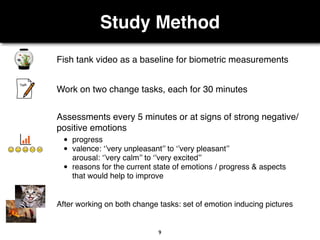
After working on both change tasks: set of emotion inducing pictures
• progress
• valence: ‘’very unpleasant’’ to ‘’very pleasant’’
arousal: ‘’very calm’’ to ‘’very excited’’
• reasons for the current state of emotions / progress & aspects
that would help to improve
Assessments every 5 minutes or at signs of strong negative/
positive emotions
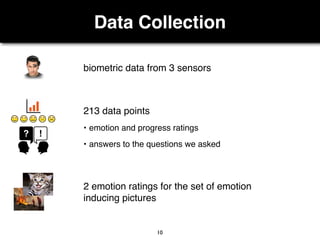
Data Collection
10
biometric data from 3 sensors
213 data points
• emotion and progress ratings
• answers to the questions we asked
2 emotion ratings for the set of emotion
inducing pictures
Research Questions
11
Correlation of emotions and progress?
Aspects and practices that affect developers’ emotions
and progress
Biometric sensors to determine developers’ emotions
and progress
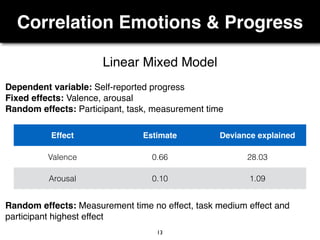
Correlation Emotions & Progress
12
Linear Mixed Model
Dependent variable: Self-reported progress
Fixed effects: Valence, arousal
Random effects: Participant, task, measurement time
Correlation Emotions & Progress
13
Linear Mixed Model
Dependent variable: Self-reported progress
Fixed effects: Valence, arousal
Random effects: Participant, task, measurement time
Random effects: Measurement time no effect, task medium effect and
participant highest effect
Effect Estimate Deviance explained
Valence 0.66 28.03
Arousal 0.10 1.09
Correlation Emotions & Progress
14
Correlation Emotions & Progress
14
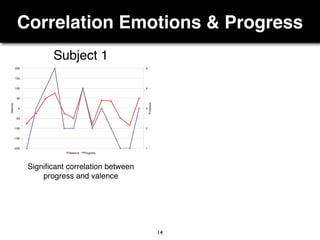
Subject 1
Significant correlation between
progress and valence
Correlation Emotions & Progress
14
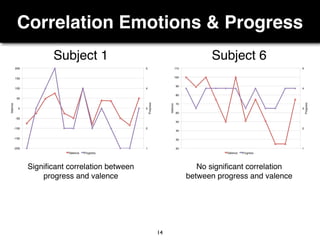
Subject 6Subject 1
Significant correlation between
progress and valence
No significant correlation
between progress and valence
Correlation Emotions & Progress
14
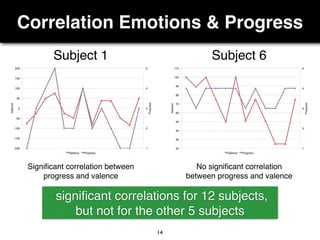
Subject 6Subject 1
Significant correlation between
progress and valence
No significant correlation
between progress and valence
significant correlations for 12 subjects,
but not for the other 5 subjects
Research Questions
15
Correlation of emotions and progress?
Aspects and practices that affect developers’ emotions
and progress?
Biometric sensors to determine developers’ emotions
and progress
Top 3 Reasons for a Change in
Emotions / Progress
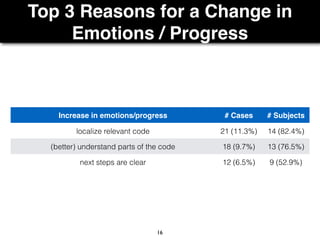
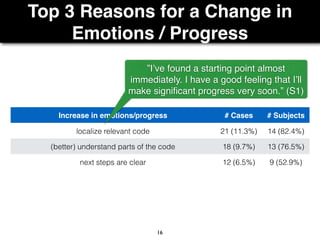
16
Increase in emotions/progress # Cases # Subjects
localize relevant code 21 (11.3%) 14 (82.4%)
(better) understand parts of the code 18 (9.7%) 13 (76.5%)
next steps are clear 12 (6.5%) 9 (52.9%)
Top 3 Reasons for a Change in
Emotions / Progress
16
Increase in emotions/progress # Cases # Subjects
localize relevant code 21 (11.3%) 14 (82.4%)
(better) understand parts of the code 18 (9.7%) 13 (76.5%)
next steps are clear 12 (6.5%) 9 (52.9%)
”I’ve found a starting point almost
immediately. I have a good feeling that I’ll
make significant progress very soon.” (S1)
Top 3 Reasons for a Change in
Emotions / Progress
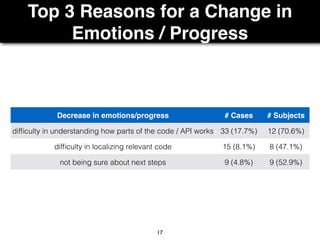
17
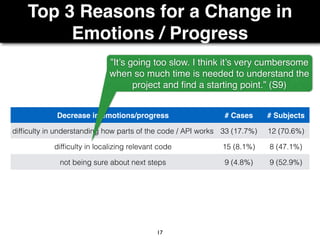
Decrease in emotions/progress # Cases # Subjects
difficulty in understanding how parts of the code / API works 33 (17.7%) 12 (70.6%)
difficulty in localizing relevant code 15 (8.1%) 8 (47.1%)
not being sure about next steps 9 (4.8%) 9 (52.9%)
Top 3 Reasons for a Change in
Emotions / Progress
17
Decrease in emotions/progress # Cases # Subjects
difficulty in understanding how parts of the code / API works 33 (17.7%) 12 (70.6%)
difficulty in localizing relevant code 15 (8.1%) 8 (47.1%)
not being sure about next steps 9 (4.8%) 9 (52.9%)
”It’s going too slow. I think it’s very cumbersome
when so much time is needed to understand the
project and find a starting point.” (S9)
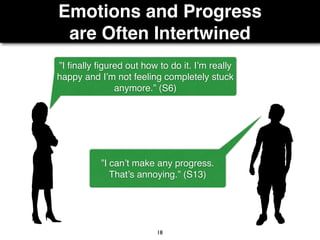
Emotions and Progress
are Often Intertwined
18
”I finally figured out how to do it. I’m really
happy and I’m not feeling completely stuck
anymore.” (S6)
”I can’t make any progress.
That’s annoying.” (S13)
Research Questions
19
Correlation of emotions and progress?
Aspects and practices that affect developers’ emotions
and progress
Biometric sensors to determine developers’ emotions
and progress?
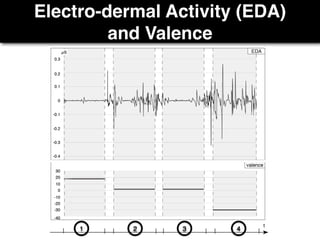
Electro-dermal Activity (EDA)

and Valence
20
1 2 3 4
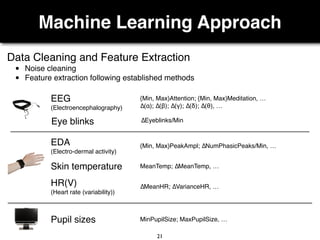
Machine Learning Approach
21
Data Cleaning and Feature Extraction
• Noise cleaning
• Feature extraction following established methods
{Min, Max}Attention; {Min, Max}Meditation, …
∆(α); ∆(β); ∆(γ); ∆(δ); ∆(θ), …
{Min, Max}PeakAmpl; ∆NumPhasicPeaks/Min, …
MinPupilSize; MaxPupilSize, …
EEG
(Electroencephalography)
Pupil sizes
Eye blinks
EDA
(Electro-dermal activity)
Skin temperature
HR(V)
(Heart rate (variability))
MeanTemp; ∆MeanTemp, …
∆MeanHR; ∆VarianceHR, …
∆Eyeblinks/Min
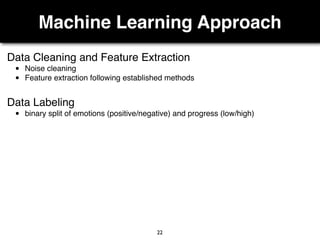
Machine Learning Approach
22
Data Cleaning and Feature Extraction
• Noise cleaning
• Feature extraction following established methods
Data Labeling
• binary split of emotions (positive/negative) and progress (low/high)
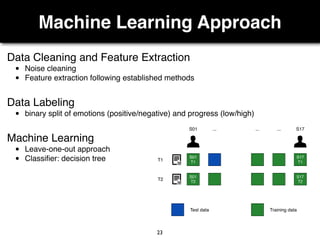
Machine Learning Approach
23
Data Cleaning and Feature Extraction
• Noise cleaning
• Feature extraction following established methods
Data Labeling
• binary split of emotions (positive/negative) and progress (low/high)
Machine Learning
• Leave-one-out approach
• Classifier: decision tree S01
T1
S17
T1
S01
T2
S17
T2
T1
...S01 S17
Test data Training data
......
T2
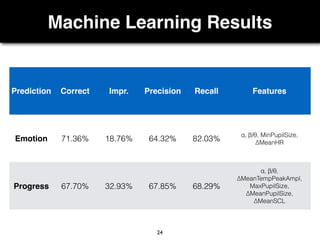
Machine Learning Results
24
Prediction Correct Impr. Precision Recall Features
Emotion 71.36% 18.76% 64.32% 82.03%
α, β/θ, MinPupilSize,
∆MeanHR
Progress 67.70% 32.93% 67.85% 68.29%
α, β/θ,
∆MeanTempPeakAmpl,
MaxPupilSize,
∆MeanPupilSize,
∆MeanSCL
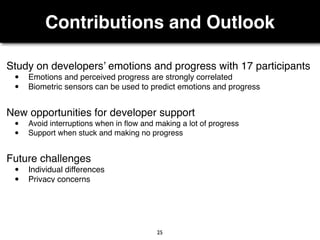
Contributions and Outlook
25
Study on developers’ emotions and progress with 17 participants
• Emotions and perceived progress are strongly correlated
• Biometric sensors can be used to predict emotions and progress
Future challenges
• Individual differences
• Privacy concerns
New opportunities for developer support
• Avoid interruptions when in flow and making a lot of progress
• Support when stuck and making no progress
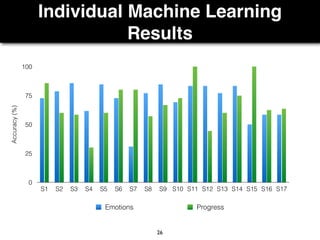
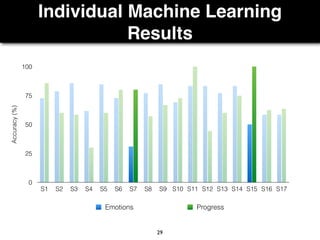
Individual Machine Learning
Results
26
Accuracy(%)
0
25
50
75
100
S1 S2 S3 S4 S5 S6 S7 S8 S9 S10 S11 S12 S13 S14 S15 S16 S17
Emotions Progress
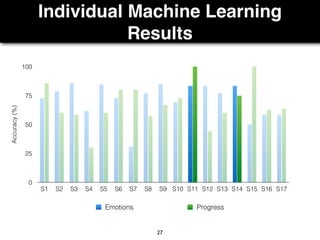
Individual Machine Learning
Results
27
Accuracy(%)
0
25
50
75
100
S1 S2 S3 S4 S5 S6 S7 S8 S9 S10 S11 S12 S13 S14 S15 S16 S17
Emotions Progress
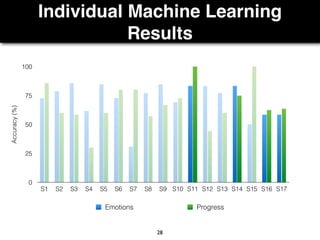
Individual Machine Learning
Results
28
Accuracy(%)
0
25
50
75
100
S1 S2 S3 S4 S5 S6 S7 S8 S9 S10 S11 S12 S13 S14 S15 S16 S17
Emotions Progress
Individual Machine Learning
Results
29
Accuracy(%)
0
25
50
75
100
S1 S2 S3 S4 S5 S6 S7 S8 S9 S10 S11 S12 S13 S14 S15 S16 S17
Emotions Progress
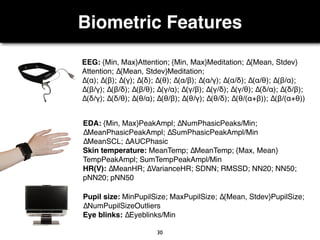
Biometric Features
3030
EEG: {Min, Max}Attention; {Min, Max}Meditation; ∆{Mean, Stdev}
Attention; ∆{Mean, Stdev}Meditation;
∆(α); ∆(β); ∆(γ); ∆(δ); ∆(θ); ∆(α/β); ∆(α/γ); ∆(α/δ); ∆(α/θ); ∆(β/α);
∆(β/γ); ∆(β/δ); ∆(β/θ); ∆(γ/α); ∆(γ/β); ∆(γ/δ); ∆(γ/θ); ∆(δ/α); ∆(δ/β);
∆(δ/γ); ∆(δ/θ); ∆(θ/α); ∆(θ/β); ∆(θ/γ); ∆(θ/δ); ∆(θ/(α+β)); ∆(β/(α+θ))
EDA: {Min, Max}PeakAmpl; ∆NumPhasicPeaks/Min;
∆MeanPhasicPeakAmpl; ∆SumPhasicPeakAmpl/Min
∆MeanSCL; ∆AUCPhasic
Skin temperature: MeanTemp; ∆MeanTemp; {Max, Mean}
TempPeakAmpl; SumTempPeakAmpl/Min
HR(V): ∆MeanHR; ∆VarianceHR; SDNN; RMSSD; NN20; NN50;
pNN20; pNN50
Pupil size: MinPupilSize; MaxPupilSize; ∆{Mean, Stdev}PupilSize;
∆NumPupilSizeOutliers
Eye blinks: ∆Eyeblinks/Min

Stuck and Frustrated or In Flow and Happy: Sensing Developers’ Emotions and Progress

  • 1.
    Sebastian Müller andThomas Fritz Stuck and Frustrated or in Flow and Happy: Sensing Developers’ Emotions and Progress ICSE 2015, Florence, Italy
  • 4.
    Benefits of Knowing Emotionsand Progress 4 Support developers when stuck and making no progress Avoid interruptions when in flow and making a lot of progress
  • 5.
    Biometric Sensing of
 Emotions& Progress 5 positive/negative emotions (e.g. Lin et al) happiness, sadness (e.g. Li et al) positive/negative emotions (e.g. Haag et al) frustration (e.g. Scheirer et al) positive/negative emotions (e.g. Muldner et al) EEG (Electroencephalography) frustration (e.g. Kapoor et al) anxiety (e.g. Doehring) Pupil sizes Eye blinks positive/negative emotions (e.g. Haag et al) boredom, anxiety (e.g. Chanel et al) positive/negative emotions (e.g. Drachen et al) happiness (e.g. Steptoe et al) EDA (Electro-dermal activity) Skin temperature HR(V) (Heart rate (variability))
  • 6.
    Research Questions 6 Correlation ofemotions and progress? Aspects and practices that affect developers’ emotions and progress? Biometric sensors to determine developers’ emotions and progress?
  • 7.
    Study Participants &Tasks 17 participants: 6 professionals and 11 PhD students • on average 7.1 years of prof. development experience • only minor differences between professionals and students Two change tasks • Task 1: small program to interact with StackExchange API • Task 2: new feature in JHotDraw 7
  • 8.
  • 9.
  • 10.
    Study Method 9 Fish tankvideo as a baseline for biometric measurements
  • 11.
    Study Method 9 Fish tankvideo as a baseline for biometric measurements Work on two change tasks, each for 30 minutes
  • 12.
    Study Method 9 Fish tankvideo as a baseline for biometric measurements Work on two change tasks, each for 30 minutes • progress • valence: ‘’very unpleasant’’ to ‘’very pleasant’’ arousal: ‘’very calm’’ to ‘’very excited’’ • reasons for the current state of emotions / progress & aspects that would help to improve Assessments every 5 minutes or at signs of strong negative/ positive emotions
  • 13.
    Study Method 9 Fish tankvideo as a baseline for biometric measurements Work on two change tasks, each for 30 minutes After working on both change tasks: set of emotion inducing pictures • progress • valence: ‘’very unpleasant’’ to ‘’very pleasant’’ arousal: ‘’very calm’’ to ‘’very excited’’ • reasons for the current state of emotions / progress & aspects that would help to improve Assessments every 5 minutes or at signs of strong negative/ positive emotions
  • 14.
    Data Collection 10 biometric datafrom 3 sensors 213 data points • emotion and progress ratings • answers to the questions we asked 2 emotion ratings for the set of emotion inducing pictures
  • 15.
    Research Questions 11 Correlation ofemotions and progress? Aspects and practices that affect developers’ emotions and progress Biometric sensors to determine developers’ emotions and progress
  • 16.
    Correlation Emotions &Progress 12 Linear Mixed Model Dependent variable: Self-reported progress Fixed effects: Valence, arousal Random effects: Participant, task, measurement time
  • 17.
    Correlation Emotions &Progress 13 Linear Mixed Model Dependent variable: Self-reported progress Fixed effects: Valence, arousal Random effects: Participant, task, measurement time Random effects: Measurement time no effect, task medium effect and participant highest effect Effect Estimate Deviance explained Valence 0.66 28.03 Arousal 0.10 1.09
  • 18.
  • 19.
    Correlation Emotions &Progress 14 Subject 1 Significant correlation between progress and valence
  • 20.
    Correlation Emotions &Progress 14 Subject 6Subject 1 Significant correlation between progress and valence No significant correlation between progress and valence
  • 21.
    Correlation Emotions &Progress 14 Subject 6Subject 1 Significant correlation between progress and valence No significant correlation between progress and valence significant correlations for 12 subjects, but not for the other 5 subjects
  • 22.
    Research Questions 15 Correlation ofemotions and progress? Aspects and practices that affect developers’ emotions and progress? Biometric sensors to determine developers’ emotions and progress
  • 23.
    Top 3 Reasonsfor a Change in Emotions / Progress 16 Increase in emotions/progress # Cases # Subjects localize relevant code 21 (11.3%) 14 (82.4%) (better) understand parts of the code 18 (9.7%) 13 (76.5%) next steps are clear 12 (6.5%) 9 (52.9%)
  • 24.
    Top 3 Reasonsfor a Change in Emotions / Progress 16 Increase in emotions/progress # Cases # Subjects localize relevant code 21 (11.3%) 14 (82.4%) (better) understand parts of the code 18 (9.7%) 13 (76.5%) next steps are clear 12 (6.5%) 9 (52.9%) ”I’ve found a starting point almost immediately. I have a good feeling that I’ll make significant progress very soon.” (S1)
  • 25.
    Top 3 Reasonsfor a Change in Emotions / Progress 17 Decrease in emotions/progress # Cases # Subjects difficulty in understanding how parts of the code / API works 33 (17.7%) 12 (70.6%) difficulty in localizing relevant code 15 (8.1%) 8 (47.1%) not being sure about next steps 9 (4.8%) 9 (52.9%)
  • 26.
    Top 3 Reasonsfor a Change in Emotions / Progress 17 Decrease in emotions/progress # Cases # Subjects difficulty in understanding how parts of the code / API works 33 (17.7%) 12 (70.6%) difficulty in localizing relevant code 15 (8.1%) 8 (47.1%) not being sure about next steps 9 (4.8%) 9 (52.9%) ”It’s going too slow. I think it’s very cumbersome when so much time is needed to understand the project and find a starting point.” (S9)
  • 27.
    Emotions and Progress areOften Intertwined 18 ”I finally figured out how to do it. I’m really happy and I’m not feeling completely stuck anymore.” (S6) ”I can’t make any progress. That’s annoying.” (S13)
  • 28.
    Research Questions 19 Correlation ofemotions and progress? Aspects and practices that affect developers’ emotions and progress Biometric sensors to determine developers’ emotions and progress?
  • 29.
  • 30.
    Machine Learning Approach 21 DataCleaning and Feature Extraction • Noise cleaning • Feature extraction following established methods {Min, Max}Attention; {Min, Max}Meditation, … ∆(α); ∆(β); ∆(γ); ∆(δ); ∆(θ), … {Min, Max}PeakAmpl; ∆NumPhasicPeaks/Min, … MinPupilSize; MaxPupilSize, … EEG (Electroencephalography) Pupil sizes Eye blinks EDA (Electro-dermal activity) Skin temperature HR(V) (Heart rate (variability)) MeanTemp; ∆MeanTemp, … ∆MeanHR; ∆VarianceHR, … ∆Eyeblinks/Min
  • 31.
    Machine Learning Approach 22 DataCleaning and Feature Extraction • Noise cleaning • Feature extraction following established methods Data Labeling • binary split of emotions (positive/negative) and progress (low/high)
  • 32.
    Machine Learning Approach 23 DataCleaning and Feature Extraction • Noise cleaning • Feature extraction following established methods Data Labeling • binary split of emotions (positive/negative) and progress (low/high) Machine Learning • Leave-one-out approach • Classifier: decision tree S01 T1 S17 T1 S01 T2 S17 T2 T1 ...S01 S17 Test data Training data ...... T2
  • 33.
    Machine Learning Results 24 PredictionCorrect Impr. Precision Recall Features Emotion 71.36% 18.76% 64.32% 82.03% α, β/θ, MinPupilSize, ∆MeanHR Progress 67.70% 32.93% 67.85% 68.29% α, β/θ, ∆MeanTempPeakAmpl, MaxPupilSize, ∆MeanPupilSize, ∆MeanSCL
  • 34.
    Contributions and Outlook 25 Studyon developers’ emotions and progress with 17 participants • Emotions and perceived progress are strongly correlated • Biometric sensors can be used to predict emotions and progress Future challenges • Individual differences • Privacy concerns New opportunities for developer support • Avoid interruptions when in flow and making a lot of progress • Support when stuck and making no progress
  • 35.
    Individual Machine Learning Results 26 Accuracy(%) 0 25 50 75 100 S1S2 S3 S4 S5 S6 S7 S8 S9 S10 S11 S12 S13 S14 S15 S16 S17 Emotions Progress
  • 36.
    Individual Machine Learning Results 27 Accuracy(%) 0 25 50 75 100 S1S2 S3 S4 S5 S6 S7 S8 S9 S10 S11 S12 S13 S14 S15 S16 S17 Emotions Progress
  • 37.
    Individual Machine Learning Results 28 Accuracy(%) 0 25 50 75 100 S1S2 S3 S4 S5 S6 S7 S8 S9 S10 S11 S12 S13 S14 S15 S16 S17 Emotions Progress
  • 38.
    Individual Machine Learning Results 29 Accuracy(%) 0 25 50 75 100 S1S2 S3 S4 S5 S6 S7 S8 S9 S10 S11 S12 S13 S14 S15 S16 S17 Emotions Progress
  • 39.
    Biometric Features 3030 EEG: {Min,Max}Attention; {Min, Max}Meditation; ∆{Mean, Stdev} Attention; ∆{Mean, Stdev}Meditation; ∆(α); ∆(β); ∆(γ); ∆(δ); ∆(θ); ∆(α/β); ∆(α/γ); ∆(α/δ); ∆(α/θ); ∆(β/α); ∆(β/γ); ∆(β/δ); ∆(β/θ); ∆(γ/α); ∆(γ/β); ∆(γ/δ); ∆(γ/θ); ∆(δ/α); ∆(δ/β); ∆(δ/γ); ∆(δ/θ); ∆(θ/α); ∆(θ/β); ∆(θ/γ); ∆(θ/δ); ∆(θ/(α+β)); ∆(β/(α+θ)) EDA: {Min, Max}PeakAmpl; ∆NumPhasicPeaks/Min; ∆MeanPhasicPeakAmpl; ∆SumPhasicPeakAmpl/Min ∆MeanSCL; ∆AUCPhasic Skin temperature: MeanTemp; ∆MeanTemp; {Max, Mean} TempPeakAmpl; SumTempPeakAmpl/Min HR(V): ∆MeanHR; ∆VarianceHR; SDNN; RMSSD; NN20; NN50; pNN20; pNN50 Pupil size: MinPupilSize; MaxPupilSize; ∆{Mean, Stdev}PupilSize; ∆NumPupilSizeOutliers Eye blinks: ∆Eyeblinks/Min