
MOBILE
COMMUNICATION

    Wireless
     LAN
INTRODUCTION
• A wireless local area network (WLAN) links two or
  more devices using some wireless distribution
  method, and usually providing a connection
  through an access point to the wider internet. This
  gives users the mobility to move around within a
  local coverage area and still be connected to the
  network. Most modern WLANs are based on IEEE
  802.11 standards, marketed under the Wi-Fi brand
  name. Wireless LANs have become popular in the
  home due to ease of installation, and in
  commercial complexes offering wireless access to
  their customers for free.
Infra red vs Radio Transmission
• Today, two different basic transmission
  technologies can be used to set up WLANs.
• One technology is based on the transmission
  of infra red light, the other one, which is much
  more popular, uses radio transmission in the
  GHz range.
• Both technologies
• can be used to set up ad-hoc connections for
  work groups, to connect, e.g., a desktop
• with a printer without a wire, or to support
  mobility within a small area.
• Infra red technology uses diffuse light
  reflected at walls, furniture etc. or directed
  light if a line-of-sight (LOS) exists between
  sender and receiver. Senders can be simple
  light emitting diodes (LEDs) or laser diodes.
• The main advantages of infra red technology
  are its simple and extremely cheap senders
  and receivers which are integrated into nearly
  all mobile devices available today.
  PDAs, laptops, notebooks, mobile phones etc.
  have an infra red data association (IrDA)
  interface.
• No licenses are needed for infra red
  technology and shielding is very simple.
• Electrical devices do not interfere with infra
  red transmission.
• Advantages of radio transmission include the
  long-term experiences made with radio
  transmission for wide area networks
  (e.g., microwave links) and mobile cellular
  phones. Radio transmission can cover larger
  areas and can penetrate (thinner)
  walls, furniture, plants etc.
Infrastructure networks
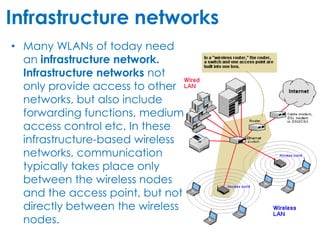
• Many WLANs of today need
  an infrastructure network.
  Infrastructure networks not
  only provide access to other
  networks, but also include
  forwarding functions, medium
  access control etc. In these
  infrastructure-based wireless
  networks, communication
  typically takes place only
  between the wireless nodes
  and the access point, but not
  directly between the wireless
  nodes.
• Typically, the design of infrastructure-based
  wireless networks is simpler because most
  of the network functionality lies within the
  access point, whereas the wireless clients
  can remain quite simple. This structure is
  reminiscent of switched Ethernet or other
  star-based networks, where a central
  element (e.g., a switch) controls network
  flow. This type of network can use different
  access schemes with or without collision.
  Collisions may occur if medium access of
  the wireless nodes and the access point is
  not coordinated. However, if only the
  access point controls medium access, no
  collisions are possible.
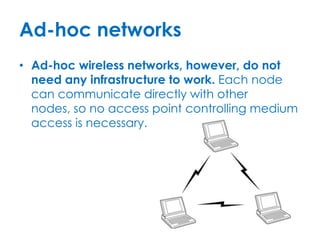
Ad-hoc networks
• Ad-hoc wireless networks, however, do not
  need any infrastructure to work. Each node
  can communicate directly with other
  nodes, so no access point controlling medium
  access is necessary.
• The network is ad hoc because it does not rely on a
  preexisting infrastructure, such as routers in wired
  networks or access points in managed
  (infrastructure) wireless networks.
  Instead, each node participates in routing by
  forwarding data for other nodes, and so the
  determination of which nodes forward data is made
  dynamically based on the network connectivity. In
  addition to the classic routing, ad hoc networks can
  use flooding for forwarding the data.
• In ad-hoc networks, the complexity of each node is
  higher because every node has to implement
  medium access mechanisms, mechanisms to
  handle hidden or exposed terminal problems, and
  perhaps priority mechanisms, to provide a certain
  quality of service.
System architecture
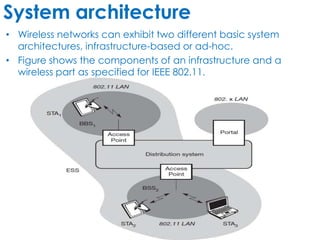
• Wireless networks can exhibit two different basic system
  architectures, infrastructure-based or ad-hoc.
• Figure shows the components of an infrastructure and a
  wireless part as specified for IEEE 802.11.
• Several nodes, called stations (STAi), are connected to
  access points (AP).
• Stations are terminals with access mechanisms to the
  wireless medium and radio contact to the AP.
• The stations and the AP which are within the same radio
  coverage form a basic service set (BSSi). The example
  shows two BSSs – BSS1 and BSS2 – which are connected
  via a distribution system.
• A distribution system connects several BSSs via the AP to
  form a single network and thereby extends the wireless
  coverage area. This network is now called an extended
  service set (ESS) and has its own identifier, the ESSID.
• The ESSID is the ‘name’ of a network and is used to
  separate different networks. Without knowing the ESSID
  (and assuming no hacking) it should not be possible to
  participate in the WLAN.
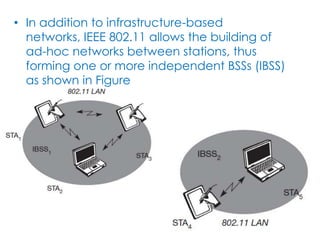
• In addition to infrastructure-based
  networks, IEEE 802.11 allows the building of
  ad-hoc networks between stations, thus
  forming one or more independent BSSs (IBSS)
  as shown in Figure
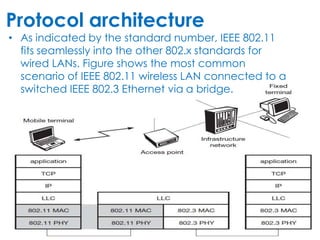
Protocol architecture
• As indicated by the standard number, IEEE 802.11
  fits seamlessly into the other 802.x standards for
  wired LANs. Figure shows the most common
  scenario of IEEE 802.11 wireless LAN connected to a
  switched IEEE 802.3 Ethernet via a bridge.
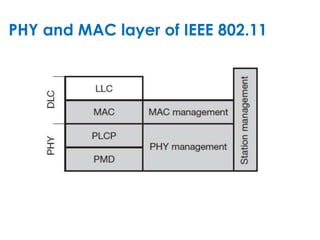
PHY and MAC layer of IEEE 802.11
Made by:
Jagjit Singh Wilku

Mc wireless lan

  • 1.
  • 2.
    INTRODUCTION • A wirelesslocal area network (WLAN) links two or more devices using some wireless distribution method, and usually providing a connection through an access point to the wider internet. This gives users the mobility to move around within a local coverage area and still be connected to the network. Most modern WLANs are based on IEEE 802.11 standards, marketed under the Wi-Fi brand name. Wireless LANs have become popular in the home due to ease of installation, and in commercial complexes offering wireless access to their customers for free.
  • 3.
    Infra red vsRadio Transmission • Today, two different basic transmission technologies can be used to set up WLANs. • One technology is based on the transmission of infra red light, the other one, which is much more popular, uses radio transmission in the GHz range. • Both technologies • can be used to set up ad-hoc connections for work groups, to connect, e.g., a desktop • with a printer without a wire, or to support mobility within a small area.
  • 4.
    • Infra redtechnology uses diffuse light reflected at walls, furniture etc. or directed light if a line-of-sight (LOS) exists between sender and receiver. Senders can be simple light emitting diodes (LEDs) or laser diodes. • The main advantages of infra red technology are its simple and extremely cheap senders and receivers which are integrated into nearly all mobile devices available today. PDAs, laptops, notebooks, mobile phones etc. have an infra red data association (IrDA) interface. • No licenses are needed for infra red technology and shielding is very simple. • Electrical devices do not interfere with infra red transmission.
  • 5.
    • Advantages ofradio transmission include the long-term experiences made with radio transmission for wide area networks (e.g., microwave links) and mobile cellular phones. Radio transmission can cover larger areas and can penetrate (thinner) walls, furniture, plants etc.
  • 6.
    Infrastructure networks • ManyWLANs of today need an infrastructure network. Infrastructure networks not only provide access to other networks, but also include forwarding functions, medium access control etc. In these infrastructure-based wireless networks, communication typically takes place only between the wireless nodes and the access point, but not directly between the wireless nodes.
  • 7.
    • Typically, thedesign of infrastructure-based wireless networks is simpler because most of the network functionality lies within the access point, whereas the wireless clients can remain quite simple. This structure is reminiscent of switched Ethernet or other star-based networks, where a central element (e.g., a switch) controls network flow. This type of network can use different access schemes with or without collision. Collisions may occur if medium access of the wireless nodes and the access point is not coordinated. However, if only the access point controls medium access, no collisions are possible.
  • 8.
    Ad-hoc networks • Ad-hocwireless networks, however, do not need any infrastructure to work. Each node can communicate directly with other nodes, so no access point controlling medium access is necessary.
  • 9.
    • The networkis ad hoc because it does not rely on a preexisting infrastructure, such as routers in wired networks or access points in managed (infrastructure) wireless networks. Instead, each node participates in routing by forwarding data for other nodes, and so the determination of which nodes forward data is made dynamically based on the network connectivity. In addition to the classic routing, ad hoc networks can use flooding for forwarding the data. • In ad-hoc networks, the complexity of each node is higher because every node has to implement medium access mechanisms, mechanisms to handle hidden or exposed terminal problems, and perhaps priority mechanisms, to provide a certain quality of service.
  • 10.
    System architecture • Wirelessnetworks can exhibit two different basic system architectures, infrastructure-based or ad-hoc. • Figure shows the components of an infrastructure and a wireless part as specified for IEEE 802.11.
  • 11.
    • Several nodes,called stations (STAi), are connected to access points (AP). • Stations are terminals with access mechanisms to the wireless medium and radio contact to the AP. • The stations and the AP which are within the same radio coverage form a basic service set (BSSi). The example shows two BSSs – BSS1 and BSS2 – which are connected via a distribution system. • A distribution system connects several BSSs via the AP to form a single network and thereby extends the wireless coverage area. This network is now called an extended service set (ESS) and has its own identifier, the ESSID. • The ESSID is the ‘name’ of a network and is used to separate different networks. Without knowing the ESSID (and assuming no hacking) it should not be possible to participate in the WLAN.
  • 12.
    • In additionto infrastructure-based networks, IEEE 802.11 allows the building of ad-hoc networks between stations, thus forming one or more independent BSSs (IBSS) as shown in Figure
  • 13.
    Protocol architecture • Asindicated by the standard number, IEEE 802.11 fits seamlessly into the other 802.x standards for wired LANs. Figure shows the most common scenario of IEEE 802.11 wireless LAN connected to a switched IEEE 802.3 Ethernet via a bridge.
  • 14.
    PHY and MAClayer of IEEE 802.11
  • 15.