BUSINESS RESEARCH
METHODOLOGY LECTURES
BY
NTANGSI MAX MEMFIH
Research Methods Lectures by Ntangsi 1
Topic 1: INTRODUCTION
Session Objectives
To understand the meaning of research,
To understand the meaning of research
Methodology,
To understand the objectives of research
To understand the characteristics of research
To understand the basic steps of conducting
research - Problem Solving Approach .
Basic Concepts or Definitions
 Definition of Research
 Definition of Methodology
 Definition of Research Methodology
 The Aims of Research
Characteristics of research
 Basic Steps to Conduct Research
3Research Methods Lecture by Ntangsi Max
What is Research?
Research is:
“…the systematic process of collecting
and analyzing data (information) in
order to increase our understanding of
the phenomenon on which we are
concerned or interested”
In short, it is the search for knowledge
through objective and systematic
method of finding solutions to problems.
4Research Methods Lecture by Ntangsi
More Understanding of Research
Research is a careful and systematic process
of inquiry to find answers to problems of
interest.
Research include: use of facts, use of
theories, data (facts) analysis, sampling,
doing an experiment, going to library to read
up on a topic
To do ‘research’ is to investigate the problem
systematically and thoroughly
Goal of research is to solve ‘problem’ of
interest
5Research Methods Lecture by Ntangsi
Characteristics of Research
1. Originates with a question or a problem.
2. Requires clear articulation of a goal.
3. Follows a specific plan or procedure.
4. Often divides main problem into sub problems.
5. Guided by specific problem, question, or
hypothesis.
6. Accepts certain critical assumptions.
7. Requires collection and interpretation of data.
8. Cyclical (helical) in nature - Repetitive.
6Research Methods Lecture by Ntangsi
The Aims of Research
 To understand a phenomenon better so as to find out
the truth about it
 To describe a phenomenon as it is
 To predict about “something” in the future
 To explain solutions to problems
 To interpret what is being investigated and to make
recommendations
 To Discover new things – innovation.
 Though each study has its own specific purpose, this
may fall under the following broad groupings:
 To gain familiarity with a phenomenon or to achieve new
insights into it - exploratory or formulative
 To portray accurately the characteristics of a particular
individual, situation or a group - descriptive
 To determine the frequency with which something
occurs – diagnostic, etc.
7Research Methods Lecture by Ntangsi
Motivation for Research
What makes people to undertake research?
 Desire to get additional academic or professional
qualifications along with consequential benefits,
 Desire to face the challenge in solving the societal
problems - be of service to society,
 Desire to get intellectual joy of doing some creative
work,
 Desire to get respectability,
 Desire to create additional knowledge or new things,
 Directives of organizations or government,
 Employment conditions,
 Curiosity about new things,
 Desire to understand causal relationships,
 Social thinking and awakening, etc.
Research Methods Lecture by Ntangsi 8
Types of Research
Descriptive vs. Analytical
Descriptive research includes surveys and fact-
finding enquiries of different kinds - Ex post facto
research.
 The major purpose of descriptive research is to
describe the state of affairs as it exists at present.
 The main characteristic of this method is that the
researcher has no control over the variables; he can
only report what has happened or what is happening.
 The methods used in descriptive research are survey
methods
 Analytical research on the other hand uses facts
or information available, and analyze these to
make a critical evaluation of the situation.
Research Methods Lecture by Ntangsi 9
Types of Research Cont'd
Applied vs. Fundamental
 Applied research (Action Research) aims at finding
solutions for an immediate problem facing a society or
an organization – Development focused.
 Fundamental research is mainly concerned with
generalizations and with the formulation of a theory.
“Gathering knowledge for knowledge’s sake is termed
‘pure’ or ‘basic’ research.
Quantitative vs. Qualitative
 Quantitative research is based on the measurement of
quantity or amount. It is applicable to phenomena that
can be expressed in terms of quantity.
 Qualitative research, on the other hand, is concerned
with qualitative phenomenon, i.e., phenomena relating to
or involving quality or kind.
Research Methods Lecture by Ntangsi 10
Types of Research Cont'd
Conceptual vs. Empirical
 Conceptual research is that related to some abstract
idea(s) or theory. It is generally used by philosophers
and thinkers to develop new concepts or to reinterpret
existing ones.
 Empirical research relies on experience or observation
alone, often without due regard for system and theory. It
is data-based research, coming up with conclusions
which are capable of being verified by observation or
experiment.
 Other Types of Researches include one-time (cross
sectional) research or longitudinal research, field-
setting research or laboratory research, clinical or
diagnostic research, Historical research, etc.
The above research types gives rise to research
approaches
Research Methods Lecture by Ntangsi 11
Scientific Methods
“Methods” means way
Methodology is the discipline of scientific
procedures .
Methodology is therefore about;
A formalized approach to conduct research
A series of steps and deliverables
Research Methodology in Business is
“A collection of methods, procedures,
techniques, tools and documentations/aids
which help the researchers in their efforts to
conduct a research in Business”
12Research Methods Lecture by Ntangsi
Research Methodology Vs. Research
Method
Research Methodology:
 Conceptual frameworks and assumptions
used to inform research
 Elaboration of research methods
Research Method:
 Research techniques or procedures used to
gather and analyses data
 A Research method is therefore a subset of
research methodology
13Research Methods Lecture by Ntangsi
Research Methodology Elaborated
 A research methodology will consist of phases, sub‐
phases, which will guide the researchers in their choice of
the methods, techniques, procedures, tools, etc., that might
be appropriate at each stage of the research and also help
them plan, manage, control and evaluate the progress of
research.
 A research methodology represents a way to develop
research systematically.
 A research methodology represents a way to do scientific
inquiry.
 A research methodology should have a sound
theoretical basis.
 A research methodology should be focused (a plan)
 It leads to a successful research.
14Research Methods Lecture by Ntangsi
Why Methodology?
It will make you better able to understand and
utilize scientific information in both your
personal life and your work.
 It will make you a more literate and cultured
person.
It provides you some insight not only into
particular scientific findings but also into the
general nature of science as a human activity.
It helps you to successfully carry out the
research in a coordinated fashion 15Research Methods Lecture by Ntangsi
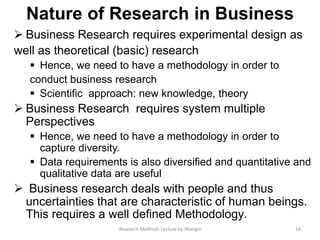
Nature of Research in Business
 Business Research requires experimental design as
well as theoretical (basic) research
 Hence, we need to have a methodology in order to
conduct business research
 Scientific approach: new knowledge, theory
 Business Research requires system multiple
Perspectives
 Hence, we need to have a methodology in order to
capture diversity.
 Data requirements is also diversified and quantitative and
qualitative data are useful
 Business research deals with people and thus
uncertainties that are characteristic of human beings.
This requires a well defined Methodology.
16Research Methods Lecture by Ntangsi
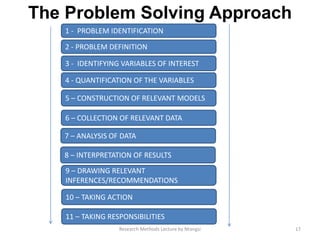
The Problem Solving Approach
1 - PROBLEM IDENTIFICATION
2 - PROBLEM DEFINITION
3 - IDENTIFYING VARIABLES OF INTEREST
5 – CONSTRUCTION OF RELEVANT MODELS
6 – COLLECTION OF RELEVANT DATA
7 – ANALYSIS OF DATA
8 – INTERPRETATION OF RESULTS
4 - QUANTIFICATION OF THE VARIABLES
9 – DRAWING RELEVANT
INFERENCES/RECOMMENDATIONS
10 – TAKING ACTION
17Research Methods Lecture by Ntangsi
11 – TAKING RESPONSIBILITIES
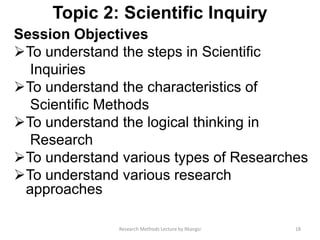
Topic 2: Scientific Inquiry
Session Objectives
To understand the steps in Scientific
Inquiries
To understand the characteristics of
Scientific Methods
To understand the logical thinking in
Research
To understand various types of Researches
To understand various research
approaches
18Research Methods Lecture by Ntangsi
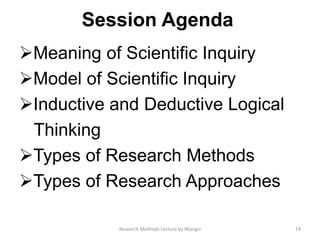
Session Agenda
Meaning of Scientific Inquiry
Model of Scientific Inquiry
Inductive and Deductive Logical
Thinking
Types of Research Methods
Types of Research Approaches
19Research Methods Lecture by Ntangsi
What is Scientific Inquiry?
 Scientific inquiry is a term that encompasses a
variety of techniques that scientists use to explore
the natural world and propose explanations based on
the evidence they find.
 The objective of scientific inquiry is to find and to
characterize the patterns as resulted from the
exploration.
 Scientific inquiry is founded on experiment and
observations as opposed to purely rational or
isolated logical thought.
 Scientific Inquiry can enrich our understanding of
science
20Research Methods Lecture by Ntangsi
Why Scientific Inquiry?
It will make us more knowledgeable about
something.
You will be able to explain about something
more thorough.
It will make us a more literate and cultured
persons.
It will provide us with more ideas.
It will enable us to take more informed
Decisions.
21Research Methods Lecture by Ntangsi
Characteristics of Scientific Inquiry
Based on facts
Objective Consideration
Analytical
Quantitative in Nature
Deductive Logic-Hypothesis
Inductive Logic-Generalization
Dynamic with time
22Research Methods Lecture by Ntangsi
Activities in Scientific Inquiry
Making observations
Posing questions
Finding out what is already known
Planning investigations
Reviewing past knowledge in light of actual
evidence
Using tools to gather, analyze, and interpret
data
Proposing explanations
Communicating the results.
23Research Methods Lecture by Ntangsi
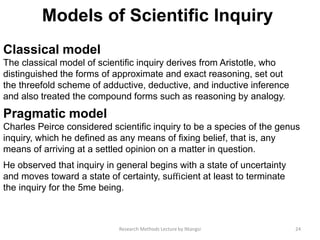
Models of Scientific Inquiry
Classical model
The classical model of scientific inquiry derives from Aristotle, who
distinguished the forms of approximate and exact reasoning, set out
the threefold scheme of adductive, deductive, and inductive inference
and also treated the compound forms such as reasoning by analogy.
Pragmatic model
Charles Peirce considered scientific inquiry to be a species of the genus
inquiry, which he defined as any means of fixing belief, that is, any
means of arriving at a settled opinion on a matter in question.
He observed that inquiry in general begins with a state of uncertainty
and moves toward a state of certainty, sufficient at least to terminate
the inquiry for the 5me being.
24Research Methods Lecture by Ntangsi
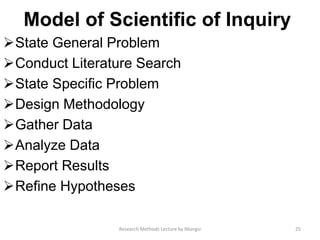
Model of Scientific of Inquiry
State General Problem
Conduct Literature Search
State Specific Problem
Design Methodology
Gather Data
Analyze Data
Report Results
Refine Hypotheses
25Research Methods Lecture by Ntangsi
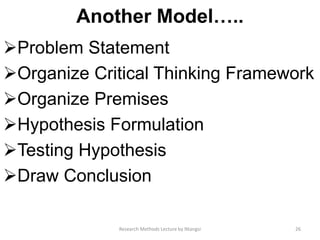
Another Model…..
Problem Statement
Organize Critical Thinking Framework
Organize Premises
Hypothesis Formulation
Testing Hypothesis
Draw Conclusion
26Research Methods Lecture by Ntangsi
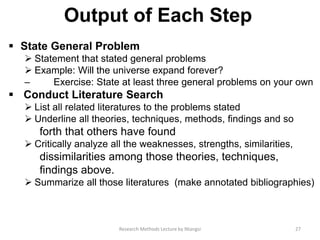
Output of Each Step
 State General Problem
 Statement that stated general problems
 Example: Will the universe expand forever?
– Exercise: State at least three general problems on your own
 Conduct Literature Search
 List all related literatures to the problems stated
 Underline all theories, techniques, methods, findings and so
forth that others have found
 Critically analyze all the weaknesses, strengths, similarities,
dissimilarities among those theories, techniques,
findings above.
 Summarize all those literatures (make annotated bibliographies)
27Research Methods Lecture by Ntangsi
Output of Each Step
 State Specific Problem
 Statement of general problem to specific problem
– Example: What are the factors that cause the universe
expanded?
– Exercise: State at least two specific problems that can
be derived
from the above exercise
Design Methodology
 List all steps to be taken in order to answer those stated
problems
 Establish the seZng of experiment
 Provide all necessary means, tools, instruments
 Define the object, variables, etc
28Research Methods Lecture by Ntangsi
Output of Each Step
Gather Data
–Organize data in tables, graphics
Analyze Data
– Interpret the organized, and processed data
Report the Results
29Research Methods Lecture by Ntangsi
Basic Skills of Scientific Inquiry
Observing
Classifying and sequencing
Communicating
Measuring
Predicting
Hypothesizing
Inferring
Defining, controlling, and manipulating variable in
experimentation
Designing, constructing and interpreting models
Interpreting, analyzing and evaluating data
30Research Methods Lecture by Ntangsi
Uses of Scientific Inquiry
Make connections with real world situations
To encourage more active problem solving
approach to learning and thinking
To apply mathematical skills
Review what is already known in light of
experimental evidence
Propose answers, explanations and predictions
Use tools to gather, analyze and interpret data
31Research Methods Lecture by Ntangsi
Exercises Your Thought
Develop a scientific model of your own
– Post deliverables of each step of the model
Categorized the scientific model into a research
method
Give examples of deductive and inductive logic
or research
32Research Methods Lecture by Ntangsi
TOPIC 3: PROBLEM IDENTIFICATION
Session Objectives
To understand the first step of conducting
research - stating the problem
 To understand what a research problem is,
To be able to state main research problems
To be able to identify specific research problems
To be able to derive research questions
To be able to identify variables involved in a
research
To be able to derive research objectives
To be able to construct hypotheses
33Research Methods Lecture by Ntangsi
The Problem Solving Approach/Research Process
1. Problem Identification
2. Problem Definition/Formulation
3. Identification of Variables of Interests
4. Quantification of the variables
5. Construction of Mathematical Models
6. Collection of Data
7. Analysis of Data
8. Interpretation of Results
9. Drawing relevant
Inferences/Recommendations
10. Implementation (Taking Action) and
11.Taking Responsibilities 34Research Methods Lecture by Ntangsi
Problem Identification
Determine a well defined general problem
 Sources: observation, research articles, scientific
discussions, experience, etc.
 Point of interest: phenomena, theories, previous
research results, etc.
Exercise your thought to express the problems
Write them as quickly and as clearly as possible
Be ready, that some (may be all) of your general
problems are not researchable
 Conduct literature search
 Consult experts 35Research Methods Lecture by Ntangsi Max
Problem Formulation
This involves;
Identification of Research Problem
A Problem exist when what is differs
from what ought to be,
Identification of the Scope of Research
Identification of Research Questions
Identification of Research Objectives
Stating of Hypothesis
 1. Statistical Hypothesis
 2. Hypothetical Statement 36Research Methods Lecture by Ntangsi
Conditions Under which Problems Exist
There must be an entity to which the problem
can be attributed (individual, society or
organization, geographical area, etc),
There must be at least two courses of action,
to be pursued,
There must be at least two possible outcomes
of which one should be preferred,
The courses of action available must provides
some chance of obtaining the objective,
Problem exist only if the best course of action
is not known. 37Research Methods Lecture by Ntangsi
Components of a Research Problem
There must be an individual or a group which
has some difficulty or the problem.
There must be some objective(s) to be attained,
There must be alternative means for obtaining
the objective(s)
There must be some doubt in the mind of a
researcher with regard to the best alternative,
There must be some environment(s) to which
the difficulty pertains.
38Research Methods Lecture by Ntangsi
Factors Affecting Complexity of Problem(s)
The environment may change affecting the
efficiencies of the courses of action or the
values of the outcomes;
The number of alternative courses of action
may be very large;
Externalities - Persons not involved in making
the decision may be affected by it and react to it
favourably or unfavourably,
Available resources to use in addressing the
problem(s),
Knowledge level of the researcher or team, etc.
39Research Methods Lecture by Ntangsi
Sources of Res. Problems in Businesses
Performance Level of the company,
Customer Complaints,
Conversing with company stakeholders like
employees, shareholders, suppliers, etc.
Observation of abnormal happenings in the firm,
Activities deviating from the Business/ Strategic
plan,
Competitors excelling at the expense of the firm,
Reading of relevant reports of the firm,
Personal knowledge of the firm in respect of the
industry,
Experiences from similar firms, etc.
40Research Methods Lecture by Ntangsi
SELECTING THE PROBLEM
The research problem chosen for study must be
carefully selected.
 Avoid topics which have been overdone,
 Controversial topics should also be avoided,
 Too narrow or too vague problems should be avoided.
 Selected topics you are familiar with,
 Select topics that are feasible so that the related
research material are within one’s reach;
 Select important topics in the circumstances,
 Consider the resources available (time, money, etc)
 Select topics which are useful and will contribute to
solving existing problems or adding to knowledge,
 The selection of a problem must be preceded by a
preliminary study 41Research Methods Lecture by Ntangsi
Questions to be asked before final Selection
Whether you are well equipped in terms of the
background to carry out the research? – the
knowledge required, your area of interests,
Whether the study falls within the budget you can
afford as well as the time available to you for the
study?
Whether the necessary cooperation can be
obtained from those who must participate in
research as subjects? – Can data be obtained?
Is the study going to be useful to the researcher/
company in particular and to society in general?
How long will the research take and how much will
it cost? etc.
42Research Methods Lecture by Ntangsi
NECESSITY OF DEFINING THE PROBLEM CLEARLY
“A problem clearly stated is a problem half
solved” This statement signifies the need for
defining a research problem properly and clearly.
The problem to be investigated must be defined
unambiguously.
Questions like: What data are to be collected?
What characteristics of data are relevant and need
to be studied? What relations are to be explored?
What techniques are to be used for the purpose?
and similar other questions will have straight
answers once the problem is well defined.
43Research Methods Lecture by Ntangsi
TECHNIQUES INVOLVED IN DEFINING A PROBLEM
 Defining a research problem properly and
clearly is a crucial part of a research study and
must in no case be done hurriedly. Useful
Steps involves include;
statement of the problem in a general way;
understanding the nature of the problem;
surveying the available literature;
developing the ideas through discussions;
Rephrasing the research problem into a
working proposition.
44Research Methods Lecture by Ntangsi
Defining the Research Problem
Technical terms and words or phrases, with special
meanings used in the statement of the problem,
should be clearly refined.
Basic assumptions or postulates (if any) relating to
the research problem should be clearly stated.
A straight forward statement of the value of the
investigation (i.e., the criteria for the selection of
the problem) should be provided.
The suitability of the time-period and the sources
of data available must also be considered by the
researcher in defining the problem.
The scope of the investigation or the limits within
which the problem is to be studied must be
mentioned explicitly in defining a research
problem. 45Research Methods Lecture by Ntangsi
Research Problems/Questions
 Research needs both problems and questions
 Qualities of good research questions:
 The Research Questions should be clear, straightforward
and easily understood by others
 The Research Questions states the relationship between
two or more variables.
 The variables mentioned in the Research Questions
should be measurable – qualitatively and quantitatively.
 The answers to the Research Questions are not
immediately obvious.
 The Research Questions indicates the method that is to
be adopted, i.e. the data collection techniques
 The Research Questions can be answered in the time
available to you.
 The Research Questions can be answered with the
resources available to you.
46Research Methods Lecture by Ntangsi
Determine Research Objectives
 Make sure you have a strong reason why such research
is worth doing
 Study the impact, effects, role?
 Study the usage?
 Study features, Etc.
 Research objectives should reflect the solution of the
problem/questions
– If you can not state the problem/questions, then,
you can not state the objectives
 Build your Objectives based on facts (previous studies,
existing problems, the aims of research, etc.)
 Main and specific Objectives
 The objectives should relate to the research questions.
47Research Methods Lecture by Ntangsi
Qualities of good research Objectives:
• They should be categorical i.e each should start with to….
• They should be linked to the research problem/questions
– derived from research questions
 The Research objectives should be clear, straightforward and
easily understood by others
 The Research objectives states the relationship between two or
more variables.
 The variables mentioned in the Research objectives should be
measurable – qualitatively or quantitatively.
 The answer to the Research objectives is not immediately
obvious.
 The Research objectives indicates the method that is to be
adopted, i.e. the data collection techniques
 The Research objectives can be answered in the time available to
you.
 The Research objectives can be answered with the resources
available to you. 48Research Methods Lecture by Ntangsi
Identification of Variables of Interest
A variable is a property that can take on many values
e.g. Age is a variable. It can take on many different
values, such as 18, 49, 72, and so on, Gender is a
variable. It can take on two different values, either male
or female, Place (in a race) is another variable. It can
take on values such as 1st place, 2nd place, 3rd place,
and so on.
Two kinds of variables: Quantitative Variables, and
Qualitative/Categorical Variables:
 A quantitative variable is count and measured
numerically. There are two further kinds of quantitative
variables: Discrete and Continuous
 Qualitative/Categorical variables are non count or
measured data but allows for classification based on
some precise characteristics.
Research Methods Lecture by Ntangsi 49
Stating of Hypothesis
 Declarative statements linking variable(s) to another(s)
 Basically, there are two types of hypotheses:
– Hypothetical statement
– Statistical hypothesis
 Hypothetical statement does not use
statistical analysis and thus not useful in research
 Statistical hypothesis uses statistical analysis.
 The Hypotheses should be linked to the research
objectives.
 If possible, each specific objective could give rise to a
hypothesis.
 Once stated in a study must be tested,
50Research Methods Lecture by Ntangsi
Qualities of Good Hypothesis
Power of Prediction
Closest to Observable things
Simplicity
Clarity – conceptually and practically
Relate variables to others
Stated in null form
Testable empirically
Relevant to the problem
Specific to a particular problem
Relevant to available techniques
Useful for new discoveries
Consistency and harmony, etc.
51Research Methods Lecture by Ntangsi
Questions
Bring an Illustration on problem Definition.
Identify some specific problems related to your
organization or any other structure
Build arguments why such specific problems are
worth to research.
State these arguments as research problems
Generate the Objectives
Express your experience in stating hypothesis
– Hypothetical statements
– Statistical hypotheses
52Research Methods Lecture by Ntangsi
Topic 4: How to Review Literature
Session Objectives
 To understand how to search relevant literatures.
 To understand the objectives of reviewing literature
 To understand the processes of reviewing literature
 To understand the components of literature to be
reviewed.
 To understand the state‐of‐the‐art literature related to
the problem statement.
 To understand how to structure the literature review
section.
 To understand various referencing methods, etc.
53Research Methods Lecture by Ntangsi
Overview of Previous Sessions
The statement of general problem(s) as the
basis to find related literature.
 At this state, the nature of the problem(s) still
shaky and blurred.
Reviewing literature will enhance the statement
of the problem(s).
 Literatures reviewed need to have logical connection
to the problem statement.
Finding and reviewing related literatures are an
art as well a scientific acts.
54Research Methods Lecture by Ntangsi
What is a Literature Review?
It is a survey of scholarly articles, books and
other sources (e.g. dissertations, journals,
conference proceedings) relevant to a
particular issue, area of research, or theory
• Textbook, magazine, Bulletin are suggested
It is providing a description, summary, and
critical evaluation of each work (each
research article)
The purpose is to offer an overview of
significant literature published on a topic
(overview the state-of-the-art).
55Research Methods Lecture by Ntangsi
Definition Cont’d
 A Literature review is a body of text that aims to review the
critical points of current knowledge on a particular topic.
 Most often associated with science‐oriented literature, such as
a thesis, the literature review usually precedes a research
proposal, methodology and results section.
 Its ultimate goal is to bring the reader up to date with current
literature on a topic and forms the basis for another goal, such
as the justification for future research in the area.
 A good literature review is characterized by: a logical flow
of ideas; current and relevant references with consistent,
appropriate referencing style; proper use of terminology;
and an unbiased and comprehensive view of the previous
research on the topic.
56Research Methods Lecture by Ntangsi
Definition Cont’d
 According to Cooper (1988) "a literature review uses
as its database reports of primary or original
scholarship, and does not report new primary
scholarship itself.
 The primary reports used in the literature may be
verbal (oral Literature), but in the vast majority of
cases reports are written documents.
 The types of scholarship may be empirical,
theoretical, critical/analytic, or methodological in
nature. A literature review seeks to describe,
summarize, evaluate, clarify and/or integrate the
content of primary reports".
57Research Methods Lecture by Ntangsi
How to Find Relevant Literatures?
Search with the key‐word of the research topic.
– Use broader key‐word (term) if the documents
retrieved are few or none.
– Use narrower key‐words if the documents retrieved are
too much.
– Use synonyms or related terms to enhance the search
Pick the most recent and related articles or
books to start with.
Start looking for another related articles through:
– New search terms found in the related articles
– List of references in the chosen article
58Research Methods Lecture by Ntangsi
The Objectives of Reviewing Literature
 Places each work (research article) in the context of its
contribution to the understanding of the subject under review
 Describes the relationship of each work to the others
under consideration
 Identifies new ways to interpret, and shed light on any gaps in
previous research
 Resolves conflicts amongst seemingly contradictory studies
 Identifies areas of prior scholarship to prevent duplication of
efforts
 Points the way forward for further research
 Places one's original work (like theses or dissertations) in the
context of existing literature
 Provides a base for the development of a methodology, etc
59Research Methods Lecture by Ntangsi
Why do a Literature Review?
 To identify gaps in the existing works/literature
 To avoid reinventing the wheel (at the very least this will
save time and it can stop you from making the same
mistakes as others)
 To identify methods that could be relevant to your project
 To carry on from where others have already reached
(reviewing the literature enables you to build
on the platform of existing knowledge and ideas)
 To identify other people working in the same area (a
researcher network is a valuable resource)
 To increase your breadth of knowledge in the subject area
 To be able to identify a research problem,
 To see the level of work done in a particular aspect of
study,
60Research Methods Lecture by Ntangsi
Why Review Literature Cont’d
To fine tune your research problem,
To identify similar works in your area,
To provide the intellectual context for your own
work, enabling you to position your research
relative to other works,
To identify opposing views
To put your work into perspective
To demonstrate that you can access previous
work in an area
To identify information and ideas that may be
relevant to your research
61Research Methods Lecture by Ntangsi
Elements of Literature to Review
 The concepts involved in the research area (topic),
 An overview of the subject, issue or theory under consideration
along with the objectives of the literature review,
 Division of works under review into categories (e.g. those
in support of a particular position, those against, and
those offering alternative ideas entirely)
 Explanation of how each work is similar to and how it varies
from the others,
 The methodologies used in addressing similar problems,
 Findings arrived at by similar studies,
 Conclusions as to which pieces are best considered in their
arguments, are most convincing of their opinions, and make
the greatest contribution to the understanding and development
of their area of research,
62Research Methods Lecture by Ntangsi
How to Review Literature
 Compare: Try to find the similarities among literatures
 Explain how each work is similar to the others.
 Contrast: Try to find the differences among literatures
 Explain how each work differs from the others.
 Criticize: put your own opinion on what is written in
the literature.
 Criticize the strength and weakness of the research
 Synthesize: combine several literatures into an idea
 Summarize: restate the article or research with your
own words in a concise way
63Research Methods Lecture by Ntangsi
Where to Place Your Literature Review?
A literature review constitutes an essential chapter
of a thesis or dissertation,
Usually, it is placed in Chapter 2 of your thesis or
dissertation,
Where it is not to be considered as a chapter, it
should logically be connected to research
problems, research methodology, analysis and
conclusions.
In business reports, literature review may be
placed in chapter one as part of the problematic.
However; to make it very visible in a research, it
should be placed in chapter two.
64Research Methods Lecture by Ntangsi
Points to Consider When Reviewing
 Authority - What are the writer's credentials? Are the
author's arguments supported by evidence (e.g. primary,
historical material, case studies, narratives, statistics, recent
scientific findings)?
 Objectivity - Is the author's perspective even‐handed
or prejudicial? Is contrary data considered or is certain pertinent
information ignored to prove the author's point?
 Persuasiveness - Which of the author's theses/ideas/
findings are most/least convincing?
 Value-Are the author's arguments and conclusions convincing?
 Does the work ultimately contribute in any significant way to an
understanding of the subject?
 Historical versus contemporary issues,
 Methodological issues versus results, etc.
65Research Methods Lecture by Ntangsi
Points to Discuss in Literature Review
What is the problem and why is it important?
Is the problem clearly defined?
Try to state the problem as simply as you can
Is the research methodology well stated?
How’s the data being created and manipulated?
Is the manipulated data sufficiently interpreted?
What is the contribution of the study?
Is the conclusion related to the problems?
Is the evidence sufficient enough to support
conclusion? Etc.
66Research Methods Lecture by Ntangsi
The Structure of a Literature Review Section
Three Issues are to be addressed;
Conceptual Issues/Framework,
 Various concepts involved in the topic are
defined
Theoretical Issues/Framework
 Various theoretical issues raised to provide an
analytical framework and
Empirical Issues/Framework
 Findings of previous works reviewed.
67Research Methods Lecture by Ntangsi
Referencing in Scientific Writing
What is referencing?
 It is a method used to demonstrate to your readers that you
have conducted a thorough and appropriate literature review.
 It serves the purpose of accurately acknowledging other
people's work and ideas which you have used in writing your
own work,
Why do referencing?
 Accurate referencing is commensurate with good academic
and professional practice and enhances the presentation of
your work: it shows that your writing is based on knowledge
and informed by appropriate academic and professional
reading. It avoids plagiarism.
 It also ensures that anyone reading your work can trace the
sources you have used in the development of your work, and
give you credit for your research efforts and quality – guides
others.
Research Methods Lecture by Ntangsi 68
Referencing styles
There are several different styles of referencing:
AMA (American Medical Association)
APA (American Psychological Association)
MLA (Modern Language Association of America)
AGLC (Australian Guide to Legal Citation)
CSE/CBE (Council of Science Editors/Council of
Biology Editors)
Oxford Style
Harvard Style
Chicago Style
Vancouver Style, etc.
Research Methods Lecture by Ntangsi 69
Referencing styles Cont‘d
Each style has its own rules for properly citing
sources.
Author-date styles (e.g. APA, MLA, and Harvard)
put the author's name inside the text of the
document.
Documentary-note styles (e.g. Chicago and
Oxford) put the author's name in a footnote at the
bottom of each page, or in an endnote at the end
of the write up
All of the most common styles list every source
used in a document at the end, in a reference list
or bibliography
Research Methods Lecture by Ntangsi 70
Referencing styles Cont‘d
 The styles differ in format. For example, an APA in-text
citation incorporates the author's name, the year of
publication, and sometimes the page number, separated by a
comma: (Lazar, 2006, p. 52)
 An MLA in-text citation, on the other hand, does not include
the year or commas: (Lazar 52).
Where to Use Which?
 APA style is commonly used in Education, Business, and
some Social Sciences and Humanities disciplines.
 MLA style is often used in English and Media Studies.
 Oxford style is often used in History, Philosophy, and
Classics.
 Harvard and Chicago styles are used by most individual
disciplines.
 The APA and Harvard styles should be used for MBA
Dissertations in UB and general business studies.
Research Methods Lecture by Ntangsi 71
Topic 5: RESEARCH METHODOLOGY AND PROPOSAL
Objectives of Session
 To understand what a research methodology is all about;
 To understand the uses of a research methodology in
scientific work;
 To understand how to develop a research methodology;
 Understand the structure and content of a research
methodology
 Understand what a research proposal is all about,
 The usefulness of a research proposal,
 Why prepare research proposals,
 The language and tenses used in research proposals,
 The structure of research proposals,
 When to prepare research proposals,
 Guidelines on costing a research.
Research Methods Lecture by Ntangsi 72
Research Methodology - Meaning
 “Research Methodology” implies more than simply the
methods you intend to use to collect and analyze data.
 It is often necessary to include a consideration of the
concepts and theories which underlie the methods.
 The methods should be described in enough detail for
the study to be replicated, or at least repeated in a
similar way in another situation.
 Every stage should be explained and justified with
clear reasons for the choice of your particular methods
and materials.
 It specifies the area of study showing clearly the
relevant characteristics of the case study.
 It shows the sources of data and the methods that will
be used in collecting various types of data
Research Methods Lecture by Ntangsi 73
Meaning Cont'd
 It specifies the type of variables on which data will be
collected
 It shows the tools that will be used in analyzing data
and how the results will be presented in the study.
 It shows the limitations of proposed data and
analytical tools
 It indicates various professional considerations
(Research ethics) that are involved in a study.
 It thus shows the approach and design that will be
adopted in undertaking a study.
 It also provides a foundation on which the research
process is built.
 It shows the limitations of data and tools.
 It therefore directs the course of the study.
Research Methods Lecture by Ntangsi 74
Research Methodology - Usefulness
It helps in providing answers to the following questions;
 How is the study area like-what are the characteristics of
the study area?
 From where will data for the study come from?
 What are the variables on which data will be collected?
 What methods will be used in collecting relevant data?
 What statistical and/or mathematical tools will be used in
analyzing data?
 How will the hypotheses be tested?
 What are the limitations of the data that will be collected
and the tools that will be used for analysis?
 What are the ethical issues that will come into play
during the study?
Research Methods Lecture by Ntangsi 75
Research Methodology - Structure
 Background to Study Area
 Data Collection
 Sources of data
 Methods of data collection
 Variables on which data is collected
 Analytical tools
 Types of tools - Description
 Specification of the tools - Models
 Limitations of data and tools
 Types of data
 Resources used and the terrain,
 Theoretical and practical limitations of tools, etc.
 Ethical Issues involved in the study
 In the process of data collection
 In the presentation of results or in the write up
Research Methods Lecture by Ntangsi 76
A Research Proposal
A research proposal is like an "action plan" for your
proposed piece of research.
It shows what you believe your research is all about and
what it will cover,
The proposal is expected to;
 Show that you are engaging in genuine enquiry, finding
out about something worthwhile in a particular context,
 Establish a particular theoretical orientation,
 Link your proposed work with the work of others, while
proving you are acquainted with major schools of
thoughts relevant to the topic,
 Establish your methodological approach, and
 Shows your level of understanding and preparedness for
the study,
 Show that the study is understood and is possible.
Research Methods Lecture by Ntangsi 77
Structure of a Research Proposal
 Cover Page
 Preliminary Pages
 Acknowledgements
 Abstract
 Table of Content
 List of Acronyms, etc
 Chapter One: Introduction
 Background to Study
 Problem Statement and Justification of Study (Should
contain research questions as the last item)
 Objectives of Study
 Hypotheses
 Significance of Study
 Structure of the Report (Optional)
Research Methods Lecture by Ntangsi 78
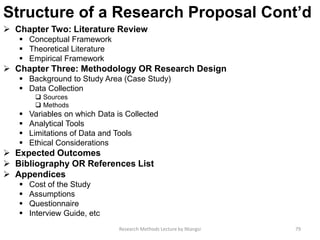
Structure of a Research Proposal Cont’d
 Chapter Two: Literature Review
 Conceptual Framework
 Theoretical Literature
 Empirical Framework
 Chapter Three: Methodology OR Research Design
 Background to Study Area (Case Study)
 Data Collection
 Sources
 Methods
 Variables on which Data is Collected
 Analytical Tools
 Limitations of Data and Tools
 Ethical Considerations
 Expected Outcomes
 Bibliography OR References List
 Appendices
 Cost of the Study
 Assumptions
 Questionnaire
 Interview Guide, etc
Research Methods Lecture by Ntangsi 79
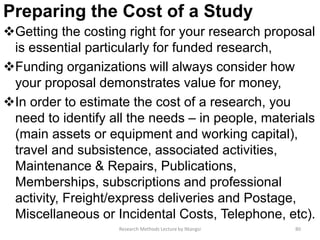
Preparing the Cost of a Study
Getting the costing right for your research proposal
is essential particularly for funded research,
Funding organizations will always consider how
your proposal demonstrates value for money,
In order to estimate the cost of a research, you
need to identify all the needs – in people, materials
(main assets or equipment and working capital),
travel and subsistence, associated activities,
Maintenance & Repairs, Publications,
Memberships, subscriptions and professional
activity, Freight/express deliveries and Postage,
Miscellaneous or Incidental Costs, Telephone, etc).
Research Methods Lecture by Ntangsi 80
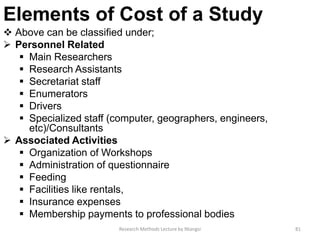
Elements of Cost of a Study
 Above can be classified under;
 Personnel Related
 Main Researchers
 Research Assistants
 Secretariat staff
 Enumerators
 Drivers
 Specialized staff (computer, geographers, engineers,
etc)/Consultants
 Associated Activities
 Organization of Workshops
 Administration of questionnaire
 Feeding
 Facilities like rentals,
 Insurance expenses
 Membership payments to professional bodies
Research Methods Lecture by Ntangsi 81
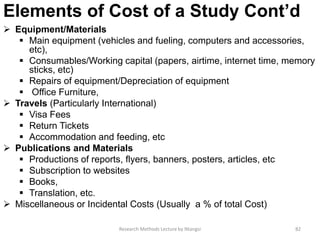
Elements of Cost of a Study Cont’d
 Equipment/Materials
 Main equipment (vehicles and fueling, computers and accessories,
etc),
 Consumables/Working capital (papers, airtime, internet time, memory
sticks, etc)
 Repairs of equipment/Depreciation of equipment
 Office Furniture,
 Travels (Particularly International)
 Visa Fees
 Return Tickets
 Accommodation and feeding, etc
 Publications and Materials
 Productions of reports, flyers, banners, posters, articles, etc
 Subscription to websites
 Books,
 Translation, etc.
 Miscellaneous or Incidental Costs (Usually a % of total Cost)
Research Methods Lecture by Ntangsi 82
Elements of Cost of a Study Cont’d
Parameters that could be considered include;
Number of days
Number of people
Rates of payment of honorarium
Allowances
Duration of travels
Accommodation rates
Suppliers/Direct Market Purchases, etc.
Research Methods Lecture by Ntangsi 83
TOPIC 6: DATA COLLECTION
Session Objectives
 To Understand what data is and the various Types of Data,
 To understand the concepts of validity and reliability of data,
 To understand various sources of data,
 To understand secondary data and where to collect it,
 To know various reasons why secondary data should be used,
 To understand the various merits and demerits of using secondary data,
 To understand primary data and where to collect it,
 To know the various reasons why primary data should be used,
 To know the various merits and demerits of using primary data,
 To understand sampling and various types of sampling and when to apply,
 To learn how to generate qustionnaire and how to administer them,
 To learn various types of interviews and how to undertake them,
 To understand Focus Group Discussions and Key Informant Interviews,
 To learn how to collect data through observation,
 To learn about survey research,
 To learn the merits and demerits of using various methods of primary data
collection, etc.
Research Methods Lecture by Ntangsi 84
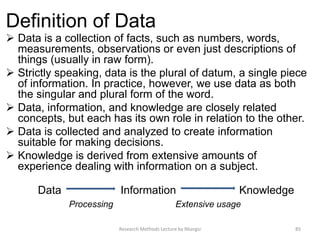
Definition of Data
 Data is a collection of facts, such as numbers, words,
measurements, observations or even just descriptions of
things (usually in raw form).
 Strictly speaking, data is the plural of datum, a single piece
of information. In practice, however, we use data as both
the singular and plural form of the word.
 Data, information, and knowledge are closely related
concepts, but each has its own role in relation to the other.
 Data is collected and analyzed to create information
suitable for making decisions.
 Knowledge is derived from extensive amounts of
experience dealing with information on a subject.
Data Information Knowledge
Processing Extensive usage
Research Methods Lecture by Ntangsi 85
Data collection – Meaning
 It is the process of gathering and/or measuring data or
information on variables of interest,
 This should be done in an established systematic
fashion that enables one to answer stated research
questions, test hypotheses, and evaluate outcomes.
 This is a component of research which is common to
all fields of study including physical and social
sciences, humanities, business, etc.
 The methods vary by discipline, but the emphasis on
ensuring accurate and honest collection remains the
same.
 Irrespective of discipline, this must follow a precise
procedure.
 This defines the success or failure of the study
Research Methods Lecture by Ntangsi 86
Usefulness of Data
The goal for all data collection is to capture quality
evidence that when analyzed can provide
convincing and credible answers to the research
questions.
Accurate data collection is therefore essential to
maintaining the integrity of research.
Consequences from improperly collected data
include:
 Inability to answer research questions
accurately.
 Inability to repeat and validate the study.
Inaccurate data can arise from
 improper definition of the required data,
 Use of wrong collection methods or wrong
application of collection methods, etc
Research Methods Lecture by Ntangsi 87
Types of Data
In business studies, the majority of researchers
need to collect some data to answer their research
questions.
Once the researcher has decided to collect data,
s/he has to decide what kind of data to collect so as
to achieve the research objectives.
The choice of the type of data to collect will depend
on which type of data is needed for a particular
research problem/objective.
Two types of Data exists
Qualitative and Quantitative Data
Research Methods Lecture by Ntangsi 88
Quantitative and Qualitative Data
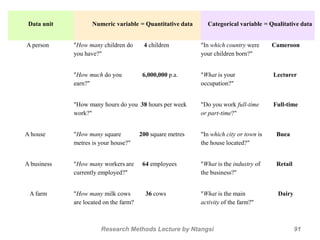
 Quantitative data are measures of values or counts and
are expressed as numbers.
 Quantitative data are data about numeric variables
(e.g. how many; how much; or how often).
Quantitative = Quantity
 Qualitative data are measures of 'types' and may be
represented by a name, symbol, or a number code.
 Qualitative data are data about categorical variables
(e.g. what type).
Qualitative = Quality
 Data collected about a numeric variable will always be
quantitative and data collected about a categorical
variable will always be qualitative. Therefore, you can
identify the type of data, prior to collection, based on
whether the variable is numeric or categorical.
Research Methods Lecture by Ntangsi 89
Why are quantitative and qualitative data important?
Quantitative and qualitative data provide different
outcomes, and are often used together to get a full
picture of a population. For example, if data are
collected on annual income (quantitative),
occupation data (qualitative) could also be
gathered to get more detail on the average annual
income for each type of occupation.
Quantitative and qualitative data can be gathered
from the same data unit depending on whether the
variable of interest is numerical or categorical.
Research Methods Lecture by Ntangsi 90
Research Methods Lecture by Ntangsi 91
Data unit Numeric variable = Quantitative data Categorical variable = Qualitative data
A person "How many children do
you have?"
4 children "In which country were
your children born?"
Cameroon
"How much do you
earn?"
6,000,000 p.a. "What is your
occupation?"
Lecturer
"How many hours do you
work?"
38 hours per week "Do you work full-time
or part-time?"
Full-time
A house "How many square
metres is your house?"
200 square metres "In which city or town is
the house located?"
Buea
A business "How many workers are
currently employed?"
64 employees "What is the industry of
the business?"
Retail
A farm "How many milk cows
are located on the farm?
36 cows "What is the main
activity of the farm?"
Dairy
The difference in emphasis on Qualitative vs Quantitative Data
Research Methods Lecture by Ntangsi 92
Discrete and Continuous Data
Quantitative Data can be discrete or continuous
Discrete data is count data and can only take
integral values e.g. the number of students in a
class (you can't have half a student), the number
of children in a family, etc.
Continuous data is measured data and can take
both integral and frictional values or any value
(within a range) e.g. A person's height: could be
any value (within the range of human heights), not
just certain fixed heights, Time in a race: you could
even measure it in fractions of a second, etc.
Scatter plots and line graphs are used to graph
quantitative data whether discrete or continuous.
Research Methods Lecture by Ntangsi 93
Nominal and Ordinal Data
Qualitative data could be nominal or ordinal in
nature.
With nominal data; values or observations can
be assigned a code in the form of a number
where the numbers are simply labels. You can
count but not order or measure nominal data.
Examples: Sex, and eye colour.
With ordinal data, values or observations can
be ranked (put in order) or have a rating scale
attached. You can count and order, but not
measure ordinal data. Example: house
numbers, swimming level, ranks in class, etc.
Research Methods Lecture by Ntangsi 94
Validity and Reliability of Research Data
 Many reasons why research may not yield good results can
be traced to problems with how data is collected. In
particular, many research mistakes occur due to problems
associated with data validity and data reliability.
 Validity refers to how well data measures what it is
purported to measure. Content validity is important in this
case. (Other types include Face Validity, construct validity,
Criterion-Related Validity, Formative Validity, etc).
 Reliability is the degree to which data produces stable and
consistent results and particularly Internal reliability (Other
types include test-retest reliability, Parallel forms reliability,
etc).
 The source of data and the method used in collecting the
data affect both validity and the reliability of the data and the
eventual usefulness of the research results.
Research Methods Lecture by Ntangsi 95
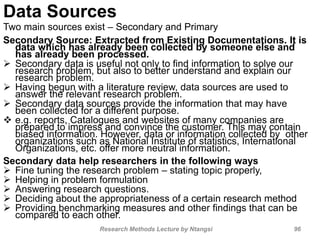
Data Sources
Two main sources exist – Secondary and Primary
Secondary Source: Extracted from Existing Documentations. It is
data which has already been collected by someone else and
has already been processed.
 Secondary data is useful not only to find information to solve our
research problem, but also to better understand and explain our
research problem.
 Having begun with a literature review, data sources are used to
answer the relevant research problem.
 Secondary data sources provide the information that may have
been collected for a different purpose.
 e.g. reports, Catalogues and websites of many companies are
prepared to impress and convince the customer. This may contain
biased information. However, data or information collected by other
organizations such as National Institute of statistics, International
Organizations, etc. offer more neutral information.
Secondary data help researchers in the following ways
 Fine tuning the research problem – stating topic properly,
 Helping in problem formulation
 Answering research questions.
 Deciding about the appropriateness of a certain research method
 Providing benchmarking measures and other findings that can be
compared to each other.
Research Methods Lecture by Ntangsi 96
Secondary Data Cont’d
Merits of secondary data
 Saving in time and money-the first and foremost
advantage of using secondary data obviously is the
enormous saving in time and money.
 Can provide high quality and reliable data.
e.g. They are collected and compiled by experts using
rigorous methods. Secondary sources provide
excellent historical data. (Data collected by specialized
institutions and by specialists)
 Facilitates cross-cultural/international research.
e.g. It is easier to compare similar data from two or
more countries or industries, etc.
 Suggests suitable methods to handle data or a
particular research problem.
 Secondary data are not only inexpensive but are
relatively easy to access.
 Begin with secondary data and only when they are
exhausted proceed with primary data.
Research Methods Lecture by Ntangsi 97
How to get started when searching secondary Data
Research Methods Lecture by Ntangsi 98
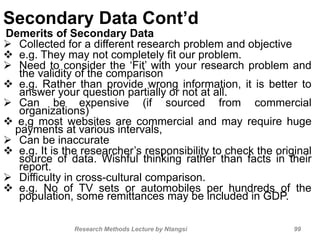
Secondary Data Cont’d
Demerits of Secondary Data
 Collected for a different research problem and objective
 e.g. They may not completely fit our problem.
 Need to consider the ‘Fit’ with your research problem and
the validity of the comparison
 e.g. Rather than provide wrong information, it is better to
answer your question partially or not at all.
 Can be expensive (if sourced from commercial
organizations)
 e,g most websites are commercial and may require huge
payments at various intervals,
 Can be inaccurate
 e.g. It is the researcher’s responsibility to check the original
source of data. Wishful thinking rather than facts in their
report.
 Difficulty in cross-cultural comparison.
 e.g. No of TV sets or automobiles per hundreds of the
population, some remittances may be included in GDP.
Research Methods Lecture by Ntangsi 99
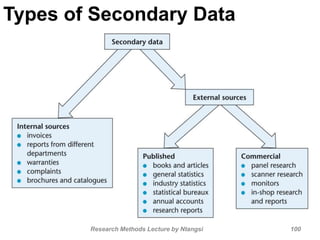
Types of Secondary Data
Research Methods Lecture by Ntangsi 100
Primary Data
This is data collected directly from source or from
the field by the researcher or initiated by the
researcher. It has not been previously published.
It is first hand. Usually collected raw.
Primary data is that which is collected afresh and
for the first time, and thus happen to be original in
character.
When secondary data is not available or is unable
to help answer our research questions, we must
collect data that are relevant to our particular
study directly from source ourselves.
We have several choices as regards the means or
ways of collecting primary data: observations,
experiments, surveys, questionnaires, focus
groups discussions, or interviews as illustrated in
the following figure.
Research Methods Lecture by Ntangsi 101
Sources of Primary Data
Research Methods Lecture by Ntangsi 102
Merits of Primary Data
 The data is collected for the particular research at
hand. This means that it is more consistent with
research problems and objectives.
 It is usually more reliable and accurate and in the form
required.
 Addresses specific research issues as the researcher
controls the search design to fit the needs.
 Great control; not only does primary data enable the
researcher to focus on specific subjects, it also enables
the researcher to have a higher control over how the
information is collected
 Proprietary Issues - Collector of primary data is the
owner of the information and need not share it with
other companies and competitors.
 It leads to better interpretation since it is based on
relevant issues as they are.
 Recent and up to date showing current trends/issues,
 Collected in the form and in the units required, etc.
Research Methods Lecture by Ntangsi 103
Demerits of Primary Data
 Time Consuming - Because of exhaustive nature of the
exercise, the time required to do research accurately is
very long.
 High Cost - Collecting data from source can be very costly.
 More number of resources are required - putting aside
cost and time, other resources like human resources and
materials are needed in larger quantity to conduct surveys
and other primary data collection.
 Dependence on the willingness and ability of respondents.
 It is difficult to get access; to find consumers, companies,
or other target groups who are willing to cooperate and
answer our questions.
 e.g. This is really hard if the case has sensitive issues or
research questions.
 The researher needs to be careful in using proper tools,
procedures and methods of analysis.
 The researher has less degree of control in data collection.
Unexpected factor can influence and interfere with efficient
data collection
Research Methods Lecture by Ntangsi 104
Which Source should be Used in a Research?
Factors to be considered;
Nature of study;
Location of the study vis-à-vis the researcher;
Level of Accuracy Required;
Availability of Resources;
Time Required for the Study;
The experience of the Researcher;
Purpose of the Study;
The Methods to be Employed in the Study; etc.
Research Methods Lecture by Ntangsi 105
Various Ways of Collecting Primary Data
Observation
This is a data collection tool which entails listening and
watching things or people’s behaviour in a way that allows
some type of learning and analytical interpretation.
 Main advantages: collecting first-hand information, subjective
bias is eliminated if is done accurately, independent of
respondents’ willingness,
 Main disadvantages: observations made by indivuduals -
human error, it is an expensive method, time consuming, can
only provide limited data, .
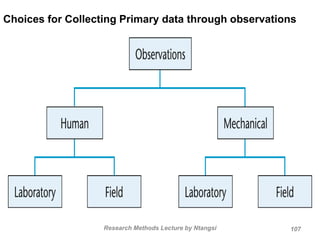
 Field observation
 Contrived setting
 Participant vs. non-participant
 Mechanical vs. human
Research Methods Lecture by Ntangsi 106
Choices for Collecting Primary data through observations
Research Methods Lecture by Ntangsi 107
Interviews
Research Methods Lecture by Ntangsi 108
Interviews demand real interaction between the
researcher(s) and respondent(s). To run an
interview effectively and efficently without any
disturbances, the researcher(s) need to know
the respondent(s), their background, values and
expectations. The interview process involves;
Preparing for interview – interview guide
Getting an appointment
Pre-interview
The interview
Managing the interview
Post interview
Research Methods Lecture by Ntangsi 109
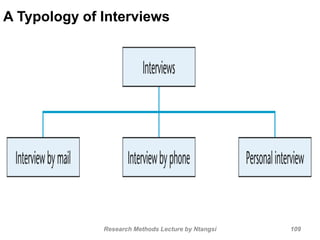
A Typology of Interviews
Personal interviews
Requires a face-to-face contact between interviewer and the interviewee
Major Advantages
 More information and in greater depth can be obtained,
 Possibility of overcoming the resistance on the path of interviewee,
 There is greater flexibility under this method,
 Observation method can as well be applied to recording verbal
answers to various questions,
 The interviewer can usually control which person(s) will answer the
questions,
 The interviewer may catch the informant off-guard and thus may
secure the most spontaneous reactions,
 The language of the interview can be adopted to the ability or
educational level of the person interviewed to avoid misinterpretation,
 The interviewer can collect supplementary information about the
respondent’s personal characteristics and environment which is often
of great value in interpreting results,
• Sample size can be controlled more effectively as there arises no
difficulty of the missing returns; non-response generally remains very
low, etc.
Research Methods Lecture by Ntangsi 110
Main Weaknesses
 It is a very expensive method, specially when large and widely
spread geographical sample is taken,
 There remains the possibility of the bias of interviewer as well as that
of the respondent; there also remains the headache of supervision
and control of interviewers,
 Certain types of respondents such as important officials or executives
or people in high income groups may not be easily approachable,
 More-time-consuming, specially when the sample is large and re-
calls upon the respondents are necessary,
 The presence of the interviewer on the spot may over-stimulate the
respondent, sometimes even to the extent that s/he may give
imaginary information,
 The organization required for selecting, training and supervising the
field-staff is more complex with formidable problems,
 Interviewing at times may also introduce systematic errors,
 Effective interview presupposes proper rapport with respondents that
would facilitate free and frank responses. This is often a very difficult
requirement, etc.
Research Methods Lecture by Ntangsi 111
Telephone interviews
The chief merits of are:
 It is more flexible in comparison to mailing method.
 It is faster than other methods i.e., a quick way of obtaining
information.
 It may be cheaper than personal interviewing method; here
the cost per response may be relatively low.
 Recall is easy; callbacks are simple and economical.
 There is a higher rate of response than what we have in
mailing method; the non-response is generally very low.
 Replies can be recorded without causing embarrassment to
respondents.
 Interviewer can explain requirements more easily.
 At times, access can be gained to respondents who
otherwise cannot be contacted for one reason or the other.
 No field staff is required.
 Representative and wider distribution of sample is possible.
Research Methods Lecture by Ntangsi 112
Demerits include
• Little time is given to respondents for considered answers;
interview period is not likely to exceed five minutes in most
cases.
• Restricted to respondents who have telephone facilities.
• Extensive geographical coverage may get restricted by cost
considerations.
• It is not suitable for intensive surveys where comprehensive
answers are required to various questions.
• Possibility of the bias of the interviewer is relatively high.
• Questions have to be short and to the point; probes are
difficult to handle,
• Difficulties ensuring that the respondents are themselves –
the identity, etc.
Research Methods Lecture by Ntangsi 113
Interview by Mail/Email
Merits include;
 Provides great savings in costs; less travelling, transcription
costs, venue renting, etc.
 Wide geographical coverage,
 Needs less equipments like tapes, tape recorders, batteries
and transcribing machines, etc
 Flexibility in terms of when to respond,
 Averagely fast when emails are involved, etc
Demerits include;
 High non response since respondent is usually not obliged,
 Non flexible in terms of the questions,
 Difficulties ensuring that the respondents are themselves –
the identity,
 Accessibility – whether the mails or emails will be received,
 Possibility of misinterpreting questions, etc.
Research Methods Lecture by Ntangsi 114
Key Informant Interviews (KIIs)
Purpose: KIIs is to collect information from a wide range of people—including
community leaders, professionals, or residents—who have first hand knowledge
about the community. These community experts, with their particular knowledge
and understanding, can provide insights on the nature of problems and give
recommendations for solutions. This could take any form.
Advantages
 Detailed and rich data can be gathered in a relatively easy and cheap way
 Allows interviewer to establish rapport with the respondent and clarify questions
 Provides an opportunity to build or strengthen relationships with important
community informants and stakeholders
 Can raise awareness, interest, and enthusiasm around an issue
 Can contact informants to clarify issues as needed
Disadvantages
 Selecting the “right” key informants may be difficult so they represent diverse
backgrounds and viewpoints
 May be challenging to reach and schedule interviews with busy and/or hard-to-
reach respondents
 Difficult to generalize results to the larger population unless interviewing many key
informants
Research Methods Lecture by Ntangsi 115
Focused Group Discussion (FGD)
 A FGD is a good way to gather together people from similar
backgrounds or experiences to discuss a specific topic of interest.
The group of participants is guided by a moderator (or group
facilitator) who introduces topics for discussion and helps the
group to participate in a lively and natural discussion amongst
themselves.
 The strength of FGD relies on allowing the participants to agree or
disagree with each other so that it provides an insight into how a
group thinks about an issue, about the range of opinion and ideas,
and the inconsistencies and variation that exists in a particular
community in terms of beliefs and their experiences and practices.
 FGDs can be used to explore the meanings of survey findings that
cannot be explained statistically, the range of opinions/views on a
topic of interest and to collect a wide variety of local terms. In
bridging research and policy, FGD can be useful in providing an
insight into different opinions among different parties involved in
the change process, thus enabling the process to be managed
more smoothly. It is also a good method to employ prior to
designing questionnaires
Research Methods Lecture by Ntangsi 116
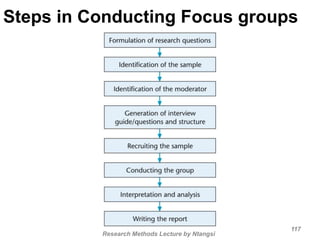
Steps in Conducting Focus groups
Research Methods Lecture by Ntangsi
117
Merits and Demerits of FGDs
Merits
 Provides plurality of ideas - more ideas are generated,
 Quick and relatively easy to go about it,
 The group dynamic can provide useful information that individual
data collection may not provide,
 Useful in gaining insight into a topic that may be more difficult to
obtain through other data collection methods,
Demerits
 Susceptible to facilitator bias,
 The discussion can be dominated or sidetracked by a few
individuals,
 Data analysis may become time consuming and needs to be well
planned in advance,
 Does not provide valid information at the individual level,
 The information is not representative of other groups,
 FGs are a very artificial environment which can influence the
responses that are generated,
 May be very costly, etc.
Research Methods Lecture by Ntangsi 118
Collection of Data through Questionnaires
Nature of questionnaire
 Could be structured or non structured
 Open ended or closed
 Instructions very useful
Guidelines for Constructing a Questionnaire
 Simple and concise language
 Realistic demand
 Understanding of the questions
 One dimensional question
 No escape route
 Specific questions not general
 No suggestive questions
 Polite language
 Straightforward questions
 Questions in right order
 Neat and tidy questionnaire
 Do not make assumptions about the respondents,
 Not too long,
 Pre-test, etc.
Research Methods Lecture by Ntangsi 119
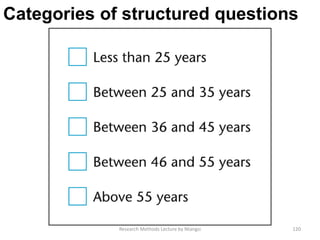
Categories of structured questions
Research Methods Lecture by Ntangsi 120
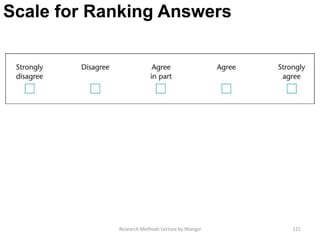
Scale for Ranking Answers
Research Methods Lecture by Ntangsi 121
Questionnaire Administration
As with Interviews, questionnaire can be
administered through face to face, by
telephone, by mail/email or with enumerators
filling in the questions
Face to face or personal contact, by telephone,
by mail/email have the same strengths and
weaknesses like with interviews
Administering questionnaires through
enumerators (Schedules) is useful where the
population is largely illiterate. This increases
response rate and uniformity in responses.
Method very costly and time consuming.
Research Methods Lecture by Ntangsi 122
Merits and Demerits of Questionnaire
Merits
 Practical implying the most understood by both
researchers and respondents,
 Large amounts of data can be collected from a large
number of people – wide coverage,
 High possibility of greater validity in the data,
 Uniformity in data collected since same questions are
asked,
 Puts less pressure on the respondents,
 Anonymity can be assured and a high chance of
getting correct responses,
 One of the most flexible tool for data collection
 Useful preliminary tool for more elaborate research,
Research Methods Lecture by Ntangsi 123
Merits and Demerits of Questionnaire Cont‘d
Demerits
 Limited Response particularly among very busy people or
illiterates,
 May lack personal Contacts depending on the type used,
 May lead to poor response rate since respondents are not
obliged,
 Possibilities of Incomplete entries,
 Possibilities of manipulated entries,
 Not suitable for delicate, sensitive, intricate and confidential
issues
 May be very costly particularly when a survey is involved,
 May require specialist skills to establish and to extract
useful information from filled questionnaire,
 May be time consuming, etc.
Research Methods Lecture by Ntangsi 124
Sampling
 All items in any field of inquiry constitute a ‘Universe’ or ‘Population.’
A complete enumeration of all items in the ‘population’ is known as a
census. (Requires lots of time, money, energy and expertise).
 Sampling refers to selecting only a few items or respondents
(Sample) from the population to be representative of the total
population.
 A sample (n) < the population (N).
 A sample design/type is a plan or an instrument for obtaining a
sample from a given population. It refers to the technique or the
procedure that the researcher intends to adopt in selecting items
from the universe or population to constitute the sample.
 There are many sample designs from which a researcher can
choose. Some designs are relatively more precise and easier to
apply than others. Researchers must select or prefer sample designs
which should be reliable and appropriate for any given research.
 Obviously, researcher must select that design which, for a given
sample size and for a given cost, has a smaller sampling error
 A good sample should be that which is representative of the
population from which it is drawn.
Research Methods Lecture by Ntangsi 125
Why Do Sampling?
 In reality there is simply not enough resources: time,
energy, money, labour, expertise, equipment, access
to suitable sites to measure every single item of the
population. Only governments can undertake
census.
 In some Cases, samples may be more accurate than
census such that even in a census, sampling is done
to ascertain the census results
 To be able to undertake studies with the use of
primary data,
 To be able to do cross – checking of study results in
a relatively shorter time and few resources,
 Therefore an appropriate sampling strategy is
adopted to obtain a representative, and statistically
valid sample of the whole
Research Methods Lecture by Ntangsi 126
The Sampling Process
Research Methods Lecture by Ntangsi 127
What to Consider in Choosing a Sampling Design
Type of universe – whether finite or infinite (but
necessary to define it to be finite).
The nature of the universe in terms of
homogenous / heterogenous population.
Sampling unit - a geographical one such as state,
district, village, etc., or a construction unit such as
house, flat, etc., or it may be a social unit such as
family, club, school, etc., or it may be an individual.
Comprehensive Source list also known as
‘sampling frame’ from which sample is to be drawn.
Research Methods Lecture by Ntangsi 128
What to Consider - Cont‘d
 Size of sample i.e. the number of items to be selected
from the universe to constitute a sample.
 Larger sample sizes are more accurate
representations of the whole,
 The sample size chosen is a balance between
obtaining a statistically valid representation, and the
time, energy, money, labour, equipment and access
available
 Budgetary constraint because the size of the sample
and also the type of sampling have cost implications.
 Knowledgeability in applying the chosen sampling
type,
 Sampling error, etc.
Research Methods Lecture by Ntangsi 129
Characteristics of a Good Sampling Design
Sample design must result in a truly representative
sample.
Sample design must be such which results in a
small sampling error.
Sample design must be viable in the context of
funds available for the research study.
Sample design must be such that systematic bias
can be controlled in a better way.
Sample design should be such that the results of
the sample study can be applied, in general, for
the universe with a reasonable level of confidence.
Research Methods Lecture by Ntangsi 130
Types of Sampling Designs
1. Probability Sampling
Simple random sampling
Systematic random sampling
Stratified random sampling
Multistage sampling
Multiphase sampling
Cluster sampling
2. Non-Probability Sampling
Convenience sampling
Purposive sampling
Quota sampling, etc.
Research Methods Lecture by Ntangsi 131
Random Sampling
 Applicable when population is small, homogeneous & readily available
 All subsets of the frame are given an equal probability. Each element of the
frame thus has an equal probability of selection.
 It provides for greatest number of possible samples. This is done by
assigning a number to each unit in the sampling frame.
 A table of random number or lottery system is used to determine which units
are to be selected.
Merits
 Estimates are easy to calculate.
 Simple random sampling is always an Equal Prob. Selection (EPS) design,
and thus could give little sample error.
Disadvantages
 If sampling frame is large, this method becomes impracticable.
 Minority subgroups of interest in population may not be present in sample in
sufficient numbers for study.
 In heterogeneous situations, sample error becomes very large.
 The cost of obtainning the sample can be high if the units are widely
scattered.
Research Methods Lecture by Ntangsi
132
Systematic Sampling
 This relies on arranging the target population according to some ordering
scheme and then selecting elements at regular intervals through that ordered
list.
 Systematic sampling involves a random start and then proceeds with the
selection of every kth element from then onwards. In this case, k=(population
size/sample size).
 It is important that the starting point is not automatically the first in the list, but
is instead randomly chosen from within the first to the kth element in the list.
 A simple example would be to select every 10th name from the telephone
directory (an 'every 10th' sample, also referred to as 'sampling with a skip of
10').
 Usually used in Production Lines for quality control purposes.
Merits
 Sample easy to select
 Suitable sampling frame can be identified easily
 Sample evenly spread over entire reference population
Demerits
 Sample may be biased if hidden periodicity in population coincides with that
of selection.
 Difficult to assess precision of estimates from one survey.
Research Methods Lecture by Ntangsi 133
Stratified Sampling
 Where population embraces a number of distinct categories, the frame can be
organized into separate "strata." Each stratum is then sampled as an
independent sub-population, out of which individual elements can be randomly
selected. Converting heterogeneous groups into homogeneous sub groups.
 Every unit in a stratum has same chance of being selected.
 Using same sampling fraction for all strata ensures proportionate representation
in the sample.
 Adequate representation of minority subgroups of interest can be ensured by
stratification & varying sampling fraction between strata as required.
 Since each stratum is treated as an independent population, different sampling
approaches can be applied to different strata.
Merits
 A stratified random sampling can give higher precision with the same sample size
or alternatively the same precision with a smaller sample. A stratified random
sampling can also give separate results for each stratum.
 Converts heterogeneous groups into homogeneous sub groups.
Drawbacks
 First, sampling frame of entire population has to be prepared separately for each
stratum
 Second, when examining multiple criteria, stratifying variables may be related to
some, but not to others, further complicating the design, and potentially reducing
the utility of the strata.
 Finally, in some cases (such as designs with a large number of strata, or those
with a specified minimum sample size per group), stratified sampling can
potentially require a larger sample than would other methods
Research Methods Lecture by Ntangsi 134
Cluster Sampling
 This is an example of 'two-stage sampling' .
 First stage a sample of areas is chosen;
 Second stage a sample of respondents within those areas is
selected.
 Population divided into clusters of homogeneous units, usually
based on geographical contiguity.
 Sampling units are groups rather than individuals.
 A sample of such clusters is then selected.
 All units from the selected clusters are studied or a few could be
studied for some groups.
Advantages
 Cuts down on the cost of preparing a sampling frame.
 This can reduce travel and other administrative costs.
Disadvantages
 Sampling error is higher for a simple random sample of same size.
 If there is large variation between clusters in the variables to be
examined, the method may yield poor precision.
Research Methods Lecture by Ntangsi 135
Multistage Sampling
 Complex form of cluster sampling in which two or more levels of
units are embedded one in the other.
 First stage, random number of divisions chosen in all regions.
 Followed by random number of districts, villages.
 Then third stage units will be houses.
 All ultimate units (houses, for instance) selected at last step are
surveyed.
 This technique, is essentially the process of taking random samples
of preceding random samples.
 Not as effective as true random sampling, but probably solves more
of the problems inherent to random sampling.
 An effective strategy because it banks on multiple randomizations.
As such, extremely useful.
 Multistage sampling used frequently when a complete list of all
members of the population do not exist or is inappropriate.
 Moreover, by avoiding the use of all sample units in all selected
clusters, multistage sampling avoids the large, and perhaps
unnecessary, costs associated with traditional cluster sampling.
Research Methods Lecture by Ntangsi 136
Multi phase Sampling
Sampling is done in phases such that at each
phase, a particular objective is achieved.
Usually starts with a broader objective at initial
phase and then other specific issues are
addressed through other phases.
Survey by such procedure is less costly, less
laborious & more purposeful
May require more resources as the process
goes on. Mostly used in medical research
where there is initial screening and the sample
selected is tested for more precise diseases.
Research Methods Lecture by Ntangsi 137
Non-Probability Sampling
Quota Sampling
 The population is first segmented into mutually
exclusive sub-groups, just as in stratified sampling.
 Then judgment used to select subjects or units from
each segment based on a specified proportion.
 For example, an interviewer may be told to sample 200
females and 300 males between the age of 45 and 60.
 It is this second step which makes the technique one of
non-probability sampling.
 In quota sampling the selection of the sample is non-
random .
 For example interviewers might be tempted to interview
those who look most helpful. The problem is that these
samples may be biased because not everyone gets a
chance of selection. This random element is its greatest
weakness and quota versus probability has been a
matter of controversy for many years
Research Methods Lecture by Ntangsi 138
Convenience Sampling
 Sometimes known as grab or opportunity sampling or accidental or
haphazard sampling.
 A type of non probability sampling which involves the sample being drawn
from that part of the population which is close to hand. That is, readily
available and convenient.
 The researcher using such a sample cannot scientifically make
generalizations about the total population from this sample because it
would not be representative enough.
 For example, if the interviewer was to conduct a survey at a shopping
center early in the morning on a given day, the people that he/she could
interview would be limited to those there at that given time, which would not
represent the views of other members of society in such an area, if the
survey was to be conducted at different times of the day and several times
per week.
 This type of sampling is most useful for pilot testing.
 In social science research, snowball sampling is a similar technique, where
existing study subjects are used to recruit more subjects into the sample.
Research Methods Lecture by Ntangsi 139
Judgmental sampling or Purposive sampling
The researcher chooses the sample based on
who s/he thinks would be appropriate for the
study. This is used primarily when there is a
limited number of people that have expertise in
the area being researched. Similar to KII.
Usually gives high response rate.
Also gives a high sample error or bias.
Reduces non response rate.
Research Methods Lecture by Ntangsi 140
Panel Sampling
 Method of first selecting a group of participants through
a random sampling method and then asking that group
for the same information again several times over a
period of time.
 Therefore, each participant is given same survey or
interview at two or more time points; each period of data
collection is called a "wave".
 This sampling methodology often chosen for large scale
or nation-wide studies in order to gauge changes in the
population with regard to any number of variables from
chronic illness to job stress to weekly food expenditures.
 Panel sampling can also be used to inform researchers
about within-person health changes due to age or help
explain changes in continuous dependent variables such
as spousal interaction.
 There have been several proposed methods of
analyzing panel sample data, including growth curves.
Research Methods Lecture by Ntangsi 141
Which Sampling Method is Preferable?
 Factors to be considered: These are same as choosing a
source of data and/or method of data collection.
 Nature of study;
 Nature of Population;
 Level of Accuracy Required;
 Availability of Resources;
 Time Required for the Study;
 The experience of the Researcher;
 Purpose of the Study;
 Scale of study,
 The expertise of the person(s) involved,
 Level of Freedom involved,
 The Methods to be Employed in the Study; etc.
Research Methods Lecture by Ntangsi 142
Which Sampling Method is Preferable Cont’d?
 Examples
 Determining the proportion of undernourished five year olds in a
village.
 Investigating nutritional status of preschool children in the SWR.
 Assessing the Performance of Micro financial Institutions in Douala.
 Assessing the Factors that motivate workers in CDC.
 Examining the rate of adoption of ICTs in Higher Institutions of
learning in Cameroon.
 Assessing the Impact of Corrupt Practices on Students’ Performance
in UB.
 Assessing the Impact of CSR of SONARA on the Limbe Municipality.
 Assessing the role played by the community in the development of
the CSR of MTN Cameroon.
 Estimating the costs of domestic violence on men in Fako Division.
 Assessing the Role of Advertisement on the consumption pattern of
Guinness Products in Douala.
Research Methods Lecture by Ntangsi 143
7. DATA PROCESSING AND ANALYSIS
The data, after collection, has to be processed and
analyzed for it to be useful.
 Technically speaking, processing implies editing, coding,
classification and tabulation of collected data so that
they are amenable to analysis.
 The term analysis of data refers to the break down of
data OR the computation of certain measures along with
searching for patterns of relationship that exist among
data-groups.
 Data analysis provides results that need to be
interpreted and discussed so as to achieve the
objectives of a study.
 In the process of data analysis, relationships or
differences supporting or conflicting with original or new
hypotheses should be subjected to statistical tests to
validate various hypotheses.
Research Methods Lecture by Ntangsi 144
Data Processing Operations
1. Editing
 This is a process of examining the collected raw data
(specially in surveys) to detect errors and omissions and to
correct these when possible.
 Editing involves a careful scrutiny of the completed
questionnaires and/or schedules to eliminate inconsistent
and contradictory responses.
 Editing is done to assure that the data are accurate,
consistent with other facts gathered, uniformly entered, as
completed as possible and have been well arranged to
facilitate coding and tabulation.
 Two types of editing exist; field editing and central editing.
 Field editing consists in the review of the reporting forms by
the enumerator to be more legible and to avoid
abbreviations or short hand. This do not involve changing
nature of responses but rather tries to clean various
unorthodox styles of writing for clarity purposes.
Research Methods Lecture by Ntangsi 145
Editing Cont’d
 Central editing should take place when all forms or
schedules have been completed and returned to the
office. This type of editing implies that all forms should
get a thorough editing by a single editor in a small study
and by a team of editors in case of a large inquiry.
 Editor(s) may correct the obvious errors such as an
entry in the wrong place, entry recorded in months when
it should have been recorded in weeks, and the like.
 In case of inappropriate or missing replies, the editor can
sometimes determine the proper answer by reviewing
the other information in the questionnaire.
 At times, the respondent can be contacted for
clarification if possible.
 The main objective of central editing is to harmonise the
responses
Research Methods Lecture by Ntangsi 146
2. Coding
 This refers to the process of assigning numerals or other
symbols to answers so that responses can be put into a
limited number of categories or classes.
 Such classes should be appropriate to the research
problem under consideration and should be exhaustive
and mutually exclusive.
 Another rule to be observed in coding is that of
unidimensionality, implying single meaning.
 Coding is necessary for efficient analysis and through it
the several replies from the field may be reduced to a
small number of classes which contain the critical
information required for analysis.
 Coding decisions should usually be taken at the
designing stage of the questionnaire.
Research Methods Lecture by Ntangsi 147
3. Classification
Classification of data means the process of
arranging data in groups or classes on the
basis of common characteristics.
Most research studies result in a large volume
of raw data which must be reduced into
homogeneous groups if we are to get
meaningful relationships.
Classification necessitates Data having a
common characteristics to be placed in one
class and in this way the entire data get divided
into a number of groups or classes.
Research Methods Lecture by Ntangsi 148
Data Classification Cont’d
 Classification can take one of the following two types, depending
upon the nature of the phenomenon involved:
 Classification according to attributes - this involves describing the
data (such as literacy, gender, honesty, etc.) – Qualitative Data
 Descriptive characteristics refer to qualitative phenomenon which
cannot be measured quantitatively; only their presence or absence in
an individual item can be noticed.
 Such classification can be simple classification or manifold
classification.
 In simple classification we consider only one attribute and divide the
universe into two classes —one class consisting of items possessing
the given attribute and the other class consisting of items which do
not possess the given attribute – Dummy Variables
 In manifold classification we consider two or more attributes
simultaneously, and divide that data into a number of classes (total
number of classes of final order is given by 2n; where n = number of
attributes considered).
 Whenever data are classified according to attributes, the researcher
must see that the attributes are defined in such a manner that there is
least possibility of any doubt/ambiguity concerning the said attributes.
Research Methods Lecture by Ntangsi 149
Data Classification Cont’d
Classification according to class intervals - this
involves numerical characteristics (such as weight,
height, income, etc.) – Quantitative Data
 Various classes will depend on the volume of data
and on the intervals. The interval could be equal or
unequal. If equal, Sturges rule can be used in
determining the class interval.
i = R/(1 + 3.3 log N).
where i = size of class interval;
R = Range (i.e., difference between the
values of the largest item and smallest item among
the given items);
N = Number of items to be grouped.
Research Methods Lecture by Ntangsi 150
4. Tabulation
 The results of various classification are tables.
Tabulation is essential because of the following
reasons.
It conserves space and reduces explanatory and
descriptive statement to a minimum.
It facilitates the process of comparison.
It facilitates the summation of items and the
detection of errors and omissions.
It provides a basis for various statistical
computations to obtain results.
These results need to be interpreted and
discussed to show what have been found out in
the research process.
Research Methods Lecture by Ntangsi 151
Generally accepted principles of tabulation:
 Every table should be named and should have a clear, concise and
adequate title
 The units of measurement under each heading or sub-heading must
always be indicated
 Source or sources from where the data in the table have been
obtained must be indicated just below the table.
 Abbreviations should be avoided to the extent possible and ditto
marks should not be used in the table.
 Table should be made as logical, clear, accurate and simple as
possible. If the data happen to be very large, they should not be
crowded in a single table for that would make the table unwieldy and
inconvenient.
 Miscellaneous and exceptional items, if any, should be usually placed
in the last row of the table.
 Explanatory footnotes, if any, concerning the table should be placed
directly beneath the table, along with the reference symbols used in
the table.
Research Methods Lecture by Ntangsi 152
Common Problems in Data Processing
Two main problems could exist;
The problem concerning “Don’t know” (or DK)
responses. When these are few, no problem but
these are many, questionnaire may need to be
reviewed and process repeated.
Use or percentages. This must be done
properly
Research Methods Lecture by Ntangsi 153
8. ELEMENTS/TYPES OF ANALYSIS
This implies the computation of certain indices or
measures along with searching for patterns of
relationship that exist among the data groups.
Analysis, particularly in case of survey or
experimental data, involves estimating the values
of unknown parameters of the population and
testing of hypotheses for drawing inferences.
Analysis may, therefore, be categorized as
descriptive analysis or/and inferential analysis
Discussed by Dobdinga
Research Methods Lecture by Ntangsi 154
9. INTERPRETATION AND REPORT WRITING
After collecting and analyzing the data, the researcher
has to accomplish the task of drawing inferences
followed by report writing.
This has to be done very carefully, otherwise misleading
conclusions may be drawn and the whole purpose of
doing the research may be defeated.
It is only through proper interpretation and discussions
that the researcher can expose relations and processes
that underlie his findings.
In case of hypotheses testing studies, if hypotheses are
tested and upheld several times, the researcher may
arrive at generalizations. But in case the researcher had
no hypothesis to start with, s/he would try to explain
his/her findings on the basis of the specific objectives.
Research Methods Lecture by Ntangsi 155
Objectives of Session
 Understand the meaning of interpretation and discussion of
research findings,
 Understand why and how to go about interpretation and
discussion of results,
 Master the various techniques of interpretation and
discussion of results,
 Understand the differences between interpretation and
discussion of results,
 Master the art of writing research reports,
 How to go about reviewing a report,
 The content of a research report,
 The language to be used in a research report,
 The various ways of editing and proof reading to get a final
report,
 Various precautions to take at each stage of report writing,
 Various types of reports.
Research Methods Lecture by Ntangsi 156
Meaning of Interpretation and Discussion of Results
Interpretation
 Interpretation refers to the task of attaching meaning to the results
from data analysis.
 Interpretation also imply the establishment of some explanatory
concepts. In one sense, interpretation is concerned with
relationships within the results of the study.
Discussion
 Discussion refers to drawing inferences from the results. In fact, it
is a search for broader meaning of the research results in the
context of how useful are the results in policy issues.
 Discussion also imply the effort to establish continuity in research
through linking the results of a given study with those of another,
 Discussion thus extends beyond the results of the study to include
the results of other researches, theories and hypotheses.
Research Methods Lecture by Ntangsi 157
Meaning Cont’d
Interpretation and discussion thus constitute the
ways through which the factors that seem to
explain what has been observed by the researcher
in the course of the study can be better understood
and these also provide a theoretical conception
which can serve as a guide for further researches.
This section is often considered the most important
part of a research because this is where you:
 demonstrates your ability as a researcher to think
critically about an issue,
 develop creative solutions to problems based upon
a logical synthesis of the findings,
 formulate a deeper, more profound understanding
of the research problem under investigation.
Research Methods Lecture by Ntangsi 158
Why Interpretation and Discussion?
Interpretation and discussion are essential for the simple
reason that the usefulness and utility of research lie in proper
interpretation and discussion of the results. These are being
considered the basic component of the research process
because of the following reasons:
 It is through interpretation and discussion that the
researcher can well understand the principle that works
beneath the findings. Through this, the researcher can link
up findings of the study with those of other studies,
 Interpretation and discussion lead to the establishment of
explanatory concepts that can serve as a guide for future
studies; it opens new avenues of intellectual adventure and
stimulates the quest for more knowledge.
 Researchers can better appreciate only through
interpretation and discussion why the findings are what they
are and can make others to understand the real significance
of the research findings.
Research Methods Lecture by Ntangsi 159
Techniques of Interpretation and Discussions
The task of interpretation requires some skills and dexterity on the part
of the researcher. Interpretation is an art that one learns through
practice and experience. The technique of interpretation and
discussion often involves the following steps;
 The Researcher must give reasonable explanations of the relations
which have been found and must interpret the lines of relationship in
terms of the underlying processes.
 Extraneous information, if collected during the study, must be
considered while interpreting the final results of research study, for it
may prove to be a key factor in understanding the problem under
consideration.
 Researchers must accomplish the task of interpretation only after
considering all relevant factors affecting the problem to avoid false
generalization.
 It is advisable, before embarking upon final interpretation and
discussions, to consult someone having insight into the study and
who is frank and honest and will not hesitate to point out omissions
and errors in logical argumentation.
Research Methods Lecture by Ntangsi 160
Precautions in Interpretation and Discussions
The researcher should always remember that even if the
data is properly collected and analyzed, wrong
interpretation and discussions would lead to inaccurate
conclusions. It is, therefore, absolutely essential that the
task of interpretation and discussion be accomplished with
patience and in an impartial manner and also in correct
perspective. Researchers must pay attention to the
following points for correct interpretation and discussions;
 At the outset, the researcher must invariably satisfy
himself or herself that;
1) The results are appropriate, trustworthy and adequate
for drawing inferences;
2) The results reflect good homogeneity; and that
3) Proper analysis has been done through the proper
statistical methods.
Research Methods Lecture by Ntangsi 161
Precautions Cont‘d
 The researcher must remain cautious about the errors that
can possibly arise in the process of interpreting results.
Errors can arise due to false generalization and/or due to
wrong interpretation of statistical measures.
 S/He must always keep in mind that the task of interpretation
is very much intertwined with analysis and cannot be
distinctly separated.
 S/He must never lose sight of the fact that his or her task is
not only to make sensitive observations of relevant
occurrences, but also to identify and disengage the factors
that are initially hidden to the eye.
 The researcher must remember that “ideally in the course of
a research study, there should be constant interaction
between initial hypotheses, empirical observations and
theoretical conceptions.
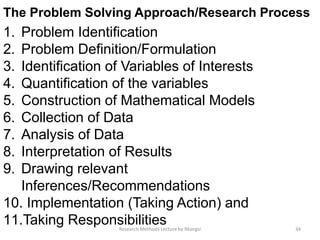
Research Methods Lecture by Ntangsi 162
Writing the Report
What is a research report
 Research reports present the results of formal
investigations by individuals or organizations or
institutions as the case may be.
 This consists of the presentation of the research and its
results in a rigorously formatted document that follows a
conventional structure.
 In presenting your research report, you pull all its
elements together into a focused, coherent document.
 Research reports contain a standard set of elements
that include
 front matter
 body
 end matter
Research Methods Lecture by Ntangsi 163
Significance of Report Writing
A Research report is considered a major component
of the research study for the research task remains
incomplete till the report has been presented and/or
written. As a matter of fact even the most
brilliant hypothesis, highly well designed and
conducted research study, and the most striking
generalizations and findings are of little value unless
they are effectively communicated to others.
The purpose of research is not well served unless
the findings are made known to others. Research
results must invariably enter the general store of
knowledge through the report.
Research Methods Lecture by Ntangsi 164
Various Steps in Writing a Research Report
Research reports are the product of slow,
painstaking, accurate inductive work. The usual
steps involved in writing reports are;
a) Logical analysis of the subject-matter;
b) Preparation of an outline;
c) Preparation of the rough draft;
d) Rewriting and polishing;
e) Preparation of the bibliography; and
f) Writing the final draft or copy.
Research Methods Lecture by Ntangsi 165
a - Logical analysis of the subject matter
The first step is concerned primarily with the development
of a subject. There are two ways in which to develop a
subject;
i. logically and
ii. chronologically.
The logical development is made on the basis of mental
connections and associations between the one thing and
another by means of analysis.
Logical treatment often consists in developing the material
from the simple possible to the most complex structures.
Chronological development is based on a connection or
sequence in time or occurrence. The directions for doing or
making something usually follow the chronological order.
Research Methods Lecture by Ntangsi 166
b - Preparation of an outline
Outlines are the framework upon which long
written works are constructed.
These are an aid to the logical organization of the
material and a reminder of the points to be
stressed in the report in a chronological way.
Usually point in point form – See the template of
a research proposal for the outline of a research
proposal.
Each research activity has its outline which must
be put in a logical and chronological manner.
Research Methods Lecture by Ntangsi 167
c - Preparation of the rough draft
This follows the logical analysis of the subject and
the preparation of the outline.
Such a step is of utmost importance for the
researcher now sits to write down what s/he has
done in the context of his/her research study.
S/He will write down the procedure adopted in
collecting the material for the study along with
various limitations faced,
The technique of analysis adopted,
The broad findings and generalizations and
The various suggestions s/he wants to offer
regarding the problem concerned and findings
arrived at.
Research Methods Lecture by Ntangsi 168
d - Rewriting and polishing of the draft
 This step happens to be the most difficult part of all formal writing.
 Usually this step requires more time than the writing of the rough
draft.
 The careful revision makes the difference between a mediocre and a
good piece of writing.
 While rewriting and polishing, one should check the report for
weaknesses in logical development or presentation.
 The researcher should also “see whether or not the material, as it is
presented, has unity and cohesion; does the report stand upright and
firm and exhibit a definite pattern,
 Or does it resembles an old wall of moldering cement and loose
brick.”
 In addition the researcher should give due attention to the fact that in
the rough draft s/he has been consistent or not.
 S/He should check the mechanics of writing — grammar, spelling
and tenses; sentence structures, etc, – see editing and proof reading
Research Methods Lecture by Ntangsi 169
e - Preparation of the Bibliography
 The bibliography, is a list of books in some way pertinent
to the research which has been done.
 It should contain all those works which the researcher
has consulted.
 The bibliography should be arranged alphabetically and
may be divided into two parts; the first part may contain
the names of books and pamphlets, and the second part
may contain the names of magazine and newspaper
articles.
 Generally, this pattern of bibliography is considered
convenient and satisfactory from the point of view of
reader, though it is not the only way of presenting
bibliography.
 The entries in bibliography should be made adopting the
appropriate order.
Research Methods Lecture by Ntangsi 170
Bibliography Cont‘d
 For books and pamphlets, the order should be;
1. Name of author, last name first. date
2. Title, could be underlined or put in italics.
3. Place, publisher, and place of publication.
4. Number of volumes or edition.
Example
Ntangsi, M. M. (2015): Quantitative Techniques, Vikas Publishing House Pvt. Ltd.,
Buea. 3rd Edition
 For magazines and newspapers; the order should be;
1. Name of the author, last name first.
2. Title of article, in quotation marks.
3. Name of periodical, underlined or indicate in italics.
4. The volume or volume and number.
5. The date of the issue.
6. The pagination.
Example
Robert V. Roosa, (2015): “Coping with Short-term International Money Flows”, The
Banker, Buea, September p. 995
Research Methods Lecture by Ntangsi 171
f - Writing the final draft and Copy
 The final draft should be written in a concise and objective style
and in simple language, avoiding vague expressions such as “it
seems”, “there may be”, and the likes.
 While writing the final draft, the researcher must avoid abstract
terminology and technical jargon.
 Illustrations and examples based on common experiences must
be incorporated in the final draft as they happen to be most
effective in communicating the research findings to others.
 A research report should not be dull, but must entice people and
maintain interest and must show originality.
 It must be remembered that every report should be an attempt to
solve some intellectual or professional problem and must
contribute to the solution of the problem and must add to the
knowledge of both the researcher and the readers
 It most relate to the results of similar studies reviewed in the
empirical literature, Research Methods Lecture by Ntangsi 172
g- Editing and Proof Reading of a Report
 Why Edit or Proof Read a Report?
 To correct errors so as to make the report better in quality and
content
 To produce a predictable and logical structure between and within
sections.
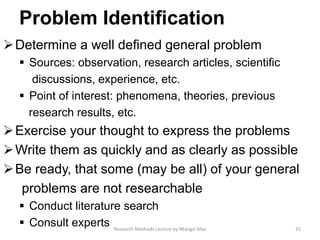
 A predictable and logical structure produces overall coherence in
the report, which allows the audience to read efficiently and to use
its information effectively.
 To correct language irregularity such as tenses, use of proper
words, use of capital letters, etc.
How to Edit or Proof Read a Report
 Reviewing the Organization of the Report: The objective is to
ensure that structure is of standard and coherent.
 Divide your document into sections and subsections by inserting
headings and subheadings,
 Read over the headings and subheadings of the report to ensure
consistency and coherency,
Research Methods Lecture by Ntangsi 173
How to Edit or Proof Read a Report Cont‘d
 Ensure that all tables and figures are named, have proper titles and sources
with dates,
 Ensure that the spacing is appropriate as well as the font sizes of words,
 Ensure that various preliminary pages are provided.
 Revising the Content: The objective is to ensure that all information is
accurate, complete, and comprehensible.
 Harmonize the language – American versus British English,
 Review the tenses to capture what is presented and the fact that research
has already taken place,
 Review the wordings to ensure that these are simple and transmit the proper
message.
 Ensure that sentences and paragraphs are properly put – not too long or too
short.
 Be specific. Replace vague phrases and words with more descriptive ones.
 Ensure that the content of preliminary pages are correct.
 Check the table of content to be sure that the page numbers are correct,
 Ensure a balance in the content of various chapters – one chapter should
not be over loaded – too long.
Research Methods Lecture by Ntangsi 174
Layout of the Research Report
 A comprehensive layout of the research report should comprise
 Preliminary pages;
 The main text; and
 The end matter or pages
Preliminary Pages
These are pages before the main report and should comprise;
 Cover page with correct information
 Dedication and/or copyright statement
 Declaration for a thesis
 Certification for a thesis
 Acknowledgements in the form of ‘Preface’ or ‘Foreword’.
 Abstract or Executive Summary
 List of Acronyms,
 A table of contents including list of tables and figures
Research Methods Lecture by Ntangsi 175
Main Text
This provides the complete outline of the
research report along with all details.
The main text of the report should have the
following main sections or chapters;
Introductory Chapter
The Literature Review
The Methodology
The Results, Interpretations and Discussions
A Summary of the Findings, Conclusions,
Recommendations and Proposals for Further
Studies
Research Methods Lecture by Ntangsi 176
The End Matter or Pages
This should consists of;
Bibliography or References
Appendices which should be made up of
questionnaires or interview guides, introductory
letters, some main data or raw data, pictures,
diagrams, etc.
Index (an alphabetical listing of names, places
and topics along with the numbers of the pages
in a book or report on which they are
mentioned or discussed). This is more useful in
a book.
Research Methods Lecture by Ntangsi 177
Types of Reports
Research reports vary greatly in length and
type. In each individual case, both the length
and the form are largely dictated by the
problems at hand.
Theses and Dissertations – 60 pages in UB
Journal Articles – varies depending on the
journal
Presentations at conferences – varies
Books – No specific length
Research Methods Lecture by Ntangsi 178

Mba604 course materials lecture (RESERCH METHODOLOGY BY NTANSI MAX)

  • 1.
    BUSINESS RESEARCH METHODOLOGY LECTURES BY NTANGSIMAX MEMFIH Research Methods Lectures by Ntangsi 1
  • 2.
    Topic 1: INTRODUCTION SessionObjectives To understand the meaning of research, To understand the meaning of research Methodology, To understand the objectives of research To understand the characteristics of research To understand the basic steps of conducting research - Problem Solving Approach .
  • 3.
    Basic Concepts orDefinitions  Definition of Research  Definition of Methodology  Definition of Research Methodology  The Aims of Research Characteristics of research  Basic Steps to Conduct Research 3Research Methods Lecture by Ntangsi Max
  • 4.
    What is Research? Researchis: “…the systematic process of collecting and analyzing data (information) in order to increase our understanding of the phenomenon on which we are concerned or interested” In short, it is the search for knowledge through objective and systematic method of finding solutions to problems. 4Research Methods Lecture by Ntangsi
  • 5.
    More Understanding ofResearch Research is a careful and systematic process of inquiry to find answers to problems of interest. Research include: use of facts, use of theories, data (facts) analysis, sampling, doing an experiment, going to library to read up on a topic To do ‘research’ is to investigate the problem systematically and thoroughly Goal of research is to solve ‘problem’ of interest 5Research Methods Lecture by Ntangsi
  • 6.
    Characteristics of Research 1.Originates with a question or a problem. 2. Requires clear articulation of a goal. 3. Follows a specific plan or procedure. 4. Often divides main problem into sub problems. 5. Guided by specific problem, question, or hypothesis. 6. Accepts certain critical assumptions. 7. Requires collection and interpretation of data. 8. Cyclical (helical) in nature - Repetitive. 6Research Methods Lecture by Ntangsi
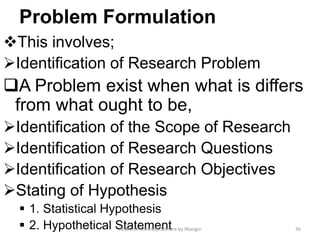
  • 7.
    The Aims ofResearch  To understand a phenomenon better so as to find out the truth about it  To describe a phenomenon as it is  To predict about “something” in the future  To explain solutions to problems  To interpret what is being investigated and to make recommendations  To Discover new things – innovation.  Though each study has its own specific purpose, this may fall under the following broad groupings:  To gain familiarity with a phenomenon or to achieve new insights into it - exploratory or formulative  To portray accurately the characteristics of a particular individual, situation or a group - descriptive  To determine the frequency with which something occurs – diagnostic, etc. 7Research Methods Lecture by Ntangsi
  • 8.
    Motivation for Research Whatmakes people to undertake research?  Desire to get additional academic or professional qualifications along with consequential benefits,  Desire to face the challenge in solving the societal problems - be of service to society,  Desire to get intellectual joy of doing some creative work,  Desire to get respectability,  Desire to create additional knowledge or new things,  Directives of organizations or government,  Employment conditions,  Curiosity about new things,  Desire to understand causal relationships,  Social thinking and awakening, etc. Research Methods Lecture by Ntangsi 8
  • 9.
    Types of Research Descriptivevs. Analytical Descriptive research includes surveys and fact- finding enquiries of different kinds - Ex post facto research.  The major purpose of descriptive research is to describe the state of affairs as it exists at present.  The main characteristic of this method is that the researcher has no control over the variables; he can only report what has happened or what is happening.  The methods used in descriptive research are survey methods  Analytical research on the other hand uses facts or information available, and analyze these to make a critical evaluation of the situation. Research Methods Lecture by Ntangsi 9
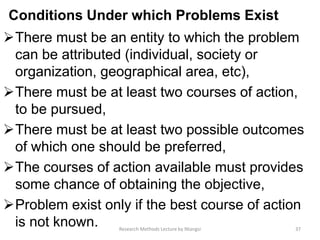
  • 10.
    Types of ResearchCont'd Applied vs. Fundamental  Applied research (Action Research) aims at finding solutions for an immediate problem facing a society or an organization – Development focused.  Fundamental research is mainly concerned with generalizations and with the formulation of a theory. “Gathering knowledge for knowledge’s sake is termed ‘pure’ or ‘basic’ research. Quantitative vs. Qualitative  Quantitative research is based on the measurement of quantity or amount. It is applicable to phenomena that can be expressed in terms of quantity.  Qualitative research, on the other hand, is concerned with qualitative phenomenon, i.e., phenomena relating to or involving quality or kind. Research Methods Lecture by Ntangsi 10
  • 11.
    Types of ResearchCont'd Conceptual vs. Empirical  Conceptual research is that related to some abstract idea(s) or theory. It is generally used by philosophers and thinkers to develop new concepts or to reinterpret existing ones.  Empirical research relies on experience or observation alone, often without due regard for system and theory. It is data-based research, coming up with conclusions which are capable of being verified by observation or experiment.  Other Types of Researches include one-time (cross sectional) research or longitudinal research, field- setting research or laboratory research, clinical or diagnostic research, Historical research, etc. The above research types gives rise to research approaches Research Methods Lecture by Ntangsi 11
  • 12.
    Scientific Methods “Methods” meansway Methodology is the discipline of scientific procedures . Methodology is therefore about; A formalized approach to conduct research A series of steps and deliverables Research Methodology in Business is “A collection of methods, procedures, techniques, tools and documentations/aids which help the researchers in their efforts to conduct a research in Business” 12Research Methods Lecture by Ntangsi
  • 13.
    Research Methodology Vs.Research Method Research Methodology:  Conceptual frameworks and assumptions used to inform research  Elaboration of research methods Research Method:  Research techniques or procedures used to gather and analyses data  A Research method is therefore a subset of research methodology 13Research Methods Lecture by Ntangsi
  • 14.
    Research Methodology Elaborated A research methodology will consist of phases, sub‐ phases, which will guide the researchers in their choice of the methods, techniques, procedures, tools, etc., that might be appropriate at each stage of the research and also help them plan, manage, control and evaluate the progress of research.  A research methodology represents a way to develop research systematically.  A research methodology represents a way to do scientific inquiry.  A research methodology should have a sound theoretical basis.  A research methodology should be focused (a plan)  It leads to a successful research. 14Research Methods Lecture by Ntangsi
  • 15.
    Why Methodology? It willmake you better able to understand and utilize scientific information in both your personal life and your work.  It will make you a more literate and cultured person. It provides you some insight not only into particular scientific findings but also into the general nature of science as a human activity. It helps you to successfully carry out the research in a coordinated fashion 15Research Methods Lecture by Ntangsi
  • 16.
    Nature of Researchin Business  Business Research requires experimental design as well as theoretical (basic) research  Hence, we need to have a methodology in order to conduct business research  Scientific approach: new knowledge, theory  Business Research requires system multiple Perspectives  Hence, we need to have a methodology in order to capture diversity.  Data requirements is also diversified and quantitative and qualitative data are useful  Business research deals with people and thus uncertainties that are characteristic of human beings. This requires a well defined Methodology. 16Research Methods Lecture by Ntangsi
  • 17.
    The Problem SolvingApproach 1 - PROBLEM IDENTIFICATION 2 - PROBLEM DEFINITION 3 - IDENTIFYING VARIABLES OF INTEREST 5 – CONSTRUCTION OF RELEVANT MODELS 6 – COLLECTION OF RELEVANT DATA 7 – ANALYSIS OF DATA 8 – INTERPRETATION OF RESULTS 4 - QUANTIFICATION OF THE VARIABLES 9 – DRAWING RELEVANT INFERENCES/RECOMMENDATIONS 10 – TAKING ACTION 17Research Methods Lecture by Ntangsi 11 – TAKING RESPONSIBILITIES
  • 18.
    Topic 2: ScientificInquiry Session Objectives To understand the steps in Scientific Inquiries To understand the characteristics of Scientific Methods To understand the logical thinking in Research To understand various types of Researches To understand various research approaches 18Research Methods Lecture by Ntangsi
  • 19.
    Session Agenda Meaning ofScientific Inquiry Model of Scientific Inquiry Inductive and Deductive Logical Thinking Types of Research Methods Types of Research Approaches 19Research Methods Lecture by Ntangsi
  • 20.
    What is ScientificInquiry?  Scientific inquiry is a term that encompasses a variety of techniques that scientists use to explore the natural world and propose explanations based on the evidence they find.  The objective of scientific inquiry is to find and to characterize the patterns as resulted from the exploration.  Scientific inquiry is founded on experiment and observations as opposed to purely rational or isolated logical thought.  Scientific Inquiry can enrich our understanding of science 20Research Methods Lecture by Ntangsi
  • 21.
    Why Scientific Inquiry? Itwill make us more knowledgeable about something. You will be able to explain about something more thorough. It will make us a more literate and cultured persons. It will provide us with more ideas. It will enable us to take more informed Decisions. 21Research Methods Lecture by Ntangsi
  • 22.
    Characteristics of ScientificInquiry Based on facts Objective Consideration Analytical Quantitative in Nature Deductive Logic-Hypothesis Inductive Logic-Generalization Dynamic with time 22Research Methods Lecture by Ntangsi
  • 23.
    Activities in ScientificInquiry Making observations Posing questions Finding out what is already known Planning investigations Reviewing past knowledge in light of actual evidence Using tools to gather, analyze, and interpret data Proposing explanations Communicating the results. 23Research Methods Lecture by Ntangsi
  • 24.
    Models of ScientificInquiry Classical model The classical model of scientific inquiry derives from Aristotle, who distinguished the forms of approximate and exact reasoning, set out the threefold scheme of adductive, deductive, and inductive inference and also treated the compound forms such as reasoning by analogy. Pragmatic model Charles Peirce considered scientific inquiry to be a species of the genus inquiry, which he defined as any means of fixing belief, that is, any means of arriving at a settled opinion on a matter in question. He observed that inquiry in general begins with a state of uncertainty and moves toward a state of certainty, sufficient at least to terminate the inquiry for the 5me being. 24Research Methods Lecture by Ntangsi
  • 25.
    Model of Scientificof Inquiry State General Problem Conduct Literature Search State Specific Problem Design Methodology Gather Data Analyze Data Report Results Refine Hypotheses 25Research Methods Lecture by Ntangsi
  • 26.
    Another Model….. Problem Statement OrganizeCritical Thinking Framework Organize Premises Hypothesis Formulation Testing Hypothesis Draw Conclusion 26Research Methods Lecture by Ntangsi
  • 27.
    Output of EachStep  State General Problem  Statement that stated general problems  Example: Will the universe expand forever? – Exercise: State at least three general problems on your own  Conduct Literature Search  List all related literatures to the problems stated  Underline all theories, techniques, methods, findings and so forth that others have found  Critically analyze all the weaknesses, strengths, similarities, dissimilarities among those theories, techniques, findings above.  Summarize all those literatures (make annotated bibliographies) 27Research Methods Lecture by Ntangsi
  • 28.
    Output of EachStep  State Specific Problem  Statement of general problem to specific problem – Example: What are the factors that cause the universe expanded? – Exercise: State at least two specific problems that can be derived from the above exercise Design Methodology  List all steps to be taken in order to answer those stated problems  Establish the seZng of experiment  Provide all necessary means, tools, instruments  Define the object, variables, etc 28Research Methods Lecture by Ntangsi
  • 29.
    Output of EachStep Gather Data –Organize data in tables, graphics Analyze Data – Interpret the organized, and processed data Report the Results 29Research Methods Lecture by Ntangsi
  • 30.
    Basic Skills ofScientific Inquiry Observing Classifying and sequencing Communicating Measuring Predicting Hypothesizing Inferring Defining, controlling, and manipulating variable in experimentation Designing, constructing and interpreting models Interpreting, analyzing and evaluating data 30Research Methods Lecture by Ntangsi
  • 31.
    Uses of ScientificInquiry Make connections with real world situations To encourage more active problem solving approach to learning and thinking To apply mathematical skills Review what is already known in light of experimental evidence Propose answers, explanations and predictions Use tools to gather, analyze and interpret data 31Research Methods Lecture by Ntangsi
  • 32.
    Exercises Your Thought Developa scientific model of your own – Post deliverables of each step of the model Categorized the scientific model into a research method Give examples of deductive and inductive logic or research 32Research Methods Lecture by Ntangsi
  • 33.
    TOPIC 3: PROBLEMIDENTIFICATION Session Objectives To understand the first step of conducting research - stating the problem  To understand what a research problem is, To be able to state main research problems To be able to identify specific research problems To be able to derive research questions To be able to identify variables involved in a research To be able to derive research objectives To be able to construct hypotheses 33Research Methods Lecture by Ntangsi
  • 34.
    The Problem SolvingApproach/Research Process 1. Problem Identification 2. Problem Definition/Formulation 3. Identification of Variables of Interests 4. Quantification of the variables 5. Construction of Mathematical Models 6. Collection of Data 7. Analysis of Data 8. Interpretation of Results 9. Drawing relevant Inferences/Recommendations 10. Implementation (Taking Action) and 11.Taking Responsibilities 34Research Methods Lecture by Ntangsi
  • 35.
    Problem Identification Determine awell defined general problem  Sources: observation, research articles, scientific discussions, experience, etc.  Point of interest: phenomena, theories, previous research results, etc. Exercise your thought to express the problems Write them as quickly and as clearly as possible Be ready, that some (may be all) of your general problems are not researchable  Conduct literature search  Consult experts 35Research Methods Lecture by Ntangsi Max
  • 36.
    Problem Formulation This involves; Identificationof Research Problem A Problem exist when what is differs from what ought to be, Identification of the Scope of Research Identification of Research Questions Identification of Research Objectives Stating of Hypothesis  1. Statistical Hypothesis  2. Hypothetical Statement 36Research Methods Lecture by Ntangsi
  • 37.
    Conditions Under whichProblems Exist There must be an entity to which the problem can be attributed (individual, society or organization, geographical area, etc), There must be at least two courses of action, to be pursued, There must be at least two possible outcomes of which one should be preferred, The courses of action available must provides some chance of obtaining the objective, Problem exist only if the best course of action is not known. 37Research Methods Lecture by Ntangsi
  • 38.
    Components of aResearch Problem There must be an individual or a group which has some difficulty or the problem. There must be some objective(s) to be attained, There must be alternative means for obtaining the objective(s) There must be some doubt in the mind of a researcher with regard to the best alternative, There must be some environment(s) to which the difficulty pertains. 38Research Methods Lecture by Ntangsi
  • 39.
    Factors Affecting Complexityof Problem(s) The environment may change affecting the efficiencies of the courses of action or the values of the outcomes; The number of alternative courses of action may be very large; Externalities - Persons not involved in making the decision may be affected by it and react to it favourably or unfavourably, Available resources to use in addressing the problem(s), Knowledge level of the researcher or team, etc. 39Research Methods Lecture by Ntangsi
  • 40.
    Sources of Res.Problems in Businesses Performance Level of the company, Customer Complaints, Conversing with company stakeholders like employees, shareholders, suppliers, etc. Observation of abnormal happenings in the firm, Activities deviating from the Business/ Strategic plan, Competitors excelling at the expense of the firm, Reading of relevant reports of the firm, Personal knowledge of the firm in respect of the industry, Experiences from similar firms, etc. 40Research Methods Lecture by Ntangsi
  • 41.
    SELECTING THE PROBLEM Theresearch problem chosen for study must be carefully selected.  Avoid topics which have been overdone,  Controversial topics should also be avoided,  Too narrow or too vague problems should be avoided.  Selected topics you are familiar with,  Select topics that are feasible so that the related research material are within one’s reach;  Select important topics in the circumstances,  Consider the resources available (time, money, etc)  Select topics which are useful and will contribute to solving existing problems or adding to knowledge,  The selection of a problem must be preceded by a preliminary study 41Research Methods Lecture by Ntangsi
  • 42.
    Questions to beasked before final Selection Whether you are well equipped in terms of the background to carry out the research? – the knowledge required, your area of interests, Whether the study falls within the budget you can afford as well as the time available to you for the study? Whether the necessary cooperation can be obtained from those who must participate in research as subjects? – Can data be obtained? Is the study going to be useful to the researcher/ company in particular and to society in general? How long will the research take and how much will it cost? etc. 42Research Methods Lecture by Ntangsi
  • 43.
    NECESSITY OF DEFININGTHE PROBLEM CLEARLY “A problem clearly stated is a problem half solved” This statement signifies the need for defining a research problem properly and clearly. The problem to be investigated must be defined unambiguously. Questions like: What data are to be collected? What characteristics of data are relevant and need to be studied? What relations are to be explored? What techniques are to be used for the purpose? and similar other questions will have straight answers once the problem is well defined. 43Research Methods Lecture by Ntangsi
  • 44.
    TECHNIQUES INVOLVED INDEFINING A PROBLEM  Defining a research problem properly and clearly is a crucial part of a research study and must in no case be done hurriedly. Useful Steps involves include; statement of the problem in a general way; understanding the nature of the problem; surveying the available literature; developing the ideas through discussions; Rephrasing the research problem into a working proposition. 44Research Methods Lecture by Ntangsi
  • 45.
    Defining the ResearchProblem Technical terms and words or phrases, with special meanings used in the statement of the problem, should be clearly refined. Basic assumptions or postulates (if any) relating to the research problem should be clearly stated. A straight forward statement of the value of the investigation (i.e., the criteria for the selection of the problem) should be provided. The suitability of the time-period and the sources of data available must also be considered by the researcher in defining the problem. The scope of the investigation or the limits within which the problem is to be studied must be mentioned explicitly in defining a research problem. 45Research Methods Lecture by Ntangsi
  • 46.
    Research Problems/Questions  Researchneeds both problems and questions  Qualities of good research questions:  The Research Questions should be clear, straightforward and easily understood by others  The Research Questions states the relationship between two or more variables.  The variables mentioned in the Research Questions should be measurable – qualitatively and quantitatively.  The answers to the Research Questions are not immediately obvious.  The Research Questions indicates the method that is to be adopted, i.e. the data collection techniques  The Research Questions can be answered in the time available to you.  The Research Questions can be answered with the resources available to you. 46Research Methods Lecture by Ntangsi
  • 47.
    Determine Research Objectives Make sure you have a strong reason why such research is worth doing  Study the impact, effects, role?  Study the usage?  Study features, Etc.  Research objectives should reflect the solution of the problem/questions – If you can not state the problem/questions, then, you can not state the objectives  Build your Objectives based on facts (previous studies, existing problems, the aims of research, etc.)  Main and specific Objectives  The objectives should relate to the research questions. 47Research Methods Lecture by Ntangsi
  • 48.
    Qualities of goodresearch Objectives: • They should be categorical i.e each should start with to…. • They should be linked to the research problem/questions – derived from research questions  The Research objectives should be clear, straightforward and easily understood by others  The Research objectives states the relationship between two or more variables.  The variables mentioned in the Research objectives should be measurable – qualitatively or quantitatively.  The answer to the Research objectives is not immediately obvious.  The Research objectives indicates the method that is to be adopted, i.e. the data collection techniques  The Research objectives can be answered in the time available to you.  The Research objectives can be answered with the resources available to you. 48Research Methods Lecture by Ntangsi
  • 49.
    Identification of Variablesof Interest A variable is a property that can take on many values e.g. Age is a variable. It can take on many different values, such as 18, 49, 72, and so on, Gender is a variable. It can take on two different values, either male or female, Place (in a race) is another variable. It can take on values such as 1st place, 2nd place, 3rd place, and so on. Two kinds of variables: Quantitative Variables, and Qualitative/Categorical Variables:  A quantitative variable is count and measured numerically. There are two further kinds of quantitative variables: Discrete and Continuous  Qualitative/Categorical variables are non count or measured data but allows for classification based on some precise characteristics. Research Methods Lecture by Ntangsi 49
  • 50.
    Stating of Hypothesis Declarative statements linking variable(s) to another(s)  Basically, there are two types of hypotheses: – Hypothetical statement – Statistical hypothesis  Hypothetical statement does not use statistical analysis and thus not useful in research  Statistical hypothesis uses statistical analysis.  The Hypotheses should be linked to the research objectives.  If possible, each specific objective could give rise to a hypothesis.  Once stated in a study must be tested, 50Research Methods Lecture by Ntangsi
  • 51.
    Qualities of GoodHypothesis Power of Prediction Closest to Observable things Simplicity Clarity – conceptually and practically Relate variables to others Stated in null form Testable empirically Relevant to the problem Specific to a particular problem Relevant to available techniques Useful for new discoveries Consistency and harmony, etc. 51Research Methods Lecture by Ntangsi
  • 52.
    Questions Bring an Illustrationon problem Definition. Identify some specific problems related to your organization or any other structure Build arguments why such specific problems are worth to research. State these arguments as research problems Generate the Objectives Express your experience in stating hypothesis – Hypothetical statements – Statistical hypotheses 52Research Methods Lecture by Ntangsi
  • 53.
    Topic 4: Howto Review Literature Session Objectives  To understand how to search relevant literatures.  To understand the objectives of reviewing literature  To understand the processes of reviewing literature  To understand the components of literature to be reviewed.  To understand the state‐of‐the‐art literature related to the problem statement.  To understand how to structure the literature review section.  To understand various referencing methods, etc. 53Research Methods Lecture by Ntangsi
  • 54.
    Overview of PreviousSessions The statement of general problem(s) as the basis to find related literature.  At this state, the nature of the problem(s) still shaky and blurred. Reviewing literature will enhance the statement of the problem(s).  Literatures reviewed need to have logical connection to the problem statement. Finding and reviewing related literatures are an art as well a scientific acts. 54Research Methods Lecture by Ntangsi
  • 55.
    What is aLiterature Review? It is a survey of scholarly articles, books and other sources (e.g. dissertations, journals, conference proceedings) relevant to a particular issue, area of research, or theory • Textbook, magazine, Bulletin are suggested It is providing a description, summary, and critical evaluation of each work (each research article) The purpose is to offer an overview of significant literature published on a topic (overview the state-of-the-art). 55Research Methods Lecture by Ntangsi
  • 56.
    Definition Cont’d  ALiterature review is a body of text that aims to review the critical points of current knowledge on a particular topic.  Most often associated with science‐oriented literature, such as a thesis, the literature review usually precedes a research proposal, methodology and results section.  Its ultimate goal is to bring the reader up to date with current literature on a topic and forms the basis for another goal, such as the justification for future research in the area.  A good literature review is characterized by: a logical flow of ideas; current and relevant references with consistent, appropriate referencing style; proper use of terminology; and an unbiased and comprehensive view of the previous research on the topic. 56Research Methods Lecture by Ntangsi
  • 57.
    Definition Cont’d  Accordingto Cooper (1988) "a literature review uses as its database reports of primary or original scholarship, and does not report new primary scholarship itself.  The primary reports used in the literature may be verbal (oral Literature), but in the vast majority of cases reports are written documents.  The types of scholarship may be empirical, theoretical, critical/analytic, or methodological in nature. A literature review seeks to describe, summarize, evaluate, clarify and/or integrate the content of primary reports". 57Research Methods Lecture by Ntangsi
  • 58.
    How to FindRelevant Literatures? Search with the key‐word of the research topic. – Use broader key‐word (term) if the documents retrieved are few or none. – Use narrower key‐words if the documents retrieved are too much. – Use synonyms or related terms to enhance the search Pick the most recent and related articles or books to start with. Start looking for another related articles through: – New search terms found in the related articles – List of references in the chosen article 58Research Methods Lecture by Ntangsi
  • 59.
    The Objectives ofReviewing Literature  Places each work (research article) in the context of its contribution to the understanding of the subject under review  Describes the relationship of each work to the others under consideration  Identifies new ways to interpret, and shed light on any gaps in previous research  Resolves conflicts amongst seemingly contradictory studies  Identifies areas of prior scholarship to prevent duplication of efforts  Points the way forward for further research  Places one's original work (like theses or dissertations) in the context of existing literature  Provides a base for the development of a methodology, etc 59Research Methods Lecture by Ntangsi
  • 60.
    Why do aLiterature Review?  To identify gaps in the existing works/literature  To avoid reinventing the wheel (at the very least this will save time and it can stop you from making the same mistakes as others)  To identify methods that could be relevant to your project  To carry on from where others have already reached (reviewing the literature enables you to build on the platform of existing knowledge and ideas)  To identify other people working in the same area (a researcher network is a valuable resource)  To increase your breadth of knowledge in the subject area  To be able to identify a research problem,  To see the level of work done in a particular aspect of study, 60Research Methods Lecture by Ntangsi
  • 61.
    Why Review LiteratureCont’d To fine tune your research problem, To identify similar works in your area, To provide the intellectual context for your own work, enabling you to position your research relative to other works, To identify opposing views To put your work into perspective To demonstrate that you can access previous work in an area To identify information and ideas that may be relevant to your research 61Research Methods Lecture by Ntangsi
  • 62.
    Elements of Literatureto Review  The concepts involved in the research area (topic),  An overview of the subject, issue or theory under consideration along with the objectives of the literature review,  Division of works under review into categories (e.g. those in support of a particular position, those against, and those offering alternative ideas entirely)  Explanation of how each work is similar to and how it varies from the others,  The methodologies used in addressing similar problems,  Findings arrived at by similar studies,  Conclusions as to which pieces are best considered in their arguments, are most convincing of their opinions, and make the greatest contribution to the understanding and development of their area of research, 62Research Methods Lecture by Ntangsi
  • 63.
    How to ReviewLiterature  Compare: Try to find the similarities among literatures  Explain how each work is similar to the others.  Contrast: Try to find the differences among literatures  Explain how each work differs from the others.  Criticize: put your own opinion on what is written in the literature.  Criticize the strength and weakness of the research  Synthesize: combine several literatures into an idea  Summarize: restate the article or research with your own words in a concise way 63Research Methods Lecture by Ntangsi
  • 64.
    Where to PlaceYour Literature Review? A literature review constitutes an essential chapter of a thesis or dissertation, Usually, it is placed in Chapter 2 of your thesis or dissertation, Where it is not to be considered as a chapter, it should logically be connected to research problems, research methodology, analysis and conclusions. In business reports, literature review may be placed in chapter one as part of the problematic. However; to make it very visible in a research, it should be placed in chapter two. 64Research Methods Lecture by Ntangsi
  • 65.
    Points to ConsiderWhen Reviewing  Authority - What are the writer's credentials? Are the author's arguments supported by evidence (e.g. primary, historical material, case studies, narratives, statistics, recent scientific findings)?  Objectivity - Is the author's perspective even‐handed or prejudicial? Is contrary data considered or is certain pertinent information ignored to prove the author's point?  Persuasiveness - Which of the author's theses/ideas/ findings are most/least convincing?  Value-Are the author's arguments and conclusions convincing?  Does the work ultimately contribute in any significant way to an understanding of the subject?  Historical versus contemporary issues,  Methodological issues versus results, etc. 65Research Methods Lecture by Ntangsi
  • 66.
    Points to Discussin Literature Review What is the problem and why is it important? Is the problem clearly defined? Try to state the problem as simply as you can Is the research methodology well stated? How’s the data being created and manipulated? Is the manipulated data sufficiently interpreted? What is the contribution of the study? Is the conclusion related to the problems? Is the evidence sufficient enough to support conclusion? Etc. 66Research Methods Lecture by Ntangsi
  • 67.
    The Structure ofa Literature Review Section Three Issues are to be addressed; Conceptual Issues/Framework,  Various concepts involved in the topic are defined Theoretical Issues/Framework  Various theoretical issues raised to provide an analytical framework and Empirical Issues/Framework  Findings of previous works reviewed. 67Research Methods Lecture by Ntangsi
  • 68.
    Referencing in ScientificWriting What is referencing?  It is a method used to demonstrate to your readers that you have conducted a thorough and appropriate literature review.  It serves the purpose of accurately acknowledging other people's work and ideas which you have used in writing your own work, Why do referencing?  Accurate referencing is commensurate with good academic and professional practice and enhances the presentation of your work: it shows that your writing is based on knowledge and informed by appropriate academic and professional reading. It avoids plagiarism.  It also ensures that anyone reading your work can trace the sources you have used in the development of your work, and give you credit for your research efforts and quality – guides others. Research Methods Lecture by Ntangsi 68
  • 69.
    Referencing styles There areseveral different styles of referencing: AMA (American Medical Association) APA (American Psychological Association) MLA (Modern Language Association of America) AGLC (Australian Guide to Legal Citation) CSE/CBE (Council of Science Editors/Council of Biology Editors) Oxford Style Harvard Style Chicago Style Vancouver Style, etc. Research Methods Lecture by Ntangsi 69
  • 70.
    Referencing styles Cont‘d Eachstyle has its own rules for properly citing sources. Author-date styles (e.g. APA, MLA, and Harvard) put the author's name inside the text of the document. Documentary-note styles (e.g. Chicago and Oxford) put the author's name in a footnote at the bottom of each page, or in an endnote at the end of the write up All of the most common styles list every source used in a document at the end, in a reference list or bibliography Research Methods Lecture by Ntangsi 70
  • 71.
    Referencing styles Cont‘d The styles differ in format. For example, an APA in-text citation incorporates the author's name, the year of publication, and sometimes the page number, separated by a comma: (Lazar, 2006, p. 52)  An MLA in-text citation, on the other hand, does not include the year or commas: (Lazar 52). Where to Use Which?  APA style is commonly used in Education, Business, and some Social Sciences and Humanities disciplines.  MLA style is often used in English and Media Studies.  Oxford style is often used in History, Philosophy, and Classics.  Harvard and Chicago styles are used by most individual disciplines.  The APA and Harvard styles should be used for MBA Dissertations in UB and general business studies. Research Methods Lecture by Ntangsi 71
  • 72.
    Topic 5: RESEARCHMETHODOLOGY AND PROPOSAL Objectives of Session  To understand what a research methodology is all about;  To understand the uses of a research methodology in scientific work;  To understand how to develop a research methodology;  Understand the structure and content of a research methodology  Understand what a research proposal is all about,  The usefulness of a research proposal,  Why prepare research proposals,  The language and tenses used in research proposals,  The structure of research proposals,  When to prepare research proposals,  Guidelines on costing a research. Research Methods Lecture by Ntangsi 72
  • 73.
    Research Methodology -Meaning  “Research Methodology” implies more than simply the methods you intend to use to collect and analyze data.  It is often necessary to include a consideration of the concepts and theories which underlie the methods.  The methods should be described in enough detail for the study to be replicated, or at least repeated in a similar way in another situation.  Every stage should be explained and justified with clear reasons for the choice of your particular methods and materials.  It specifies the area of study showing clearly the relevant characteristics of the case study.  It shows the sources of data and the methods that will be used in collecting various types of data Research Methods Lecture by Ntangsi 73
  • 74.
    Meaning Cont'd  Itspecifies the type of variables on which data will be collected  It shows the tools that will be used in analyzing data and how the results will be presented in the study.  It shows the limitations of proposed data and analytical tools  It indicates various professional considerations (Research ethics) that are involved in a study.  It thus shows the approach and design that will be adopted in undertaking a study.  It also provides a foundation on which the research process is built.  It shows the limitations of data and tools.  It therefore directs the course of the study. Research Methods Lecture by Ntangsi 74
  • 75.
    Research Methodology -Usefulness It helps in providing answers to the following questions;  How is the study area like-what are the characteristics of the study area?  From where will data for the study come from?  What are the variables on which data will be collected?  What methods will be used in collecting relevant data?  What statistical and/or mathematical tools will be used in analyzing data?  How will the hypotheses be tested?  What are the limitations of the data that will be collected and the tools that will be used for analysis?  What are the ethical issues that will come into play during the study? Research Methods Lecture by Ntangsi 75
  • 76.
    Research Methodology -Structure  Background to Study Area  Data Collection  Sources of data  Methods of data collection  Variables on which data is collected  Analytical tools  Types of tools - Description  Specification of the tools - Models  Limitations of data and tools  Types of data  Resources used and the terrain,  Theoretical and practical limitations of tools, etc.  Ethical Issues involved in the study  In the process of data collection  In the presentation of results or in the write up Research Methods Lecture by Ntangsi 76
  • 77.
    A Research Proposal Aresearch proposal is like an "action plan" for your proposed piece of research. It shows what you believe your research is all about and what it will cover, The proposal is expected to;  Show that you are engaging in genuine enquiry, finding out about something worthwhile in a particular context,  Establish a particular theoretical orientation,  Link your proposed work with the work of others, while proving you are acquainted with major schools of thoughts relevant to the topic,  Establish your methodological approach, and  Shows your level of understanding and preparedness for the study,  Show that the study is understood and is possible. Research Methods Lecture by Ntangsi 77
  • 78.
    Structure of aResearch Proposal  Cover Page  Preliminary Pages  Acknowledgements  Abstract  Table of Content  List of Acronyms, etc  Chapter One: Introduction  Background to Study  Problem Statement and Justification of Study (Should contain research questions as the last item)  Objectives of Study  Hypotheses  Significance of Study  Structure of the Report (Optional) Research Methods Lecture by Ntangsi 78
  • 79.
    Structure of aResearch Proposal Cont’d  Chapter Two: Literature Review  Conceptual Framework  Theoretical Literature  Empirical Framework  Chapter Three: Methodology OR Research Design  Background to Study Area (Case Study)  Data Collection  Sources  Methods  Variables on which Data is Collected  Analytical Tools  Limitations of Data and Tools  Ethical Considerations  Expected Outcomes  Bibliography OR References List  Appendices  Cost of the Study  Assumptions  Questionnaire  Interview Guide, etc Research Methods Lecture by Ntangsi 79
  • 80.
    Preparing the Costof a Study Getting the costing right for your research proposal is essential particularly for funded research, Funding organizations will always consider how your proposal demonstrates value for money, In order to estimate the cost of a research, you need to identify all the needs – in people, materials (main assets or equipment and working capital), travel and subsistence, associated activities, Maintenance & Repairs, Publications, Memberships, subscriptions and professional activity, Freight/express deliveries and Postage, Miscellaneous or Incidental Costs, Telephone, etc). Research Methods Lecture by Ntangsi 80
  • 81.
    Elements of Costof a Study  Above can be classified under;  Personnel Related  Main Researchers  Research Assistants  Secretariat staff  Enumerators  Drivers  Specialized staff (computer, geographers, engineers, etc)/Consultants  Associated Activities  Organization of Workshops  Administration of questionnaire  Feeding  Facilities like rentals,  Insurance expenses  Membership payments to professional bodies Research Methods Lecture by Ntangsi 81
  • 82.
    Elements of Costof a Study Cont’d  Equipment/Materials  Main equipment (vehicles and fueling, computers and accessories, etc),  Consumables/Working capital (papers, airtime, internet time, memory sticks, etc)  Repairs of equipment/Depreciation of equipment  Office Furniture,  Travels (Particularly International)  Visa Fees  Return Tickets  Accommodation and feeding, etc  Publications and Materials  Productions of reports, flyers, banners, posters, articles, etc  Subscription to websites  Books,  Translation, etc.  Miscellaneous or Incidental Costs (Usually a % of total Cost) Research Methods Lecture by Ntangsi 82
  • 83.
    Elements of Costof a Study Cont’d Parameters that could be considered include; Number of days Number of people Rates of payment of honorarium Allowances Duration of travels Accommodation rates Suppliers/Direct Market Purchases, etc. Research Methods Lecture by Ntangsi 83
  • 84.
    TOPIC 6: DATACOLLECTION Session Objectives  To Understand what data is and the various Types of Data,  To understand the concepts of validity and reliability of data,  To understand various sources of data,  To understand secondary data and where to collect it,  To know various reasons why secondary data should be used,  To understand the various merits and demerits of using secondary data,  To understand primary data and where to collect it,  To know the various reasons why primary data should be used,  To know the various merits and demerits of using primary data,  To understand sampling and various types of sampling and when to apply,  To learn how to generate qustionnaire and how to administer them,  To learn various types of interviews and how to undertake them,  To understand Focus Group Discussions and Key Informant Interviews,  To learn how to collect data through observation,  To learn about survey research,  To learn the merits and demerits of using various methods of primary data collection, etc. Research Methods Lecture by Ntangsi 84
  • 85.
    Definition of Data Data is a collection of facts, such as numbers, words, measurements, observations or even just descriptions of things (usually in raw form).  Strictly speaking, data is the plural of datum, a single piece of information. In practice, however, we use data as both the singular and plural form of the word.  Data, information, and knowledge are closely related concepts, but each has its own role in relation to the other.  Data is collected and analyzed to create information suitable for making decisions.  Knowledge is derived from extensive amounts of experience dealing with information on a subject. Data Information Knowledge Processing Extensive usage Research Methods Lecture by Ntangsi 85
  • 86.
    Data collection –Meaning  It is the process of gathering and/or measuring data or information on variables of interest,  This should be done in an established systematic fashion that enables one to answer stated research questions, test hypotheses, and evaluate outcomes.  This is a component of research which is common to all fields of study including physical and social sciences, humanities, business, etc.  The methods vary by discipline, but the emphasis on ensuring accurate and honest collection remains the same.  Irrespective of discipline, this must follow a precise procedure.  This defines the success or failure of the study Research Methods Lecture by Ntangsi 86
  • 87.
    Usefulness of Data Thegoal for all data collection is to capture quality evidence that when analyzed can provide convincing and credible answers to the research questions. Accurate data collection is therefore essential to maintaining the integrity of research. Consequences from improperly collected data include:  Inability to answer research questions accurately.  Inability to repeat and validate the study. Inaccurate data can arise from  improper definition of the required data,  Use of wrong collection methods or wrong application of collection methods, etc Research Methods Lecture by Ntangsi 87
  • 88.
    Types of Data Inbusiness studies, the majority of researchers need to collect some data to answer their research questions. Once the researcher has decided to collect data, s/he has to decide what kind of data to collect so as to achieve the research objectives. The choice of the type of data to collect will depend on which type of data is needed for a particular research problem/objective. Two types of Data exists Qualitative and Quantitative Data Research Methods Lecture by Ntangsi 88
  • 89.
    Quantitative and QualitativeData  Quantitative data are measures of values or counts and are expressed as numbers.  Quantitative data are data about numeric variables (e.g. how many; how much; or how often). Quantitative = Quantity  Qualitative data are measures of 'types' and may be represented by a name, symbol, or a number code.  Qualitative data are data about categorical variables (e.g. what type). Qualitative = Quality  Data collected about a numeric variable will always be quantitative and data collected about a categorical variable will always be qualitative. Therefore, you can identify the type of data, prior to collection, based on whether the variable is numeric or categorical. Research Methods Lecture by Ntangsi 89
  • 90.
    Why are quantitativeand qualitative data important? Quantitative and qualitative data provide different outcomes, and are often used together to get a full picture of a population. For example, if data are collected on annual income (quantitative), occupation data (qualitative) could also be gathered to get more detail on the average annual income for each type of occupation. Quantitative and qualitative data can be gathered from the same data unit depending on whether the variable of interest is numerical or categorical. Research Methods Lecture by Ntangsi 90
  • 91.
    Research Methods Lectureby Ntangsi 91 Data unit Numeric variable = Quantitative data Categorical variable = Qualitative data A person "How many children do you have?" 4 children "In which country were your children born?" Cameroon "How much do you earn?" 6,000,000 p.a. "What is your occupation?" Lecturer "How many hours do you work?" 38 hours per week "Do you work full-time or part-time?" Full-time A house "How many square metres is your house?" 200 square metres "In which city or town is the house located?" Buea A business "How many workers are currently employed?" 64 employees "What is the industry of the business?" Retail A farm "How many milk cows are located on the farm? 36 cows "What is the main activity of the farm?" Dairy
  • 92.
    The difference inemphasis on Qualitative vs Quantitative Data Research Methods Lecture by Ntangsi 92
  • 93.
    Discrete and ContinuousData Quantitative Data can be discrete or continuous Discrete data is count data and can only take integral values e.g. the number of students in a class (you can't have half a student), the number of children in a family, etc. Continuous data is measured data and can take both integral and frictional values or any value (within a range) e.g. A person's height: could be any value (within the range of human heights), not just certain fixed heights, Time in a race: you could even measure it in fractions of a second, etc. Scatter plots and line graphs are used to graph quantitative data whether discrete or continuous. Research Methods Lecture by Ntangsi 93
  • 94.
    Nominal and OrdinalData Qualitative data could be nominal or ordinal in nature. With nominal data; values or observations can be assigned a code in the form of a number where the numbers are simply labels. You can count but not order or measure nominal data. Examples: Sex, and eye colour. With ordinal data, values or observations can be ranked (put in order) or have a rating scale attached. You can count and order, but not measure ordinal data. Example: house numbers, swimming level, ranks in class, etc. Research Methods Lecture by Ntangsi 94
  • 95.
    Validity and Reliabilityof Research Data  Many reasons why research may not yield good results can be traced to problems with how data is collected. In particular, many research mistakes occur due to problems associated with data validity and data reliability.  Validity refers to how well data measures what it is purported to measure. Content validity is important in this case. (Other types include Face Validity, construct validity, Criterion-Related Validity, Formative Validity, etc).  Reliability is the degree to which data produces stable and consistent results and particularly Internal reliability (Other types include test-retest reliability, Parallel forms reliability, etc).  The source of data and the method used in collecting the data affect both validity and the reliability of the data and the eventual usefulness of the research results. Research Methods Lecture by Ntangsi 95
  • 96.
    Data Sources Two mainsources exist – Secondary and Primary Secondary Source: Extracted from Existing Documentations. It is data which has already been collected by someone else and has already been processed.  Secondary data is useful not only to find information to solve our research problem, but also to better understand and explain our research problem.  Having begun with a literature review, data sources are used to answer the relevant research problem.  Secondary data sources provide the information that may have been collected for a different purpose.  e.g. reports, Catalogues and websites of many companies are prepared to impress and convince the customer. This may contain biased information. However, data or information collected by other organizations such as National Institute of statistics, International Organizations, etc. offer more neutral information. Secondary data help researchers in the following ways  Fine tuning the research problem – stating topic properly,  Helping in problem formulation  Answering research questions.  Deciding about the appropriateness of a certain research method  Providing benchmarking measures and other findings that can be compared to each other. Research Methods Lecture by Ntangsi 96
  • 97.
    Secondary Data Cont’d Meritsof secondary data  Saving in time and money-the first and foremost advantage of using secondary data obviously is the enormous saving in time and money.  Can provide high quality and reliable data. e.g. They are collected and compiled by experts using rigorous methods. Secondary sources provide excellent historical data. (Data collected by specialized institutions and by specialists)  Facilitates cross-cultural/international research. e.g. It is easier to compare similar data from two or more countries or industries, etc.  Suggests suitable methods to handle data or a particular research problem.  Secondary data are not only inexpensive but are relatively easy to access.  Begin with secondary data and only when they are exhausted proceed with primary data. Research Methods Lecture by Ntangsi 97
  • 98.
    How to getstarted when searching secondary Data Research Methods Lecture by Ntangsi 98
  • 99.
    Secondary Data Cont’d Demeritsof Secondary Data  Collected for a different research problem and objective  e.g. They may not completely fit our problem.  Need to consider the ‘Fit’ with your research problem and the validity of the comparison  e.g. Rather than provide wrong information, it is better to answer your question partially or not at all.  Can be expensive (if sourced from commercial organizations)  e,g most websites are commercial and may require huge payments at various intervals,  Can be inaccurate  e.g. It is the researcher’s responsibility to check the original source of data. Wishful thinking rather than facts in their report.  Difficulty in cross-cultural comparison.  e.g. No of TV sets or automobiles per hundreds of the population, some remittances may be included in GDP. Research Methods Lecture by Ntangsi 99
  • 100.
    Types of SecondaryData Research Methods Lecture by Ntangsi 100
  • 101.
    Primary Data This isdata collected directly from source or from the field by the researcher or initiated by the researcher. It has not been previously published. It is first hand. Usually collected raw. Primary data is that which is collected afresh and for the first time, and thus happen to be original in character. When secondary data is not available or is unable to help answer our research questions, we must collect data that are relevant to our particular study directly from source ourselves. We have several choices as regards the means or ways of collecting primary data: observations, experiments, surveys, questionnaires, focus groups discussions, or interviews as illustrated in the following figure. Research Methods Lecture by Ntangsi 101
  • 102.
    Sources of PrimaryData Research Methods Lecture by Ntangsi 102
  • 103.
    Merits of PrimaryData  The data is collected for the particular research at hand. This means that it is more consistent with research problems and objectives.  It is usually more reliable and accurate and in the form required.  Addresses specific research issues as the researcher controls the search design to fit the needs.  Great control; not only does primary data enable the researcher to focus on specific subjects, it also enables the researcher to have a higher control over how the information is collected  Proprietary Issues - Collector of primary data is the owner of the information and need not share it with other companies and competitors.  It leads to better interpretation since it is based on relevant issues as they are.  Recent and up to date showing current trends/issues,  Collected in the form and in the units required, etc. Research Methods Lecture by Ntangsi 103
  • 104.
    Demerits of PrimaryData  Time Consuming - Because of exhaustive nature of the exercise, the time required to do research accurately is very long.  High Cost - Collecting data from source can be very costly.  More number of resources are required - putting aside cost and time, other resources like human resources and materials are needed in larger quantity to conduct surveys and other primary data collection.  Dependence on the willingness and ability of respondents.  It is difficult to get access; to find consumers, companies, or other target groups who are willing to cooperate and answer our questions.  e.g. This is really hard if the case has sensitive issues or research questions.  The researher needs to be careful in using proper tools, procedures and methods of analysis.  The researher has less degree of control in data collection. Unexpected factor can influence and interfere with efficient data collection Research Methods Lecture by Ntangsi 104
  • 105.
    Which Source shouldbe Used in a Research? Factors to be considered; Nature of study; Location of the study vis-à-vis the researcher; Level of Accuracy Required; Availability of Resources; Time Required for the Study; The experience of the Researcher; Purpose of the Study; The Methods to be Employed in the Study; etc. Research Methods Lecture by Ntangsi 105
  • 106.
    Various Ways ofCollecting Primary Data Observation This is a data collection tool which entails listening and watching things or people’s behaviour in a way that allows some type of learning and analytical interpretation.  Main advantages: collecting first-hand information, subjective bias is eliminated if is done accurately, independent of respondents’ willingness,  Main disadvantages: observations made by indivuduals - human error, it is an expensive method, time consuming, can only provide limited data, .  Field observation  Contrived setting  Participant vs. non-participant  Mechanical vs. human Research Methods Lecture by Ntangsi 106
  • 107.
    Choices for CollectingPrimary data through observations Research Methods Lecture by Ntangsi 107
  • 108.
    Interviews Research Methods Lectureby Ntangsi 108 Interviews demand real interaction between the researcher(s) and respondent(s). To run an interview effectively and efficently without any disturbances, the researcher(s) need to know the respondent(s), their background, values and expectations. The interview process involves; Preparing for interview – interview guide Getting an appointment Pre-interview The interview Managing the interview Post interview
  • 109.
    Research Methods Lectureby Ntangsi 109 A Typology of Interviews
  • 110.
    Personal interviews Requires aface-to-face contact between interviewer and the interviewee Major Advantages  More information and in greater depth can be obtained,  Possibility of overcoming the resistance on the path of interviewee,  There is greater flexibility under this method,  Observation method can as well be applied to recording verbal answers to various questions,  The interviewer can usually control which person(s) will answer the questions,  The interviewer may catch the informant off-guard and thus may secure the most spontaneous reactions,  The language of the interview can be adopted to the ability or educational level of the person interviewed to avoid misinterpretation,  The interviewer can collect supplementary information about the respondent’s personal characteristics and environment which is often of great value in interpreting results, • Sample size can be controlled more effectively as there arises no difficulty of the missing returns; non-response generally remains very low, etc. Research Methods Lecture by Ntangsi 110
  • 111.
    Main Weaknesses  Itis a very expensive method, specially when large and widely spread geographical sample is taken,  There remains the possibility of the bias of interviewer as well as that of the respondent; there also remains the headache of supervision and control of interviewers,  Certain types of respondents such as important officials or executives or people in high income groups may not be easily approachable,  More-time-consuming, specially when the sample is large and re- calls upon the respondents are necessary,  The presence of the interviewer on the spot may over-stimulate the respondent, sometimes even to the extent that s/he may give imaginary information,  The organization required for selecting, training and supervising the field-staff is more complex with formidable problems,  Interviewing at times may also introduce systematic errors,  Effective interview presupposes proper rapport with respondents that would facilitate free and frank responses. This is often a very difficult requirement, etc. Research Methods Lecture by Ntangsi 111
  • 112.
    Telephone interviews The chiefmerits of are:  It is more flexible in comparison to mailing method.  It is faster than other methods i.e., a quick way of obtaining information.  It may be cheaper than personal interviewing method; here the cost per response may be relatively low.  Recall is easy; callbacks are simple and economical.  There is a higher rate of response than what we have in mailing method; the non-response is generally very low.  Replies can be recorded without causing embarrassment to respondents.  Interviewer can explain requirements more easily.  At times, access can be gained to respondents who otherwise cannot be contacted for one reason or the other.  No field staff is required.  Representative and wider distribution of sample is possible. Research Methods Lecture by Ntangsi 112
  • 113.
    Demerits include • Littletime is given to respondents for considered answers; interview period is not likely to exceed five minutes in most cases. • Restricted to respondents who have telephone facilities. • Extensive geographical coverage may get restricted by cost considerations. • It is not suitable for intensive surveys where comprehensive answers are required to various questions. • Possibility of the bias of the interviewer is relatively high. • Questions have to be short and to the point; probes are difficult to handle, • Difficulties ensuring that the respondents are themselves – the identity, etc. Research Methods Lecture by Ntangsi 113
  • 114.
    Interview by Mail/Email Meritsinclude;  Provides great savings in costs; less travelling, transcription costs, venue renting, etc.  Wide geographical coverage,  Needs less equipments like tapes, tape recorders, batteries and transcribing machines, etc  Flexibility in terms of when to respond,  Averagely fast when emails are involved, etc Demerits include;  High non response since respondent is usually not obliged,  Non flexible in terms of the questions,  Difficulties ensuring that the respondents are themselves – the identity,  Accessibility – whether the mails or emails will be received,  Possibility of misinterpreting questions, etc. Research Methods Lecture by Ntangsi 114
  • 115.
    Key Informant Interviews(KIIs) Purpose: KIIs is to collect information from a wide range of people—including community leaders, professionals, or residents—who have first hand knowledge about the community. These community experts, with their particular knowledge and understanding, can provide insights on the nature of problems and give recommendations for solutions. This could take any form. Advantages  Detailed and rich data can be gathered in a relatively easy and cheap way  Allows interviewer to establish rapport with the respondent and clarify questions  Provides an opportunity to build or strengthen relationships with important community informants and stakeholders  Can raise awareness, interest, and enthusiasm around an issue  Can contact informants to clarify issues as needed Disadvantages  Selecting the “right” key informants may be difficult so they represent diverse backgrounds and viewpoints  May be challenging to reach and schedule interviews with busy and/or hard-to- reach respondents  Difficult to generalize results to the larger population unless interviewing many key informants Research Methods Lecture by Ntangsi 115
  • 116.
    Focused Group Discussion(FGD)  A FGD is a good way to gather together people from similar backgrounds or experiences to discuss a specific topic of interest. The group of participants is guided by a moderator (or group facilitator) who introduces topics for discussion and helps the group to participate in a lively and natural discussion amongst themselves.  The strength of FGD relies on allowing the participants to agree or disagree with each other so that it provides an insight into how a group thinks about an issue, about the range of opinion and ideas, and the inconsistencies and variation that exists in a particular community in terms of beliefs and their experiences and practices.  FGDs can be used to explore the meanings of survey findings that cannot be explained statistically, the range of opinions/views on a topic of interest and to collect a wide variety of local terms. In bridging research and policy, FGD can be useful in providing an insight into different opinions among different parties involved in the change process, thus enabling the process to be managed more smoothly. It is also a good method to employ prior to designing questionnaires Research Methods Lecture by Ntangsi 116
  • 117.
    Steps in ConductingFocus groups Research Methods Lecture by Ntangsi 117
  • 118.
    Merits and Demeritsof FGDs Merits  Provides plurality of ideas - more ideas are generated,  Quick and relatively easy to go about it,  The group dynamic can provide useful information that individual data collection may not provide,  Useful in gaining insight into a topic that may be more difficult to obtain through other data collection methods, Demerits  Susceptible to facilitator bias,  The discussion can be dominated or sidetracked by a few individuals,  Data analysis may become time consuming and needs to be well planned in advance,  Does not provide valid information at the individual level,  The information is not representative of other groups,  FGs are a very artificial environment which can influence the responses that are generated,  May be very costly, etc. Research Methods Lecture by Ntangsi 118
  • 119.
    Collection of Datathrough Questionnaires Nature of questionnaire  Could be structured or non structured  Open ended or closed  Instructions very useful Guidelines for Constructing a Questionnaire  Simple and concise language  Realistic demand  Understanding of the questions  One dimensional question  No escape route  Specific questions not general  No suggestive questions  Polite language  Straightforward questions  Questions in right order  Neat and tidy questionnaire  Do not make assumptions about the respondents,  Not too long,  Pre-test, etc. Research Methods Lecture by Ntangsi 119
  • 120.
    Categories of structuredquestions Research Methods Lecture by Ntangsi 120
  • 121.
    Scale for RankingAnswers Research Methods Lecture by Ntangsi 121
  • 122.
    Questionnaire Administration As withInterviews, questionnaire can be administered through face to face, by telephone, by mail/email or with enumerators filling in the questions Face to face or personal contact, by telephone, by mail/email have the same strengths and weaknesses like with interviews Administering questionnaires through enumerators (Schedules) is useful where the population is largely illiterate. This increases response rate and uniformity in responses. Method very costly and time consuming. Research Methods Lecture by Ntangsi 122
  • 123.
    Merits and Demeritsof Questionnaire Merits  Practical implying the most understood by both researchers and respondents,  Large amounts of data can be collected from a large number of people – wide coverage,  High possibility of greater validity in the data,  Uniformity in data collected since same questions are asked,  Puts less pressure on the respondents,  Anonymity can be assured and a high chance of getting correct responses,  One of the most flexible tool for data collection  Useful preliminary tool for more elaborate research, Research Methods Lecture by Ntangsi 123
  • 124.
    Merits and Demeritsof Questionnaire Cont‘d Demerits  Limited Response particularly among very busy people or illiterates,  May lack personal Contacts depending on the type used,  May lead to poor response rate since respondents are not obliged,  Possibilities of Incomplete entries,  Possibilities of manipulated entries,  Not suitable for delicate, sensitive, intricate and confidential issues  May be very costly particularly when a survey is involved,  May require specialist skills to establish and to extract useful information from filled questionnaire,  May be time consuming, etc. Research Methods Lecture by Ntangsi 124
  • 125.
    Sampling  All itemsin any field of inquiry constitute a ‘Universe’ or ‘Population.’ A complete enumeration of all items in the ‘population’ is known as a census. (Requires lots of time, money, energy and expertise).  Sampling refers to selecting only a few items or respondents (Sample) from the population to be representative of the total population.  A sample (n) < the population (N).  A sample design/type is a plan or an instrument for obtaining a sample from a given population. It refers to the technique or the procedure that the researcher intends to adopt in selecting items from the universe or population to constitute the sample.  There are many sample designs from which a researcher can choose. Some designs are relatively more precise and easier to apply than others. Researchers must select or prefer sample designs which should be reliable and appropriate for any given research.  Obviously, researcher must select that design which, for a given sample size and for a given cost, has a smaller sampling error  A good sample should be that which is representative of the population from which it is drawn. Research Methods Lecture by Ntangsi 125
  • 126.
    Why Do Sampling? In reality there is simply not enough resources: time, energy, money, labour, expertise, equipment, access to suitable sites to measure every single item of the population. Only governments can undertake census.  In some Cases, samples may be more accurate than census such that even in a census, sampling is done to ascertain the census results  To be able to undertake studies with the use of primary data,  To be able to do cross – checking of study results in a relatively shorter time and few resources,  Therefore an appropriate sampling strategy is adopted to obtain a representative, and statistically valid sample of the whole Research Methods Lecture by Ntangsi 126
  • 127.
    The Sampling Process ResearchMethods Lecture by Ntangsi 127
  • 128.
    What to Considerin Choosing a Sampling Design Type of universe – whether finite or infinite (but necessary to define it to be finite). The nature of the universe in terms of homogenous / heterogenous population. Sampling unit - a geographical one such as state, district, village, etc., or a construction unit such as house, flat, etc., or it may be a social unit such as family, club, school, etc., or it may be an individual. Comprehensive Source list also known as ‘sampling frame’ from which sample is to be drawn. Research Methods Lecture by Ntangsi 128
  • 129.
    What to Consider- Cont‘d  Size of sample i.e. the number of items to be selected from the universe to constitute a sample.  Larger sample sizes are more accurate representations of the whole,  The sample size chosen is a balance between obtaining a statistically valid representation, and the time, energy, money, labour, equipment and access available  Budgetary constraint because the size of the sample and also the type of sampling have cost implications.  Knowledgeability in applying the chosen sampling type,  Sampling error, etc. Research Methods Lecture by Ntangsi 129
  • 130.
    Characteristics of aGood Sampling Design Sample design must result in a truly representative sample. Sample design must be such which results in a small sampling error. Sample design must be viable in the context of funds available for the research study. Sample design must be such that systematic bias can be controlled in a better way. Sample design should be such that the results of the sample study can be applied, in general, for the universe with a reasonable level of confidence. Research Methods Lecture by Ntangsi 130
  • 131.
    Types of SamplingDesigns 1. Probability Sampling Simple random sampling Systematic random sampling Stratified random sampling Multistage sampling Multiphase sampling Cluster sampling 2. Non-Probability Sampling Convenience sampling Purposive sampling Quota sampling, etc. Research Methods Lecture by Ntangsi 131
  • 132.
    Random Sampling  Applicablewhen population is small, homogeneous & readily available  All subsets of the frame are given an equal probability. Each element of the frame thus has an equal probability of selection.  It provides for greatest number of possible samples. This is done by assigning a number to each unit in the sampling frame.  A table of random number or lottery system is used to determine which units are to be selected. Merits  Estimates are easy to calculate.  Simple random sampling is always an Equal Prob. Selection (EPS) design, and thus could give little sample error. Disadvantages  If sampling frame is large, this method becomes impracticable.  Minority subgroups of interest in population may not be present in sample in sufficient numbers for study.  In heterogeneous situations, sample error becomes very large.  The cost of obtainning the sample can be high if the units are widely scattered. Research Methods Lecture by Ntangsi 132
  • 133.
    Systematic Sampling  Thisrelies on arranging the target population according to some ordering scheme and then selecting elements at regular intervals through that ordered list.  Systematic sampling involves a random start and then proceeds with the selection of every kth element from then onwards. In this case, k=(population size/sample size).  It is important that the starting point is not automatically the first in the list, but is instead randomly chosen from within the first to the kth element in the list.  A simple example would be to select every 10th name from the telephone directory (an 'every 10th' sample, also referred to as 'sampling with a skip of 10').  Usually used in Production Lines for quality control purposes. Merits  Sample easy to select  Suitable sampling frame can be identified easily  Sample evenly spread over entire reference population Demerits  Sample may be biased if hidden periodicity in population coincides with that of selection.  Difficult to assess precision of estimates from one survey. Research Methods Lecture by Ntangsi 133
  • 134.
    Stratified Sampling  Wherepopulation embraces a number of distinct categories, the frame can be organized into separate "strata." Each stratum is then sampled as an independent sub-population, out of which individual elements can be randomly selected. Converting heterogeneous groups into homogeneous sub groups.  Every unit in a stratum has same chance of being selected.  Using same sampling fraction for all strata ensures proportionate representation in the sample.  Adequate representation of minority subgroups of interest can be ensured by stratification & varying sampling fraction between strata as required.  Since each stratum is treated as an independent population, different sampling approaches can be applied to different strata. Merits  A stratified random sampling can give higher precision with the same sample size or alternatively the same precision with a smaller sample. A stratified random sampling can also give separate results for each stratum.  Converts heterogeneous groups into homogeneous sub groups. Drawbacks  First, sampling frame of entire population has to be prepared separately for each stratum  Second, when examining multiple criteria, stratifying variables may be related to some, but not to others, further complicating the design, and potentially reducing the utility of the strata.  Finally, in some cases (such as designs with a large number of strata, or those with a specified minimum sample size per group), stratified sampling can potentially require a larger sample than would other methods Research Methods Lecture by Ntangsi 134
  • 135.
    Cluster Sampling  Thisis an example of 'two-stage sampling' .  First stage a sample of areas is chosen;  Second stage a sample of respondents within those areas is selected.  Population divided into clusters of homogeneous units, usually based on geographical contiguity.  Sampling units are groups rather than individuals.  A sample of such clusters is then selected.  All units from the selected clusters are studied or a few could be studied for some groups. Advantages  Cuts down on the cost of preparing a sampling frame.  This can reduce travel and other administrative costs. Disadvantages  Sampling error is higher for a simple random sample of same size.  If there is large variation between clusters in the variables to be examined, the method may yield poor precision. Research Methods Lecture by Ntangsi 135
  • 136.
    Multistage Sampling  Complexform of cluster sampling in which two or more levels of units are embedded one in the other.  First stage, random number of divisions chosen in all regions.  Followed by random number of districts, villages.  Then third stage units will be houses.  All ultimate units (houses, for instance) selected at last step are surveyed.  This technique, is essentially the process of taking random samples of preceding random samples.  Not as effective as true random sampling, but probably solves more of the problems inherent to random sampling.  An effective strategy because it banks on multiple randomizations. As such, extremely useful.  Multistage sampling used frequently when a complete list of all members of the population do not exist or is inappropriate.  Moreover, by avoiding the use of all sample units in all selected clusters, multistage sampling avoids the large, and perhaps unnecessary, costs associated with traditional cluster sampling. Research Methods Lecture by Ntangsi 136
  • 137.
    Multi phase Sampling Samplingis done in phases such that at each phase, a particular objective is achieved. Usually starts with a broader objective at initial phase and then other specific issues are addressed through other phases. Survey by such procedure is less costly, less laborious & more purposeful May require more resources as the process goes on. Mostly used in medical research where there is initial screening and the sample selected is tested for more precise diseases. Research Methods Lecture by Ntangsi 137
  • 138.
    Non-Probability Sampling Quota Sampling The population is first segmented into mutually exclusive sub-groups, just as in stratified sampling.  Then judgment used to select subjects or units from each segment based on a specified proportion.  For example, an interviewer may be told to sample 200 females and 300 males between the age of 45 and 60.  It is this second step which makes the technique one of non-probability sampling.  In quota sampling the selection of the sample is non- random .  For example interviewers might be tempted to interview those who look most helpful. The problem is that these samples may be biased because not everyone gets a chance of selection. This random element is its greatest weakness and quota versus probability has been a matter of controversy for many years Research Methods Lecture by Ntangsi 138
  • 139.
    Convenience Sampling  Sometimesknown as grab or opportunity sampling or accidental or haphazard sampling.  A type of non probability sampling which involves the sample being drawn from that part of the population which is close to hand. That is, readily available and convenient.  The researcher using such a sample cannot scientifically make generalizations about the total population from this sample because it would not be representative enough.  For example, if the interviewer was to conduct a survey at a shopping center early in the morning on a given day, the people that he/she could interview would be limited to those there at that given time, which would not represent the views of other members of society in such an area, if the survey was to be conducted at different times of the day and several times per week.  This type of sampling is most useful for pilot testing.  In social science research, snowball sampling is a similar technique, where existing study subjects are used to recruit more subjects into the sample. Research Methods Lecture by Ntangsi 139
  • 140.
    Judgmental sampling orPurposive sampling The researcher chooses the sample based on who s/he thinks would be appropriate for the study. This is used primarily when there is a limited number of people that have expertise in the area being researched. Similar to KII. Usually gives high response rate. Also gives a high sample error or bias. Reduces non response rate. Research Methods Lecture by Ntangsi 140
  • 141.
    Panel Sampling  Methodof first selecting a group of participants through a random sampling method and then asking that group for the same information again several times over a period of time.  Therefore, each participant is given same survey or interview at two or more time points; each period of data collection is called a "wave".  This sampling methodology often chosen for large scale or nation-wide studies in order to gauge changes in the population with regard to any number of variables from chronic illness to job stress to weekly food expenditures.  Panel sampling can also be used to inform researchers about within-person health changes due to age or help explain changes in continuous dependent variables such as spousal interaction.  There have been several proposed methods of analyzing panel sample data, including growth curves. Research Methods Lecture by Ntangsi 141
  • 142.
    Which Sampling Methodis Preferable?  Factors to be considered: These are same as choosing a source of data and/or method of data collection.  Nature of study;  Nature of Population;  Level of Accuracy Required;  Availability of Resources;  Time Required for the Study;  The experience of the Researcher;  Purpose of the Study;  Scale of study,  The expertise of the person(s) involved,  Level of Freedom involved,  The Methods to be Employed in the Study; etc. Research Methods Lecture by Ntangsi 142
  • 143.
    Which Sampling Methodis Preferable Cont’d?  Examples  Determining the proportion of undernourished five year olds in a village.  Investigating nutritional status of preschool children in the SWR.  Assessing the Performance of Micro financial Institutions in Douala.  Assessing the Factors that motivate workers in CDC.  Examining the rate of adoption of ICTs in Higher Institutions of learning in Cameroon.  Assessing the Impact of Corrupt Practices on Students’ Performance in UB.  Assessing the Impact of CSR of SONARA on the Limbe Municipality.  Assessing the role played by the community in the development of the CSR of MTN Cameroon.  Estimating the costs of domestic violence on men in Fako Division.  Assessing the Role of Advertisement on the consumption pattern of Guinness Products in Douala. Research Methods Lecture by Ntangsi 143
  • 144.
    7. DATA PROCESSINGAND ANALYSIS The data, after collection, has to be processed and analyzed for it to be useful.  Technically speaking, processing implies editing, coding, classification and tabulation of collected data so that they are amenable to analysis.  The term analysis of data refers to the break down of data OR the computation of certain measures along with searching for patterns of relationship that exist among data-groups.  Data analysis provides results that need to be interpreted and discussed so as to achieve the objectives of a study.  In the process of data analysis, relationships or differences supporting or conflicting with original or new hypotheses should be subjected to statistical tests to validate various hypotheses. Research Methods Lecture by Ntangsi 144
  • 145.
    Data Processing Operations 1.Editing  This is a process of examining the collected raw data (specially in surveys) to detect errors and omissions and to correct these when possible.  Editing involves a careful scrutiny of the completed questionnaires and/or schedules to eliminate inconsistent and contradictory responses.  Editing is done to assure that the data are accurate, consistent with other facts gathered, uniformly entered, as completed as possible and have been well arranged to facilitate coding and tabulation.  Two types of editing exist; field editing and central editing.  Field editing consists in the review of the reporting forms by the enumerator to be more legible and to avoid abbreviations or short hand. This do not involve changing nature of responses but rather tries to clean various unorthodox styles of writing for clarity purposes. Research Methods Lecture by Ntangsi 145
  • 146.
    Editing Cont’d  Centralediting should take place when all forms or schedules have been completed and returned to the office. This type of editing implies that all forms should get a thorough editing by a single editor in a small study and by a team of editors in case of a large inquiry.  Editor(s) may correct the obvious errors such as an entry in the wrong place, entry recorded in months when it should have been recorded in weeks, and the like.  In case of inappropriate or missing replies, the editor can sometimes determine the proper answer by reviewing the other information in the questionnaire.  At times, the respondent can be contacted for clarification if possible.  The main objective of central editing is to harmonise the responses Research Methods Lecture by Ntangsi 146
  • 147.
    2. Coding  Thisrefers to the process of assigning numerals or other symbols to answers so that responses can be put into a limited number of categories or classes.  Such classes should be appropriate to the research problem under consideration and should be exhaustive and mutually exclusive.  Another rule to be observed in coding is that of unidimensionality, implying single meaning.  Coding is necessary for efficient analysis and through it the several replies from the field may be reduced to a small number of classes which contain the critical information required for analysis.  Coding decisions should usually be taken at the designing stage of the questionnaire. Research Methods Lecture by Ntangsi 147
  • 148.
    3. Classification Classification ofdata means the process of arranging data in groups or classes on the basis of common characteristics. Most research studies result in a large volume of raw data which must be reduced into homogeneous groups if we are to get meaningful relationships. Classification necessitates Data having a common characteristics to be placed in one class and in this way the entire data get divided into a number of groups or classes. Research Methods Lecture by Ntangsi 148
  • 149.
    Data Classification Cont’d Classification can take one of the following two types, depending upon the nature of the phenomenon involved:  Classification according to attributes - this involves describing the data (such as literacy, gender, honesty, etc.) – Qualitative Data  Descriptive characteristics refer to qualitative phenomenon which cannot be measured quantitatively; only their presence or absence in an individual item can be noticed.  Such classification can be simple classification or manifold classification.  In simple classification we consider only one attribute and divide the universe into two classes —one class consisting of items possessing the given attribute and the other class consisting of items which do not possess the given attribute – Dummy Variables  In manifold classification we consider two or more attributes simultaneously, and divide that data into a number of classes (total number of classes of final order is given by 2n; where n = number of attributes considered).  Whenever data are classified according to attributes, the researcher must see that the attributes are defined in such a manner that there is least possibility of any doubt/ambiguity concerning the said attributes. Research Methods Lecture by Ntangsi 149
  • 150.
    Data Classification Cont’d Classificationaccording to class intervals - this involves numerical characteristics (such as weight, height, income, etc.) – Quantitative Data  Various classes will depend on the volume of data and on the intervals. The interval could be equal or unequal. If equal, Sturges rule can be used in determining the class interval. i = R/(1 + 3.3 log N). where i = size of class interval; R = Range (i.e., difference between the values of the largest item and smallest item among the given items); N = Number of items to be grouped. Research Methods Lecture by Ntangsi 150
  • 151.
    4. Tabulation  Theresults of various classification are tables. Tabulation is essential because of the following reasons. It conserves space and reduces explanatory and descriptive statement to a minimum. It facilitates the process of comparison. It facilitates the summation of items and the detection of errors and omissions. It provides a basis for various statistical computations to obtain results. These results need to be interpreted and discussed to show what have been found out in the research process. Research Methods Lecture by Ntangsi 151
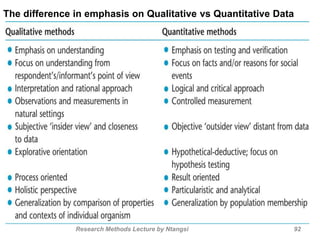
  • 152.
    Generally accepted principlesof tabulation:  Every table should be named and should have a clear, concise and adequate title  The units of measurement under each heading or sub-heading must always be indicated  Source or sources from where the data in the table have been obtained must be indicated just below the table.  Abbreviations should be avoided to the extent possible and ditto marks should not be used in the table.  Table should be made as logical, clear, accurate and simple as possible. If the data happen to be very large, they should not be crowded in a single table for that would make the table unwieldy and inconvenient.  Miscellaneous and exceptional items, if any, should be usually placed in the last row of the table.  Explanatory footnotes, if any, concerning the table should be placed directly beneath the table, along with the reference symbols used in the table. Research Methods Lecture by Ntangsi 152
  • 153.
    Common Problems inData Processing Two main problems could exist; The problem concerning “Don’t know” (or DK) responses. When these are few, no problem but these are many, questionnaire may need to be reviewed and process repeated. Use or percentages. This must be done properly Research Methods Lecture by Ntangsi 153
  • 154.
    8. ELEMENTS/TYPES OFANALYSIS This implies the computation of certain indices or measures along with searching for patterns of relationship that exist among the data groups. Analysis, particularly in case of survey or experimental data, involves estimating the values of unknown parameters of the population and testing of hypotheses for drawing inferences. Analysis may, therefore, be categorized as descriptive analysis or/and inferential analysis Discussed by Dobdinga Research Methods Lecture by Ntangsi 154
  • 155.
    9. INTERPRETATION ANDREPORT WRITING After collecting and analyzing the data, the researcher has to accomplish the task of drawing inferences followed by report writing. This has to be done very carefully, otherwise misleading conclusions may be drawn and the whole purpose of doing the research may be defeated. It is only through proper interpretation and discussions that the researcher can expose relations and processes that underlie his findings. In case of hypotheses testing studies, if hypotheses are tested and upheld several times, the researcher may arrive at generalizations. But in case the researcher had no hypothesis to start with, s/he would try to explain his/her findings on the basis of the specific objectives. Research Methods Lecture by Ntangsi 155
  • 156.
    Objectives of Session Understand the meaning of interpretation and discussion of research findings,  Understand why and how to go about interpretation and discussion of results,  Master the various techniques of interpretation and discussion of results,  Understand the differences between interpretation and discussion of results,  Master the art of writing research reports,  How to go about reviewing a report,  The content of a research report,  The language to be used in a research report,  The various ways of editing and proof reading to get a final report,  Various precautions to take at each stage of report writing,  Various types of reports. Research Methods Lecture by Ntangsi 156
  • 157.
    Meaning of Interpretationand Discussion of Results Interpretation  Interpretation refers to the task of attaching meaning to the results from data analysis.  Interpretation also imply the establishment of some explanatory concepts. In one sense, interpretation is concerned with relationships within the results of the study. Discussion  Discussion refers to drawing inferences from the results. In fact, it is a search for broader meaning of the research results in the context of how useful are the results in policy issues.  Discussion also imply the effort to establish continuity in research through linking the results of a given study with those of another,  Discussion thus extends beyond the results of the study to include the results of other researches, theories and hypotheses. Research Methods Lecture by Ntangsi 157
  • 158.
    Meaning Cont’d Interpretation anddiscussion thus constitute the ways through which the factors that seem to explain what has been observed by the researcher in the course of the study can be better understood and these also provide a theoretical conception which can serve as a guide for further researches. This section is often considered the most important part of a research because this is where you:  demonstrates your ability as a researcher to think critically about an issue,  develop creative solutions to problems based upon a logical synthesis of the findings,  formulate a deeper, more profound understanding of the research problem under investigation. Research Methods Lecture by Ntangsi 158
  • 159.
    Why Interpretation andDiscussion? Interpretation and discussion are essential for the simple reason that the usefulness and utility of research lie in proper interpretation and discussion of the results. These are being considered the basic component of the research process because of the following reasons:  It is through interpretation and discussion that the researcher can well understand the principle that works beneath the findings. Through this, the researcher can link up findings of the study with those of other studies,  Interpretation and discussion lead to the establishment of explanatory concepts that can serve as a guide for future studies; it opens new avenues of intellectual adventure and stimulates the quest for more knowledge.  Researchers can better appreciate only through interpretation and discussion why the findings are what they are and can make others to understand the real significance of the research findings. Research Methods Lecture by Ntangsi 159
  • 160.
    Techniques of Interpretationand Discussions The task of interpretation requires some skills and dexterity on the part of the researcher. Interpretation is an art that one learns through practice and experience. The technique of interpretation and discussion often involves the following steps;  The Researcher must give reasonable explanations of the relations which have been found and must interpret the lines of relationship in terms of the underlying processes.  Extraneous information, if collected during the study, must be considered while interpreting the final results of research study, for it may prove to be a key factor in understanding the problem under consideration.  Researchers must accomplish the task of interpretation only after considering all relevant factors affecting the problem to avoid false generalization.  It is advisable, before embarking upon final interpretation and discussions, to consult someone having insight into the study and who is frank and honest and will not hesitate to point out omissions and errors in logical argumentation. Research Methods Lecture by Ntangsi 160
  • 161.
    Precautions in Interpretationand Discussions The researcher should always remember that even if the data is properly collected and analyzed, wrong interpretation and discussions would lead to inaccurate conclusions. It is, therefore, absolutely essential that the task of interpretation and discussion be accomplished with patience and in an impartial manner and also in correct perspective. Researchers must pay attention to the following points for correct interpretation and discussions;  At the outset, the researcher must invariably satisfy himself or herself that; 1) The results are appropriate, trustworthy and adequate for drawing inferences; 2) The results reflect good homogeneity; and that 3) Proper analysis has been done through the proper statistical methods. Research Methods Lecture by Ntangsi 161
  • 162.
    Precautions Cont‘d  Theresearcher must remain cautious about the errors that can possibly arise in the process of interpreting results. Errors can arise due to false generalization and/or due to wrong interpretation of statistical measures.  S/He must always keep in mind that the task of interpretation is very much intertwined with analysis and cannot be distinctly separated.  S/He must never lose sight of the fact that his or her task is not only to make sensitive observations of relevant occurrences, but also to identify and disengage the factors that are initially hidden to the eye.  The researcher must remember that “ideally in the course of a research study, there should be constant interaction between initial hypotheses, empirical observations and theoretical conceptions. Research Methods Lecture by Ntangsi 162
  • 163.
    Writing the Report Whatis a research report  Research reports present the results of formal investigations by individuals or organizations or institutions as the case may be.  This consists of the presentation of the research and its results in a rigorously formatted document that follows a conventional structure.  In presenting your research report, you pull all its elements together into a focused, coherent document.  Research reports contain a standard set of elements that include  front matter  body  end matter Research Methods Lecture by Ntangsi 163
  • 164.
    Significance of ReportWriting A Research report is considered a major component of the research study for the research task remains incomplete till the report has been presented and/or written. As a matter of fact even the most brilliant hypothesis, highly well designed and conducted research study, and the most striking generalizations and findings are of little value unless they are effectively communicated to others. The purpose of research is not well served unless the findings are made known to others. Research results must invariably enter the general store of knowledge through the report. Research Methods Lecture by Ntangsi 164
  • 165.
    Various Steps inWriting a Research Report Research reports are the product of slow, painstaking, accurate inductive work. The usual steps involved in writing reports are; a) Logical analysis of the subject-matter; b) Preparation of an outline; c) Preparation of the rough draft; d) Rewriting and polishing; e) Preparation of the bibliography; and f) Writing the final draft or copy. Research Methods Lecture by Ntangsi 165
  • 166.
    a - Logicalanalysis of the subject matter The first step is concerned primarily with the development of a subject. There are two ways in which to develop a subject; i. logically and ii. chronologically. The logical development is made on the basis of mental connections and associations between the one thing and another by means of analysis. Logical treatment often consists in developing the material from the simple possible to the most complex structures. Chronological development is based on a connection or sequence in time or occurrence. The directions for doing or making something usually follow the chronological order. Research Methods Lecture by Ntangsi 166
  • 167.
    b - Preparationof an outline Outlines are the framework upon which long written works are constructed. These are an aid to the logical organization of the material and a reminder of the points to be stressed in the report in a chronological way. Usually point in point form – See the template of a research proposal for the outline of a research proposal. Each research activity has its outline which must be put in a logical and chronological manner. Research Methods Lecture by Ntangsi 167
  • 168.
    c - Preparationof the rough draft This follows the logical analysis of the subject and the preparation of the outline. Such a step is of utmost importance for the researcher now sits to write down what s/he has done in the context of his/her research study. S/He will write down the procedure adopted in collecting the material for the study along with various limitations faced, The technique of analysis adopted, The broad findings and generalizations and The various suggestions s/he wants to offer regarding the problem concerned and findings arrived at. Research Methods Lecture by Ntangsi 168
  • 169.
    d - Rewritingand polishing of the draft  This step happens to be the most difficult part of all formal writing.  Usually this step requires more time than the writing of the rough draft.  The careful revision makes the difference between a mediocre and a good piece of writing.  While rewriting and polishing, one should check the report for weaknesses in logical development or presentation.  The researcher should also “see whether or not the material, as it is presented, has unity and cohesion; does the report stand upright and firm and exhibit a definite pattern,  Or does it resembles an old wall of moldering cement and loose brick.”  In addition the researcher should give due attention to the fact that in the rough draft s/he has been consistent or not.  S/He should check the mechanics of writing — grammar, spelling and tenses; sentence structures, etc, – see editing and proof reading Research Methods Lecture by Ntangsi 169
  • 170.
    e - Preparationof the Bibliography  The bibliography, is a list of books in some way pertinent to the research which has been done.  It should contain all those works which the researcher has consulted.  The bibliography should be arranged alphabetically and may be divided into two parts; the first part may contain the names of books and pamphlets, and the second part may contain the names of magazine and newspaper articles.  Generally, this pattern of bibliography is considered convenient and satisfactory from the point of view of reader, though it is not the only way of presenting bibliography.  The entries in bibliography should be made adopting the appropriate order. Research Methods Lecture by Ntangsi 170
  • 171.
    Bibliography Cont‘d  Forbooks and pamphlets, the order should be; 1. Name of author, last name first. date 2. Title, could be underlined or put in italics. 3. Place, publisher, and place of publication. 4. Number of volumes or edition. Example Ntangsi, M. M. (2015): Quantitative Techniques, Vikas Publishing House Pvt. Ltd., Buea. 3rd Edition  For magazines and newspapers; the order should be; 1. Name of the author, last name first. 2. Title of article, in quotation marks. 3. Name of periodical, underlined or indicate in italics. 4. The volume or volume and number. 5. The date of the issue. 6. The pagination. Example Robert V. Roosa, (2015): “Coping with Short-term International Money Flows”, The Banker, Buea, September p. 995 Research Methods Lecture by Ntangsi 171
  • 172.
    f - Writingthe final draft and Copy  The final draft should be written in a concise and objective style and in simple language, avoiding vague expressions such as “it seems”, “there may be”, and the likes.  While writing the final draft, the researcher must avoid abstract terminology and technical jargon.  Illustrations and examples based on common experiences must be incorporated in the final draft as they happen to be most effective in communicating the research findings to others.  A research report should not be dull, but must entice people and maintain interest and must show originality.  It must be remembered that every report should be an attempt to solve some intellectual or professional problem and must contribute to the solution of the problem and must add to the knowledge of both the researcher and the readers  It most relate to the results of similar studies reviewed in the empirical literature, Research Methods Lecture by Ntangsi 172
  • 173.
    g- Editing andProof Reading of a Report  Why Edit or Proof Read a Report?  To correct errors so as to make the report better in quality and content  To produce a predictable and logical structure between and within sections.  A predictable and logical structure produces overall coherence in the report, which allows the audience to read efficiently and to use its information effectively.  To correct language irregularity such as tenses, use of proper words, use of capital letters, etc. How to Edit or Proof Read a Report  Reviewing the Organization of the Report: The objective is to ensure that structure is of standard and coherent.  Divide your document into sections and subsections by inserting headings and subheadings,  Read over the headings and subheadings of the report to ensure consistency and coherency, Research Methods Lecture by Ntangsi 173
  • 174.
    How to Editor Proof Read a Report Cont‘d  Ensure that all tables and figures are named, have proper titles and sources with dates,  Ensure that the spacing is appropriate as well as the font sizes of words,  Ensure that various preliminary pages are provided.  Revising the Content: The objective is to ensure that all information is accurate, complete, and comprehensible.  Harmonize the language – American versus British English,  Review the tenses to capture what is presented and the fact that research has already taken place,  Review the wordings to ensure that these are simple and transmit the proper message.  Ensure that sentences and paragraphs are properly put – not too long or too short.  Be specific. Replace vague phrases and words with more descriptive ones.  Ensure that the content of preliminary pages are correct.  Check the table of content to be sure that the page numbers are correct,  Ensure a balance in the content of various chapters – one chapter should not be over loaded – too long. Research Methods Lecture by Ntangsi 174
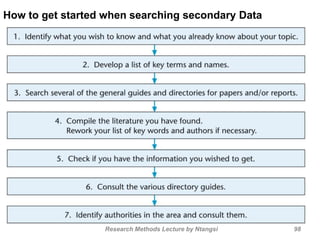
  • 175.
    Layout of theResearch Report  A comprehensive layout of the research report should comprise  Preliminary pages;  The main text; and  The end matter or pages Preliminary Pages These are pages before the main report and should comprise;  Cover page with correct information  Dedication and/or copyright statement  Declaration for a thesis  Certification for a thesis  Acknowledgements in the form of ‘Preface’ or ‘Foreword’.  Abstract or Executive Summary  List of Acronyms,  A table of contents including list of tables and figures Research Methods Lecture by Ntangsi 175
  • 176.
    Main Text This providesthe complete outline of the research report along with all details. The main text of the report should have the following main sections or chapters; Introductory Chapter The Literature Review The Methodology The Results, Interpretations and Discussions A Summary of the Findings, Conclusions, Recommendations and Proposals for Further Studies Research Methods Lecture by Ntangsi 176
  • 177.
    The End Matteror Pages This should consists of; Bibliography or References Appendices which should be made up of questionnaires or interview guides, introductory letters, some main data or raw data, pictures, diagrams, etc. Index (an alphabetical listing of names, places and topics along with the numbers of the pages in a book or report on which they are mentioned or discussed). This is more useful in a book. Research Methods Lecture by Ntangsi 177
  • 178.
    Types of Reports Researchreports vary greatly in length and type. In each individual case, both the length and the form are largely dictated by the problems at hand. Theses and Dissertations – 60 pages in UB Journal Articles – varies depending on the journal Presentations at conferences – varies Books – No specific length Research Methods Lecture by Ntangsi 178