Wesley D. Gougeon 21 October 2009
History of Cosmetics Industry Cosmetics Industry Present Day Five Forces in the Beauty Products Industry Case Discussion Questions Questions
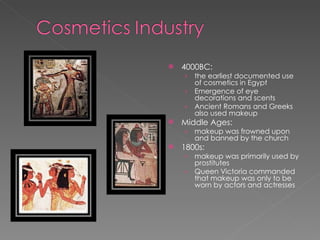
4000BC:  the earliest documented use of cosmetics in Egypt Emergence of eye decorations and scents Ancient Romans and Greeks also used makeup Middle Ages:  makeup was frowned upon and banned by the church 1800s:  makeup was primarily used by prostitutes Queen Victoria commanded that makeup was only to be worn by actors and actresses
1909: L’Oreal of France was founded 1910: Max Factor and Elizabeth Arden were founded in the United States 1911: Nivea of Germany and Shishedo of Japan were founded
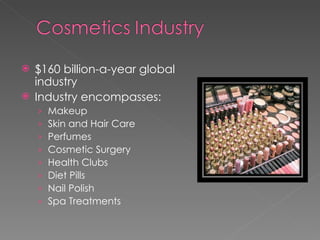
$160 billion-a-year global industry Industry encompasses: Makeup Skin and Hair Care Perfumes Cosmetic Surgery Health Clubs Diet Pills Nail Polish Spa Treatments
According to our text, the cosmetics industry has been growing at roughly 7% per year, as a result of: Wealthier, aging baby-boomers in developed economies More prosperous middle class in rising economies Women outlive men by roughly eight years Our rapidly growing youth-obsessed culture “ Men can age in an attractive way while women are expected to replicate – and Restylane – their 20s into their 60s.” Maureen Dowd, Op-ed Columnist


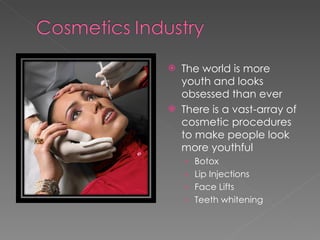
The world is more youth and looks obsessed than ever  There is a vast-array of cosmetic procedures to make people look more youthful Botox Lip Injections Face Lifts Teeth whitening
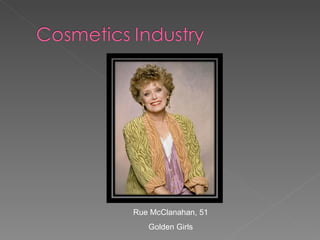
Rue McClanahan, 51 Golden Girls
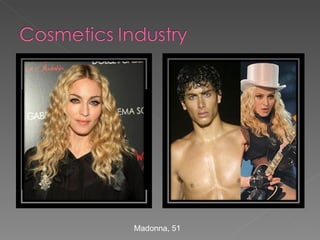
Madonna Madonna, 51
 
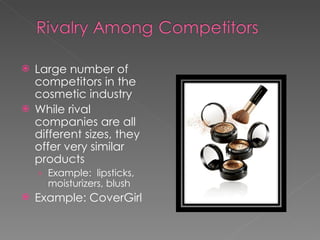
Large number of competitors in the cosmetic industry While rival companies are all different sizes, they offer very similar products Example:  lipsticks, moisturizers, blush  Example: CoverGirl
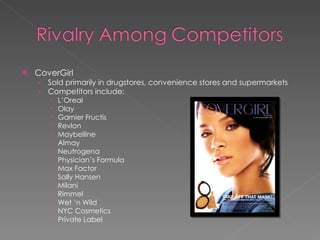
CoverGirl Sold primarily in drugstores, convenience stores and supermarkets Competitors include: L’Oreal Olay Garnier Fructis  Revlon Maybelline Almay Neutrogena Physician’s Formula Max Factor Sally Hansen  Milani Rimmel Wet ‘n Wild NYC Cosmetics Private Label
A number of new entrants have emerged: Chanel Dior Ralph Lauren Yves Saint Laurent  Johnson & Johnson, Procter & Gamble and Unilever pose major threats to the industry
Procter & Gamble and Unilever pose the most serious threats to the industry As their products such a diapers and soaps advance, they continue to add resources into their beauty divisions In 2008, L’Oreal, Procter & Gamble, Estee Lauder, Unilever and Johnson & Johnson became the top five companies in the cosmetics and toiletries markets  They had a combined market share of around 43% The market became more consolidated from 2003-2008 2008: Unilever and Johnson & Johnson gained share while L’Oreal and Estee Lauder lost share Procter & Gamble’s share held steadily
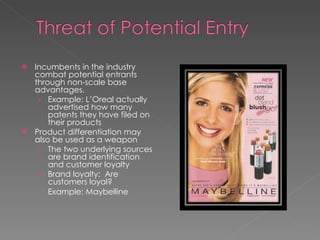
Incumbents in the industry combat potential entrants through non-scale base advantages. Example: L’Oreal actually advertised how many patents they have filed on their products Product differentiation may also be used as a weapon The two underlying sources are brand identification and customer loyalty Brand loyalty:  Are customers loyal? Example: Maybelline
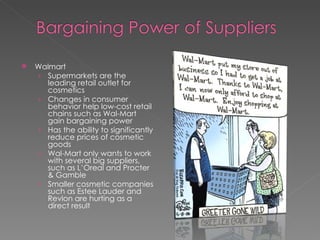
Walmart Supermarkets are the leading retail outlet for cosmetics Changes in consumer behavior help low-cost retail chains such as Wal-Mart gain bargaining power Has the ability to significantly reduce prices of cosmetic goods Wal-Mart only wants to work with several big suppliers, such as L’Oreal and Procter & Gamble Smaller cosmetic companies such as Estee Lauder and Revlon are hurting as a direct result
Competitors of Wal-Mart are fighting back, by highlighting the unique benefits and qualities of their products Shiseido stated that its Body Creator skin gel can melt 1.1 kilograms of body fat per month Estee Lauder boasts about its Advanced Night Repair that has a ‘Synchronized Recovery Complex’ In addition to supplying cosmetics to traditional department stores, companies may establish a number of free standing stores through forward integration Example: MAC Cosmetics Companies that have extensive brand portfolios are in a better position to bargain and negotiate with retailers than their smaller counterparts
Given smaller household budgets, consumers are more cautious about buying certain beauty products  Retail sales of fragrances declined 5% in 2008  Sales of premium cosmetics declined 3% in 2008 Salon hair sales also declined 6% in 2008 Not all cosmetics and toiletries were negatively effected in 2008
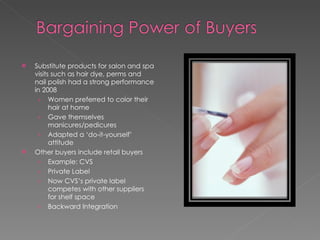
Substitute products for salon and spa visits such as hair dye, perms and nail polish had a strong performance in 2008 Women preferred to color their hair at home Gave themselves manicures/pedicures Adapted a ‘do-it-yourself’ attitude Other buyers include retail buyers Example: CVS Private Label Now CVS’s private label competes with other suppliers for shelf space Backward Integration
Private label experienced gains in 2008 Shares increased to 3% of value  In 2003, private label only had a 2% value share Private label’s share growth in 2008 was mostly on account of the weakening economy Consumers cut back by purchasing private label products,  Large gains for private label occurred in bath and shower products, oral hygiene and sun care.
 
Between 2008 and 2013: Sales of cosmetics and fragrances are forecasted to decline by 3% in constant value Men’s grooming products are expected to show great growth Anti-aging products are expected to grow 17% Battery toothbrushes and teeth bleaching kits are expected to grow 15% Body wash, shower gel, liquid soaps and hand sanitizers are expected to grow as well Private label brands are expected to grow
Why do incumbents have long staying power in the industry? Great brand recognition Ability of industry leaders to reinvent themselves Strong competition forces them to strive to work harder on developing the highest quality products at the best possible price
How do new entrants overcome entry barriers? Luxury good firms, such as Chanel and Dior have developed cosmetic products and fragrances Procter & Gamble and Unilever are pouring resources into their beauty divisions Private labels How do incumbents react to new entries? Incumbents highlight their unique products Focus on their quality and brand loyalty
Why do retail chains gain bargaining power as buyers at the expense of department stores?  Changes in consumer behaviors help chains such as Wal-Mart gain bargaining power Department stores have higher selling costs Sales in premium cosmetics are declining
Should traditional competitors focus on expanding new country markets in emerging economies, or on entering hot new growth product markets in developed economies? In order to stay on top of this competitive environment, traditional competitors should focus their efforts on both Traditional competitors should focus on expanding new country markets in emerging economies such as Brazil, China, India, Russia and South Korea They should also enter into new growth product markets such as teeth whitening and anti-aging products in developed economies, such as the United States
 
http://www.articlesbase.com/health-articles/history-of-makeup-1163802.html http://www.portal.euromonitor.com/passport/ResultsList.aspx http :// www.nytimes.com/specials/women/nyt9http://www.thehistoryof.net/the-history-of-cosmetics.html8/21angi.html http://www.nytimes.com/2009/09/20/opinion/20dowd.html

Mba Power Point Sample Wesley D. Gougeon

  • 1.
    Wesley D. Gougeon21 October 2009
  • 2.
    History of CosmeticsIndustry Cosmetics Industry Present Day Five Forces in the Beauty Products Industry Case Discussion Questions Questions
  • 3.
    4000BC: theearliest documented use of cosmetics in Egypt Emergence of eye decorations and scents Ancient Romans and Greeks also used makeup Middle Ages: makeup was frowned upon and banned by the church 1800s: makeup was primarily used by prostitutes Queen Victoria commanded that makeup was only to be worn by actors and actresses
  • 4.
    1909: L’Oreal ofFrance was founded 1910: Max Factor and Elizabeth Arden were founded in the United States 1911: Nivea of Germany and Shishedo of Japan were founded
  • 5.
    $160 billion-a-year globalindustry Industry encompasses: Makeup Skin and Hair Care Perfumes Cosmetic Surgery Health Clubs Diet Pills Nail Polish Spa Treatments
  • 6.
    According to ourtext, the cosmetics industry has been growing at roughly 7% per year, as a result of: Wealthier, aging baby-boomers in developed economies More prosperous middle class in rising economies Women outlive men by roughly eight years Our rapidly growing youth-obsessed culture “ Men can age in an attractive way while women are expected to replicate – and Restylane – their 20s into their 60s.” Maureen Dowd, Op-ed Columnist
  • 7.
  • 8.
  • 9.
  • 10.
    The world ismore youth and looks obsessed than ever There is a vast-array of cosmetic procedures to make people look more youthful Botox Lip Injections Face Lifts Teeth whitening
  • 11.
    Rue McClanahan, 51Golden Girls
  • 12.
  • 13.
  • 14.
    Large number ofcompetitors in the cosmetic industry While rival companies are all different sizes, they offer very similar products Example: lipsticks, moisturizers, blush Example: CoverGirl
  • 15.
    CoverGirl Sold primarilyin drugstores, convenience stores and supermarkets Competitors include: L’Oreal Olay Garnier Fructis Revlon Maybelline Almay Neutrogena Physician’s Formula Max Factor Sally Hansen Milani Rimmel Wet ‘n Wild NYC Cosmetics Private Label
  • 16.
    A number ofnew entrants have emerged: Chanel Dior Ralph Lauren Yves Saint Laurent Johnson & Johnson, Procter & Gamble and Unilever pose major threats to the industry
  • 17.
    Procter & Gambleand Unilever pose the most serious threats to the industry As their products such a diapers and soaps advance, they continue to add resources into their beauty divisions In 2008, L’Oreal, Procter & Gamble, Estee Lauder, Unilever and Johnson & Johnson became the top five companies in the cosmetics and toiletries markets They had a combined market share of around 43% The market became more consolidated from 2003-2008 2008: Unilever and Johnson & Johnson gained share while L’Oreal and Estee Lauder lost share Procter & Gamble’s share held steadily
  • 18.
    Incumbents in theindustry combat potential entrants through non-scale base advantages. Example: L’Oreal actually advertised how many patents they have filed on their products Product differentiation may also be used as a weapon The two underlying sources are brand identification and customer loyalty Brand loyalty: Are customers loyal? Example: Maybelline
  • 19.
    Walmart Supermarkets arethe leading retail outlet for cosmetics Changes in consumer behavior help low-cost retail chains such as Wal-Mart gain bargaining power Has the ability to significantly reduce prices of cosmetic goods Wal-Mart only wants to work with several big suppliers, such as L’Oreal and Procter & Gamble Smaller cosmetic companies such as Estee Lauder and Revlon are hurting as a direct result
  • 20.
    Competitors of Wal-Martare fighting back, by highlighting the unique benefits and qualities of their products Shiseido stated that its Body Creator skin gel can melt 1.1 kilograms of body fat per month Estee Lauder boasts about its Advanced Night Repair that has a ‘Synchronized Recovery Complex’ In addition to supplying cosmetics to traditional department stores, companies may establish a number of free standing stores through forward integration Example: MAC Cosmetics Companies that have extensive brand portfolios are in a better position to bargain and negotiate with retailers than their smaller counterparts
  • 21.
    Given smaller householdbudgets, consumers are more cautious about buying certain beauty products Retail sales of fragrances declined 5% in 2008 Sales of premium cosmetics declined 3% in 2008 Salon hair sales also declined 6% in 2008 Not all cosmetics and toiletries were negatively effected in 2008
  • 22.
    Substitute products forsalon and spa visits such as hair dye, perms and nail polish had a strong performance in 2008 Women preferred to color their hair at home Gave themselves manicures/pedicures Adapted a ‘do-it-yourself’ attitude Other buyers include retail buyers Example: CVS Private Label Now CVS’s private label competes with other suppliers for shelf space Backward Integration
  • 23.
    Private label experiencedgains in 2008 Shares increased to 3% of value In 2003, private label only had a 2% value share Private label’s share growth in 2008 was mostly on account of the weakening economy Consumers cut back by purchasing private label products, Large gains for private label occurred in bath and shower products, oral hygiene and sun care.
  • 24.
  • 25.
    Between 2008 and2013: Sales of cosmetics and fragrances are forecasted to decline by 3% in constant value Men’s grooming products are expected to show great growth Anti-aging products are expected to grow 17% Battery toothbrushes and teeth bleaching kits are expected to grow 15% Body wash, shower gel, liquid soaps and hand sanitizers are expected to grow as well Private label brands are expected to grow
  • 26.
    Why do incumbentshave long staying power in the industry? Great brand recognition Ability of industry leaders to reinvent themselves Strong competition forces them to strive to work harder on developing the highest quality products at the best possible price
  • 27.
    How do newentrants overcome entry barriers? Luxury good firms, such as Chanel and Dior have developed cosmetic products and fragrances Procter & Gamble and Unilever are pouring resources into their beauty divisions Private labels How do incumbents react to new entries? Incumbents highlight their unique products Focus on their quality and brand loyalty
  • 28.
    Why do retailchains gain bargaining power as buyers at the expense of department stores? Changes in consumer behaviors help chains such as Wal-Mart gain bargaining power Department stores have higher selling costs Sales in premium cosmetics are declining
  • 29.
    Should traditional competitorsfocus on expanding new country markets in emerging economies, or on entering hot new growth product markets in developed economies? In order to stay on top of this competitive environment, traditional competitors should focus their efforts on both Traditional competitors should focus on expanding new country markets in emerging economies such as Brazil, China, India, Russia and South Korea They should also enter into new growth product markets such as teeth whitening and anti-aging products in developed economies, such as the United States
  • 30.
  • 31.
    http://www.articlesbase.com/health-articles/history-of-makeup-1163802.html http://www.portal.euromonitor.com/passport/ResultsList.aspx http:// www.nytimes.com/specials/women/nyt9http://www.thehistoryof.net/the-history-of-cosmetics.html8/21angi.html http://www.nytimes.com/2009/09/20/opinion/20dowd.html

Editor's Notes

  • #4 The makeup they used was unsafe: it was said to have contained poisonous mercury and lead. Women such as Cleopatra were fond of this trend. Cosmetics are as old as vanity In the middle ages, makeup was restricted to use within the upper classes
  • #5 -L'Oreal first started in 1909 specializing in hair colouring products in France, this grew rather rapidly and eventually caught the eye of some now established cosmetics companies in the USA. -The year 1910 was when the likes of Max Factor, Elizabeth Arden and Helena Rubinstein began their global domination of this now lucrative market. -These companies were not joined by any others till Revlon joined in shortly before WWII and Estee Lauder just after WWII.
  • #6 -Cosmetics are as defined as "any substance or mixture of substances manufactured, sold or represented for use in cleansing, improving or altering the complexion, skin, hair or teeth and includes deodorants and perfumes." -These products include beauty preparations such as make-up and skin cream as well as grooming aids such as shampoo and deodorant. However, it does not include personal care products that are regulated as drug or natural health care products.
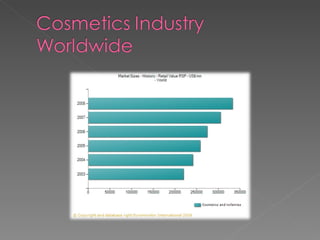
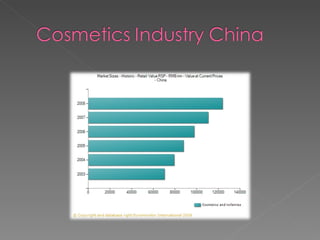
  • #8 -Industry grew worldwide from 220 billion in 2003, to 333 billion in 2008.
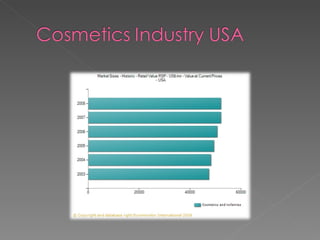
  • #9 -Grew from a 47 billion dollar industry in 2003 to 52 billion dollar industry in 2008. -Sales in the Cosmetics Industry actually declined from 2007-2008, on account of the recession. -Cosmetics and toiletries sales growth slowed as the US fell into a deep crisis, with rising job losses and reduced availability of consumer credit. ----Worries about the US economy led to reduced consumer confidence and lower spending. -US GDP grew by only 1.1% in 2008, lower than the 2.9% and 2.8% growth achieved in 2005 and 2006, respectively. -Americans took a back to basics approach, and focused on necessities such as food and fuel. -This turn of events turned to massive discounting in the cosmetics inudstry. -Retailers including Macy’s, Neiman Marcus, Nordstrom and Saks Fifth Avenue marked down fragrance prices temporarily. -While the discounts had the effect of selling fragrances, they hampered value growth. Retailers also discounted colour cosmetics gift sets from Bobbi Brown and MAC. As a result, sales of premium cosmetics and toiletries declined in 2008, after growing in 2007.
  • #10 -Looks more consistent with the Cosmetics industry in the world. -Grew from a 70 billion dollar industry to a 123 billion dollar industry in 2008
  • #16 All are marketing to the same types of women All offer similar products around similar price All are sold at the same places
  • #17 -The brands that were entering the market had strong brand name recognition already. -The customers knew of the great quality of their product and were more willing to trust/try new products from these vendors. -Incumbents, as our book states, are current member of an industry that compete against each other.
  • #18 -Procter & Gamble is gaining share, like several other companies, through acquisition. -In 2001, P&G purchased Clairol, and in 2008 acquired Frederic Fekkai, which are skincare and hair products that are sold and Nordstrom and other retailers. -Johnson & Johnson own Neutrogena. -Potential entrants, or other suppliers -According to the Patent Office, L'Oreal has 28,462 of them, 20,000 of which are linked to products such as lipstick, mascara and nail varnish.
  • #19 -Non-scale-base advantage is a low-cost advantage that are not derived from the economies of scale. -Product differentiation refers to the uniqueness of products that customers value -Incumbents would like customers to identify their brands with some unique attributes.
  • #20 -The changes in consumer behavior are at the expense of high-end department stores, whose selling costs are high and sales are declining.
  • #21 -Competitors are highlighting why their products command such a higher price point and why you should purchase them -Forward Integration is acquiring and owning downstream assets. -Through forward integration, the suppliers may threaten to become both suppliers and rivals.
  • #22 -Premium cosmetics grew by 2% in 2008
  • #23 -Backward integration refers to the acquiring and owning of upstream assets.
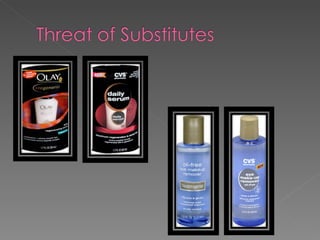
  • #24 -Private label products typically cost at least 20% less than national brands -Another reason for the share gain has been the efforts of retailers in certain drug store chains to introduce more private label products and support them with merchandising. Ex. Olay vs. CVS products – strategically placed next to the item, almost identical product packagaing. -2008 experienced large gains for private label. These gains occurred in bath and shower products, orgal hygiene and sun care.
  • #26 -Due to the immaturity of these subsectors and growing comfort with grooming regimens among younger American men, sales of these male-specific products are expected to continue growing, regardless of the economy. -