Get Answers on www.smuHelp.comGetAnswersonwww.smuHelp.com
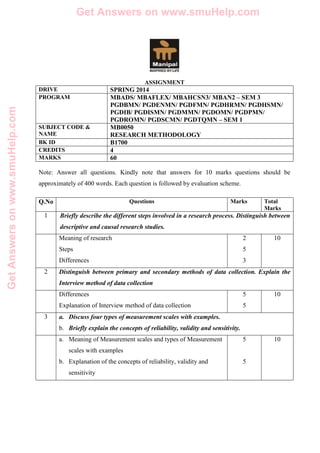
ASSIGNMENT
DRIVE SPRING 2014
PROGRAM MBADS/ MBAFLEX/ MBAHCSN3/ MBAN2 – SEM 3
PGDBMN/ PGDENMN/ PGDFMN/ PGDHRMN/ PGDHSMN/
PGDIB/ PGDISMN/ PGDMMN/ PGDOMN/ PGDPMN/
PGDROMN/ PGDSCMN/ PGDTQMN – SEM 1
SUBJECT CODE &
NAME
MB0050
RESEARCH METHODOLOGY
BK ID B1700
CREDITS 4
MARKS 60
Note: Answer all questions. Kindly note that answers for 10 marks questions should be
approximately of 400 words. Each question is followed by evaluation scheme.
Q.No Questions Marks Total
Marks
1 Briefly describe the different steps involved in a research process. Distinguish between
descriptive and causal research studies.
Meaning of research
Steps
Differences
2
5
3
10
2 Distinguish between primary and secondary methods of data collection. Explain the
Interview method of data collection
Differences
Explanation of Interview method of data collection
5
5
10
3 a. Discuss four types of measurement scales with examples.
b. Briefly explain the concepts of reliability, validity and sensitivity.
a. Meaning of Measurement scales and types of Measurement
scales with examples
b. Explanation of the concepts of reliability, validity and
sensitivity
5
5
10
Get Answers on www.smuHelp.comGetAnswersonwww.smuHelp.com
4 a. Distinguish between:
i. Schedules and Questionnaires
ii. Open ended and closed ended questions
b. What are the different modes of administering a questionnaire? What are the
conditions that merit the use of one over the other? Discuss by using suitable
examples.
a. Differences
b. Modes of administering a questionnaire
4
6
10
5 a. What is the analysis of variance? What are the assumptions of the technique?
Give a few examples where the techniques could be used.
b. The following data represents the number of units produced by four operators
during three different shifts:
Shifts Operator
A B C D
I 10 8 12 13
II 10 12 14 15
III 12 10 11 14
Perform a two-way analysis of variance and interpret the result.
a. Meaning, Assumptions and examples
b. Formulas, Calculation, Solution and Interpretation to the
problem
4
6
10
6 Explain the three basic principles of professional ethics that any research must follow.
How do you follow an ethical practice while collecting information from the
respondents?
Basic principles of professional ethics
Ethical codes related to respondents
6
4
10
Get Answers on www.smuHelp.comGetAnswersonwww.smuHelp.com

Mb0050

  • 1.
    Get Answers onwww.smuHelp.comGetAnswersonwww.smuHelp.com ASSIGNMENT DRIVE SPRING 2014 PROGRAM MBADS/ MBAFLEX/ MBAHCSN3/ MBAN2 – SEM 3 PGDBMN/ PGDENMN/ PGDFMN/ PGDHRMN/ PGDHSMN/ PGDIB/ PGDISMN/ PGDMMN/ PGDOMN/ PGDPMN/ PGDROMN/ PGDSCMN/ PGDTQMN – SEM 1 SUBJECT CODE & NAME MB0050 RESEARCH METHODOLOGY BK ID B1700 CREDITS 4 MARKS 60 Note: Answer all questions. Kindly note that answers for 10 marks questions should be approximately of 400 words. Each question is followed by evaluation scheme. Q.No Questions Marks Total Marks 1 Briefly describe the different steps involved in a research process. Distinguish between descriptive and causal research studies. Meaning of research Steps Differences 2 5 3 10 2 Distinguish between primary and secondary methods of data collection. Explain the Interview method of data collection Differences Explanation of Interview method of data collection 5 5 10 3 a. Discuss four types of measurement scales with examples. b. Briefly explain the concepts of reliability, validity and sensitivity. a. Meaning of Measurement scales and types of Measurement scales with examples b. Explanation of the concepts of reliability, validity and sensitivity 5 5 10
  • 2.
    Get Answers onwww.smuHelp.comGetAnswersonwww.smuHelp.com 4 a. Distinguish between: i. Schedules and Questionnaires ii. Open ended and closed ended questions b. What are the different modes of administering a questionnaire? What are the conditions that merit the use of one over the other? Discuss by using suitable examples. a. Differences b. Modes of administering a questionnaire 4 6 10 5 a. What is the analysis of variance? What are the assumptions of the technique? Give a few examples where the techniques could be used. b. The following data represents the number of units produced by four operators during three different shifts: Shifts Operator A B C D I 10 8 12 13 II 10 12 14 15 III 12 10 11 14 Perform a two-way analysis of variance and interpret the result. a. Meaning, Assumptions and examples b. Formulas, Calculation, Solution and Interpretation to the problem 4 6 10 6 Explain the three basic principles of professional ethics that any research must follow. How do you follow an ethical practice while collecting information from the respondents? Basic principles of professional ethics Ethical codes related to respondents 6 4 10
  • 3.
    Get Answers onwww.smuHelp.comGetAnswersonwww.smuHelp.com