ENHANCING MULTI-ASPECT COLLABORATIVE
FILTERING FOR PERSONALIZED
RECOMMENDATION
Khairudin, N., Sharef, N. M., Mustapha, N., Noah, S A. M.,
CONTENT
2
INTRODUCTION
PROPOSED METHOD
EXPERIMENTAL RESULTS
CONCLUSIONS
3
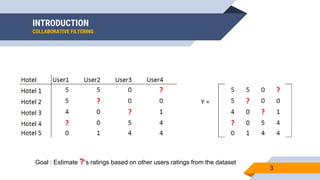
Goal : Estimate ?’s ratings based on other users ratings from the dataset
INTRODUCTION
COLLABORATIVE FILTERING
INTRODUCTION
COLLABORATIVE FILTERING
4
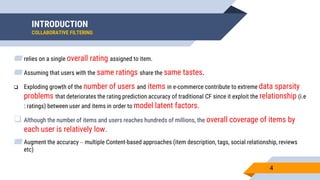
▰relies on a single overall rating assigned to item.
▰Assuming that users with the same ratings share the same tastes.
 Exploding growth of the number of users and items in e-commerce contribute to extreme data sparsity
problems that deteriorates the rating prediction accuracy of traditional CF since it exploit the relationship (i.e
: ratings) between user and items in order to model latent factors.
 Although the number of items and users reaches hundreds of millions, the overall coverage of items by
each user is relatively low.
▰Augment the accuracy – multiple Content-based approaches (item description, tags, social relationship, reviews
etc)
INTRODUCTION
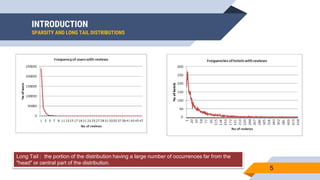
SPARSITY AND LONG TAIL DISTRIBUTIONS
5
Long Tail : the portion of the distribution having a large number of occurrences far from the
"head" or central part of the distribution.
INTRODUCTION
REVIEW-BASED RS
6
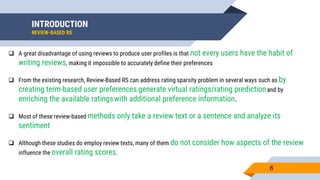
 A great disadvantage of using reviews to produce user profiles is that not every users have the habit of
writing reviews, making it impossible to accurately define their preferences
 From the existing research, Review-Based RS can address rating sparsity problem in several ways such as by
creating term-based user preferences, generate virtual ratings/rating predictionand by
enriching the available ratingswith additional preference information.
 Most of these review-based methods only take a review text or a sentence and analyze its
sentiment
 Although these studies do employ review texts, many of them do not consider how aspects of the review
influence the overall rating scores.
INTRODUCTION
REVIEW APSECTS
7
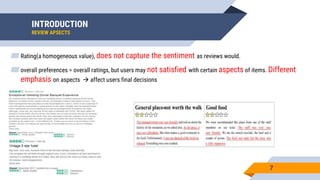
▰Rating(a homogeneous value), does not capture the sentiment as reviews would.
▰overall preferences = overall ratings, but users may not satisfied with certain aspects of items. Different
emphasis on aspects  affect users final decisions
INTRODUCTION
ASPECTS
8
 sometimes called as topic, has attracted a lot of attention in recent years. The question is which aspect is most
important.
 Aspect can be used to identify user preferences since users usually placed different emphasis towards
different aspects of the item they experienced. [Yang, et al. 2016]
 Overall rating comes from a weighted combination of the ratings for individual aspects.[Nie, et al. 2014]
 Aspect preferences can deal with sparsity problem – similarity is measured by users aspects preference profiles,
no matter how many entities they rate commonly
Therefore, the aspects element can be one of the components to improve
prediction accuracy by suggesting more accurate recommendation based
on users’ preferences
INTRODUCTION
RECOMMENDATION APPROACHES
9
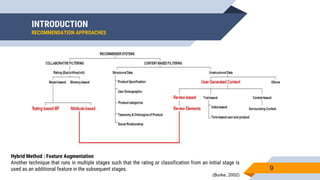
Hybrid Method : Feature Augmentation
Another technique that runs in multiple stages such that the rating or classification from an initial stage is
used as an additional feature in the subsequent stages.
(Burke, 2002)
OBJECTIVES
10
proposed the multi-aspect CF to
enhance the predictive accuracy of
multi-aspect recommendation by
using Tensor Factorization.
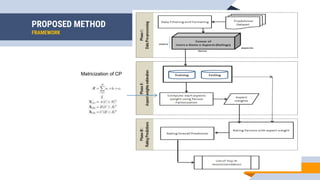
PROPOSED METHOD
FRAMEWORK
11
Matricization of CP
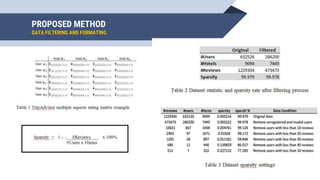
PROPOSED METHOD
DATA FILTERING AND FORMATING
12
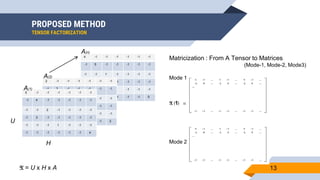
PROPOSED METHOD
TENSOR FACTORIZATION
13
4 -1 -1 -1 -1 -1 -1
-1 5 -1 -1 -1 -1 -1
-1 -1 1 -1 -1 -1 -1
-1 3 -1 -1 -1 -1 -1
-1 -1 -1 1 -1 -1 -1
-1 -1 -1 -1 -1 -1 5
2 -1 -1 -1 -1 -1 -1
-1 3 -1 -1 -1 -1 -1
-1 -1 2 -1 -1 -1 -1
-1 3 -1 -1 -1 -1 -1
-1 -1 -1 1 -1 -1 -1
-1 -1 -1 -1 -1 -1 2
5 -1 -1 -1 -1 -1 -1
-1 4 -1 -1 -1 -1 -1
-1 -1 2 -1 -1 -1 -1
-1 3 -1 -1 -1 -1 -1
-1 -1 -1 1 -1 -1 -1
-1 -1 -1 -1 -1 -1 4
U
H
A(1)
A(2)
A(n)
Matricization : From A Tensor to Matrices
(Mode-1, Mode-2, Mode3)
Mode 1 (Column)
X (1) =
Mode 2 (Row)
X = U x H x A
EXPERIMENTAL RESULT
14
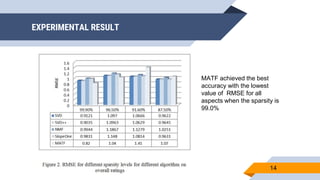
MATF achieved the best
accuracy with the lowest
value of RMSE for all
aspects when the sparsity is
99.0%
EXPERIMENTAL RESULT
15
RMSE results for 99%, 96% sparsity rate for all aspects
EXPERIMENTAL RESULT
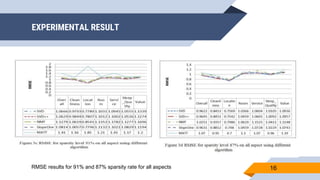
16RMSE results for 91% and 87% sparsity rate for all aspects
CONCLUSION
17
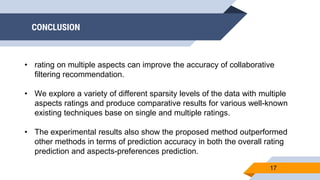
• rating on multiple aspects can improve the accuracy of collaborative
filtering recommendation.
• We explore a variety of different sparsity levels of the data with multiple
aspects ratings and produce comparative results for various well-known
existing techniques base on single and multiple ratings.
• The experimental results also show the proposed method outperformed
other methods in terms of prediction accuracy in both the overall rating
prediction and aspects-preferences prediction.
THANK YOU

Enhancing Multi-Aspect Collaborative Filtering for Personalized Recommendation

  • 1.
    ENHANCING MULTI-ASPECT COLLABORATIVE FILTERINGFOR PERSONALIZED RECOMMENDATION Khairudin, N., Sharef, N. M., Mustapha, N., Noah, S A. M.,
  • 2.
  • 3.
    3 Goal : Estimate?’s ratings based on other users ratings from the dataset INTRODUCTION COLLABORATIVE FILTERING
  • 4.
    INTRODUCTION COLLABORATIVE FILTERING 4 ▰relies ona single overall rating assigned to item. ▰Assuming that users with the same ratings share the same tastes.  Exploding growth of the number of users and items in e-commerce contribute to extreme data sparsity problems that deteriorates the rating prediction accuracy of traditional CF since it exploit the relationship (i.e : ratings) between user and items in order to model latent factors.  Although the number of items and users reaches hundreds of millions, the overall coverage of items by each user is relatively low. ▰Augment the accuracy – multiple Content-based approaches (item description, tags, social relationship, reviews etc)
  • 5.
    INTRODUCTION SPARSITY AND LONGTAIL DISTRIBUTIONS 5 Long Tail : the portion of the distribution having a large number of occurrences far from the "head" or central part of the distribution.
  • 6.
    INTRODUCTION REVIEW-BASED RS 6  Agreat disadvantage of using reviews to produce user profiles is that not every users have the habit of writing reviews, making it impossible to accurately define their preferences  From the existing research, Review-Based RS can address rating sparsity problem in several ways such as by creating term-based user preferences, generate virtual ratings/rating predictionand by enriching the available ratingswith additional preference information.  Most of these review-based methods only take a review text or a sentence and analyze its sentiment  Although these studies do employ review texts, many of them do not consider how aspects of the review influence the overall rating scores.
  • 7.
    INTRODUCTION REVIEW APSECTS 7 ▰Rating(a homogeneousvalue), does not capture the sentiment as reviews would. ▰overall preferences = overall ratings, but users may not satisfied with certain aspects of items. Different emphasis on aspects  affect users final decisions
  • 8.
    INTRODUCTION ASPECTS 8  sometimes calledas topic, has attracted a lot of attention in recent years. The question is which aspect is most important.  Aspect can be used to identify user preferences since users usually placed different emphasis towards different aspects of the item they experienced. [Yang, et al. 2016]  Overall rating comes from a weighted combination of the ratings for individual aspects.[Nie, et al. 2014]  Aspect preferences can deal with sparsity problem – similarity is measured by users aspects preference profiles, no matter how many entities they rate commonly Therefore, the aspects element can be one of the components to improve prediction accuracy by suggesting more accurate recommendation based on users’ preferences
  • 9.
    INTRODUCTION RECOMMENDATION APPROACHES 9 Hybrid Method: Feature Augmentation Another technique that runs in multiple stages such that the rating or classification from an initial stage is used as an additional feature in the subsequent stages. (Burke, 2002)
  • 10.
    OBJECTIVES 10 proposed the multi-aspectCF to enhance the predictive accuracy of multi-aspect recommendation by using Tensor Factorization.
  • 11.
  • 12.
  • 13.
    PROPOSED METHOD TENSOR FACTORIZATION 13 4-1 -1 -1 -1 -1 -1 -1 5 -1 -1 -1 -1 -1 -1 -1 1 -1 -1 -1 -1 -1 3 -1 -1 -1 -1 -1 -1 -1 -1 1 -1 -1 -1 -1 -1 -1 -1 -1 -1 5 2 -1 -1 -1 -1 -1 -1 -1 3 -1 -1 -1 -1 -1 -1 -1 2 -1 -1 -1 -1 -1 3 -1 -1 -1 -1 -1 -1 -1 -1 1 -1 -1 -1 -1 -1 -1 -1 -1 -1 2 5 -1 -1 -1 -1 -1 -1 -1 4 -1 -1 -1 -1 -1 -1 -1 2 -1 -1 -1 -1 -1 3 -1 -1 -1 -1 -1 -1 -1 -1 1 -1 -1 -1 -1 -1 -1 -1 -1 -1 4 U H A(1) A(2) A(n) Matricization : From A Tensor to Matrices (Mode-1, Mode-2, Mode3) Mode 1 (Column) X (1) = Mode 2 (Row) X = U x H x A
  • 14.
    EXPERIMENTAL RESULT 14 MATF achievedthe best accuracy with the lowest value of RMSE for all aspects when the sparsity is 99.0%
  • 15.
    EXPERIMENTAL RESULT 15 RMSE resultsfor 99%, 96% sparsity rate for all aspects
  • 16.
    EXPERIMENTAL RESULT 16RMSE resultsfor 91% and 87% sparsity rate for all aspects
  • 17.
    CONCLUSION 17 • rating onmultiple aspects can improve the accuracy of collaborative filtering recommendation. • We explore a variety of different sparsity levels of the data with multiple aspects ratings and produce comparative results for various well-known existing techniques base on single and multiple ratings. • The experimental results also show the proposed method outperformed other methods in terms of prediction accuracy in both the overall rating prediction and aspects-preferences prediction.
  • 18.