MAYA CIVILIZATION 
ESPINA
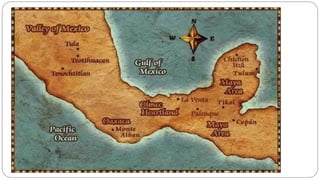
Geography 
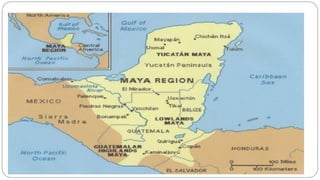
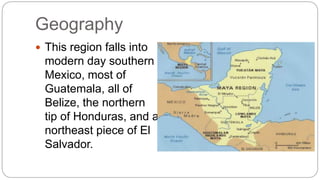
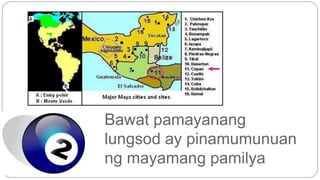
 This region falls into 
modern day southern 
Mexico, most of 
Guatemala, all of 
Belize, the northern 
tip of Honduras, and a 
northeast piece of El 
Salvador.
Geography 
 You can find dry and arid land, rainforests, 
swamps, and coastal areas. In the highlands to 
the south, among the Sierra Madre mountains, 
there are 37 volcanoes. 
 Earthquakes were frequent, there was flooding 
and mudslides, hurricanes and droughts.
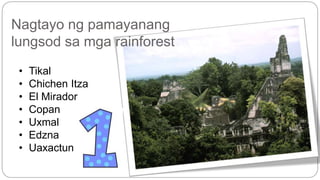
Nagtayo ng pamayanang 
lungsod sa mga rainforest 
• Tikal 
• Chichen Itza 
• El Mirador 
• Copan 
• Uxmal 
• Edzna 
• Uaxactun
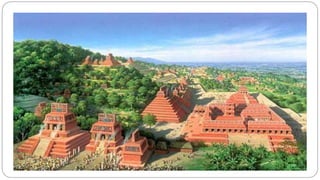
Bawat pamayanang 
lungsod ay pinamumunuan 
ng mayamang pamilya
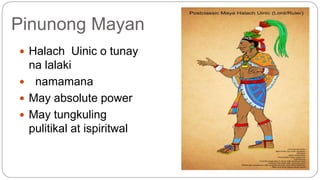
Pinunong Mayan 
 Halach Uinic o tunay 
na lalaki 
 namamana 
 May absolute power 
 May tungkuling 
pulitikal at ispiritwal
Uniting FORCES of MAYAN 
 All the Maya spoke the same language (Mayan.) 
 They worshipped the same gods 
 They set up their cities in the same way 
 They had very similar laws 
 They dressed in the same way 
 The cities were connected with roadways that 
were kept in good repair
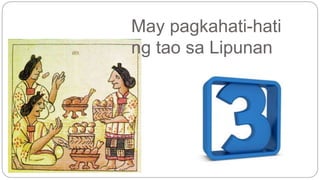
May pagkahati-hati 
ng tao sa Lipunan
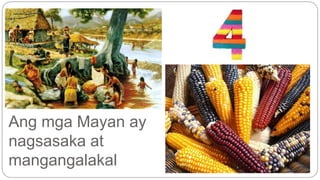
Ang mga Mayan ay 
nagsasaka at 
mangangalakal
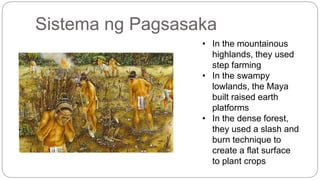
Sistema ng Pagsasaka 
• In the mountainous 
highlands, they used 
step farming 
• In the swampy 
lowlands, the Maya 
built raised earth 
platforms 
• In the dense forest, 
they used a slash and 
burn technique to 
create a flat surface 
to plant crops
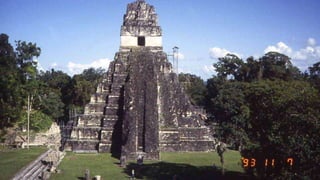
The Maya were great 
builders
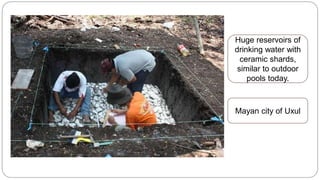
Huge reservoirs of 
drinking water with 
ceramic shards, 
similar to outdoor 
pools today. 
Mayan city of Uxul
Sumasamba sa kalikasan 
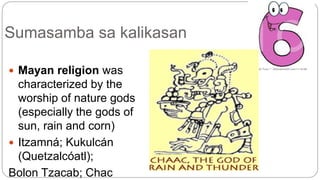
 Mayan religion was 
characterized by the 
worship of nature gods 
(especially the gods of 
sun, rain and corn) 
 Itzamná; Kukulcán 
(Quetzalcóatl); 
Bolon Tzacab; Chac
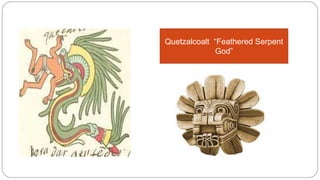
Quetzalcoalt “Feathered Serpent 
God”
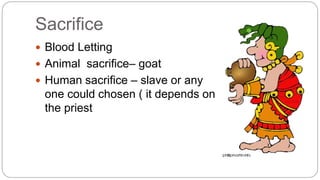
Sacrifice 
 Blood Letting 
 Animal sacrifice– goat 
 Human sacrifice – slave or any 
one could chosen ( it depends on 
the priest
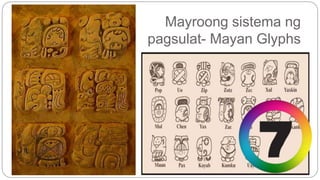
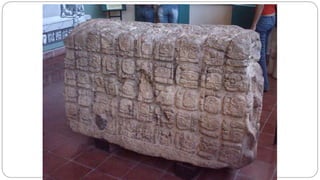
Mayroong sistema ng 
pagsulat- Mayan Glyphs
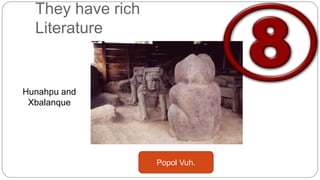
They have rich 
Literature 
Hunahpu and 
Xbalanque 
Popol Vuh.
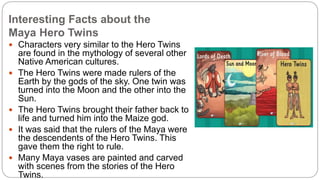
Interesting Facts about the 
Maya Hero Twins 
 Characters very similar to the Hero Twins 
are found in the mythology of several other 
Native American cultures. 
 The Hero Twins were made rulers of the 
Earth by the gods of the sky. One twin was 
turned into the Moon and the other into the 
Sun. 
 The Hero Twins brought their father back to 
life and turned him into the Maize god. 
 It was said that the rulers of the Maya were 
the descendents of the Hero Twins. This 
gave them the right to rule. 
 Many Maya vases are painted and carved 
with scenes from the stories of the Hero 
Twins.
The Mysterious Mayas
Dahilan ng Pagkawala ? 
 Pagkasira ng kalikasan 
 Paglaki ng populasyon 
 Patuloy na digmaan 
 Pagbagsak ng produksyon ng pagkain
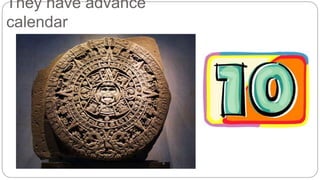
They have advance 
calendar
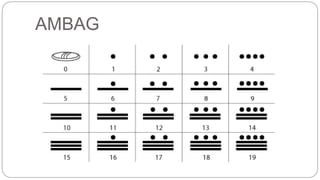
AMBAG
Toltec
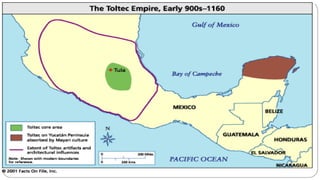
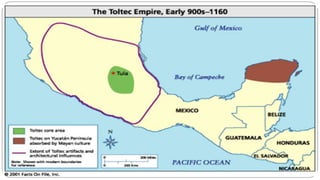
 Ang impeyo ng mga 
Toltec ay umusbong sa 
Central Mexico kung saan 
ang pangunahing lungsod 
ay ang Tula. 
 Pinaniniwalaang nagmula 
sa kulturang Teotihuacan.
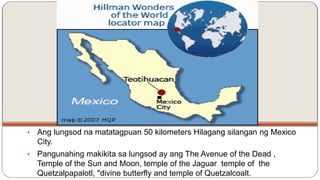
• Ang lungsod na matatagpuan 50 kilometers Hilagang silangan ng Mexico 
City. 
• Pangunahing makikita sa lungsod ay ang The Avenue of the Dead , 
Temple of the Sun and Moon, temple of the Jaguar temple of the 
Quetzalpapalotl, "divine butterfly and temple of Quetzalcoalt.
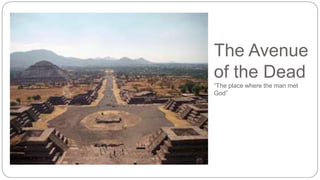
The Avenue 
of the Dead 
“The place where the man met 
God”
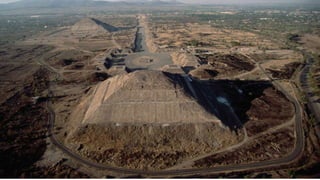
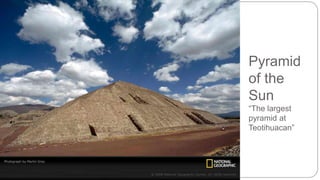
Pyramid 
of the 
Sun 
“The largest 
pyramid at 
Teotihuacan”
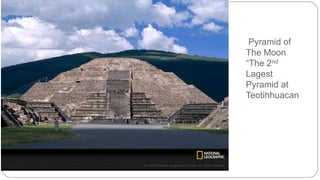
Pyramid of 
The Moon 
“The 2nd 
Lagest 
Pyramid at 
Teotihhuacan
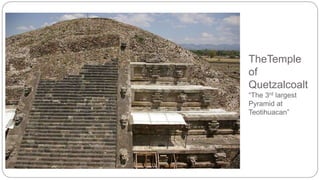
TheTemple 
of 
Quetzalcoalt 
“The 3rd largest 
Pyramid at 
Teotihuacan”
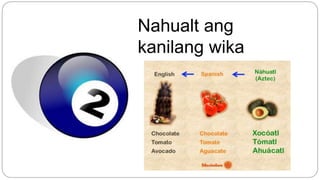
Nahualt ang 
kanilang wika
Ang kauna-unahang 
gumamit ng 
puwesang militar 
upang masakop ang 
mga karatig lugar.
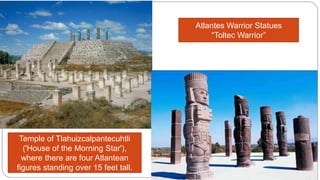
Atlantes Warrior Statues 
“Toltec Warrior” 
Temple of Tlahuizcalpantecuhtli 
('House of the Morning Star'), 
where there are four Atlantean 
figures standing over 15 feet tall.
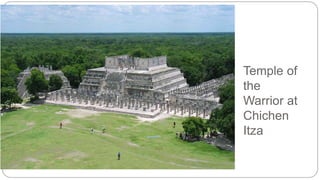
Temple of 
the 
Warrior at 
Chichen 
Itza
Mga ekspertong minero 
at mangangalakal
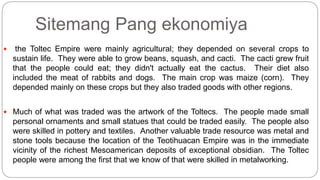
Sitemang Pang ekonomiya 
 the Toltec Empire were mainly agricultural; they depended on several crops to 
sustain life. They were able to grow beans, squash, and cacti. The cacti grew fruit 
that the people could eat; they didn't actually eat the cactus. Their diet also 
included the meat of rabbits and dogs. The main crop was maize (corn). They 
depended mainly on these crops but they also traded goods with other regions. 
 Much of what was traded was the artwork of the Toltecs. The people made small 
personal ornaments and small statues that could be traded easily. The people also 
were skilled in pottery and textiles. Another valuable trade resource was metal and 
stone tools because the location of the Teotihuacan Empire was in the immediate 
vicinity of the richest Mesoamerican deposits of exceptional obsidian. The Toltec 
people were among the first that we know of that were skilled in metalworking.
• Si CHALCHIUH 
TLATONAC ang 
kauna-unahang hari 
at tagapagtatag ng 
Tula. 
Ang mga pinuno ay 
pinaniniwalang diyos.
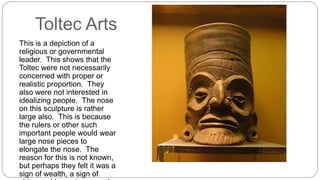
Toltec Arts 
This is a depiction of a 
religious or governmental 
leader. This shows that the 
Toltec were not necessarily 
concerned with proper or 
realistic proportion. They 
also were not interested in 
idealizing people. The nose 
on this sculpture is rather 
large also. This is because 
the rulers or other such 
important people would wear 
large nose pieces to 
elongate the nose. The 
reason for this is not known, 
but perhaps they felt it was a 
sign of wealth, a sign of 
virtue and honesty, or maybe
Sumasamba 
kay 
Quetzalcoatl
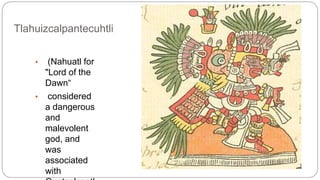
Tlahuizcalpantecuhtli 
• (Nahuatl for 
"Lord of the 
Dawn“ 
• considered 
a dangerous 
and 
malevolent 
god, and 
was 
associated 
with 
Quetzalcoatl
Kilala sa stone 
carving at metal 
working
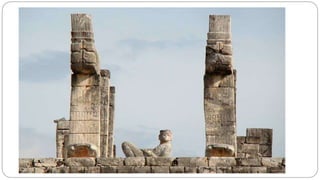
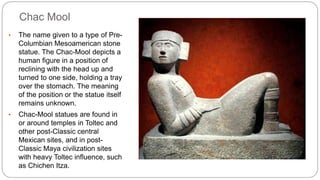
Chac Mool 
• The name given to a type of Pre- 
Columbian Mesoamerican stone 
statue. The Chac-Mool depicts a 
human figure in a position of 
reclining with the head up and 
turned to one side, holding a tray 
over the stomach. The meaning 
of the position or the statue itself 
remains unknown. 
• Chac-Mool statues are found in 
or around temples in Toltec and 
other post-Classic central 
Mexican sites, and in post- 
Classic Maya civilization sites 
with heavy Toltec influence, such 
as Chichen Itza.
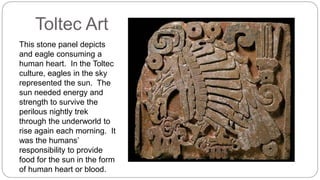
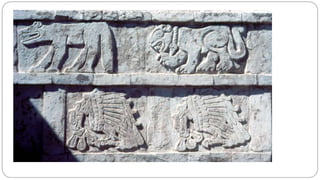
Toltec Art 
This stone panel depicts 
and eagle consuming a 
human heart. In the Toltec 
culture, eagles in the sky 
represented the sun. The 
sun needed energy and 
strength to survive the 
perilous nightly trek 
through the underworld to 
rise again each morning. It 
was the humans’ 
responsibility to provide 
food for the sun in the form 
of human heart or blood.
Ang kaalaman ukol sa mga Toltec 
ay mula sa mga alamat hango sa 
sumusunod na kabihasnan at 
batay sa mga panulat ng mga 
Aztec
AZTEC
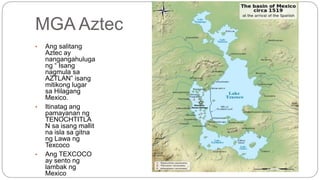
MGA Aztec 
• Ang salitang 
Aztec ay 
nangangahuluga 
ng “ Isang 
nagmula sa 
AZTLAN” isang 
mitikong lugar 
sa Hilagang 
Mexico. 
• Itinatag ang 
pamayanan ng 
TENOCHTITLA 
N sa isang mallit 
na isla sa gitna 
ng Lawa ng 
Texcoco 
• Ang TEXCOCO 
ay sento ng 
lambak ng 
Mexico
Aztec 
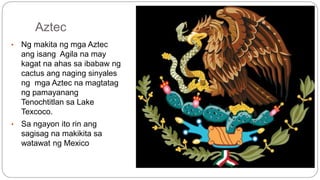
• Ng makita ng mga Aztec 
ang isang Agila na may 
kagat na ahas sa ibabaw ng 
cactus ang naging sinyales 
ng mga Aztec na magtatag 
ng pamayanang 
Tenochtitlan sa Lake 
Texcoco. 
• Sa ngayon ito rin ang 
sagisag na makikita sa 
watawat ng Mexico
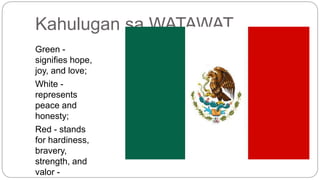
Kahulugan sa WATAWAT 
Green - 
signifies hope, 
joy, and love; 
White - 
represents 
peace and 
honesty; 
Red - stands 
for hardiness, 
bravery, 
strength, and 
valor -
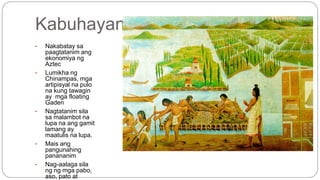
Kabuhayan 
• Nakabatay sa 
paagtatanim ang 
ekonomiya ng 
Aztec 
• Lumikha ng 
Chinampas, mga 
artipisyal na pulo 
na kung tawagin 
ay mga floating 
Gaden 
• Nagtatanim sila 
sa malambot na 
lupa na ang gamit 
lamang ay 
maatulis na lupa. 
• Mais ang 
pangunahing 
panananim 
• Nag-aalaga sila 
ng ng mga pabo, 
aso, pato at 
gansa.
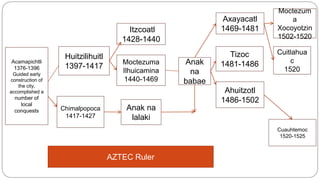
Acamapichtli 
1376-1396 
Guided early 
construction of 
the city, 
accomplished a 
number of 
local 
conquests 
Huitzilihuitl 
1397-1417 
Chimalpopoca 
1417-1427 
Itzcoatl 
1428-1440 
Moctezuma 
Ilhuicamina 
1440-1469 
Anak 
na 
babae 
Anak na 
lalaki 
Axayacatl 
1469-1481 
Tizoc 
1481-1486 
Ahuitzotl 
1486-1502 
Moctezum 
a 
Xocoyotzin 
1502-1520 
Cuitlahua 
c 
1520 
Cuauhtemoc 
1520-1525 
AZTEC Ruler
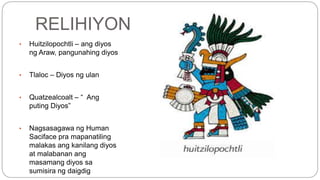
RELIHIYON 
• Huitzilopochtli – ang diyos 
ng Araw, pangunahing diyos 
• Tlaloc – Diyos ng ulan 
• Quatzealcoalt – “ Ang 
puting Diyos” 
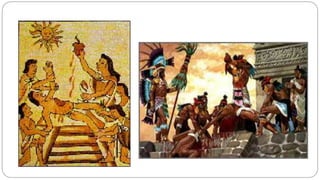
• Nagsasagawa ng Human 
Saciface pra mapanatiling 
malakas ang kanilang diyos 
at malabanan ang 
masamang diyos sa 
sumisira ng daigdig
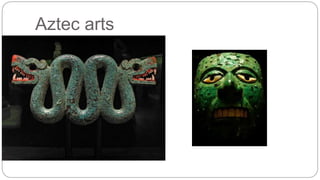
Aztec arts
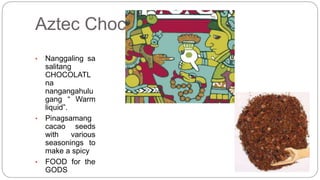
Aztec Chocolate 
• Nanggaling sa 
salitang 
CHOCOLATL 
na 
nangangahulu 
gang “ Warm 
liquid”. 
• Pinagsamang 
cacao seeds 
with various 
seasonings to 
make a spicy 
• FOOD for the 
GODS
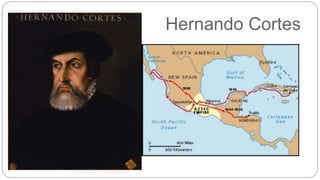
Hernando Cortes
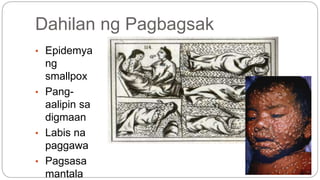
Dahilan ng Pagbagsak 
• Epidemya 
ng 
smallpox 
• Pang-aalipin 
sa 
digmaan 
• Labis na 
paggawa 
• Pagsasa 
mantala 
 http://www.yoH_t_enrQ
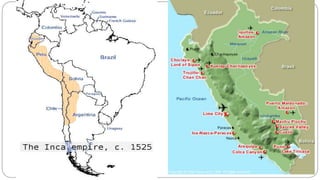
Heograpiya ng South America 
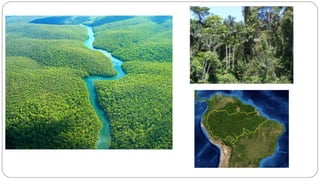
 Hilaga – matatagpuan ang Amazon River na 
dumadaloy sa mayayabong na kagubatan 
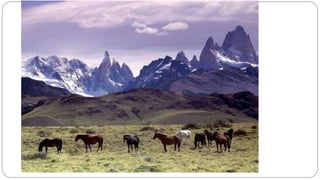
 Timog – Mga praire at steppe sa Andes Mountain 
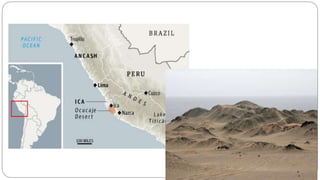
 Kanluran – tuyot na mga disyeto sa gulod ng mga 
bundok na nakahilera sa sa Pacific Ocean.
Three Geograpical Regions 
 Andes Mountains: North to south were the Andes 
Mountains - home of the Inca civilization. The 
mountains dominated Incan society. The mountain 
peaks were worshiped as gods. 
The Andes created a natural barrier between the 
coastal desert on one side and the jungle on the other. 
The snow-capped mountains were full of deep gorges. 
The Inca built bridges across the gorges so they 
could reach all parts of their empire quickly and easily. 
These mountain gorges were natural barriers. If an 
enemy approached, the Incas could simply burn the 
bridges.
Three Geograpical Regions 
 Amazon Jungle: On one side of the Andes was the Amazon 
jungle. The Incas must have entered the jungle occasionally, as 
they did know about the many valuable things that could be 
found in the Amazon, like wood and fruit and natural medicines. 
But they never established settlements there. They had no desire 
to live in the jungle. The Incas expanded north and south 
instead. 
 Coastal Desert: Between the mountains and the Pacific Ocean 
is a coastal desert 2000 miles long and between 30-100 miles 
wide. The desert provided a wonderful natural barrier. Some 
scientists think it is the driest place in the world. It is not 
completely barren. There are fertile strips where small rivers and 
streams run from the Andes mountaintops to the sea.
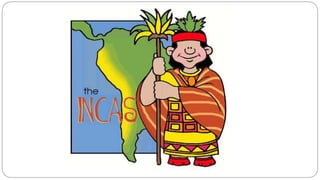
Inca 
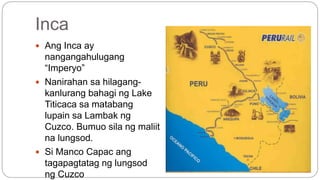
 Ang Inca ay 
nangangahulugang 
“Imperyo” 
 Nanirahan sa hilagang-kanlurang 
bahagi ng Lake 
Titicaca sa matabang 
lupain sa Lambak ng 
Cuzco. Bumuo sila ng maliit 
na lungsod. 
 Si Manco Capac ang 
tagapagtatag ng lungsod 
ng Cuzco
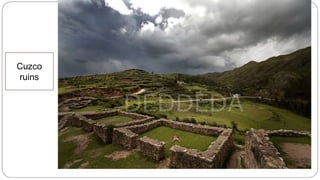
Cuzco 
ruins
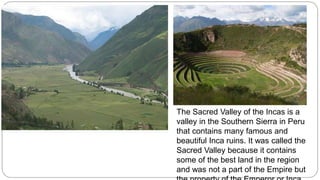
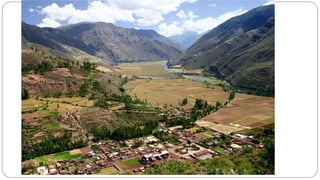
The Sacred Valley of the Incas is a 
valley in the Southern Sierra in Peru 
that contains many famous and 
beautiful Inca ruins. It was called the 
Sacred Valley because it contains 
some of the best land in the region 
and was not a part of the Empire but 
the property of the Emperor or Inca
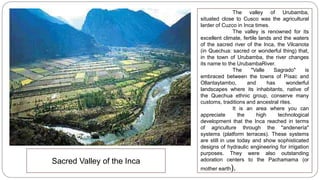
Sacred Valley of the Inca 
The valley of Urubamba, 
situated close to Cusco was the agricultural 
larder of Cuzco in Inca times. 
The valley is renowned for its 
excellent climate, fertile lands and the waters 
of the sacred river of the Inca, the Vilcanota 
(in Quechua: sacred or wonderful thing) that, 
in the town of Urubamba, the river changes 
its name to the UrubambaRiver. 
The "Valle Sagrado" is 
embraced between the towns of Písac and 
Ollantaytambo, and has wonderful 
landscapes where its inhabitants, native of 
the Quechua ethnic group, conserve many 
customs, traditions and ancestral rites. 
It is an area where you can 
appreciate the high technological 
development that the Inca reached in terms 
of agriculture through the "andenería" 
systems (platform terraces). These systems 
are still in use today and show sophisticated 
designs of hydraulic engineering for irrigation 
purposes. They were also outstanding 
adoration centers to the Pachamama (or 
mother earth).
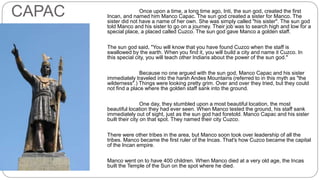
MANCO 
CAPAC Once upon a time, a long time ago, Inti, the sun god, created the first 
Incan, and named him Manco Capac. The sun god created a sister for Manco. The 
sister did not have a name of her own. She was simply called "his sister". The sun god 
told Manco and his sister to go on a journey. Their job was to search high and low for a 
special place, a placed called Cuzco. The sun god gave Manco a golden staff. 
The sun god said, "You will know that you have found Cuzco when the staff is 
swallowed by the earth. When you find it, you will build a city and name it Cuzco. In 
this special city, you will teach other Indians about the power of the sun god." 
Because no one argued with the sun god, Manco Capac and his sister 
immediately traveled into the harsh Andes Mountains (referred to in this myth as "the 
wilderness".) Things were looking pretty grim. Over and over they tried, but they could 
not find a place where the golden staff sank into the ground. 
One day, they stumbled upon a most beautiful location, the most 
beautiful location they had ever seen. When Manco tested the ground, his staff sank 
immediately out of sight, just as the sun god had foretold. Manco Capac and his sister 
built their city on that spot. They named their city Cuzco. 
There were other tribes in the area, but Manco soon took over leadership of all the 
tribes. Manco became the first ruler of the Incas. That's how Cuzco became the capital 
of the Incan empire. 
Manco went on to have 400 children. When Manco died at a very old age, the Incas 
built the Temple of the Sun on the spot where he died.
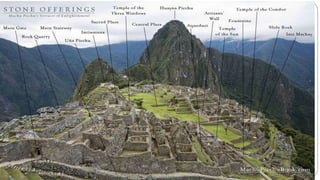
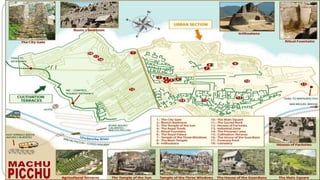
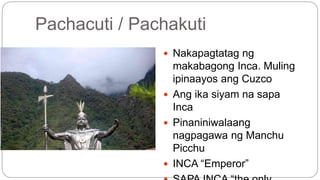
Pachacuti / Pachakuti 
 Nakapagtatag ng 
makabagong Inca. Muling 
ipinaayos ang Cuzco 
 Ang ika siyam na sapa 
Inca 
 Pinaniniwalaang 
nagpagawa ng Manchu 
Picchu 
 INCA “Emperor” 
 SAPA INCA “the only
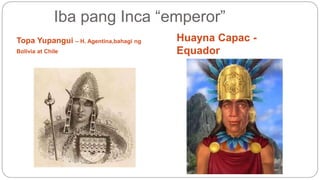
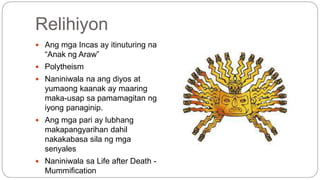
Iba pang Inca “emperor” 
Topa Yupangui – H. Agentina,bahagi ng 
Bolivia at Chile 
Huayna Capac - 
Equador
Relihiyon 
 Ang mga Incas ay itinuturing na 
“Anak ng Araw” 
 Polytheism 
 Naniniwala na ang diyos at 
yumaong kaanak ay maaring 
maka-usap sa pamamagitan ng 
iyong panaginip. 
 Ang mga pari ay lubhang 
makapangyarihan dahil 
nakakabasa sila ng mga 
senyales 
 Naniniwala sa Life after Death - 
Mummification
Relihiyon 
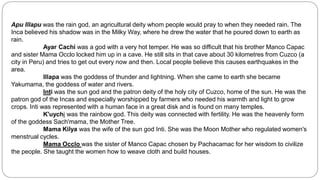
 The Incas also worshiped huacas - 
sacred places or objects. Huacas were 
everywhere. A huaca could be a large 
building, or a tiny statue that fit in the 
palm of your hand. Every family said daily 
prayers to little family huacas. Priests 
performed daily ceremonies at the 
temples, offering prayers to the huacas in 
their care. 
Festivals: Every month, the Incas held a 
major religious festival. Festivals were 
held outside. Games, songs, dancing, 
food, parades, and sacrifice (of animals 
usually) were all part of the festivities. If 
something special was happening, like 
the crowning of a new emperor or a 
drought, the Incas would include human 
sacrifice as part of the festival.
Apu Illapu was the rain god, an agricultural deity whom people would pray to when they needed rain. The 
Inca believed his shadow was in the Milky Way, where he drew the water that he poured down to earth as 
rain. 
Ayar Cachi was a god with a very hot temper. He was so difficult that his brother Manco Capac 
and sister Mama Occlo locked him up in a cave. He still sits in that cave about 30 kilometres from Cuzco (a 
city in Peru) and tries to get out every now and then. Local people believe this causes earthquakes in the 
area. 
Illapa was the goddess of thunder and lightning. When she came to earth she became 
Yakumama, the goddess of water and rivers. 
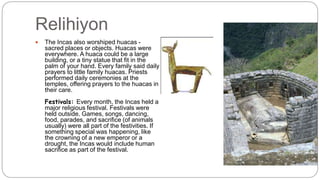
Inti was the sun god and the patron deity of the holy city of Cuzco, home of the sun. He was the 
patron god of the Incas and especially worshipped by farmers who needed his warmth and light to grow 
crops. Inti was represented with a human face in a great disk and is found on many temples. 
K'uychi was the rainbow god. This deity was connected with fertility. He was the heavenly form 
of the goddess Sach'mama, the Mother Tree. 
Mama Kilya was the wife of the sun god Inti. She was the Moon Mother who regulated women's 
menstrual cycles. 
Mama Occlo was the sister of Manco Capac chosen by Pachacamac for her wisdom to civilize 
the people. She taught the women how to weave cloth and build houses.
Manco Capac was Pachacamac's son, celebrated for his courage. He was sent to earth to 
become the first king of the Incas. He taught his people how to grow plants, make weapons, 
work together, share resources and worship the gods. 
Pachacamac was the creator god of the Inca, also known as Viracocha. He was the 
sky god who created the sun, the moon and the people. He brought Manco Capac and Mama 
Occlo to the world to civilize people and teach them skills such as farming and crafts. 
Pachamama was the goddess of the earth or earth mother and wife of Pachacamac. 
She is still the object of a cult all over the Andean mountains where people make her offerings of 
coca leaf and 'chicha' beer and pray to her on all major agricultural occasions. 
Qochamama was the goddess of the sea or Sea Mother, especially worshipped in the 
coastal regions. 
Sach'amama means Mother Tree. She was a goddess in the shape of a snake with 
two heads. When she passed on to the heavenly world she transformed into K'uychi. 
Yakumama means Mother Water. This water goddess was portrayed as a snake. 
When she came to the earth's surface, she transformed into a great river. She could also pass to 
the upper world. In that shape she was called Illapa meaning thunder and lightning.
Lipunan 
 The Royal 
 Kabilang sa mayayamang 
angkan 
 Di nagbabayad ng buwis 
 Nagmamay-ari ng lupa at 
Llamas 
 May magandang kasuotan 
 Mayroon maraming asawa 
 The common People 
 Walang karapatan na magmay-ari 
ng lupa o negosyo 
 Karamihan sa pangkat na ito ay 
magsasaka 
 Nagbabayad ng buwis sa 
pamamagitan ng mahabang 
pagtatrabaho. 
 Hindi nabibigyan ng sapat na 
edukasyon 
 Binibigyan lamang ng 
magkaroon ng isang asawa 
 Ang bahay ay gawa sa luwad
Dahilan ng tagumpay ng Inca 
 Communication: (roads, runners(chaskis), string 
writing) 
 Specialized Professions (engineers, metal 
workers, stone masons, other artisans) 
 Service Tax (huge free labor force) 
 Technology (terrace farming, surplus crops, 
irrigation systems) 
 Strong Central Government (all powerful Inca, 
strict laws, basic needs satisfied)
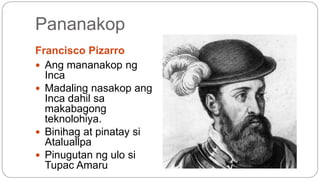
Pananakop 
Francisco Pizarro 
 Ang mananakop ng 
Inca 
 Madaling nasakop ang 
Inca dahil sa 
makabagong 
teknolohiya. 
 Binihag at pinatay si 
Ataluallpa 
 Pinugutan ng ulo si 
Tupac Amaru
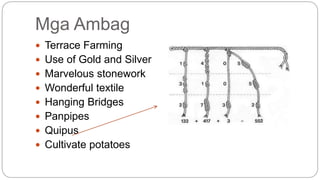
Mga Ambag 
 Terrace Farming 
 Use of Gold and Silver 
 Marvelous stonework 
 Wonderful textile 
 Hanging Bridges 
 Panpipes 
 Quipus 
 Cultivate potatoes
http://incas.mrdonn.org/geography.html

Maya civilization

  • 1.
  • 3.
    Geography  Thisregion falls into modern day southern Mexico, most of Guatemala, all of Belize, the northern tip of Honduras, and a northeast piece of El Salvador.
  • 4.
    Geography  Youcan find dry and arid land, rainforests, swamps, and coastal areas. In the highlands to the south, among the Sierra Madre mountains, there are 37 volcanoes.  Earthquakes were frequent, there was flooding and mudslides, hurricanes and droughts.
  • 6.
    Nagtayo ng pamayanang lungsod sa mga rainforest • Tikal • Chichen Itza • El Mirador • Copan • Uxmal • Edzna • Uaxactun
  • 8.
    Bawat pamayanang lungsoday pinamumunuan ng mayamang pamilya
  • 9.
    Pinunong Mayan Halach Uinic o tunay na lalaki  namamana  May absolute power  May tungkuling pulitikal at ispiritwal
  • 10.
    Uniting FORCES ofMAYAN  All the Maya spoke the same language (Mayan.)  They worshipped the same gods  They set up their cities in the same way  They had very similar laws  They dressed in the same way  The cities were connected with roadways that were kept in good repair
  • 11.
    May pagkahati-hati ngtao sa Lipunan
  • 13.
    Ang mga Mayanay nagsasaka at mangangalakal
  • 14.
    Sistema ng Pagsasaka • In the mountainous highlands, they used step farming • In the swampy lowlands, the Maya built raised earth platforms • In the dense forest, they used a slash and burn technique to create a flat surface to plant crops
  • 15.
    The Maya weregreat builders
  • 17.
    Huge reservoirs of drinking water with ceramic shards, similar to outdoor pools today. Mayan city of Uxul
  • 18.
    Sumasamba sa kalikasan  Mayan religion was characterized by the worship of nature gods (especially the gods of sun, rain and corn)  Itzamná; Kukulcán (Quetzalcóatl); Bolon Tzacab; Chac
  • 19.
  • 20.
    Sacrifice  BloodLetting  Animal sacrifice– goat  Human sacrifice – slave or any one could chosen ( it depends on the priest
  • 21.
    Mayroong sistema ng pagsulat- Mayan Glyphs
  • 23.
    They have rich Literature Hunahpu and Xbalanque Popol Vuh.
  • 24.
    Interesting Facts aboutthe Maya Hero Twins  Characters very similar to the Hero Twins are found in the mythology of several other Native American cultures.  The Hero Twins were made rulers of the Earth by the gods of the sky. One twin was turned into the Moon and the other into the Sun.  The Hero Twins brought their father back to life and turned him into the Maize god.  It was said that the rulers of the Maya were the descendents of the Hero Twins. This gave them the right to rule.  Many Maya vases are painted and carved with scenes from the stories of the Hero Twins.
  • 25.
  • 26.
    Dahilan ng Pagkawala?  Pagkasira ng kalikasan  Paglaki ng populasyon  Patuloy na digmaan  Pagbagsak ng produksyon ng pagkain
  • 27.
  • 28.
  • 30.
  • 32.
     Ang impeyong mga Toltec ay umusbong sa Central Mexico kung saan ang pangunahing lungsod ay ang Tula.  Pinaniniwalaang nagmula sa kulturang Teotihuacan.
  • 34.
    • Ang lungsodna matatagpuan 50 kilometers Hilagang silangan ng Mexico City. • Pangunahing makikita sa lungsod ay ang The Avenue of the Dead , Temple of the Sun and Moon, temple of the Jaguar temple of the Quetzalpapalotl, "divine butterfly and temple of Quetzalcoalt.
  • 36.
    The Avenue ofthe Dead “The place where the man met God”
  • 37.
    Pyramid of the Sun “The largest pyramid at Teotihuacan”
  • 38.
    Pyramid of TheMoon “The 2nd Lagest Pyramid at Teotihhuacan
  • 39.
    TheTemple of Quetzalcoalt “The 3rd largest Pyramid at Teotihuacan”
  • 40.
  • 41.
    Ang kauna-unahang gumamitng puwesang militar upang masakop ang mga karatig lugar.
  • 43.
    Atlantes Warrior Statues “Toltec Warrior” Temple of Tlahuizcalpantecuhtli ('House of the Morning Star'), where there are four Atlantean figures standing over 15 feet tall.
  • 44.
    Temple of the Warrior at Chichen Itza
  • 45.
    Mga ekspertong minero at mangangalakal
  • 46.
    Sitemang Pang ekonomiya  the Toltec Empire were mainly agricultural; they depended on several crops to sustain life. They were able to grow beans, squash, and cacti. The cacti grew fruit that the people could eat; they didn't actually eat the cactus. Their diet also included the meat of rabbits and dogs. The main crop was maize (corn). They depended mainly on these crops but they also traded goods with other regions.  Much of what was traded was the artwork of the Toltecs. The people made small personal ornaments and small statues that could be traded easily. The people also were skilled in pottery and textiles. Another valuable trade resource was metal and stone tools because the location of the Teotihuacan Empire was in the immediate vicinity of the richest Mesoamerican deposits of exceptional obsidian. The Toltec people were among the first that we know of that were skilled in metalworking.
  • 47.
    • Si CHALCHIUH TLATONAC ang kauna-unahang hari at tagapagtatag ng Tula. Ang mga pinuno ay pinaniniwalang diyos.
  • 48.
    Toltec Arts Thisis a depiction of a religious or governmental leader. This shows that the Toltec were not necessarily concerned with proper or realistic proportion. They also were not interested in idealizing people. The nose on this sculpture is rather large also. This is because the rulers or other such important people would wear large nose pieces to elongate the nose. The reason for this is not known, but perhaps they felt it was a sign of wealth, a sign of virtue and honesty, or maybe
  • 49.
  • 50.
    Tlahuizcalpantecuhtli • (Nahuatlfor "Lord of the Dawn“ • considered a dangerous and malevolent god, and was associated with Quetzalcoatl
  • 51.
    Kilala sa stone carving at metal working
  • 53.
    Chac Mool •The name given to a type of Pre- Columbian Mesoamerican stone statue. The Chac-Mool depicts a human figure in a position of reclining with the head up and turned to one side, holding a tray over the stomach. The meaning of the position or the statue itself remains unknown. • Chac-Mool statues are found in or around temples in Toltec and other post-Classic central Mexican sites, and in post- Classic Maya civilization sites with heavy Toltec influence, such as Chichen Itza.
  • 54.
    Toltec Art Thisstone panel depicts and eagle consuming a human heart. In the Toltec culture, eagles in the sky represented the sun. The sun needed energy and strength to survive the perilous nightly trek through the underworld to rise again each morning. It was the humans’ responsibility to provide food for the sun in the form of human heart or blood.
  • 56.
    Ang kaalaman ukolsa mga Toltec ay mula sa mga alamat hango sa sumusunod na kabihasnan at batay sa mga panulat ng mga Aztec
  • 57.
  • 58.
    MGA Aztec •Ang salitang Aztec ay nangangahuluga ng “ Isang nagmula sa AZTLAN” isang mitikong lugar sa Hilagang Mexico. • Itinatag ang pamayanan ng TENOCHTITLA N sa isang mallit na isla sa gitna ng Lawa ng Texcoco • Ang TEXCOCO ay sento ng lambak ng Mexico
  • 59.
    Aztec • Ngmakita ng mga Aztec ang isang Agila na may kagat na ahas sa ibabaw ng cactus ang naging sinyales ng mga Aztec na magtatag ng pamayanang Tenochtitlan sa Lake Texcoco. • Sa ngayon ito rin ang sagisag na makikita sa watawat ng Mexico
  • 60.
    Kahulugan sa WATAWAT Green - signifies hope, joy, and love; White - represents peace and honesty; Red - stands for hardiness, bravery, strength, and valor -
  • 61.
    Kabuhayan • Nakabataysa paagtatanim ang ekonomiya ng Aztec • Lumikha ng Chinampas, mga artipisyal na pulo na kung tawagin ay mga floating Gaden • Nagtatanim sila sa malambot na lupa na ang gamit lamang ay maatulis na lupa. • Mais ang pangunahing panananim • Nag-aalaga sila ng ng mga pabo, aso, pato at gansa.
  • 62.
    Acamapichtli 1376-1396 Guidedearly construction of the city, accomplished a number of local conquests Huitzilihuitl 1397-1417 Chimalpopoca 1417-1427 Itzcoatl 1428-1440 Moctezuma Ilhuicamina 1440-1469 Anak na babae Anak na lalaki Axayacatl 1469-1481 Tizoc 1481-1486 Ahuitzotl 1486-1502 Moctezum a Xocoyotzin 1502-1520 Cuitlahua c 1520 Cuauhtemoc 1520-1525 AZTEC Ruler
  • 63.
    RELIHIYON • Huitzilopochtli– ang diyos ng Araw, pangunahing diyos • Tlaloc – Diyos ng ulan • Quatzealcoalt – “ Ang puting Diyos” • Nagsasagawa ng Human Saciface pra mapanatiling malakas ang kanilang diyos at malabanan ang masamang diyos sa sumisira ng daigdig
  • 65.
  • 66.
    Aztec Chocolate •Nanggaling sa salitang CHOCOLATL na nangangahulu gang “ Warm liquid”. • Pinagsamang cacao seeds with various seasonings to make a spicy • FOOD for the GODS
  • 67.
  • 68.
    Dahilan ng Pagbagsak • Epidemya ng smallpox • Pang-aalipin sa digmaan • Labis na paggawa • Pagsasa mantala  http://www.yoH_t_enrQ
  • 71.
    Heograpiya ng SouthAmerica  Hilaga – matatagpuan ang Amazon River na dumadaloy sa mayayabong na kagubatan  Timog – Mga praire at steppe sa Andes Mountain  Kanluran – tuyot na mga disyeto sa gulod ng mga bundok na nakahilera sa sa Pacific Ocean.
  • 72.
    Three Geograpical Regions  Andes Mountains: North to south were the Andes Mountains - home of the Inca civilization. The mountains dominated Incan society. The mountain peaks were worshiped as gods. The Andes created a natural barrier between the coastal desert on one side and the jungle on the other. The snow-capped mountains were full of deep gorges. The Inca built bridges across the gorges so they could reach all parts of their empire quickly and easily. These mountain gorges were natural barriers. If an enemy approached, the Incas could simply burn the bridges.
  • 73.
    Three Geograpical Regions  Amazon Jungle: On one side of the Andes was the Amazon jungle. The Incas must have entered the jungle occasionally, as they did know about the many valuable things that could be found in the Amazon, like wood and fruit and natural medicines. But they never established settlements there. They had no desire to live in the jungle. The Incas expanded north and south instead.  Coastal Desert: Between the mountains and the Pacific Ocean is a coastal desert 2000 miles long and between 30-100 miles wide. The desert provided a wonderful natural barrier. Some scientists think it is the driest place in the world. It is not completely barren. There are fertile strips where small rivers and streams run from the Andes mountaintops to the sea.
  • 78.
    Inca  AngInca ay nangangahulugang “Imperyo”  Nanirahan sa hilagang-kanlurang bahagi ng Lake Titicaca sa matabang lupain sa Lambak ng Cuzco. Bumuo sila ng maliit na lungsod.  Si Manco Capac ang tagapagtatag ng lungsod ng Cuzco
  • 79.
  • 82.
    The Sacred Valleyof the Incas is a valley in the Southern Sierra in Peru that contains many famous and beautiful Inca ruins. It was called the Sacred Valley because it contains some of the best land in the region and was not a part of the Empire but the property of the Emperor or Inca
  • 83.
    Sacred Valley ofthe Inca The valley of Urubamba, situated close to Cusco was the agricultural larder of Cuzco in Inca times. The valley is renowned for its excellent climate, fertile lands and the waters of the sacred river of the Inca, the Vilcanota (in Quechua: sacred or wonderful thing) that, in the town of Urubamba, the river changes its name to the UrubambaRiver. The "Valle Sagrado" is embraced between the towns of Písac and Ollantaytambo, and has wonderful landscapes where its inhabitants, native of the Quechua ethnic group, conserve many customs, traditions and ancestral rites. It is an area where you can appreciate the high technological development that the Inca reached in terms of agriculture through the "andenería" systems (platform terraces). These systems are still in use today and show sophisticated designs of hydraulic engineering for irrigation purposes. They were also outstanding adoration centers to the Pachamama (or mother earth).
  • 85.
    MANCO CAPAC Onceupon a time, a long time ago, Inti, the sun god, created the first Incan, and named him Manco Capac. The sun god created a sister for Manco. The sister did not have a name of her own. She was simply called "his sister". The sun god told Manco and his sister to go on a journey. Their job was to search high and low for a special place, a placed called Cuzco. The sun god gave Manco a golden staff. The sun god said, "You will know that you have found Cuzco when the staff is swallowed by the earth. When you find it, you will build a city and name it Cuzco. In this special city, you will teach other Indians about the power of the sun god." Because no one argued with the sun god, Manco Capac and his sister immediately traveled into the harsh Andes Mountains (referred to in this myth as "the wilderness".) Things were looking pretty grim. Over and over they tried, but they could not find a place where the golden staff sank into the ground. One day, they stumbled upon a most beautiful location, the most beautiful location they had ever seen. When Manco tested the ground, his staff sank immediately out of sight, just as the sun god had foretold. Manco Capac and his sister built their city on that spot. They named their city Cuzco. There were other tribes in the area, but Manco soon took over leadership of all the tribes. Manco became the first ruler of the Incas. That's how Cuzco became the capital of the Incan empire. Manco went on to have 400 children. When Manco died at a very old age, the Incas built the Temple of the Sun on the spot where he died.
  • 86.
    Pachacuti / Pachakuti  Nakapagtatag ng makabagong Inca. Muling ipinaayos ang Cuzco  Ang ika siyam na sapa Inca  Pinaniniwalaang nagpagawa ng Manchu Picchu  INCA “Emperor”  SAPA INCA “the only
  • 87.
    Iba pang Inca“emperor” Topa Yupangui – H. Agentina,bahagi ng Bolivia at Chile Huayna Capac - Equador
  • 88.
    Relihiyon  Angmga Incas ay itinuturing na “Anak ng Araw”  Polytheism  Naniniwala na ang diyos at yumaong kaanak ay maaring maka-usap sa pamamagitan ng iyong panaginip.  Ang mga pari ay lubhang makapangyarihan dahil nakakabasa sila ng mga senyales  Naniniwala sa Life after Death - Mummification
  • 89.
    Relihiyon  TheIncas also worshiped huacas - sacred places or objects. Huacas were everywhere. A huaca could be a large building, or a tiny statue that fit in the palm of your hand. Every family said daily prayers to little family huacas. Priests performed daily ceremonies at the temples, offering prayers to the huacas in their care. Festivals: Every month, the Incas held a major religious festival. Festivals were held outside. Games, songs, dancing, food, parades, and sacrifice (of animals usually) were all part of the festivities. If something special was happening, like the crowning of a new emperor or a drought, the Incas would include human sacrifice as part of the festival.
  • 90.
    Apu Illapu wasthe rain god, an agricultural deity whom people would pray to when they needed rain. The Inca believed his shadow was in the Milky Way, where he drew the water that he poured down to earth as rain. Ayar Cachi was a god with a very hot temper. He was so difficult that his brother Manco Capac and sister Mama Occlo locked him up in a cave. He still sits in that cave about 30 kilometres from Cuzco (a city in Peru) and tries to get out every now and then. Local people believe this causes earthquakes in the area. Illapa was the goddess of thunder and lightning. When she came to earth she became Yakumama, the goddess of water and rivers. Inti was the sun god and the patron deity of the holy city of Cuzco, home of the sun. He was the patron god of the Incas and especially worshipped by farmers who needed his warmth and light to grow crops. Inti was represented with a human face in a great disk and is found on many temples. K'uychi was the rainbow god. This deity was connected with fertility. He was the heavenly form of the goddess Sach'mama, the Mother Tree. Mama Kilya was the wife of the sun god Inti. She was the Moon Mother who regulated women's menstrual cycles. Mama Occlo was the sister of Manco Capac chosen by Pachacamac for her wisdom to civilize the people. She taught the women how to weave cloth and build houses.
  • 91.
    Manco Capac wasPachacamac's son, celebrated for his courage. He was sent to earth to become the first king of the Incas. He taught his people how to grow plants, make weapons, work together, share resources and worship the gods. Pachacamac was the creator god of the Inca, also known as Viracocha. He was the sky god who created the sun, the moon and the people. He brought Manco Capac and Mama Occlo to the world to civilize people and teach them skills such as farming and crafts. Pachamama was the goddess of the earth or earth mother and wife of Pachacamac. She is still the object of a cult all over the Andean mountains where people make her offerings of coca leaf and 'chicha' beer and pray to her on all major agricultural occasions. Qochamama was the goddess of the sea or Sea Mother, especially worshipped in the coastal regions. Sach'amama means Mother Tree. She was a goddess in the shape of a snake with two heads. When she passed on to the heavenly world she transformed into K'uychi. Yakumama means Mother Water. This water goddess was portrayed as a snake. When she came to the earth's surface, she transformed into a great river. She could also pass to the upper world. In that shape she was called Illapa meaning thunder and lightning.
  • 92.
    Lipunan  TheRoyal  Kabilang sa mayayamang angkan  Di nagbabayad ng buwis  Nagmamay-ari ng lupa at Llamas  May magandang kasuotan  Mayroon maraming asawa  The common People  Walang karapatan na magmay-ari ng lupa o negosyo  Karamihan sa pangkat na ito ay magsasaka  Nagbabayad ng buwis sa pamamagitan ng mahabang pagtatrabaho.  Hindi nabibigyan ng sapat na edukasyon  Binibigyan lamang ng magkaroon ng isang asawa  Ang bahay ay gawa sa luwad
  • 93.
    Dahilan ng tagumpayng Inca  Communication: (roads, runners(chaskis), string writing)  Specialized Professions (engineers, metal workers, stone masons, other artisans)  Service Tax (huge free labor force)  Technology (terrace farming, surplus crops, irrigation systems)  Strong Central Government (all powerful Inca, strict laws, basic needs satisfied)
  • 94.
    Pananakop Francisco Pizarro  Ang mananakop ng Inca  Madaling nasakop ang Inca dahil sa makabagong teknolohiya.  Binihag at pinatay si Ataluallpa  Pinugutan ng ulo si Tupac Amaru
  • 95.
    Mga Ambag Terrace Farming  Use of Gold and Silver  Marvelous stonework  Wonderful textile  Hanging Bridges  Panpipes  Quipus  Cultivate potatoes
  • 96.