THE MAYA CIVILIZATION
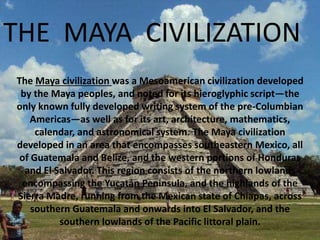
The Maya civilization was a Mesoamerican civilization developed
by the Maya peoples, and noted for its hieroglyphic script—the
only known fully developed writing system of the pre-Columbian
Americas—as well as for its art, architecture, mathematics,
calendar, and astronomical system. The Maya civilization
developed in an area that encompasses southeastern Mexico, all
of Guatemala and Belize, and the western portions of Honduras
and El Salvador. This region consists of the northern lowlands
encompassing the Yucatán Peninsula, and the highlands of the
Sierra Madre, running from the Mexican state of Chiapas, across
southern Guatemala and onwards into El Salvador, and the
southern lowlands of the Pacific littoral plain.
The Archaic period, prior to 2000 BC, saw the first developments in saw the
establishment of the first complex societies in the Maya region, agriculture and
the earliest villages. The Preclassic period (c. 2000 BC to 250 AD) and the
cultivation of the staple crops of the Maya diet, including maize, beans,
squashes, and chili peppers. The first Maya cities developed around 750 BC, and
by 500 BC these cities possessed monumental architecture, including large
temples with elaborate stucco façades. Hieroglyphic writing was being used in
the Maya region by the 3rd century BC. In the Late Preclassic a number of large
cities developed in the Petén Basin, and Kaminaljuyu rose to prominence in the
Guatemalan Highlands. Beginning around 250 AD, the Classic period is largely
defined as when the Maya were raising sculpted monuments with Long Count
dates. This period saw the Maya civilization develop a large number of city-
states linked by a complex trade network. In the Maya Lowlands two great
rivals, Tikal and Calakmul, became powerful. The Classic period also saw the
intrusive intervention of the central Mexican city of Teotihuacan in Maya
dynastic politics. In the 9th century, there was a widespread political collapse in
the central Maya region, resulting in internecine warfarem the abandonment of
cities, and a northward shift of population. The Postclassic period saw the rise
of Chichen Itza in the north, and the expansion of the aggressive K'iche'
kingdom in the Guatemalan Highlands. In the 16th century, the Spanish Empire
colonized the Mesoamerican region, and a lengthy series of campaigns saw the
fall of Nojpetén, the last Maya city in 1697
Classic period rule was centred on the concept of the
"divine king", who acted as a mediator between mortals
and the supernatural realm. Kingship was patrilineal,
and power would normally pass to the eldest son. A
prospective king was also expected to be a successful
war leader. Maya politics was dominated by a closed
system of patronage, although the exact political make-
up of a kingdom varied from city-state to city-state. By
the Late Classic, the aristocracy had greatly increased,
resulting in the corresponding reduction in the exclusive
power of the divine king. The Maya civilization
developed highly sophisticated artforms, and the Maya
created art using both perishable and non-perishable
materials, including wood, jade, obsidian, ceramics,
sculpted stone monuments, stucco, and finely painted
murals.
Maya cities tended to expand haphazardly, and the city centre
would be occupied by ceremonial and administrative complexes,
surrounded by an irregular sprawl of residential districts.
Different parts of a city would often be linked by causeways. The
principal architecture of the city consisted of palaces, pyramid-
temples, ceremonial ballcourts, and structures aligned for
astronomical observation. The Maya elite were literate, and
developed a complex system of hieroglyphic writing that was the
most advanced in the pre-Columbian Americas. The Maya
recorded their history and ritual knowledge in screenfold books,
of which only three uncontested examples remain, the rest
having been destroyed by the Spanish. There are also a great
many examples of Maya text found on stelae and ceramics. The
Maya developed a highly complex series of interlocking ritual
calendars, and employed mathematics that included one of the
earliest instances of the explicit zero in the world. As a part of
their religion, the Maya practised human sacrifice.
The history of Maya civilization is
divided into three principal periods:
the Preclassic, Classic, and Postclassic
periods. These were preceded by the
Archaic Period, during which the first
settled villages and early developments
in agriculture emerged. Modern
scholars regard these periods as
arbitrary divisions of Maya chronology,
rather than indicative of cultural
evolution or decline. Definitions of the
start and end dates of period spans can
vary by as much as a century,
depending on the author
THANKS FOR WATCHING
ΕΠΙΜΕΛΕΙΑ: Σουκαριέ
Τουλάιλ , Κόκκαλη
Γιώργου και Γκιουλέα
Στάθη

Maya

  • 1.
    THE MAYA CIVILIZATION TheMaya civilization was a Mesoamerican civilization developed by the Maya peoples, and noted for its hieroglyphic script—the only known fully developed writing system of the pre-Columbian Americas—as well as for its art, architecture, mathematics, calendar, and astronomical system. The Maya civilization developed in an area that encompasses southeastern Mexico, all of Guatemala and Belize, and the western portions of Honduras and El Salvador. This region consists of the northern lowlands encompassing the Yucatán Peninsula, and the highlands of the Sierra Madre, running from the Mexican state of Chiapas, across southern Guatemala and onwards into El Salvador, and the southern lowlands of the Pacific littoral plain.
  • 2.
    The Archaic period,prior to 2000 BC, saw the first developments in saw the establishment of the first complex societies in the Maya region, agriculture and the earliest villages. The Preclassic period (c. 2000 BC to 250 AD) and the cultivation of the staple crops of the Maya diet, including maize, beans, squashes, and chili peppers. The first Maya cities developed around 750 BC, and by 500 BC these cities possessed monumental architecture, including large temples with elaborate stucco façades. Hieroglyphic writing was being used in the Maya region by the 3rd century BC. In the Late Preclassic a number of large cities developed in the Petén Basin, and Kaminaljuyu rose to prominence in the Guatemalan Highlands. Beginning around 250 AD, the Classic period is largely defined as when the Maya were raising sculpted monuments with Long Count dates. This period saw the Maya civilization develop a large number of city- states linked by a complex trade network. In the Maya Lowlands two great rivals, Tikal and Calakmul, became powerful. The Classic period also saw the intrusive intervention of the central Mexican city of Teotihuacan in Maya dynastic politics. In the 9th century, there was a widespread political collapse in the central Maya region, resulting in internecine warfarem the abandonment of cities, and a northward shift of population. The Postclassic period saw the rise of Chichen Itza in the north, and the expansion of the aggressive K'iche' kingdom in the Guatemalan Highlands. In the 16th century, the Spanish Empire colonized the Mesoamerican region, and a lengthy series of campaigns saw the fall of Nojpetén, the last Maya city in 1697
  • 3.
    Classic period rulewas centred on the concept of the "divine king", who acted as a mediator between mortals and the supernatural realm. Kingship was patrilineal, and power would normally pass to the eldest son. A prospective king was also expected to be a successful war leader. Maya politics was dominated by a closed system of patronage, although the exact political make- up of a kingdom varied from city-state to city-state. By the Late Classic, the aristocracy had greatly increased, resulting in the corresponding reduction in the exclusive power of the divine king. The Maya civilization developed highly sophisticated artforms, and the Maya created art using both perishable and non-perishable materials, including wood, jade, obsidian, ceramics, sculpted stone monuments, stucco, and finely painted murals.
  • 4.
    Maya cities tendedto expand haphazardly, and the city centre would be occupied by ceremonial and administrative complexes, surrounded by an irregular sprawl of residential districts. Different parts of a city would often be linked by causeways. The principal architecture of the city consisted of palaces, pyramid- temples, ceremonial ballcourts, and structures aligned for astronomical observation. The Maya elite were literate, and developed a complex system of hieroglyphic writing that was the most advanced in the pre-Columbian Americas. The Maya recorded their history and ritual knowledge in screenfold books, of which only three uncontested examples remain, the rest having been destroyed by the Spanish. There are also a great many examples of Maya text found on stelae and ceramics. The Maya developed a highly complex series of interlocking ritual calendars, and employed mathematics that included one of the earliest instances of the explicit zero in the world. As a part of their religion, the Maya practised human sacrifice.
  • 5.
    The history ofMaya civilization is divided into three principal periods: the Preclassic, Classic, and Postclassic periods. These were preceded by the Archaic Period, during which the first settled villages and early developments in agriculture emerged. Modern scholars regard these periods as arbitrary divisions of Maya chronology, rather than indicative of cultural evolution or decline. Definitions of the start and end dates of period spans can vary by as much as a century, depending on the author
  • 6.
    THANKS FOR WATCHING ΕΠΙΜΕΛΕΙΑ:Σουκαριέ Τουλάιλ , Κόκκαλη Γιώργου και Γκιουλέα Στάθη