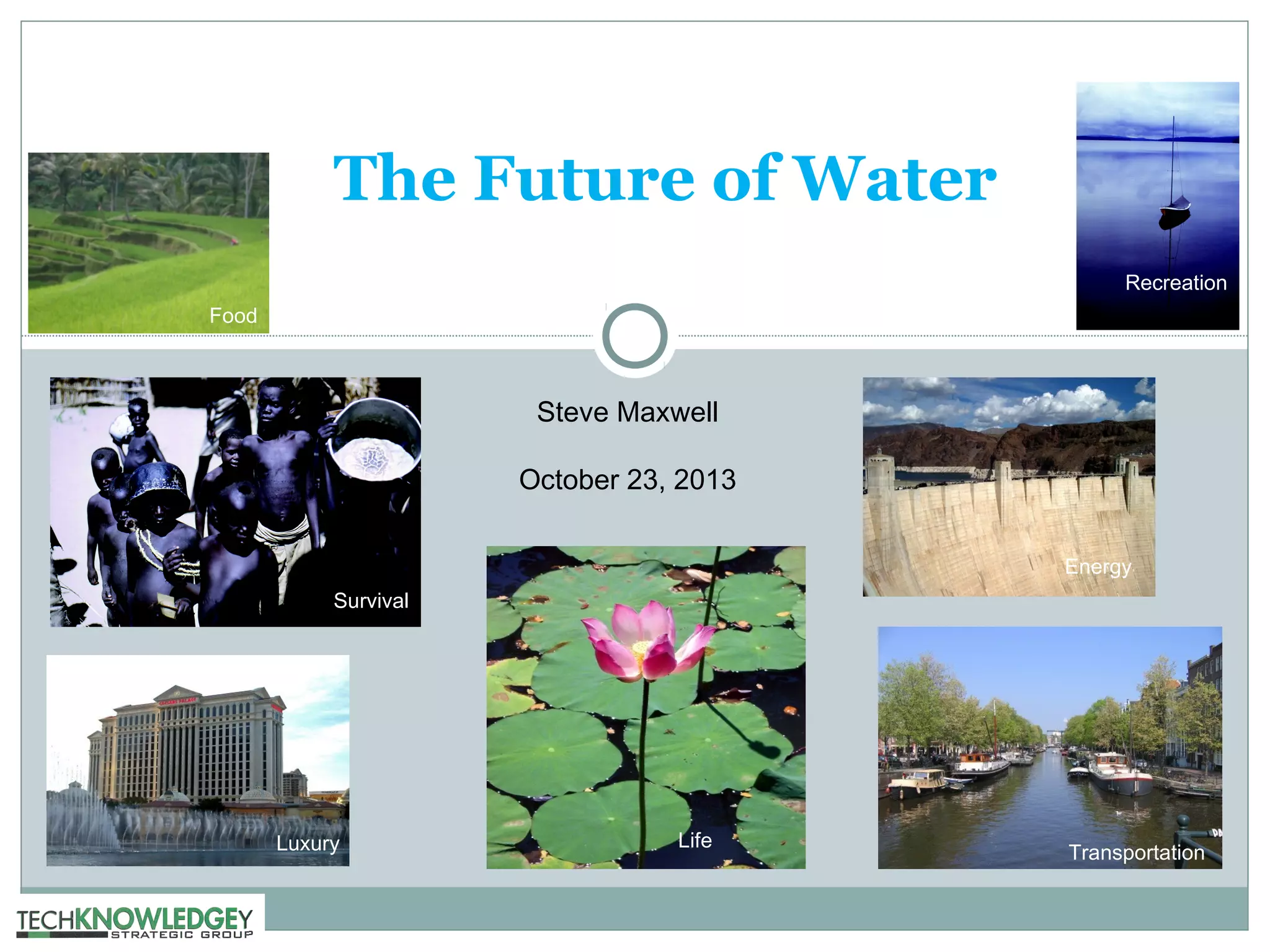
The Future of Water
Recreation
Food

Steve Maxwell
October 23, 2013
Energy
Survival

Luxury

Life

Transportation
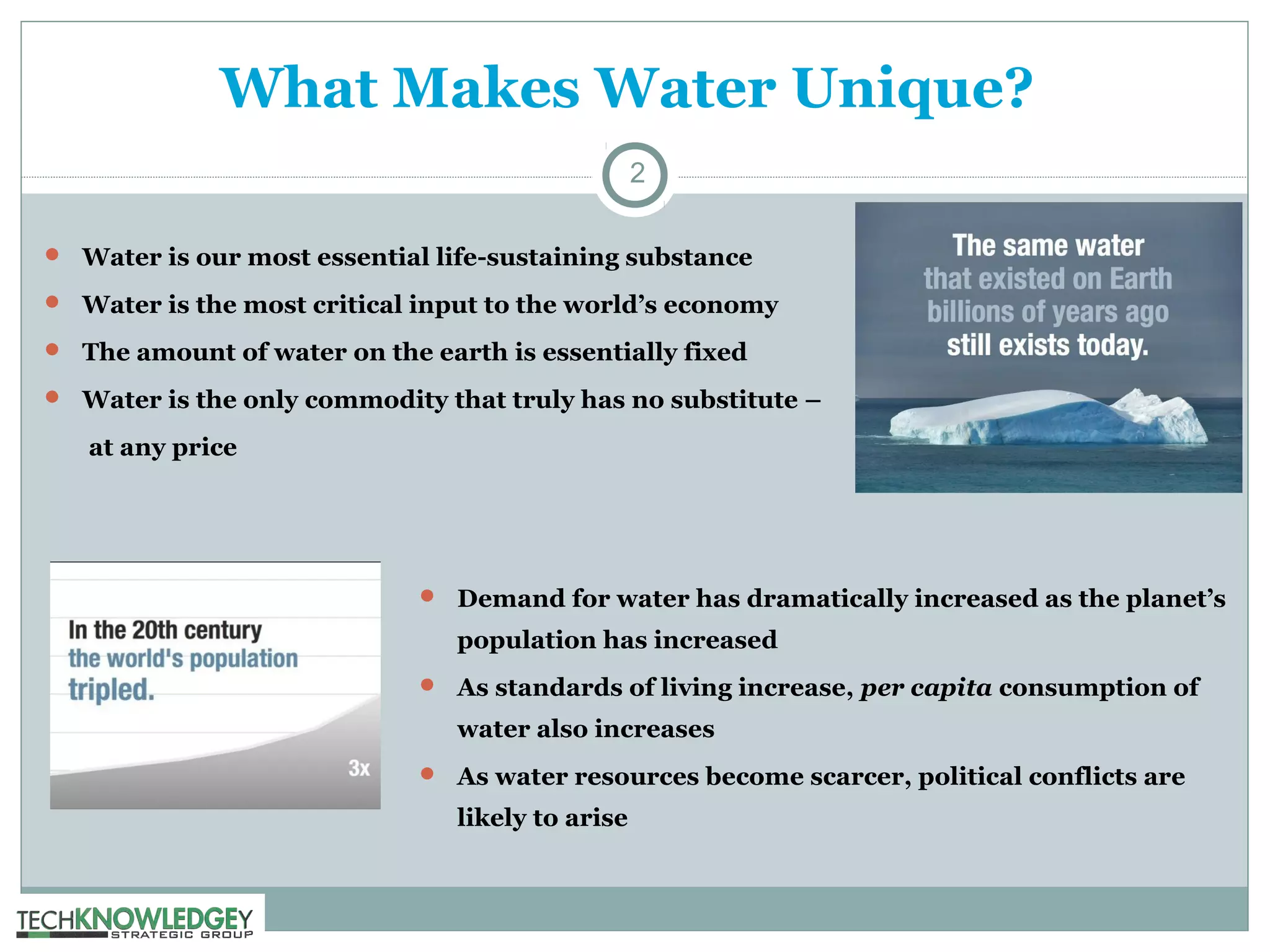
What Makes Water Unique?
2
 Water is our most essential life-sustaining substance
 Water is the most critical input to the world’s economy
 The amount of water on the earth is essentially fixed
 Water is the only commodity that truly has no substitute –

at any price

 Demand for water has dramatically increased as the planet’s

population has increased
 As standards of living increase, per capita consumption of

water also increases
 As water resources become scarcer, political conflicts are

likely to arise
Background and Context
3
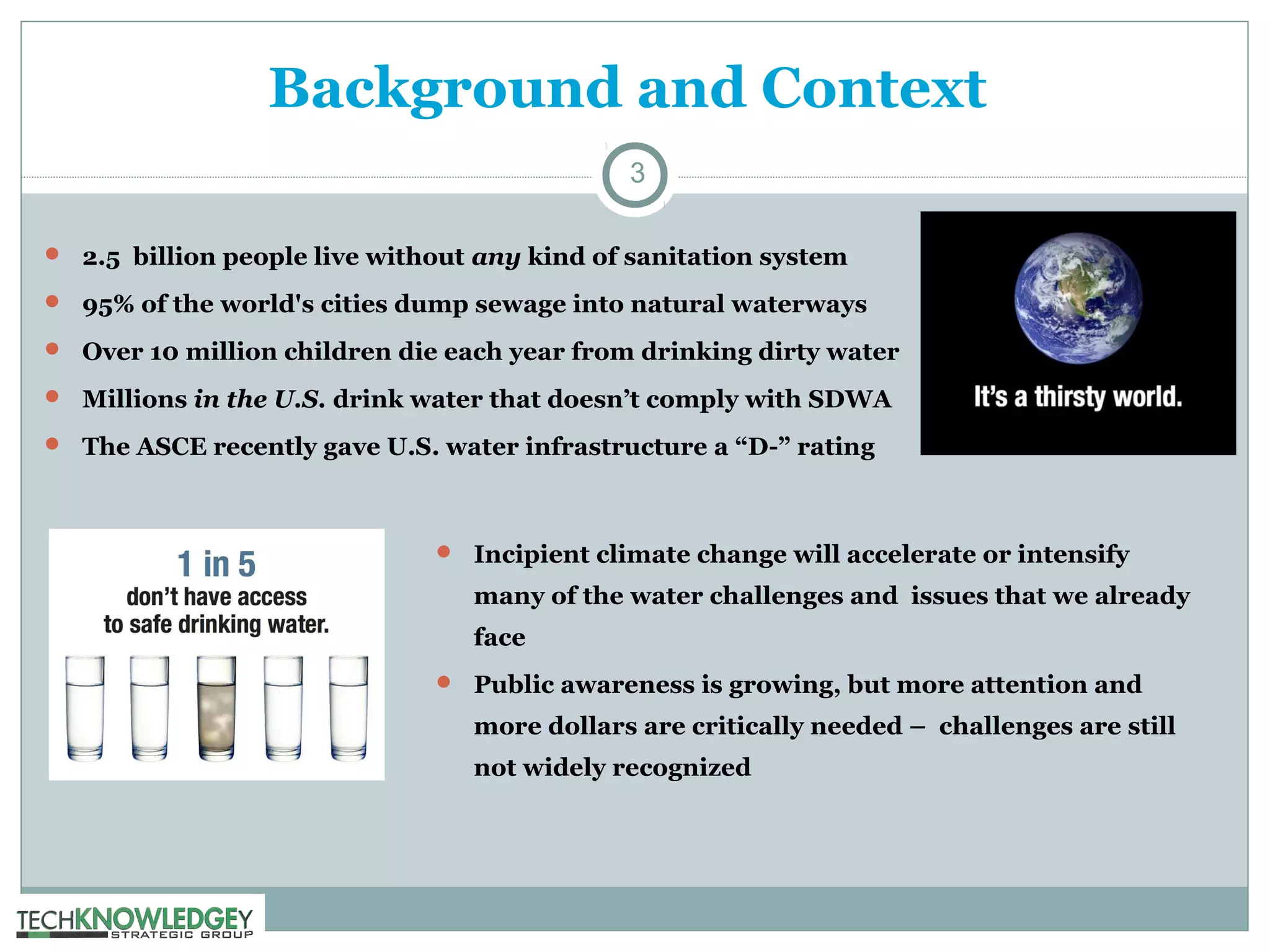
 2.5 billion people live without any kind of sanitation system
 95% of the world's cities dump sewage into natural waterways
 Over 10 million children die each year from drinking dirty water
 Millions in the U.S. drink water that doesn’t comply with SDWA
 The ASCE recently gave U.S. water infrastructure a “D-” rating

 Incipient climate change will accelerate or intensify

many of the water challenges and issues that we already
face
 Public awareness is growing, but more attention and

more dollars are critically needed – challenges are still
not widely recognized
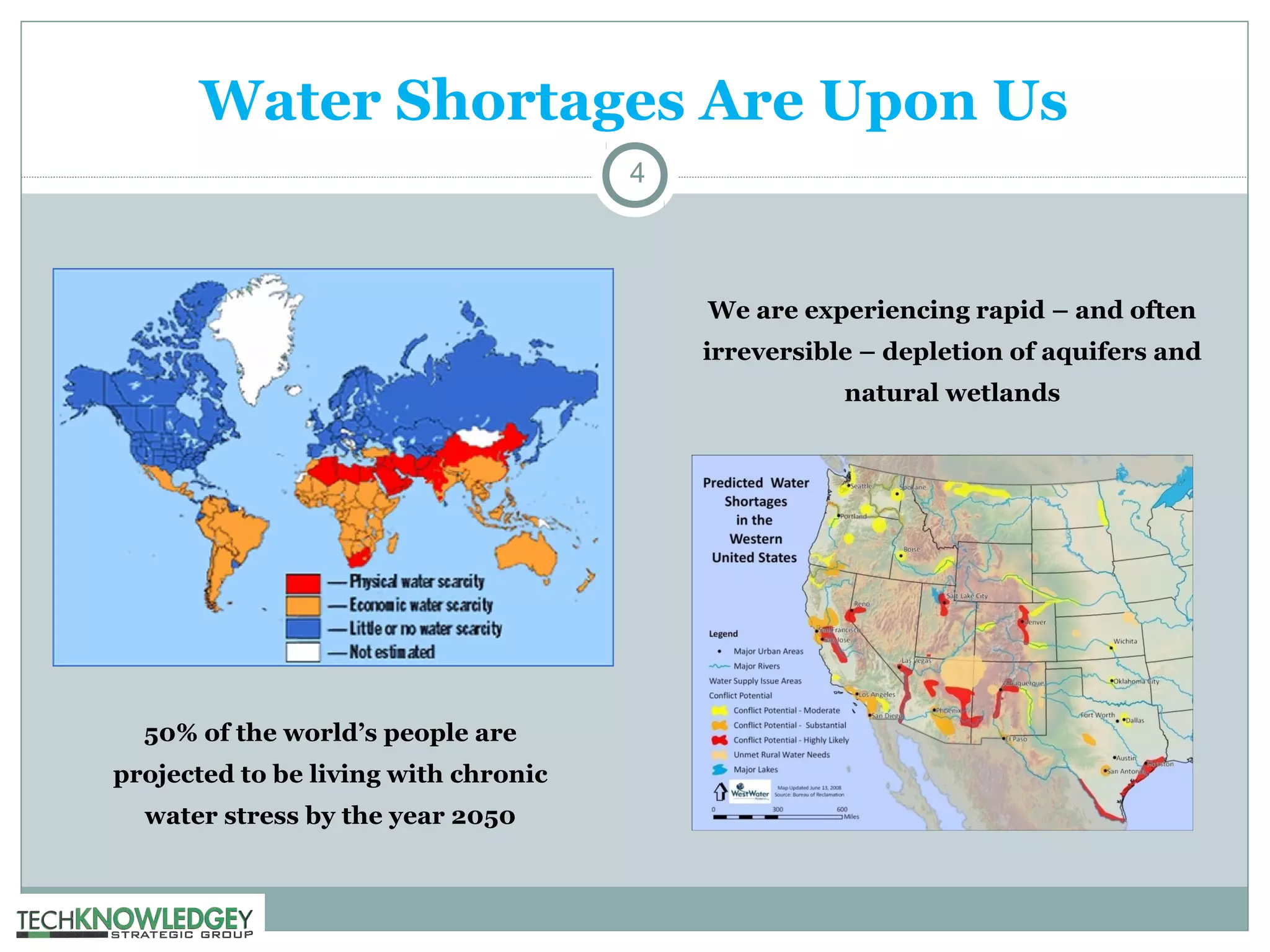
Water Shortages Are Upon Us
4

We are experiencing rapid – and often
irreversible – depletion of aquifers and
natural wetlands

50% of the world’s people are
projected to be living with chronic
water stress by the year 2050
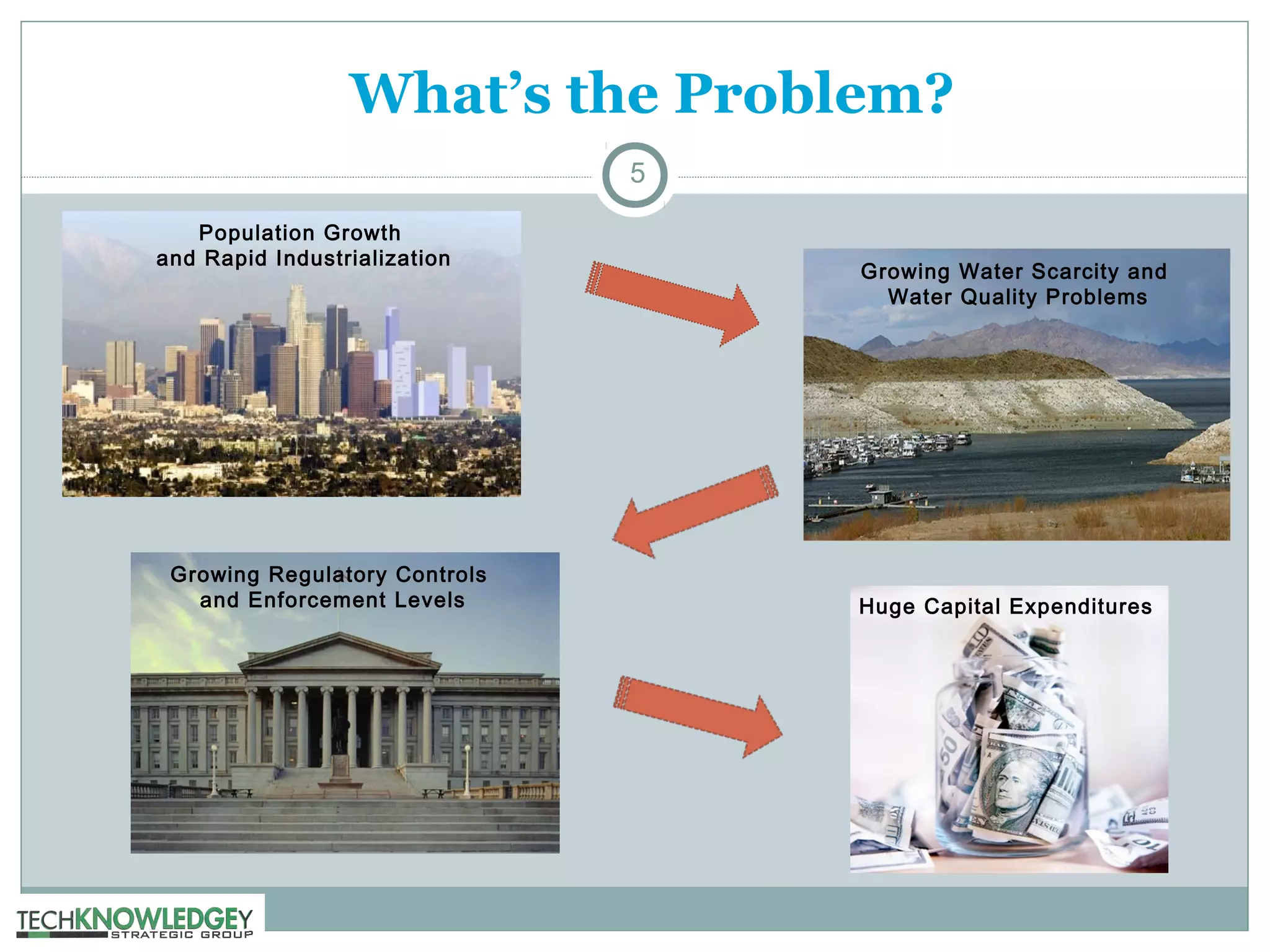
What’s the Problem?
5
Population Growth
and Rapid Industrialization

Growing Regulatory Controls
and Enforcement Levels

Growing Water Scarcity and
Water Quality Problems

Huge Capital Expenditures
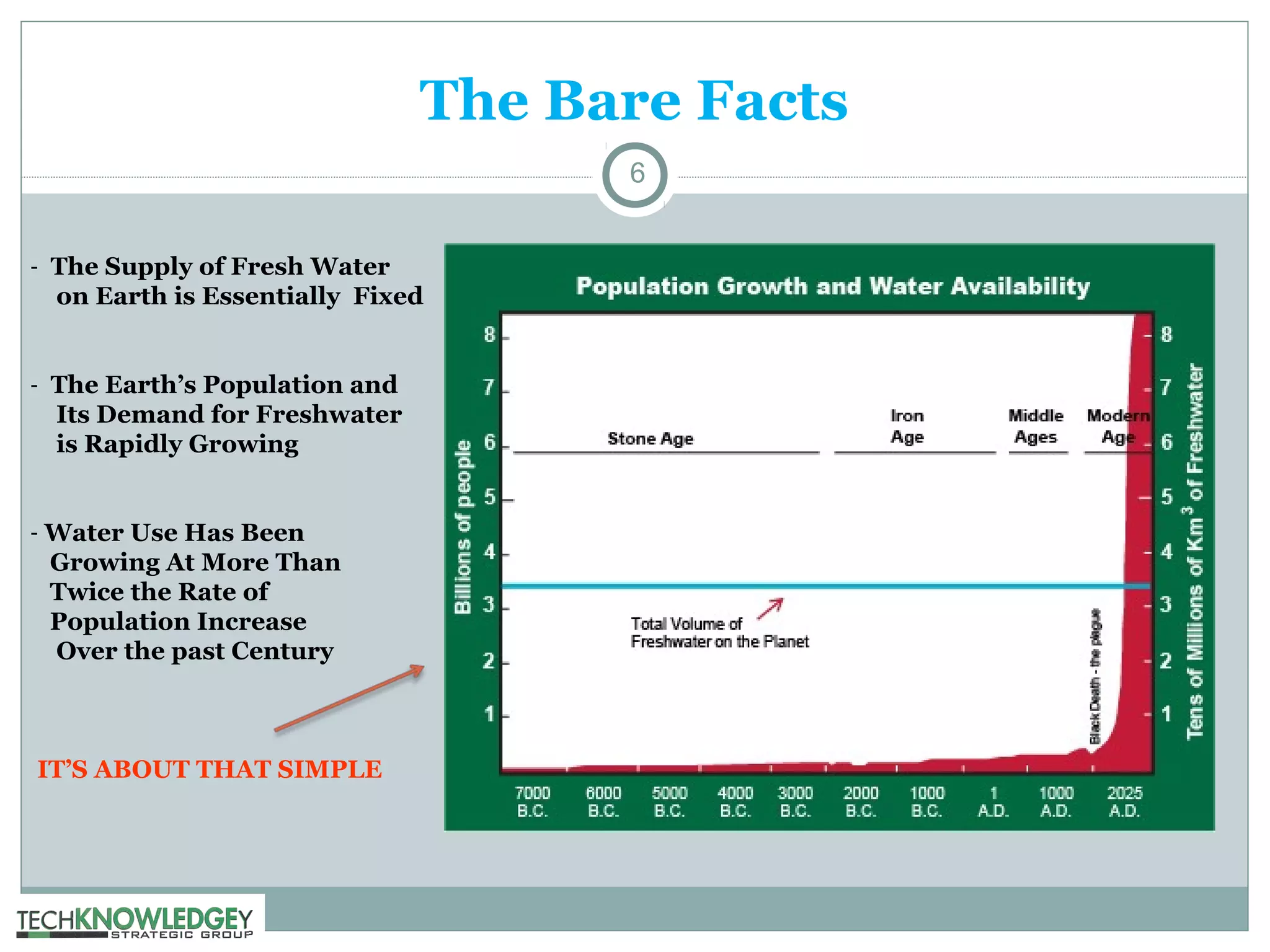
The Bare Facts
6
- The Supply of Fresh Water

on Earth is Essentially Fixed
- The Earth’s Population and

Its Demand for Freshwater
is Rapidly Growing
- Water Use Has Been

Growing At More Than
Twice the Rate of
Population Increase
Over the past Century

IT’S ABOUT THAT SIMPLE
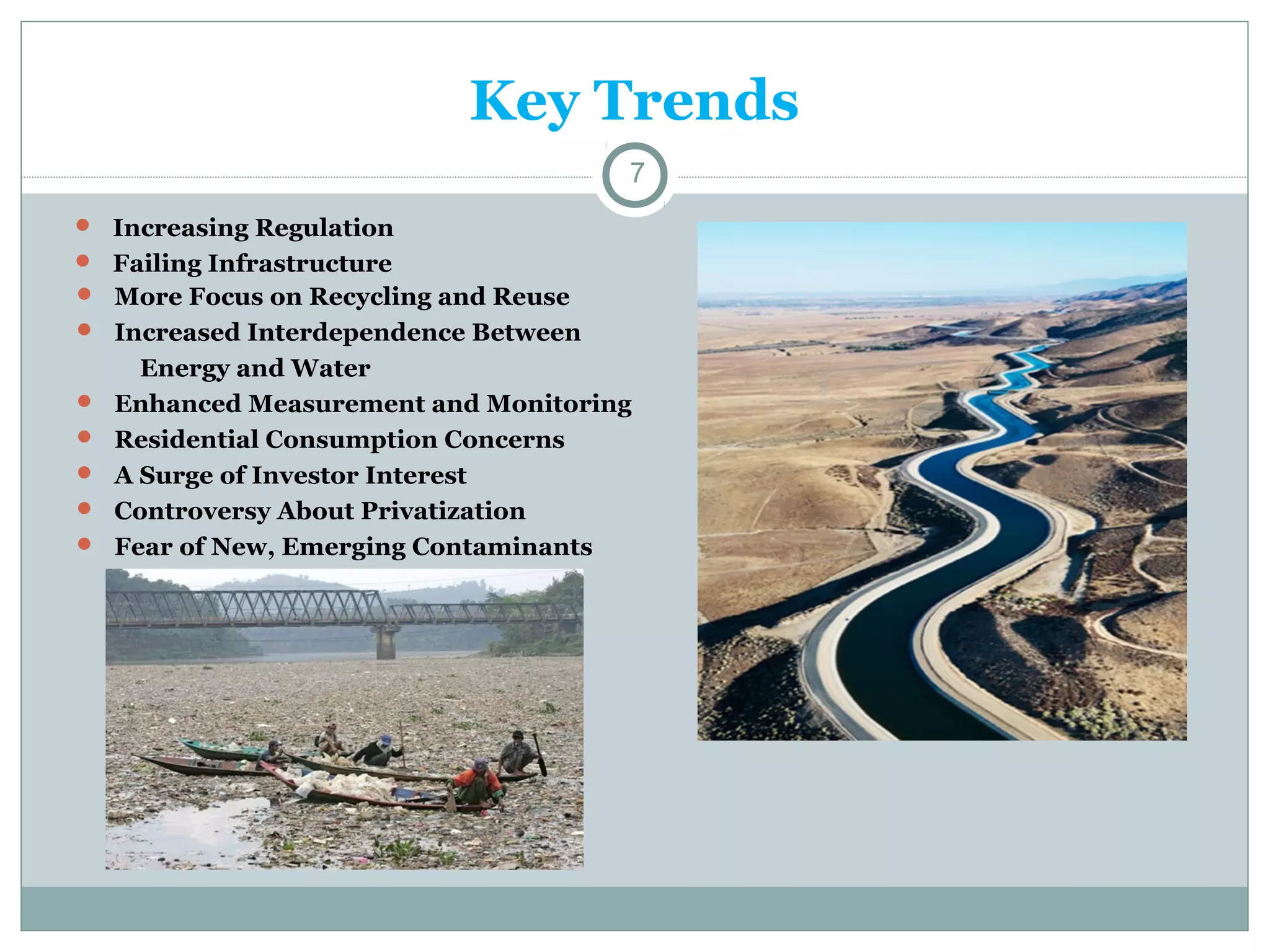
Key Trends
7
 Increasing Regulation
 Failing Infrastructure
 More Focus on Recycling and Reuse
 Increased Interdependence Between






Energy and Water
Enhanced Measurement and Monitoring
Residential Consumption Concerns
A Surge of Investor Interest
Controversy About Privatization
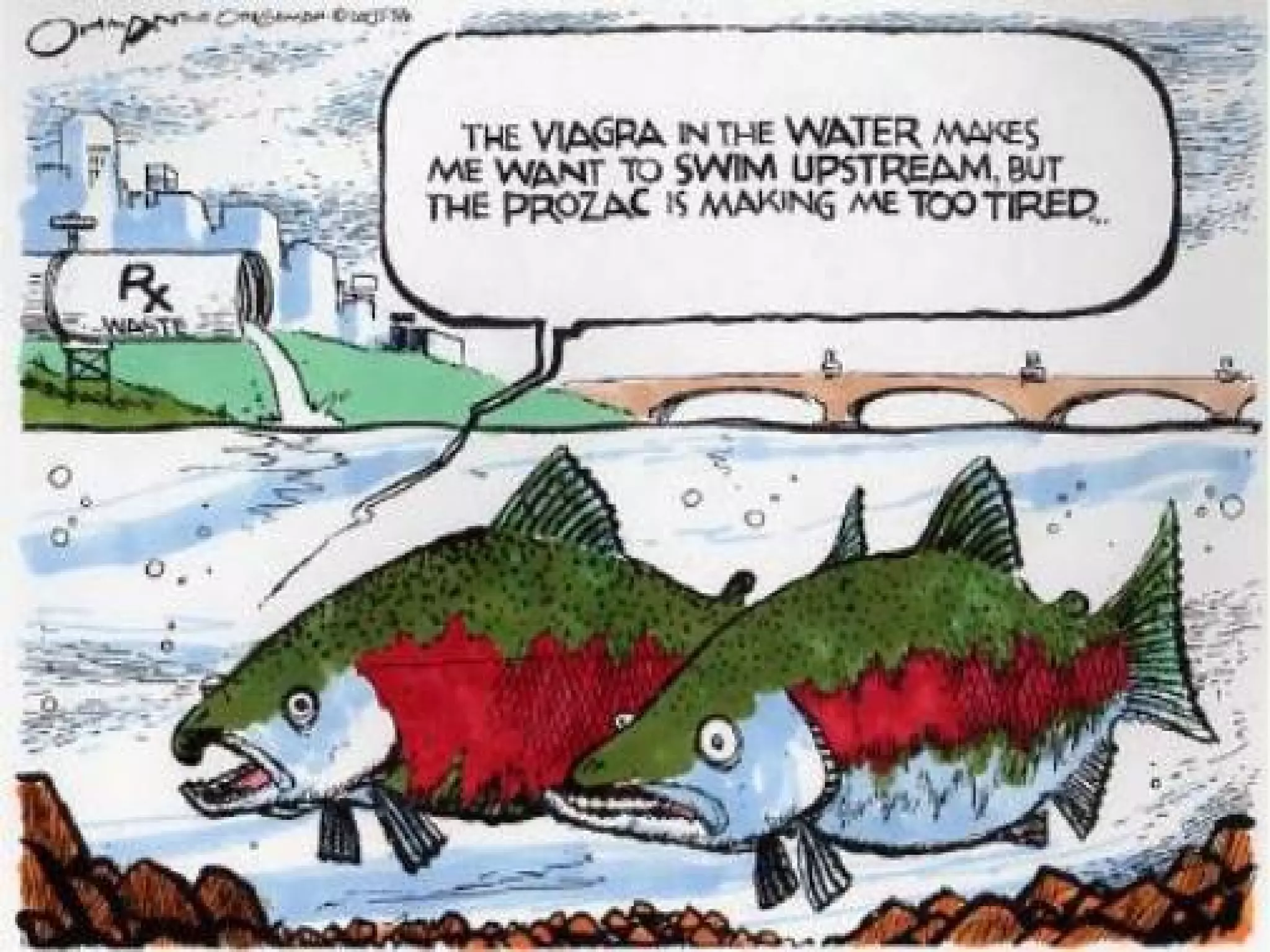
Fear of New, Emerging Contaminants
Emerging Solutions
9
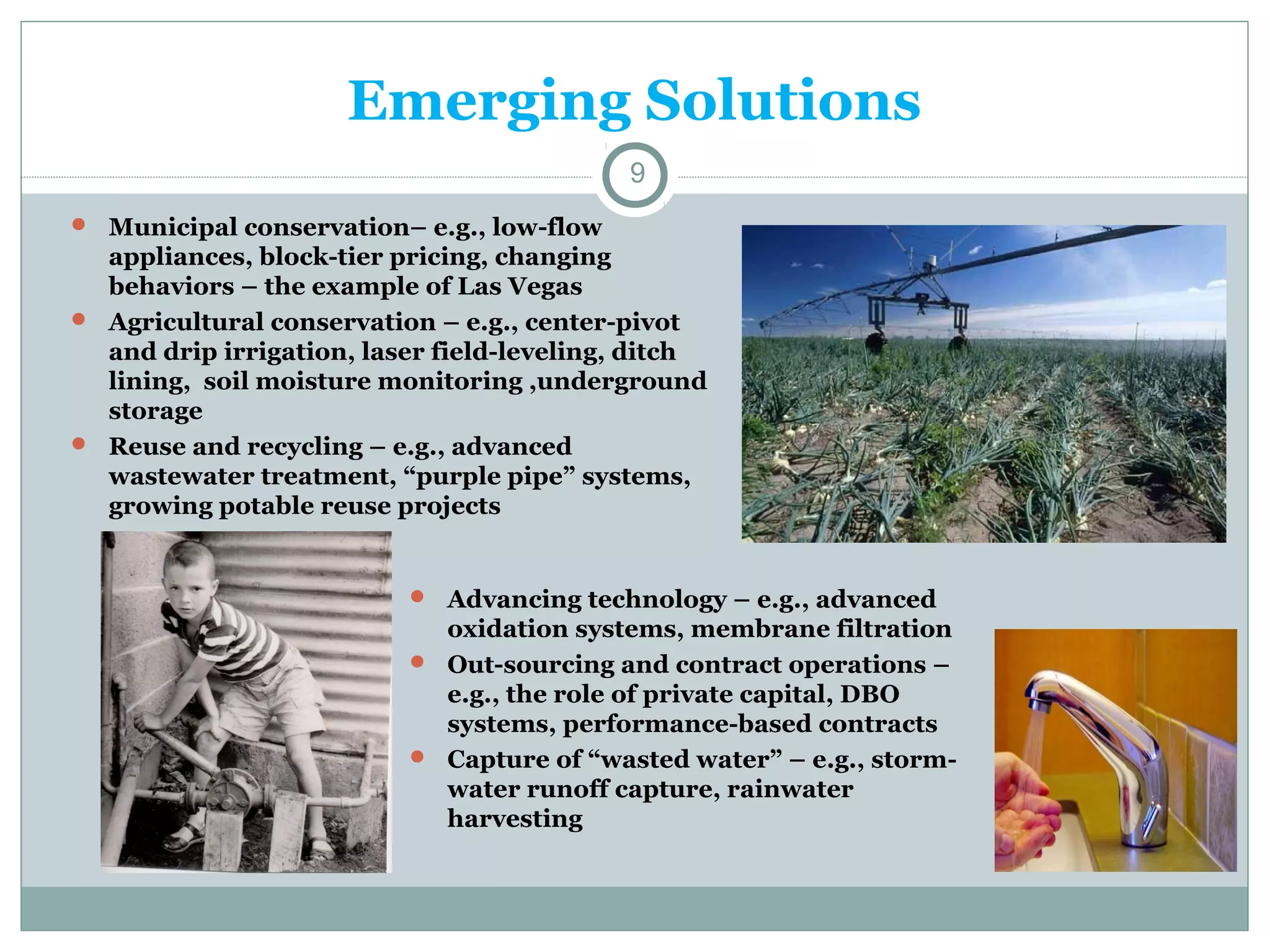
 Municipal conservation– e.g., low-flow

appliances, block-tier pricing, changing
behaviors – the example of Las Vegas
 Agricultural conservation – e.g., center-pivot
and drip irrigation, laser field-leveling, ditch
lining, soil moisture monitoring ,underground
storage
 Reuse and recycling – e.g., advanced
wastewater treatment, “purple pipe” systems,
growing potable reuse projects

 Advancing technology – e.g., advanced

oxidation systems, membrane filtration
 Out-sourcing and contract operations –
e.g., the role of private capital, DBO
systems, performance-based contracts
 Capture of “wasted water” – e.g., stormwater runoff capture, rainwater
harvesting
The Future of Water: Four Key Themes
10



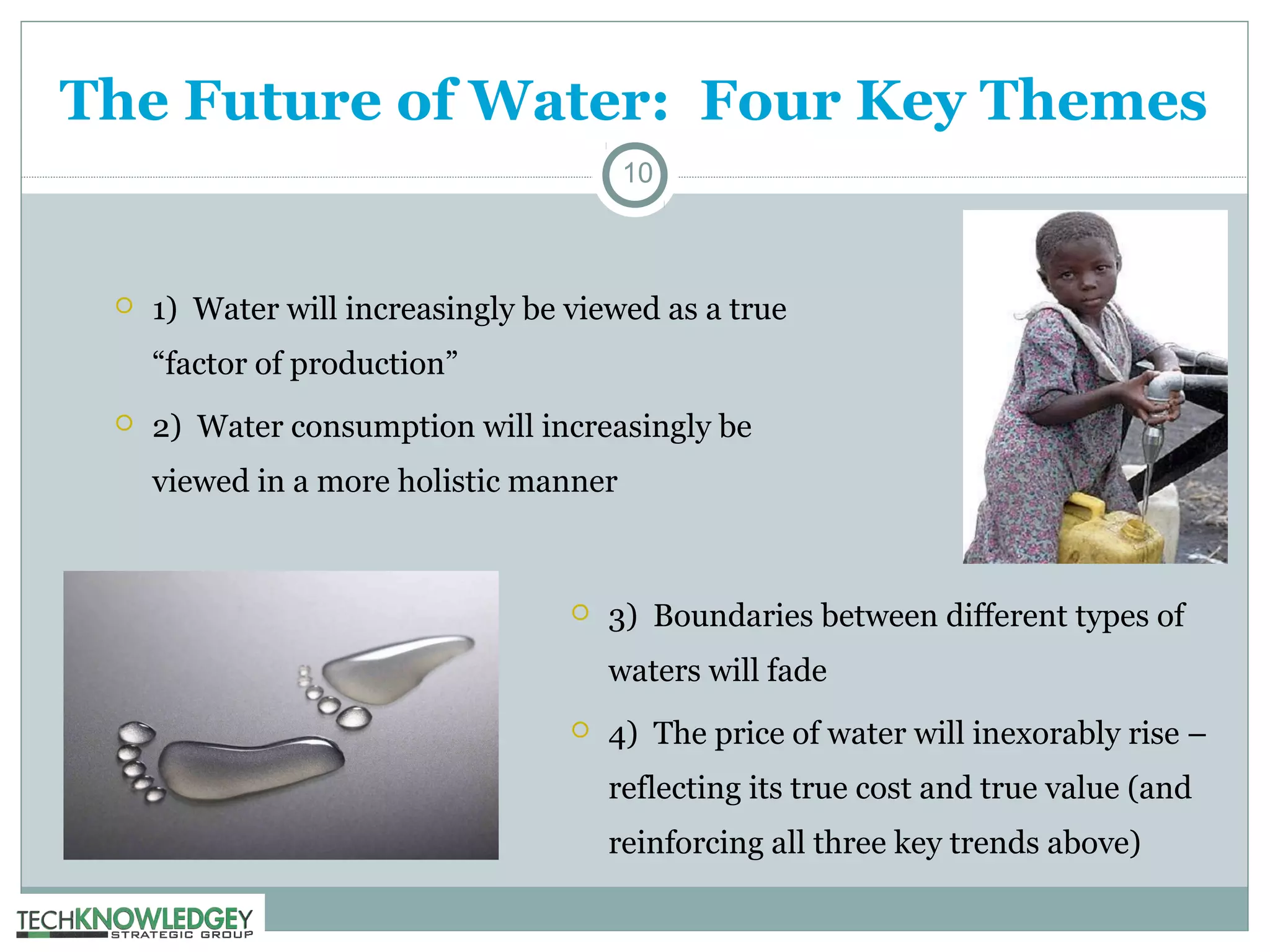
1) Water will increasingly be viewed as a true
“factor of production”



2) Water consumption will increasingly be
viewed in a more holistic manner



3) Boundaries between different types of
waters will fade



4) The price of water will inexorably rise –
reflecting its true cost and true value (and
reinforcing all three key trends above)
Water as a “Factor of Production”
11


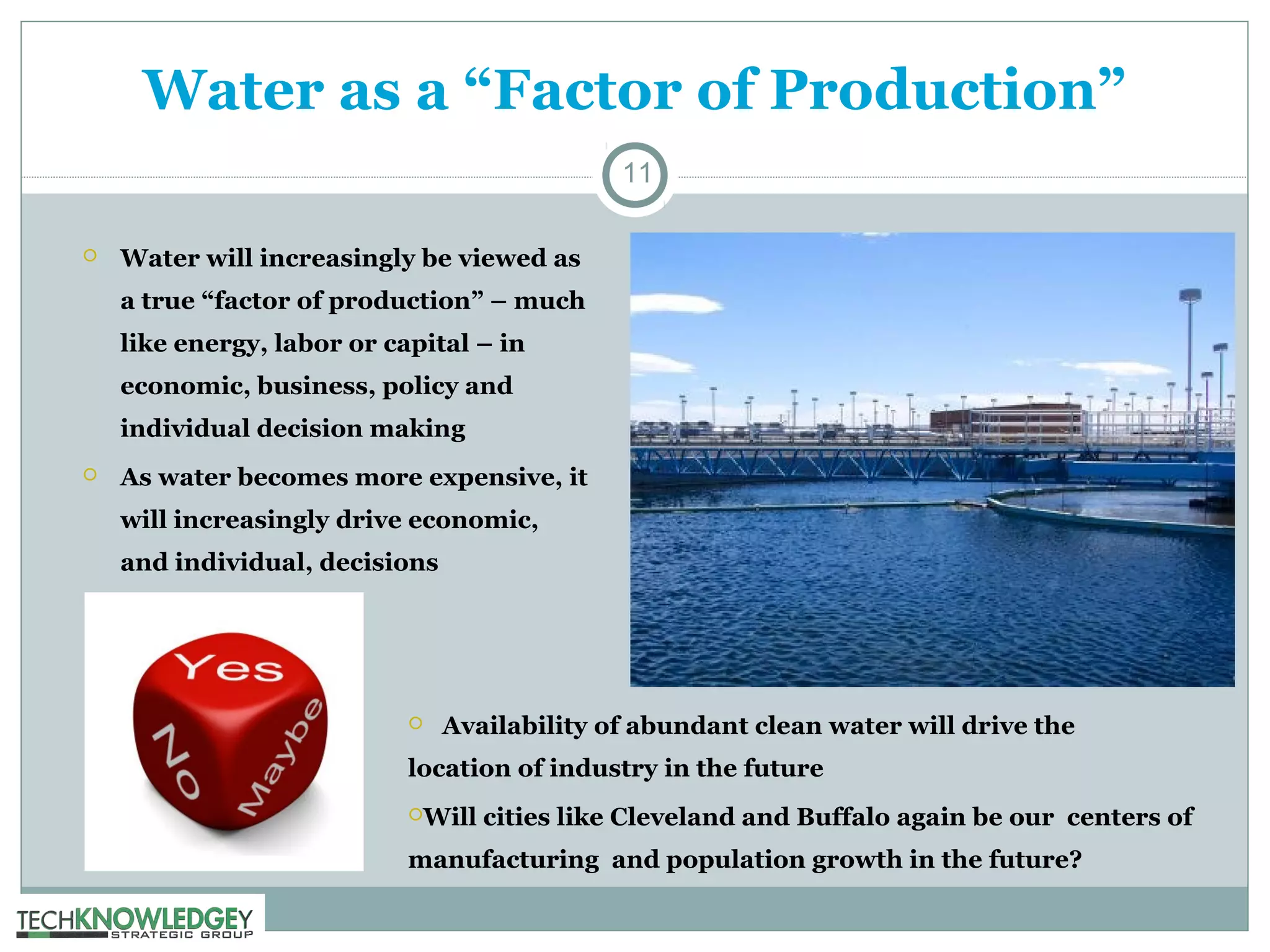
Water will increasingly be viewed as
a true “factor of production” – much
like energy, labor or capital – in
economic, business, policy and
individual decision making



As water becomes more expensive, it
will increasingly drive economic,
and individual, decisions



Availability of abundant clean water will drive the

location of industry in the future
Will

cities like Cleveland and Buffalo again be our centers of

manufacturing and population growth in the future?
A More Holistic View of Water
12


We only directly utilize some 50 to
300 gallons per day of water



But we consume far more water
contained in the products and
services that we consume, and the
various activities we engage in



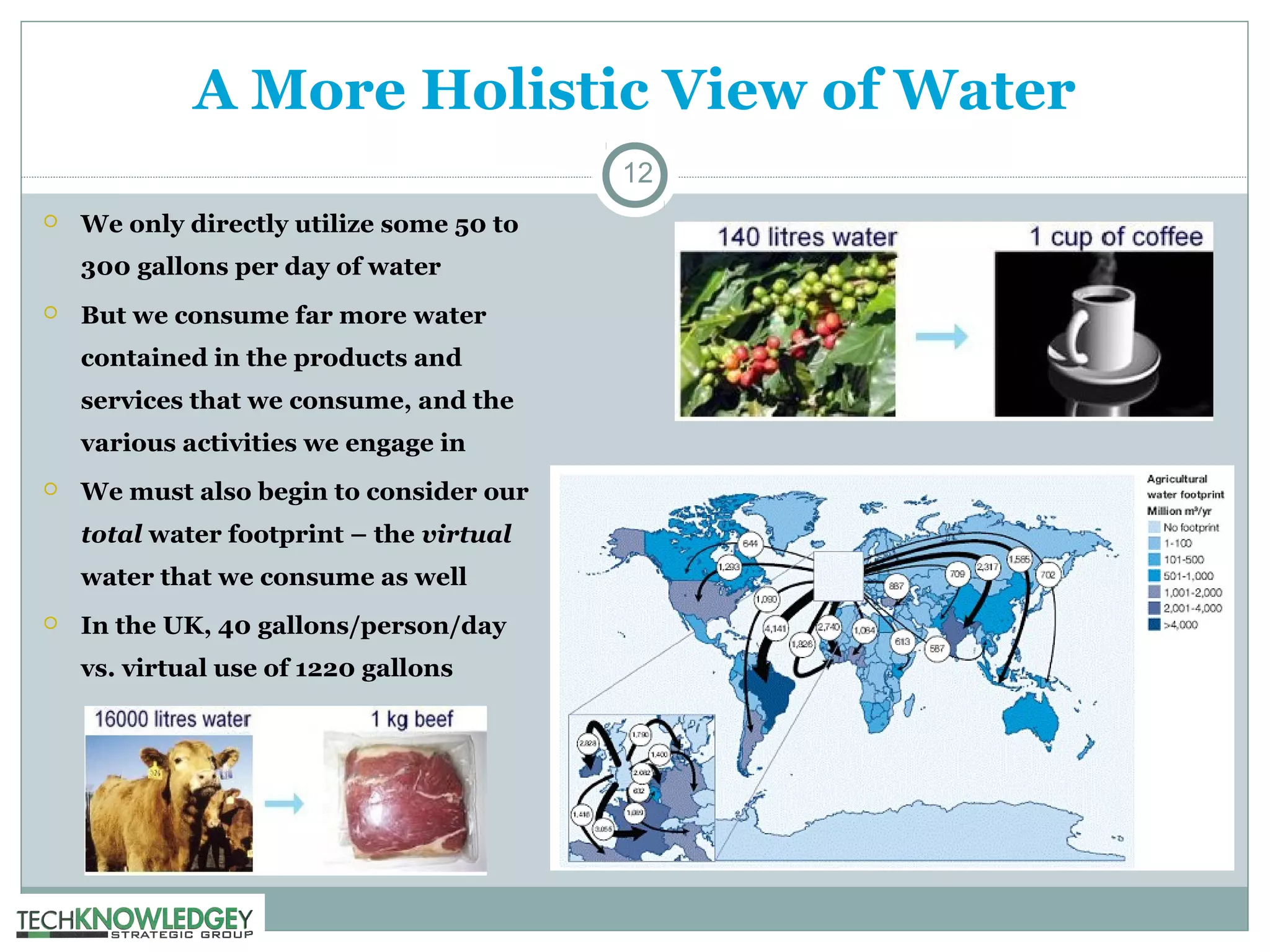
We must also begin to consider our
total water footprint – the virtual
water that we consume as well



In the UK, 40 gallons/person/day
vs. virtual use of 1220 gallons
Managing “One Water”
13



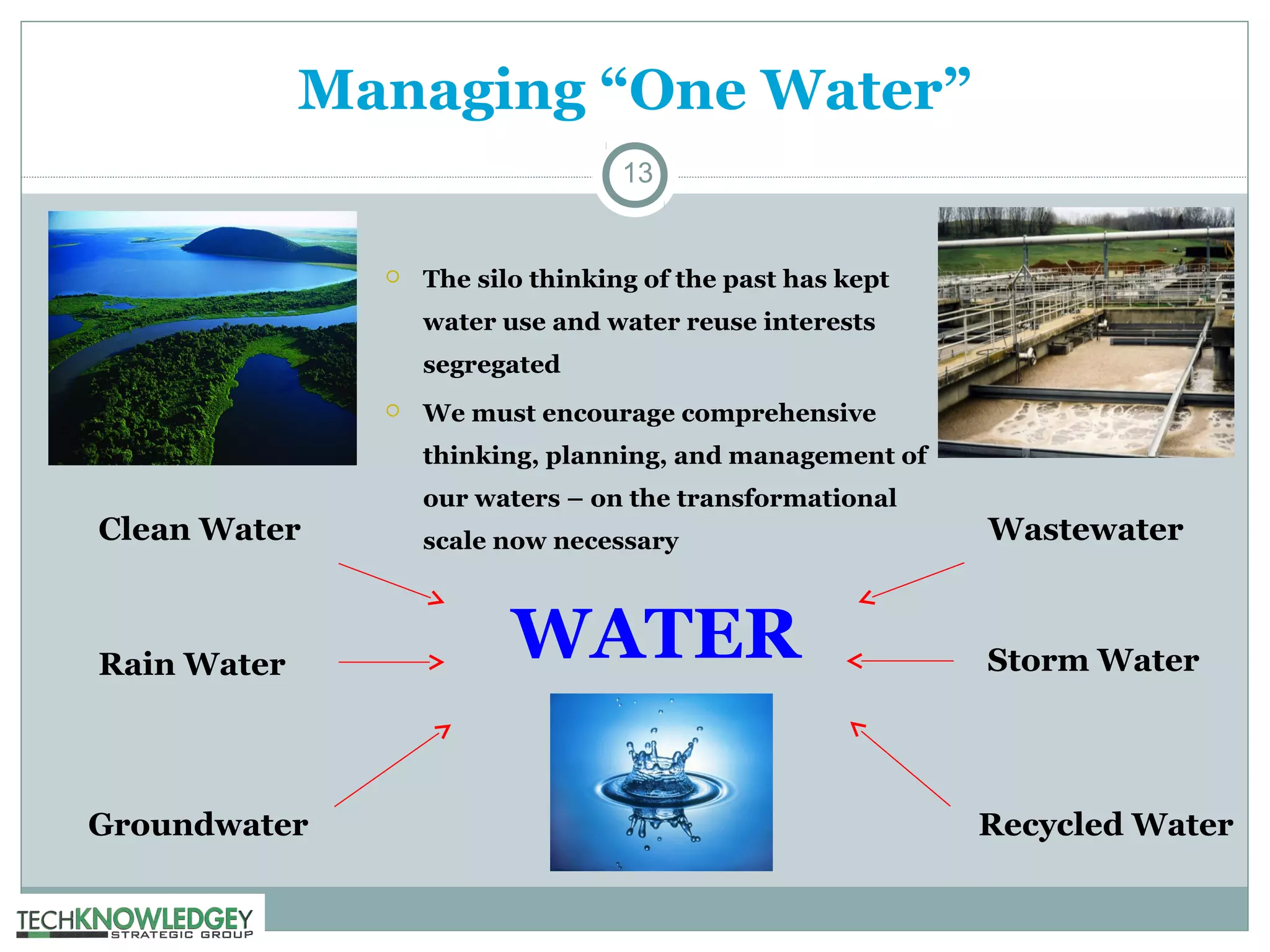
The silo thinking of the past has kept
water use and water reuse interests
segregated



We must encourage comprehensive
thinking, planning, and management of

Clean Water

Rain Water

Groundwater

our waters – on the transformational
scale now necessary

WATER

Wastewater

Storm Water

Recycled Water
Rising Water Prices
14


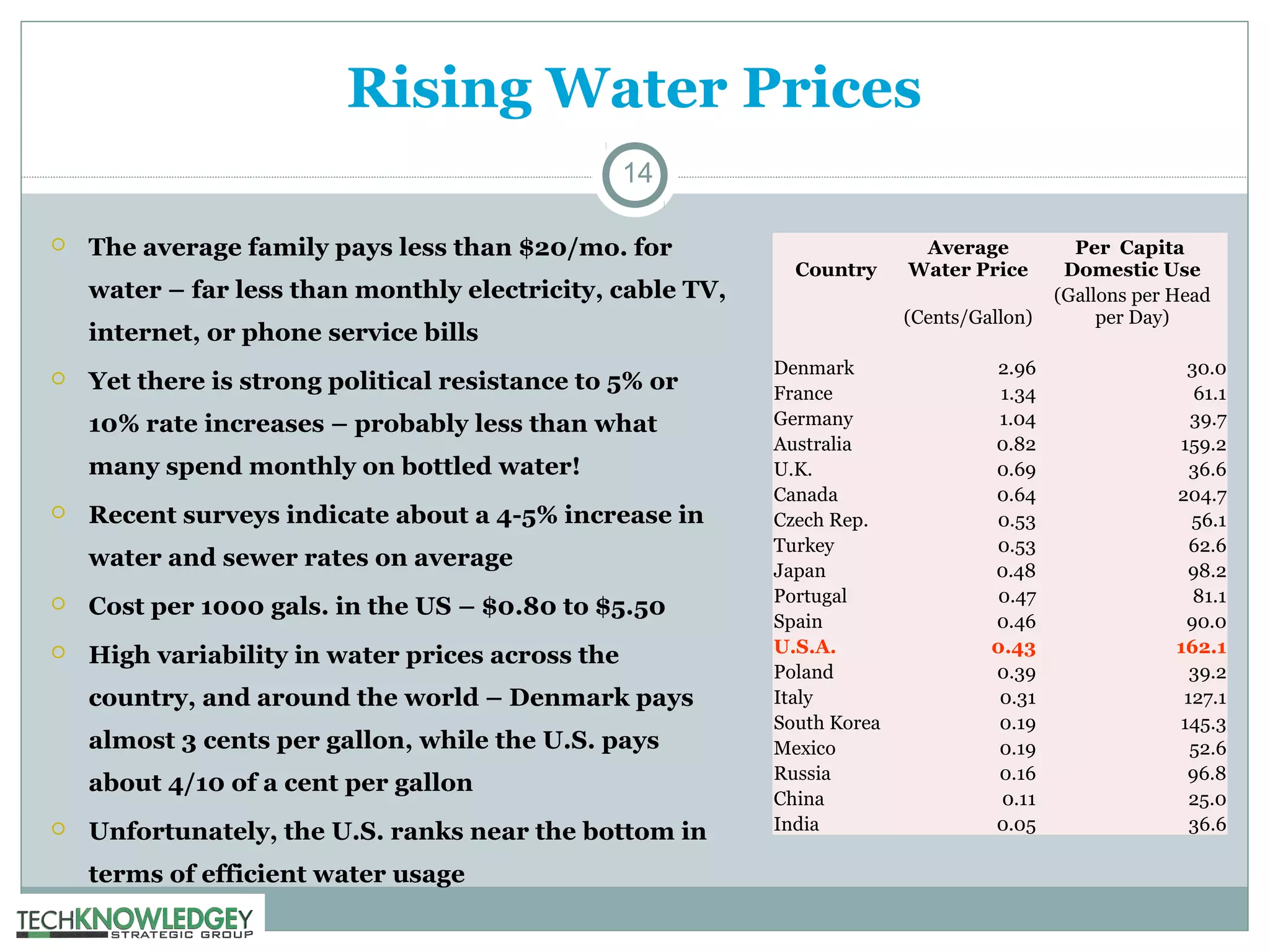
The average family pays less than $20/mo. for
water – far less than monthly electricity, cable TV,

Country

(Cents/Gallon)

internet, or phone service bills


Yet there is strong political resistance to 5% or
10% rate increases – probably less than what
many spend monthly on bottled water!



Recent surveys indicate about a 4-5% increase in
water and sewer rates on average



Cost per 1000 gals. in the US – $0.80 to $5.50



High variability in water prices across the
country, and around the world – Denmark pays
almost 3 cents per gallon, while the U.S. pays
about 4/10 of a cent per gallon



Unfortunately, the U.S. ranks near the bottom in
terms of efficient water usage

Average
Water Price

Denmark
France
Germany
Australia
U.K.
Canada
Czech Rep.
Turkey
Japan
Portugal
Spain
U.S.A.
Poland
Italy
South Korea
Mexico
Russia
China
India

2.96
1.34
1.04
0.82
0.69
0.64
0.53
0.53
0.48
0.47
0.46
0.43
0.39
0.31
0.19
0.19
0.16
0.11
0.05

Per Capita
Domestic Use
(Gallons per Head
per Day)
30.0
61.1
39.7
159.2
36.6
204.7
56.1
62.6
98.2
81.1
90.0
162.1
39.2
127.1
145.3
52.6
96.8
25.0
36.6
The Value of Water
15
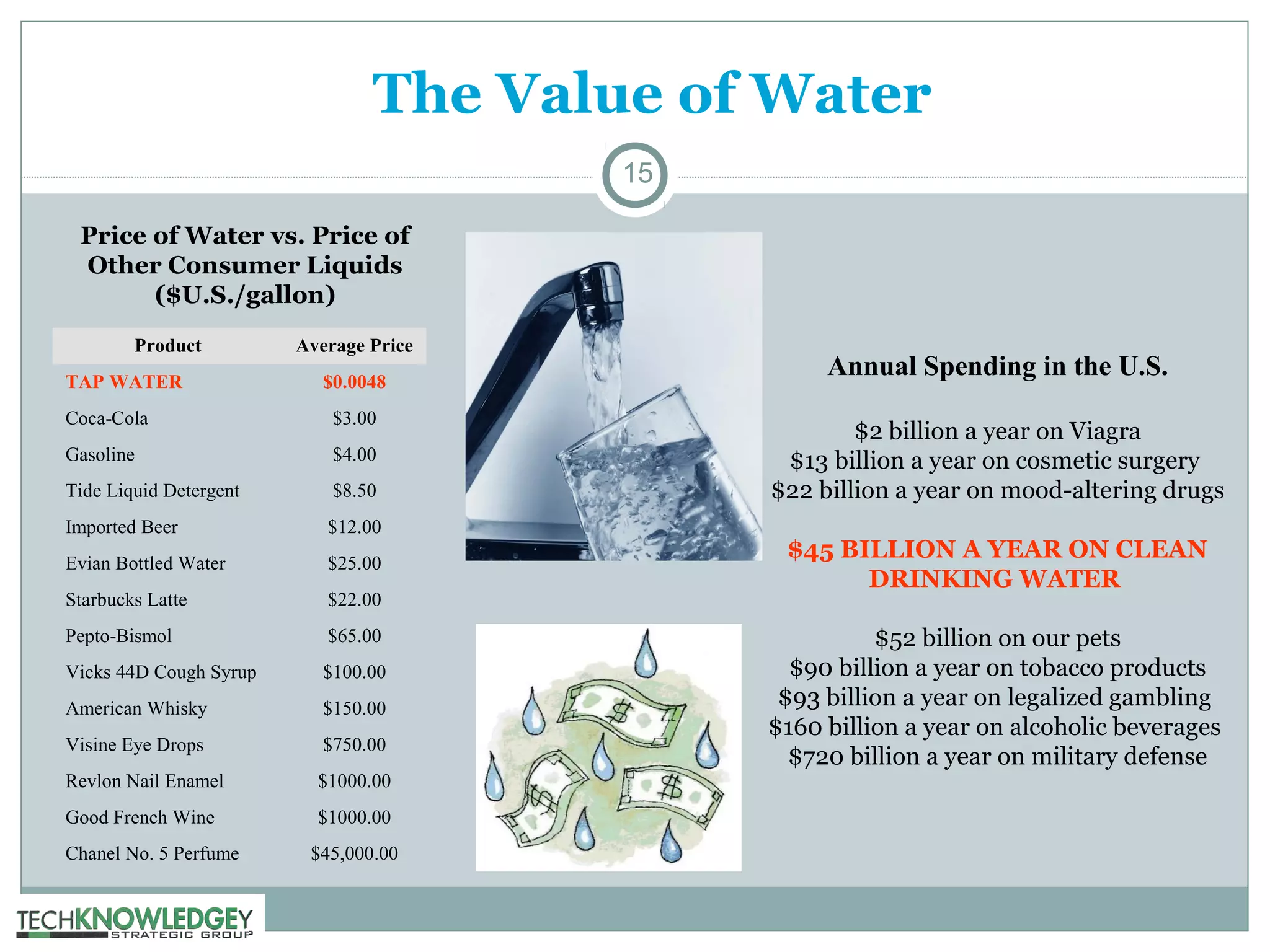
Price of Water vs. Price of
Other Consumer Liquids
($U.S./gallon)
Product
TAP WATER

Average Price
$0.0048

Coca-Cola

$3.00

Gasoline

$4.00

Tide Liquid Detergent

$8.50

Imported Beer

$12.00

Evian Bottled Water

$25.00

Starbucks Latte

$22.00

Pepto-Bismol

$65.00

Vicks 44D Cough Syrup

$100.00

American Whisky

$150.00

Visine Eye Drops

$750.00

Revlon Nail Enamel

$1000.00

Good French Wine

$1000.00

Chanel No. 5 Perfume

$45,000.00

Annual Spending in the U.S.
$2 billion a year on Viagra
$13 billion a year on cosmetic surgery
$22 billion a year on mood-altering drugs
$45 BILLION A YEAR ON CLEAN
DRINKING WATER
$52 billion on our pets
$90 billion a year on tobacco products
$93 billion a year on legalized gambling
$160 billion a year on alcoholic beverages
$720 billion a year on military defense
Future Trends
16


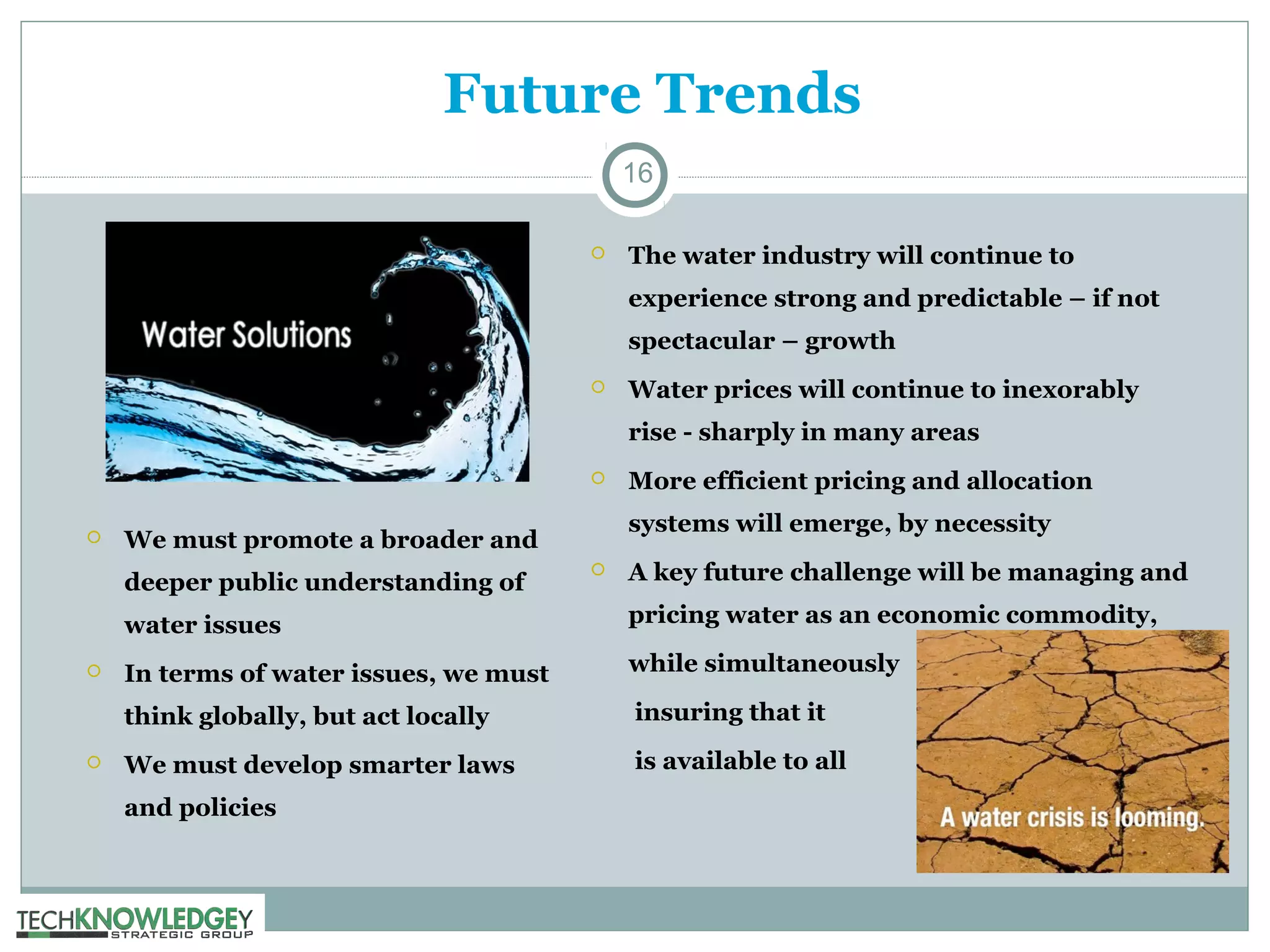
The water industry will continue to
experience strong and predictable – if not
spectacular – growth



Water prices will continue to inexorably
rise - sharply in many areas




systems will emerge, by necessity

We must promote a broader and
deeper public understanding of

More efficient pricing and allocation



A key future challenge will be managing and

water issues



In terms of water issues, we must

while simultaneously

think globally, but act locally



pricing water as an economic commodity,

insuring that it

We must develop smarter laws

is available to all

and policies

NZC - Maxwell

  • 1.
    The Future ofWater Recreation Food Steve Maxwell October 23, 2013 Energy Survival Luxury Life Transportation
  • 2.
    What Makes WaterUnique? 2  Water is our most essential life-sustaining substance  Water is the most critical input to the world’s economy  The amount of water on the earth is essentially fixed  Water is the only commodity that truly has no substitute – at any price  Demand for water has dramatically increased as the planet’s population has increased  As standards of living increase, per capita consumption of water also increases  As water resources become scarcer, political conflicts are likely to arise
  • 3.
    Background and Context 3 2.5 billion people live without any kind of sanitation system  95% of the world's cities dump sewage into natural waterways  Over 10 million children die each year from drinking dirty water  Millions in the U.S. drink water that doesn’t comply with SDWA  The ASCE recently gave U.S. water infrastructure a “D-” rating  Incipient climate change will accelerate or intensify many of the water challenges and issues that we already face  Public awareness is growing, but more attention and more dollars are critically needed – challenges are still not widely recognized
  • 4.
    Water Shortages AreUpon Us 4 We are experiencing rapid – and often irreversible – depletion of aquifers and natural wetlands 50% of the world’s people are projected to be living with chronic water stress by the year 2050
  • 5.
    What’s the Problem? 5 PopulationGrowth and Rapid Industrialization Growing Regulatory Controls and Enforcement Levels Growing Water Scarcity and Water Quality Problems Huge Capital Expenditures
  • 6.
    The Bare Facts 6 -The Supply of Fresh Water on Earth is Essentially Fixed - The Earth’s Population and Its Demand for Freshwater is Rapidly Growing - Water Use Has Been Growing At More Than Twice the Rate of Population Increase Over the past Century IT’S ABOUT THAT SIMPLE
  • 7.
    Key Trends 7  IncreasingRegulation  Failing Infrastructure  More Focus on Recycling and Reuse  Increased Interdependence Between      Energy and Water Enhanced Measurement and Monitoring Residential Consumption Concerns A Surge of Investor Interest Controversy About Privatization Fear of New, Emerging Contaminants
  • 9.
    Emerging Solutions 9  Municipalconservation– e.g., low-flow appliances, block-tier pricing, changing behaviors – the example of Las Vegas  Agricultural conservation – e.g., center-pivot and drip irrigation, laser field-leveling, ditch lining, soil moisture monitoring ,underground storage  Reuse and recycling – e.g., advanced wastewater treatment, “purple pipe” systems, growing potable reuse projects  Advancing technology – e.g., advanced oxidation systems, membrane filtration  Out-sourcing and contract operations – e.g., the role of private capital, DBO systems, performance-based contracts  Capture of “wasted water” – e.g., stormwater runoff capture, rainwater harvesting
  • 10.
    The Future ofWater: Four Key Themes 10  1) Water will increasingly be viewed as a true “factor of production”  2) Water consumption will increasingly be viewed in a more holistic manner  3) Boundaries between different types of waters will fade  4) The price of water will inexorably rise – reflecting its true cost and true value (and reinforcing all three key trends above)
  • 11.
    Water as a“Factor of Production” 11  Water will increasingly be viewed as a true “factor of production” – much like energy, labor or capital – in economic, business, policy and individual decision making  As water becomes more expensive, it will increasingly drive economic, and individual, decisions  Availability of abundant clean water will drive the location of industry in the future Will cities like Cleveland and Buffalo again be our centers of manufacturing and population growth in the future?
  • 12.
    A More HolisticView of Water 12  We only directly utilize some 50 to 300 gallons per day of water  But we consume far more water contained in the products and services that we consume, and the various activities we engage in  We must also begin to consider our total water footprint – the virtual water that we consume as well  In the UK, 40 gallons/person/day vs. virtual use of 1220 gallons
  • 13.
    Managing “One Water” 13  Thesilo thinking of the past has kept water use and water reuse interests segregated  We must encourage comprehensive thinking, planning, and management of Clean Water Rain Water Groundwater our waters – on the transformational scale now necessary WATER Wastewater Storm Water Recycled Water
  • 14.
    Rising Water Prices 14  Theaverage family pays less than $20/mo. for water – far less than monthly electricity, cable TV, Country (Cents/Gallon) internet, or phone service bills  Yet there is strong political resistance to 5% or 10% rate increases – probably less than what many spend monthly on bottled water!  Recent surveys indicate about a 4-5% increase in water and sewer rates on average  Cost per 1000 gals. in the US – $0.80 to $5.50  High variability in water prices across the country, and around the world – Denmark pays almost 3 cents per gallon, while the U.S. pays about 4/10 of a cent per gallon  Unfortunately, the U.S. ranks near the bottom in terms of efficient water usage Average Water Price Denmark France Germany Australia U.K. Canada Czech Rep. Turkey Japan Portugal Spain U.S.A. Poland Italy South Korea Mexico Russia China India 2.96 1.34 1.04 0.82 0.69 0.64 0.53 0.53 0.48 0.47 0.46 0.43 0.39 0.31 0.19 0.19 0.16 0.11 0.05 Per Capita Domestic Use (Gallons per Head per Day) 30.0 61.1 39.7 159.2 36.6 204.7 56.1 62.6 98.2 81.1 90.0 162.1 39.2 127.1 145.3 52.6 96.8 25.0 36.6
  • 15.
    The Value ofWater 15 Price of Water vs. Price of Other Consumer Liquids ($U.S./gallon) Product TAP WATER Average Price $0.0048 Coca-Cola $3.00 Gasoline $4.00 Tide Liquid Detergent $8.50 Imported Beer $12.00 Evian Bottled Water $25.00 Starbucks Latte $22.00 Pepto-Bismol $65.00 Vicks 44D Cough Syrup $100.00 American Whisky $150.00 Visine Eye Drops $750.00 Revlon Nail Enamel $1000.00 Good French Wine $1000.00 Chanel No. 5 Perfume $45,000.00 Annual Spending in the U.S. $2 billion a year on Viagra $13 billion a year on cosmetic surgery $22 billion a year on mood-altering drugs $45 BILLION A YEAR ON CLEAN DRINKING WATER $52 billion on our pets $90 billion a year on tobacco products $93 billion a year on legalized gambling $160 billion a year on alcoholic beverages $720 billion a year on military defense
  • 16.
    Future Trends 16  The waterindustry will continue to experience strong and predictable – if not spectacular – growth  Water prices will continue to inexorably rise - sharply in many areas   systems will emerge, by necessity We must promote a broader and deeper public understanding of More efficient pricing and allocation  A key future challenge will be managing and water issues  In terms of water issues, we must while simultaneously think globally, but act locally  pricing water as an economic commodity, insuring that it We must develop smarter laws is available to all and policies