01/2012 
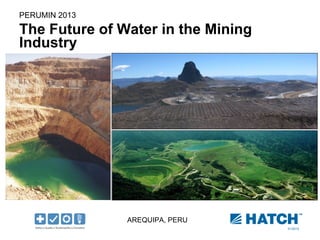
PERUMIN 2013 
The Future of Water in the Mining 
Industry 
AREQUIPA, PERU
2 
01/2012 
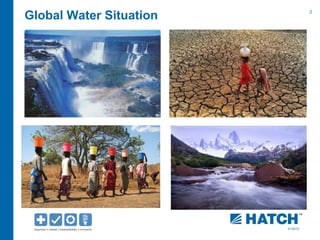
Global Water Situation
3 
01/2012 
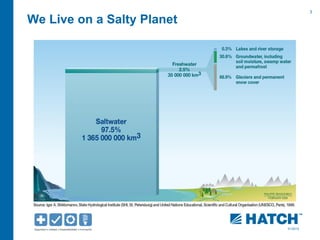
We Live on a Salty Planet
4 
01/2012 
A Growing Population Needs More Water 
From Allianz.com
5 
01/2012 
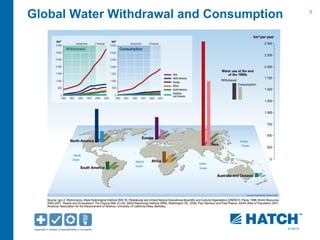
Global Water Withdrawal and Consumption
6 
01/2012 
Global Fresh Water Withdrawals 
Agriculture 
2,800 km3/yr 
70% 
Municipal & 
Domestic 
400 km3/yr 
10% 
Industrial/Energy 
800 km3/yr 
20% 
, 0, 0% 
Total global withdrawal approx 4,000 km3/yr in 2010 
Mining 
7-9 km3/yr 
0.2%
7 
01/2012 
Environmental Water Scarcity Index for 2030 
NIC, 2012
8 
01/2012 
Effects of Climate Change
9 
01/2012 
Water Challenges, Causes and Risks 
(From CEO Water Mandate, 2012)
10 
01/2012 
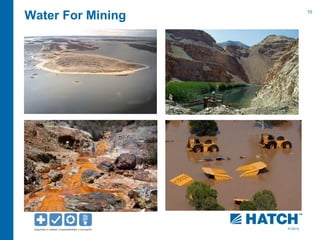
Water For Mining
11 
01/2012 
Copper Demand Curve 
(World Copper Factbook, 2010)
12 
01/2012 
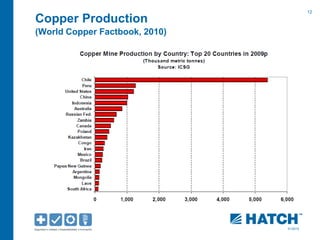
Copper Production 
(World Copper Factbook, 2010)
13 
01/2012 
Mining Industry Differentiators 
 Water is essential for most mining 
 Mining and processing often at a 
massive scale, large water 
requirements 
 Operations are relatively short lived, 
water requirements are temporary 
 Remote global locations 
 Little or no infrastructure 
 Often must deal with stringent 
regulatory requirements 
 Environmental sensitivity 
 Social issues and conflicts
14 
01/2012 
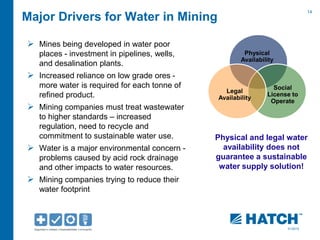
Major Drivers for Water in Mining 
 Mines being developed in water poor 
places - investment in pipelines, wells, 
and desalination plants. 
 Increased reliance on low grade ores - 
more water is required for each tonne of 
refined product. 
 Mining companies must treat wastewater 
to higher standards – increased 
regulation, need to recycle and 
commitment to sustainable water use. 
 Water is a major environmental concern - 
problems caused by acid rock drainage 
and other impacts to water resources. 
 Mining companies trying to reduce their 
water footprint 
Physical 
Availability 
Social 
License to 
Operate 
Legal 
Availability 
Physical and legal water 
availability does not 
guarantee a sustainable 
water supply solution!
15 
01/2012 
Future of Mine Water Resource Management
16 
01/2012 
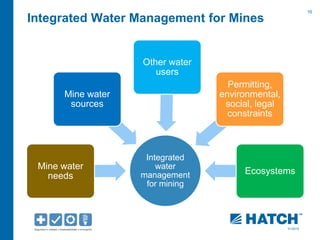
Integrated Water Management for Mines 
Integrated 
water 
management 
for mining 
Mine water 
needs 
Mine water 
sources 
Permitting, 
environmental, 
social, legal 
constraints 
Ecosystems 
Other water 
users
17 
01/2012 
Integrated Water Management – Key Areas 
ADMINISTRATIVE 
Meet regulatory standards 
Integrate water strategy into 
corporate and business unit 
strategies 
Develop management structure 
COMMUNITIES 
Engage early with all stakeholders, 
including communities 
Use water unsuitable for other 
industries, i.e., sea water 
TECHNOLOGICAL/INNOVATION 
Manage Water: 
Establish water balance 
Measurement instrumentation 
Manage database 
Audit results 
Preventive water use: 
Redesign process 
Minimize water losses 
Water-saving techniques 
Protective management strategies/ 
measures and technical solutions: 
Determine potential for AMD 
Identify discharge points 
Improvement of infrastructure to contain runoff 
Monitoring information management 
 Tools are available to proactively 
manage water
18 
01/2012 
Water Footprint, Carbon Footprint & Lifecycle 
Assessment 
WATER 
FOOTPRINT 
CARBON 
FOOTPRINT 
LIFE CYCLE 
ASSESSMENT 
Measures freshwater 
appropriation 
Measures emission 
GH-gases 
Measures overall 
environmental impact 
Spatial and temporal 
dimension 
No spatial / temporal 
dimension 
No spatial dimension 
Actual, locally specific 
values 
Global average values 
Actual water volume, 
no weighting 
Weighting water volume 
based on impacts 
Reducing specific water 
footprint (water use 
units are not 
interchangeable) 
Many efforts focused 
on offsetting (carbon 
emission units are 
interchangeable) 
Water footprint, 
Carbon footprint 
and Life Cycle 
Assessment are 
complementary 
tools
19 
01/2012 
Water Disclosure is Becoming a Reality
20 
01/2012 
Future of Water Governance 
 Future water governance changes will be seen in four main 
areas: technology, energy, water pricing and other users’ rights to 
water 
TECHNOLOGY ENERGY 
New technologies are developed to meet 
stringent regulations 
Conservation and efficient use 
VALUE OF WATER RIGHTS TO WATER 
Water supply and demand 
Conflicts and priorities 
Source: http://www.willmsshier.com/articles.asp?id=86
21 
01/2012 
Efficiency of Water Use for Mining 
 Corporate goals and commitment to efficient water use 
 Accurate water balance and measurements of water use 
 Process optimization to reduce waste water volumes 
 Improved tailings water management – thickened and dry stack 
tailings 
 Water re-use 
 Zero liquid discharge
22 
01/2012 
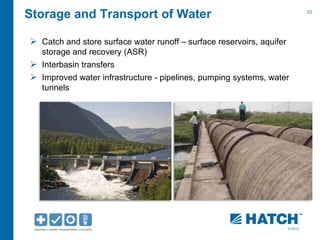
Storage and Transport of Water 
 Catch and store surface water runoff – surface reservoirs, aquifer 
storage and recovery (ASR) 
 Interbasin transfers 
 Improved water infrastructure - pipelines, pumping systems, water 
tunnels
23 
01/2012 
Potential Groundwater Sources 
 Characterization of aquifers – water in storage and recharge 
 Use of groundwater with marginal quality - treatment 
 Permitting and environmental issues with potential groundwater sources – 
can we use brackish water resources? 
 Aquifer storage and recovery (ASR) to optimize water storage 
Injection for ASR
24 
01/2012 
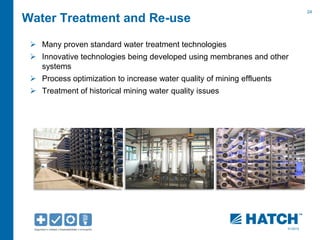
Water Treatment and Re-use 
 Many proven standard water treatment technologies 
 Innovative technologies being developed using membranes and other 
systems 
 Process optimization to increase water quality of mining effluents 
 Treatment of historical mining water quality issues
25 
01/2012 
Desalination Systems 
 Desalination plants 
 Intakes and outfalls 
 Pumping and piping 
systems 
 Power sources
26 
01/2012 
Tailings and Water - Industry Trends 
High density tailings using: 
 Thickeners 
 Filtration 
 Centrifuge 
 Chemical additives 
Improved water management: 
 Upstream cutoff for valley impoundments 
 Separation of seepage and decant flows 
 Reduced beaching length (dry climate) 
 Reduced wet footprint (wet climate)
27 
01/2012 
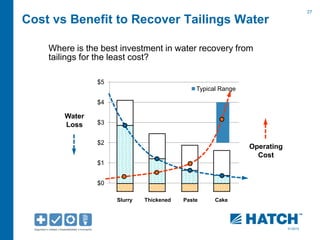
Cost vs Benefit to Recover Tailings Water 
Where is the best investment in water recovery from 
tailings for the least cost? 
$0 
$1 
$2 
$3 
$4 
$5 
Typical Range 
Water 
Loss 
Operating 
Cost 
Slurry Thickened Paste Cake
28 
01/2012 
Mining Impacts on Water 
Environmental 
 Heavy metal 
contamination and 
leaching 
 Acid Mine Drainage 
 Processing chemical 
pollution 
 Erosion and 
sedimentation 
Social 
 Depletion of surface and 
groundwater supplies 
 Soil and water pollution 
 Conflict with other water-related 
or water-intensive 
industries (i.e., agriculture) 
 Water shortages and 
ecosystem damage 
 Displacement of people/ 
communities 
Water has been 
called “mining’s 
most common 
casualty” 
James Lyon, interview, 
Mineral Policy Center, 
Washington DC
29 
01/2012 
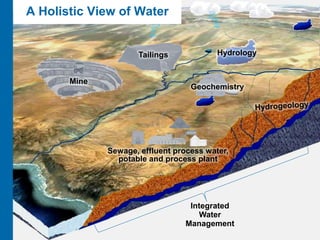
Mine 
Integrated 
Water 
Management 
Sewage, effluent process water, 
potable and process plant 
Tailings 
Geochemistry 
Hydrology 
A Holistic View of Water
30 
01/2012 
Mine Water in Peru and Chile
31 
01/2012 
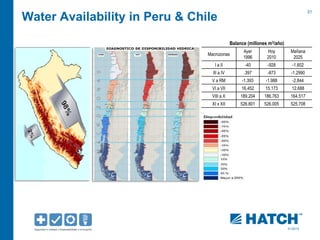
Water Availability in Peru & Chile 
Balance (millones m3/aňo) 
Macrozonas 
Ayer 
1996 
Hoy 
2010 
Maňana 
2025 
I a II -40 -928 -1.602 
III a IV .397 -873 -1.2990 
V a RM -1.393 -1.988 -2.844 
VI a VII 16.452 15.173 12.688 
VIII a X 189.204 186.763 164.517 
XI x XII 526.801 526.005 525.708
32 
01/2012 
Water Challenges in Peru 
Increasing glacial retreat rates 
Only 22% of sewage water from 
cities receives some kind of 
treatment prior to discharge. 
78% is discharged & lost 
50% of rain water is lost
33 
01/2012 
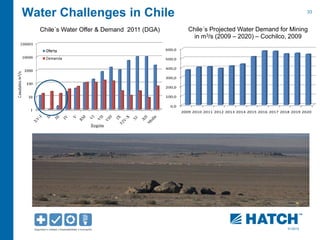
Water Challenges in Chile 
Chile´s Projected Water Demand for Mining 
in m3/s (2009 – 2020) – Cochilco, 2009 
Chile´s Water Offer & Demand 2011 (DGA)
34 
01/2012 
The Gap Between Water Availability and 
Demand 
 A gap already exists in areas of Chile and Peru 
 It will get worse with time as demand increases and available water decreases 
 How are we going to overcome the problem for the mining industry? 
Water Demand 
Water Availability 
Growing Gap 
Gap 
2000 2010 Time in Years 
W a t e r V o l u m e 
1950 
In Chile and Peru, desalination will 
be an essential source of water as 
other sources are not always 
available. We need to find ways to 
reduce costs and impacts of energy 
production
35 
01/2012 
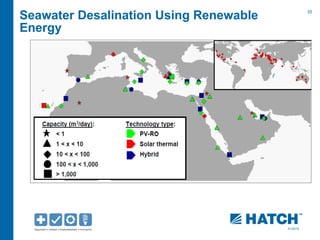
Seawater Desalination Using Renewable 
Energy
36 
01/2012 
Potential for Solar Power 
Historical development of 
global cumulative photo 
voltaic power installed per 
region 
MW
37 
01/2012 
Potential for Wind Power 
Cost Reduction of Wind Power Comparison of Energy Sources
38 
01/2012 
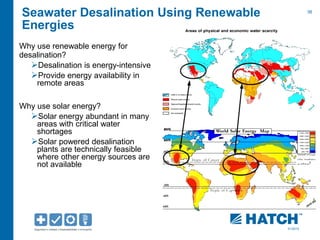
Seawater Desalination Using Renewable 
Energies 
Why use renewable energy for 
desalination? 
Desalination is energy-intensive 
Provide energy availability in 
remote areas 
Why use solar energy? 
Solar energy abundant in many 
areas with critical water 
shortages 
Solar powered desalination 
plants are technically feasible 
where other energy sources are 
not available
39 
01/2012 
The Future of Water for Mining - Issues and 
Solutions 
Issues 
Water is essential for mining 
Global water demand is increasing 
Water shortages will be more common 
Mining often conflicts with other users 
Regulation will increase 
Historic problems must be addressed 
Many mines are not effective water users 
Solutions 
Consider water an asset to be managed 
Deal with water as an integrated system 
Proactively engage other water users 
Implement technical innovations 
Develop alternative water sources 
Manage water footprint 
PROCESS 
TAILINGS 
ENVIRONMENTAL 
HYDRO-TECHNICAL 
GEOTECHNICAL 
CIVIL 
WATER 
Holistic water management 
takes a multidisciplinary 
approach
40 
01/2012

PERUMIN 31: The Future of Water in The Mining Industry

  • 1.
    01/2012 PERUMIN 2013 The Future of Water in the Mining Industry AREQUIPA, PERU
  • 2.
    2 01/2012 GlobalWater Situation
  • 3.
    3 01/2012 WeLive on a Salty Planet
  • 4.
    4 01/2012 AGrowing Population Needs More Water From Allianz.com
  • 5.
    5 01/2012 GlobalWater Withdrawal and Consumption
  • 6.
    6 01/2012 GlobalFresh Water Withdrawals Agriculture 2,800 km3/yr 70% Municipal & Domestic 400 km3/yr 10% Industrial/Energy 800 km3/yr 20% , 0, 0% Total global withdrawal approx 4,000 km3/yr in 2010 Mining 7-9 km3/yr 0.2%
  • 7.
    7 01/2012 EnvironmentalWater Scarcity Index for 2030 NIC, 2012
  • 8.
    8 01/2012 Effectsof Climate Change
  • 9.
    9 01/2012 WaterChallenges, Causes and Risks (From CEO Water Mandate, 2012)
  • 10.
    10 01/2012 WaterFor Mining
  • 11.
    11 01/2012 CopperDemand Curve (World Copper Factbook, 2010)
  • 12.
    12 01/2012 CopperProduction (World Copper Factbook, 2010)
  • 13.
    13 01/2012 MiningIndustry Differentiators  Water is essential for most mining  Mining and processing often at a massive scale, large water requirements  Operations are relatively short lived, water requirements are temporary  Remote global locations  Little or no infrastructure  Often must deal with stringent regulatory requirements  Environmental sensitivity  Social issues and conflicts
  • 14.
    14 01/2012 MajorDrivers for Water in Mining  Mines being developed in water poor places - investment in pipelines, wells, and desalination plants.  Increased reliance on low grade ores - more water is required for each tonne of refined product.  Mining companies must treat wastewater to higher standards – increased regulation, need to recycle and commitment to sustainable water use.  Water is a major environmental concern - problems caused by acid rock drainage and other impacts to water resources.  Mining companies trying to reduce their water footprint Physical Availability Social License to Operate Legal Availability Physical and legal water availability does not guarantee a sustainable water supply solution!
  • 15.
    15 01/2012 Futureof Mine Water Resource Management
  • 16.
    16 01/2012 IntegratedWater Management for Mines Integrated water management for mining Mine water needs Mine water sources Permitting, environmental, social, legal constraints Ecosystems Other water users
  • 17.
    17 01/2012 IntegratedWater Management – Key Areas ADMINISTRATIVE Meet regulatory standards Integrate water strategy into corporate and business unit strategies Develop management structure COMMUNITIES Engage early with all stakeholders, including communities Use water unsuitable for other industries, i.e., sea water TECHNOLOGICAL/INNOVATION Manage Water: Establish water balance Measurement instrumentation Manage database Audit results Preventive water use: Redesign process Minimize water losses Water-saving techniques Protective management strategies/ measures and technical solutions: Determine potential for AMD Identify discharge points Improvement of infrastructure to contain runoff Monitoring information management  Tools are available to proactively manage water
  • 18.
    18 01/2012 WaterFootprint, Carbon Footprint & Lifecycle Assessment WATER FOOTPRINT CARBON FOOTPRINT LIFE CYCLE ASSESSMENT Measures freshwater appropriation Measures emission GH-gases Measures overall environmental impact Spatial and temporal dimension No spatial / temporal dimension No spatial dimension Actual, locally specific values Global average values Actual water volume, no weighting Weighting water volume based on impacts Reducing specific water footprint (water use units are not interchangeable) Many efforts focused on offsetting (carbon emission units are interchangeable) Water footprint, Carbon footprint and Life Cycle Assessment are complementary tools
  • 19.
    19 01/2012 WaterDisclosure is Becoming a Reality
  • 20.
    20 01/2012 Futureof Water Governance  Future water governance changes will be seen in four main areas: technology, energy, water pricing and other users’ rights to water TECHNOLOGY ENERGY New technologies are developed to meet stringent regulations Conservation and efficient use VALUE OF WATER RIGHTS TO WATER Water supply and demand Conflicts and priorities Source: http://www.willmsshier.com/articles.asp?id=86
  • 21.
    21 01/2012 Efficiencyof Water Use for Mining  Corporate goals and commitment to efficient water use  Accurate water balance and measurements of water use  Process optimization to reduce waste water volumes  Improved tailings water management – thickened and dry stack tailings  Water re-use  Zero liquid discharge
  • 22.
    22 01/2012 Storageand Transport of Water  Catch and store surface water runoff – surface reservoirs, aquifer storage and recovery (ASR)  Interbasin transfers  Improved water infrastructure - pipelines, pumping systems, water tunnels
  • 23.
    23 01/2012 PotentialGroundwater Sources  Characterization of aquifers – water in storage and recharge  Use of groundwater with marginal quality - treatment  Permitting and environmental issues with potential groundwater sources – can we use brackish water resources?  Aquifer storage and recovery (ASR) to optimize water storage Injection for ASR
  • 24.
    24 01/2012 WaterTreatment and Re-use  Many proven standard water treatment technologies  Innovative technologies being developed using membranes and other systems  Process optimization to increase water quality of mining effluents  Treatment of historical mining water quality issues
  • 25.
    25 01/2012 DesalinationSystems  Desalination plants  Intakes and outfalls  Pumping and piping systems  Power sources
  • 26.
    26 01/2012 Tailingsand Water - Industry Trends High density tailings using:  Thickeners  Filtration  Centrifuge  Chemical additives Improved water management:  Upstream cutoff for valley impoundments  Separation of seepage and decant flows  Reduced beaching length (dry climate)  Reduced wet footprint (wet climate)
  • 27.
    27 01/2012 Costvs Benefit to Recover Tailings Water Where is the best investment in water recovery from tailings for the least cost? $0 $1 $2 $3 $4 $5 Typical Range Water Loss Operating Cost Slurry Thickened Paste Cake
  • 28.
    28 01/2012 MiningImpacts on Water Environmental  Heavy metal contamination and leaching  Acid Mine Drainage  Processing chemical pollution  Erosion and sedimentation Social  Depletion of surface and groundwater supplies  Soil and water pollution  Conflict with other water-related or water-intensive industries (i.e., agriculture)  Water shortages and ecosystem damage  Displacement of people/ communities Water has been called “mining’s most common casualty” James Lyon, interview, Mineral Policy Center, Washington DC
  • 29.
    29 01/2012 Mine Integrated Water Management Sewage, effluent process water, potable and process plant Tailings Geochemistry Hydrology A Holistic View of Water
  • 30.
    30 01/2012 MineWater in Peru and Chile
  • 31.
    31 01/2012 WaterAvailability in Peru & Chile Balance (millones m3/aňo) Macrozonas Ayer 1996 Hoy 2010 Maňana 2025 I a II -40 -928 -1.602 III a IV .397 -873 -1.2990 V a RM -1.393 -1.988 -2.844 VI a VII 16.452 15.173 12.688 VIII a X 189.204 186.763 164.517 XI x XII 526.801 526.005 525.708
  • 32.
    32 01/2012 WaterChallenges in Peru Increasing glacial retreat rates Only 22% of sewage water from cities receives some kind of treatment prior to discharge. 78% is discharged & lost 50% of rain water is lost
  • 33.
    33 01/2012 WaterChallenges in Chile Chile´s Projected Water Demand for Mining in m3/s (2009 – 2020) – Cochilco, 2009 Chile´s Water Offer & Demand 2011 (DGA)
  • 34.
    34 01/2012 TheGap Between Water Availability and Demand  A gap already exists in areas of Chile and Peru  It will get worse with time as demand increases and available water decreases  How are we going to overcome the problem for the mining industry? Water Demand Water Availability Growing Gap Gap 2000 2010 Time in Years W a t e r V o l u m e 1950 In Chile and Peru, desalination will be an essential source of water as other sources are not always available. We need to find ways to reduce costs and impacts of energy production
  • 35.
    35 01/2012 SeawaterDesalination Using Renewable Energy
  • 36.
    36 01/2012 Potentialfor Solar Power Historical development of global cumulative photo voltaic power installed per region MW
  • 37.
    37 01/2012 Potentialfor Wind Power Cost Reduction of Wind Power Comparison of Energy Sources
  • 38.
    38 01/2012 SeawaterDesalination Using Renewable Energies Why use renewable energy for desalination? Desalination is energy-intensive Provide energy availability in remote areas Why use solar energy? Solar energy abundant in many areas with critical water shortages Solar powered desalination plants are technically feasible where other energy sources are not available
  • 39.
    39 01/2012 TheFuture of Water for Mining - Issues and Solutions Issues Water is essential for mining Global water demand is increasing Water shortages will be more common Mining often conflicts with other users Regulation will increase Historic problems must be addressed Many mines are not effective water users Solutions Consider water an asset to be managed Deal with water as an integrated system Proactively engage other water users Implement technical innovations Develop alternative water sources Manage water footprint PROCESS TAILINGS ENVIRONMENTAL HYDRO-TECHNICAL GEOTECHNICAL CIVIL WATER Holistic water management takes a multidisciplinary approach
  • 40.