Maximizing the Representation Gap
between In-domain & OOD Examples
Jay Nandy Wynne Hsu Mong Li Lee
National University of Singapore
{jaynandy,whsu,leeml}@comp.nus.edu.sg
ICML workshop on Uncertainty & Robustness in Deep Learning, 2020
Predictive Uncertainty of DNNs
 Data or Aleatoric uncertainty:
 Arises from the natural complexities of the
underlying distribution, such as class
overlap, label noise, homoscedastic and
heteroscedastic noise
 Distributional Uncertainty:
 Distributional mismatch between the
training and test examples during inference
 Model or Epistemic uncertainty
 Uncertainty to estimating the network parameters, given training data
 Reducible given enough training data
In-domain example with Data
or Aleatoric uncertainty
Out-of-distribution (OOD)
example, that leads to
distributional uncertainty
[Gal, 2016; Candela et al., 2009]
Contributions
 Motivation:
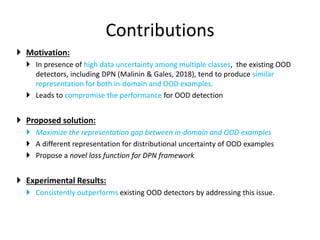
 In presence of high data uncertainty among multiple classes, the existing OOD
detectors, including DPN (Malinin & Gales, 2018), tend to produce similar
representation for both in-domain and OOD examples.
 Leads to compromise the performance for OOD detection
 Proposed solution:
 Maximize the representation gap between in-domain and OOD examples
 A different representation for distributional uncertainty of OOD examples
 Propose a novel loss function for DPN framework
 Experimental Results:
 Consistently outperforms existing OOD detectors by addressing this issue.
Existing Approaches: Non-Bayesian
• Representation of predictive uncertainty:
• Sharp categorical posterior for in-domain examples
• Flat categorical posterior for out-of-domain (OOD) examples
• Limitations:
• Cannot robustly determine the source of uncertainty
• In particular, high data uncertainty among multiple class leads to the same
representation for both in-domain and OOD examples.
In-Domain
Misclassification
Out-of-Domain (OOD)
Examples
In-Domain
Confident Prediction
[Hendrycks et al., 2019b, Lee et al., 2018]
Existing Approaches: Bayesian
• Bayesian neural networks assumes a prior distribution over the network parameters
• Approximation requires to estimate the true posterior of the model parameters
• Sample model parameters using MCMC or Deep Ensemble etc.
• Limitations:
• Computationally expensive to produce the ensemble
• Difficult to control this desired behavior
In-Domain Confident pred.
• Ensemble of prediction in one
corner of the simplex.
In-Domain Misclassification:
• Ensemble of prediction in the
middle of the simplex.
OOD Examples:
• Ensemble of prediction are
scattered over the simplex.
. . .
. . .
. . .
. . .
. . .
. . .
[Gal and Ghahramani, 2016; Lakshminarayanan et al., 2017]
Dirichlet Prior Network (Existing)
• Parameterize a prior Dirichlet distribution to the categorical posteriors over a
simplex
• Objective: Efficiently emulating the behavior of Bayesian (ensemble) approaches
Sharp Dirichlet in one corner
 Uni-modal categorical.
Sharp Dirichlet in the middle
 Multi-modal categorical
Flat Dirichlet
 Uniform categorical
over all class labels.
Confident prediction
(In-Domain Examples)
Misclassification
(In-Domain Examples)
OOD Examples
[Malinin & Gales, 2018; 2019]
Proposed Representation for OOD
• Limitation (high Data uncertainty)
• In-domain examples with high data-uncertainty, among multiple classes, leads to
producing flatter Dirichlet distribution
• Can be observed for classification task with large number of classes
• This often leads to indistinguishable representation from OOD examples.
• Compromise the OOD detection performance
Confident prediction
(In-Domain Examples)
Misclassification
(In-Domain Examples)
OOD Examples
Desired Actual
[see detailed analysis in our paper]
Proposed Representation for OOD
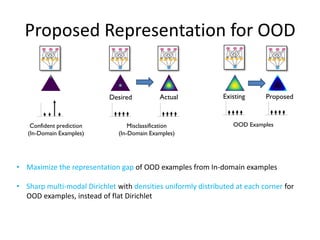
• Maximize the representation gap of OOD examples from In-domain examples
• Sharp multi-modal Dirichlet with densities uniformly distributed at each corner for
OOD examples, instead of flat Dirichlet
Confident prediction
(In-Domain Examples)
Misclassification
(In-Domain Examples)
OOD Examples
Desired Actual Existing Proposed
Proposed Loss function
Confident prediction
(In-Domain Examples)
Misclassification
(In-Domain Examples)
OOD Examples
Desired Actual Existing Proposed
We propose a novel loss function to separately model the mean and precision of the
output Dirichlet distribution:
• Mean: Cross entropy loss with soft-max activation
• Precision:A novel explicit precision regularization function
Provides a better control on the desired representation.
We show that the existing RKL loss cannot produce this representation
[see more detailed analysis in our paper]
Proposed Loss function
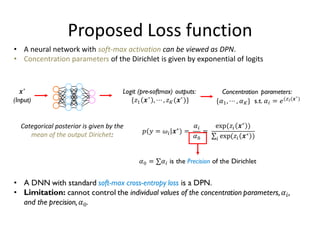
• A neural network with soft-max activation can be viewed as DPN.
• Concentration parameters of the Dirichlet is given by exponential of logits
Categorical posterior is given by the
mean of the output Dirichet:
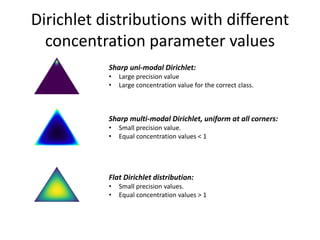
Dirichlet distributions with different
concentration parameter values
Sharp uni-modal Dirichlet:
• Large precision value
• Large concentration value for the correct class.
Flat Dirichlet distribution:
• Small precision values.
• Equal concentration values > 1
Sharp multi-modal Dirichlet, uniform at all corners:
• Small precision value.
• Equal concentration values < 1
Proposed Loss function
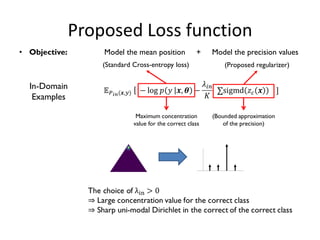
In-Domain
Examples
• Objective: Model the mean position + Model the precision values
(Standard Cross-entropy loss) (Proposed regularizer)
(Bounded approximation
of the precision)
Maximum concentration
value for the correct class
Proposed Loss function
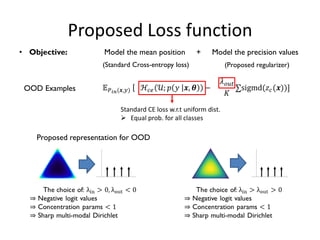
• Objective: Model the mean position + Model the precision values
(Standard Cross-entropy loss) (Proposed regularizer)
Standard CE loss w.r.t uniform dist.
 Equal prob. for all classes
OOD Examples
Proposed representation for OOD
Uncertainty Measures
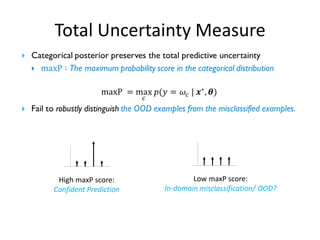
Total Uncertainty Measure
High maxP score:
Confident Prediction
Low maxP score:
In-domain misclassification/ OOD?
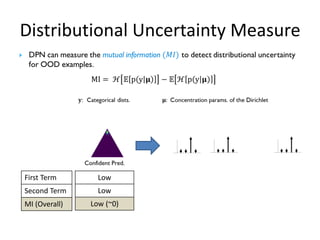
Distributional Uncertainty Measure
Confident Pred.
First Term
Second Term
MI (Overall)
Low
Low
Low (~0)
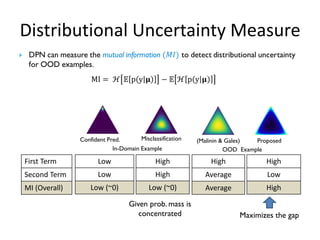
Distributional Uncertainty Measure
Given prob. mass is
concentrated
High
Low
High
In-Domain Example OOD Example
Misclassification (Malinin & Gales) ProposedConfident Pred.
Maximizes the gap
First Term
Second Term
MI (Overall)
Low
Low
Low (~0)
High
High
Low (~0)
High
Average
Average
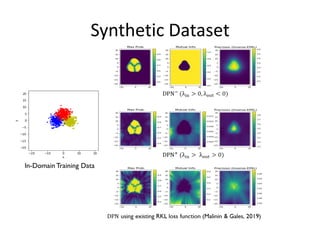
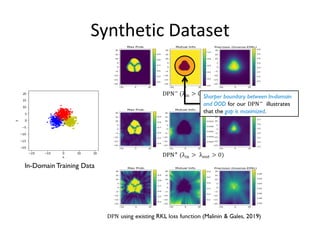
Synthetic Dataset
In-Domain Training Data
Synthetic Dataset
In-Domain Training Data
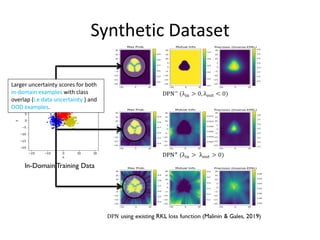
Larger uncertainty scores for both
in-domain examples with class
overlap (i.e data uncertainty ) and
OOD examples.
Synthetic Dataset
In-Domain Training Data
Synthetic Dataset
In-Domain Training Data
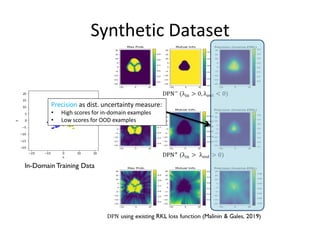
Precision as dist. uncertainty measure:
• High scores for in-domain examples
• Low scores for OOD examples
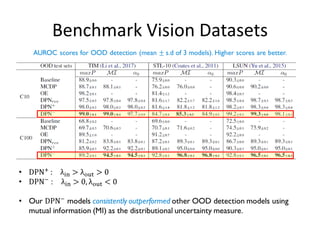
Benchmark Vision Datasets
Conclusion
 We show that: in presence of high data uncertainty, the existing OOD detection
models, including DPN, tend to produce similar representation for both in-domain
and OOD examples, leading to compromise OOD detection performance
 We propose to model the distributional uncertainty using multi-modal Dirichlet
distribution for DPN (Malinin & Gales, 2018) to maximize the representation gap
between in-domain and OOD examples
 Experimental results demonstrates that our proposed technique consistently
outperforms other OOD detection models by addressing this issue.
Thank You 

Maximizing the Representation Gap between In-domain & OOD examples

  • 1.
    Maximizing the RepresentationGap between In-domain & OOD Examples Jay Nandy Wynne Hsu Mong Li Lee National University of Singapore {jaynandy,whsu,leeml}@comp.nus.edu.sg ICML workshop on Uncertainty & Robustness in Deep Learning, 2020
  • 2.
    Predictive Uncertainty ofDNNs  Data or Aleatoric uncertainty:  Arises from the natural complexities of the underlying distribution, such as class overlap, label noise, homoscedastic and heteroscedastic noise  Distributional Uncertainty:  Distributional mismatch between the training and test examples during inference  Model or Epistemic uncertainty  Uncertainty to estimating the network parameters, given training data  Reducible given enough training data In-domain example with Data or Aleatoric uncertainty Out-of-distribution (OOD) example, that leads to distributional uncertainty [Gal, 2016; Candela et al., 2009]
  • 3.
    Contributions  Motivation:  Inpresence of high data uncertainty among multiple classes, the existing OOD detectors, including DPN (Malinin & Gales, 2018), tend to produce similar representation for both in-domain and OOD examples.  Leads to compromise the performance for OOD detection  Proposed solution:  Maximize the representation gap between in-domain and OOD examples  A different representation for distributional uncertainty of OOD examples  Propose a novel loss function for DPN framework  Experimental Results:  Consistently outperforms existing OOD detectors by addressing this issue.
  • 4.
    Existing Approaches: Non-Bayesian •Representation of predictive uncertainty: • Sharp categorical posterior for in-domain examples • Flat categorical posterior for out-of-domain (OOD) examples • Limitations: • Cannot robustly determine the source of uncertainty • In particular, high data uncertainty among multiple class leads to the same representation for both in-domain and OOD examples. In-Domain Misclassification Out-of-Domain (OOD) Examples In-Domain Confident Prediction [Hendrycks et al., 2019b, Lee et al., 2018]
  • 5.
    Existing Approaches: Bayesian •Bayesian neural networks assumes a prior distribution over the network parameters • Approximation requires to estimate the true posterior of the model parameters • Sample model parameters using MCMC or Deep Ensemble etc. • Limitations: • Computationally expensive to produce the ensemble • Difficult to control this desired behavior In-Domain Confident pred. • Ensemble of prediction in one corner of the simplex. In-Domain Misclassification: • Ensemble of prediction in the middle of the simplex. OOD Examples: • Ensemble of prediction are scattered over the simplex. . . . . . . . . . . . . . . . . . . [Gal and Ghahramani, 2016; Lakshminarayanan et al., 2017]
  • 6.
    Dirichlet Prior Network(Existing) • Parameterize a prior Dirichlet distribution to the categorical posteriors over a simplex • Objective: Efficiently emulating the behavior of Bayesian (ensemble) approaches Sharp Dirichlet in one corner  Uni-modal categorical. Sharp Dirichlet in the middle  Multi-modal categorical Flat Dirichlet  Uniform categorical over all class labels. Confident prediction (In-Domain Examples) Misclassification (In-Domain Examples) OOD Examples [Malinin & Gales, 2018; 2019]
  • 7.
    Proposed Representation forOOD • Limitation (high Data uncertainty) • In-domain examples with high data-uncertainty, among multiple classes, leads to producing flatter Dirichlet distribution • Can be observed for classification task with large number of classes • This often leads to indistinguishable representation from OOD examples. • Compromise the OOD detection performance Confident prediction (In-Domain Examples) Misclassification (In-Domain Examples) OOD Examples Desired Actual [see detailed analysis in our paper]
  • 8.
    Proposed Representation forOOD • Maximize the representation gap of OOD examples from In-domain examples • Sharp multi-modal Dirichlet with densities uniformly distributed at each corner for OOD examples, instead of flat Dirichlet Confident prediction (In-Domain Examples) Misclassification (In-Domain Examples) OOD Examples Desired Actual Existing Proposed
  • 9.
    Proposed Loss function Confidentprediction (In-Domain Examples) Misclassification (In-Domain Examples) OOD Examples Desired Actual Existing Proposed We propose a novel loss function to separately model the mean and precision of the output Dirichlet distribution: • Mean: Cross entropy loss with soft-max activation • Precision:A novel explicit precision regularization function Provides a better control on the desired representation. We show that the existing RKL loss cannot produce this representation [see more detailed analysis in our paper]
  • 10.
    Proposed Loss function •A neural network with soft-max activation can be viewed as DPN. • Concentration parameters of the Dirichlet is given by exponential of logits Categorical posterior is given by the mean of the output Dirichet:
  • 11.
    Dirichlet distributions withdifferent concentration parameter values Sharp uni-modal Dirichlet: • Large precision value • Large concentration value for the correct class. Flat Dirichlet distribution: • Small precision values. • Equal concentration values > 1 Sharp multi-modal Dirichlet, uniform at all corners: • Small precision value. • Equal concentration values < 1
  • 12.
    Proposed Loss function In-Domain Examples •Objective: Model the mean position + Model the precision values (Standard Cross-entropy loss) (Proposed regularizer) (Bounded approximation of the precision) Maximum concentration value for the correct class
  • 13.
    Proposed Loss function •Objective: Model the mean position + Model the precision values (Standard Cross-entropy loss) (Proposed regularizer) Standard CE loss w.r.t uniform dist.  Equal prob. for all classes OOD Examples Proposed representation for OOD
  • 14.
  • 15.
    Total Uncertainty Measure HighmaxP score: Confident Prediction Low maxP score: In-domain misclassification/ OOD?
  • 16.
    Distributional Uncertainty Measure ConfidentPred. First Term Second Term MI (Overall) Low Low Low (~0)
  • 17.
    Distributional Uncertainty Measure Givenprob. mass is concentrated High Low High In-Domain Example OOD Example Misclassification (Malinin & Gales) ProposedConfident Pred. Maximizes the gap First Term Second Term MI (Overall) Low Low Low (~0) High High Low (~0) High Average Average
  • 18.
  • 19.
    Synthetic Dataset In-Domain TrainingData Larger uncertainty scores for both in-domain examples with class overlap (i.e data uncertainty ) and OOD examples.
  • 20.
  • 21.
    Synthetic Dataset In-Domain TrainingData Precision as dist. uncertainty measure: • High scores for in-domain examples • Low scores for OOD examples
  • 22.
  • 23.
    Conclusion  We showthat: in presence of high data uncertainty, the existing OOD detection models, including DPN, tend to produce similar representation for both in-domain and OOD examples, leading to compromise OOD detection performance  We propose to model the distributional uncertainty using multi-modal Dirichlet distribution for DPN (Malinin & Gales, 2018) to maximize the representation gap between in-domain and OOD examples  Experimental results demonstrates that our proposed technique consistently outperforms other OOD detection models by addressing this issue. Thank You 