By:Khaled sadeq
Maxillary sinus
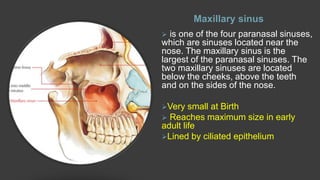
๏ƒ˜ is one of the four paranasal sinuses,
which are sinuses located near the
nose. The maxillary sinus is the
largest of the paranasal sinuses. The
two maxillary sinuses are located
below the cheeks, above the teeth
and on the sides of the nose.
๏ƒ˜Very small at Birth
๏ƒ˜ Reaches maximum size in early
adult life
๏ƒ˜Lined by ciliated epithelium
Surgical anatomy
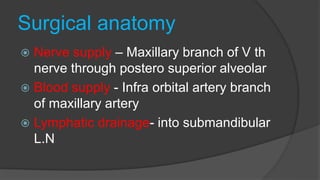
๏‚ž Nerve supply โ€“ Maxillary branch of V th
nerve through postero superior alveolar
๏‚ž Blood supply - Infra orbital artery branch
of maxillary artery
๏‚ž Lymphatic drainage- into submandibular
L.N
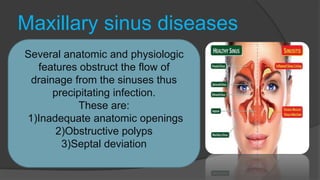
Maxillary sinus diseases
๏‚ž Sinusitis
๏‚ž Oro antral fistula
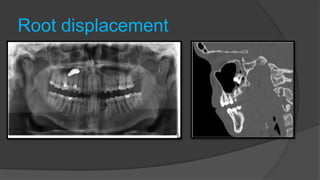
๏‚ž Root displacement
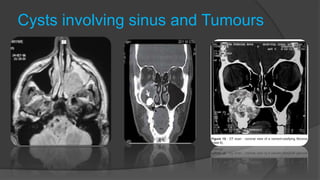
๏‚ž Cysts involving sinus
๏‚ž Tumours
Several anatomic and physiologic
features obstruct the flow of
drainage from the sinuses thus
precipitating infection.
These are:
1)Inadequate anatomic openings
2)Obstructive polyps
3)Septal deviation
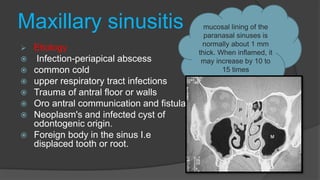
Maxillary sinusitis
๏ƒ˜ Etiology
๏‚ž Infection-periapical abscess
๏‚ž common cold
๏‚ž upper respiratory tract infections
๏‚ž Trauma of antral floor or walls
๏‚ž Oro antral communication and fistula
๏‚ž Neoplasm's and infected cyst of
odontogenic origin.
๏‚ž Foreign body in the sinus I.e
displaced tooth or root.
mucosal lining of the
paranasal sinuses is
normally about 1 mm
thick. When inflamed, it
may increase by 10 to
15 times
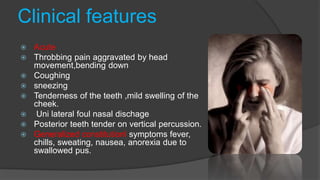
Clinical features
๏‚ž Acute
๏‚ž Throbbing pain aggravated by head
movement,bending down
๏‚ž Coughing
๏‚ž sneezing
๏‚ž Tenderness of the teeth ,mild swelling of the
cheek.
๏‚ž Uni lateral foul nasal dischage
๏‚ž Posterior teeth tender on vertical percussion.
๏‚ž Generalized constitutionl symptoms fever,
chills, sweating, nausea, anorexia due to
swallowed pus.
Clinical Examination
๏‚ž Palpation for tenderness over the lateral
wall of the
sinus
๏‚ž Transillumination of the sinuses is an
additional diagnostic test.
The light source is placed over the
infraorbital rim, in a darkened room and
light transmission is observed through the
hard palate. Compared with the sinus of
the opposite side, the involved sinus
shows decreased transmission of light due
to accumulation of fluids, debris, pus and
thickening of the sinus mucosa.
Radiographic Examinations
๏‚ž It is helpful to compare one side to the other
when examining the radiograph.
๏‚ž There should be no evidence of thickened
mucosa on the bony walls (usually indicative of
chronic sinus disease), nor air filled levels
caused by accumulation of mucus, pus or blood,
or foreign bodies.
๏‚ž Complete opacification of the maxillary sinus
may be caused by the mucosal hypertrophy and
fluid accumulation of sinusitis, filling with blood
secondary to trauma, or by neoplasia.
๏‚ž Dental pathologic conditions such as cysts or
granulomas may produce radiolucent lesions
that extend into the sinus cavity
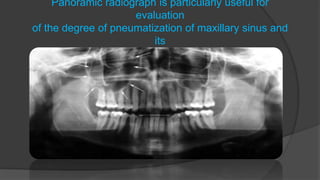
Panoramic radiograph is particularly useful for
evaluation
of the degree of pneumatization of maxillary sinus and
its
relationship to the roots of maxillary teeth
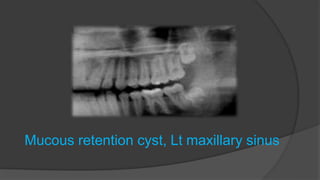
Mucous retention cyst, Lt maxillary sinus
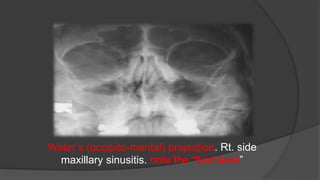
Waterโ€™s (occipito-mental) projection. Rt. side
maxillary sinusitis. note the โ€œfluid levelโ€
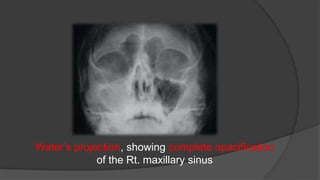
Waterโ€™s projection, showing complete opacification
of the Rt. maxillary sinus
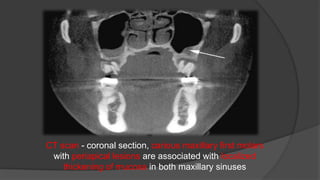
CT scan - coronal section, carious maxillary first molars
with periapical lesions are associated with localized
thickening of mucosa in both maxillary sinuses
Management
๏‚ž Non surgical
๏ƒผ Antral regimen ; bed rest ,plenty of fluids maintenance of oral
hygiene
๏ƒผ Antibiotics (Amoxicillin is the first line)
๏ƒผ Anti inflammatory (corticosteroids) for chronic cases
๏ƒผ Analgesics
๏ƒผ nasal decongestants
๏ƒผ mucolytic agents
๏ƒผ Steam inhalation
๏‚ž Surgical approaches
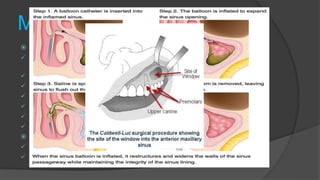
๏ƒผ Surgical drainage of pus and lavage of sinus cavity.
๏ƒผ Caldwell-luc surgery
Caldwell-Luc operation
๏‚ž comprises osteotomy of
theanterior sinus wall and
creation of artificial opening ofthe
sinus into the inferior nasal
meatus.
๏‚ž aggressive surgery
๏‚ž High incidence of complications.
๏‚ž May results in permanent defect
of anterior maxilla, sclerosis of
the antral walls and ollapse of the
sinus cavity(7)
Indications for the Caldwell-Luc
operation
๏‚ž 1. Retrieval of a root or tooth from the sinus
๏‚ž 2. Enucleation of odontogenic cysts or mucoceles from the
๏‚ž sinus
๏‚ž 3. Removal of odontogenic tumor from the sinus
๏‚ž 4. Treatment of acute maxillary sinusitis resistant to
๏‚ž medical therapy or showing evidence of extending beyond
๏‚ž the sinus
๏‚ž 5. Treatment of chronic sinusitis
๏‚ž 6. Management of oroantral fistula
๏‚ž 7. Repair of fractures of the antrum or zygoma
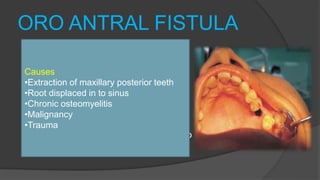
ORO ANTRAL FISTULA
๏‚ž rare complications of oral surgery.
๏‚ž Extraction of maxillary posterior teeth
is the most common cause.
๏‚ž characterized by the presence of
epithelium arising from the oral
mucosa and/or from the antral sinus
mucosa that, if not removed,could
inhibit spontaneous healing.
๏‚ž Closing is important to avoid food and
saliva contamination that could lead to
bacterial infection,impaired healing
and chronic sinusitis.
Causes
โ€ขExtraction of maxillary posterior teeth
โ€ขRoot displaced in to sinus
โ€ขChronic osteomyelitis
โ€ขMalignancy
โ€ขTrauma
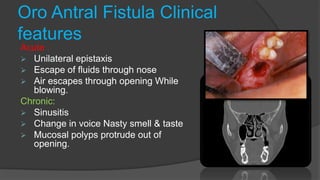
Oro Antral Fistula Clinical
features
Acute :
๏ƒ˜ Unilateral epistaxis
๏ƒ˜ Escape of fluids through nose
๏ƒ˜ Air escapes through opening While
blowing.
Chronic:
๏ƒ˜ Sinusitis
๏ƒ˜ Change in voice Nasty smell & taste
๏ƒ˜ Mucosal polyps protrude out of
opening.
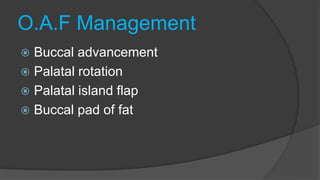
O.A.F Management
๏‚ž Buccal advancement
๏‚ž Palatal rotation
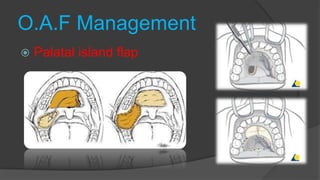
๏‚ž Palatal island flap
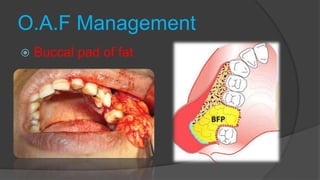
๏‚ž Buccal pad of fat
O.A.F Management
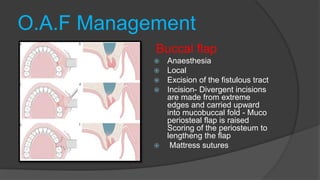
Buccal flap
๏‚ž Anaesthesia
๏‚ž Local
๏‚ž Excision of the fistulous tract
๏‚ž Incision- Divergent incisions
are made from extreme
edges and carried upward
into mucobuccal fold - Muco
periosteal flap is raised
Scoring of the periosteum to
lengtheng the flap
๏‚ž Mattress sutures
O.A.F Management
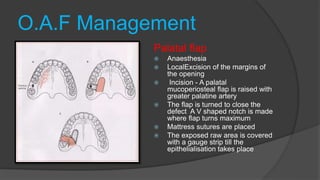
Palatal flap
๏‚ž Anaesthesia
๏‚ž LocalExcision of the margins of
the opening
๏‚ž Incision - A palatal
mucoperiosteal flap is raised with
greater palatine artery
๏‚ž The flap is turned to close the
defect A V shaped notch is made
where flap turns maximum
๏‚ž Mattress sutures are placed
๏‚ž The exposed raw area is covered
with a gauge strip till the
epithelialisation takes place
O.A.F Management
๏‚ž Palatal island flap
O.A.F Management
๏‚ž Buccal pad of fat
Root displacement
Cysts involving sinus and Tumours
RFERENCES
๏‚ž 1.Harold A. DeHaven Jr. Anatomy and Physiology of the Maxillary Sinus. in
๏‚ž Clinical Maxillary Sinus Elevation Surgery. Kao DWK (Editor), Wiley-
๏‚ž Blackwell,2014.
๏‚ž 2. Patel NA, Ferguson BJ. Odontogenic sinusitis: an ancient but underappreciated
๏‚ž cause of maxillary sinusitis. Curr Opin Otolaryngol Head Neck
๏‚ž Surg ;20:24, 2012.
๏‚ž 3. Patel NA, Ferguson BJ. Odontogenic sinusitis: an ancient but underappreciated
๏‚ž cause of maxillary sinusitis. Curr Opin Otolaryngol Head Neck
๏‚ž Surg ;20:24,2012.
๏‚ž 4. Brook I. Sinusitis of odontogenic origin. Otolaryngol Head Neck Surg;
๏‚ž 135:349,2006.
๏‚ž 5. Longhini AB, Ferguson BJ. Clinical aspects of odontogenic maxillary
๏‚ž sinusitis: a case series. Int Forum Allergy Rhinol; 1:409,2011.
๏‚ž 6. Fatterpekar GM, Delman BN, Som PM. Imaging the paranasal sinuses:
๏‚ž where we are and where we are going. Anat Rec,291:1564,2008.
๏‚ž 7. Nemec SF, et al. Sinonasal imaging after Caldwell-Luc surgery: MDCT
๏‚ž findings of an abandoned procedure in times of functional endoscopic sinus
๏‚ž surgery. Eur.J Radio. 70,31,2009.

Maxillary sinus diseases

  • 1.
  • 2.
    Maxillary sinus ๏ƒ˜ isone of the four paranasal sinuses, which are sinuses located near the nose. The maxillary sinus is the largest of the paranasal sinuses. The two maxillary sinuses are located below the cheeks, above the teeth and on the sides of the nose. ๏ƒ˜Very small at Birth ๏ƒ˜ Reaches maximum size in early adult life ๏ƒ˜Lined by ciliated epithelium
  • 3.
    Surgical anatomy ๏‚ž Nervesupply โ€“ Maxillary branch of V th nerve through postero superior alveolar ๏‚ž Blood supply - Infra orbital artery branch of maxillary artery ๏‚ž Lymphatic drainage- into submandibular L.N
  • 4.
    Maxillary sinus diseases ๏‚žSinusitis ๏‚ž Oro antral fistula ๏‚ž Root displacement ๏‚ž Cysts involving sinus ๏‚ž Tumours Several anatomic and physiologic features obstruct the flow of drainage from the sinuses thus precipitating infection. These are: 1)Inadequate anatomic openings 2)Obstructive polyps 3)Septal deviation
  • 5.
    Maxillary sinusitis ๏ƒ˜ Etiology ๏‚žInfection-periapical abscess ๏‚ž common cold ๏‚ž upper respiratory tract infections ๏‚ž Trauma of antral floor or walls ๏‚ž Oro antral communication and fistula ๏‚ž Neoplasm's and infected cyst of odontogenic origin. ๏‚ž Foreign body in the sinus I.e displaced tooth or root. mucosal lining of the paranasal sinuses is normally about 1 mm thick. When inflamed, it may increase by 10 to 15 times
  • 6.
    Clinical features ๏‚ž Acute ๏‚žThrobbing pain aggravated by head movement,bending down ๏‚ž Coughing ๏‚ž sneezing ๏‚ž Tenderness of the teeth ,mild swelling of the cheek. ๏‚ž Uni lateral foul nasal dischage ๏‚ž Posterior teeth tender on vertical percussion. ๏‚ž Generalized constitutionl symptoms fever, chills, sweating, nausea, anorexia due to swallowed pus.
  • 7.
    Clinical Examination ๏‚ž Palpationfor tenderness over the lateral wall of the sinus ๏‚ž Transillumination of the sinuses is an additional diagnostic test. The light source is placed over the infraorbital rim, in a darkened room and light transmission is observed through the hard palate. Compared with the sinus of the opposite side, the involved sinus shows decreased transmission of light due to accumulation of fluids, debris, pus and thickening of the sinus mucosa.
  • 8.
    Radiographic Examinations ๏‚ž Itis helpful to compare one side to the other when examining the radiograph. ๏‚ž There should be no evidence of thickened mucosa on the bony walls (usually indicative of chronic sinus disease), nor air filled levels caused by accumulation of mucus, pus or blood, or foreign bodies. ๏‚ž Complete opacification of the maxillary sinus may be caused by the mucosal hypertrophy and fluid accumulation of sinusitis, filling with blood secondary to trauma, or by neoplasia. ๏‚ž Dental pathologic conditions such as cysts or granulomas may produce radiolucent lesions that extend into the sinus cavity
  • 9.
    Panoramic radiograph isparticularly useful for evaluation of the degree of pneumatization of maxillary sinus and its relationship to the roots of maxillary teeth
  • 10.
    Mucous retention cyst,Lt maxillary sinus
  • 11.
    Waterโ€™s (occipito-mental) projection.Rt. side maxillary sinusitis. note the โ€œfluid levelโ€
  • 12.
    Waterโ€™s projection, showingcomplete opacification of the Rt. maxillary sinus
  • 13.
    CT scan -coronal section, carious maxillary first molars with periapical lesions are associated with localized thickening of mucosa in both maxillary sinuses
  • 14.
    Management ๏‚ž Non surgical ๏ƒผAntral regimen ; bed rest ,plenty of fluids maintenance of oral hygiene ๏ƒผ Antibiotics (Amoxicillin is the first line) ๏ƒผ Anti inflammatory (corticosteroids) for chronic cases ๏ƒผ Analgesics ๏ƒผ nasal decongestants ๏ƒผ mucolytic agents ๏ƒผ Steam inhalation ๏‚ž Surgical approaches ๏ƒผ Surgical drainage of pus and lavage of sinus cavity. ๏ƒผ Caldwell-luc surgery
  • 15.
    Caldwell-Luc operation ๏‚ž comprisesosteotomy of theanterior sinus wall and creation of artificial opening ofthe sinus into the inferior nasal meatus. ๏‚ž aggressive surgery ๏‚ž High incidence of complications. ๏‚ž May results in permanent defect of anterior maxilla, sclerosis of the antral walls and ollapse of the sinus cavity(7)
  • 16.
    Indications for theCaldwell-Luc operation ๏‚ž 1. Retrieval of a root or tooth from the sinus ๏‚ž 2. Enucleation of odontogenic cysts or mucoceles from the ๏‚ž sinus ๏‚ž 3. Removal of odontogenic tumor from the sinus ๏‚ž 4. Treatment of acute maxillary sinusitis resistant to ๏‚ž medical therapy or showing evidence of extending beyond ๏‚ž the sinus ๏‚ž 5. Treatment of chronic sinusitis ๏‚ž 6. Management of oroantral fistula ๏‚ž 7. Repair of fractures of the antrum or zygoma
  • 17.
    ORO ANTRAL FISTULA ๏‚žrare complications of oral surgery. ๏‚ž Extraction of maxillary posterior teeth is the most common cause. ๏‚ž characterized by the presence of epithelium arising from the oral mucosa and/or from the antral sinus mucosa that, if not removed,could inhibit spontaneous healing. ๏‚ž Closing is important to avoid food and saliva contamination that could lead to bacterial infection,impaired healing and chronic sinusitis. Causes โ€ขExtraction of maxillary posterior teeth โ€ขRoot displaced in to sinus โ€ขChronic osteomyelitis โ€ขMalignancy โ€ขTrauma
  • 18.
    Oro Antral FistulaClinical features Acute : ๏ƒ˜ Unilateral epistaxis ๏ƒ˜ Escape of fluids through nose ๏ƒ˜ Air escapes through opening While blowing. Chronic: ๏ƒ˜ Sinusitis ๏ƒ˜ Change in voice Nasty smell & taste ๏ƒ˜ Mucosal polyps protrude out of opening.
  • 19.
    O.A.F Management ๏‚ž Buccaladvancement ๏‚ž Palatal rotation ๏‚ž Palatal island flap ๏‚ž Buccal pad of fat
  • 20.
    O.A.F Management Buccal flap ๏‚žAnaesthesia ๏‚ž Local ๏‚ž Excision of the fistulous tract ๏‚ž Incision- Divergent incisions are made from extreme edges and carried upward into mucobuccal fold - Muco periosteal flap is raised Scoring of the periosteum to lengtheng the flap ๏‚ž Mattress sutures
  • 21.
    O.A.F Management Palatal flap ๏‚žAnaesthesia ๏‚ž LocalExcision of the margins of the opening ๏‚ž Incision - A palatal mucoperiosteal flap is raised with greater palatine artery ๏‚ž The flap is turned to close the defect A V shaped notch is made where flap turns maximum ๏‚ž Mattress sutures are placed ๏‚ž The exposed raw area is covered with a gauge strip till the epithelialisation takes place
  • 22.
  • 23.
  • 24.
  • 25.
  • 26.
    RFERENCES ๏‚ž 1.Harold A.DeHaven Jr. Anatomy and Physiology of the Maxillary Sinus. in ๏‚ž Clinical Maxillary Sinus Elevation Surgery. Kao DWK (Editor), Wiley- ๏‚ž Blackwell,2014. ๏‚ž 2. Patel NA, Ferguson BJ. Odontogenic sinusitis: an ancient but underappreciated ๏‚ž cause of maxillary sinusitis. Curr Opin Otolaryngol Head Neck ๏‚ž Surg ;20:24, 2012. ๏‚ž 3. Patel NA, Ferguson BJ. Odontogenic sinusitis: an ancient but underappreciated ๏‚ž cause of maxillary sinusitis. Curr Opin Otolaryngol Head Neck ๏‚ž Surg ;20:24,2012. ๏‚ž 4. Brook I. Sinusitis of odontogenic origin. Otolaryngol Head Neck Surg; ๏‚ž 135:349,2006. ๏‚ž 5. Longhini AB, Ferguson BJ. Clinical aspects of odontogenic maxillary ๏‚ž sinusitis: a case series. Int Forum Allergy Rhinol; 1:409,2011. ๏‚ž 6. Fatterpekar GM, Delman BN, Som PM. Imaging the paranasal sinuses: ๏‚ž where we are and where we are going. Anat Rec,291:1564,2008. ๏‚ž 7. Nemec SF, et al. Sinonasal imaging after Caldwell-Luc surgery: MDCT ๏‚ž findings of an abandoned procedure in times of functional endoscopic sinus ๏‚ž surgery. Eur.J Radio. 70,31,2009.