Department Of Oral
Pathology & Microbiology
Presenter; Dr. Priyansh Yadav
1. Para-nasal sinuses
2. Definition
3. Introduction
4. Development
5. Developmental anomalies
6. Structure
7. Nerve & blood supply
8. Microscopic features
9. Functions
10. Examination of sinus
11. Clinical importance
Para-nasal sinuses are a group of four
paired air filled spaces that surround
the nasal cavity.
There are 4 pair of Para-
nasal sinus;
1. Maxillary; below the eye
2. Frontal; above the eye
3. Ethmoidal; between the eyes
4. Sphenoidal; behind the eyes
 The maxillary sinus is the pneumatic space
that is lodged inside the body of the maxilla
and that communicates with the environment
by way of the middle nasal meatus and the
nasal vestibule.
 It drains into the middle meatus via the osteomental
complex.
 It is the largest sinus of the body.
 A.k.a ; Antrum of Highmore
 The sinus begins to develop at about 12 weeks of foetal
life, arising by lateral invagination of the mucous
membrane of middle nasal meatus forming a ‘slit’ like
space.
 It is formed by expansion of middle meatus into the
nasal cavity.
 It increases in size from 1mm to about 15 mm
(anteroposteriorly) just before birth.
 In the adult its size increases further and the average
dimensions are 34 mm anteroposteriorly, 33 mm
superoinferiorly, and 23 mm mediolaterally.
Initially, it from a slit like cavity on the
lateral wall of the middle meatus
Maxillary sinus gradually expands by
pneumatisation in pace with growth of
the maxilla and alveolar process
It expands not only downwards but
also forwards and backwards from its
initial invagination
1. AGENESIS:- Complete absence of sinus
2. APLASIA:- Incomplete formation of sinus
3. HYPOPLASIA:- Failure to develop to normal
size
4. SUPERNUMERARY:- More than usual number
of sinus
Crouzon Syndrome
• Early fusion of sutures
• Hyperplasia of maxilla & antrum
• High arched palate
Treacher Collins Syndrome
•Mandibulofacial dysostosis
•Underdeveloped maxi sinus & malar bone
Binders Syndrome
•Hypoplasia of middle 3rd of face
•Maxillary sinus hypoplasia
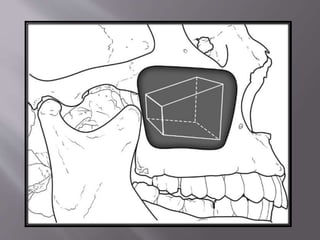
 It is generally described as a four-sided pyramid with
its base towards nasal cavity medially and apex pointing
towards zygomatic bone laterally.
 Its four sides are related to the maxilla in the following
manner;
1. ANTERIOR; to the facial surface
2. POSTERIOR; to the infratemporal surface
3. SUPERIOR; to the orbital surface
4. INFERIOR; to the alveolar process
 Roots of permanent maxillary first molar or premolar
are found very close to the sinus, only thin plate of
bone often separates them.
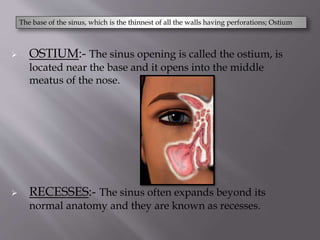
 OSTIUM:- The sinus opening is called the ostium, is
located near the base and it opens into the middle
meatus of the nose.
 RECESSES:- The sinus often expands beyond its
normal anatomy and they are known as recesses.
The base of the sinus, which is the thinnest of all the walls having perforations; Ostium
Blood supply Nerve supply
Infraorbital artery Infraorbital nerve
Posterior superior
alveolar artery
All 3 branches of
Posterior superior
alveolar nerve;
Post/Mid/Ant
 The epithelium is; pseudo stratified columnar & ciliated.
 Three layers surround the space of maxillary sinus;
1. Epithelial layer- Pseudo stratified ciliated columnar epithelium
2. Basal lamina
3. Sub-epithelial layer- This includes periosteum (lamina propria)
 Their are various glands present in the connective tissue of the
sub-epithelial layer .
 Sub epithelial glands provide serous and mucous secretion to the
sinus .
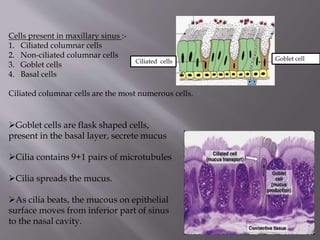
Goblet cells are flask shaped cells,
present in the basal layer, secrete mucus
Cilia contains 9+1 pairs of microtubules
Cilia spreads the mucus.
As cilia beats, the mucous on epithelial
surface moves from inferior part of sinus
to the nasal cavity.
Ciliated cells Goblet cell
Cells present in maxillary sinus :-
1. Ciliated columnar cells
2. Non-ciliated columnar cells
3. Goblet cells
4. Basal cells
Ciliated columnar cells are the most numerous cells.
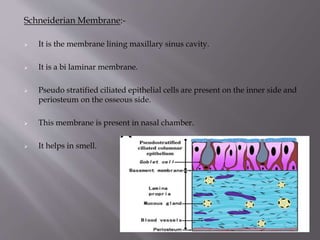
Schneiderian Membrane:-
 It is the membrane lining maxillary sinus cavity.
 It is a bi laminar membrane.
 Pseudo stratified ciliated epithelial cells are present on the inner side and
periosteum on the osseous side.
 This membrane is present in nasal chamber.
 It helps in smell.
 Decrease Skull Weight
 Impart Resonance To Voice
 Production & Storage Of Mucus
 Humidification & Warming Of Inhaled Air
 Define Facial Contour
 Immunodefensive Function
 Conserve Heat From Nasal Fossa
 Moisturize Air
 Filters Debris
 Dampens The Pressure During Inspiration
 Limit The Extent Of Facial Injury From Trauma
 Serve As An Accessory Olfactory Organ
 INSPECTION:- Middle third of the face should be inspected for the
presence of; asymmetry, swelling, erythema, ecchymosis or hematoma.
 EXTRA-ORAL PALPATION:- This includes palpation of facial wall of
sinus above the premolar where the bone is thinnest.
 INTRA-ORAL EXAMINATION:- Examination should be performed
for tenderness or paresthesia of upper molar and premolar region.
 TRANSILLUMINATION TEST:- It is performed in a darkened room
by inserting an electrically safe light into the mouth.
1. Good transillumination; It indicates presence of air in the sinus
2. Poor transillumination; It indicates presence of pus/fluid/solid lesion
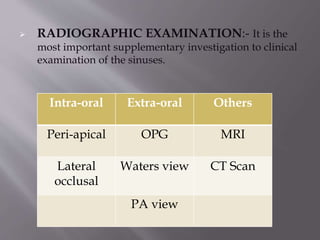
 RADIOGRAPHIC EXAMINATION:- It is the
most important supplementary investigation to clinical
examination of the sinuses.
Intra-oral Extra-oral Others
Peri-apical OPG MRI
Lateral
occlusal
Waters view CT Scan
PA view
 Maxillary sinusitis is inflammation of the maxillary sinuses. The
symptoms of sinusitis are;
1. pain in maxi teeth on the involved side
2. Headache, usually near the involved sinus
3. foul-smelling nasal or pharyngeal discharge
4. fever and weakness
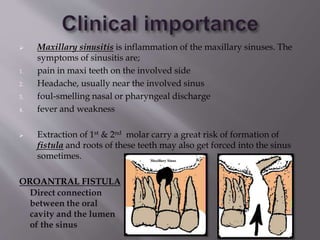
 Extraction of 1st & 2nd molar carry a great risk of formation of
fistula and roots of these teeth may also get forced into the sinus
sometimes.
OROANTRAL FISTULA
Direct connection
between the oral
cavity and the lumen
of the sinus
 Carcinoma of the maxillary sinus may invade
the palate and cause dental pain. It may also
block the nasolacrimal duct. Spread of the
tumour into the orbit causes exophthalmoses.
 Infection of the teeth close to sinus may cause
sinus infection.

Maxillary Sinus

  • 1.
    Department Of Oral Pathology& Microbiology Presenter; Dr. Priyansh Yadav
  • 2.
    1. Para-nasal sinuses 2.Definition 3. Introduction 4. Development 5. Developmental anomalies 6. Structure 7. Nerve & blood supply 8. Microscopic features 9. Functions 10. Examination of sinus 11. Clinical importance
  • 3.
    Para-nasal sinuses area group of four paired air filled spaces that surround the nasal cavity. There are 4 pair of Para- nasal sinus; 1. Maxillary; below the eye 2. Frontal; above the eye 3. Ethmoidal; between the eyes 4. Sphenoidal; behind the eyes
  • 4.
     The maxillarysinus is the pneumatic space that is lodged inside the body of the maxilla and that communicates with the environment by way of the middle nasal meatus and the nasal vestibule.
  • 5.
     It drainsinto the middle meatus via the osteomental complex.  It is the largest sinus of the body.  A.k.a ; Antrum of Highmore
  • 6.
     The sinusbegins to develop at about 12 weeks of foetal life, arising by lateral invagination of the mucous membrane of middle nasal meatus forming a ‘slit’ like space.  It is formed by expansion of middle meatus into the nasal cavity.  It increases in size from 1mm to about 15 mm (anteroposteriorly) just before birth.  In the adult its size increases further and the average dimensions are 34 mm anteroposteriorly, 33 mm superoinferiorly, and 23 mm mediolaterally.
  • 7.
    Initially, it froma slit like cavity on the lateral wall of the middle meatus Maxillary sinus gradually expands by pneumatisation in pace with growth of the maxilla and alveolar process It expands not only downwards but also forwards and backwards from its initial invagination
  • 8.
    1. AGENESIS:- Completeabsence of sinus 2. APLASIA:- Incomplete formation of sinus 3. HYPOPLASIA:- Failure to develop to normal size 4. SUPERNUMERARY:- More than usual number of sinus
  • 9.
    Crouzon Syndrome • Earlyfusion of sutures • Hyperplasia of maxilla & antrum • High arched palate Treacher Collins Syndrome •Mandibulofacial dysostosis •Underdeveloped maxi sinus & malar bone Binders Syndrome •Hypoplasia of middle 3rd of face •Maxillary sinus hypoplasia
  • 10.
     It isgenerally described as a four-sided pyramid with its base towards nasal cavity medially and apex pointing towards zygomatic bone laterally.  Its four sides are related to the maxilla in the following manner; 1. ANTERIOR; to the facial surface 2. POSTERIOR; to the infratemporal surface 3. SUPERIOR; to the orbital surface 4. INFERIOR; to the alveolar process  Roots of permanent maxillary first molar or premolar are found very close to the sinus, only thin plate of bone often separates them.
  • 12.
     OSTIUM:- Thesinus opening is called the ostium, is located near the base and it opens into the middle meatus of the nose.  RECESSES:- The sinus often expands beyond its normal anatomy and they are known as recesses. The base of the sinus, which is the thinnest of all the walls having perforations; Ostium
  • 13.
    Blood supply Nervesupply Infraorbital artery Infraorbital nerve Posterior superior alveolar artery All 3 branches of Posterior superior alveolar nerve; Post/Mid/Ant
  • 14.
     The epitheliumis; pseudo stratified columnar & ciliated.  Three layers surround the space of maxillary sinus; 1. Epithelial layer- Pseudo stratified ciliated columnar epithelium 2. Basal lamina 3. Sub-epithelial layer- This includes periosteum (lamina propria)  Their are various glands present in the connective tissue of the sub-epithelial layer .  Sub epithelial glands provide serous and mucous secretion to the sinus .
  • 15.
    Goblet cells areflask shaped cells, present in the basal layer, secrete mucus Cilia contains 9+1 pairs of microtubules Cilia spreads the mucus. As cilia beats, the mucous on epithelial surface moves from inferior part of sinus to the nasal cavity. Ciliated cells Goblet cell Cells present in maxillary sinus :- 1. Ciliated columnar cells 2. Non-ciliated columnar cells 3. Goblet cells 4. Basal cells Ciliated columnar cells are the most numerous cells.
  • 16.
    Schneiderian Membrane:-  Itis the membrane lining maxillary sinus cavity.  It is a bi laminar membrane.  Pseudo stratified ciliated epithelial cells are present on the inner side and periosteum on the osseous side.  This membrane is present in nasal chamber.  It helps in smell.
  • 17.
     Decrease SkullWeight  Impart Resonance To Voice  Production & Storage Of Mucus  Humidification & Warming Of Inhaled Air  Define Facial Contour  Immunodefensive Function
  • 18.
     Conserve HeatFrom Nasal Fossa  Moisturize Air  Filters Debris  Dampens The Pressure During Inspiration  Limit The Extent Of Facial Injury From Trauma  Serve As An Accessory Olfactory Organ
  • 19.
     INSPECTION:- Middlethird of the face should be inspected for the presence of; asymmetry, swelling, erythema, ecchymosis or hematoma.  EXTRA-ORAL PALPATION:- This includes palpation of facial wall of sinus above the premolar where the bone is thinnest.  INTRA-ORAL EXAMINATION:- Examination should be performed for tenderness or paresthesia of upper molar and premolar region.  TRANSILLUMINATION TEST:- It is performed in a darkened room by inserting an electrically safe light into the mouth. 1. Good transillumination; It indicates presence of air in the sinus 2. Poor transillumination; It indicates presence of pus/fluid/solid lesion
  • 20.
     RADIOGRAPHIC EXAMINATION:-It is the most important supplementary investigation to clinical examination of the sinuses. Intra-oral Extra-oral Others Peri-apical OPG MRI Lateral occlusal Waters view CT Scan PA view
  • 21.
     Maxillary sinusitisis inflammation of the maxillary sinuses. The symptoms of sinusitis are; 1. pain in maxi teeth on the involved side 2. Headache, usually near the involved sinus 3. foul-smelling nasal or pharyngeal discharge 4. fever and weakness  Extraction of 1st & 2nd molar carry a great risk of formation of fistula and roots of these teeth may also get forced into the sinus sometimes. OROANTRAL FISTULA Direct connection between the oral cavity and the lumen of the sinus
  • 22.
     Carcinoma ofthe maxillary sinus may invade the palate and cause dental pain. It may also block the nasolacrimal duct. Spread of the tumour into the orbit causes exophthalmoses.  Infection of the teeth close to sinus may cause sinus infection.