SOFTWARE TESTING
PRACTICAL
TOPIC – TESTING MATURITY MODEL
HEMANT SARTHAK
A41895516040
TABLE OF CONTENTS
• What is Testing Maturity Model
• Levels of TMM
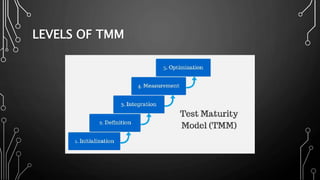
• Level 1: Initialization
• Level 2: Definition
• Level 3: Integration
• Level 4: Management and Measurement
• Level 5: Optimization
TESTING MATURITY MODEL
The Testing Maturity Model (TMM) was based on the Capability
Maturity Model, and first produced by the Illinois Institute of
Technology.
Its aim to be used in a similar way to CMM, that is to provide a
framework for assessing the maturity of the test processes in an
organisation, and so providing targets on improving maturity.
The higher the level, the better the software development
process, hence reaching each level is an expensive and time-
consuming process.
LEVELS OF TMM
LEVEL 1: INITIALIZATION
The software process is characterized as inconsistent, and
occasionally even chaotic. Defined processes and standard
practices that exist are abandoned during a crisis.
Success of the organization majorly depends on an individual
effort, talent, and heroics. The heroes eventually move on to
other organizations taking their wealth of knowledge or lessons
learnt with them.
LEVEL 2: DEFINITION
This level is all about defining the requirements. In this second
level of TMM, test strategies, test plans and test cases are
developed according to the requirements given by the client to
build a software.
The main aim of this level is to make sure that the product runs
according to the requirements and to achieve that test cases and
test plan documents are created and followed religiously.
LEVEL 3: INTEGRATION
In this level testing is integrated with the software life cycle and
becomes a part of it.
Testing comes after the development is over and the software
under test is handed over to the professional testing team.
Testing is carried out independently. The whole testing
objectives are based on the risk management.
LEVEL 4: MANAGEMENT AND
MEASUREMENT
Managing and measuring the requirements are taken care in this
level of TMM. This is the fourth level where testing becomes the
part of all the activities in software life cycle.
From reviewing the gathered requirements and design of the
software to deciding the quality criteria, is included. This builds a
clearer picture for the organization which in turn helps them to
achieve the required quality.
LEVEL 5: OPTIMIZATION
The fifth level is responsible for optimizing the test process
itself. In other words, testing processes are tested and measures
are taken to improve them iteration by iteration.
This testing is mainly carried out by the help of different tools.
Also, in this level defects are prevented by improving the
processes throughout the software life cycle so main focus is
defect prevention rather than defect detection in each phase.
THANK YOU

Maturity Testing Software DeveDevelopment Hemant

  • 1.
    SOFTWARE TESTING PRACTICAL TOPIC –TESTING MATURITY MODEL HEMANT SARTHAK A41895516040
  • 2.
    TABLE OF CONTENTS •What is Testing Maturity Model • Levels of TMM • Level 1: Initialization • Level 2: Definition • Level 3: Integration • Level 4: Management and Measurement • Level 5: Optimization
  • 3.
    TESTING MATURITY MODEL TheTesting Maturity Model (TMM) was based on the Capability Maturity Model, and first produced by the Illinois Institute of Technology. Its aim to be used in a similar way to CMM, that is to provide a framework for assessing the maturity of the test processes in an organisation, and so providing targets on improving maturity. The higher the level, the better the software development process, hence reaching each level is an expensive and time- consuming process.
  • 4.
  • 5.
    LEVEL 1: INITIALIZATION Thesoftware process is characterized as inconsistent, and occasionally even chaotic. Defined processes and standard practices that exist are abandoned during a crisis. Success of the organization majorly depends on an individual effort, talent, and heroics. The heroes eventually move on to other organizations taking their wealth of knowledge or lessons learnt with them.
  • 6.
    LEVEL 2: DEFINITION Thislevel is all about defining the requirements. In this second level of TMM, test strategies, test plans and test cases are developed according to the requirements given by the client to build a software. The main aim of this level is to make sure that the product runs according to the requirements and to achieve that test cases and test plan documents are created and followed religiously.
  • 7.
    LEVEL 3: INTEGRATION Inthis level testing is integrated with the software life cycle and becomes a part of it. Testing comes after the development is over and the software under test is handed over to the professional testing team. Testing is carried out independently. The whole testing objectives are based on the risk management.
  • 8.
    LEVEL 4: MANAGEMENTAND MEASUREMENT Managing and measuring the requirements are taken care in this level of TMM. This is the fourth level where testing becomes the part of all the activities in software life cycle. From reviewing the gathered requirements and design of the software to deciding the quality criteria, is included. This builds a clearer picture for the organization which in turn helps them to achieve the required quality.
  • 9.
    LEVEL 5: OPTIMIZATION Thefifth level is responsible for optimizing the test process itself. In other words, testing processes are tested and measures are taken to improve them iteration by iteration. This testing is mainly carried out by the help of different tools. Also, in this level defects are prevented by improving the processes throughout the software life cycle so main focus is defect prevention rather than defect detection in each phase.
  • 10.