The Test Engineering Maturity Model
W H I T E P A P E R
Abstract
Recent software testing research indicates that under pressure
to meet deadlines, the testing teams often lose focus on the
‘business’ goals expected from the activity.
This white paper talks about the Test Engineering Maturity
Model (TEMM) that Impetus Technologies has developed. TEMM
helps clients meet software testing goals while keeping
continuous focus on business needs. The paper talks about how
this framework helps companies save on time and costs, while
improving the overall quality of the product.
The five levels of the TEMM have been described and explained.
The white paper also talks about the benefits of each level, and
how they impact the testing function.
Impetus Technologies, Inc.
www.impetus.com
The Test Engineering Maturity Model
2
Introduction
For most companies, software testing is an arduous and expensive activity.
Organizations are often faced with a lack of time and resources, which limits
their ability to test each and every line of code during the test execution cycle. It
therefore becomes imperative for them to optimally utilize the limited
resources available within time-to-market constraints, to deliver better quality
products.
The size of regression test suites grows as software evolves. Their size grows to
such an extent that regression testing alone can account for as much as 50
percent of the cost of software maintenance. Due to various constraints, it is
not possible to test each and everything evolving in a software product.
Typically, such testing increases the cost and time associated with measuring
quality and stretches the release cycle without providing an adequate Return on
Investment (ROI). To meet business deadlines and measure product quality,
stakeholders use cost and time as the main driving factors. It is often seen that
companies try to measure quality based on cost and time, which leads to
unsuccessful testing endeavors. While a huge amount is spent on testing, the
product outcomes are not up to the mark and make companies feel that testing
has lost track, somewhere.
There is a clear relationship between the three elementary forces i.e. Time,
Cost, and Quality in any project. Time denotes the available time to deliver the
project, cost represents the amount of money or resources available and quality
represents the fit-to-purpose that the project must achieve to be a success.
A ‘product’ is always created to meet ‘business needs. Business is the driving
factor that decides on parameters such as time, cost, and quality. However, as
the delivery pressures increase in a release cycle, and companies focus on cost
and time to achieve a predefined quality, the concept of business loses shine.
It is therefore important to ensure that business is not ignored in a testing
environment. Industry is demanding a comprehensive testing package, a
package that can help in balancing between business, cost, quality, and time.
What is required then is a framework that takes into account the four pillars
associated with a product, and how these work in relation to each other.
Impetus Technologies’ testing practice offers comprehensive end-to-end test
engineering solutions in order to reduce the product development costs,
improve quality, and reduce time-to-market. It has developed the Test
Engineering Maturity Model, which helps in showing a definite direction for
complete product testing.
The Test Engineering Maturity Model
3
The Key Objectives of TEMM
The TEMM focuses on the following:
• Resolving the ambiguities arising during software product testing
• Providing a definite direction to attain higher ROI in product testing by
keeping business goals and risks within sight
• Defining the right set of Key Testing Activities (KTAs)
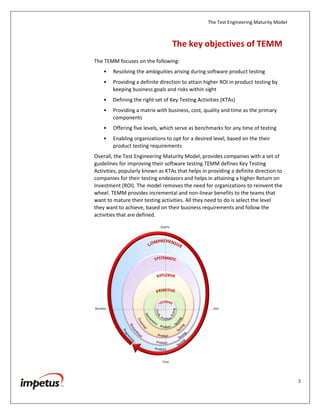
• Providing a matrix with business, cost, quality and time as the primary
components
• Offering five levels, which serve as benchmarks for any time of testing
• Enabling organizations to opt for a desired level, based on the their
product testing requirements
Overall, the Test Engineering Maturity Model, provides companies with a set of
guidelines for improving their software testing.TEMM defines Key Testing
Activities, popularly known as KTAs that helps in providing a definite direction to
companies for their testing endeavors and helps in attaining a higher Return on
Investment (ROI). The model removes the need for organizations to reinvent the
wheel. TEMM provides incremental and non-linear benefits to the teams that
want to mature their testing activities. All they need to do is select the level
they want to achieve, based on their business requirements and follow the
activities that are defined.
The Test Engineering Maturity Model
4
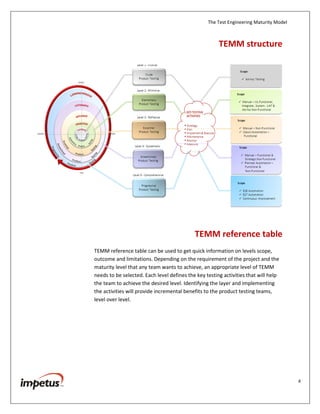
TEMM Structure
TEMM Reference Table
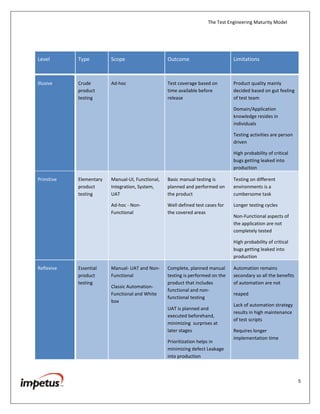
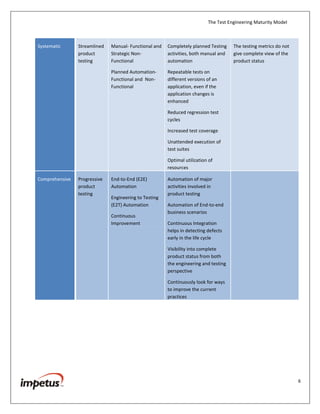
TEMM reference table can be used to get quick information on levels scope,
outcome and limitations. Depending on the requirement of the project and the
maturity level that any team wants to achieve, an appropriate level of TEMM
needs to be selected. Each level defines the key testing activities that will help
the team to achieve the desired level. Identifying the layer and implementing
the activities will provide incremental benefits to the product testing teams,
level over level.
The Test Engineering Maturity Model
5
Level Type Scope Outcome Limitations
Illusive Crude
product
testing
Ad-hoc Test coverage based on
time available before
release
Product quality mainly
decided based on gut feeling
of test team
Domain/Application
knowledge resides in
individuals
Testing activities are person
driven
High probability of critical
bugs getting leaked into
production
Primitive Elementary
product
testing
Manual-UI, Functional,
Integration, System,
UAT
Ad-hoc - Non-
Functional
Basic manual testing is
planned and performed on
the product
Well defined test cases for
the covered areas
Testing on different
environments is a
cumbersome task
Longer testing cycles
Non-Functional aspects of
the application are not
completely tested
High probability of critical
bugs getting leaked into
production
Reflexive Essential
product
testing
Manual- UAT and Non-
Functional
Classic Automation-
Functional and White
box
Complete, planned manual
testing is performed on the
product that includes
functional and non-
functional testing
UAT is planned and
executed beforehand,
minimizing surprises at
later stages
Prioritization helps in
minimizing defect Leakage
into production
Automation remains
secondary so all the benefits
of automation are not
reaped
Lack of automation strategy
results in high maintenance
of test scripts
Requires longer
implementation time
The Test Engineering Maturity Model
6
Systematic Streamlined
product
testing
Manual- Functional and
Strategic Non-
Functional
Planned Automation-
Functional and Non-
Functional
Completely planned Testing
activities, both manual and
automation
Repeatable tests on
different versions of an
application, even if the
application changes is
enhanced
Reduced regression test
cycles
Increased test coverage
Unattended execution of
test suites
Optimal utilization of
resources
The testing metrics do not
give complete view of the
product status
Comprehensive Progressive
product
testing
End-to-End (E2E)
Automation
Engineering to Testing
(E2T) Automation
Continuous
Improvement
Automation of major
activities involved in
product testing
Automation of End-to-end
business scenarios
Continuous Integration
helps in detecting defects
early in the life cycle
Visibility into complete
product status from both
the engineering and testing
perspective
Continuously look for ways
to improve the current
practices
The Test Engineering Maturity Model
7
Summary
To minimize testing nightmares and enable the software product testing process
to achieve maturity, the thumb rule is to revisit business needs at every stage.
The participation of business at every step in the testing cycle ensures that the
critical factors are balanced and producing positive results that meet business
objectives. Cost, quality, time, and business are the inseparable axes that will
certainly lead to the path of productive testing.
By implementing TEMM, companies can quickly meet their desired quality
objectives, while focusing on critical business needs. Using the designed path,
that touches each and every aspect of the testing cycle, TEMM enables
enterprises to mature their testing activities, keeping process implementation
worries behind.
As organizations move from Level 1, through Level 5, the testing activities will
yield higher benefits in terms of quality and business improvement—while
keeping costs and time at a minimum.
Impetus Technologies’ TEMM assessment methodology helps analyze and
review the testing progress, and provides updates on the exact level achieved
and the requirements for reaching the next stage.
About Impetus
Impetus is a Software Solutions and Services Company with deep
technical maturity that brings you thought leadership, proactive
innovation, and a track record of success. Our Services and Solutions
portfolio includes Carrier grade large systems, Big Data, Cloud,
Enterprise Mobility, and Test and Performance Engineering.
Website: www.impetus.com | Email: inquiry@impetus.com
© 2013 Impetus Technologies, Inc.
All rights reserved. Product and
company names mentioned herein
may be trademarks of their
respective companies. May 2013

Test Engineering Maturity Model- Impetus White Paper

  • 1.
    The Test EngineeringMaturity Model W H I T E P A P E R Abstract Recent software testing research indicates that under pressure to meet deadlines, the testing teams often lose focus on the ‘business’ goals expected from the activity. This white paper talks about the Test Engineering Maturity Model (TEMM) that Impetus Technologies has developed. TEMM helps clients meet software testing goals while keeping continuous focus on business needs. The paper talks about how this framework helps companies save on time and costs, while improving the overall quality of the product. The five levels of the TEMM have been described and explained. The white paper also talks about the benefits of each level, and how they impact the testing function. Impetus Technologies, Inc. www.impetus.com
  • 2.
    The Test EngineeringMaturity Model 2 Introduction For most companies, software testing is an arduous and expensive activity. Organizations are often faced with a lack of time and resources, which limits their ability to test each and every line of code during the test execution cycle. It therefore becomes imperative for them to optimally utilize the limited resources available within time-to-market constraints, to deliver better quality products. The size of regression test suites grows as software evolves. Their size grows to such an extent that regression testing alone can account for as much as 50 percent of the cost of software maintenance. Due to various constraints, it is not possible to test each and everything evolving in a software product. Typically, such testing increases the cost and time associated with measuring quality and stretches the release cycle without providing an adequate Return on Investment (ROI). To meet business deadlines and measure product quality, stakeholders use cost and time as the main driving factors. It is often seen that companies try to measure quality based on cost and time, which leads to unsuccessful testing endeavors. While a huge amount is spent on testing, the product outcomes are not up to the mark and make companies feel that testing has lost track, somewhere. There is a clear relationship between the three elementary forces i.e. Time, Cost, and Quality in any project. Time denotes the available time to deliver the project, cost represents the amount of money or resources available and quality represents the fit-to-purpose that the project must achieve to be a success. A ‘product’ is always created to meet ‘business needs. Business is the driving factor that decides on parameters such as time, cost, and quality. However, as the delivery pressures increase in a release cycle, and companies focus on cost and time to achieve a predefined quality, the concept of business loses shine. It is therefore important to ensure that business is not ignored in a testing environment. Industry is demanding a comprehensive testing package, a package that can help in balancing between business, cost, quality, and time. What is required then is a framework that takes into account the four pillars associated with a product, and how these work in relation to each other. Impetus Technologies’ testing practice offers comprehensive end-to-end test engineering solutions in order to reduce the product development costs, improve quality, and reduce time-to-market. It has developed the Test Engineering Maturity Model, which helps in showing a definite direction for complete product testing.
  • 3.
    The Test EngineeringMaturity Model 3 The Key Objectives of TEMM The TEMM focuses on the following: • Resolving the ambiguities arising during software product testing • Providing a definite direction to attain higher ROI in product testing by keeping business goals and risks within sight • Defining the right set of Key Testing Activities (KTAs) • Providing a matrix with business, cost, quality and time as the primary components • Offering five levels, which serve as benchmarks for any time of testing • Enabling organizations to opt for a desired level, based on the their product testing requirements Overall, the Test Engineering Maturity Model, provides companies with a set of guidelines for improving their software testing.TEMM defines Key Testing Activities, popularly known as KTAs that helps in providing a definite direction to companies for their testing endeavors and helps in attaining a higher Return on Investment (ROI). The model removes the need for organizations to reinvent the wheel. TEMM provides incremental and non-linear benefits to the teams that want to mature their testing activities. All they need to do is select the level they want to achieve, based on their business requirements and follow the activities that are defined.
  • 4.
    The Test EngineeringMaturity Model 4 TEMM Structure TEMM Reference Table TEMM reference table can be used to get quick information on levels scope, outcome and limitations. Depending on the requirement of the project and the maturity level that any team wants to achieve, an appropriate level of TEMM needs to be selected. Each level defines the key testing activities that will help the team to achieve the desired level. Identifying the layer and implementing the activities will provide incremental benefits to the product testing teams, level over level.
  • 5.
    The Test EngineeringMaturity Model 5 Level Type Scope Outcome Limitations Illusive Crude product testing Ad-hoc Test coverage based on time available before release Product quality mainly decided based on gut feeling of test team Domain/Application knowledge resides in individuals Testing activities are person driven High probability of critical bugs getting leaked into production Primitive Elementary product testing Manual-UI, Functional, Integration, System, UAT Ad-hoc - Non- Functional Basic manual testing is planned and performed on the product Well defined test cases for the covered areas Testing on different environments is a cumbersome task Longer testing cycles Non-Functional aspects of the application are not completely tested High probability of critical bugs getting leaked into production Reflexive Essential product testing Manual- UAT and Non- Functional Classic Automation- Functional and White box Complete, planned manual testing is performed on the product that includes functional and non- functional testing UAT is planned and executed beforehand, minimizing surprises at later stages Prioritization helps in minimizing defect Leakage into production Automation remains secondary so all the benefits of automation are not reaped Lack of automation strategy results in high maintenance of test scripts Requires longer implementation time
  • 6.
    The Test EngineeringMaturity Model 6 Systematic Streamlined product testing Manual- Functional and Strategic Non- Functional Planned Automation- Functional and Non- Functional Completely planned Testing activities, both manual and automation Repeatable tests on different versions of an application, even if the application changes is enhanced Reduced regression test cycles Increased test coverage Unattended execution of test suites Optimal utilization of resources The testing metrics do not give complete view of the product status Comprehensive Progressive product testing End-to-End (E2E) Automation Engineering to Testing (E2T) Automation Continuous Improvement Automation of major activities involved in product testing Automation of End-to-end business scenarios Continuous Integration helps in detecting defects early in the life cycle Visibility into complete product status from both the engineering and testing perspective Continuously look for ways to improve the current practices
  • 7.
    The Test EngineeringMaturity Model 7 Summary To minimize testing nightmares and enable the software product testing process to achieve maturity, the thumb rule is to revisit business needs at every stage. The participation of business at every step in the testing cycle ensures that the critical factors are balanced and producing positive results that meet business objectives. Cost, quality, time, and business are the inseparable axes that will certainly lead to the path of productive testing. By implementing TEMM, companies can quickly meet their desired quality objectives, while focusing on critical business needs. Using the designed path, that touches each and every aspect of the testing cycle, TEMM enables enterprises to mature their testing activities, keeping process implementation worries behind. As organizations move from Level 1, through Level 5, the testing activities will yield higher benefits in terms of quality and business improvement—while keeping costs and time at a minimum. Impetus Technologies’ TEMM assessment methodology helps analyze and review the testing progress, and provides updates on the exact level achieved and the requirements for reaching the next stage. About Impetus Impetus is a Software Solutions and Services Company with deep technical maturity that brings you thought leadership, proactive innovation, and a track record of success. Our Services and Solutions portfolio includes Carrier grade large systems, Big Data, Cloud, Enterprise Mobility, and Test and Performance Engineering. Website: www.impetus.com | Email: inquiry@impetus.com © 2013 Impetus Technologies, Inc. All rights reserved. Product and company names mentioned herein may be trademarks of their respective companies. May 2013